
The Ukraine Daily Briefing · Friday, November 13, 2026 · Day 1,724 of the Full-Scale War
Prepared by Diana Bozhyk
The Day’s Reckoning
Europe claimed its seat at the peace table on Friday, and within hours Moscow made clear what it expects that seat to cost. Meeting in Dublin, EU leaders agreed that the bloc’s institutions and five large European states will represent the continent in the next round of talks, while the Kremlin said it still doubts Europe’s intentions and reports circulated of sweeping Russian demands reaching from Odesa to Finland. Overnight, Russia sent 117 drones against Ukraine, and the morning brought rocket fire on Zaporizhzhia, a fire in a Kyiv hospital and deaths in Odesa, Donetsk and Sumy oblasts; at least nine people were killed nationwide. Ukrainian officials said the speed cap on Starshield satellite terminals was still in force along the front, even as SpaceX denied any change. Ukraine’s own long-range campaign hit a major refinery in Volgograd and drone plants in Rostov-on-Don with Neptune missiles. On the ground, Ukrainian troops edged forward near Slovyansk and south of Novopavlivka as Russian armor rolled out of the fog toward Dobropillia.
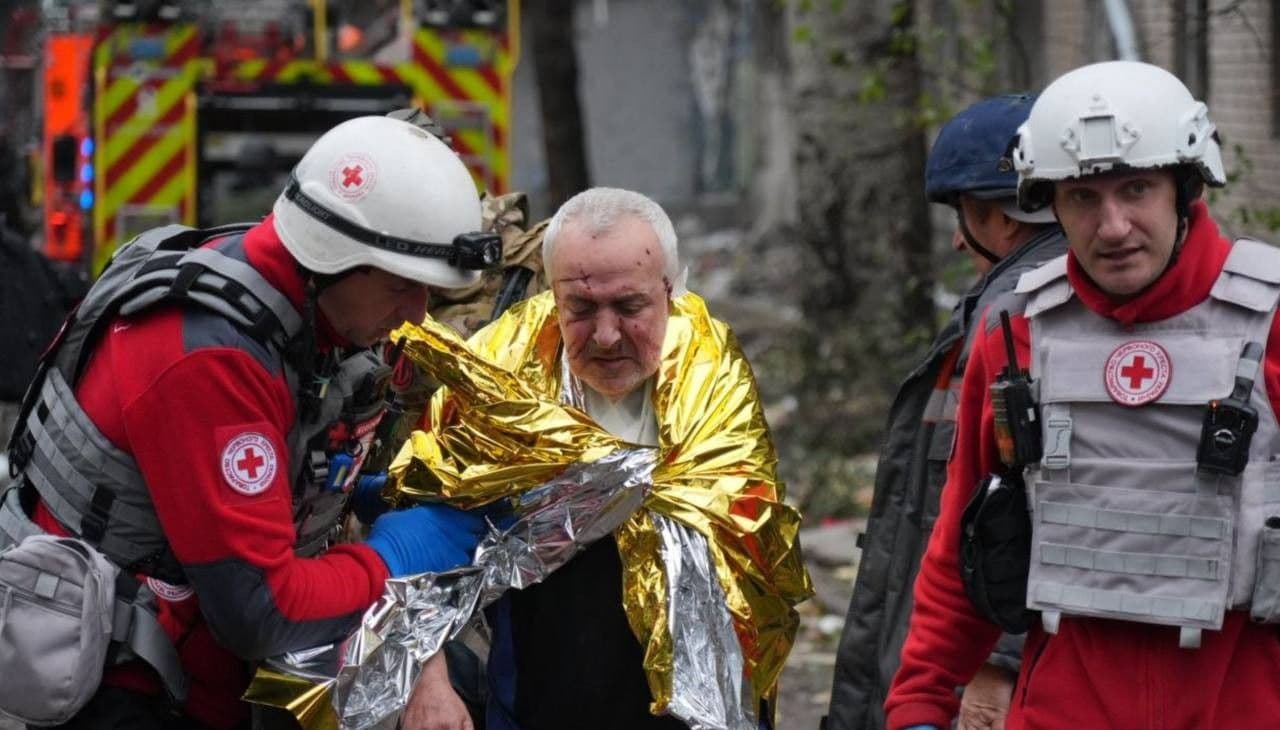
Ukrainian emergency service workers aid a man injured in a Russian strike on Zaporizhzhia, Ukraine. (Ukraine’s State Emergency Service/Telegram)
The Seat, and the Bill
“I know that the Russians don’t want me, but do we have a say in who is representing Russia? No, we don’t.” EU foreign policy chief Kaja Kallas said it to reporters in Dublin on Friday, after AFP reported that she appeared to have been left out of Europe’s new negotiating lineup. “If we give them that right, we are actually giving them leverage that they shouldn’t have.” Kushner, she added, had “finally” accepted that Europe must be at the table to implement any deal.
The lineup itself was settled at an informal summit of EU leaders. European Council President António Costa announced that Europe’s team will consist of the EU institutions plus the E5 — France, Germany, Italy, Poland and the United Kingdom, the core of the Coalition of the Willing that is working on security guarantees for Ukraine. National security advisers will take part at the technical level, Bloomberg reported; no political-level envoy has been named. “Europe must speak with one clear and united voice,” Costa said, adding that only Ukraine can decide on its territory and sovereignty, and that guarantees belong with the coalition, in close coordination with NATO. EU leaders will take up Ukraine’s financing for 2027 and beyond on November 26–27.
German Chancellor Friedrich Merz said Germany is “a guaranteed participant” and that substantive talks with Europeans are planned within weeks. Ahead of next week’s Asia-Pacific summit in China, he warned Washington against a “second Anchorage moment,” recalling the Alaska summit where President Donald Trump reportedly floated a land swap: “Please, no surprises.” Irish Prime Minister Micheál Martin saw no sign that Russia is serious.
Moscow’s answers came the same day. Kremlin spokesman Dmitry Peskov said Europeans can join talks on ending the war only once their “real” intentions are clear, and Foreign Ministry spokeswoman Maria Zakharova claimed Vladimir Putin had not even discussed European participation with US envoys Steve Witkoff and Jared Kushner — contradicting Kushner’s account a day earlier. Presidential aide Yuri Ushakov said Moscow wants Europe to negotiate a new security architecture built on Russia’s 2021 ultimatums: no NATO expansion, no allied weapons near Russia’s borders and a return of the alliance to its 1997 footprint, plus “some fresh considerations.” The Institute for the Study of War (ISW), a Washington think tank, said the terms amount to NATO’s dissolution.
The German tabloid BILD reported what those considerations might be, citing proposals allegedly shown to Europeans in Abu Dhabi: Russia keeps all occupied land and receives the rest of Donetsk and Luhansk oblasts; Ukraine stays permanently non-aligned; Odesa and Mykolaiv are barred from serving as naval bases; NATO bases leave the Baltic states; and Finland quits the alliance. Nasha Niva added a reported demand to federalize Moldova with Transnistria, in exchange for Russian nuclear weapons leaving Belarus. BILD said it was one of several drafts. Peskov denied the Finnish clause: “That was definitely not discussed.”
Peskov also urged Washington and Europe to push Kyiv into a local ceasefire in Kostyantynivka, like the one at Oleshky. ISW noted that Russia fully controls Oleshky but not Kostyantynivka, where at least 41 Ukrainian positions have been seen since September 1. A pause there, ISW assessed, would likely let Russia mass forces for a drive on Druzhkivka. Meanwhile, the White House confirmed that Trump, Putin and Chinese leader Xi Jinping will meet in Shenzhen on the sidelines of the summit on November 18–19 — to discuss nuclear arms and Iran, a senior US official said, but not Ukraine. The Kremlin, through Ushakov, insists Trump and Putin will still discuss a settlement there; German President Frank-Walter Steinmeier said Xi has no interest in the subject. Merz’s answer to Moscow’s architecture talk was blunt: “We do not need to discuss that, it already exists.”
Rubble Before Breakfast
A rescuer from Zaporizhzhia’s Cobra emergency service was clearing debris from a damaged apartment block on Friday when a concrete slab fell on him. He died at the scene he had come to make safe. Two rockets from a Russian Tornado-S launcher had hit the Kosmichnyi district that morning, setting fire to apartments on the second and third floors; rescuers freed 17 people trapped inside. At least 50 people were wounded, eight of them children. A separate strike killed a 17-year-old boy, and four people, among them a 10-year-old, were pulled from the rubble. Governor Ivan Fedorov counted 972 Russian strikes on 52 settlements in the oblast over the previous day.
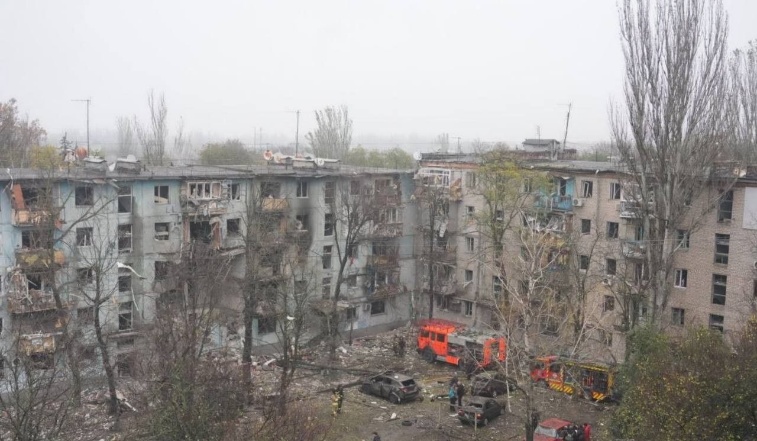
An overview of damaged apartment buildings after a Russian attack in Zaporizhzhia, Ukraine. (Ukraine’s State Emergency Service Zaporizhzhia/Telegram)
In Kyiv, drones set fire to the National Institute of Traumatology and Orthopedics, a six-story hospital in the Shevchenkivskyi district. Emergency crews rescued seven people as the second floor partly burned, and staff moved patients from the damaged wards. In Odesa, two women, aged 44 and 50, were killed and six people hospitalized after strikes on private homes; at a second site, 11 parked cars were wrecked. On Thursday evening, a drone had already set a furniture factory in southern Odesa Oblast ablaze, burning four workers and spreading across about 1,300 square meters.
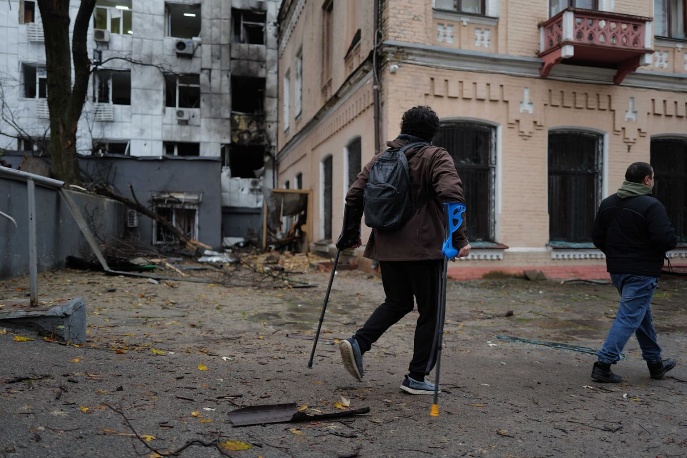
A man on crutches walks past the Institute of Traumatology and Orthopedics that Russian forces damaged in an overnight attack in Kyiv, Ukraine. (Slava Ratynskyi/The Kyiv Independent)
The list ran across the map. In Rivne, a drone hit an apartment block, injuring six people, including two children, and forcing 42 residents out. In Vinnytsia, three people were hurt and a kindergarten and energy facilities were damaged. In Sumy Oblast, an FPV drone — a small first-person-view attack drone — killed two men, aged 57 and 47, near Seredyna-Buda, one of more than 50 attacks on 25 settlements in the oblast. Donetsk Oblast lost four people, three of them in Kramatorsk and one in Bilenke. Eight were injured in Kharkiv Oblast, including three teenagers, power lines were hit in Izium and a school building and warehouse in Zlatopil; three were injured as Russia shelled Kherson and 34 other settlements, and a 50-year-old woman was badly hurt in Chernihiv Oblast. Power equipment was damaged in Poltava and Cherkasy oblasts.
The Air Force said 80 of 117 drones, 63 of them jet-powered, were shot down or jammed; 24 locations were hit. Near Komyshuvakha, where a November 2 strike on an aid distribution point has killed at least 55 people, a Security Service (SBU) official said Russian FPV drones now attack the recovery crews daily.
That evening, President Volodymyr Zelensky said he had held a “tough conversation” with officials over multi-day blackouts in Bila Tserkva and Brovary, warning that local reports did not match residents’ experience. “Problems must be solved, not concealed,” he said. Earlier, he and Prime Minister Serhii Koretskyi convened the first regular meeting with mayors from across the country, from Kharkiv and Dnipro to Uzhhorod and Vinnytsia, on preparing cities for winter. Foreign Minister Andrii Sybiha asked UN relief chief Tom Fletcher to make power and heat a humanitarian priority. “Putin is trying to deprive millions of households of electricity, heating and water,” he wrote.
Starshield: “All Missions Failing”
A Ukrainian official told Axios on Friday that problems with Starshield, the military version of SpaceX’s Starlink, had been building since November 10 — and that on November 13, every Ukrainian mission relying on it had begun to fail. SpaceX gave the outlet a flat reply: “This is false. There has been no change.”
Zelensky said the cap of 161 kilometers per hour (100 mph) on terminals in motion remains in force along the entire front and over occupied territory, making it “impossible” to use interceptor drones against Shahed-type drones. Some Russian strikes, he said, had already got through because interceptors could not reach speed in time. These are not “random errors,” he insisted, but systematic restrictions, and Defense Minister Yevhenii Khmara and Commander-in-Chief Mykhailo Drapatyi are in contact with Washington. A source in the Defense Ministry offered a narrower picture: the limit has been recorded over all occupied land, but not over Ukrainian-controlled territory. ISW said it remains unclear which description is correct.
The stakes are high because satellite links underpin Ukraine’s mid-range drone strikes, which this year have choked Russian supply lines behind the front. A corps-level commander in Donetsk Oblast told the Kyiv Independent the limit was still in place, making those drones easier for Russia to intercept or evade, and a senior figure in the Unmanned Systems Forces confirmed it. In Washington, the 105-member bipartisan Ukraine Caucus in the House of Representatives called on the Trump administration and Elon Musk to restore full access. “Congress has been clear,” the caucus wrote, “that Ukraine’s ability to defend itself and the rest of Europe is a vital national interest of the United States.”
Neptunes Over Rostov, Fire on the Volga
Videos from Volgograd overnight showed flames lighting up the sky over the Lukoil refinery — and, by morning, residents lining up at gas stations in a region already living with fuel restrictions. Ukraine’s General Staff said the strike damaged four primary processing units, a hydrotreating unit, a loading terminal and six storage tanks at the plant, one of Russia’s largest, with capacity of about 15 million tonnes of crude a year. “From here, fuel is supplied to the front and to airfields from which aircraft take off to strike Ukraine,” the General Staff said. Governor Andrey Bocharov said the attack on the city killed four people and injured two.
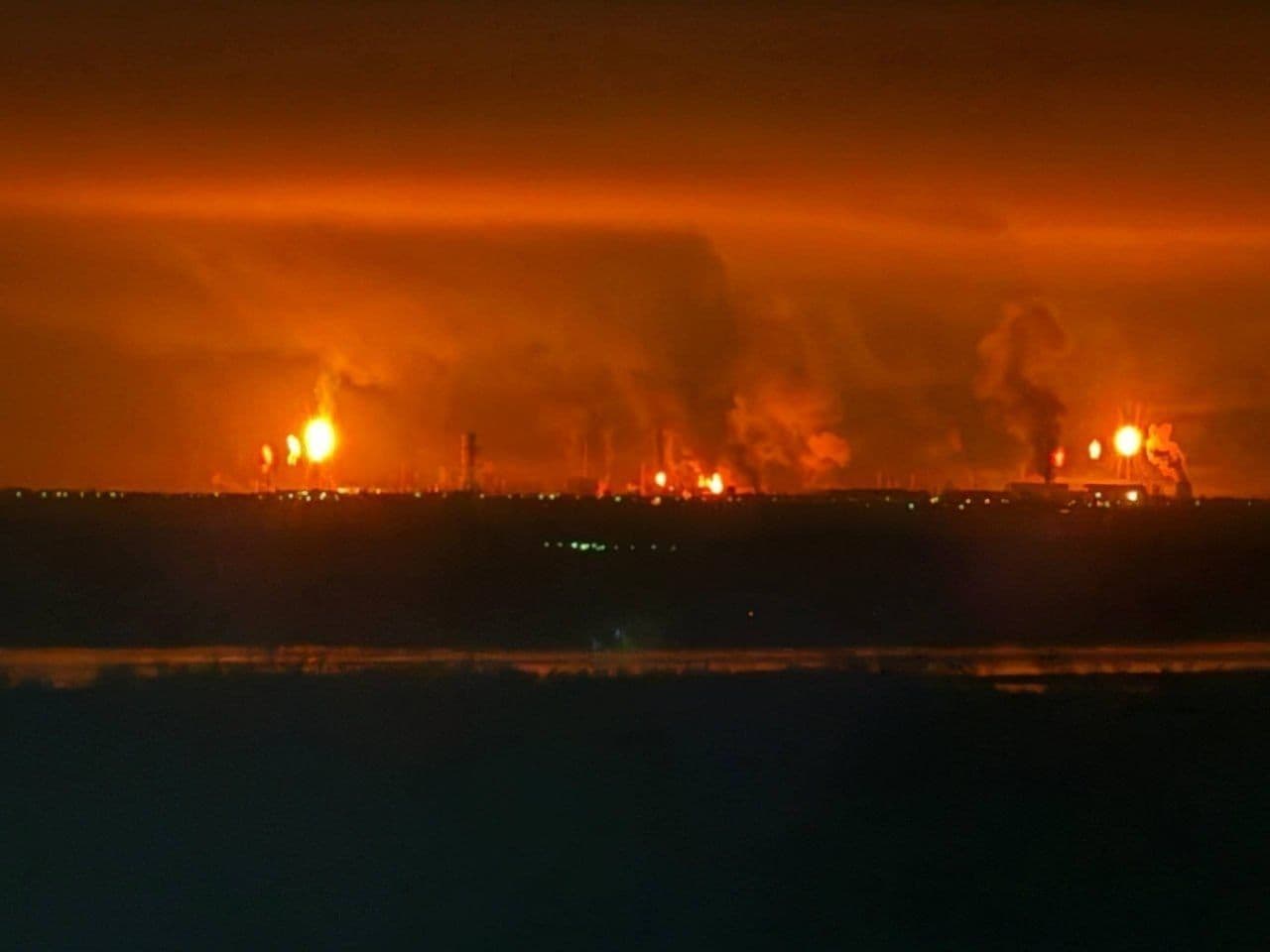
A photo appearing to show the Lukoil-Volgogradneftepererabotka refinery on fire following a Ukrainian drone attack. (Supernova_plus / Telegram)
Farther southwest, Ukraine’s Navy fired Neptune cruise missiles at three drone sites in Rostov-on-Don: the production plant and warehouse of Ionos, which builds tactical strike drones, and a service center of Aero-Hit, maker of the Veles FPV drone, where damaged drones are repaired for the front. “Some drones will not be manufactured, some will burn in the warehouse, and damaged drones will not return to the front for a long time,” the General Staff said. The Neptune, the anti-ship missile that sank the cruiser Moskva in 2022, now reportedly reaches 1,000 kilometers. Rostov Governor Yuri Slyusar claimed more than 120 drones were downed over the region, with one man wounded and five apartment buildings damaged.
Dozens of drones also flew at Moscow, disrupting several airports. Geolocated photos showed that Ukrainian forces likely hit Nebo-U and Sopka-2 radars and a 40V6 mobile radar mast in Leningrad Oblast, and an open-source analyst reported a likely strike on an oil pumping station near Prosvet in Samara Oblast. In southern Moscow, a bomb under the driver’s seat of a Toyota exploded on Kirovogradskaya Street, seriously wounding Sergei Zavorotny, a former spokesman for ex-Prime Minister Mykola Azarov whom the US Senate Intelligence Committee has identified as an agent of Russia’s foreign intelligence service. It came a day after a car bomb killed an air force colonel in St. Petersburg; Russian military bloggers complained that Ukraine is increasingly using such devices against officers in the rear.
The Line
The Russian column came out of the fog. Near Hruzke, northeast of Dobropillia, a reinforced platoon of three tanks, three infantry fighting vehicles and more than ten light vehicles pushed toward Ukrainian lines, a Ukrainian military source said; some armor reached the line of contact while infantry dismounted kilometers short, and the assault was repelled. The same source said Russia has begun moving heavy equipment toward Dobropillia itself. Commanders have warned since September that autumn would bring this: fewer leaves to hide infantry, but fog, wind and rain that blind drones and let vehicles drive deeper into the kill zone. Russia has already sent tanks fitted with active protection systems — gear that shoots down incoming drones and projectiles — into this sector, and has spent weeks slipping small infantry groups forward to prepare the way. Footage showed Russian troops raising flags in western Shylivka after one such infiltration, and Ukrainian forces striking a Russian position in western Rubizhne. Heavy losses and steady armor deliveries, ISW assessed, mark Dobropillia as Moscow’s priority.
Elsewhere, Ukraine gained ground. A Ukrainian source reported an advance in western Pyskunivka, east of Slovyansk, and a Russian military blogger conceded that Ukrainian troops had reached the outskirts of Dachne, south of Novopavlivka. Ukrainian forces counterattacked southeast of Lyman, while Russian attacks around and inside Kostyantynivka, near Borova and in the Hulyaipole direction made no confirmed gains. Neither side reported ground fighting in the Oleksandrivka or Kherson directions.
In the north, Russian infiltrators reached Pokalyane and moved west of Kupyansk-Vuzlovyi, and the Russian Defense Ministry claimed Kotivka, northeast of Kharkiv. A Ukrainian source said Russia does not fully control Kozacha Lopan, despite its claims, and footage of a Russian strike south of Kupyne showed Ukrainian troops still holding there. North of Sumy, Russian claims of attacks went unconfirmed, and ArmyInform reported that fiber-optic drones — guided by a cable that jamming cannot cut — are hitting civilian cars on the Kharkiv–Okhtyrka highway despite anti-drone netting. Near Lukyanivske, northwest of Orikhiv, Ukrainian forces struck another infiltrated position.
Major General Oleh Apostol, commander of Ukraine’s Air Assault Forces, told journalists that Russia’s offensive “has slowed down very significantly,” worn down by losses even as Moscow leans on its manpower edge. He said Russian troops plant flags in contested areas partly because junior officers mislead their superiors, and that Ukraine had retaken more than 800 square kilometers in two operations, including one near Dobropillia that halted a push by large Russian marine units, after recounting areas that were only infiltrated. ISW has assessed a net Russian loss of about 27 square kilometers in October. “Without infantry, nobody can do anything,” Apostol said. Of Russia’s gains, he offered one measure: “If they capture a single tree line in the span of a month, that hardly constitutes an operational success.”
Also Today
War funded by seized firms. Bloomberg reported that at least six Western companies’ Russian units, seized under Moscow’s “temporary management” decree, have donated about 7.1 billion rubles ($87 million) to war charities, including 600 million rubles from Rockwool’s former business and 1 billion each from AB InBev Efes and Metro AG’s operations. In November, Putin also handed Japan Tobacco International’s Russian assets to a state-picked manager.
Weekly returns from occupation. Ombudsman Dmytro Lubinets said Kyiv and Moscow have launched weekly evacuations of elderly, disabled and sick civilians from occupied areas with Red Cross help; 16 people came home on November 12. He said 486 Ukrainian women remain in Russian captivity, and up to 16,000 Ukrainians are considered missing.
A first for the RBS-70. The General Staff said the 1027th Anti-Aircraft Regiment downed a jet-powered Geran-5 drone over Kyiv Oblast with a Swedish laser-guided RBS-70 for the first time. Sybiha discussed Gripen deliveries with Swedish Foreign Minister Maria Malmer Stenergard.
Czech trainer jets. Foreign Minister Petr Macinka said Czechia could deliver four L-39 Skyfox jets for drone hunting in 2027 and eight more in 2028, pending export licenses for foreign parts.
Rassvet behind schedule. Apostol said Russia’s Starlink rival, Rassvet, is lagging, though Moscow could fix its problems.
Defense tech money and a cyberattack. Ukrainian-founded UForce, maker of Magura sea drones, raised $700 million at a $6 billion valuation, with the UK’s National Wealth Fund and the US-Ukraine Reconstruction Investment Fund among investors. German drone maker Quantum Systems confirmed it had contained a cyberattack in late October.
Rail and warehouse losses. Infrastructure Minister Mykola Kalashnyk said Ukraine has lost 630 locomotives since 2022, nearly 400 of them this year; Finland is sending 10, and a World Bank grant of about €100 million will buy some 60 used ones. The National Bank said Russia destroyed 800,000 square meters of warehouse space in the third quarter, pushing up storage rents and food prices as inflation reached 11% in October.
Moscow cancels its arms show. Russia scrapped its flagship Army 2027 defense forum, already cut back in 2024 and canceled in 2025; the Russian outlet The System has reported that former Defense Minister Sergei Shoigu’s family long profited from organizing it.
Anti-corruption cases. The Prosecutor General’s Office confirmed receiving a court order to open a vote-buying investigation into David Arakhamia, head of Zelensky’s parliamentary faction, who denies wrongdoing; watchdog head Vitaly Shabunin accused the office of shielding him. SBU general Serhiy Duka, a suspect in the “Operation Carthage” probe, was released on ₴65 million bail. France seized a $40 million Paris mansion of businessman Kostyantyn Zhevago at Ukraine’s request, in a probe into $113 million allegedly embezzled from Finance and Credit Bank; he denies wrongdoing.
Drones over Lakenheath. US Air Force personnel responded to suspected unauthorized drones at RAF Lakenheath in England; no damage was reported, and their origin is unknown.
Sport and civic life. Finland and Norway moved to block Russian and Belarusian athletes from competing on their soil. Kyiv hosts a forum on wartime democracy on November 17. France’s ambassador in Moscow, Nicolas de Rivière, called Russia’s demand for security guarantees “legitimate,” while saying Ukraine needs them too.
The Closing
In Zaporizhzhia, municipal crews began repairs on the Kosmichnyi district blocks by afternoon, after search operations ended. Psychologists sat with 31 residents, two of them children. The rescuer from Cobra had been one of the people who make that kind of afternoon possible. His colleagues finished the search without him.
A Prayer for Ukraine
1. For Those Who Defend
Lord, stand with the soldiers near Dobropillia who held as tanks came out of the fog, and with those who pushed forward at Pyskunivka and Dachne. Give clear sight to the crews whose drones lose their link in the sky, and steady hands to the gunners who track jet drones at night. Guard the wounded, comfort the exhausted, and bring home every prisoner still waiting for the exchange that was promised.
2. For the Wounded and the Grieving
Merciful God, receive the rescuer who died beneath a concrete slab in Zaporizhzhia, the boy of seventeen, the two women of Odesa and the men of Kramatorsk, Bilenke and Seredyna-Buda. Heal the fifty wounded in the Kosmichnyi district and the children hurt in Rivne. Comfort the patients moved through smoke in Kyiv’s trauma hospital, and hold every family whose morning ended in rubble.
3. For Those Who Lead and Negotiate
Lord of truth, give wisdom to the men and women who will now sit at the table for Europe and for Ukraine. Keep them from fear and from easy surrender, and let no demand made in the dark redraw the lives of free nations. Grant courage to those who speak plainly, discernment to those who listen, and a peace that rests on justice rather than on threats.
4. For Cities, Grids and Rails
God of light, strengthen the energy workers and repair crews who restore power under fire, and the mayors who gathered to prepare their towns for winter. Protect the homes of Bila Tserkva and Brovary, the warehouses, the locomotives and the hospitals. Where cables are cut and stations burn, let warmth return quickly, and let no household face the cold alone this season.
5. For a People Who Keep Standing
Faithful Lord, on the one thousand seven hundred twenty-fourth day, sustain a people who clear the rubble by afternoon and begin repairs before dark. Renew the strength of those who carry grief without stopping, and keep hope alive in the occupied towns where families wait to come home. Let Ukraine see the day when the sirens fall silent for good.
In Your mercy, in Your justice, in Your time — bring this war to its end, and let the ending be worthy of what Ukraine has endured.