
July 28, 2026
Prepared by Diana Bozhyk
President Zelensky met Donald Trump at the White House for an hour-long closed-door meeting, then watched the US Senate vote 86-12 to advance a Russia sanctions bill named for the late Senator Lindsey Graham, hours after attending his funeral. Ukraine’s military intelligence charged two soldiers from the Skelia assault regiment with torturing their own comrades, following reports of at least 26 noncombat deaths in the unit. And Ukraine marked the third anniversary of the Olenivka prison camp massacre, with Zelensky confirming 9,613 people have been recovered from Russian captivity since the war began — thousands more, he said, still waiting.
THE DAY’S RECKONING
Volodymyr Zelensky spent Tuesday moving between three of Washington’s most consequential rooms in a single day: the Oval Office, where he and Trump spoke behind closed doors for about an hour; a funeral home, where he mourned a senator who’d visited Kyiv weeks before his sudden death; and the Capitol, where he watched lawmakers vote overwhelmingly to punish the country that killed him. “It was a good meeting,” Zelensky said afterward, the kind of understatement that could mean anything from real progress to careful diplomacy. Six thousand miles away, in a Kirovohrad Oblast military unit, investigators were charging two Ukrainian soldiers with torturing two of their own — men who’d survived Russian strikes only to be beaten by their own comrades. And in Kryvyi Rih, one of Ukraine’s largest mining companies quietly announced something no missile had managed to do directly: it was suspending production, because the Black Sea had simply become too dangerous to ship its iron ore through anymore. Washington moved on diplomacy today. Ukraine kept counting what the war costs on every other front at the same time.
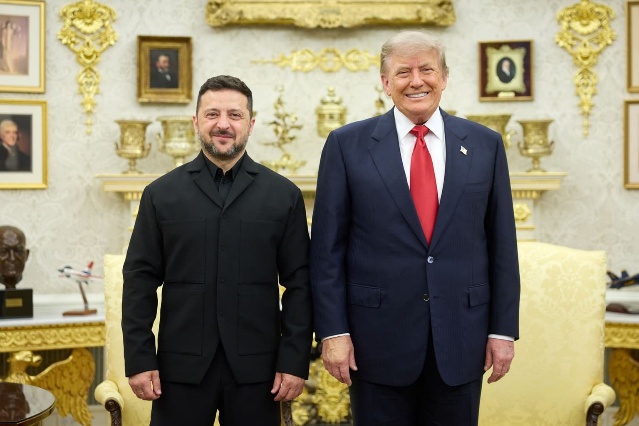
President Volodymyr Zelensky and U.S. President Donald Trump in Washington, DC. (Volodymyr Zelensky / X)
ZELENSKY AND TRUMP: “A GOOD MEETING”
Volodymyr Zelensky and Donald Trump met at the White House for roughly an hour on Tuesday morning, their first face-to-face meeting since Ankara earlier this month. “The President and I discussed licenses for Patriot interceptor production and several other ideas that could help. We also spoke about diplomacy — it’s important that the diplomatic process be reinvigorated,” Zelensky said afterward, adding that “our teams will arrange the details of their further communication.” One person familiar with the discussion said the two leaders were expected to review a proposal for a partial ceasefire covering aerial attacks, one that would later be presented to Moscow — though neither leader confirmed that detail publicly.
Presidential Office head Kyrylo Budanov offered his own summary after the meeting: Kyiv and Washington had agreed to “intensify the negotiation process at all levels.” Speaking to Fox News host Sean Hannity that evening, Zelensky went further, saying Trump “accepted that he will give us licenses” for Patriot production, and argued that Putin, not Ukraine, has lost the battlefield initiative — “this is the main thing that’s been changed.” He was careful to frame Ukraine’s continued strikes as leverage rather than an alternative to negotiation: “We are asking to stop this war each day, minimum, to negotiate ceasefire for some period of time and give possibility for diplomats to negotiate. But Putin doesn’t want, so this is the problem. That’s why we need to respond, be tough, be strong.”
A FUNERAL, THEN A VOTE: THE SENATE PASSES GRAHAM’S SANCTIONS BILL
Before the sun set on Tuesday, Zelensky had attended a funeral and watched the Senate act in the same man’s memory. Lindsey Graham — the Republican senator who died suddenly on July 11, one day after returning from a visit to Kyiv where he told Zelensky he’d finally secured Trump’s backing for a Russia sanctions bill — was buried Tuesday morning. That evening, the Senate voted 86-12 to advance legislation now named for him: the Lindsey O. Graham Sanctioning Russia and Iran Act of 2026.
The bill that passed is a watered-down version of what Graham originally proposed. His initial draft called for a blanket 500 percent tariff on any country still buying Russian oil, gas, or uranium; the version senators actually voted on caps tariffs at 100 percent, and only for the top five buyers of Russian energy and the top five countries helping Russia evade sanctions — a scaling-back Trump reportedly pushed for behind the scenes. It also folds in new sanctions on Iran, at Trump’s request. Zelensky met with more than 60 senators in a closed-door session before the vote alongside Finnish President Alexander Stubb, and thanked lawmakers afterward: “This bill is very important, sanctions against Russia are very important. It’s not only about money that helps Russia wage its war, but it’s also a big signal to Europe, Ukraine, and our people.” Most of the 12 senators who voted against it were Democrats uneasy with handing Trump broad new tariff powers — a reminder that even a near-unanimous show of support still has real disagreement folded inside it.
UKRAINE’S WEAPONS WISHLIST: LOCKHEED, RAYTHEON, AND A MISSILE AIMED AT MOSCOW
Zelensky used his Washington trip to press Ukraine’s case with the people who actually build the weapons it needs. He met separately with representatives from Lockheed Martin, the manufacturer behind Patriot interceptors, ATACMS missiles, HIMARS rocket systems, and F-16 fighters, describing talks aimed at “specific solutions” to close Ukraine’s air defense gap through joint production rather than continued reliance on imports alone. It follows an announcement five days earlier that Ukraine is separately pursuing a similar arrangement with Raytheon, though neither company has offered a concrete production timeline.
Ukraine may not need to wait on American manufacturers for everything. Denys Shtilerman, chief designer at Ukrainian defense firm Fire Point, said in an interview published this week that the company is in final testing on a new ballistic missile system, and that strikes on Moscow using the weapon could begin as early as this autumn if engine tests go well. “The military will decide where, but I think these will immediately be significant targets,” he said. Fire Point already builds the FP-1 long-range strike drone and the FP-5 Flamingo cruise missile; the new system, part of a family called FP-7 and FP-9, is designed to reach out to 850 kilometers — far enough to put Moscow itself within range from Ukrainian territory for the first time using a weapon Ukraine built entirely on its own.
KHMARA’S FIRST WEEK: MEETINGS WITHOUT MISSILES
Ukraine’s new defense minister, Yevhen Khmara, spent his first week in office almost entirely in meetings with allies, and came away with plenty of goodwill but no new interceptors. Khmara — a 39-year-old special operations veteran who helped plan last year’s audacious Operation Spiderweb, which used drones smuggled inside cargo trucks to damage or destroy dozens of Russian strategic bombers — met first with US Ambassador to NATO Matthew Whitaker on July 24 to press for faster Patriot deliveries; Ukrainian media reported the talks were friendly but produced no commitment on additional missile sales.
He fared somewhat better with Britain and Germany. A call with new UK Defense Secretary Wes Streeting covered continued support for Ukraine’s acquisition of Sweden’s Gripen fighter jet and the delivery of advanced Meteor air-to-air missiles, which would give Ukrainian pilots a weapon genuinely superior to anything Russian fighters currently carry. Meetings with German Ambassador Heiko Thoms focused on accelerating Patriot deliveries and expanding joint missile and ammunition production — requests Berlin has heard before. Germany remains Ukraine’s largest European military backer, having committed roughly $46 to 48 billion in aid, but an earlier German-led appeal for allies to donate Patriot interceptors drew just a single small contribution: five missiles, from Poland.
DEEP STRIKES: MOSCOW OBLAST BURNS AGAIN
Ukraine’s long-range campaign kept finding fresh targets barely 40 minutes from the Kremlin. Drones set fire to the Hydrostalkonstruktsiya steel fabrication plant and a logistics warehouse in Chekhov, Moscow Oblast, while a separate strike hit the boiler room of the city’s regenerative rubber plant; Moscow Oblast’s own governor confirmed a residential building and a nearby village also caught fire from falling debris. Ukraine’s General Staff separately confirmed that a strike on the Prioritet fuel storage facility in Sarapul, Udmurt Republic — a site Russia uses for long-term petroleum reserves — succeeded in starting a fire there as well.
The reach of these strikes keeps colliding with Russia’s own consumer economy. Wildberries, the retailer whose warehouses have absorbed a string of Ukrainian strikes in recent weeks, has begun a public relations counteroffensive: digital billboards in occupied Sevastopol now urge Crimean residents to “support the entrepreneurs with an order,” part of a nationwide campaign encouraging Russians to shop with sellers whose stock burned in the strikes. It’s an unusual position for a company whose own warehouses reportedly still list military helmets and body armor once you search past the euphemisms.
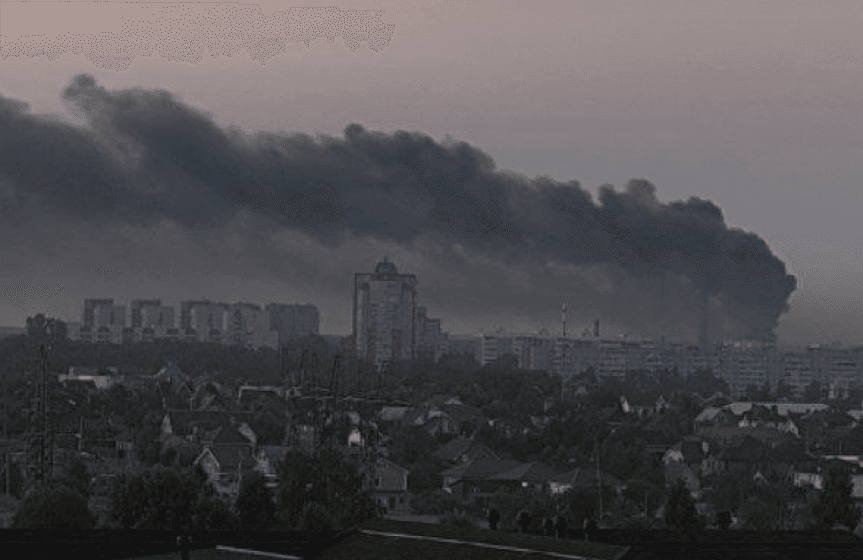
What purports to be the aftermath of a reported Ukrainian drone attack on Chekhov, Moscow Oblast, Russia overnight. (Exilenova Plus/Telegram)
CRIMEA GOES DARK IN FEODOSIA
Ukraine’s campaign to isolate occupied Crimea claimed another substation overnight, this one connected to Feodosia’s high-voltage grid, leaving much of the city without power. Ukraine’s General Staff confirmed a separate strike on a logistics and fuel depot near the village of Ichki. Crimea’s occupation water authority announced it would restrict water supply across the peninsula for emergency repairs — one more basic utility joining electricity on the list of things Crimean residents can no longer count on.
Sevastopol’s occupation governor claimed the city’s air defenses repelled a Ukrainian attack the same day the Wildberries billboards went up, an odd juxtaposition: propaganda urging residents to shop normally, displayed in a city whose governor was simultaneously describing an active attack. Neither claim does much to change what residents already know from experience — that the power, water, and normalcy Russia promised when it annexed the peninsula keep failing at a rate Moscow can no longer fully hide.
OLENIVKA, THREE YEARS LATER: 9,613 NAMES RECOVERED
Ukraine marked the anniversary of one of the war’s starkest atrocities this week: the night of July 28-29, 2022, when an explosion tore through a barracks holding Ukrainian prisoners of war in Russian-occupied Olenivka, killing more than 50 and wounding over 100 more. Ukraine’s security service has called it a deliberate attack, with explosives planted by Russian forces; Ukrainian intelligence has attributed the killings specifically to fighters from the Wagner private military company. Russia, for its part, has claimed Ukraine shelled its own soldiers — a claim Kyiv has always rejected, arguing Moscow staged the attack to destroy evidence of how badly it was mistreating the prisoners in the first place.
“This is one of those war crimes that shows what Russia truly is,” Zelensky said in a statement marking the anniversary. “It is a state that disrespects life completely, an absolute evil that cannot stop itself from killing.” He confirmed that 9,613 people have been brought home from Russian captivity since the invasion began, without specifying how many remain. “We remember everyone who still remains in captivity,” he said, adding that Ukraine continues working with international partners to negotiate further exchanges. The most recent swap, on June 26, returned 160 Ukrainian POWs in exchange for the same number of Russian soldiers.
SAVE UKRAINE BRINGS 47 CHILDREN HOME
A Ukrainian humanitarian organization, Save Ukraine, announced it has brought 47 children and teenagers back from Russian-occupied territory in recent weeks, part of the broader Bring Kids Back UA initiative. Among them: 13-year-old Anhelina, wounded by shrapnel in her own backyard, who was denied medical treatment at a hospital under occupation and threatened with removal from her mother simply because she lacked Russian documents — a direct product of Russia’s forced passportization policy in occupied territory. Eighteen-year-old Tymur survived a Russian soldier firing shots directly at him inside his own home, then fled rather than risk forced conscription into the army occupying his town.
“Thousands of children remain trapped under occupation, where they are forced to forget their roots and are openly being prepared for war. But we will not stop,” the organization said. Ukraine’s own tracking database counts at least 20,000 children abducted from occupied territory since 2022, though officials believe the real number runs far higher — Ukraine’s ombudsman estimates up to 150,000, while the presidential commissioner for children’s rights puts it between 200,000 and 300,000. An estimated 1.6 million children remain under Russian occupation today. The International Criminal Court issued arrest warrants for Putin and Russia’s children’s rights commissioner, Maria Lvova-Belova, over the abductions back in 2023.
TORTURE CHARGES INSIDE THE SKELIA REGIMENT
Ukraine’s State Bureau of Investigation charged two servicemen from the Skelia assault regiment’s medical unit with torturing and unlawfully detaining two fellow soldiers in Kirovohrad Oblast this past May. Investigators say the victims were discharged from a hospital for violating its rules, transferred to the regiment’s own medical unit, and then repeatedly beaten before being locked inside a utility building, where the abuse continued. One victim lost consciousness and was hospitalized with a traumatic brain injury and a broken nose; the second was held for nearly another full day before also being hospitalized with a brain injury and multiple bruises. Both suspects face up to 10 years in prison if convicted.
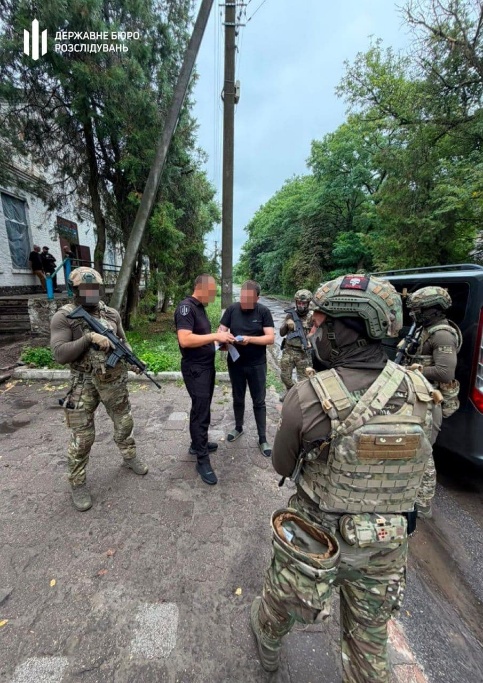
A Skelia regiment serviceman being detained with allegedly torturing and unlawfully detaining two fellow soldiers in a photo published. (Ukraine’s State Bureau of Investigation / Telegram)
The case is the latest development in a widening investigation into Skelia, one of Ukraine’s largest assault formations with more than 10,000 personnel, following a Ukrainian media investigation that documented at least 26 noncombat deaths among the regiment’s recruits between late 2025 and spring 2026. The unit’s commander was already suspended last month pending review. Ukraine’s Ground Forces have said violence, humiliation, and denial of medical care within its ranks will not be tolerated if confirmed — a standard the military is now visibly being forced to enforce against its own soldiers, not just defend against Russia’s.
KRYVYI RIH’S MINE GOES QUIET
The Southern Mining and Processing Plant, a major iron ore operation in Kryvyi Rih co-owned by Ukrainian billionaire Rinat Akhmetov’s Metinvest, announced it is suspending excavation work — not because of a direct strike, but because Russian attacks on Black Sea shipping have made it impossible to move the ore it digs. “Several shiploads of iron ore, which were supposed to be exported, accumulated in both the ports and the warehouses,” the company said, explaining it simply ran out of anywhere to put what it was still producing. Existing staff will spend the pause on repairs and maintenance, with production expected to resume in August.
It’s a different kind of casualty than the ones this war usually counts — no one killed, no building destroyed, just an entire industrial operation quietly grinding to a halt because the sea route it depends on no longer functions. “Unblocking logistics routes for Ukrainian Black Sea ports is an extremely important task for the sustainable operation of not only the mining and metallurgical industry, but also the entire Ukrainian economy,” the company said, calling on the government to do more to protect the ships and ports it depends on.
PUTIN’S MOBILIZATION MATH: PATROLS, RENTALS, AND A BRIDGE TO NORTH KOREA
Signs that ordinary Russians expect a new mobilization wave kept accumulating this week. In Bashmakovo, a small settlement in Russia’s Penza region, residents have organized a 250-person “people’s patrol” specifically to intervene when recruitment teams try to seize men off the street — a response, locals say, to recruiters who’ve beaten men mistaken for adults and coerced others into signing military contracts under duress. One resident’s relative was reportedly held, beaten, and forced to sign a contract weeks earlier; a separate case documented a man with a heart condition removed from his home while intoxicated and sent to the front, where he was killed three weeks later. Russia’s security service has opened a criminal case against the blogger who first publicized the patrols, accusing him of “calls to extremism.”Farther away, in Armenia’s capital, Russian citizens are driving up rental prices by roughly 30 percent over three months as demand for apartments in Yerevan approaches levels last seen during the 2022 mobilization — search interest in “apartments in Yerevan” has already exceeded the queries recorded the week Russia’s full-scale invasion began. Zelensky has said Putin is likely preparing to mobilize between 300,000 and 500,000 people in late September or early October, timed to land after Russia’s own parliamentary elections. Even Russia’s military posture abroad points toward a longer war: Russia and North Korea are nearing completion of their first-ever road bridge, a crossing Ukrainian investigators at Truth Hounds argue is built less for tourism or trade — bilateral commerce totals barely $34 million a year — than as a discreet military logistics corridor, easier to hide from satellite monitoring than the rail lines the two countries already share.
Russia’s own messaging about the war effort stayed mixed. Deputy Prime Minister Alexander Novak claimed the fuel crisis is “gradually stabilizing,” with Omsk lifting its retail fuel ban even as Siberia’s Altai region tightened rationing to once every 24 hours — a claim offered without supporting figures. Russia’s Navy, meanwhile, announced plans to commission 21 new vessels by year’s end, including the Perm, the first Yasen-M submarine built with Zircon hypersonic missile launchers integrated from the start.
WASHINGTON’S SLOW MONEY: $400 MILLION UKRAINE WON’T SEE UNTIL 2029
The Trump administration has told Congress it doesn’t plan to finish spending $400 million already authorized for Ukrainian military aid until fiscal year 2029 — three years from now, and just months before Trump’s own second term ends. The money, meant to fund equipment, training, weapons, and transport for Ukrainian forces, was outlined in a Pentagon spending plan sent to lawmakers back in May; two months later, none of it has been placed on contract. Lawmakers from both parties have criticized the pace as unusually slow given the scale of Ukraine’s ongoing needs, and Republican Senator Mitch McConnell has publicly criticized the delay, though most of his party has otherwise avoided pressing Trump directly on it.
Under US law, a president cannot simply withhold funds Congress has already appropriated — Trump’s first impeachment in 2019 followed a Government Accountability Office finding that his administration illegally did exactly that with Ukraine aid once before. Whether this latest delay amounts to the same thing, or just ordinary bureaucratic slowness dressed up as caution, is the kind of distinction that matters enormously to a country currently defending itself with weapons it doesn’t have enough of.
IRAQ’S ACCUSATION, AND SYBIHA’S CALL TO TEHRAN
A senior Iraqi security official claimed this week that Iraqi authorities had arrested a small group of people who “confessed” to working for Ukraine and carrying out bombings against Iraqi government facilities — an allegation Ukraine’s foreign ministry flatly rejected as baseless, noting Iraq never raised the claim through diplomatic channels before airing it publicly on television. Kyiv called the statement part of what may be “a coordinated information and psychological operation” designed to damage Ukrainian-Iraqi relations, and noted the accusation “aligns with Russian propaganda narratives” — a pointed reminder that Iran holds significant influence in Iraq, and that the claim surfaced amid already-heightened tension between Kyiv and Tehran.
That tension found a calmer outlet the same day. Foreign Minister Andrii Sybiha held what he called a “frank conversation” with his Iranian counterpart, Abbas Araghchi — their first official contact since Sybiha took office — following last weekend’s Ukrainian strike on a vessel Kyiv says was moving military cargo between Iran and Russia. “I reiterated that all of Ukraine’s actions are aimed solely at defending our country from Russian aggression and never intended to target civilian vessels or people,” Sybiha said, adding that he’d stressed “the necessity to refrain from any escalatory steps.” Whether one phone call cools a dispute that had included Iranian officials calling Ukraine’s president a “freeloader” days earlier remains to be seen.
FEDOROV STAYS OUT, PROTESTS CHANGE SHAPE
People close to Zelensky told Ukrainian media plainly this week what his public statements have only implied: Fedorov is not coming back as defense minister, full stop. According to sources cited by RBC-Ukraine, the president considers Syrskyi’s removal sufficient accommodation of what protesters demanded, and has no intention of reversing course on Fedorov regardless of how long demonstrations continue. “You cannot keep protesting for long simply ‘on vibes,'” one source close to the president said, arguing that the so-called “cardboard protests” — named for demonstrators’ handmade signs — will lose momentum without a single, sharply defined demand to rally around.
Organizers appear to sense the same risk. Rather than another stationary rally at Kyiv’s Ivan Franko Theater, they’re now discussing a march timed to Zelensky’s return from Washington later in the week. RBC-Ukraine also reported that during an earlier wave of similar protests in summer 2025, some officials had floated staging provocations at the demonstrations — proposals Zelensky rejected at the time. Whatever shape Friday’s protest takes, it will be testing a question Kyiv’s presidential team has already quietly answered for itself: whether a movement built on shared frustration can survive past the point where its original demand stops being negotiable.
WHAT TUESDAY CARRIED HOME
By the time Zelensky’s plane was somewhere back over the Atlantic, Tuesday had delivered a little of everything this war now runs on: a meeting that produced promises rather than deliveries, a funeral that turned into a legislative victory, an anniversary that reopened a three-year-old wound, and a quiet announcement from a mining company that said more about the war’s real cost than any single strike could. Nothing was resolved. Nothing usually is, in a single day of this war. But Tuesday added its own layer anyway — sanctions advanced, children recovered, soldiers charged with betraying their own — proof that the war’s ledger keeps growing on every page at once, not just the ones that make headlines.
A PRAYER FOR UKRAINE
1. For Anhelina and Tymur, and Every Child Still Waiting
Lord, a thirteen-year-old was denied treatment for her own wounds because she lacked the right papers, and an eighteen-year-old fled his home rather than be conscripted into the army that invaded it. Hold every child still living under occupation tonight, forced to hide who they are to survive. Bring the rest of them home, the way You brought these two.
2. For the Fifty Killed at Olenivka, Still Waiting on Justice
Father, three years have passed since an explosion tore through a barracks full of men who were already prisoners, already unable to defend themselves. Comfort the families who have waited three years for accountability that still hasn’t come. Let the truth of what happened that night eventually be spoken plainly, by people with the power to answer for it.
3. For Soldiers Wounded by Their Own
Lord of justice, two men survived enough of this war to still be wearing their country’s uniform, only to be beaten by the very comrades meant to fight beside them. Heal what these two now carry, in body and in trust. Let accountability inside Ukraine’s own ranks be as real and as thorough as the accountability it demands from its enemies.
4. For the Miners of Kryvyi Rih, and Every Job the Sea Has Quietly Taken
God of provision, an entire mine has gone quiet not from any direct attack, but because the sea route it depended on no longer works, leaving workers waiting on repairs instead of paychecks. Provide for every worker whose livelihood now depends on ports too dangerous to use, in this industry and in every other one war has reached without ever firing directly at it. Let safe passage return to these waters, for cargo and for the people who load it.
5. For a Country Measuring Progress in Meetings and Promises
God of patience, tonight Ukraine has licenses discussed but not signed, sanctions advanced but not yet felt, and a diplomatic process called “reinvigorated” without anything actually guaranteed to show for it. Give patience to a country that has learned, again and again, not to mistake a good meeting for a finished one, and give its leaders the wisdom to keep pressing for delivery, not just for promises.
In Your mercy, in Your justice, in Your time — bring this war to its end, and let the ending be worthy of what Ukraine has endured.