
The Night the Barn Burned
Twenty-three years ago, an Ecuadorean businessman named Enrique de la Piedra looked at the girls aging out of Ukraine’s orphanages and refused to accept what usually happens to them next. In this country, the vast majority of girls who leave the orphanage system with nothing turn to prostitution just to survive. Most boys are swallowed up by organized crime. Enrique built Rainbow Home to write a different ending for as many of these kids as he could reach.
It worked. Under the care of Vasiliy and Maria Lutso of Church of the Living God, Rainbow Home has rescued 136 girls — not just sheltered them, but taught them to farm, to sew, to bake, to run a computer, to build a life with their own two hands. Eight girls live there now in the transition home, learning those skills. Three more orphans live in the new wing built two years ago to house a group home for orphans. It is, in every sense, a family that saved itself by learning to grow its own food and be self-sufficient.
On the evening of July 13, flames broke out on the roof of the barn — the heart of the whole farm. By morning, it was gone. Burned to the ground. The blaze took the windows of the animal stalls next door and melted the tires clean off the farm equipment parked in the machine shed. Sixteen people, and every animal on the property, walked away unharmed. But the barn itself is nothing now but a row of brick pillars standing in the ash, like a rib cage with nothing left inside it.
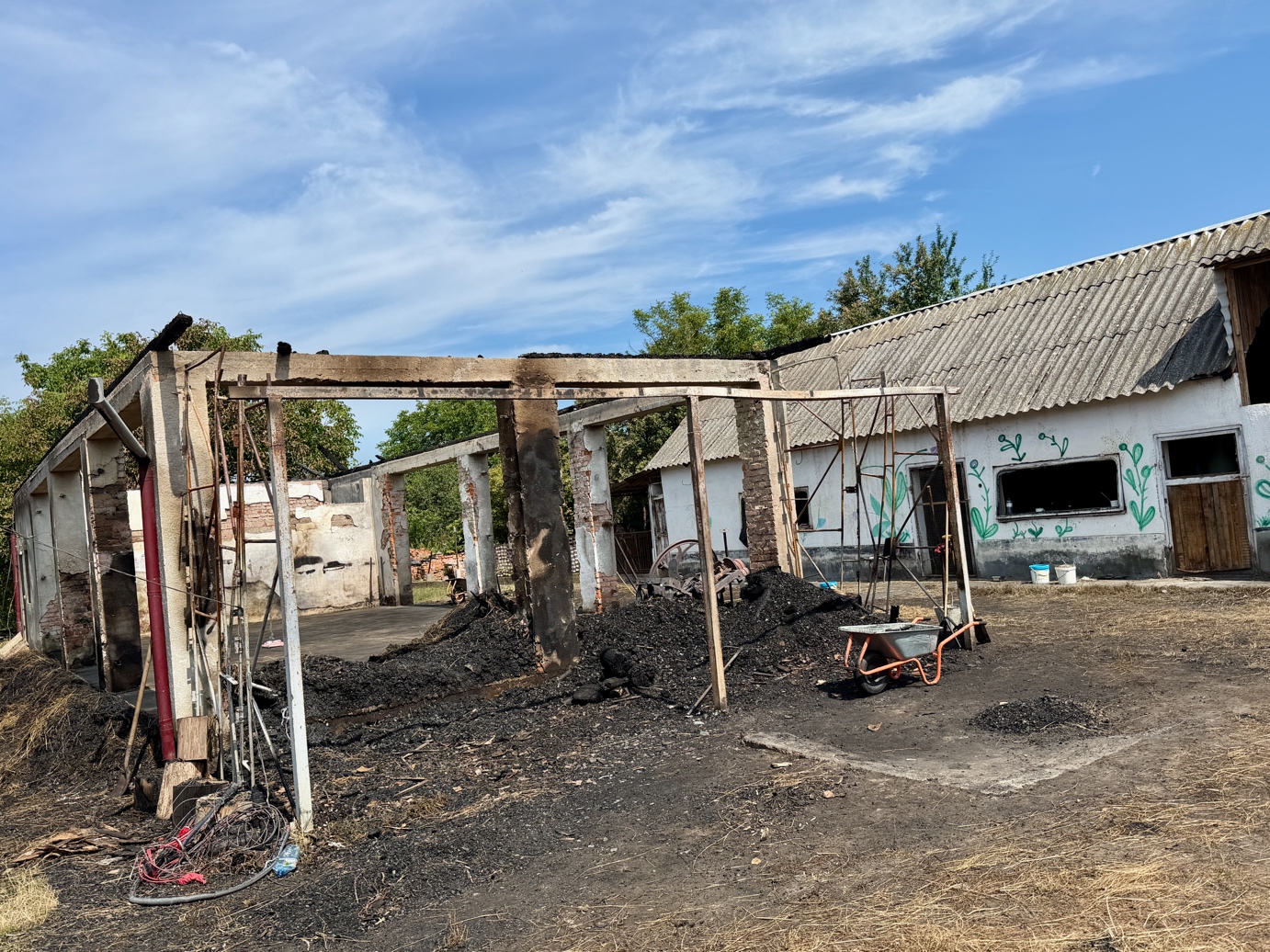
It’s hard to overstate what that barn was. It wasn’t just storage. It was warmth — the wood stacked inside it heats the entire home through the brutal Ukrainian winter. It was food — the hay and grain that feed every animal on the farm lived there too. It even generated the home’s power; the solar panels that lit Rainbow Home at night went up in the fire along with everything else. The solar company has already pledged to replace their panels for free. Everything else is now up to the people who love this place.
The girls didn’t wait to be told what to do. They swept the ash. They cleared the debris. They are already standing in the wreckage, ready to rebuild — because rebuilding is the only kind of life they’ve ever been taught to choose.
Here is what that rebuilding actually costs. The new barn will be the same footprint as the old one — 19 meters by 8.5 meters, standing 3.75 meters tall, with a 250-square-meter roof. That roof alone is 615,000 UAH — about $13,820 — in material and labor. The walls, built from simple planks spaced to let the air move through, will cost roughly another $3,000. Then there’s what has to go inside before the snow comes: two loads of hay at $900, four loads of logs for heat at $1,350, and 200 kilograms of grain to carry the animals through the next month. Add nails, hardware, the small things that always get forgotten — and the total comes to $20,000 to put Rainbow Home’s barn back the way it was before July 14.
Three organizations have already linked arms to make this happen: the Corvallis/Uzhhorod Sister City Association, Church of the Living God, and One Collective. Together, they’ve raised the first $2,200.
That leaves $17,800 between eight girls and a warm, fed winter.
Rainbow Home has spent 23 years proving that a girl who’s aged out of the system doesn’t have to become a statistic. She can become a farmer, a baker, a seamstress, a woman who knows how to build something that lasts. All she needed was a barn to make that possible. Now the barn needs us.
To give toward the Rainbow Home barn rebuild, use this link to One Collective and mark in the comments “Rainbow Home”.