
July 21, 2026
Prepared by Diana Bozhyk
President Volodymyr Zelensky dismissed his commander-in-chief, General Oleksandr Syrskyi, late Tuesday and replaced him with Major General Mykhailo Drapatyi — the demand protesters have been shouting in Kyiv’s squares for six straight days. Russian missiles struck a Liberian-flagged gas tanker off Romania’s coast hours after Ukraine’s own drones expanded their campaign against Russian oil tankers to a new stretch of coastline near Krasnodar. Ten Ukrainian civilians were killed and 87 wounded overnight in strikes on seven regions, including a shopping center in Sumy hit three times so rescuers couldn’t put out the fire. And at a hospital in Dnipro, surgeons performed a night’s worth of amputations while, one floor away, a woman gave birth.
THE DAY’S RECKONING
Late on a Tuesday night, President Zelensky did the thing protesters had spent six days demanding: he fired his top general. Not Fedorov’s reinstatement — that fight is over, quietly lost — but the other half of the demand, the half aimed at Oleksandr Syrskyi, is done. Major General Mykhailo Drapatyi, a battlefield commander protesters have chanted for by name, now runs Ukraine’s armed forces. Whether that satisfies the crowds or simply changes what they’re angry about remains to be seen. Meanwhile the war did not pause to watch the reshuffle. A Liberian tanker carrying cooking gas took a hit off Romania’s coast, the latest in a monthslong exchange where both sides now shoot first and ask about neutral flags later. Overnight drones and missiles found homes, a shopping center, and a road in seven Ukrainian regions, killing 10 people before breakfast. And in Dnipro, a surgeon who has performed nearly 60,000 operations since 2022 started his morning round the same way he starts every morning round: not knowing how many amputations he’ll do before lunch. Command changed hands today. Almost nothing else did.
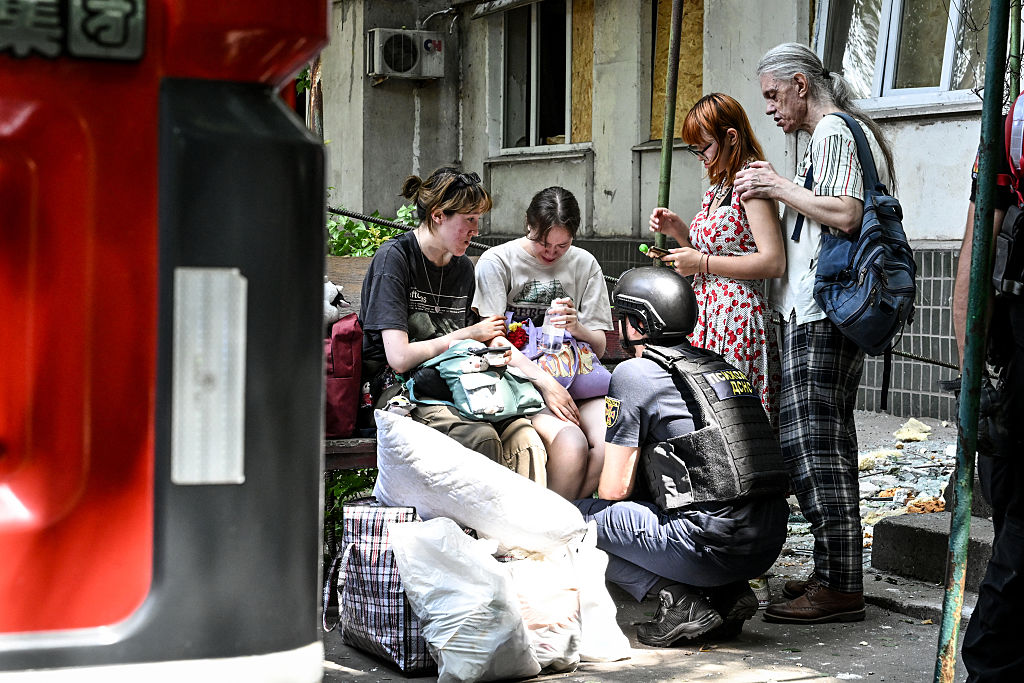
A psychologist from the State Emergency Service speaks to residents after a Russian strike in Zaporizhzhia. (Dmytro Smolienko/Ukrinform/NurPhoto via Getty Images)
THE GENERAL IS GONE
For six days, protesters filled Kyiv’s squares chanting two names: bring back Mykhailo Fedorov, the popular defense minister fired in a cabinet reshuffle, and remove Oleksandr Syrskyi, the army commander many blamed for pushing him out. Late Tuesday, President Zelensky answered exactly half of that demand. He dismissed Syrskyi as commander-in-chief of Ukraine’s Armed Forces and appointed Major General Mykhailo Drapatyi — previously commander of the Joint Forces Task Force since June 2025, and Ukraine’s Ground Forces commander before that — as his replacement.
Drapatyi was the protesters’ preferred name, according to Bloomberg reporting from earlier this week that first revealed Zelensky was considering the swap; he was described as one of eleven candidates under consideration. Fedorov himself has not been reinstated and has reportedly turned down other government posts, saying he’ll accept nothing but his old job. Separately, Ukraine’s Defense Ministry gained new leadership of its own this week: Yevhen Khmara, the former commander of the Security Service of Ukraine’s Alpha Special Operations Center — the unit responsible for the agency’s long-range operations — has taken over, according to Kyiv Post reporting describing the appointment as coming “amid Fedorov fallout.” Six days of chanting produced a new general and a new minister. Whether it produces a different war is a separate question entirely.
TEN DEAD BEFORE BREAKFAST: THE DOUBLE-TAP IN SUMY
Russia launched 58 exploding and decoy drones at Ukraine overnight — a mix of Shahed and Gerbera-type strike drones, jet-powered Banderol munitions, and Parodiya-type decoys designed to look like the real thing and waste Ukrainian air defense missiles. Ukraine’s air force shot down 46; eight got through and hit seven locations. By morning, the toll across seven regions stood at 10 dead and 87 wounded.
Sumy took the cruelest version of it. A Russian drone struck near a residential building first, wounding four people, including an 8-year-old girl and a 16-year-old boy. Then two more strikes hit the same district — a tactic called a “double-tap,” where a second or third strike targets the same spot specifically to catch rescuers and bystanders who came to help after the first one. A shopping center caught fire and burned to the ground because rescue crews couldn’t safely reach it while the threat remained. “The scale of the destruction is significant. But human lives are the most valuable thing,” local officials said. Ten people were wounded there in total. Elsewhere, the numbers stacked up fast: four killed and 13 wounded in Donetsk Oblast; three killed and eight wounded when a Russian strike hit a civilian factory in Odesa Oblast; two killed and 15 wounded, including a 13-year-old, in Kharkiv Oblast; one killed and 16 wounded in Zaporizhzhia Oblast; 23 wounded in Kherson Oblast. In Chernihiv, a mother and her 10-year-old child survived a direct hit on their house — Governor Viacheslav Chaus called it a miracle — before Russian forces struck the city center hours later, damaging an administrative building and a university. 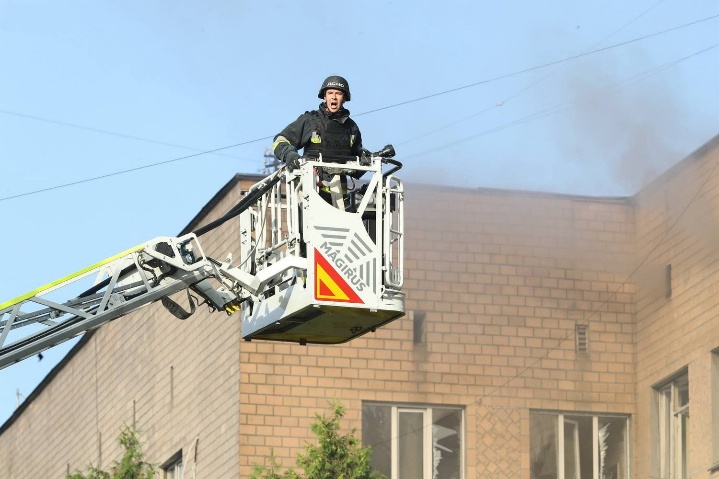
A firefighter work at the site of a Russian attack in Chernihiv Oblast. (Local authorities/Telegram)
A SECOND FRONT LINE: NIKOPOL’S FIREFIGHTERS
Two hundred miles away, in Dnipropetrovsk Oblast, a version of the same story played out with its own grim twist. Russian forces struck the Nikopol district and surrounding communities nearly 40 times overnight with drones and artillery, wounding five civilians — a 65-year-old man left in serious condition, two more hospitalized, two others treated as outpatients. Then, while emergency crews were still working to extinguish a fire in a damaged residential building, Russian forces struck again, wounding three firefighters in the act of doing their jobs.
It’s part of a pattern grim enough to have its own name: Ukrainian and international monitors have documented a rise in Russian “double-tap” attacks specifically targeting first responders, using the initial strike as bait for the rescuers who follow. Nikopol has absorbed this kind of bombardment for years now — local officials describe attack counts of 40 to 70 strikes in a single day as close to routine since 2022, which says something bleak about what counts as an ordinary Tuesday in a Ukrainian border community.
REACHING DEEPER INTO RUSSIA
Ukraine’s long-range strike campaign kept expanding its target list. The General Staff reported that Ukrainian forces — specifically the 15th Artillery Reconnaissance Brigade “Black Forest” — struck the Khalino airfield in Russia’s Kursk Oblast, damaging a MiG-29 fighter jet and a Pantsir-S1 air defense system, the mobile launcher Russia relies on to protect its bases from exactly this kind of attack; Ukraine’s own security service says a single Pantsir system costs $15 to $20 million to replace.
Farther from the front, satellite imagery and independent Russian monitors confirmed a fire had broken out at industrial facilities in Lipetsk City — home to Novolipetsk Steel, the plant that produces roughly a fifth of all the steel made in Russia, some of it feeding directly into the country’s missile production. Russian officials confirmed the fire but declined to confirm a Ukrainian strike caused it; independent outlet Astra reported it did. Closer to Moscow, newly published satellite images confirmed damage Ukrainian drones caused two days earlier to a Wildberries warehouse near Domodedovo — the kind of slow-motion confirmation that increasingly follows Ukraine’s deep strikes, arriving days after the smoke clears to prove what officials on both sides had disputed in the moment.
Ukrainian forces also kept up pressure on Russia’s water and logistics infrastructure just across the border. A regional Russian outlet reported that strikes destroyed the dam at the Belgorod Reservoir, flooding nearby areas and forcing rapid water discharge; satellite imagery taken over several days in July shows the flooding spreading. Russian officials in Belgorod confirmed damage to the dam’s hydraulic equipment without assigning blame. Ukraine’s General Staff separately confirmed strikes on a drone control point and a nearby ammunition warehouse just across the same stretch of border — a reminder that the reservoir isn’t an isolated target but one piece of a wider effort to make Russia’s own staging grounds unusable.
KOSTIANTYNIVKA, STILL NOBODY’S CITY
The fight for Kostiantynivka — the southern anchor of the Donbas “fortress belt” that stands between Russia and full control of Donetsk Oblast — remains exactly as unresolved as it’s been for weeks. Ukrainian forces recently advanced or held positions northeast of the city, and geolocated footage shows Ukrainian troops striking Russian positions inside it, even as Russian forces continue trying to infiltrate small groups into destroyed neighborhoods to establish drone launch points. A Kremlin-affiliated military blogger claimed Russian forces advanced in the city’s center and around nearby Chasiv Yar; analysts who track the war say the available footage doesn’t support that.
ISW, the independent group that tracks the war street by street, says it has now collected geolocated footage of positions inside Kostiantynivka going back to July 7 and is still working through it — a reminder of how contested and poorly mapped this single city has become. Elsewhere along that stretch of front, Russian forces are “going all-in” on the Lyman direction despite heavy losses, according to a Ukrainian military spokesperson, while making no confirmed progress at Dobropillya. In a rare piece of order-of-battle news, ISW identified a previously unseen Russian artillery unit — the 944th Self-Propelled Artillery Regiment — firing on Ukrainian positions near Dobropillya, the first confirmed sighting of that regiment in this war.
THE LINE EVERYWHERE ELSE, AND ONE MOTORIZED CHARGE
North of Kharkiv City, Russian forces pushed without gaining ground; the same held in Kupyansk, where a Ukrainian spokesperson said Russia is now feeding in reserves to try to seize the northern part of the city, and in Borova, where geolocated footage shows Ukrainian troops still holding positions Russia claims to have taken. In Sumy Oblast, Russian forces intensified their use of KAB guided bombs against Sumy City itself — 70 of them since the start of June, compared with just four across the previous four months — even as Ukrainian troops counterattacked and held the line near Yunakivka.
The one genuinely new development came from the Orikhiv direction in Zaporizhzhia Oblast, where Russian forces carried out a motorized assault — eight soldiers riding four all-terrain vehicles — on July 17, the first time that tactic has been used in this sector since February. A Ukrainian brigade spokesperson there said Russian forces can now strike Ukrainian positions up to 30 kilometers behind the line, while Ukraine can still reach twice as far into Russian-held territory, and that Russian command has begun shifting drone crews from its elite Rubikon unit into the area — a sign Moscow is trying to sharpen its edge in a sector it has otherwise left alone for months. In Kherson, neither side reported ground activity at all, though occupation authorities admitted a “technical failure” knocked out power across the entire occupied oblast.
CRIMEA’S BLACKOUT ECONOMY GETS A PRICE TAG
Ukraine’s campaign to strangle occupied Crimea’s power grid claimed at least eight more electrical substations overnight, from Kerch to Sudak to Berdyansk, part of a rolling siege that has made blackouts routine across the peninsula. Crimea’s Moscow-installed governor, Sergei Aksyonov, announced he’d struck a deal with Vladimir Putin himself: an extra five billion rubles, roughly $63.8 million, from Russia’s federal budget to compensate residents who go more than two days without power. It’s a strange kind of admission — Moscow is now budgeting, in writing, for how long it expects its own citizens in Crimea to sit in the dark.
Ukraine, meanwhile, is preparing for what comes after the blockade succeeds. The country’s Center for Strategic Communications published a public guide, “Dovidka.Crimea,” instructing residents of the occupied peninsula how to prepare for the chaos of an eventual liberation: agree on family meeting points in advance, keep cash and copies of documents on hand, and — pointedly — clear pro-Ukrainian material from phones and disable fingerprint or face unlock before crossing Russian checkpoints. It reads less like a contingency plan and more like a quiet promise that Kyiv still expects to get Crimea back.
SHIPS KEEP SINKING ON BOTH SIDES
A Liberian-flagged tanker called the Gas Lisbon, carrying cooking gas from Egypt toward the Ukrainian port of Reni, took a hit roughly 20 nautical miles off Romania’s coast — just outside Romanian territorial waters — wounding three crew members. Romanian President Nicusor Dan said the strike was “likely” part of Russia’s war on Ukraine; Ukraine’s acting foreign minister called it further proof of Russian terror. It’s at least the fourth attack on civilian merchant shipping near Ukrainian waters in barely a week.
New reporting this week confirmed just how deadly the worst of those attacks already was. The July 19 Russian missile strike on the Golden Leo — a grain carrier flying a Guinea-Bissau flag, hit by cruise missiles as it left Odesa — killed 10 members of its mostly Syrian and Indian crew, and the shipping trade journal Tradewinds News has now called it the single deadliest attack on civilian shipping by either side in the entire war. Ukraine’s own campaign against Russia’s oil-carrying “shadow fleet” — sanctioned tankers Russia uses to keep selling crude abroad despite Western price caps — has hit more than 170 vessels since it began on July 6, and this week expanded for the first time to Russia’s Krasnodar coastline, striking tankers loading Kazakh crude at the KTK terminal near Novorossiysk. One of them, the Nelsa, burned for most of a day before 22 of its 24 crew were evacuated. Kazakhstan’s government called the strikes “terrorist attacks” on a neutral cargo; Ukraine’s drone commander says his pilots aim deliberately high, at bridges and engine rooms, specifically to avoid the kind of oil spill that would pollute everyone’s coastline, Russian and Ukrainian alike.
THE WIDENING HUNTING GROUND
Ukraine has quietly opened a new layer of the drone war, one that sits between the short-range FPV drones that dominate the trenches and the long-range strikes that hit oil depots deep inside Russia. According to reporting this week, Ukrainian units are now flying medium-range attack drones — some equipped with Starlink terminals so operators can guide them while flying deep into occupied territory — on what pilots call “free hunting” missions, roaming as far as 300 kilometers behind Russian lines to find and destroy supply trucks, ammunition depots, and command posts.
“Those highways are so loaded with military logistics that it would be very hard not to find targets,” one operator-turned-analyst said, describing a zone Russia never built serious air defenses for because it never expected to need them there. Russia can’t easily fix that gap either: redeploying air defenses to cover hundreds of kilometers of rear-area highway would drain resources from everywhere else Ukrainian drones are already threatening. What used to be Russia’s safest territory — the space just behind the shooting — is quietly becoming just as dangerous as the front itself.
MOSCOW’S BUDGET MATH AND A BORDER SQUEEZE
While Ukraine strikes Russian refineries, the Kremlin is trying to paper over the damage with public money. Russia’s parliament, the State Duma, unanimously passed a bill in its third reading that lets the government pay oil companies out of the federal budget to keep selling diesel domestically below export prices — the same kind of subsidy Russia already uses for gasoline. Senior officials, including Duma Speaker Vyacheslav Volodin, promised the move would stabilize fuel supplies nationwide; the fact that this bill was needed at all is its own quiet admission of how much damage Ukraine’s long-range strikes have done to Russian refining capacity.
The same legislative session expanded the list of offenses that let Russian authorities deport migrants — including criticizing the military, joining unauthorized protests, or simply disobeying police — a move that gives Russian officials broad new leverage to threaten migrants with deportation unless they sign military contracts instead, as Russia’s own recruitment numbers keep sliding. Poland, for its part, is watching Russia’s next move with open alarm: Deputy Prime Minister and Defense Minister Wladyslaw Kosiniak-Kamysz warned that Russia may stage a false-flag drone provocation against Poland, the Baltic states, Finland, or Romania, potentially using captured Ukrainian drones to make the attack look like it came from Kyiv. Independent war analysts describe this as part of a deliberate “Phase Zero” campaign — a term for the psychological groundwork Russia lays before any real provocation, mixing propaganda, drone incursions, and sabotage to soften the ground first.
A SECRET MEETING IN BAKU
Azerbaijani President Ilham Aliyev revealed this week that former senior German and Russian officials held a secret meeting in Baku between July 12 and 14 to discuss ways to end the war — a meeting his own government says it only learned about afterward, from flight records. The unofficial German delegation reportedly included Ronald Pofalla, a former chief of staff to ex-Chancellor Angela Merkel, and Matthias Platzeck, a former state premier; the Russian side included a senior Kremlin human-rights adviser and the chairman of state gas giant Gazprom.
“If this meeting was intended to contribute to ending the war, we can only welcome that,” Aliyev said — but German Chancellor Friedrich Merz distanced his government from the talks entirely, saying he wasn’t aware of any such meeting. Neither government has explained who authorized it, what was discussed, or why it happened outside any official channel. A closed-door conversation between unofficial envoys from two of the war’s most consequential outside players surfaced this week for one simple reason: someone left a paper trail nobody expected to be checked.
SIXTY THOUSAND OPERATIONS: A MORNING AT DNIPRO’S HOSPITAL
At 9 a.m. in Dnipro’s central hospital, three amputations had already happened before most of the city had finished breakfast. Under the knife was a 27-year-old soldier, both legs shredded by a Russian drone. Hospital director Sergiy Ryzhenko has walked these corridors since 2022, overseeing anywhere from 50 to 100 operations some mornings; his staff have logged nearly 60,000 surgeries in total. “Bullet wounds have given way to drones, missiles and glide bombs,” Ryzhenko said — wounds so severe, he added, that “everything happens in a way that makes saving them almost impossible.”
One floor over, in what staff call the hospital’s “happy side,” obstetrician Olga Fandeieva delivered a baby the same morning, and a family crowded in to take photographs. “When you look at young guys who’ve had their arms and legs cut off, and then in the morning you come here and take these little paws in your hands — it’s a reset,” she said. “You understand what you live for.” Nurse Ruslana Vorobyova described patients arriving with injuries she still dreams about — “you dream that there’s an explosion somewhere,” she said — and colleagues who slip out of operating rooms because, as one put it, “I’ll never get used to this.” More than 100 kilometers from the front line, this is what an ordinary Tuesday looks like inside the building where the war’s wounded actually land.
THE NUMBERS BEHIND THE WAR, AND THE WORLD WATCHING
The United Nations added new weight to a grim trend this week: civilian casualties across Ukraine rose 37 percent in the first half of 2026 compared with the same period last year, according to Danielle Bell, head of the UN’s Human Rights Monitoring Mission, speaking from Geneva. Her office documented 1,396 civilians killed and 7,978 injured in six months — nearly double what it recorded over the same period in 2024 — driven largely by long-range missiles and drones reaching cities far from any front line, and by a 65 percent jump in casualties from short-range attack drones near the contact line. Civilians in Zaporizhzhia, Kherson, Kharkiv, and Dnipro told UN monitors they now feel “tracked by FPV drones” while doing nothing more dangerous than walking a dog or tending a garden. “These drones are fundamentally changing civilian life in frontline communities,” Bell said.
Elsewhere, the war’s edges showed up in smaller but telling ways. Laura Loomer, a prominent ally of U.S. President Donald Trump, visited Ukraine this week and publicly reversed years of pro-Kremlin rhetoric, saying she had been “propagandized by Russian media”; Zelensky’s office welcomed the visit as useful firsthand exposure. The European Union’s culture agency terminated a €2 million grant to the Venice Biennale after organizers let Russia’s pavilion reopen for the first time since the invasion, following months of protest from Ukraine and more than 20 other countries. And the IMF approved a $690 million disbursement to Ukraine, calling the country’s economic performance under wartime conditions “broadly satisfactory,” even as it acknowledged the outlook has weakened under the weight of intensified Russian strikes on infrastructure. Small stories, all pointing the same direction: a war that keeps reshaping everything near it, from steel plants to art exhibitions to a country’s central bank.
A NEW GENERAL, THE SAME WAR
By the time Kyiv’s protesters wake up to find Syrskyi gone, the war that made them angry enough to demand it will still be exactly where it was the night before: missiles over Sumy, tankers burning off two coastlines, a city named Kostiantynivka that belongs to no one. Command has changed hands before in this war and will again; it rarely changes what the war demands of the people living inside it. Tonight, a new commander inherits a front line that didn’t wait for him, a defense ministry with a new face, and a country that just proved, for the second time in a month, that it will fill its own streets to hold its leaders accountable. Whatever comes next, it will not be quiet.
A PRAYER FOR UKRAINE
1. For the Children of Sumy’s Shopping District
Lord, an 8-year-old girl and a 16-year-old boy were wounded before the day had properly begun, and a shopping center burned because the danger was too great for anyone to put out the flames. You know what it costs a community to watch something so ordinary — a market, a place to buy bread — turn to ash. Protect the children who survived that morning, and give this city’s rescuers courage for the strikes that follow the strikes.
2. For the Mother and Child Who Survived in Chernihiv
Father, a mother and her ten-year-old child walked out of a direct hit on their own home — a plain miracle, by their governor’s own word. Thank You for that mercy, and hold every family in this war who is still waiting for one like it. Let this survival be a sign, not an exception, and steady this mother’s hands as she rebuilds what was broken around her child.
3. For the Firefighters of Nikopol
Lord of the brave, three firefighters were wounded while doing the one thing their job asks of them: running toward a fire instead of away from it, even as a second strike came for them. Protect every rescuer who answers a call knowing the danger may not be over. Let their courage never become routine to us, even in a place where the sirens rarely stop.
4. For the General Taking Up This Burden
God of wisdom, a new commander accepts responsibility for an army mid-war, inheriting decisions he did not make and consequences he cannot undo. Give Mykhailo Drapatyi clarity greater than the pressure surrounding his appointment, and protect the soldiers whose lives now depend, in part, on his judgment. Let this change in command serve the defenders, not merely the politics that produced it.
5. For the Healers of Dnipro
God of mercy, tonight a surgeon will lose count of the operations he has performed since this war began, and a nurse will dream again of explosions she cannot outrun even in sleep. Hold Sergiy Ryzhenko, Ruslana Vorobyova, Olha Fandeieva, and every doctor and nurse who walks back into that corridor each morning. Grant strength to the soldier who lost both legs today, and to every patient who follows him under that same knife tomorrow.
In Your mercy, in Your justice, in Your time — bring this war to its end, and let the ending be worthy of what Ukraine has endured.