
Ukraine Daily Briefing | May 18, 2026 | Day 1,545 of the Full-Scale Invasion
Russia launched 546 aerial weapons overnight May 17–18 — 14 Iskander-M ballistic missiles, 8 Iskander-K cruise missiles, and 524 drones — primarily targeting Dnipro and Dnipropetrovsk Oblast, killing four people and injuring 60. A Russian drone struck a Chinese-owned cargo ship with a Chinese crew in the Black Sea one day before Putin’s state visit to Beijing. Belarus and Russia began joint nuclear weapons drills the same day.
The Day’s Reckoning
The strike package was the largest since May 13–14: 546 weapons, including 14 Iskander-M ballistic missiles and 8 Iskander-K cruise missiles. Ukrainian forces downed 503 drones and 4 Iskander-K missiles, but 18 ballistic and cruise missiles struck 34 locations. The primary target was Dnipro and Dnipropetrovsk Oblast. A 24-story residential building in Dnipro took a direct strike between 2 and 3 a.m.; 28 people were injured, eight requiring hospitalization. Two civilians were killed in Nikopol district the previous day. Kherson Oblast reported one killed and nine injured. Sumy Oblast reported one killed and four injured.
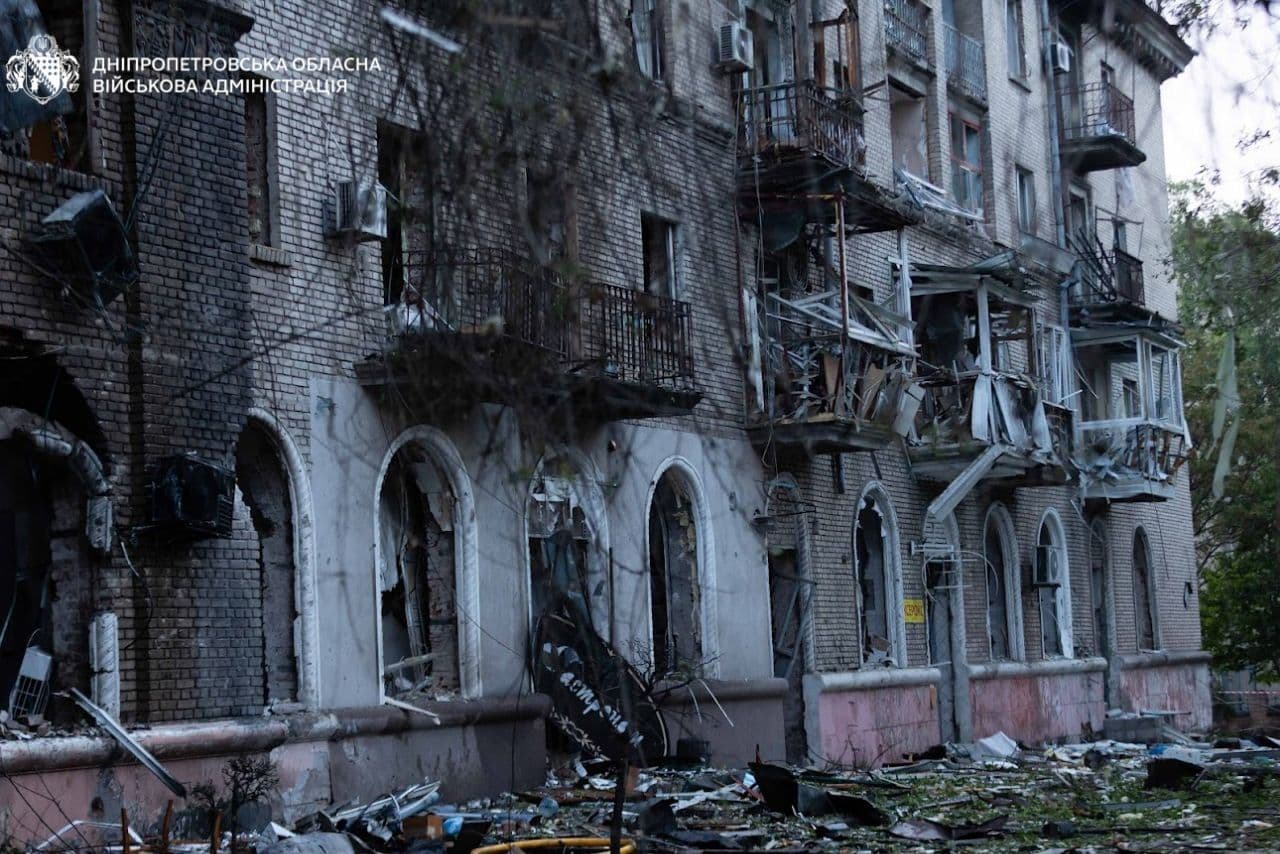
House damaged following a Russian strike on Dnipro. (Local authorities/Telegram)
The diplomatic consequence arrived before sunrise. A Russian Shahed drone struck the KSL DEYANG, a bulk carrier flying the Marshall Islands flag, owned by a Chinese company, crewed by Chinese nationals, traveling through Ukraine’s maritime corridor toward Odesa. A second vessel under Guinea-Bissau’s flag was also struck. Small fires broke out on both ships; both crews extinguished them without casualties and continued toward port. The strike landed on the eve of Putin’s May 19–20 state visit to Beijing. Ukraine’s Navy: “Russia once again demonstrates that its attacks threaten not only Ukraine. Now even the ships of its closest partners are at risk.”
While the missiles were flying, Belarus announced it had begun joint nuclear weapons exercises with Russia. The Belarusian Defense Ministry confirmed that Russian and Belarusian forces were practicing the delivery and combat preparation of nuclear munitions, testing the ability to operate from unprepared locations across Belarus. The drills involve missile forces and military aviation. Ukraine’s Foreign Ministry condemned the exercises as violating the Nuclear Non-Proliferation Treaty and described Russia as turning Belarus into “a nuclear bridgehead near NATO borders.”
Ukraine reported four new battlefield developments: its first domestically produced guided glide bomb is ready for combat deployment; Ukrainian forces liberated central Stepnohirsk in Zaporizhzhia Oblast; Russia’s Kremlin said peace talks are on pause but Moscow “expects” them to resume; and the U.S. renewed its Russian oil sanctions waiver for a third time despite having publicly stated it would not.
546 Weapons Overnight: Four Killed, 60 Injured, Dnipro 24-Story Building Struck
The Ukrainian Air Force confirmed Russian forces launched 14 Iskander-M ballistic missiles from Rostov Oblast; 8 Iskander-K cruise missiles from occupied Crimea; and 524 Shahed, Gerbera, Italmas, and Parodiya drones from Bryansk, Kursk, and Oryol cities; Millerovo, Rostov Oblast; Primorsko-Akhtarsk, Krasnodar Krai; occupied Donetsk City; and occupied Hvardiiske, Crimea. Ukrainian forces downed 4 Iskander-K missiles and 503 drones; 18 missiles and 16 drones struck 34 locations; debris fell on 11 more. The Air Force noted that Russia has been launching unusually large numbers of ballistic missiles in recent weeks, exploiting global Patriot interceptor shortages. Zelensky confirmed the strikes significantly damaged civilian infrastructure in Dnipro and Dnipropetrovsk Oblast and also hit energy and residential infrastructure.
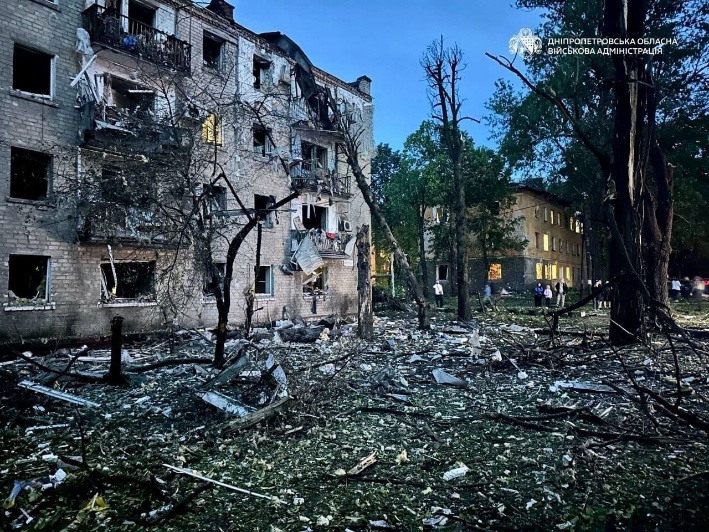
The aftermath of a Russian missile strike on Dnipro overnight. The attack injured at least 12 people across multiple Ukrainian cities. (Dnipropetrovsk Oblast Military Administration/Telegram)
Dnipropetrovsk Oblast suffered the heaviest casualties. A 24-story residential building in Dnipro was struck, with several fires reported across the city. Twenty-eight people were injured in the city, eight hospitalized in moderate condition. Four more were injured in Kryvyi Rih district. A 74-year-old woman in Kamianske and a 65-year-old man in Synelnykove district were wounded. The previous day, two civilians were killed in Nikopol district and four wounded in Synelnykove district. In Odesa City, a drone struck the Prymorskyi and Kyivskyi districts, destroying one residential building entirely, damaging a lecture hall and a kindergarten, and injuring an 11-year-old boy and a 59-year-old man. In Kherson Oblast, one person was killed and nine injured; critical infrastructure and 15 houses, a shop, a bus, and vehicles were hit. In Sumy Oblast, one person was killed and four injured in 50 strikes across residential areas. In Donetsk Oblast, four injured; 24 houses and six apartment buildings damaged across 24 strikes. In Zaporizhzhia Oblast, three injured; 756 strikes on 42 settlements. In Kharkiv Oblast, one person injured; two waves struck the Novobavarskyi district, damaging 25 homes and one apartment building; rescuers pulled two people from rubble. In Kirovohrad, Chernihiv, and Kherson oblasts, additional civilian and residential infrastructure was damaged.
Russian Drone Strikes Chinese-Owned Ship One Day Before Putin’s Beijing Visit
A Russian Shahed drone struck the bulk carrier KSL DEYANG in Ukraine’s maritime corridor approaching the port of Greater Odesa on the night of May 17–18. The vessel flies the flag of the Marshall Islands, is owned by a Chinese company, and carries a crew of Chinese nationals. A fire broke out on board but was extinguished by the crew without casualties; the ship continued toward port. A second vessel, flying the flag of Guinea-Bissau, was also struck; a fire was also extinguished without casualties. Ukraine’s Navy spokesperson Pletenchuk: “It is interesting what motivated the Russians when they decided tonight to hit a Chinese commercial vessel in our sea with a Shahed drone… Was it a ‘terrible mistake,’ comrades?”
The strike arrived one day before Putin’s scheduled state visit to Beijing on May 19–20. China has remained Russia’s primary economic partner throughout the war, purchasing Russian oil and supplying dual-use goods to the Russian military. Beijing has officially claimed neutrality. The KSL DEYANG strike is the first confirmed instance of a Russian drone hitting a Chinese-owned vessel. Russia did not comment. ISW assessed that the incident complicates Putin’s diplomatic posture ahead of the Beijing summit, as Xi Jinping has been the primary financier of Russia’s war economy during the sanctions period.
Belarus-Russia Nuclear Weapons Drills Begin
The Belarusian Defense Ministry announced on May 18 that Russian and Belarusian forces have commenced joint exercises on the use of nuclear weapons, including practicing the delivery of nuclear munitions and combat preparations in coordination with Russian forces. The exercises are led by the chief of the Belarusian General Staff and involve missile forces and military aviation. A key feature: testing the ability to conduct nuclear operations from unprepared positions across Belarus, with emphasis on concealment, long-distance movement, and operational calculations for deploying forces and equipment.
Ukraine’s Foreign Ministry condemned the exercises as an “unprecedented challenge to the global security architecture” and stated the drills violate the Nuclear Non-Proliferation Treaty by involving a non-nuclear state in nuclear weapons preparation. “Turning Belarus into its nuclear bridgehead near NATO borders, the Kremlin is effectively legitimizing the spread of nuclear weapons globally and creating a dangerous precedent for other authoritarian regimes.” Belarus became a formal host of Russian tactical nuclear weapons in 2023. Russia deployed its Oreshnik nuclear-capable missile system to Belarus in 2025. The two countries held joint nuclear drills in 2024. These drills come days after Zelensky warned Russia is pressuring Lukashenko to open a new front from Belarus against Ukraine or against a NATO state.
Ukraine’s First Domestically Produced Guided Glide Bomb Ready for Combat
Ukrainian Defense Minister Fedorov announced on May 18 that Ukraine has developed and produced its first domestically designed guided glide bomb, which is ready for combat deployment. The bomb carries a 250-kilogram warhead and took 17 months to develop. Fedorov: “This is not a copy of Western or Soviet solutions, but an original development by Ukrainian engineers designed to effectively strike fortifications, command posts, and other enemy targets dozens of kilometers behind the front line after launch.” The Defense Ministry has purchased an initial batch; pilots are currently conducting rehearsals and adapting deployment procedures for wartime conditions.
ISW assessed that Ukraine’s domestically produced guided glide bomb will likely allow Ukrainian forces to expand their battlefield air interdiction campaign against Russian assets in the near and operational rear, mirroring Russia’s use of guided glide bombs for the same purpose. Ukrainian forces have been successfully interdicting Russian logistics with drones; the glide bomb adds a larger payload capability for hardened targets. Russia has used glide bombs to keep aircraft outside Ukrainian air defense range — a tactic Ukraine is now positioned to emulate given its limited aircraft stocks. Until now, Ukraine relied on Western-supplied JDAM kits to convert conventional bombs into glide munitions.
Stepnohirsk Liberated by HUR’s Artan Special Unit
Ukraine’s military intelligence agency HUR reported on May 18 that its “Artan” special unit conducted a series of offensive actions in Stepnohirsk, Zaporizhzhia Oblast, ousting Russian forces from fortified positions and bringing key locations under Ukrainian control. Geolocated footage confirmed Ukrainian armored vehicles operating at a crossroads on the E105 highway in central Stepnohirsk and southwest of the settlement. Stepnohirsk sits 30 kilometers south of Zaporizhzhia City along the strategically important North-South E105 highway.
Russian forces had not occupied Stepnohirsk outright but had repeatedly infiltrated from Kamianske, five kilometers to the south. ISW’s geolocated footage confirms Ukrainian forces maintaining positions in central Stepnohirsk and at the M-18 highway junction southwest of the settlement and southeast of Prymorske. The GUR separately confirmed Ukrainian forces cleared Russian infiltrators from southern Stepnohirsk. Ukrainian Southern Defense Forces Spokesperson Voloshyn stated that Russia had been attempting to use Stepnohirsk as a stepping stone toward bringing Zaporizhzhia City within artillery range. ISW also confirmed that Ukrainian forces advance was confirmed in the Oleksandrivka direction during this period.
Pokrovsk: Ukrainian Positions Nearly Cut Off, 25-km Kill Zone
Ukraine’s 7th Rapid Reaction Corps of the Air Assault Forces published a detailed battlefield assessment on May 18 describing deteriorating conditions in the northern Pokrovsk area. Ukrainian troops hold several positions north of Pokrovsk that are “almost cut off.” Russian forces control the high ground and buildings in the area and deploy surveillance and electronic warfare systems that dominate the aerial environment over northern Pokrovsk and nearby Hryshyne. The corps described a roughly 25-kilometer kill zone north of Pokrovsk where Russian drone operators launch strikes from industrial areas in Pokrovsk and mining sites near Rodynske. Ukrainian unmanned ground vehicles attempting to deliver supplies are immediately destroyed by Russian FPV drones. Troops are forced to dismount approximately 15 kilometers from the front line and travel 26 kilometers through tree lines and ravines over up to three days.
The corps described this journey as “hide-and-seek with death” and stated that Ukrainian infantry often enters Pokrovsk without armored support or reserves while being “constantly detected and targeted by omnipresent drones whose launch points [they] cannot see.” The 7th Corps stated that Russian forces are deploying additional artillery near Pokrovsk and building a network of drone launch sites to support operations in the Hryshyne direction northwest of the city. ISW confirmed Russian forces continued offensive operations in the Pokrovsk direction on May 18 without confirmed advances. The 83rd Separate VDV Brigade, redeployed from northern Sumy Oblast, is now operating in the Pokrovsk direction. The Russian military command continued deploying reserves and equipment to the area during the ceasefire and afterward.
Kremlin: Talks Paused but Russia “Expects” Them to Resume
Kremlin spokesman Peskov stated on May 18 that U.S.-mediated peace talks are currently on pause but that Moscow “expects” them to be resumed and anticipates continued U.S. mediation efforts. “We expect that (the peace process) will be resumed after all. And we expect our American colleagues to continue their peacemaking and mediation efforts,” Peskov said. The statement marks a rhetorical shift from Russian FM Lavrov’s April declaration that talks with Ukraine were not Russia’s top priority. The last trilateral U.S.-Ukraine-Russia talks took place on February 16 in Geneva. A planned follow-up was canceled when U.S. attention shifted to the Middle East after the Iran strikes. Key blocking issues remain: Russia demands Ukrainian withdrawal from Donbas; Ukraine insists on freezing the current front line.
U.S. Renews Russian Oil Sanctions Waiver for Third Time; Shaheen-Warren Condemnation
U.S. Treasury Secretary Bessent announced on May 18 that the U.S. has renewed the sanctions waiver allowing countries to purchase Russian seaborne oil stranded at sea — the third such renewal since the Iran conflict disrupted global energy markets. The previous waiver expired on May 16. Bessent: “This extension will provide additional flexibility… This general license will help stabilize the physical crude market and ensure oil reaches the most energy-vulnerable countries.” The renewal contradicts Bessent’s own April 25 public statement that Washington did not plan another renewal. A U.S. official had initially told the Kyiv Independent that the waiver would not be renewed; Treasury reversed course the same day.
Democratic Senators Shaheen and Warren issued a joint condemnation: “The Trump Administration is delivering another dangerous and indefensible gift to Vladimir Putin by extending sanctions relief for Russian oil yet again.” They estimated the combined waivers have provided Russia with approximately $150 million per day and more than $4 billion over the first exemption period. The senators cited Russia’s deadly attacks on Kyiv, strikes on American corporate facilities in Ukraine (Cargill, Coca-Cola, Boeing, Philip Morris, Mondelez International), and Moscow’s support for Iran in targeting U.S. service members. “This decision is particularly galling,” the statement read.
Russia’s Economic Deterioration: 11 Banks Near Liquidation, Oil Wells Closed
Zelensky reported on May 18, citing a briefing by acting Foreign Intelligence Service chief Oleh Luhovskyi, that Russian intelligence documents show: one Russian oil company alone has suspended operations at approximately 400 oil wells; Russian oil refining has fallen by 10 percent in 2026; 11 Russian financial institutions are preparing to liquidate; 8 more banking institutions cannot resolve accumulated problems without external resources; Russia’s federal budget deficit has already reached approximately $80 billion in the first five months of 2026. Zelensky described the $80 billion figure as “optimistic” given the near-bankruptcy of many Russian regional budgets. Russian GDP contracted 1.8 percent over the past two months. Russian Economic Minister Reshetnikov separately acknowledged labor shortages are constraining the Russian economy, in contrast with Putin’s public characterization of low unemployment as a sign of health.
Germany uncovered a large sanctions-evasion network that allegedly supplied Russia’s military industry with European dual-use technology through Turkey and shell companies, Politico reported on May 18. A Lübeck-based trading firm, Global Trade, allegedly functioned as a covert procurement arm for Russian industry post-invasion. Police arrested a 39-year-old businessman identified as Nikita S. in raids linked to a four-year investigation. The network allegedly shipped microcontrollers, sensors, converters, ball bearings, and other dual-use components via Turkish company MR Global and Russian company Kolovrat. Some shipments were traced to Russian defense entities and nuclear research institutes. Germany’s BND gained access to internal documents and matched EU export records with Russian import data. Prosecutors believe the network handled around 16,000 shipments worth more than €30 million. An internal message reportedly read: “Make it look clean. No Russian reference anywhere.”
Lapin May Replace Kartapolov as State Duma Defense Committee Chair
Sources in the Russian State Duma and the United Russia party told Kommersant on May 14 that Colonel General Alexander Lapin is being considered as the next Defense Committee chairperson, potentially replacing incumbent Andrei Kartapolov. Kartapolov is a close Shoigu associate whom the Kremlin has been trying to marginalize as part of its campaign to neutralize Shoigu’s influence. Sources said Kartapolov may not seek reelection; a Defense Ministry source told Kommersant the MoD has often expressed “surprise” at his statements. Kartapolov responded on May 18 that he plans to seek a second Duma term. Lapin commanded the Central Grouping of Forces in 2022, became Ground Forces Chief of Staff in 2023, and commanded the Leningrad Military District and Northern Grouping of Forces in 2024 before being replaced by Nikiforov in August 2025 and becoming an advisor to Tatarstan’s head. ISW assessed any Lapin appointment would continue Putin’s pattern of rotating poorly-performing commanders into government-adjacent positions rather than dismissing them.
Frontline: Caspian Second Strike, Borova Footage Fabricated, UGVs in Kharkiv
The Ukrainian General Staff confirmed on May 18 that Ukrainian forces struck a Russian Project 21980 Grachonok-class anti-sabotage boat near Kaspiysk, Dagestan, overnight May 17–18 — a second Caspian naval strike in 48 hours, following the May 16–17 Svetlyak-class patrol ship strike. The General Staff also confirmed on May 18 that the May 15 strike at Yeysk Airbase destroyed a Be-200 multirole amphibious aircraft and Ka-27 ship-based helicopter, confirming previously reported BDA. Russian sources published footage on May 18 purportedly showing Russian forces in Borova; geolocations confirmed the footage was actually taken in Kolomyichykha, Luhansk Oblast, nine kilometers from Borova. Ukrainian officials refuted Russian MoD’s May 16 claim of seizing Borova. In northern Kharkiv Oblast, Russian forces abandoned mechanized assaults after heavy losses and returned to infiltration tactics; Ukrainian forces are deploying strike UGVs to destroy Russian infantry remotely and to conduct remote mining. Russian forces attacked northeast of Velykyi Burluk near Budarky. A Ukrainian brigade commander reported that in the Kupyansk direction, Russian assault intensity directly correlates with weather: clear skies mean drone-supported assaults; cloud cover means only artillery and mortars. Supercam and ZALA reconnaissance drones are being used for constant counter-battery target acquisition.
New Russian Order of Battle: Elements of the Russian Hermes unit of Unmanned Systems Forces were observed striking Ukrainian forces north of Lyman — the first ISW evidence of this unit’s existence. A source reporting on the Russian Western Grouping claimed Ukrainian forces liberated Stavky northeast of Slovyansk — not confirmed by ISW. In the Kostyantynivka-Druzhkivka direction, a Ukrainian unmanned systems platoon commander reported that Russian FPV drones can now reach Kharkiv Oblast from Donetsk Oblast, with the kill zone extending approximately 30 kilometers behind the Ukrainian front line. In western Zaporizhzhia Oblast, geolocated footage published May 18 confirmed Ukrainian forces hold central Stepnohirsk and the M-18 highway junction. Ukrainian forces cleared Russian infiltrators from southern Stepnohirsk. In the Oleksandrivka direction, Mashovets confirmed Ukrainian forces hold Ternove; Russian forces are attempting to recapture positions lost in Spring 2026 counterattacks; the 120th Naval Infantry Division (newly formed from the 336th Naval Infantry Brigade, Baltic Fleet) has been deployed to support the 36th CAA effort. Russian forces advanced west of Myrne southwest of Hulyaipole, confirmed by geolocated footage published May 16.
Ukrainian strikes May 17–18: drone control point in Karnatnoye, Bryansk Oblast (12 km from border); airspace control station in Lesnoye, Bryansk Oblast (71 km from border); UAV control point in Dvorichna (Kupyansk direction); drone control point near Kamyanske (Zaporizhzhia, 3 km from front); troop concentration in occupied Olhyne (Kherson, 22 km). In Sumy Oblast, Russian forces claimed advances near Nova Sich and south of Yunakivka — not confirmed by ISW.
Budanov: Ten Assassination Attempts, Peace Process Still Possible; World Gymnastics Lifts Bans; NAVI Win
Kyrylo Budanov — newly appointed head of Ukraine’s Presidential Office, former HUR chief — told The Times in an interview published May 15 that Russia continues attempting to assassinate him even as he leads peace negotiations. He said he has survived at least 10 assassination attempts and described this as “absolutely normal” given his role. Despite the threats, Budanov said he believes the peace process can still lead to an end of the war: “I believe in the negotiation process… its completion and the result.” He noted that the 1,000-for-1,000 exchange was reduced to 205 in the first phase and no new talks have been scheduled. He confirmed volunteer recruitment alone cannot meet army needs: “After 12 and a half years of war, there is nothing to motivate such numbers of people to volunteer… Mobilization remains unavoidable.”
World Gymnastics announced on May 18 that it is lifting all restrictions on Russian and Belarusian athletes with immediate effect, allowing them to compete under their national flags for the first time since February 2022. The organization governs artistic, rhythmic, acrobatic, aerobic gymnastics, and trampolining. The move follows similar easing by the IOC and International Paralympic Committee. Ukrainian Sports Minister has previously stated that Russian athletes competing internationally while Russia kills Ukrainian athletes is unacceptable — over 400 Ukrainian athletes and coaches have been killed since the invasion began. Ukrainian e-sports team NAVI won the Intel Extreme Masters Atlanta 2026 CS2 tournament on May 18, defeating German team GamerLegion 2-1 after beating Russian team BetBoom 2-0 in the quarter-finals; player Igor “w0nderful” Zhdanov won MVP honors. Prize: $125,000. Peak viewership: 600,000.
Yermak Released on Hr 140 Million Bail
Andriy Yermak, Zelensky’s former chief of staff, was released from pretrial detention on bail of Hr 140 million ($3.1 million) on May 18, after four days in custody. The bail was sourced from multiple contributors including Serhii Rebrov, former head coach of Ukraine’s national football team. Yermak faces money laundering charges tied to Hr 460 million allegedly funneled through shell companies to construct a luxury compound in Kozyn south of Kyiv. Conditions of release: electronic bracelet, must remain in Kyiv, cannot contact other suspects, must surrender foreign passports. Yermak denied wrongdoing: “I haven’t fled, nor do I intend to. I’m staying in Ukraine.” He vowed to appeal the court’s ruling. The case is part of Operation Midas, which has produced charges against eight individuals including ex-Deputy PM Chernyshov and Timur Mindich.
The Weight of May 18
Russia struck Ukraine with 546 weapons overnight. Fourteen ballistic missiles flew. Twenty-eight people were injured when a 24-story building in Dnipro was struck. One was killed in Kherson. One in Sumy.
A Russian drone hit a Chinese ship in the Black Sea. The ship was carrying Chinese nationals and owned by a Chinese company. Putin’s state visit to Beijing begins tomorrow. Belarus started nuclear weapons drills with Russia while the missiles were flying.
Ukraine produced its first glide bomb. Stepnohirsk was liberated. Eleven Russian banks are preparing to liquidate. The U.S. renewed the Russian oil waiver for the third time despite saying it would not. Senators called it a gift to Putin.
A Prayer for Ukraine
1. For the Four Killed and the Sixty Injured
Lord, a 24-story building in Dnipro was struck between 2 and 3 in the morning. Twenty-eight people were injured. One person was killed in Kherson, nine injured. One killed in Sumy, four injured. Four dead from one night’s work. Receive them. Hold the 60 injured — the eight in Dnipro who were hospitalized in moderate condition, the 11-year-old boy in Odesa, the people in Kherson whose houses and bus were struck. And hold the emergency workers in Dnipro who pulled people from a 24-story building in the dark.
2. For the Chinese Sailors in the Black Sea
Father, a Russian drone struck a Chinese ship carrying Chinese sailors in the Black Sea, one day before Putin flies to Beijing. Small fires broke out. The crew put them out. Nobody was killed. The Navy called it “something new” with barely concealed irony. We pray for the sailors on both ships — the KSL DEYANG and the Guinea-Bissau vessel — who were in a maritime corridor that Ukraine has tried to keep safe, carrying cargo that has nothing to do with a war that Russia started. We pray that this incident has consequences for Putin’s Beijing meeting. That Xi Jinping asks the question the sailors’ families are asking.
3. For the Soldiers in the Kill Zone North of Pokrovsk
God of endurance, Ukrainian soldiers are holding positions north of Pokrovsk that their own commanders describe as nearly cut off. They travel 26 kilometers over up to three days through tree lines and ravines to reach the front. Armored vehicles are destroyed before they can arrive. Drones are overhead constantly. The kill zone is 25 kilometers deep. They fight without reserves, without armor, often without anyone who can see their launch point. We pray for those soldiers. Give them the precision strike support they need. Give their commanders the wisdom to know when a position must be held and when it must not. And give Ukraine the glide bombs and the drones and the intelligence to make the 25-kilometer kill zone work for Ukraine as well.
4. For the Countries on Belarus’s Border
Lord, Belarus began nuclear weapons exercises with Russia on May 18. The drills test delivery of nuclear munitions and operations from unprepared positions across Belarusian territory. The drills come days after Zelensky warned Russia is pressuring Lukashenko to open a new front. Poland, Lithuania, Latvia, Estonia, and Ukraine all share borders with Belarus. We pray for the governments and defense forces of those countries, who are monitoring every exercise and every redeployment and every new logistics route. Give them the intelligence they need. Give NATO the coherence to act on what the intelligence shows. And let Lukashenko, whoever advises him, understand that there is no version of this war that ends well for the country that becomes its second front.
5. For the 11 Banks and the Economy That Cannot Admit What It Is
God of justice, 11 Russian financial institutions are preparing to liquidate. Eight more cannot resolve their problems without external resources. The budget deficit is $80 billion in five months. Oil wells are being shut down by the hundreds. Oil refining is down 10 percent. The country’s own government-linked analysts have confirmed a systemic banking crisis for three months running. Putin’s government has not told its people any of this. We pray for the Russian people who are living inside an economy that their government is describing as healthy while quietly selling gold reserves, raising VAT, and letting banks quietly fail. And we pray that the combination of military pressure and economic pressure eventually reaches a threshold where the Kremlin runs out of room to pretend — and chooses to end the war. In Your mercy, in Your justice, in Your time.