
September 13, 2026
Prepared by Diana Bozhyk
Russian forces struck a passenger train and a gas station near the Yahodyn-Dorohusk border crossing into Poland just minutes after Ukrainian authorities evacuated a diplomatic delegation that included former British Prime Minister Boris Johnson and senior German and Estonian officials, in what available evidence strongly suggests was a deliberate attempt to kill or injure Western officials leaving Ukraine. Jared Kushner said Russia, Ukraine, and the US have reached agreement on every issue except territory, only for Kremlin aide Yuri Ushakov to contradict him hours later, while President Trump publicly told Zelensky to stop striking Russian diesel infrastructure. Russian forces launched 453 drones overnight and 323 more during the day, deliberately killed two civilians in a targeted strike on a car in Kramatorsk, and Ukraine’s navy used an automatic turret to intercept an enemy drone boat for the first time in history.
THE DAY’S RECKONING
Fifteen minutes. That’s how much warning stood between a Russian drone and a train carrying Boris Johnson, a German security adviser, and other European officials as they crossed out of Ukraine today. Ukrainian monitors pulled the diplomatic train out early because of a drone threat. The drone found the next train through anyway, striking its locomotive two kilometers from the Polish border. Nobody on board was hurt. The message, everyone involved seems to agree, was unmistakable regardless.
Everything else about today moved with the same mixture of diplomatic noise and battlefield reality. Jared Kushner said a peace deal is basically done except for the hardest part. The Kremlin’s own aide said, actually, no, nothing’s settled. Trump told Zelensky to stop hitting Russian diesel plants. Two civilians in Kramatorsk died because Russian forces deliberately aimed at their car. Ukraine’s navy fought off an enemy drone boat with an automatic turret, the first time that’s ever happened. Nothing today resolved cleanly. Everything today measured how much this war keeps testing the boundary between what’s aimed at Ukraine and what’s aimed, quite deliberately, at everyone standing near it.
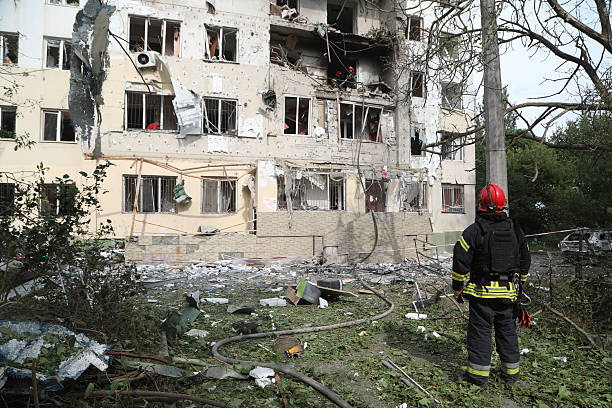
A multi-story residential building is seen damaged in Odesa as a firefighter looks on following a Russian strike. (Arthur Shvits/Anadolu via Getty Images)
RUSSIA TARGETS A TRAIN CARRYING EUROPEAN OFFICIALS OUT OF UKRAINE
Russian forces struck a passenger train locomotive and a gas station near the Yahodyn-Dorohusk border crossing on the Ukrainian-Polish border today, hitting the train just two kilometers from Polish territory. Ukrzaliznytsia confirmed the Central Monitoring Group had evacuated a diplomatic train carrying European security officials — including former British Prime Minister Boris Johnson, German security adviser Günter Sautter, Bundestag member Robin Wagener, and Estonian Foreign Minister Margus Tsahkna’s delegation — just 15 minutes before the strike hit the next train through, after the group departed early due to a drone threat. Ukrzaliznytsia said it’s “quite likely” the officials’ train was the actual intended target.
The available evidence strongly supports the conclusion that this was a deliberate assassination attempt against Western officials. Polish Prime Minister Donald Tusk confirmed the strikes and called Russian escalation “becoming a fact,” while Foreign Minister Andrii Sybiha said the attack was “Putin’s terror knocking directly on the doors of the EU and NATO.” Johnson called for Western allies to provide Ukraine with the air defenses needed to prevent exactly this kind of strike. Russia’s Defense Ministry acknowledged striking railway infrastructure it claimed facilitates military cargo transport — even though the train it hit was carrying passengers leaving, not weapons entering, Ukraine.
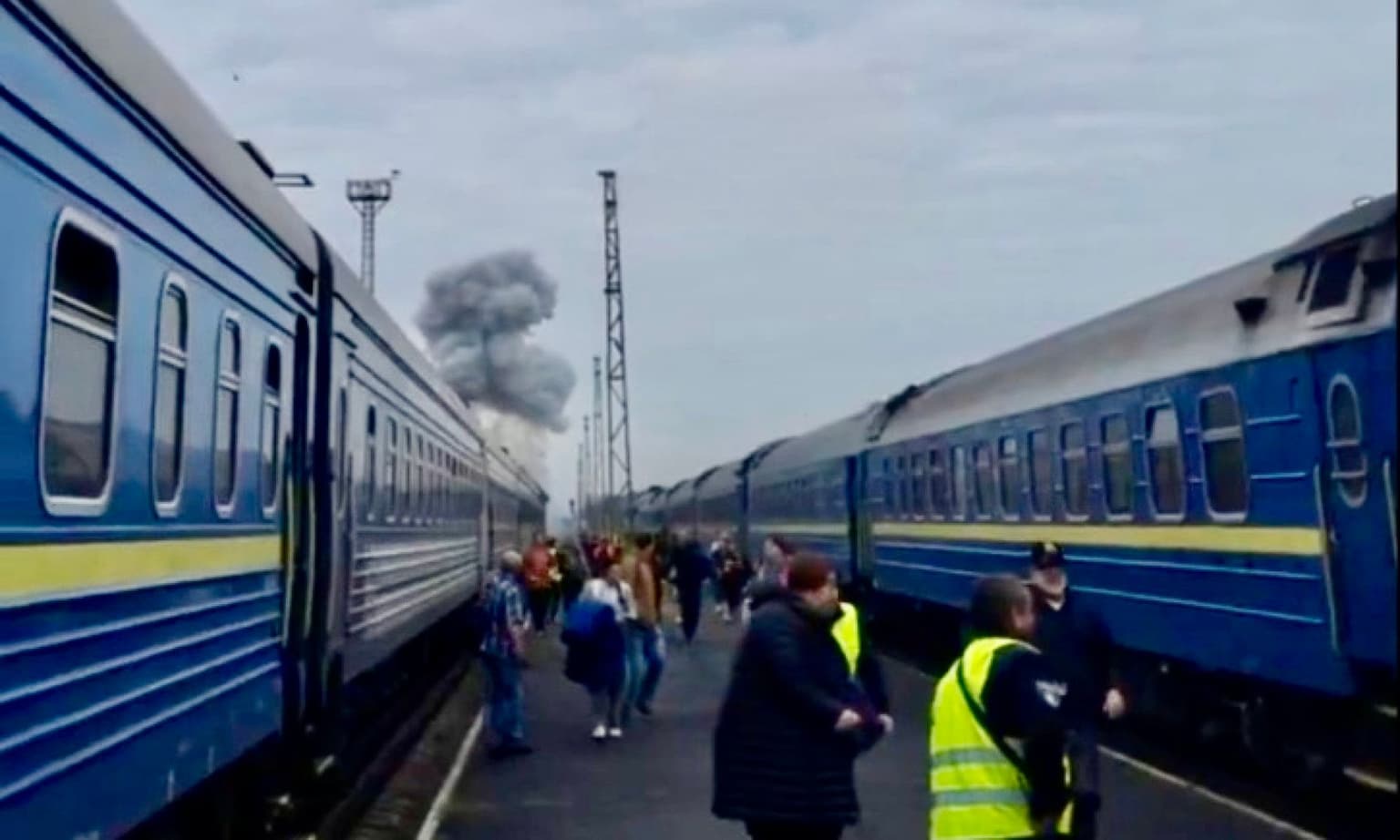
Screenshot from a video showing the aftermath of a Russian attack near the Yahodyn checkpoint on Ukraine’s border with Poland. (@mediapivden / Telegram)
KUSHNER SAYS A DEAL IS DONE — USHAKOV DISAGREES
Jared Kushner told the Yalta European Strategy conference yesterday that Russia, Ukraine, and the United States have reached agreement on every issue in peace negotiations except territorial questions, claiming Putin has already outlined his territorial demands and that “the rest of the agreement is already developed and agreed upon” if Ukraine accepts them. Kushner acknowledged the fluid battlefield situation would still shape any final territorial line.
Kremlin aide Yuri Ushakov contradicted him directly today, telling reporters “there are many unresolved issues in negotiations including territorial ones” and that a “shift” on territorial positions would merely make negotiations easier — not that a deal was otherwise complete. The contradiction matters: Putin has repeatedly reaffirmed his June 2024 demand that Ukraine surrender the entirety of Luhansk, Donetsk, Zaporizhzhia, and Kherson oblasts, including large areas Russian forces have never occupied and have failed to seize in over a decade of trying.
Analysts assess the Kremlin’s actual strategy is to convince Washington to pressure Ukraine into ceding, diplomatically, territory Russian forces have proven unable to take by force — a wager that costs Moscow nothing to keep making as long as American officials keep describing progress that Russian officials keep quietly denying. The pattern has repeated often enough this year that Ukrainian officials have grown visibly wary of American optimism that isn’t matched by anything concrete coming from Moscow’s own public statements.
TRUMP TELLS ZELENSKY TO STOP STRIKING RUSSIAN DIESEL PLANTS
President Trump said today that Zelensky needs to halt Ukrainian strikes on Russian diesel fuel infrastructure, framing the campaign as a contributor to a global diesel shortage worsened by America’s own war against Iran. “Mr. Zelensky has to do one thing. He has to stop knocking out diesel fuel in Russia. Let him go after targets, but not diesel fuel, because he’s causing a shortage of diesel,” Trump said, adding “we spoke to Mr. Zelensky about it.”
The request lands awkwardly against Ukraine’s actual strategy: Zelensky has repeatedly offered Russia a mutual ceasefire on energy infrastructure strikes, an offer Putin has rejected every time. Ukraine’s refinery campaign serves two purposes simultaneously — reducing the oil and gas revenue funding Russia’s invasion, and pressuring Moscow toward exactly the kind of reciprocal energy truce Trump could instead be asking Putin to accept.
Trump’s own war against Iran has already knocked out more than 20 percent of Middle Eastern refining capacity and effectively closed the Strait of Hormuz, disrupting roughly a fifth of global oil supply — a far larger driver of the current diesel shortage than Ukraine’s strikes on a country that started this war in the first place. Ukrainian officials haven’t publicly responded to Trump’s specific request, but the comment underscores a recurring tension in the alliance: American diplomatic priorities occasionally colliding with the exact battlefield strategy Ukraine considers most effective at pressuring Moscow toward the negotiating table Trump himself keeps pushing for.

U.S. President Donald Trump attends the final day of the Irish Open, in Doonbeg, Ireland. U(Charles McQuillan/Getty Images)
PESKOV ADMITS RUSSIA OPENED “PANDORA’S BOX” IN RETALIATION
Kremlin spokesperson Dmitry Peskov told reporters today that Russia is now striking Ukraine “indiscriminately” specifically in response to Kyiv’s intensified attacks on Russian economic infrastructure. “The Russian Federation did not strike everything and anything. It started doing so after the Ukrainians themselves opened Pandora’s box,” Peskov said, echoing Putin’s own August 22 warning that Russia would retaliate against Ukraine’s “sensitive economic sectors” after Kyiv began striking Russian refineries and logistics networks in earnest.
The admission is notable mainly for its bluntness: a senior Kremlin official openly confirming that Russia’s strike targeting has expanded specifically as retaliation, rather than maintaining the fiction that Russian strikes have always focused narrowly on legitimate military targets. Moscow has dramatically increased its use of jet-powered attack drones in recent weeks, subjecting Kyiv to near-continuous strikes stretching from late August into September.
Ukraine’s own campaign against Russian energy infrastructure continues regardless, aimed at reducing the oil and gas revenue that funds the invasion — a pressure campaign Peskov’s comments suggest is working precisely well enough to provoke this kind of public acknowledgment. Russia has systematically targeted Ukraine’s energy grid since the war’s first year, inflicting extensive damage and repeated blackouts; today’s admission simply confirms that whatever restraint Russia claims to have once exercised has now been formally abandoned in the name of retaliation.
TWO KILLED IN A DELIBERATE STRIKE ON A KRAMATORSK CAR
A Russian morning strike deliberately targeted a civilian car moving through central Kramatorsk today, killing two people and injuring four more, according to Donetsk Oblast Governor Vadym Filashkin. “Two people were killed and four were injured as a result of the morning strike on Kramatorsk. The enemy deliberately attacked a civilian car moving in the center of the city,” Filashkin said. The strike was part of a broader pattern documented by Ukraine’s Donetsk Oblast Prosecutor’s Office: four FAB-250 glide bomb strikes against Kramatorsk today alone, killing at least two civilians and injuring at least 10, deliberately targeting vehicles to shut down road access into the city.
“Again and again, the Russians prove that they came here to kill everyone they can reach. Every day in Donetsk region is a mortal danger,” Filashkin said, renewing his call for families with children to evacuate the region entirely. Military analysts describe the tactic as a deliberate operational template: Russian forces systematically strike civilian vehicles specifically to halt all road use in contested areas, weaponizing civilian harm as a calculated tool to isolate Ukrainian positions ahead of future offensive operations, rather than as incidental collateral damage from strikes aimed elsewhere.
Emergency response units and municipal services were dispatched to the impact site to extinguish fires, provide medical care to the wounded, and assess the full extent of the destruction — a routine now so familiar to Kramatorsk’s remaining residents that officials increasingly frame it less as an emergency response protocol than as an unavoidable feature of daily life in a city that refuses, despite everything, to fully empty out.
A MASSIVE BARRAGE: 453 DRONES OVERNIGHT, 323 MORE BY DAY
Russian forces launched 453 Shahed-type, Gerbera-type, and Parodiya decoy drones alongside Banderol loitering munitions overnight, roughly half of them jet-powered; Ukrainian forces intercepted 405 drones and four Banderols, with strikes hitting 13 locations and debris falling at seven more. Russia launched an additional 323 drones during the day, 14 of them jet-powered, with Ukrainian forces downing 310. Strikes hit residential, energy, industrial, railway, and port infrastructure across eight oblasts: Chernihiv, Dnipropetrovsk, Khmelnytskyi, Kyiv, Mykolaiv, Odesa, Zhytomyr, and Ternopil. Nationwide, Russian attacks killed at least six people and injured 43 more over the day.
Ukrainian presidential defense adviser Serhiy Beskrestnov said Russia deliberately waited for cloudy weather to launch its heaviest jet-powered drone waves, since overcast conditions make it harder for Ukrainian interceptor operators to visually track and down the faster drones — though the same poor visibility also degrades the jet-powered drones’ own targeting accuracy and makes them easier for electronic-warfare systems to jam. The tactical trade-off illustrates how granular the ongoing arms race between Russian strike capability and Ukrainian air defense has become, with both sides now factoring weather conditions directly into daily strike-and-defense calculations.
The overnight assault deliberately brought the war close to Poland’s own border, with the Yahodyn-Dorohusk strikes forming just one part of a far larger nationwide barrage that stretched from Ukraine’s western frontier to its central and eastern regions in a single coordinated push — underscoring that today’s most politically sensitive strike wasn’t an isolated incident, but one piece of the broadest single-day assault Ukraine has absorbed in weeks.
UKRAINE’S DEEP STRIKES: THREE MORE REFINERIES AND A DRONE PORT
Ukrainian forces struck the Slavyansk Oil Refinery in Krasnodar Krai, the TANEKO refinery in Tatarstan, and a Russian drone storage and launch site in Millerovo, Rostov Oblast, overnight, with Russian regional authorities confirming fires at both refineries. Updated damage assessments released today showed the September 11 strike on the Saratov refinery damaged a primary processing unit and a section of the main pipeline, while satellite imagery confirmed a strike on the Volgogradpromproekt chemical plant destroyed part of its main workshop and strikes on the Tsimbulova droneport in Oryol Oblast damaged drone storage hangars and Shahed launchers.
Russian authorities are visibly scrambling to adapt: satellite imagery published this week shows Russia erecting walls from shipping containers, anti-drone netting, and metal frames at the Novoshakhtinsk refinery in Rostov Oblast and the Lukoil facility in Kstovo, Nizhny Novgorod Oblast — improvised, largely passive defenses that reflect how few active options Russia has left to protect facilities Ukraine keeps finding regardless.
Separately, Ukrainian and Russian monitoring channels reported explosions and fires at Crimea’s Kacha and Belbek airfields, with NASA satellite fire-tracking data confirming a blaze near Kacha specifically. The pace and geographic spread of tonight’s strikes — three separate refineries and a drone-launch site, spanning multiple Russian regions in a single overnight window — illustrates how routine Ukraine’s deep-strike operations have become, no longer isolated headline events but a sustained, near-nightly campaign methodically working through Russia’s oil and drone infrastructure one facility at a time.
THE FIRST-EVER USV TURRET INTERCEPT IN THE BLACK SEA
Ukraine’s Navy said today its forces used a Sargan-3000 unmanned surface vessel equipped with an automatic turret to search for and destroy a Russian unmanned surface vessel in the Black Sea — the first reported instance of one uncrewed naval boat intercepting another using an automated weapons system rather than manual targeting. The engagement builds directly on Ukraine’s disclosure yesterday of what it called history’s first drone-on-drone naval battle, suggesting the tactic is becoming a repeatable capability rather than a one-off demonstration.
The development reflects both sides’ accelerating shift toward unmanned maritime combat: Ukraine has struck 105 Russian vessels in its Sea of Azov campaign alone this summer, while Russia has separately been observed constructing what satellite imagery suggests is its first dedicated naval-drone port in occupied Crimea. As conventional warships on both sides grow increasingly vulnerable to drone and missile strikes, the Black Sea is quietly becoming a proving ground for exactly the kind of autonomous, turret-equipped naval combat that militaries worldwide have mostly only theorized about until now.
The Sargan-3000 itself passed combat testing back in April and has since become one of Ukraine’s most versatile maritime platforms, capable of both reconnaissance and direct engagement. Naval analysts note that automated targeting removes a critical human bottleneck from drone-versus-drone combat, where engagement windows can close in seconds — meaning today’s intercept likely represents not a one-off technical milestone, but the opening chapter of a genuinely new phase in how this war is fought at sea.
ANTHROPIC SAYS RUSSIAN HACKERS USED AI FOR ESPIONAGE
AI company Anthropic disclosed in a report published this week that a Russian state-linked hacking group known as Midnight Blizzard used its Claude AI models to conduct espionage operations against Ukrainian and European targets. “One of the operators is a Russian speaker using the handle ‘JackPoterz’ whose tradecraft and targeting are consistent with Russian state-nexus espionage,” Anthropic wrote, describing operations targeting government ministries, defense and intelligence bodies, embassies, think tanks, and defense-industrial companies concentrated in Ukraine and Europe but extending to the Middle East and maritime agencies in Asia.
The group specifically targeted WhatsApp accounts belonging to high-level officials and scanned email and remote-access systems across more than two dozen Ukrainian government organizations, with drone technology providers and their supply chains a recurring focus. Anthropic warned the trend will likely accelerate: “As models continue to evolve and improve, we assess that more actors, from lone wolves to organized entities, will continue to adopt AI frameworks to enable more sophisticated cyberattacks at greater speed and scale.”
The disclosure positions this war’s cyber dimension as an early, high-stakes test case for how AI tools reshape state-sponsored espionage more broadly. Unlike traditional hacking campaigns, AI-assisted operations can iterate faster and probe more targets simultaneously, potentially compressing timelines that once took skilled human operators weeks into a matter of hours — a shift security researchers say will force both Ukrainian and Western institutions to fundamentally rethink how they detect and respond to intrusions going forward.
ZELENSKY SANCTIONS HIS FORMER PRESS SECRETARY
President Zelensky signed a decree today imposing sanctions on his own former press secretary, Iuliia Mendel, stripping her of state awards, freezing her assets, and barring her from moving capital out of Ukraine. Mendel has become an increasingly vocal Zelensky critic, appearing on US podcaster Tucker Carlson’s show in May, where she called Zelensky “a dictator” and “the greatest obstacle to peace” in Ukraine — a dramatic reversal from her earlier public praise of his leadership.
“A few days before my address to the European Parliament, Volodymyr Zelensky — my former boss — imposed sanctions on me,” Mendel wrote on X, revealing she’d been invited to speak at a sideline event by Germany’s far-right AfD party, which has criticized both military support for Ukraine and financial support for Ukrainian refugees. “I anticipated the possibility of sanctions. This does not change my position,” she said, calling the sanctions unconstitutional and claiming Zelensky uses them “against anyone who advocates for peace.” The case adds a genuinely uncomfortable dimension to Ukraine’s wartime political landscape: a former government insider now aligned with European far-right voices skeptical of continued Ukrainian resistance, facing state sanctions for exactly the kind of criticism a healthy democracy would normally need to tolerate, even at wartime.
CANADA WEIGHS JOINING THE EU’S €90 BILLION LOAN
Canada is discussing joining the European Union’s €90 billion Ukraine support loan, with both sides hoping to finalize Ottawa’s contribution before the EU-Canada summit in Montreal this October, the Financial Times reported today. The loan, unveiled in January and already disbursing funds since June, directs the majority of its financing toward Ukrainian defense, including €6.1 billion specifically for air defenses, missiles, ammunition, and radars. The UK is currently the only non-EU country participating.
Canada’s push reflects Prime Minister Mark Carney’s broader strategy of deepening ties with Europe partly to reduce dependence on the United States amid Trump’s ongoing trade disputes with Ottawa — Carney has separately floated Canada pursuing “association membership” with the EU itself. Canada has committed $8.5 billion in military support and over $750 million in reconstruction funding to Ukraine since 2022, on top of the 100-year partnership and $2 billion in fresh commitments announced just three days ago during Zelensky’s visit to Calgary.
If finalized, Canada’s contribution would mark the first time a non-European, non-UK country joins the loan directly, potentially opening a template other allied nations outside the EU’s borders could eventually follow. Officials on both sides described the timeline as tight but realistic, with the October Montreal summit serving as a natural deadline to formalize whatever figure the two governments ultimately negotiate.
RUSSIA’S CONFIRMED DEATH TOLL KEEPS CLIMBING
Independent Russian outlet Mediazona added 6,097 more names to its verified list of Russian soldiers killed in Ukraine in its latest update, bringing confirmed military deaths since February 2022 to a count that includes over 80,679 volunteer soldiers, 26,979 recruited prisoners, and 20,350 mobilized troops, plus 7,656 officers — figures Mediazona stresses likely understate the true total, since verification relies on public obituaries, family posts, and local media rather than official Russian disclosure. Ukraine’s own General Staff separately reported today that total Russian casualties — killed, captured, wounded, or missing — have reached 1,506,900 since the invasion began, while British intelligence estimated on September 11 that roughly 500,000 Russian troops have been killed outright.
The figures arrive as Russia continues struggling to replace its losses through voluntary recruitment, consistently falling short of its monthly target of 30,000 new soldiers and increasingly relying on exploiting or deceiving foreign nationals to fill the gap — practices Amnesty International concluded last week frequently amount to human trafficking. The Kremlin has responded to this kind of independent casualty tracking not by disputing the numbers directly, but by adding Mediazona to Russia’s “foreign agents” list for a second time last month, a designation meant to discourage Russians from trusting or engaging with the outlet’s reporting.
A RUSSIAN HOSPICE FOUNDER FACES PRISON FOR A PEACE MESSAGE
Lida Moniava, the founder of one of Russia’s most respected children’s hospice organizations, has been placed under curfew and now faces potential imprisonment after citing United Nations civilian death tolls from the war in Ukraine — a case that illustrates just how far Russia’s crackdown on antiwar speech now reaches, even toward figures with no history of political activism. Moniava, widely known and respected across Russia for her hospice work, becomes the latest in a growing list of prominent Russian civil-society figures facing prosecution simply for referencing internationally documented facts about the war’s civilian toll. The specific charges reportedly stem from her public citation of UN civilian casualty figures for Ukraine, treated by Russian prosecutors as equivalent to spreading “false information” discrediting the country’s armed forces under the same wartime speech laws that have already sent other critics to prison for years at a time.
The case fits a pattern that’s intensified sharply ahead of this month’s State Duma elections, as Russian authorities move to silence any public figure whose reach and credibility might carry real weight with ordinary Russians — a threat state prosecutors evidently consider more dangerous coming from a beloved children’s charity founder with no political base than from career opposition politicians already dismissed by much of the public as predictable critics of the Kremlin.
MEANWHILE, AT THE ACTUAL FRONT
Ukrainian military observer Kostyantyn Mashovets reported that Russian forces made tactically significant gains around Orikhiv before September 1 but have since failed to exploit them, with Ukrainian counterattacks constraining Russian positions west and northwest of the town for weeks before heavy drone strikes and clearing operations pushed Russian infiltrators out of northern and central Novodanylivka entirely. Russian forces have concentrated their highest offensive tempo of the war toward Kostyantynivka and Dobropillya, averaging 24 and 32 attacks per day respectively since August 1, while slowing their pace toward Slovyansk to just four attacks daily this month — a shift analysts attribute directly to the collapse of Russia’s northern encirclement effort near Lyman.
Near Kupyansk, Ukrainian forces maintained positions in northern Kivsharivka despite Russian claims otherwise, while near Hulyaipole, a Ukrainian brigade spokesperson reported Russian forces have cut their daily assault rate from 20-30 down to roughly 10, relying increasingly on small infiltration groups of just one to three soldiers rather than larger coordinated pushes. Russian forces claimed to have seized Chernyakiv northeast of Velykyi Burluk, though the claim remains unconfirmed by independent monitors, consistent with a broader pattern of Russian sources continuing to assert an encirclement of roughly 2,000 Ukrainian troops northeast of Kharkiv City that researchers still find no evidence to support, ten days after the claim first surfaced.
A TRAIN MISSED BY MINUTES, A DEAL DENIED BY HOURS
By nightfall, today’s closest calls sat uncomfortably next to its confirmed losses. A train carrying European officials survived by fifteen minutes. A peace deal that one envoy called nearly finished got contradicted by the Kremlin’s own aide within hours. Neither gap closed cleanly by day’s end.
Two people in Kramatorsk died because Russian forces aimed specifically at their car. A Russian hospice founder now risks prison for quoting UN statistics. And somewhere in the Black Sea tonight, an automated turret fired on an enemy drone boat in a battle that would have sounded like science fiction just a year ago. Nothing today ended. Everything today confirmed how thoroughly this war keeps blurring the line between the battlefield and everywhere else it’s willing to reach.
A PRAYER FOR UKRAINE
1. For the Two Killed in a Targeted Strike on Kramatorsk
Lord, two people died today because Russian forces deliberately aimed at the car carrying them through their own city. We grieve a death made crueler by its intention. Receive them both, comfort the four injured and their families, and protect every driver in Donetsk Oblast still forced to choose between staying home and simply trying to live an ordinary life.
2. For Every Official Whose Safety Depends on Minutes
Father, we thank you that a train full of diplomats survived today by the narrowest possible margin. We ask for continued protection over everyone whose work now requires traveling through danger simply to represent their countries in a war zone. Give security teams the foresight that saved lives today, and give them that same foresight again tomorrow, and every day after this one.
3. For a Russian Woman Facing Prison for Simple Honesty
Lord of the brave, we lift up Lida Moniava and every Russian citizen now facing consequences for repeating facts their own government would rather bury. Protect her from whatever punishment awaits, and give her the endurance to keep speaking even under real threat to her freedom. Let truth-telling, however quietly done, matter more than the fear meant to silence it entirely.
4. For Clarity Between What’s Promised and What’s Actually True
God of truth, we pray for discernment in a week full of contradictory claims about peace — deals called nearly finished, then denied within hours. Give journalists and citizens alike the patience to wait for verified truth rather than convenient headlines. And give negotiators on every side the integrity to describe progress honestly, even when honesty is less exciting than the alternative.
5. For an End to Strikes That Reach Beyond the Battlefield
God of peace, we pray against a war that keeps testing how far its violence can reach — into train cars, into diplomatic convoys, into the ordinary movement of people trying simply to leave or return home safely. Protect every traveler, every civilian, every person whose only crime is proximity to a war they didn’t choose. Let this reach shrink with each passing week.
In Your mercy, in Your justice, in Your time — bring this war to its end, and let the ending be worthy of what Ukraine has endured.