
September 12, 2026
Prepared by Diana Bozhyk
Ukrainian forces have effectively eliminated a Russian salient north of Lyman that had threatened to encircle the entire Fortress Belt defensive line in Donetsk Oblast, a breakthrough that comes as Russian generals reportedly asked Vladimir Putin to approve mobilizing 800,000 additional troops to sustain the war effort. President Zelensky said he’s willing to meet Putin face-to-face at December’s G20 summit in Miami, only for Foreign Minister Sergei Lavrov to reject any pause in fighting and insist any meeting happen in Moscow instead. A massive overnight barrage killed at least four people and injured more than 80 across Odesa, Kryvyi Rih, and Kharkiv, while Russian forces struck Zaporizhstal’s steel plant for the third time in a month and Ukraine’s navy recorded what it called the first-ever battle between unmanned naval drones.
THE DAY’S RECKONING
For the first time since Ukraine’s 2024 Kursk offensive, Ukrainian forces have genuinely wrested back the strategic initiative — not just holding the line, but breaking apart a Russian plan months in the making. The salient north of Lyman, meant to be one jaw of a pincer squeezing Ukraine’s entire eastern defensive network, is gone. Russian commanders are quietly asking their own president for 800,000 more soldiers just to keep the rest of that plan alive.
Everything else about today moved with the same mixture of genuine progress and unrelenting cost. Zelensky offered to sit across from Putin in Miami this December — the first such offer since 2019. Lavrov’s answer arrived within hours: come to Moscow, and don’t expect the war to pause while you’re deciding. Odesa woke to a burning apartment tower. Kryvyi Rih buried two steelworkers. Zaporizhstal took its third missile strike in a month, on a plant that hadn’t even resumed operating since the last two. Ukraine’s navy fought what it says was history’s first battle between two unmanned boats. Nothing today offered a clean resolution. Everything today measured how much ground, real and rhetorical, keeps shifting under a war that refuses to simplify.
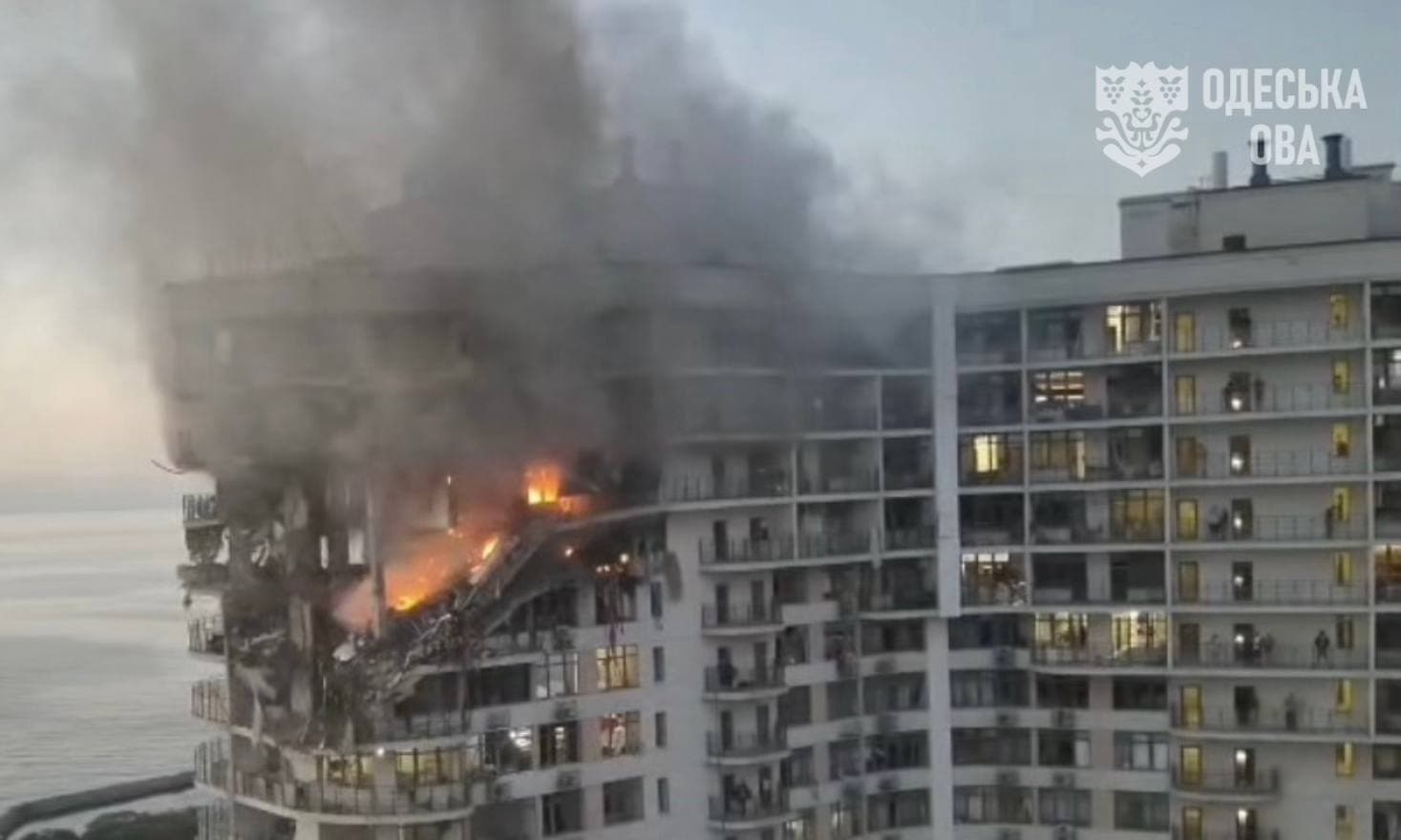
The aftermath of a Russian attack on a residential building in Odesa. (Odesa Oblast Military Administration/Telegram)
UKRAINE BREAKS RUSSIA’S ENCIRCLEMENT ATTEMPT NORTH OF LYMAN
Independent military analysts confirmed today that Ukrainian forces have effectively eliminated the Russian salient north of Lyman that had anchored Moscow’s plan to encircle Ukraine’s entire Fortress Belt defensive network in Donetsk Oblast. Russian sources themselves increasingly acknowledge the collapse: multiple milbloggers reported between September 9 and 12 that Ukrainian forces pushed Russian troops back to the Zherebets River, with one claiming Ukrainian units have already forded it. Ukraine’s own Strategic Communications Center amplified that claim today, though officials haven’t formally confirmed the full extent of the advance.
The breakthrough disrupts a two-pronged Russian plan that had been building for months: one arm advancing from Lyman and Dobropillya to encircle the Fortress Belt from the north, the other from the south near Kostyantynivka. With the northern prong now broken, analysts assess Russian commanders will likely need to entirely redesign their campaign for the region — either reinforcing a renewed push toward Lyman with what’s left of two badly weakened combined-arms armies, or abandoning the wider encirclement concept altogether. Russian forces have failed to seize Lyman itself since fall 2022, and this latest setback makes any near-term successful assault increasingly unlikely given how much of the attacking force has reportedly already been consumed in the failed effort.
RUSSIAN GENERALS ASK PUTIN FOR 800,000 MORE TROOPS
Ukraine’s military intelligence chief, Lieutenant General Oleh Ivashchenko, told The Times in an interview published today that Russian generals have asked Putin to approve mobilizing an additional 800,000 troops beyond current recruitment levels, likely timed for after this month’s State Duma elections. Ivashchenko said Russia’s casualty rate now exceeds its daily recruitment rate, with roughly 60 percent of casualties killed outright — an extraordinarily high ratio compared to the standard 1:3 killed-to-wounded rate in modern warfare, suggesting Russian units are increasingly unable to evacuate and treat their own wounded.
Russia’s military bureaucracy likely cannot actually absorb a call-up that large. Ivashchenko said Russia’s current systems can handle mobilizing, training, and equipping no more than 300,000 to 500,000 recruits at once, even with a new law allowing conscription processes to run year-round specifically to avoid 2022’s bureaucratic bottlenecks. Analysts assess Putin is more likely to pursue a gradual, semi-covert mobilization through rolling call-ups than a single dramatic announcement, given the domestic backlash his only prior mobilization triggered. Russia currently recruits roughly 1,000 to 1,200 people daily against average daily casualties of 1,374 since July — a gap that will likely force some form of expanded mobilization regardless of Putin’s preferred pace or method.
A MASSIVE BARRAGE HITS ODESA, KRYVYI RIH, AND KHARKIV OVERNIGHT
Russian forces launched a coordinated nationwide assault beginning at 6 p.m. Friday, combining Iskander-M and KN-23 ballistic missiles, eight sea-launched Kalibr cruise missiles, six Kh-59/69 guided missiles, and 129 Shahed-type, Banderol, and decoy drones — roughly half of them jet-powered. Odesa bore the brunt: strikes set the 21st through 23rd floors of a 25-story residential building ablaze, injuring at least 35 people including a five-month-old infant and a 17-year-old boy, with two people still missing as rescue crews worked through the wreckage. A separate strike in nearby Chornomorsk injured five civilians, four of them children, damaging homes and a hotel housing a rehabilitation center.
In Kryvyi Rih, a ballistic missile strike on the ArcelorMittal steel plant killed two employees and injured two more, damaging production and auxiliary facilities alongside five apartment buildings, a healthcare center, and three schools nearby; one additional body was recovered from rubble hours later, raising the city’s overall toll. In Kharkiv’s Kyivskyi district, a drone strike killed a 32-year-old man and injured two more residents. Ukrainian air defenses intercepted 110 of the roughly 149 total aerial threats nationwide. Zelensky renewed his call for a mutual “energy truce,” warning that Russia’s continued strikes on infrastructure would draw a reciprocal Ukrainian response: “If the Russians do not strike our energy system… Ukraine will likewise refrain from responding.”
ZAPORIZHSTAL STRUCK A THIRD TIME IN A MONTH
Russian forces launched four ballistic missiles at the Zaporizhstal steel plant early today, injuring four workers and inflicting what the company called critical damage — the third ballistic missile attack on the facility since August 11, following a second strike on August 27. The plant hadn’t resumed production since the earlier attacks, meaning today’s strike hit a facility that was already sitting idle. Three injured workers were hospitalized with moderate injuries; a fourth declined hospitalization and stayed to help emergency crews.
Metinvest Chief Operating Officer Oleksandr Myronenko rejected any suggestion the plant served a military purpose: “Zaporizhstal produced pig iron and steel for civilian needs. The plant did not produce military goods and did not house anything on its territory that could make it a military target.” He said damage assessments remain preliminary but that destruction has visibly compounded with each successive strike, hitting the blast furnace and open-hearth shops, electrical grids, and logistics infrastructure. Because the plant was already offline, officials said reduced on-site staffing meant no risk of a broader technological or environmental disaster — a narrow silver lining in a strike that otherwise represents a deliberate, repeated effort to ensure the facility never resumes operating at all.
ZELENSKY OFFERS TO MEET PUTIN — LAVROV SAYS COME TO MOSCOW INSTEAD
President Zelensky told Deutsche Welle today he’s willing to meet Putin face-to-face at December’s G20 summit in Miami, which would mark the first direct encounter between the two leaders since December 2019. “Yes, of course. We must come. We must meet, talk, and make decisions,” Zelensky said, adding that any meeting must prioritize tangible outcomes over symbolism: “It is not about words… What matters are results.” Kremlin spokesperson Dmitry Peskov had separately said this week that Zelensky was welcome to visit Moscow instead.
Foreign Minister Sergei Lavrov delivered the more pointed rejection hours later, telling Russian outlet Vesti that Moscow won’t pause its invasion during any negotiation process: “We are still ready for negotiations, but the war against Ukraine will not be stopped during this period. We have already had this experience and have drawn conclusions” — an apparent reference to earlier limited truces Russian forces violated within hours. On Zelensky’s Miami invitation specifically, Lavrov repeated the Kremlin’s standard deflection: “An invitation was sent to him. If he wants to meet, then he should come” to Moscow. Peskov separately confirmed Moscow remains open to a possible Trump-Putin-Xi trilateral summit at November’s APEC meeting in Shenzhen, an idea reportedly raised during Putin and Trump’s September 8 phone call.
THE FIRST-EVER NAVAL DRONE VS. DRONE BATTLE
Ukraine’s Navy said today its forces destroyed a Russian naval drone in the Black Sea using a Ukrainian Sargan-3000 unmanned boat armed with a 12.7mm remote weapons station — what the Navy called “the first-ever battle between unmanned naval boats.” The operation was conducted jointly with Ukraine’s military intelligence directorate, which first detected the Russian vessel before the Sargan-3000 engaged and destroyed it, with video of the encounter published on the Navy’s Telegram channel.
The engagement marks a genuine shift in how this war is being fought at sea — from naval drones striking conventional warships, which Ukraine has done repeatedly and effectively throughout the year, toward drone-on-drone combat as both sides increasingly move toward fully unmanned maritime operations. Ukraine has struck 105 Russian vessels in its Sea of Azov campaign alone this summer, while satellite imagery has separately shown Russia constructing what appears to be its first dedicated naval-drone port in occupied Crimea — evidence that Moscow, having lost so many of its larger warships to Ukrainian strikes, is now racing to build its own unmanned naval capability to compete on increasingly equal terms.
Ukraine’s Sargan-3000 passed its own combat testing back in April, described by the Navy as a highly maneuverable multi-purpose platform capable of both reconnaissance and strike missions. The Kyiv Independent said it could not independently verify the Navy’s account of today’s engagement, a standard caveat for military-reported operations, but the underlying trend — both sides steadily replacing crewed vessels with unmanned ones across the Black Sea — has been building for months regardless of how any single encounter is ultimately verified.
UKRAINE’S DEEP STRIKES: CHEMICAL PLANTS, DRONE FACTORIES, AND 285 TANKERS
Ukrainian forces struck the Tolyattikauchuk rubber plant in Samara Oblast overnight, a facility producing synthetic rubbers used in solid rocket fuel for ballistic missiles, sparking a fire visible in resident footage. In Taganrog, Rostov Oblast, Ukrainian forces hit an FPV-drone production facility, drone storage warehouses, an oil-products tank, a radar system, and a Pantsir-S2 air-defense system, with large fires reported near the city’s airfield. Zelensky said the same 24-hour window also brought strikes on a separate chemical facility in Perm Krai and an unspecified target in the Black Sea, along with earlier-week strikes that destroyed a Su-33 fighter jet and two Mi-8 helicopters in Krasnodar and Rostov.
Separately, Unmanned Systems Forces Commander Robert Brovdi disclosed the scale of Ukraine’s campaign against Russian oil shipping: 285 tankers struck in the Black and Azov seas over the past 10 weeks, including nine in July, 54 in August, and 16 more in the first 11 days of September alone. A Ukrainian FP-1 or FP-2 drone struck the Armada Leader tanker today specifically. The accelerating pace — from single digits in July to dozens monthly by August — reflects a deliberate escalation of Ukraine’s campaign against the shadow fleet Russia depends on to keep exporting oil despite Western sanctions.
RUSSIA’S OIL INDUSTRY WON’T RECOVER, IEA WARNS
The International Energy Agency revised its outlook for Russian oil processing capacity downward today, projecting output will hold near 4 million barrels a day over the next 18 months — a 30 percent decline from pre-2022 levels — while warning even that assessment may understate the industry’s actual problems. The IEA said Ukrainian strikes have caused a near-total halt to Russian refined-product exports and that colder weather approaching this winter will likely compound the strain on an already stretched energy system.
The agency specifically credited Ukraine’s improved targeting precision: strikes increasingly hit refineries’ secondary-processing units, which require up to eight months to repair, using multiple drone waves against single sites to overwhelm both passive and active Russian defenses. International sanctions are separately limiting Russia’s access to replacement parts needed for repairs. Ukraine has struck at least 26 separate Russian refineries since the start of 2026, primarily targeting the electric desalination and distillation units that function as each facility’s operational heart.
The IEA’s assessment echoes Russian Central Bank Chairwoman Elvira Nabiullina’s own acknowledgment yesterday that fuel shortages from Ukrainian strikes were the primary driver of Russia’s summer inflation surge. Together, the two assessments — one from an independent international energy body, the other from inside Russia’s own financial establishment — offer an unusually convergent picture of a strike campaign whose economic effects are becoming difficult for anyone, including Moscow itself, to credibly minimize.
A DAYTIME BARRAGE DESIGNED TO DEMORALIZE, NOT DESTROY
Russian forces launched 410 strike drones during daylight hours today — the largest single-day total since early July — but used an unusually high proportion of older, slower propeller-driven models that Ukrainian forces reliably intercept at high rates, with 336 of the 410 drones shot down. Analysts assess the choice was deliberate: rather than maximizing damage with faster jet-powered drones, Russia appears to have prioritized simply keeping air-raid sirens active and disrupting ordinary Ukrainian life for as long as possible, with drones still entering Ukrainian airspace as of 6 p.m. local time.
The daytime barrage fits a broader shift in Russian tactics this month: rather than occasionally launching massive overnight packages of several hundred drones, as Russia did as recently as early July, strikes now arrive more consistently in smaller nightly waves of 100 to 200 drones, supplemented by these larger but less lethal daytime volleys. The approach reflects Russia’s growing reliance on faster jet-powered drones for nighttime precision strikes, reserving older stockpiled models for exactly this kind of psychological pressure campaign — sustained disruption calculated to wear down civilian morale rather than inflict maximum physical destruction in any single strike.
The distinction matters practically for Ukraine’s own defenders: older propeller-driven Shaheds remain far easier to intercept than jet-powered variants, meaning today’s high volume didn’t translate into a correspondingly high casualty count. But the sheer duration of the alert, stretching across an entire working day with no clear end point announced by officials, illustrates how effectively Russia has learned to weaponize disruption itself, independent of whether any individual drone actually reaches its target.
RUSSIA’S WAR HAS COST POLAND €113 BILLION
Poland’s state statistics office estimated today that Russia’s invasion of Ukraine has cost the Polish economy more than €113 billion in lost GDP value between 2022 and 2025 — 490.1 billion zloty, including 126 billion zloty in corporate-sector losses and 292.1 billion zloty in household losses. Statistics Poland chief Marek Cierpiał-Wolan said roughly a third of Poland’s inflation above target stemmed directly from the war’s economic shockwaves, with real wages falling two percent in 2022 alone even as nominal wages spiked.
Parliamentary foreign affairs committee chairman Paweł Kowal said the figures matter beyond documenting harm: “It is essential to establish such an account for the post-war period and to demonstrate to others inclined to act against international law that methods exist to calculate costs not only for the country under attack.” The estimate captures a broader truth many European economies have absorbed quietly throughout the war — that supporting Ukraine and containing Russia has carried genuine, calculable costs for allied nations, not just the country under direct attack, even before accounting for the tens of billions in direct aid Poland has separately committed since 2022.
The report lands amid ongoing debate about how Europe should ultimately seek compensation from Russia for the war’s broader economic damage, a discussion that’s gained renewed urgency as EU member states continue wrestling with whether and how to use roughly €200 billion in frozen Russian assets to fund Ukraine directly, rather than simply documenting losses without a clear mechanism to recover them.
BUNGE’S SUNFLOWER OIL PLANT STRUCK AS FOOD INFRASTRUCTURE BURNS
Russian strikes damaged the Bunge-owned vegetable oil processing plant in central Dnipro yesterday, forcing the American-owned facility — producer of the well-known Oleina sunflower oil brand — to suspend operations for at least the second time this year. Bunge confirmed damage to its facilities but said no plant employees were injured; broader consequences of the strike in the surrounding area killed two people and injured two more, according to Ukraine’s State Emergency Service, with responders extinguishing a fire that destroyed 12 cars and two minibuses nearby.
Dnipro Mayor Borys Filatov specifically highlighted the plant’s American ownership, part of a pattern of Ukrainian officials increasingly emphasizing foreign corporate ties when Russian strikes hit facilities owned by US or European companies. An earlier January strike on the same plant spilled roughly 300 tons of sunflower oil onto city streets. Oleina has built 25 years of consumer trust in Ukraine since 1998, and Bunge — a 200-year-old US agribusiness giant — acquired the Dnipro Oil Extraction Plant in 2002. The repeated targeting adds to a broader pattern Russia has pursued since early August: systematic strikes against Ukraine’s civilian commercial and industrial supply chains, extending well beyond agriculture into factories, warehouses, and retail networks nationwide.
RUSSIA KEEPS TARGETING UKRAINE’S TRAINS
Russian forces struck passenger and freight rail infrastructure in Fastiv, Kyiv Oblast, and Lutsk, Volyn Oblast, today, prompting Ukrzaliznytsia to evacuate trains and rail workers in both locations before impact. “The enemy is once again attacking the railway… Passengers were evacuated from the train in advance, and employees were evacuated from their workplaces. Everyone is safe,” board chairman Oleksandr Pertsovskyi said, warning that continued Shahed activity across Ukrainian airspace could force further schedule disruptions.
Ukrzaliznytsia separately announced it would temporarily suspend direct passenger service to Sumy City, rerouting trains to terminate at Konotop roughly 80 miles away, with bus shuttles bridging the final stretch. The move follows a brutal stretch between September 8 and 9, when Russian strikes hit four separate passenger trains across northern and eastern Ukraine, killing three people and injuring at least 20 more — including two women who died after their Kyiv-Sumy train’s locomotive was struck, and an attendant killed after re-entering a Dnipro-Zaporizhzhia train to help evacuate other passengers. Rail travel has served as Ukraine’s primary transportation backbone since the country closed its civilian airspace at the war’s outset, making this campaign a direct strike at the infrastructure ordinary Ukrainians depend on most to simply move around their own country.
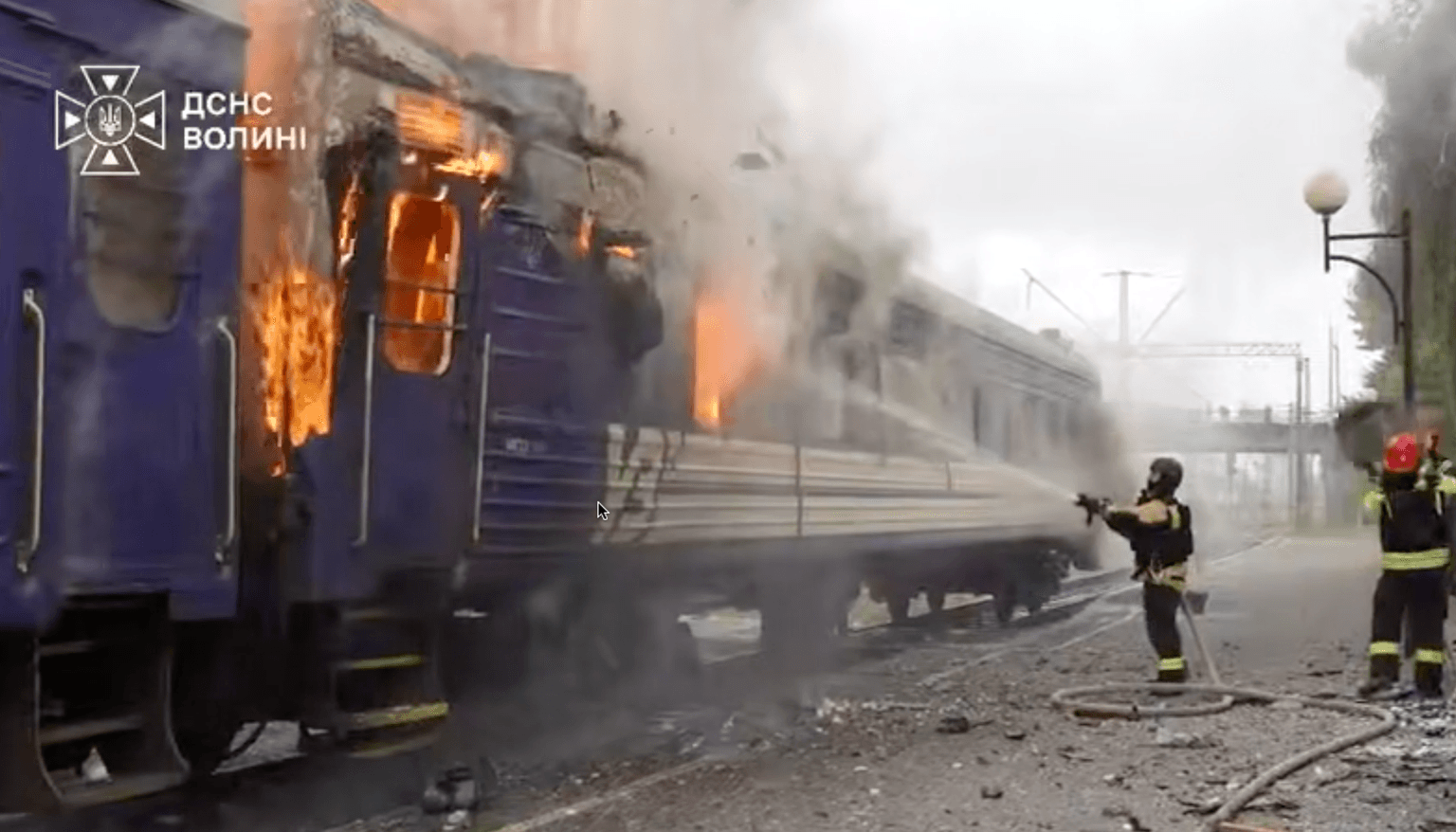
Firefighters extinguish a blaze at a passenger train hit by a Russian drone in Lutsk, Volyn Oblast. (Screenshot / Ukraine’s State Emergency Service / Telegram)
MODI PRESSES PUTIN AGAIN AT BRICS
Indian Prime Minister Narendra Modi urged Vladimir Putin to end the war during bilateral talks on the sidelines of the BRICS summit in New Delhi today, the second such direct appeal in under two weeks following a similar exchange at the Shanghai Cooperation Organization summit on August 31. “The land of Gandhi and the land of Buddha has only one message — peace,” Modi said, according to India’s Ministry of External Affairs, which said the two leaders also discussed maritime security in the Black Sea following the deaths of at least five Indian seafarers in recent strikes on commercial shipping.
India has maintained close economic ties with Russia throughout the war, significantly expanding discounted crude oil imports while declining to join Western sanctions — even as it continues engaging directly with Kyiv, following Foreign Minister Subrahmanyam Jaishankar’s visit to Ukraine earlier this month. The summit itself marked Chinese President Xi Jinping’s first visit to India since 2019, alongside Iranian President Masoud Pezeshkian and representatives from the UAE, Saudi Arabia, and Egypt — a gathering that placed both the Ukraine war and the Middle East conflict squarely on a shared multilateral agenda increasingly resistant to Western-led diplomatic frameworks.
Modi’s repeated appeals, however sincerely meant, haven’t yet translated into any visible shift in Russia’s negotiating posture, and India’s own continued oil purchases undercut the moral weight of counseling peace to a leader New Delhi keeps helping finance economically. Still, the willingness to raise the issue twice in as many weeks, on record, at consecutive major summits, suggests India increasingly wants to be seen occupying a middle ground between full alignment with Moscow and genuine pressure toward ending the war.
A SECOND EXPLOSION AT A BULGARIAN ARMS PLANT, AND A RECORD RECRUITMENT BOUNTY
An explosion sparked a large fire at a Bulgarian ammunition warehouse operated by arms manufacturer EMCO overnight, the second such incident at one of the company’s sites in just over a month. The blaze broke out near the village of Tsareva Livada and spread between warehouses; no injuries were reported. EMCO, owned by Bulgarian arms trader Emilian Gebrev and a supplier of ammunition to Ukraine, called the explosion “no exception to the series of sabotage against the Bulgarian defense industry,” insisting the warehouse’s recent Interior Ministry inspection and months of disuse ruled out human error. Bulgaria’s interior minister said investigators haven’t ruled out external interference but also flagged genuine security shortcomings at the site.
EMCO facilities have repeatedly drawn suspected Russian sabotage attempts; Bulgarian authorities issued arrest warrants in 2024 for six Russian citizens linked to a string of warehouse explosions between 2011 and 2020, with investigators tying some incidents to a 2015 poisoning attempt against Gebrev himself and to Russia’s GRU Unit 29155. Separately, Russian outlet Vyorstka reported that Irkutsk Oblast has raised its bounty for recruiting foreign nationals into Russia’s military to 1.5 million rubles per recruit — the highest such payment offered by any Russian region, and nearly four times higher than the same incentive just seven months ago, part of a broader pattern of Russian regions competing to attract foreign fighters as domestic recruitment continues falling short of battlefield losses.
A SALIENT BROKEN, A MEETING OFFERED, A PLANT STRUCK AGAIN
By nightfall, today’s furthest edges pulled toward the same uneasy conclusion this war keeps returning to: real progress on one front, unrelenting cost on every other. Ukraine broke a months-long Russian encirclement plan north of Lyman. Russian generals are quietly asking for 800,000 more soldiers to keep trying anyway. Zelensky offered Putin a room in Miami. Lavrov offered Moscow instead, with no pause in the fighting either way.
Two steelworkers in Kryvyi Rih won’t see tomorrow. A plant in Zaporizhzhia has now been struck three times without ever managing to restart. And somewhere in the Black Sea tonight, two unmanned boats fought a battle that had never happened before in the history of naval warfare. Nothing today ended. Everything today confirmed how much this war keeps reinventing the ways it can still surprise everyone watching it.
A PRAYER FOR UKRAINE
1. For the Steelworkers Lost in Kryvyi Rih
Lord, two workers are gone tonight, killed at a plant that’s kept running through years of war only to be struck by a missile on an ordinary shift. We grieve labor met with violence instead of safety. Receive them both, comfort their families and colleagues, and protect every worker still showing up to jobs that shouldn’t require this much courage simply to clock in.
2. For the Missing in Odesa
Father, two people remain unaccounted for tonight beneath the wreckage of a burning apartment tower. We ask for mercy in the searching, and for answers, however hard, rather than permanent uncertainty for those still waiting. Comfort the 35 injured, including an infant not yet old enough to understand any of this, and give rescue crews strength for work that never seems to end.
3. For Every Soldier Facing a War That Keeps Demanding More
Lord of the weary, we pray for soldiers on every side of this war, as generals quietly ask for hundreds of thousands more lives to spend on ground already paid for many times over. Give commanders the conscience to question orders that treat people as numbers. And give the soldiers themselves, wherever they stand, some measure of protection from decisions made so far above them.
4. For Wisdom in Every Room Where This War’s Ending Is Discussed
God of peace, we pray for clarity between offers made in good faith and rejections dressed as openness. Give negotiators discernment to know the difference, and give Ukraine’s own leaders the strength to keep proposing real steps forward even when the other side keeps answering with conditions instead of commitment. Let genuine progress outlast the performance that so often surrounds it.
5. For Industries and Workers Bearing This War’s Quiet Costs
God of provision, we pray for every worker, every plant, every ordinary business absorbing damage that rarely makes headlines on its own. Give resilience to those rebuilding after each new strike, and give nations bearing this war’s spillover costs, even from a distance, resolve to keep counting what’s actually being lost. Let no cost go unacknowledged simply because it’s shared rather than singular.
In Your mercy, in Your justice, in Your time — bring this war to its end, and let the ending be worthy of what Ukraine has endured.