
September 4, 2026
Prepared by Diana Bozhyk
A Russian jet-powered drone struck the headquarters of Ukraine’s Security Service in central Kyiv, deliberately targeting the office of acting chief Oleksandr Poklad and injuring 12 people, hours after Russian sources fabricated claims of encircling 2,000 Ukrainian soldiers near Kharkiv. President Zelensky ordered Ukrainian forces to halt offensive operations from September 5 through 8 ahead of a planned visit by US envoys Steve Witkoff and Jared Kushner, even as Russia refused to guarantee the delegation’s safety and Kremlin sources reportedly worked to prevent the Kyiv leg of the trip entirely. Ukraine’s anti-corruption bureau opened a new investigation reaching into the Prosecutor General’s own office, global food prices hit a four-year high on Black Sea disruptions, and Bulgaria’s former president blamed the West, not Russia, for last month’s drone attack on a German airport.
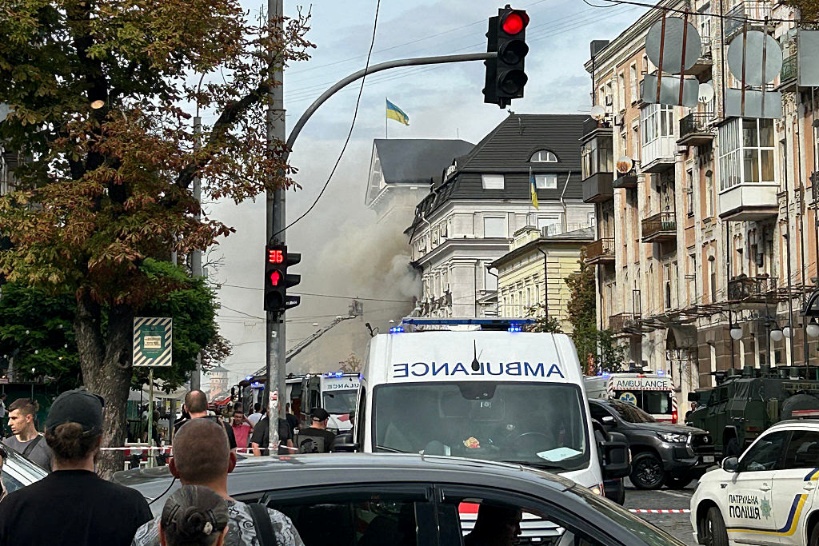
Onlookers watch as Ukrainian rescue personnel work to extinguish a fire in the headquarters of the State Security Service (SBU) following a Russian attack in Kyiv. (Maryke Vermaak / AFP via Getty Images)
THE DAY’S RECKONING
Somewhere in Kyiv today, a drone flew seven kilometers up, tracked all the way from Donetsk, and found the exact office where Ukraine’s top domestic spy works. It missed him. Twelve other people weren’t so lucky. Zelensky’s response was immediate and blunt: find where to hit back, and wait only for the moment that does the most damage.
Everything else about today moved around that same tension — a country trying to prove it wants peace while absorbing proof that the other side doesn’t. Ukraine ordered its own troops to stand down for four days, a goodwill gesture timed to a visit from two American envoys Russia seems determined to keep away from Kyiv entirely. Russian sources spent the same day inventing an encirclement that never happened. Bulgaria’s former president stood in his own parliament and blamed Ukraine’s allies for a drone attack Germany has already traced to Moscow. A new corruption investigation reached into the office meant to prosecute corruption. Nothing about today suggested anyone is close to done fighting. Everything about it suggested both sides know exactly how much further this can still go.
A DRONE TARGETS THE HEAD OF UKRAINE’S SECURITY SERVICE
A Russian jet-powered Geran-4 drone struck the headquarters of Ukraine’s Security Service in central Kyiv today, deliberately targeting the office of acting SBU chief Oleksandr Poklad, President Zelensky confirmed. The drone hit a non-residential building opposite St. Sophia’s Cathedral around 3:30 p.m., injuring at least 12 people, seven of whom were hospitalized. Poklad himself was unharmed. The SBU confirmed the drone “purposefully struck” his office and vowed “the Russians will receive a painful response to their blows.”
Presidential defense adviser Serhiy Beskrestnov said the drone was likely guided in real time through a mesh-network repeater with internet access that a Russian agent activated somewhere within roughly three miles of the building during the attack — evidence, he said, of Russia’s growing ability to steer its faster jet-powered drones toward precise, high-value targets rather than simply launching them and hoping for a hit. Zelensky said by evening that Ukraine had already decided where to strike back, with only the timing left open “for maximum effect.” It’s the first known Russian attack on SBU headquarters in the capital. The blast also damaged a building within the St. Sophia Cathedral complex, a UNESCO World Heritage site roughly 100 meters away, prompting Foreign Minister Andrii Sybiha to call on UNESCO to “act decisively” to protect Ukraine’s cultural heritage and to condemn what he called Moscow’s real answer to renewed peace efforts: a strike on the agency meant to defend against exactly this kind of attack.
UKRAINE ORDERS A UNILATERAL TRUCE AHEAD OF THE ENVOYS’ VISIT
President Zelensky confirmed today that US envoys Steve Witkoff and Jared Kushner will visit Kyiv on September 6, following a stop in Moscow the day before — the pair’s first-ever visit to Ukraine’s capital after months of shuttling exclusively to meetings with Russian officials. To make the visit possible, Ukrainian forces were reportedly ordered to halt offensive operations from midnight on September 5 through the end of September 8, a unilateral pause sources described to Ukrainska Pravda as Kyiv’s own proposal rather than any formal bilateral ceasefire.
Zelensky said Ukraine would refrain from aerial strikes on Russia during the visit specifically for the envoys’ safety, urging Moscow to reciprocate. “We are ready to meet with them in Ukraine. This is very important. It is important that the United States remains active,” he said. President Trump confirmed the envoys were carrying “a proposal to end the war” to Moscow, adding cryptically, “there may be a good chance that we’ll do it.” The gesture carries real diplomatic weight: after months of American diplomacy routed almost entirely through Moscow, a Ukrainian-initiated pause specifically to enable a Kyiv visit signals Zelensky is still willing to extend goodwill even to a process that’s repeatedly sidelined his own government’s direct input.
RUSSIA WON’T GUARANTEE THE US DELEGATION’S SAFETY
Despite Ukraine’s gesture, Russia gave no matching assurance. Kremlin spokesperson Dmitry Peskov confirmed the White House had asked Moscow to halt strikes on Kyiv during the envoys’ visit, but declined to say whether Russia had actually agreed. A source close to the Trump administration told the Kyiv Independent that Witkoff had grown increasingly nervous about the trip, adding that Russian officials were actively working to discourage it: “The Russians don’t want them to come here to Kyiv, and Witkoff is always sensitive to Russian sentiment. They’re being told there that it’s dangerous.”
The envoys had reportedly planned to fly directly into Boryspil despite Kyiv’s closed airspace, but those plans fell into doubt once Russia declined to commit to any pause. Ukrainian lawmaker Oleksiy Honcharenko speculated that a same-day drone strike near Kyiv’s Zhulyany Airport, which reportedly damaged two decommissioned Soviet-era aircraft, may have been a deliberate signal from Putin that he has no real interest in negotiating with either Washington or Kyiv.
The pattern fits a broader dynamic Ukraine had already absorbed once before: Ukraine paused strikes on Moscow during CIA Director John Ratcliffe’s visit there in late August, without ever receiving any comparable assurance in return. Neither the White House nor the Kremlin has publicly confirmed exactly what mutual understanding, if any, actually governs strikes during this particular visit — leaving Ukraine to extend trust unilaterally while Russia keeps every option open.
A FABRICATED ENCIRCLEMENT NEAR KHARKIV
Russian sources spent the day amplifying a claim that doesn’t survive basic scrutiny: that Russian forces had fully encircled 2,000 Ukrainian soldiers northeast of Kharkiv City after seizing four small settlements along the border. Russia’s Ministry of Defense presented the claim without any supporting visual evidence, and even a Kremlin-affiliated military blogger publicly acknowledged the encirclement claim needed further confirmation before anyone should treat it as real.
Ukraine’s 16th Army Corps flatly refuted the claims of both the settlement seizures and any encirclement in its area of responsibility, pointing out the false claims conveniently emerged just as Russia faces a worsening gasoline crisis, sustained Ukrainian strikes on its refineries, and looming State Duma elections. It’s a now-familiar pattern: Putin made an almost identical false claim just two days earlier, asserting Russian forces had trapped roughly 5,000 Ukrainian troops near the Oskil Reservoir — a claim researchers found no evidence to support at all. Russian officials have leaned on exactly this kind of fabricated battlefield triumph for months, using state television to reassure a domestic audience that collapse, not stalemate, defines Ukraine’s actual position, regardless of what troops on the ground and independent researchers can actually confirm about the same stretch of contested territory.
RUSSIA’S DRONES GET FASTER, ITS SATELLITES KEEP FAILING
Russia’s weapons programs are advancing unevenly — genuine gains in strike-drone precision, offset by a satellite constellation that keeps falling short of its own targets. Presidential defense adviser Serhiy Beskrestnov said Russia is now prioritizing jet-powered Geran-4 drones capable of speeds up to 550 kilometers per hour, and that Russian operators can now maintain live control over mesh-networked drones from up to 175 kilometers away — double last year’s effective range, enabling far more precise strikes against valuable, moving targets like today’s SBU attack rather than simply launching drones toward fixed coordinates.
Russia’s Rassvet satellite constellation, built as a homegrown Starlink alternative, tells the opposite story. Beskrestnov reported that half of Russia’s 36 launched satellites failed to reach their intended orbits, reportedly due to engine defects, even as Russia prepares another batch for launch regardless. Satellites stuck at lower altitudes face shorter operational lifespans from atmospheric drag and faster fuel depletion, meaning the constellation’s practical usefulness — steadier, more precise connectivity for Russian strike and reconnaissance drones — remains well short of what Moscow needs, even as the underlying drone technology it’s meant to support keeps improving regardless. The mismatch matters strategically: Russia is investing heavily in both programs simultaneously, betting that faster drones and better satellite guidance will eventually combine into a genuinely harder-to-stop strike capability, even though right now each program is advancing at a very different pace than the other.
MEANWHILE, AT THE FRONT
A Ukrainian assault unit built mostly from Colombian and Brazilian volunteers overran Russian positions near Dvorichna and Zapadne, north of Kupyansk, liberating roughly four square kilometers in a daylight infantry assault captured on helmet-camera footage. The 23rd Assault Regiment, roughly 500 soldiers drawn heavily from Latin America and commanded by an ethnic Armenian volunteer named Gamlet Avagyan, has now taken close to 14 square kilometers in the sector since late August — a rare instance of genuine mechanized-style maneuver in a war usually reduced to static, drone-saturated stalemate.
Elsewhere, Ukrainian officials refuted Russian claims of seizing Svyatohirsk, northwest of Lyman, with a brigade spokesperson noting Russian infiltrators remain far from both the settlement and the Siverskyi Donets River. Ukrainian forces advanced east of Slovyansk near Rai-Oleksandrivka, directly contradicting General Gerasimov’s own claims from over a week earlier, while near Kostyantynivka, Ukrainian troops continued holding contested pockets that a Kremlin-linked commentator admitted complicate any further Russian advance.
Near Novopavlivka, Ukrainian forces advanced west of Kotlyarivka, and in Kherson City, Russian forces struck a civilian minibus, killing one person and injuring 12 more in yet another entry in the city’s ongoing “human safari” campaign against ordinary residents. Near Dobropillya, Russian forces continued limited infiltration attempts without confirmed advances, and Ukrainian intermediate-range strikes kept hitting Russian logistics and command infrastructure in occupied Luhansk and Donetsk oblasts, part of the same sustained pressure campaign that’s defined most of the front for weeks now.
TWO RUSSIAN REFINERIES CONFIRMED OFFLINE, A THIRD STRUCK 1,300 KILOMETERS AWAY
Ukraine’s General Staff confirmed today that two major Russian oil facilities have suspended operations following earlier Ukrainian strikes. Lukoil’s NORSI refinery in Nizhny Novgorod Oblast — Russia’s fourth-largest refinery and second-largest gasoline producer, roughly 500 miles from the border — shut down after an August 26 strike, while the Novatek-Ust-Luga complex on the Baltic coast, one of Russia’s largest ports, halted operations after a September 1 strike damaged its condensate-processing and hydrocracking equipment.
Separately, Ukrainian drones reportedly struck the Sterlitamak Petrochemical Plant in Bashkortostan, more than 1,300 kilometers from Ukraine’s border — a facility supplying aviation fuel and materials to Russia’s defense industry, now targeted for at least the fourth time since November 2025. Russian authorities acknowledged a drone attack on the surrounding industrial zone without confirming the specific facility struck. Russia’s own Defense Ministry claimed it intercepted 490 Ukrainian drones nationwide overnight — an unverified figure, but one that, if even roughly accurate, illustrates just how many separate strikes Ukraine is now attempting on a single average night across a country that spans eleven time zones.
Together, the three strikes reflect a deliberate widening of Ukraine’s target list beyond the handful of refineries hit repeatedly earlier in the year, spreading pressure across facilities that supply everything from gasoline for ordinary Russian drivers to fuel and materials feeding Russia’s own defense-industrial base directly.
GLOBAL FOOD PRICES HIT A FOUR-YEAR HIGH
The UN’s Food and Agriculture Organization reported today that global food prices climbed to their highest level since March 2022, driven substantially by continued disruption to Black Sea grain exports. The FAO’s Food Price Index averaged 133.3 points in August — still about 16 percent below the invasion’s initial peak, but the highest reading in over four years, with grain prices rising specifically due to “continued uncertainty surrounding Black Sea export flows.”
Roughly 90 percent of Ukraine’s agricultural exports move through the Black Sea, a trade that accounted for a fifth of the country’s GDP before the war, and Ukraine’s own exports fell to just 30 percent of target in the first two weeks of August alone as Russian strikes on ports and civilian grain vessels intensified. Russia has rejected reinstating the 2022-2023 Black Sea Grain Initiative that once kept exports moving safely, opting instead to escalate strikes on shipping infrastructure — a choice that’s now visibly showing up in supermarket prices well beyond Ukraine’s own borders, reaching consumers with no connection to the war beyond what they pay for bread. The FAO separately lowered its forecast for global grain production this year, citing both the Black Sea disruption and unrelated weather stress, projecting the second-largest harvest on record even as the annual decline from last year’s total marks the steepest drop since 2018.
UKRAINE’S FUNDING GAP AND THE FROZEN-ASSETS QUESTION AGAIN
Deputy Prime Minister for European Integration Vsevolod Chentsov told EU counterparts in Ireland today that non-EU countries need to substantially increase their financial support for Ukraine, as Kyiv works to close a $27 billion budget shortfall before year’s end. “We are talking both to the EU and other partners to cover the gap for this year… frontloading is probably one of the solutions, but it is not a silver bullet,” he said, referencing Zelensky’s earlier push to accelerate 2027 EU funding into the current year.
Chentsov also reopened discussion of using roughly $230 billion in frozen Russian assets, an idea that collapsed in December 2025 after Belgium — which hosts the bulk of the assets through Euroclear — demanded other countries share the legal risk of Russian retaliation. “That was a very ambitious proposal last year,” Chentsov said, adding Ukraine now needs “to consider different figures as a first step.” EU diplomats say the UK, holding roughly $30 billion in frozen assets itself, has signaled willingness to participate if needed — a detail that could help address Belgium’s core objection, though no formal agreement has moved forward since the original proposal stalled. Chentsov’s remarks echoed a similar message Ukraine’s new EU ambassador delivered in Brussels two days earlier, underscoring that Kyiv’s financing gap has become urgent enough to warrant coordinated messaging across multiple senior officials in the same week.
BULGARIA’S FORMER PRESIDENT BLAMES THE WEST FOR RUSSIA’S DRONE ATTACK
Bulgarian Prime Minister Rumen Radev suggested today that Germany’s own military support for Ukraine provoked last month’s Russian drone attack on Leipzig Airport — an attack Germany officially attributed to Russian intelligence just three days earlier. “What can we expect when we attack another country with our long-range weapons? Will it stand by or will it respond?” Radev asked in Bulgaria’s parliament, despite the fact that no Western country has directly struck Russian territory with its own forces; several have simply supplied Ukraine weapons to defend itself.
Radev, who led a Russia-friendly party to a landslide election victory in April after resigning the presidency, called European long-range weapons transfers to Ukraine “a reckless act” and urged Europe to “sit down at the negotiating table as soon as possible” given Russia’s nuclear status. It’s consistent with his record: he blocked EU sanctions on the head of Russia’s Orthodox Church in June and pulled Bulgaria out of the Coalition of the Willing, the 30-plus-country group coordinating security guarantees for Ukraine, in July — making him one of the most openly Russia-sympathetic heads of government currently sitting inside the EU. Kremlin spokesperson Dmitry Peskov praised Radev’s party specifically for its “willingness to resolve issues through pragmatic dialogue with the Russian Federation” following its April election win, a compliment Radev has done little since to distance himself from.
A NEW CORRUPTION INVESTIGATION REACHES THE PROSECUTOR GENERAL’S OFFICE
Ukraine’s anti-corruption bureau announced an operation today targeting a criminal organization it says is led by an official inside Ukraine’s own Prosecutor General’s Office, allegedly protecting a network of scam call centers and laundering illicit assets. Investigators detained Serhiy Kropyva, a deputy head of the office’s international cooperation department, and searched the offices of Prosecutor General Ruslan Kravchenko, his deputy Maria Vdovychenko, and Odesa Oblast Governor Oleh Kiper, according to Ukrainska Pravda sources — though the Prosecutor General’s office disputed reports that Kravchenko’s own office was searched.
The case adds to a corruption reckoning that’s touched an increasing share of Zelensky’s own governing apparatus this year: former deputy chief of staff Iryna Mudra faces separate money-laundering charges, presidential chief of staff Kyrylo Budanov has reportedly appeared on investigators’ own recordings tied to that case, and former chief of staff Andriy Yermak faces separate corruption charges filed in May. Ukraine’s Prosecutor General’s office said it would “fully cooperate” with anti-corruption authorities and confirmed the implicated employee would be suspended for the duration of the investigation — a now-familiar procedural response to a scandal that keeps finding new institutions to touch, even as officials publicly insist each new case reflects the system working rather than the system failing.
RUSSIA TIGHTENS ITS GRIP ON UKRAINIAN CHILDREN IN OCCUPIED TERRITORY
Russia has quietly added new bureaucratic barriers making it harder for Ukrainian children to leave occupied territory, a Ukrainian charity focused on their return told reporters today. Since the start of 2026, Russia has required minors without existing passports to obtain Russian biometric travel documents before leaving — a change from earlier rules that allowed simple birth certificates. “The Russians are colonizers who seize territory, taking children with them,” said Oleksandra Dvoretska of Bring Kids Back UA.
Despite the added obstacles, Ukraine returned 103 children and young people from occupied territory in August, more than double July’s total, partly reflecting growing capacity to manage the process and a rising number of young people, particularly those facing forced conscription into Russia’s military, actively trying to leave on their own. Ukraine’s Justice Ministry has now confirmed 20,610 individual cases of child deportation or forced transfer, though officials believe the real number is far higher — Ukraine’s ombudsman estimates up to 150,000 children affected, while the presidential children’s rights commissioner puts the range as high as 300,000. The International Criminal Court issued arrest warrants for Putin and Russia’s children’s rights commissioner in 2023 specifically over this practice, warrants that remain unenforced given Russia’s refusal to recognize the court’s jurisdiction over its own officials.
A DRONE, A TRUCE, AN INVESTIGATION REACHING INWARD
By nightfall, the day’s contradictions were hard to look past. Ukraine ordered its own soldiers to stand down for four days as a gesture of good faith. Russia answered by putting a drone through the window of the office belonging to the man meant to protect the country from exactly that kind of attack. A former president in Bulgaria stood in his own parliament and blamed the wrong side for a bombing his own closest ally had already solved.
Twelve people are recovering tonight near a cathedral that’s stood since the 11th century. A corruption case just reached the office meant to prosecute corruption. And somewhere in occupied Ukraine, a 21-year-old who managed to escape a draft notice is finally safe, one of just over a hundred children Ukraine managed to bring home this month, out of a number nobody has ever fully counted. Nothing today ended. Everything today measured how much distance still remains between a gesture of peace and an actual one.
A PRAYER FOR UKRAINE
1. For the Twelve Wounded Near St. Sophia’s Cathedral
Lord, twelve people are recovering tonight from an attack aimed at silencing the very people meant to protect this country. We grieve violence reaching into the heart of a city, striking near a place that has stood sacred for a thousand years. Heal the wounded fully, comfort those still shaken by how close danger came today, and protect every person doing work that makes them a deliberate target.
2. For a Truce Offered in Good Faith
Father, we lift up a country that chose to pause its own strikes as a gesture toward peace, even without any guarantee the other side would do the same. Give that gesture weight beyond the four days it covers. Protect Ukrainian soldiers and civilians during this pause, and give Russia’s leaders a conscience they’ve shown little sign of possessing so far.
3. For Every Child Still Trying to Come Home
Lord of the lost, we pray for the tens of thousands of Ukrainian children still separated from their families in occupied territory, and for the charities and officials working to bring them back despite every obstacle placed in their path. Protect the young people risking everything to escape forced conscription. Let every barrier built to keep a child from home eventually fail against the people determined to bring them back.
4. For Honesty Inside Institutions Meant to Serve Justice
God of truth, we pray for Ukraine’s ongoing corruption investigations, now reaching into the very office responsible for prosecuting crime. Give investigators courage to follow evidence wherever it leads, whatever office or official it touches next. And give the country patience with a reckoning that keeps widening, so that accountability, however uncomfortable, ultimately serves the people this system exists to protect.
5. For Clarity in the Face of Convenient Lies
God of truth, we pray against every fabricated victory and every false framing that shifts blame from an aggressor onto its victims. Give journalists and researchers persistence to keep correcting the record, and give leaders everywhere the integrity to name what’s actually happening rather than what’s politically convenient. Let truth outlast every effort to bury it.
In Your mercy, in Your justice, in Your time — bring this war to its end, and let the ending be worthy of what Ukraine has endured.