
August 29, 2026
Prepared by Diana Bozhyk
A Russian drone strike on an ammunition warehouse in the village of Myla, outside Kyiv, triggered secondary detonations that killed at least 37 people, including the local community head who died as a first responder, and damaged 130 residential buildings. The blast capped a 28-hour Russian strike campaign that hit Kyiv for a third consecutive day, killing a two-year-old girl and a 14-year-old girl in separate strikes, while Ukraine’s deputy presidential office head revealed Moscow has ordered contingency plans for a future operation against Kyiv and Chernihiv. Ukraine struck retail and port infrastructure in Russia’s Rostov Oblast hard enough to trigger a regional state of emergency, even as the Kremlin declared peace talks are now on a “deep pause.”
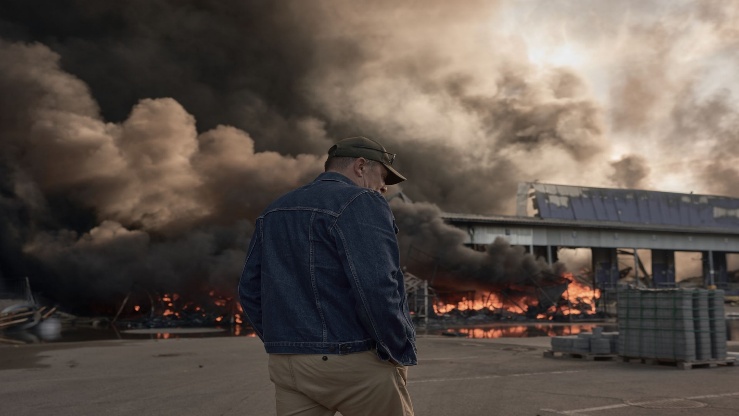
A man looks on as smoke rises from a fire at a large warehouse storing car tires and wheels following a Russian strike in Bucha district, Kyiv Oblast, Ukraine. (Kostiantyn Liberov / Libkos / Getty Images)
THE DAY’S RECKONING
Taras Didych ran toward the fire, not away from it. He was the head of a small community west of Kyiv, and when a Russian drone hit a warehouse full of ammunition near his village, he did what community heads sometimes do in this war: he showed up to help. A second wave of explosions killed him along with at least 36 other people, in a blast so large it damaged 130 homes and forced hundreds to evacuate in the middle of the night.
That single explosion arrived at the tail end of 28 straight hours of Russian strikes on Kyiv — the third consecutive day the capital came under fire, with a two-year-old girl and a 14-year-old girl among the dead elsewhere in the region. And while rescue crews were still pulling people from the rubble in Myla, Ukraine’s own intelligence revealed something else worth sitting with: Russia has ordered its generals to draft plans for a future operation against Kyiv and Chernihiv. Nothing about that plan is imminent, officials stressed. But on a day when a warehouse fire killed 37 people in a village most of the world had never heard of, the idea that Moscow is still drawing up bigger ambitions landed with its own particular weight.
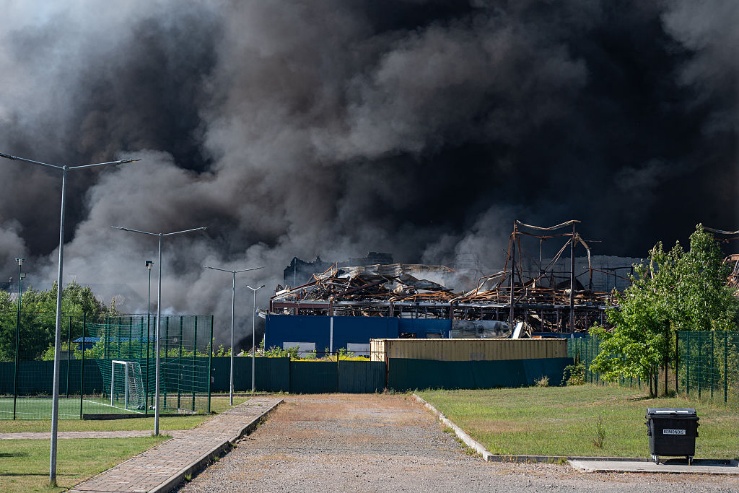
A warehouse storing car tires burns after a Russian attack in Kyiv Oblast. (Danylo Antoniuk/Ukrinform/NurPhoto via Getty Images)
A WAREHOUSE IN MYLA: 37 DEAD IN A SINGLE EXPLOSION
A Russian jet-powered Geran-4 drone struck a facility storing Ukrainian military ammunition in the village of Myla, in Kyiv Oblast’s Bucha district, at approximately 8:10 p.m. on August 28. The initial strike triggered a chain reaction of detonations involving shells, mines, and other munitions that continued through the night, ultimately killing at least 37 people and injuring 42 more, including four children, according to Kyiv Oblast Governor Tymur Tkachenko. Among the dead was Taras Didych, head of the nearby Dmytrivka community, who had rushed to the scene as one of the first responders.
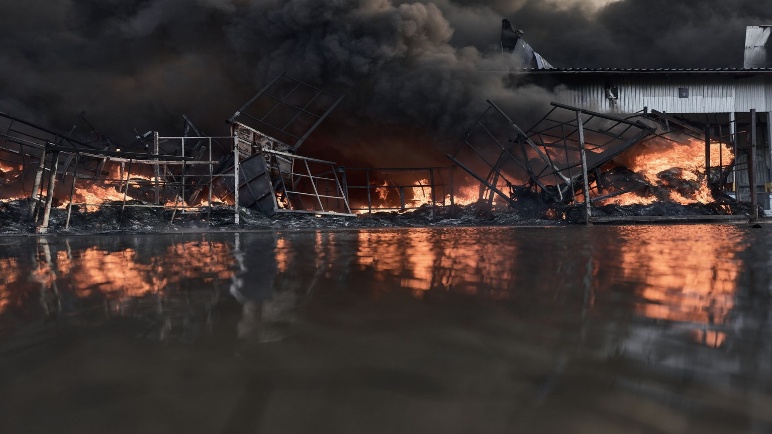
Smoke rises from a fire at a large warehouse storing car tires and wheels following a Russian strike in Bucha district, Kyiv Oblast, Ukraine. (Kostiantyn Liberov / Libkos / Getty Images)
The scale of the devastation was severe: at least 130 residential buildings were damaged, along with a care facility for elderly and disabled residents, and 381 people, including 59 children, were evacuated. Authorities closed sections of the M-06 Kyiv-Chop highway as explosions continued. “It sounded like real metal rain. It was terrifying,” resident Maryna Bondarenko told the Kyiv Independent. Another, Tetiana Biletska, said explosions came “every 20 to 30 seconds, and then literally every second,” adding she had passed the warehouse almost daily without knowing ammunition was stored there.
President Zelensky confirmed the target was a military ammunition depot and demanded accountability. “There are rules: ammunition cannot be near houses and other residential buildings,” he wrote. “Those who allowed this must be held responsible for their decisions.” Ukraine’s SBU and National Police opened a criminal negligence investigation, and Prime Minister Serhii Koretskyi drew a direct line to a nearly identical tragedy in July: a strike on an ammunition depot in Vyshneve, also in Kyiv Oblast, that killed eight people after officials had illegally approved its location near homes. “Making the same mistakes in the fifth year of a full-scale invasion is criminal negligence,” Koretskyi said, promising “severe punishment.” Kyiv Oblast declared August 30 a day of mourning.
KYIV’S THIRD CONSECUTIVE DAY UNDER FIRE
Russia launched more than 550 Banderol loitering munitions, Shahed- and Gerbera-type strike drones, and decoys against Ukraine across two consecutive days, alongside an unspecified number of Onyx anti-ship and Iskander-M ballistic missiles fired from occupied Crimea overnight. Ukrainian air-raid alerts stretched for more than 28 hours total, spanning three separate calendar days — an abnormally prolonged campaign CNN reported was likely designed specifically to exhaust Ukrainian air defenses and disrupt civilian life before inflicting maximum damage later in the sequence. Kyiv’s military said 233 drones were shot down or suppressed overnight alone, with a further 224 drones, most jet-powered, launched during daylight hours the following day and 199 of those intercepted by evening.
The human toll fell hardest on children. A two-year-old girl died from injuries after a Russian drone crashed in Kyiv’s Obolon district, Mayor Vitali Klitschko said, with eight more people injured in the capital that morning. Separately, a 14-year-old girl was killed in the Boryspil district of Kyiv Oblast, regional governor Tkachenko confirmed. A later drone strike that evening sparked fire on the second through fifth floors of a 12-story residential building in Obolon after a drone fell between apartment blocks. Falling debris also sparked fires at a warehouse in the Holosiivskyi district and a ninth-floor apartment in Sviatoshynskyi, though no casualties were reported at either site. Kyiv had already recorded 13 air-raid alerts on August 27 alone — a single-day record since the invasion began — before the barrage continued into the following two days without meaningful pause.
RUSSIA REVEALS ITS OWN PLANS FOR KYIV AND CHERNIHIV
Ukrainian officials disclosed today that Russia’s political leadership has ordered military commanders to draft contingency plans for a future operation targeting Kyiv and Chernihiv — though they were careful to stress no such offensive is currently forming.
“We did indeed receive information from intelligence, verified from several sources, that the military leadership of the Armed Forces of the Russian Federation received a task from the political leadership to plan such an operation in several variants in the direction of Kyiv and Chernihiv,” said Pavlo Palisa, deputy head of Ukraine’s Presidential Office. He emphasized that the existence of these plans doesn’t indicate an imminent attack, and that Ukraine currently sees no evidence of Russia actually assembling the strike force such an operation would require. Ukraine’s General Staff has already developed its own strategic response options in case the planning ever moves toward execution, Palisa added.
The disclosure lines up with a broader pattern Palisa separately described: Russia’s political leadership has set Russian military commanders an unrealistic December 31 deadline to seize the entirety of Donetsk and Luhansk oblasts, a target military leadership reportedly pushed back against, requesting a March 2027 deadline instead — itself, Palisa said, still unrealistic given the current pace of fighting. It’s the 15th deadline Putin has set for capturing the full Donbas since 2022; Russian forces have missed every previous one. Contingency planning toward Kyiv and Chernihiv, in that light, reads less as an imminent threat and more as Moscow quietly preparing options in case its current strategy in Donetsk continues falling short of its own repeatedly broken timelines.
RUSSIA’S FUEL SQUEEZE TIGHTENS
Russia’s government voted today to extend its export ban on diesel, marine fuel, and gas oils for direct producers through September 30, keeping in place restrictions originally set to expire at the end of August — a sign the domestic fuel crisis Ukrainian strikes have created shows no sign of easing on Moscow’s preferred timeline. Rosneft chief Igor Sechin claimed the same day that his company is meeting domestic fuel demand despite constrained refining capacity, a claim that sits awkwardly against Russia’s refining output hitting a 20-year low earlier this month.
The extension adds to a stack of measures Russia has layered on top of each other since gasoline shortages began spreading nationwide: a general ban on gasoline and jet fuel exports through the end of the year, price controls under consideration for lower-quality fuel grades, and now a renewed restriction specifically targeting diesel and marine fuel. Each measure treats a symptom of the same underlying cause — sustained Ukrainian strikes on Russian refineries that keep taking processing capacity offline faster than Russia can repair it under current sanctions. The result is a government increasingly forced to manage its own fuel supply through administrative bans rather than production, even as it publicly insists, through officials like Sechin, that the situation remains fully under control.
MEANWHILE, AT THE ACTUAL FRONT
Away from the Kyiv barrage, the ground war continued its familiar rhythm of contested claims and modest, hard-won movement.
Ukrainian forces recently advanced near Dorozhnye, southeast of Dobropillya, and either maintained or advanced positions west and south of Novyi Donbas, directly contradicting Russian claims of controlling the same ground. Near Sumy City, Ukraine’s Kursk Grouping of Forces flatly refuted a Russian Ministry of Defense claim of seizing Khrapivshchyna, stating Ukrainian forces control the settlement outright. Near Kupyansk and Borova, Russian forces continued offensive operations without confirmed advances as Ukrainian troops counterattacked near Dvorichna, Ridkodub, Nove, and Katerynivka. Near Slovyansk, a Ukrainian brigade spokesperson reported Russian forces are accumulating personnel and equipment for an intensified push toward Lyman, with foreign recruits — primarily from Latin America, Africa, and Southeast Asia — now making up roughly 30 percent of Russian personnel in that sector, though the spokesperson described the buildup as poorly trained overall.
Near Kramatorsk, Russian forces deliberately struck a hospital, damaging its emergency department, and hit a Ukrainian postal truck, injuring the driver and destroying roughly 500 parcels — strikes a humanitarian representative said have driven a 20 percent increase in civilians seeking evacuation from Donetsk Oblast. Separately, the International Atomic Energy Agency reported that the Russian-occupied Zaporizhzhia Nuclear Power Plant has now gone 10 days without external power, relying on diesel generators with only about 10 more days of fuel remaining — a genuinely dangerous situation for a facility that depends on continuous power to keep its reactors safely cooled.
UKRAINE STRIKES ROSTOV’S RETAIL AND PORT INFRASTRUCTURE
Ukrainian forces struck warehouses belonging to three major Russian retailers — Ozon, electronics chain DNS, and produce wholesaler Chyzhyk — in Rostov Oblast overnight into August 28, with Ozon confirming a fire at its Rostov-on-Don facility and Russian opposition outlet Astra identifying a separate blaze at a DNS warehouse in Aksay. It’s the first known Ukrainian strike against a DNS facility, expanding the target list beyond Wildberries and Ozon to Russia’s fourth-largest online retailer.
The strikes’ economic reach extended well past retail. Rostov Oblast Governor Yuriy Slyusar declared a state of emergency on August 28, citing disruptions to maritime shipping across the Azov-Black Sea basin and a halt to port operations following Ukrainian drone strikes on regional logistics infrastructure. Slyusar said the disruption has caused storage facilities to overfill with agricultural produce that can no longer move by sea — a serious problem given that Russia’s Black Sea and Azov Sea ports account for more than 80 percent of the country’s total grain exports. Separately, Ukraine’s ongoing campaign to suppress Russian air defenses continued in Bryansk Oblast, where Ukrainian forces destroyed a Buk-M3 anti-aircraft system near Klintsy and a Pantsir-S1 system near Kletnaya — both positioned to protect Russian territory near the Ukrainian border from exactly this kind of deep strike.
UKRAINE PETITIONS TO BLOCK RUSSIA’S STARLINK RIVAL
Foreign Minister Andrii Sybiha announced today that Ukraine has formally petitioned the International Telecommunication Union to block Russia’s military satellite system, Rassvet, from operating over Ukrainian territory — a direct challenge to Moscow’s homegrown alternative to Starlink.
Sybiha said Ukraine submitted a formal note through its UN mission in Geneva demanding that Ukrainian territory be excluded from Rassvet’s declared service areas across all frequency bands. “The purpose for Russia to use such satellites over the territory of Ukraine is absolutely clear and it has nothing to do with civilian purposes,” Sybiha wrote, accusing Moscow of intending to use the system to support its war effort and commit what he called “genocidal crimes.” He called on international partners to back Ukraine’s position and take similar steps within their own territories.
Rassvet, developed by Russian firm Bureau 1440, became a priority for Moscow after Ukraine worked with SpaceX earlier this year to introduce a registration system that cut off unauthorized Russian battlefield access to Starlink terminals. The program has faced real technical setbacks — two satellites from a July launch failed their orbit-raising maneuvers and risk burning up in the atmosphere, while several others sit well below their intended altitudes — but analysts say the system already provides limited operational capability, with satellites passing over Ukraine roughly four times daily and offering at least two stable hour-long communication windows.
PESKOV DECLARES PEACE TALKS ON “DEEP PAUSE”
Kremlin spokesperson Dmitry Peskov told reporters today that peace negotiations between Russia and Ukraine are currently on a “deep pause,” a notably blunter formulation than his earlier summer comments confirming ongoing dialogue with US negotiators. “We’re pressing forward with the special military operation and our troops are making gains on the front lines,” Peskov said. “As for peace talks, that topic is currently on a deep pause.” He added that Russian forces are “intentionally destroying the Kyiv regime’s military and military-adjacent infrastructure” and that “the Ukrainian side knows our demands full well. They just don’t want to discuss them peacefully.”
The comment lands the same week CIA Director John Ratcliffe reportedly visited Moscow specifically to push the Kremlin toward serious negotiations, and a senior Vatican diplomatic envoy separately met Foreign Minister Sergei Lavrov to appeal for peace — both efforts Peskov’s remarks appear to dismiss outright. Putin continues to demand Ukraine cede full control of Donetsk Oblast as a precondition for any ceasefire, a condition Kyiv has repeatedly rejected. Ukraine’s own presidential chief of staff, Kyrylo Budanov, offered a strikingly similar assessment from the other side today, confirming in a television interview that halting the war along the current line of contact remains impossible because Russia categorically refuses to stop fighting — meaning both sides, for once, are describing the same stalemate in almost identical terms.
BUDANOV: WINTER FIGHTING CONFIRMED, A PRISONER SWAP “VERY SOON”
Presidential chief of staff Kyrylo Budanov confirmed today that fighting will continue through the coming winter, telling Ukraine’s national broadcast that ongoing dialogue with Moscow currently consists almost entirely of prisoner exchanges — with another major swap expected imminently. He characterized the exchanges as a technical track connected to “preparations for something major,” though he offered no further detail on what that might eventually involve.
In a separate interview aired the previous day, Budanov shared a striking anecdote from the trilateral negotiations held in 2025: Russian delegates, he said, had badly misread a wave of peaceful protests in Ukraine — likely referring to the demonstrations demanding Fedorov’s reinstatement — as evidence of a Western-orchestrated coup. Believing the Ukrainian government was on the verge of collapse, Russian representatives reportedly told Budanov directly that “the war is over” and that further dialogue was pointless. Budanov said he explained to them they were misreading Ukrainian society entirely, working off disinformation fed to them by their own agents — and that the Russian delegation later privately acknowledged the misjudgment once their expectations of a political collapse went unmet. It’s a small but telling detail about just how distorted Moscow’s understanding of Ukrainian domestic politics can become, even at the negotiating table, when filtered through intelligence sources with their own incentive to tell the Kremlin what it wants to hear.
LUKASHENKO AND PUTIN MEET, OFFICIALLY JUST ABOUT TRADE
Belarusian President Alexander Lukashenko met Vladimir Putin at his Novo-Ogaryovo residence outside Moscow today, with the Kremlin insisting the conversation covered trade turnover, Russian investment, and technology cooperation — not the war in Ukraine or military affairs.
The meeting capped a week of Belarusian-Russian engagement: Lukashenko met Russian Prime Minister Mikhail Mishustin the previous day to discuss industrial integration, telling him Belarus is “fulfilling and even overfulfilling” its supply obligations to Russia, including fuel and food. He also referenced a “common problem” on the two countries’ shared southern and western borders — language widely read as an oblique reference to Ukraine, notwithstanding the Kremlin’s insistence that the war didn’t come up directly in his talks with Putin.
The visit followed a snap combat-readiness inspection Lukashenko ordered for Belarus’s military on August 26, explicitly linked by Belarusian officials to CIA Director Ratcliffe’s presence in Moscow the same week. Independent monitors have also documented ongoing construction of a new military rail terminus near Yakimovka, roughly 25 miles from the Ukrainian border, designed to accommodate up to 60 railcars with ramps built for rapid unloading of heavy military vehicles — infrastructure that, regardless of what Lukashenko and Putin discussed today, suggests Belarus’s military posture toward Ukraine keeps quietly hardening.
RUSSIANS KEEP FLEEING, THIS TIME TO GEORGIA AND ARMENIA
More than 113,000 Russians crossed into Georgia through the Verkhny Lars checkpoint over the past week, Politico reported, with more than 20,000 crossing on August 20 alone — figures Russia’s own Federal Customs Service confirmed significantly exceed prior years. Demand for long-term apartment rentals in Tbilisi and Yerevan has surged as much as 30 percent compared to last year, with realtors comparing the rush to the exodus that followed Russia’s 2022 mobilization, when roughly 700,000 people fled the country within weeks.
Armenia is openly preparing to receive draft evaders. “To a Russian person, I can say only one thing: ‘Welcome to Armenia,'” said Alen Simonyan, secretary of Armenia’s Security Council, telling TV Rain the country won’t hinder anyone seeking to avoid being sent to the Ukrainian front. The exodus comes even as Russia’s UN ambassador, Vasily Nebenzya, maintains publicly that a new mobilization remains “not planned and not expected” — a denial increasingly difficult to square with figures showing Russia has struggled to consistently hit its target of 30,000 contract soldiers a month, with some months falling as low as 27,000. Ukrainian intelligence continues to assess that Russia is preparing to mobilize an additional 600,000 people across 2026 and 2027, with analysts suggesting Moscow will likely wait until after September’s elections to make any announcement official.
GERMANY PREPARES TO FORMALLY BLAME RUSSIA FOR LEIPZIG
Germany is preparing to formally attribute the attempted drone attack at Leipzig-Halle Airport to Russia and impose sanctions on Russian entities in response, Politico reported, citing three officials familiar with the matter, with Chancellor Friedrich Merz’s government expected to announce the measures within the coming week, potentially alongside a new EU sanctions package.
The August 4 incident involved a drone equipped with explosives found near a Ukrainian Antonov cargo plane also used to transport military equipment. US intelligence officials assessed on August 26 that the device showed signs of production by Russia’s military intelligence agency, the GRU. Merz has already warned the incident will carry “severe consequences,” saying Germany faces “very real threats” and that those behind hybrid attacks “will pay a price,” though a government spokesperson said formal attribution would only follow a complete weighing of the investigation’s results.
The response under consideration reportedly includes both intensified sanctions and increased arms deliveries to Ukraine — timed to potentially coincide with an informal EU foreign ministers’ meeting in Ireland on September 1, giving Germany a natural venue to coordinate the announcement with broader European partners already alarmed by the incident. A second drone and a cache of explosives were subsequently discovered in a field near Leipzig airport on August 25, adding to the sense among German officials that the original incident was neither isolated nor accidental, but part of a deliberate campaign against critical infrastructure Germany relies on to move military aid toward Ukraine.
BALTIC NATIONS FORM A TASK FORCE AGAINST HYBRID THREATS, AND A FINNISH PRESIDENT’S BLUNT ASSESSMENT
Interior ministers from nine countries bordering the Baltic Sea — Germany, Denmark, Estonia, Finland, Latvia, Lithuania, Poland, Sweden, Norway, and Ireland — met in northern Germany to establish a joint task force against hybrid warfare, agreeing to improve critical infrastructure protection and coordinate drone defense through joint exercises. “The hybrid activities to which our countries are exposed point to a further escalation,” German Interior Minister Alexander Dobrindt said, citing the Leipzig airport incident and repeated damage to undersea communications cables in the Baltic Sea as evidence the threat is intensifying. The group is pushing for hybrid-threat defense to be built directly into the EU’s next seven-year budget, with their next meeting expected to focus specifically on Russia’s shadow fleet of sanctions-evading oil tankers.
Separately, Finnish President Alexander Stubb offered an unusually direct public assessment of Russia’s remaining options in an interview published today, arguing Moscow won’t use nuclear weapons or directly attack NATO because China has privately signaled it wouldn’t allow it — “we will never allow that to happen,” he said a Chinese official told him this summer — and because NATO’s deterrent remains, in his words, stronger than any other military alliance in the world. Stubb said Russia’s only realistic escalation option left is mobilization, which he expects Moscow to pursue this fall despite the domestic political risk, pointing to new Russian laws restricting freedom of movement as evidence preparations are already underway. “At this pace, they can’t maintain their war effort for much longer,” he said.
KHERSON’S DAILY TOLL, NEPAL’S MISSING UKRAINIANS
Russian drone attacks on Kherson City killed one man and injured at least three others this morning, regional officials said, with a direct strike killing one victim in the Korabelny district and separate attacks injuring men aged 44, 54, and 57 across the Dniprovsky district and city center. It follows a 24-hour period in which Russian attacks across the broader Kherson region killed one person and injured 26 more, including a child, damaging seven apartment buildings, 15 private homes, a cellular tower, a gas pipeline, and multiple vehicles including ambulances — the same grinding, near-daily toll the city has absorbed for months without meaningful respite.
Separately, Ukraine’s Foreign Ministry said 56 Ukrainian citizens remain missing following catastrophic flooding and landslides that struck the Nepal-Tibet border on August 26 after a Himalayan glacier collapse — an update from the initial estimate of 53. No Ukrainian deaths or injuries have been confirmed as of today, and the ministry said it remains in close contact with affected families while Ukraine’s embassies in India and China coordinate with local search-and-rescue teams. The disaster has killed at least 626 people overall and left nearly 3,000 missing across both countries, including at least 540 foreign nationals, with fog continuing to limit air-search operations to the mornings.
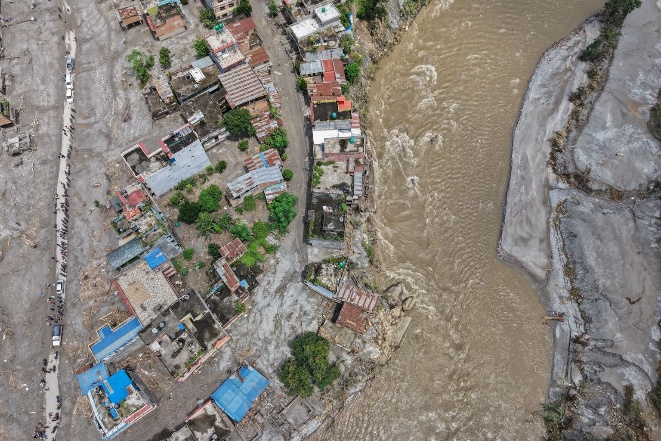
An aerial photo shows houses at a town along the Trishuli River destroyed by the flash floods, amid increasing deaths and missing people, in Devighat, Nuwakot, Nepal. (Daniel Ceng/Anadolu via Getty Images)
A COMMUNITY HEAD WHO RAN TOWARD THE FIRE
By nightfall, the day’s weight settled around one image more than any other: a local official who ran toward an exploding warehouse to help his neighbors, and didn’t make it back. Taras Didych’s death sits at the center of a night that also took a two-year-old girl, a 14-year-old girl, and dozens of others whose names will take days to fully confirm.
Twenty-eight hours of sirens. A warehouse full of ammunition that should never have been near people’s homes. A Kremlin spokesperson calling peace talks a “deep pause” while his own government drafts contingency plans for cities that haven’t been attacked yet. Nothing today moved the war toward an ending. Everything today measured, in the plainest terms available, exactly how much this war still asks of the people simply trying to survive it.
A PRAYER FOR UKRAINE
1. For Taras Didych and Every First Responder Who Ran Toward Danger
Lord, a community leader died tonight doing exactly what his neighbors needed most — running toward an explosion to help, rather than away from it. We honor a life spent in service, ended in the act of serving still. Comfort the community he led, and give every rescuer and official who runs toward danger in this war the protection their courage deserves, even when it cannot be guaranteed.
2. For the Children Lost in Kyiv
Father, a two-year-old girl and a fourteen-year-old girl are both gone tonight, their whole lives ahead of them until a war that had nothing to do with them took that future away. We have no words adequate to losses this young. Receive them both gently, and comfort their families with a tenderness we cannot offer from here, in a grief no parent should ever have to carry.
3. For the Village of Myla, Still Counting Its Losses
Lord of the brokenhearted, we lift up every family in Myla and Dmytrivka still searching for someone, still waiting on a final number that keeps rising. Comfort the 381 people who fled their homes in the middle of the night, and give this small community the strength to rebuild what one warehouse fire took from all of them at once.
4. For Accountability That Actually Changes Something
God of justice, we pray that this investigation into how ammunition ended up so close to people’s homes leads somewhere real this time — not just words, but changed practice, changed oversight, lives saved the next time a drone finds a target it shouldn’t have been able to reach. Let this tragedy be the last of its kind, not simply the latest.
5. For a War Both Sides Now Admit Won’t End Soon
God of endurance, we pray for a country told plainly, by its own leaders, that winter will bring more fighting, not less. Give Ukraine’s people strength for a season neither side pretends will be easy. And give the wider world clarity to keep showing up, in ways that actually matter, for as long as this war keeps asking everything of the people living through it.
In Your mercy, in Your justice, in Your time — bring this war to its end, and let the ending be worthy of what Ukraine has endured.