
August 28, 2026
Prepared by Diana Bozhyk
Ukrainian forces struck a nuclear-capable Tu-95MS bomber at Russia’s Engels-2 airbase, even as Kyiv endured 17 air-raid alerts across 33 hours — the most in a single stretch since the war began — while Russian drones destroyed warehouses full of books, groceries, and packages across the capital region. Bloomberg reported Russia’s finance minister warned of a $64 billion treasury shortfall this spring, forcing 35 percent austerity cuts, even as Russia’s own refining capacity fell to a 20-year low and gasoline prices rose in 55 regions. President Zelensky said Russia’s naval losses have confined its warships to a single port and that Moscow may now arm civilian vessels to compensate, while presidential chief of staff Kyrylo Budanov said Ukraine cannot mobilize fewer than 30,000 people a month and that the war won’t end soon.
THE DAY’S RECKONING
Seventeen air-raid alerts in 33 hours. That’s not a typo — it’s what Kyiv actually lived through this week, the longest stretch of sirens since the war began, while Russian drones methodically worked their way through the capital’s warehouses: books, groceries, parcels, toys, all of it burning in turn. Somewhere in that same stretch, a Ukrainian strike found a nuclear-capable bomber sitting on a runway a thousand miles away and put a hole in its wing.
Behind the daily violence, both sides quietly revealed just how strained they actually are. Russia’s own finance minister warned the treasury ran $64 billion short back in April, forcing austerity even the Kremlin didn’t want to advertise. Its refineries are now producing less oil than at any point in twenty years. Meanwhile, Ukraine’s own leadership admitted its hardest truth out loud: 30,000 people, every month, with no real alternative, and no war ending fast enough to make that number smaller anytime soon. Neither side is winning cleanly. Both sides are simply finding out, in public, how much they can still absorb.
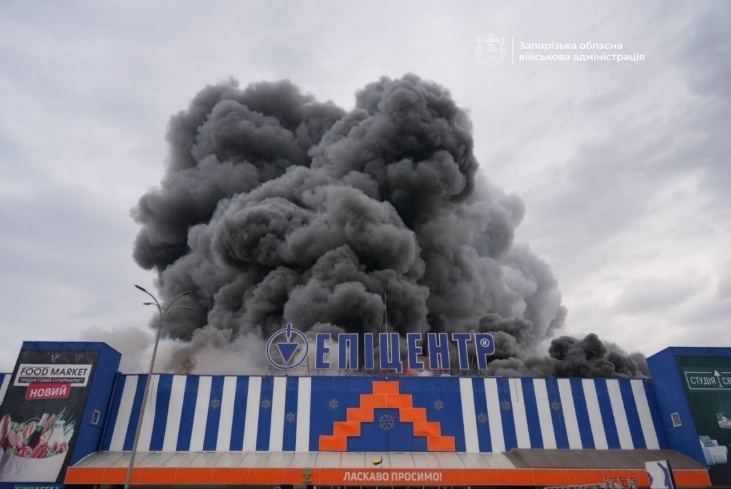
Russian forces attacked an Epicenter hypermarket in the regional capital of Zaporizhzhia on the morning. At least four people were injured in the attack, according to local authorities. (Regional Governor Ivan Fedorov/Telegram)
UKRAINE STRIKES A NUCLEAR-CAPABLE BOMBER AT ENGELS-2
Ukrainian forces struck a Tu-95MS strategic bomber at Russia’s Engels-2 Airbase in Saratov Oblast, President Zelensky confirmed, with satellite imagery showing visible damage to the aircraft’s right wing. The strike matters well beyond one damaged plane: the Tu-95MS is a nuclear-capable bomber Russia regularly uses to fire air-launched cruise missiles at Ukrainian cities, and Engels-2 sits deep enough in Russian territory, ringed by enough layered air defenses, that reaching it at all demonstrates a level of penetration capability Ukraine has spent years building toward.
The strike adds to a growing list of hits against Russia’s strategic bomber fleet and its supporting infrastructure this year, part of a deliberate Ukrainian campaign to degrade the specific aircraft responsible for many of the missiles that land on Ukrainian apartment buildings and power stations. Unlike drone-launch sites or oil refineries, strategic bomber bases represent some of Russia’s most heavily defended and symbolically significant military assets — facilities the Kremlin has treated as effectively untouchable for most of the war. A confirmed hit there sends a message distinct from the message sent by burning warehouses: that no part of Russia’s military architecture, however well-guarded or however tied to its nuclear posture, is now automatically off-limits to Ukrainian reach.
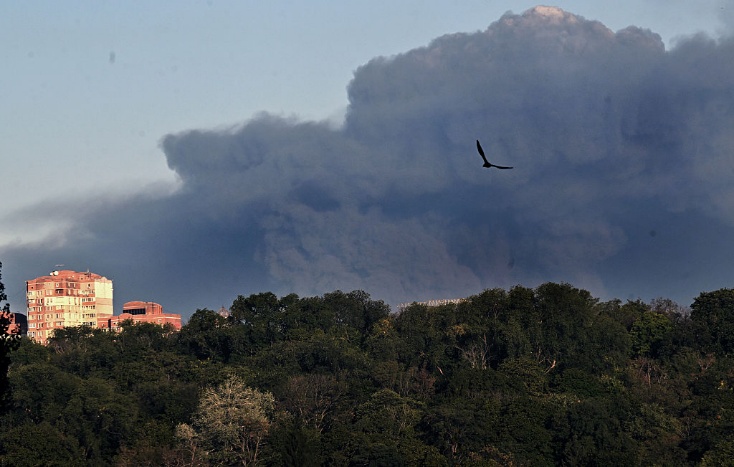
Smoke rises over Kyiv early following a Russian attack on Ukraine’s capital and Kyiv Oblast overnight. (Sergei Supinsky / AFP via Getty Images)
RUSSIA’S HIDDEN BUDGET CRISIS
Behind Moscow’s public confidence, a clearer picture of genuine fiscal strain emerged today. Bloomberg reported that Russian Finance Minister Anton Siluanov warned Prime Minister Mikhail Mishustin back in April that the federal treasury’s account had swung into a 5.5 trillion ruble — roughly $64 billion — shortfall, forcing immediate spending restrictions. Russian authorities responded with austerity measures requiring 35 percent cuts to non-war spending and instructed federal agencies to prepare for a 15 percent reduction in staffing. Bloomberg separately reported that Russian officials had previously and unsuccessfully petitioned Putin to cut defense spending amid the growing crisis — a request the Russian president apparently refused outright.
The timing carries real political weight: these disclosures are surfacing barely three weeks before September 20 State Duma elections that Putin has deliberately transformed into a referendum on the war itself, meaning any visible sign of fiscal strain lands at the worst possible moment for a Kremlin trying to project strength. Separately, Russia’s Defense Ministry published a draft amendment today that would dramatically expand military officials’ access to Russians’ personal data — employment records, banking details, medical history, tax filings — specifically to support conscription and mobilization systems. Russia also conducted a training launch of an intercontinental ballistic missile from Plesetsk Cosmodrome, continuing a long-running pattern of nuclear saber-rattling meant to project strength precisely when the underlying economic picture suggests otherwise.
RUSSIA’S REFINING COLLAPSE
Ukraine’s campaign against Russian oil infrastructure produced its starkest data point yet today: Russia’s refining output has fallen to its lowest level in two decades.
Overnight, Ukrainian forces struck the Slavneft-YANOS oil refinery in Yaroslavl — one of Russia’s largest oil-processing facilities — sparking a fire the regional governor confirmed damaged industrial infrastructure in the city. It’s at least the eighth time Ukraine has struck this specific refinery since the start of the year. Bloomberg reported the cumulative effect today: Russia refined roughly 3.8 million barrels of oil per day in August, compared to a summer average of 5.3 to 5.5 million barrels — a drop of nearly 20 percent from the same month last year, and the lowest refining volume Russia has recorded in 20 years. Gasoline prices rose across 55 Russian regions in a single week, and officials are now considering price controls on lower-quality fuel grades that require less refining capacity to produce, a stopgap that treats the symptom rather than the cause.
Separately, Russian opposition outlet Verstka reported that Ozon — Russia’s second-largest online retailer, now a recurring Ukrainian target — sold more than 2.13 million units of dual-use and military-relevant goods worth roughly $290 million between August 2025 and July 2026, including body armor, firearm components, and drones. The figures lend concrete support to Ukraine’s stated justification for treating e-commerce warehouses as legitimate military targets rather than purely civilian infrastructure.
MEANWHILE, AT THE ACTUAL FRONT
Away from the economic pressure campaign, the ground war produced a familiar mix of contested claims and confirmed strikes deep behind Russian lines.
Near Sumy City, Ukrainian forces counterattacked and held their ground against continued Russian pressure, while Russian sources posted what researchers assess is likely AI-altered flag-raising footage near Mohrytsya, part of an ongoing pattern of digital fabrication. Near Kupyansk, Russian forces increasingly relied on light multiple-launch rocket systems for area strikes, while concealing artillery in forests and using unmanned ground vehicles to sustain logistics in the drone-saturated environment. Notably, even Kremlin-aligned military sources acknowledged today that Ukrainian forces hold the initiative in several areas around Lyman, with one Russian-aligned source conceding Ukrainian troops can operate “relatively freely” in the city’s center — a rare admission that Russian claims of controlling Lyman since 2025 don’t match current reality. Near Kostyantynivka, a Ukrainian soldier reported Russian forces have actually reduced infiltration attempts in the short term, with Ukrainian troops clearing infiltrators from Oleksiyevo-Druzhkivka and Osykove entirely.

An agricultural warehouse stands damaged by Russian shelling in Sumy Oblast, Ukraine. (BrightBird/Global Images Ukraine via Getty Images)
Ukraine’s own strikes reached deep behind the front: a command post strike in occupied Donetsk City on August 26 reportedly killed a senior Russian officer, Lieutenant Colonel Andrey Moiseyenko of the 41st Combined Arms Army. Ukraine’s Unmanned Systems Forces also disclosed that its “Crimean Switch Off” operation, running continuously since July 1, has now struck 315 separate energy nodes across occupied Crimea and other occupied territories — a sustained campaign to keep occupied infrastructure destabilized rather than a series of isolated strikes.
KYIV’S RECORD 33 HOURS UNDER SIEGE
Kyiv recorded 13 separate air-raid alerts on August 27 alone — the highest single-day total since the war began — lasting a combined 872 minutes, nearly 15 hours. The barrage continued overnight and into the next morning, bringing the total to 17 alerts across a 33-hour span, as Russia launched at least 398 drones during the period, more than half of them jet-powered, deliberately timed in waves every 30 to 60 minutes specifically to prolong the disruption rather than concentrate it into a single strike.
The human cost of that disruption is measured less in casualties than in daily life ground to a halt: Kyiv’s metro suspends above-ground service during alerts, Nova Poshta branches stop serving customers, shopping malls and gyms direct visitors to shelters, and public transit schedules collapse. Warehouses across Kyiv Oblast bore the physical brunt — 14 destroyed or damaged in a single night, including facilities storing books for major Ukrainian publishers. A warehouse belonging to publisher A-ba-ba-ha-la-ma-ha was destroyed outright; its director, Ivan Malkovych, said the photographs from the scene were too “apocalyptic” to share. A separate facility in Sviatopetrivske burned down entirely, destroying inventory belonging to publisher Vivat and bookstore chains Readeat and Book.ua. Russian forces struck a Nova Poshta logistics site in Bilohorodka three separate times — twice more after firefighters had already arrived to fight the first blaze.
REGIONAL CASUALTIES ACROSS THE COUNTRY
Beyond Kyiv, Russian strikes killed and injured people across at least seven regions in a single 24-hour window. In Kharkiv Oblast, a 26-year-old man was killed in Kharkiv City and a 38-year-old woman was killed in Zmiiv, with four more injured including two children. Sumy Oblast lost a 54-year-old woman in Seredyna-Buda and a 61-year-old man in the Sumy community itself, with five more injured. Kherson Oblast lost one person with 11 injured, including a child. Zaporizhzhia Oblast lost one civilian woman as Russian forces attacked 53 separate settlements, while a drone strike burned down the region’s last operating Epicentr hypermarket, injuring four more people — the second Epicentr location hit in as many days, after a jet-powered drone killed one man and injured five others at a Kharkiv location the previous day.
Donetsk Oblast lost one person with three injured. Dnipropetrovsk Oblast lost two people in the Synelnykove district overnight, on top of eight injured the previous day in Nikopol and Pavlohrad, where a strike set a home-improvement supermarket ablaze and left two women and a 69-year-old man hospitalized in serious condition. Kyiv Oblast itself lost one person in Bucha district, a man who suffered multiple shrapnel wounds, with two more injured elsewhere in the region. Agriculture Minister Taras Vysotskyi confirmed today that Russian strikes have now destroyed roughly 90 percent of Ukraine’s modern storage facilities for various goods — a staggering figure he paired with reassurance that Ukraine faces no risk of actual food shortages, even as businesses scramble to bypass warehousing entirely and ship goods directly from supplier to shelf.
A DISTILLERY DESTROYED BEYOND REPAIR
One of Ukraine’s largest and most technologically advanced distilleries was destroyed beyond repair in a strike on Zaporizhzhia Oblast, the company confirmed today, a loss that illustrates how thoroughly Russia’s economic targeting campaign now reaches into industries with no conceivable military relevance.
The Khortytsia Distillery, launched in 2003 and owned by Global Spirits — a Ukrainian firm headquartered in the United States — was hit four times in a single attack, sparking a fire that burned for three hours. Company officials said between 3 and 4 million bottles of spirits were destroyed or partially melted, product on which the company had already paid excise taxes before the strike. Global Spirits describes Khortytsia as the most technologically advanced distillery in Eastern Europe, capable of producing 16 bottles every second and employing 500 people. It’s not the company’s first loss this year: a July 19 strike on its main warehouse cost roughly $2.2 million in destroyed inventory. “Despite everything, we have not lost the main thing — the ability to move forward, preserve jobs, pay taxes, and support the economy of Ukraine,” the company said after that earlier attack, a sentiment tested considerably further by today’s news.
ZELENSKY: RUSSIA’S NAVY IS TRAPPED, AND UKRAINE WANTS 1,000 DRONES A DAY
President Zelensky delivered two significant announcements today, one describing a crisis inside Russia’s own navy, the other setting an ambitious new target for Ukraine’s own strike capacity.
Citing a report from military intelligence chief Oleh Ivashchenko, Zelensky said Russia is now considering arming civilian vessels with small arms and electronic warfare equipment and placing military personnel aboard them, because the Russian navy can no longer safely escort its own ships to Black Sea ports. Ukrainian intelligence assesses that sustained drone strikes have effectively confined Russian warships to the single port of Novorossiysk, with some categories of Russian exports down as much as 80 percent this month alone. “These are significant losses for the Russian federal budget, as well as for regional budgets, which were already on the brink of bankruptcy,” Zelensky said, adding that Ukraine would respond to any militarization of civilian shipping with unspecified measures of its own.
Separately, Zelensky set a new goal in his evening address: increasing Ukraine’s long-range drone strikes from a current average of over 300 per day to 1,000. “The main priority is to strengthen our defense against jet-powered Shaheds and to step up the frequency of our deep strikes against Russia,” he said, noting Russia is already experiencing reduced gasoline supply, fewer exports, and strained logistics as a direct result of the current pace. “For the first time in its history, Russia is importing gasoline,” he added, pointing to Moscow’s use of state budget funds to prop up its own oil companies as evidence the pressure campaign is working.
BUDANOV’S BLUNT MATH: 30,000 A MONTH, NO QUICK END
Presidential chief of staff Kyrylo Budanov delivered an unusually candid television interview today, laying out Ukraine’s manpower reality in blunt terms while also addressing his own entanglement in the corruption scandal that’s engulfed the presidential office this week.
“We have to find the courage and honestly say: we cannot mobilize fewer than 30,000 people a month. This is the minimum number needed to maintain what we have,” Budanov said, acknowledging public anger over instances of forceful mobilization while insisting reform can’t actually reduce the underlying numbers Ukraine needs. “No matter how much we say that we will call differently now, the quantitative indicators will not change,” he said. On the war’s timeline, Budanov was equally direct: “We will not stop the war now. Not because we don’t want to, it’s just not realistic,” though he suggested visible negotiations may resume soon in a more technical, preparatory form rather than as a genuine breakthrough.
Asked about the corruption tapes in which his own voice and name reportedly feature — recordings tied to the same scandal that led to former deputy chief of staff Iryna Mudra’s dismissal and charges — Budanov offered a notably unbothered response: “Let the court sort it out. You know, it comes up in a lot of places.” The comment did little to quiet questions about how directly implicated Ukraine’s second-most-powerful official actually is in a scandal that keeps widening by the day.
A HELICOPTER OFFICER’S DEATH IN ST. PETERSBURG
Russian and Ukrainian media identified the officer killed in yesterday’s car bombing in St. Petersburg’s Shushary neighborhood as Sergei Sechkov, a major in Russia’s 332nd Separate Helicopter Regiment — a unit Ukrainian military intelligence labeled “war criminals” back in 2022 over alleged crimes against Ukrainian civilians. His father confirmed the death to independent Russian outlet Agentstvo.
Russian outlet Fontanka reported, citing unnamed sources, that a 24-year-old woman allegedly planted the bomb after being contacted and persuaded by Ukraine’s Armed Forces months earlier, with an alleged promise of relocation to Ukraine after completing the attack; the woman reportedly flew from Russia to Turkey and then to Moldova following the explosion. Ukraine has not commented on the incident or the claim.
It’s the latest in a string of unexplained deaths and attacks targeting Russian military-linked figures this year, following the June car bombing that killed a Russian official responsible for supplying missile and artillery ammunition, and an August 1 explosion that killed the son-in-law of Russia’s Aerospace Forces commander at a Moscow restaurant. Sechkov’s wife was reportedly in the vehicle at the time of the blast and remains hospitalized. Russian authorities have opened a formal investigation but, as with several similar incidents this year, have offered little in the way of public detail about suspects or motive beyond the account attributed to Fontanka’s sources — leaving the case, like the others before it, to circulate largely through unverified claims and competing narratives on both sides of the border.
FEDOROV BECOMES AN ADVISER TO ITALY
Former Ukrainian defense minister Mykhailo Fedorov, dismissed from his post in mid-July amid a cabinet reshuffle that triggered the war’s largest domestic protests, announced today he’s accepted a role advising Italian Defense Minister Guido Crosetto on defense innovation, unveiled during the first stop of an international trip focused on digitalization and defense technology.
“Ukraine’s experience can become the foundation for a new European defense model,” Fedorov said, adding that the role would operate in a non-staff capacity and that his primary focus remains projects in Ukraine itself. His press service said he plans to travel next to the United States “to secure resources for new defense tech projects.” Fedorov and Crosetto had already met multiple times during Fedorov’s tenure as minister, including through the Ramstein format that coordinates international military aid to Ukraine.
The appointment adds an interesting wrinkle to Fedorov’s post-dismissal trajectory: even as he’s floated as a potential political rival to Zelensky domestically, he’s simultaneously building an international advisory profile that keeps him squarely inside the defense-technology conversations he became known for while still in government. His press service said he’s received job offers from numerous private companies and international partners since leaving office, suggesting the Italy role is likely one of several parallel tracks he’s now pursuing rather than a single definitive next step in a political career still very much in flux.
CORRUPTION WIDENS: A NEW SUSPECT CHARGED
Ukraine’s anti-corruption bureau charged businessman and former Dnipropetrovsk Oblast lawmaker Vasyl Astion today, expanding the sprawling corporate-raiding and money-laundering case that’s already implicated a sitting lawmaker, a former presidential deputy chief of staff, and senior Sense Bank executives.
Investigators allege Astion was recruited specifically for his connections and influence in the judicial system, helping ensure commercial court judges issued rulings favorable to companies tied to the criminal organization at the center of the case. The organization allegedly took over two companies with combined assets worth roughly $5.6 million and laundered $3.4 million through a series of bank accounts to post bail for a suspect in a separate, larger corruption case involving Ukraine’s state nuclear power monopoly.
Astion had previously been identified in recordings NABU and its prosecutorial partner released as part of the investigation. He now joins lawmaker Vadym Stolar and former lawmaker Maksym Mykytas among those formally charged in a case that continues to expand its reach into Ukraine’s judicial and financial systems with each new disclosure. NABU first confirmed on August 19 that it was targeting the alleged criminal organization, describing it as led by a current and former lawmaker with direct involvement from senior officials inside the President’s Office — a description that, in the weeks since, has proven to undersell rather than overstate just how far the scheme’s reach ultimately extended.
A BATTALION COMMANDER SAYS DRUGS WERE PLANTED ON HIM
A former battalion commander who publicly criticized Ukraine’s senior military leadership said today that cannabis was planted in his car in an apparent attempt to frame him — an allegation that, if true, would mark a troubling escalation in the internal conflicts simmering within Ukraine’s military command structure.
Oleksandr Shyrshyn, formerly of the 47th Separate Mechanized Brigade, said he was stopped near a traffic accident in Kharkiv and that police found drugs, along with scales suggesting intent to distribute, hidden in his car’s back-seat armrest — an area he said he never uses. Shyrshyn had previously called military orders during the 2024 Kursk operation “idiotic,” resigned in protest, and was subsequently declared “undisciplined” by then-Commander-in-Chief Oleksandr Syrskyi. Shyrshyn suggested the incident may be connected to his ongoing conflict with the commander of the 225th Separate Assault Regiment, a unit already facing separate media investigations into alleged mistreatment of soldiers and abnormally high non-combat casualty rates. A journalist who reviewed the case said the drugs appeared to have been planted in advance, with the vehicle’s alarm apparently disabled beforehand and police seemingly aware in advance of exactly where to search. Neither Ukraine’s National Police nor the SBU have commented on the allegations.
FOREIGN FIGHTERS GET MORE TIME, RUSSIANS FLEE TO GEORGIA
Two developments today touched opposite sides of the same underlying pressure: Ukraine trying to retain the foreign fighters it depends on, and ordinary Russians trying to escape a mobilization wave they increasingly expect is coming.
Ukraine’s government approved a draft law extending the legal residency period for foreign and stateless nationals who served in Ukraine’s military from three to six months after their contract ends, with time served counting toward the five-year residency requirement for permanent status. Prime Minister Serhii Koretskyi said the measure specifically addresses volunteers from Russia and Belarus who face prosecution in their home countries and can’t easily obtain travel documents, introducing a special certificate for those unable to safely return home to renew a passport.
Meanwhile, Politico reported that more than 113,000 Russians crossed into Georgia via the Upper Lars checkpoint in a single week, a spike that echoes the exodus following Russia’s 2022 partial mobilization, when Georgia absorbed over 100,000 arrivals within days of Putin’s announcement. The current surge comes as Russia’s own human rights groups report rising requests for legal help from military-age men, particularly reservists, even as the Kremlin continues denying any mobilization is planned — a denial that, this time, isn’t stopping people from leaving anyway.
A BOMBER STRUCK, A CITY BESIEGED, A NUMBER ADMITTED
By nightfall, the day’s honesty cut in both directions. Ukraine’s leadership admitted, plainly, that 30,000 mobilized soldiers a month isn’t a choice but a floor. Russia’s own finance minister admitted, however quietly, that the treasury ran tens of billions of dollars short this spring. Neither admission changes anything about tomorrow. Both mark a rare moment when the war’s true costs surfaced in daylight rather than staying buried in classified briefings and denied press statements.
A bomber in Saratov sits with a hole in its wing. A distillery in Zaporizhzhia will never produce another bottle. And in Kyiv, families spent 33 hours listening for sirens, moving to shelters, and waiting — again — for an all-clear that, this week, took longer to come than almost any point before it. Nothing today ended. Everything today made the arithmetic of what’s still required, on every side, a little harder to avoid looking at directly.
A PRAYER FOR UKRAINE
1. For the Families of Kharkiv and Sumy
Lord, a young man in Kharkiv, a woman in Zmiiv, a woman in Seredyna-Buda, a man in Sumy — four ordinary lives ended today across two regions, each one a whole world to someone still grieving tonight. We cannot make peace with losses this scattered, this routine. Receive each of them by name, and comfort the families now facing a version of grief that keeps repeating itself across this country, day after day, without pause.
2. For a City Exhausted by Its Own Sirens
Father, we lift up the people of Kyiv, who spent 33 straight hours moving between shelters and daily life, waiting for a threat that never fully stopped. Grant them rest they cannot currently find, and patience for the disruption that keeps interrupting even ordinary errands. Protect them through every future siren, and let exhaustion never become the same thing as surrender.
3. For Every Soldier Facing an Unclear Future
Lord of the weary, we pray for Ukraine’s soldiers and the tens of thousands still needed each month to hold the line — for those already serving beyond what anyone should be asked to endure, and for those who will be called next. Give commanders wisdom to protect the people under them, and give the country resolve to build a mobilization system worthy of the sacrifice it demands.
4. For Truth Inside Institutions Meant to Serve
God of truth, we pray for Ukraine’s ongoing corruption investigations, reaching now into courts, banks, and the president’s own inner circle. Give investigators courage to keep following evidence, whatever names it touches, however senior or well-protected. Let accountability, however uncomfortable, ultimately strengthen the country’s ability to keep fighting rather than weaken the trust it depends on to hold together under pressure this severe.
5. For an End That Still Feels Far Away
God of patience, we pray for a country told, honestly, that peace is not close — and for strength to keep going anyway. Give Ukraine’s leaders wisdom in the long, grinding work ahead, and give ordinary Ukrainians reason to keep hoping even when the timeline offered is longer than anyone wants to hear. Let endurance itself become its own quiet form of victory.
In Your mercy, in Your justice, in Your time — bring this war to its end, and let the ending be worthy of what Ukraine has endured.