
July 30, 2026
Prepared by Diana Bozhyk
A Russian ballistic missile destroyed a single house in the village of Radushne overnight, killing all ten members of one family — two parents, seven children, and an 18-month-old grandson — in the deadliest strike of a night that also hit Lviv, Kyiv, Brovary, and Poltava, killing at least eight people nationally before Radushne’s toll was even confirmed. A Russian cruise missile crossed into Polish territory during the same barrage and crashed in a field near Lublin, the first time a Russian missile — rather than a drone — has entered NATO airspace during this war. And Ukraine’s new commander-in-chief, Mykhailo Drapatyi, relieved three senior generals in his first real exercise of authority, even as a fresh investigation accused a second Ukrainian assault regiment of shooting its own retreating soldiers.
THE DAY’S RECKONING
Somewhere in a village called Radushne, outside Kryvyi Rih, a family that had raised ten children together was eating dinner or watching television or doing whatever an ordinary Wednesday evening asks of an ordinary family, when a missile fired from hundreds of kilometers away ended all of it at once. By morning, neighbors were telling the family’s eldest son, over a village group chat because no one could reach him by phone, that nothing remained of his parents’ house but its foundation. The same night, in Lviv, a police officer named Volodymyr Shandra died under the rubble of a high-rise apartment building; in Kyiv, a market stall owner watched twenty years of hand-collected antiques burn; and somewhere over eastern Poland, a Russian cruise missile that was never meant to land there did anyway, cratering a field two kilometers from the nearest home. By evening, Ukraine’s newest army commander had fired three generals, and a fresh investigation had accused a second Ukrainian regiment of the kind of internal abuse that toppled a commander-in-chief just last week. Some nights this war simply adds to a running total. This one rewrote what the total actually measures.
A FAMILY OF TEN, GONE IN AN INSTANT
Artem Voronov was 47. His wife, Olena, was 41. Together they had raised ten children in Radushne, a village outside Kryvyi Rih in Dnipropetrovsk Oblast; seven of those children were still living at home when a Russian ballistic missile struck their house directly overnight. Mark, who would have turned 18 in a month and studied at a railway technical college, died alongside 15-year-old Dominika, 14-year-old Viorika, 12-year-old Zakharii, 11-year-old Azarii Ilai, 9-year-old Federika, and 6-year-old Emilia. Their 18-month-old nephew, also named Artem, was visiting that night and died with them — the son of the couple’s eldest child, who is currently serving in Ukraine’s military.

A photo of the Voronov family, killed by a Russian ballistic missile strike on their family house in Radushne, Dnipropetrovsk Oblast.
“The impact of the Russian missile was so powerful that almost nothing remained of the house,” Zelensky wrote, adding that fragments of human remains would need forensic examination to identify which family member they belonged to. The couple’s son Matvii, who lives in Poland, learned what had happened from a neighbor typing into the village’s group chat: “Matvii, I was there, only the foundations remained from the house. They were all killed.” Local officials say preliminary evidence points to a North Korean-supplied KN-23 ballistic missile — the first confirmed use of North Korean weaponry against Ukraine in nearly a year. “The alliance between the Moscow scumbags and the deranged regime in North Korea exists for the sake of missiles, North Korean troops on our borders here in Europe, and killing our Ukrainian children,” Zelensky said. A neighbor and family friend later described the household to reporters: one son a newly graduated artillery captain, a daughter living in Germany, another son in Poland. “The parents invested everything in their children,” she said.
A MISSILE CROSSES INTO POLAND
During the same overnight barrage, an object Polish officials say was almost certainly a Russian Kh-101 cruise missile crossed into Polish territory and crashed in a field near Tarnawa-Kolonia, in the Lublin region — roughly 100 kilometers from the Ukrainian border and just two kilometers from residential homes. It left a crater some 10 meters wide. No one was hurt, and Prime Minister Donald Tusk was careful to note there’s no reason to think Polish territory was the intended target — but he was equally direct about what had actually happened. “All the indications are that it was a Russian Kh-101 cruise missile, but we want to be 100 percent certain about the type of missile and who launched it,” Tusk said, standing at the crater itself.
It’s a meaningful first: Russian drones have drifted into NATO airspace and Moldova’s before, but this is the first time a Russian missile has done so during the war. Poland scrambled fighter jets and an airborne early warning aircraft as the barrage unfolded, and Ukrainian pilots reportedly attempted to intercept the missiles approaching the Polish border themselves — one country’s air force, in effect, helping guard a neighbor’s sky. Tusk said afterward that Poland would “consider as soon as possible the issue of further assistance to Ukraine, including the transfer of additional missiles for Patriot systems, should such a need arise.” Whether the near miss changes Warsaw’s calculus in any lasting way, or simply becomes one more data point in a war that keeps testing where its edges actually are, is a question only the next incident will really answer.
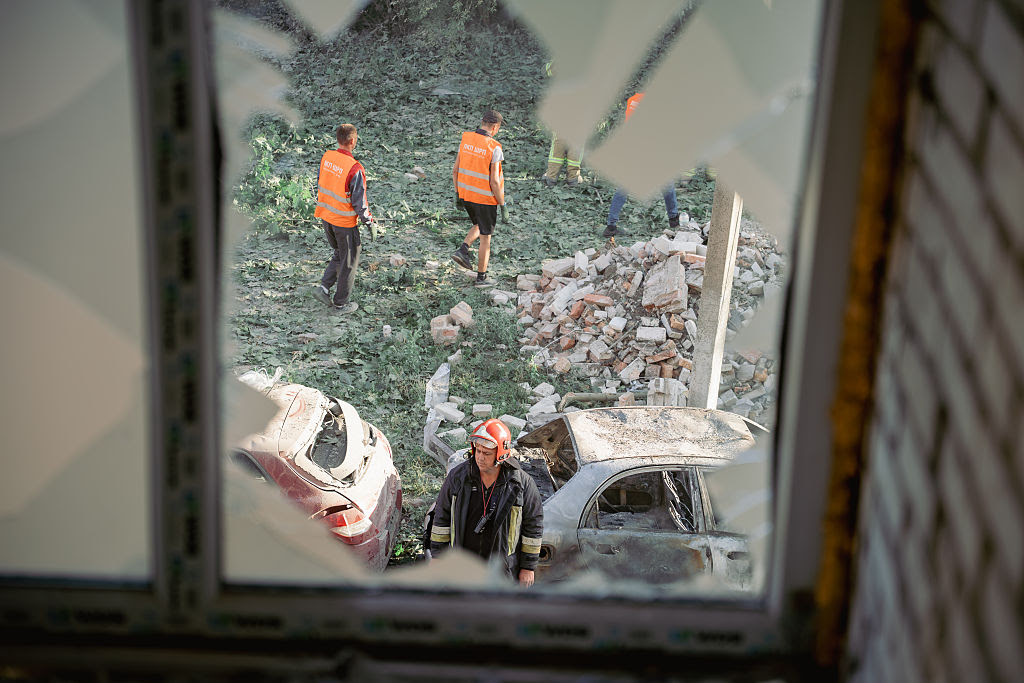
LVIV’S NIGHT: A POLICEMAN IN THE RUBBLE
Multiple explosions tore through Lviv beginning around 4:40 a.m., roughly 70 kilometers from the Polish border, striking two high-rise residential buildings on Paton and Vyhovskoho streets. At least 38 people were injured, 14 of them hospitalized. Rescue crews spent the day searching the rubble on Paton Street, where residents said people remained trapped for hours; by evening, Mayor Andrii Sadovyi confirmed the body of 35-year-old police officer Volodymyr Shandra had been recovered from the wreckage.
Rescuers and municipal workers stand outside a damaged apartment building after a Russian missile attack in Lviv, Ukraine. (Maria Derhachova / Global Images Ukraine / Getty Images)
“I didn’t hear the alert because I was asleep,” 67-year-old resident Iryna Yefimenko told reporters, describing how a window flew into her room after something struck her on the head. “When I went to bed last night, I never thought that by morning I’d be left barefoot, with nothing. My home was completely torn apart.” Explosions followed almost immediately afterward in Ivano-Frankivsk, in the far western oblast that borders Romania — a reminder that this strike reached corners of the country that rarely see this kind of violence at all.
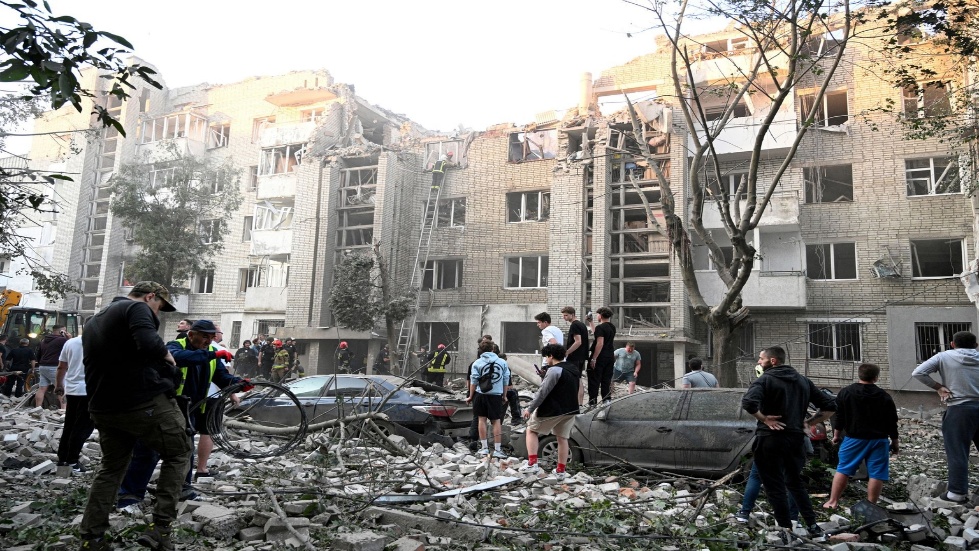
Local residents watch as first responders operate at a residential building partially destroyed by Russian missile strikes in Lviv, Ukraine. (Yuriy Dyachyshyn / AFP / Getty Images)
KYIV, BROVARY, AND POLTAVA: THE REST OF THE NIGHT’S TOLL
Kyiv absorbed two separate waves of explosions overnight, the first around 1:18 a.m. and a second around 3:50 a.m., killing one person and injuring two to three more. Fires broke out at a garage in the Sviatoshynskyi district and at a market in Obolon, where a 63-year-old vendor named Svitlana watched two decades of hand-collected antiques burn. “You spend 20 years collecting, searching, looking for these things. And now we have been left with nothing,” she said, describing wooden display cabinets, crystal, porcelain, icons, and paintings reduced to ash. “These things have a soul.” On Kyiv’s outskirts, in Brovary, three homes were damaged and five people injured, including a child.
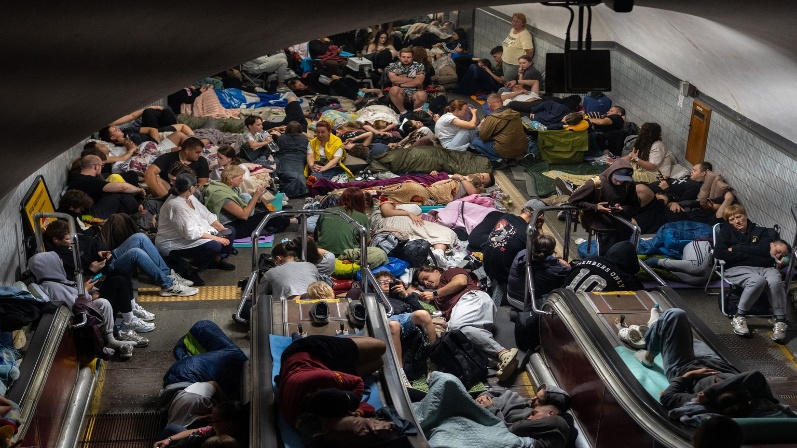
People take shelter at a metro station during a Russian missile strike on Kyiv, Ukraine, early. (Oleksii Filippov / AFP / Getty Images)
In Poltava, Russian drones struck warehouse facilities belonging to a local enterprise, killing one person, and hit a Nova Poshta logistics terminal without causing injuries there. Zelensky said preliminary counts nationwide stood at eight dead and dozens wounded even before Radushne’s full toll was confirmed. “This Russian evil can only be stopped by the whole world. No one in the world can be left alone against such terror,” he wrote. “When we say that Ukraine needs Patriot missiles, we are not talking about abstractions — we are talking about precisely such families.”
DRAPATYI CLEARS HOUSE
Ukraine’s new commander-in-chief made his authority felt for the first time this week, relieving three senior generals in quick succession: Major General Oleksandr Gruzevych as chief of staff and deputy commander of the Land Forces, Major General Volodymyr Karpenko as commander of the Logistics Forces, and Major General Andriy Malinovsky from his secondment overseeing Ukraine’s long-range strike campaign at the General Staff. Ukrainian media reported that a presidential decree will create an entirely new command structure specifically to coordinate long-range strikes going forward, rather than leaving that coordination split across existing departments.
The military shuffle came alongside a wider government one: Ukraine’s Cabinet approved human rights activist Lyubov Halan and defense-industry manager Serhiy Boiev as new deputy defense ministers, while Zelensky separately appointed former Economy Minister Oleksiy Sobolev as deputy head of the presidential office, Olena Voronova to run the SBU’s personnel department, and Brigadier General Oleh Fedoriv to lead the SBU’s Alpha Special Operations Center — the same elite unit new Defense Minister Yevhen Khmara used to command. A week after Syrskyi’s removal, Ukraine’s military and security leadership is being rebuilt almost entirely from the top down.
ANOTHER REGIMENT, ANOTHER SCANDAL
A fresh investigation by Ukrainian outlet Texty accused the commander of Ukraine’s 225th Assault Regiment, Oleh Shyriaiev, of ordering troops to fire on their own retreating soldiers — a practice sometimes called “blocking forces” or “nullifying,” first associated with Russia’s Wagner mercenaries at Bakhmut and now, according to multiple soldier testimonies, present inside at least one of Ukraine’s own units. “There are no ‘our own,'” a voice recording attributed to Shyriaiev tells troops in the leaked message, sent while the regiment fought in Russia’s Kursk Oblast. “Anything that’s moving is the enemy. Anyone fleeing their positions is a deserter — and they’re the enemy too.”
Shyriaiev has denied the allegation, telling the outlet the message referred to Russian soldiers disguising themselves in Ukrainian uniforms to infiltrate front-line positions. The regiment itself acknowledged one beating incident within its Shkval battalion and said an internal investigation was underway, while declining to comment further. It’s the second such investigation into one of Ukraine’s large assault regiments in as many months, following the 425th Regiment’s “Skelia” scandal — and it lands one day after Drapatyi’s General Staff announced an audit of exactly this kind of unit, an effort that suddenly looks less like routine housekeeping and more like an urgent necessity.
EIGHTEEN OFFICERS KILLED IN ONE STRIKE
Ukrainian forces killed at least 18 Russian military personnel — including a regiment commander, his deputy for logistics, and a medical company commander — in a single precision strike on a Russian personnel concentration in occupied Lysychansk, Luhansk Oblast, using a GBU-64 guided bomb. Dozens of other Russian officers were reportedly wounded in the same strike. It’s an unusually senior casualty count for a single hit, and one that briefly knocked out an entire regiment’s command structure at once.
Elsewhere along the strike campaign into Russia itself, Ukrainian forces hit the Taman seaport in Krasnodar Krai, including the Tamanneftegaz oil export terminal, sparking fires visible in satellite heat-anomaly data. The Financial Times, reviewing photographs, satellite imagery, and thermal data, reported that Ukrainian strikes have now disabled more than 30 percent of Russia’s actual oil refining capacity and 45 percent of its nominal capacity — damage that, at ten of Russia’s largest refineries, has persisted for weeks or months after the original strikes rather than being quickly repaired.
CRIMEA’S GRID BUCKLES FURTHER
Ukraine’s siege of occupied Crimea’s infrastructure kept expanding. Commander Robert “Magyar” Brovdi’s forces struck 10 energy facilities across occupied Ukrainian territory over two days, six of them in Crimea, alongside a naval drone base near Snizhne and radar shelters near Okhotnyche; Ukrainian military intelligence separately confirmed the destruction of a Murmansk-BM electronic warfare system near Cape Fiolent, a system capable of jamming signals at ranges up to 5,000 kilometers. The resulting power restrictions stopped trams running in Yevpatoria for nearly two hours, and Russia briefly closed the Kerch Bridge as explosions rocked the peninsula and air defenses opened fire over Sevastopol.
Crimea’s own occupation authorities are reportedly admitting they can’t keep up: Radio Free Europe’s Crimea service reported that occupation head Sergei Aksyonov has approved a plan shifting air defense responsibility onto local Crimean authorities, since the regional BARS-Crimea reserve formation can no longer adequately protect the peninsula’s infrastructure on its own. Separately, Ukrainian forces struck four more Russian tankers overnight, bringing the total hit since the campaign began July 6 to 205 vessels.
UKRAINE’S MONEY FOR THE FIGHT: EU’S LATEST BILLIONS
Ukraine received a fresh €3.47 billion tranche from the European Union’s €90 billion wartime loan program, Prime Minister Serhii Koretskyi announced, earmarked for drones — including long-range jet-powered models — missiles, and Sweden’s Gripen fighter jets. The EU separately approved changes unlocking an additional €8.3 billion in financing for 2026 under a broader “Ukraine Plan” that also adds new reform requirements around rule of law and anti-corruption measures Kyiv must meet to keep the money flowing. “Today’s decision reaffirms the European Union’s confidence in Ukraine’s reform efforts,” Koretskyi said.
It’s the kind of financial architecture that rarely makes for dramatic headlines next to a missile striking a family home, but it’s the machinery that keeps everything else — the drones, the Gripens, the government payroll — actually functioning through a fifth year of war.
WASHINGTON’S ENVOYS, FINALLY BOUND FOR KYIV
Trump administration envoys Steve Witkoff and Jared Kushner are expected to make their first-ever visit to Kyiv in the second half of August, timed to coincide with Ukraine’s 35th anniversary of independence from the Soviet Union, according to reporting citing people familiar with the plans; Ukraine’s ambassador to Washington confirmed the intention but said no firm date has been set. Both envoys have visited Moscow multiple times to meet Putin directly but have never once traveled to Ukraine itself — a gap Zelensky reportedly raised directly with Trump during their White House meeting on July 28, which people familiar with the discussions called one of the meeting’s few concrete outcomes. Laura Loomer, the Trump ally whose views on the war reversed after visiting Ukraine, has also personally pressed Trump on the idea: “If other high-level diplomats could come here, they could too,” she reportedly told him by phone from Kyiv.
A US FACTORY BECOMES A TARGET
A Russian ballistic missile destroyed a drone factory in Kyiv belonging to Terminal Autonomy, a US corporation registered in Delaware that builds AI-guided precision strike drones designed to keep operating after Russian jamming — the first known Russian strike specifically on a US-owned military manufacturer inside Ukraine. No one was hurt. “The Russians don’t care who owns the manufacturing facility. It’s still a target,” said Anthony Vinci, a former senior US intelligence official, noting it joins a growing list of American-linked companies Russia has struck in Ukraine since mid-2025, including facilities tied to Coca-Cola, Boeing, Mondelez, and Philip Morris. Russian state media confirmed the strike days earlier without disclosing the plant’s American ownership, describing it only as employing “specialists from a Ukrainian-American company.”
WILDBERRIES: THE LIST OF CITIES KEEPS GROWING
Ukraine’s drone campaign against Wildberries added two more cities to its map overnight, striking logistics hubs in Penza Oblast and the Republic of Udmurt, with further strikes reported in Volgograd and Tatarstan the same week. Leningrad Oblast’s governor said roughly 1,500 local sellers have already lost merchandise to the fires. Russian authorities, rather than reinforcing air defenses around the facilities, spent the week focused on managing the consumer fallout instead — Deputy Prime Minister Alexander Novak chaired a government meeting specifically on stabilizing the retail sector’s finances, a response ISW noted prioritizes Wildberries’ shoppers over the actual vulnerability Ukraine keeps exploiting.
WHAT THIS NIGHT COST, AND WHAT IT WARNED
By the time Thursday’s sun came up over Radushne, there was no longer a house there to search, only a foundation and a village chat full of neighbors confirming, one message at a time, that an entire family was gone. Lviv buried a policeman. Kyiv buried a stranger to most of the country and grieved a stall of broken porcelain. And a missile that was never supposed to land in Poland did anyway, landing softly enough in an empty field to kill no one and loudly enough to remind an entire alliance that its own safety was never as separate from this war as anyone wanted to believe. Command changed hands in Kyiv today too, and a second regiment stands accused of turning its weapons on its own. None of it undoes what Radushne lost. All of it will still be there tomorrow, waiting to be added to whatever comes next.
A PRAYER FOR UKRAINE
1. For the Ten of the Voronov Family
Lord, an entire household — two parents, seven children, and a grandson not yet two years old — was erased in a single instant, in a home meant to be the safest place they knew. We have no words equal to a loss this complete, and we do not pretend to. Receive Artem, Olena, and their children by name, each one known fully to You. Hold Matvii and every surviving relative through a grief that arrived through a stranger’s message in a group chat, and let this family’s names be spoken long after tonight’s news cycle forgets them.
2. For Officer Shandra, and Every Rescuer Still Searching Lviv’s Rubble
Father, a police officer died beneath a building that was supposed to keep his neighbors safe, and rescue crews spent the day searching for others who might still be found. Comfort his family and colleagues, and grant strength to every rescuer still working through rubble in Lviv tonight. Let their exhaustion be met with rest, and their search be met with mercy, whatever they still find.
3. For a Continent Now Sharing Ukraine’s Sky
Lord of nations, a missile crossed a border it was never supposed to cross, and landed softly enough that no one died, though it easily could have. Use this near miss to move hearts that have been slow to act, in Warsaw and everywhere else watching this war edge closer to home. Protect every country now realizing, for the first time, how close this danger actually sits.
4. For the Soldiers Silenced by Their Own Side
God of justice, more Ukrainian soldiers have come forward this week describing violence from the very comrades meant to fight beside them, in a second regiment now facing the same accusations as the first. Give courage to every soldier still deciding whether to speak, and wisdom to the commanders now responsible for making these units safe. Let the truth surface fully, and let it actually change something this time.
5. For a Country Asking, Again, for Enough
God of provision, tonight Ukraine counts a night’s losses against missiles it still cannot fully stop, and asks its allies again for the interceptors that might have changed tonight’s outcome. Move the hearts of those who hold the power to send them, and let the asking not have to happen again after tonight. Give this country patience for a wait that has already gone on far longer than anyone should have to bear.
In Your mercy, in Your justice, in Your time — bring this war to its end, and let the ending be worthy of what Ukraine has endured.