
July 31, 2026
Prepared by Diana Bozhyk
Russian ballistic missiles struck five Kyiv districts overnight, killing nine people and wounding 28 — the second mass strike on the capital in three days. Hours earlier, President Trump told his own Cabinet that Washington had “not agreed” to license Ukraine’s domestic Patriot production, directly contradicting what Zelensky said after their White House meeting just three days ago. In Kharkiv, a 69-year-old man recruited by Russian intelligence tried to assassinate a decorated Ukrainian corps commander with a pistol that jammed at the critical moment. And in Kyiv’s streets, protesters demanding Mykhailo Fedorov’s reinstatement returned in their largest numbers yet, sixteen days into a movement Zelensky’s own advisors expected to fade by now.
THE DAY’S RECKONING
Kyiv had barely finished counting Thursday’s dead when Saturday delivered its own barrage — ten explosions in quick succession before dawn, car alarms echoing across the city, a five-story building in Solomianskyi partially collapsing into fire. By the time rescuers finished pulling 35 people from its upper floors, the toll across five districts stood at nine dead and 28 wounded, four of them children. In Radushne, where an entire family had been erased two days earlier, residents gathered instead to leave flowers and children’s toys at what used to be a house, while the family’s surviving son, a soldier named Danylo, arrived to learn he had lost everyone: parents, seven siblings, and his own year-and-a-half-old son. In Washington, President Trump told reporters at Camp David that handing Ukraine the technology to build its own Patriot interceptors was “a hard thing to give away” — three days after Zelensky said Trump had already agreed to it. And in Kharkiv, a jammed pistol was the only thing standing between a Ukrainian corps commander and an assassin recruited over the internet by people pretending to be his own security service. Some days this war repeats itself. This one repeated itself twice before lunch.
KYIV STRUCK AGAIN: NINE DEAD IN A SECOND BALLISTIC BARRAGE
Russian ballistic missiles hit five Kyiv districts in the early hours of Saturday, the second mass strike on the capital in three days. Seven people were killed in the Darnytskyi district and two in Solomianskyi, according to Ukraine’s State Emergency Service; 28 people were wounded in total, including four children, with 17 hospitalized. AFP journalists in the city counted more than ten explosions in a row, forceful enough to set off car alarms across Kyiv.
In Solomianskyi, a five-story residential building partially collapsed and caught fire; rescuers evacuated 35 people from its upper floors, three requiring hospitalization. Darnytskyi took the worst of it — an administrative building and a nearby structure were destroyed, cars burned, a crater opened in a public square, and fires broke out along an entire street. In Shevchenkivskyi, fires spread through a non-residential building and a film studio; ambulances themselves caught fire responding to the scene. It was Kyiv’s second mass-casualty night in three days, following Thursday’s attack on Radushne, Lviv, and the capital itself.
RADUSHNE AND LVIV, ONE DAY LATER
A day of mourning was declared across the Kryvyi Rih district, and residents of Radushne spent it gathered beside the ruins of the Voronov family home, leaving flowers, children’s drawings, and a toy for each of the seven children who died there. Six family members were confirmed dead by Friday — the parents, Artem and Olena, along with children Mark, Azarii Ilai, and Emilia — while identification work continued on the rest given the scale of the destruction. The family’s dog was found alive in the wreckage.
“The family was wonderful. There was always life there,” neighbor Liudmyla told public broadcaster Suspilne, recalling that Olena had returned from visiting an older daughter in Germany just one day before the strike. The couple’s eldest son, Ukrainian serviceman Danylo Voronov, was away with his wife when the missile hit; his own young son had been staying with his grandparents, due to come home that weekend. “I lost everyone: my parents, sisters, brothers and son,” Danylo said, arriving at what remained of his childhood home. He recalled plans to go fishing with a brother and play chess with his father on his next visit. In Lviv, search-and-rescue operations continued for a second day through the rubble of the high-rises hit Thursday, as the city absorbed what its own losses had already made clear: this war’s reach no longer respects distance from the front line.
AN ASSASSINATION ATTEMPT FOILED BY A JAMMED GUN
Colonel Ihor Oboliensky, commander of Ukraine’s 2nd Khartiia Corps and a Hero of Ukraine decorated just two weeks earlier, survived an assassination attempt in Kharkiv when his attacker’s pistol malfunctioned at the moment of the attack. Ukrainian police detained a 69-year-old local man near a barbershop; according to Ukrainska Pravda, he had been recruited by Russian intelligence officers posing as Ukraine’s own Security Service, who convinced him Oboliensky was a “traitor” using an AI-generated image showing the commander standing beside the Kremlin in Russian-themed clothing. The attacker approached Oboliensky from behind with a Makarov pistol before the weapon failed to fire; both he and an accomplice are now in custody.
“We will definitely respond to this attempted strike against Ukraine and a Ukrainian commander,” Zelensky said, thanking Oboliensky for his service and urging him to strike occupying forces “even harder.” It’s not an isolated case: Russian intelligence has repeatedly recruited Ukrainian citizens this year for similar plots, including attempts on military intelligence officer Andrii Yusov and Third Army Corps commander Andrii Biletskyi. Oboliensky, who has fought Russian forces since 2014 and helped build the volunteer brigade that became the Khartiia Corps, was in the middle of one of the most contested stretches of the front when someone he never saw coming nearly ended his war entirely.
TRUMP WALKS BACK THE PATRIOT LICENSE
Three days after Zelensky said Trump had “accepted that he will give us licenses” for Ukraine to build its own Patriot interceptors, Trump told his Cabinet the opposite. “We have not agreed to that. We’re talking about it, but it’s a hard thing to give away that kind of technology,” he said at Camp David, calling it a “big step” and adding, unprompted, that recipients of such technology “can someday turn on you.” He’d told the Financial Times something similar two days earlier: “We’re not sure” about the license, framing Patriot production as something the US doesn’t typically outsource at all.
It’s a real reversal from the language Trump used at the NATO summit in Ankara on July 8 — “We’re gonna give a license to you to make Patriots… this way you can’t complain that we’re not giving you enough” — and from what Zelensky described after their July 28 Oval Office meeting. Currently only Japan and Germany hold licenses to build Patriots outside the US. Hours after Trump’s Cabinet remarks, Zelensky held what he called a “productive” call with Vice President JD Vance about air defense, describing it afterward in careful, diplomatic terms that avoided any direct mention of the reversal. Ukrainian officials told reporters the July 28 meeting’s one clear outcome wasn’t Patriots at all, but a promise that Trump’s envoys would finally visit Kyiv.
THE REGIONAL TOLL BEYOND KYIV
Away from the capital, Russian attacks killed at least nine more people and wounded 48 across seven other regions over the same 24 hours. Kherson Oblast took the heaviest toll, with strikes on 49 settlements killing four and wounding five; Dnipropetrovsk Oblast’s Nikopol district lost three people with seven wounded, while Pavlohrad separately lost two with five wounded after a glide bomb tore through an apartment building between its second and third floors, destroying four residences outright. Sumy Oblast reported nine wounded across two communities, ranging in age from 23 to 63; Kharkiv Oblast reported injuries in three separate villages including a 72-year-old woman; Zaporizhzhia Oblast reported six wounded, Donetsk Oblast five across three towns, and Chernihiv Oblast four after a Gerbera drone strike on Semenivka.
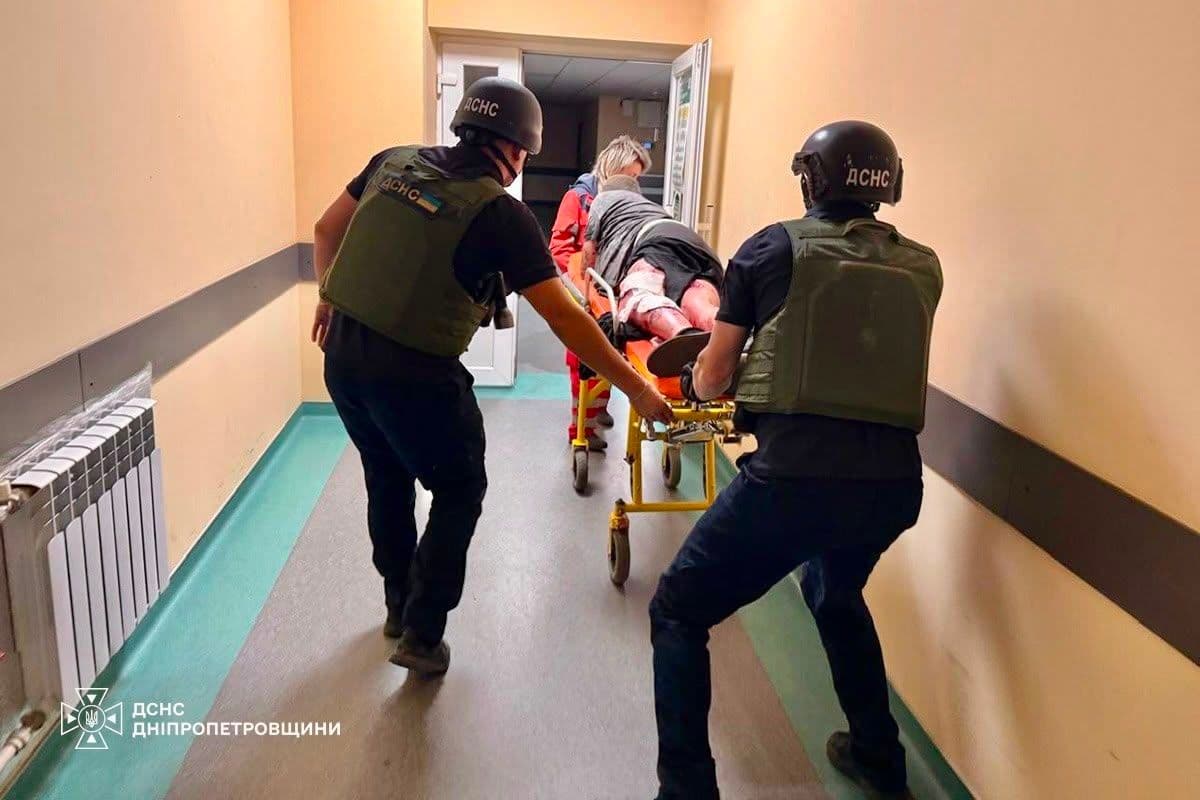
Ukraine’s State Emergency Service personnel evacuate an injured man after a Russian attack on the Nikopol district of Dnipropetrovsk Oblast overnight. (Ukraine’s State Emergency Service/Telegram)
None of these losses individually made international headlines next to Kyiv’s night or Radushne’s mourning. Stacked together across a single 24-hour window, they’re the ordinary arithmetic of a war that keeps demanding new sums even on its quieter days.
DRAPATYI HALTS RECRUITMENT TO THE REGIMENTS UNDER SCRUTINY
Commander-in-Chief Mykhailo Drapatyi ordered assault regiments across Ukraine’s Ground Forces to suspend new recruitment starting July 26, according to Ukrainska Pravda, citing sources in four units. Assault units can no longer draw personnel from reserve battalions or territorial recruitment centers, and transfers from other units have also been frozen; the only remaining path in is a program for soldiers returning from unauthorized absence before mid-June. It’s the first time Ukraine’s top military command has moved to restrict how assault regiments replenish their ranks.
The order lands directly on the two units at the center of this month’s abuse scandals: the 425th “Skelia” Regiment, which grew from an intended 3,000 to 4,000 troops to more than 10,000 under former Commander-in-Chief Syrskyi, and the 225th Regiment now facing its own accusations of soldiers being shot for retreating. Both units were widely seen as having received outsized autonomy and resources under Syrskyi’s command, while other assault units with comparable battlefield records, like the 1st Separate and 475th regiments, never got the same authorization to keep expanding. Sources inside the affected regiments told the outlet some personnel are now openly wondering whether their units will be broken up entirely under Drapatyi. General Staff sources, however, told a separate outlet, Babel, that no official order suspending recruitment had actually been issued — a discrepancy neither side has yet resolved publicly, even as the General Staff’s own July 29 audit of unit staffing continues in parallel.
SIXTEEN DAYS AND GROWING: PROTESTS SURGE BACK TO THOUSANDS
Protesters returned to Kyiv’s streets for what organizers called a “march for dialogue and reforms in defense” — the sixteenth consecutive day of demonstrations demanding Fedorov’s reinstatement, and, after several recent gatherings that drew only hundreds, a crowd that swelled back into the thousands. “I call on Volodymyr Zelensky to hear his people and continue the dialogue with Fedorov,” organizer Dmytro Koziatynskyi said, proposing a specific compromise: give Fedorov a year to carry out reforms, then judge him on results.
The renewed energy followed an interview Fedorov gave two days earlier suggesting his own push for transparency in defense procurement may have been what got him fired. “It’s true that many people in our country are involved in the defense industry. It’s true that there were different indications, and many events took place at the Defense Ministry,” he said, stopping just short of naming names. Zelensky has offered no fuller explanation beyond citing a conflict with Syrskyi — a conflict that, with Syrskyi gone, no longer has an obvious second party, and a silence that sixteen days of marching has done nothing to fill.
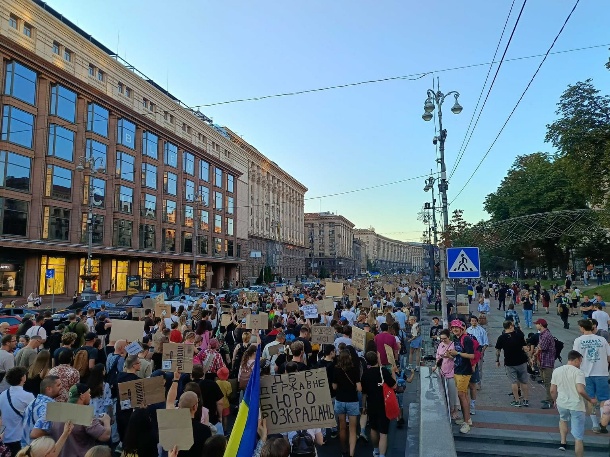
Protestors marching in Kyiv, as protests enter their third week. (Oleg Sukhov / The Kyiv Independent)
POLAND: “AN ALLIANCE TEST”
Polish officials confirmed with finality what had been suspected since Thursday night: the object that crashed near Tarnawa-Kolonia was a Russian Kh-101 cruise missile. “Today, the Polish Foreign Ministry summoned the Russian ambassador in connection with the missile that hit Polish territory yesterday,” Prime Minister Tusk wrote, while Deputy Defense Minister Cezary Tomczyk went further in tone: “It was a provocation, an intention, an alliance test. Let’s not have any illusions — this type of situation, or such provocations, will happen again.”
New detail emerged about just how close the incident came to escalating further. Roughly 20 Russian missiles flew toward Poland during the same overnight barrage that ultimately launched 70 nationwide; Polish forces intercepted most before they reached Polish airspace, but one slipped through. A Ukrainian fighter pilot had been tracking that missile toward the border and broke off pursuit only 20 seconds before it would have crossed into Polish territory — wary that Poland’s own F-16s might mistake his aircraft for the threat itself. Ukraine’s foreign minister, Andrii Sybiha, spoke by phone with his Polish counterpart Radoslaw Sikorski, pledging full cooperation with the investigation — a notably warmer exchange than the strained relationship that had defined Kyiv-Warsaw contact just weeks earlier.
DEEP STRIKES: VOLGOGRAD, TAMAN, AND AN AIRCRAFT PLANT IN CRIMEA
Ukraine’s SBU claimed a coordinated overnight operation striking three targets at once: the Lukoil-Volgogradneftepererabotka refinery in Volgograd, one of Russia’s largest with an annual capacity of 15 million metric tons; two aircraft storage hangars and a production facility at an aircraft plant in occupied Yevpatoria, Crimea; and the port of Taman in Krasnodar Krai, where a large fire broke out at an oil storage facility. Volgograd’s governor said the strike there killed one woman and wounded eight more, along with hitting an unspecified industrial facility and warehouse. Zelensky separately confirmed strikes on logistics centers in Sarapul, Kazan, and Volgograd — between 500 and 1,300 kilometers from Ukraine — without clarifying whether they were Wildberries facilities specifically.
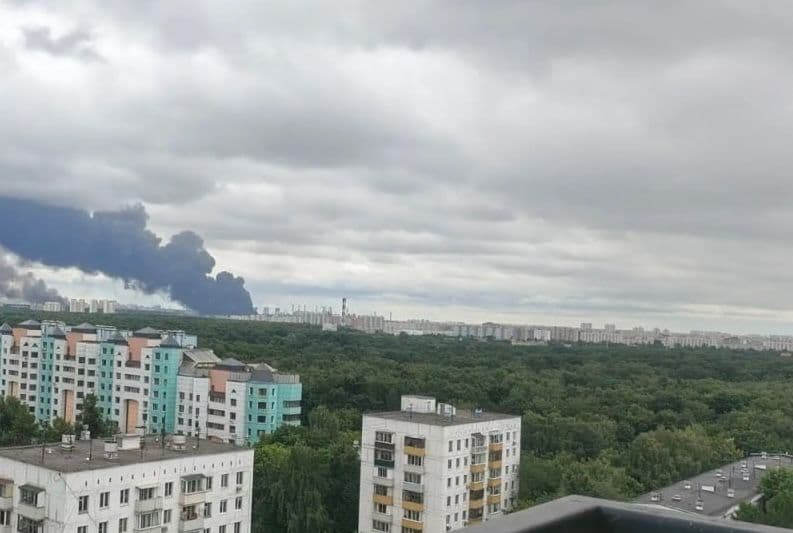
Smoke rises above the reported site of an oil refinery in Russia’s Volgograd Oblast following an overnight attack by Ukrainian forces. (Exilenova+/Telegram)
A fire also broke out at the Nizhnekamskneftekhim petrochemical plant in Tatarstan, owned by Russian conglomerate Sibur; independent Russian monitors said it was likely triggered by cumulative damage from a series of recent drone strikes on the same industrial zone rather than a single new hit. It’s the kind of secondary damage that’s becoming its own pattern — facilities failing not from the strike that hits them, but from the strain of repeated ones.
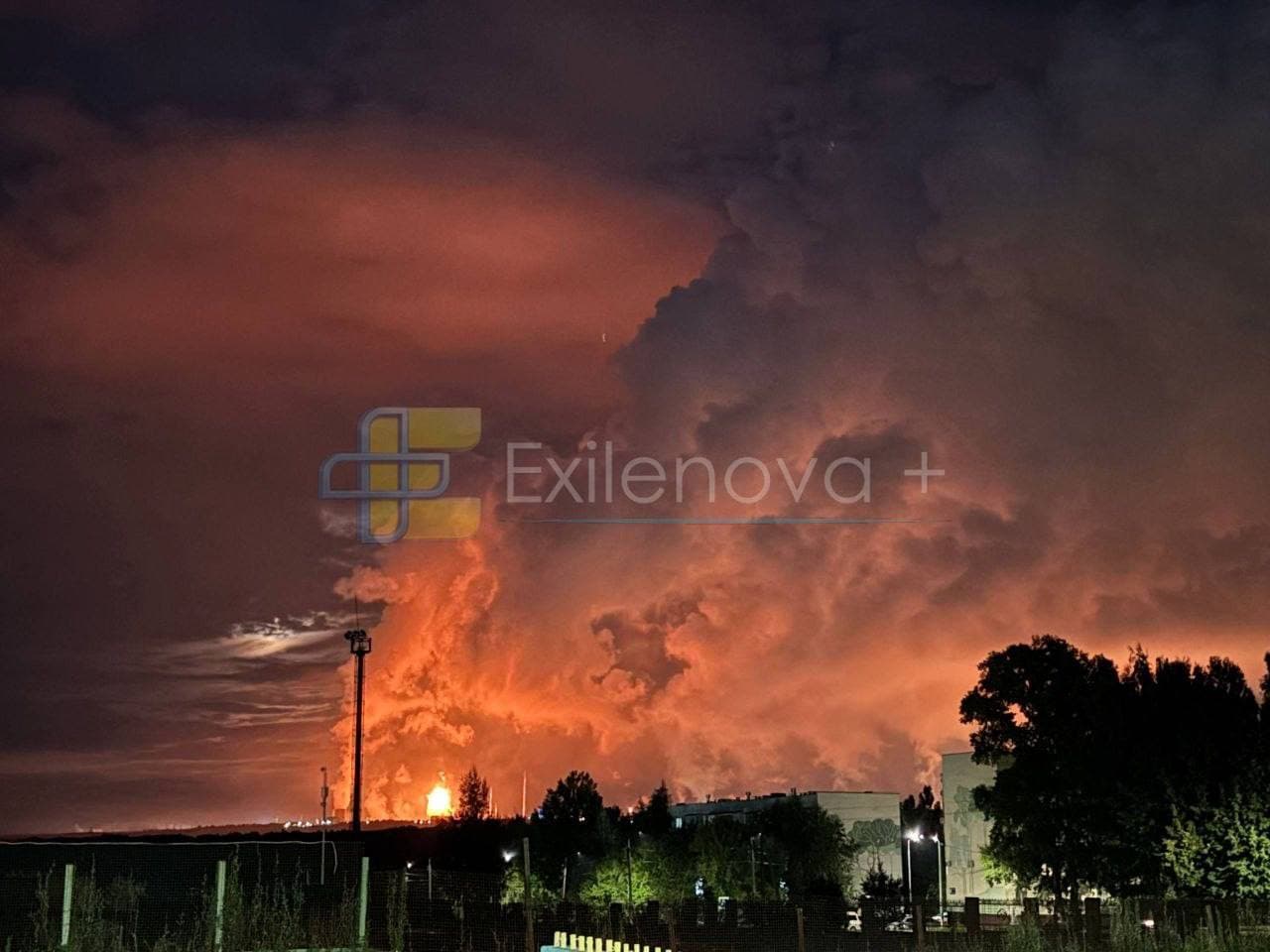
Photo from local residents reportedly shows flames and clouds of smoke rising over the Nizhnekamskneftekhim (NKNK) synthetic rubber plant in the Russian city of Nizhnekamsk, Tatarstan. (Exilenova-Plus / Telegram)
WILDBERRIES’ RICHEST WOMAN RESPONDS
Tatiana Kim, the founder and CEO of Wildberries and Russia’s wealthiest woman, addressed the strikes on her company’s warehouses directly for the first time, calling Ukraine’s campaign a “terrorist attack” and insisting sellers who lost merchandise won’t be compensated. “Attacks against us are attacks against hundreds of millions of people in ten countries at once,” she said in a video message, arguing the strikes qualify as force majeure regardless of what her company’s terms of service say, and pointing sellers instead toward eventual Russian government support.
Independent Russian outlet Agentstvo’s own analysis, published the same day, undercuts her framing of scattered bad luck: Ukrainian strikes have now damaged 10 of Wildberries’ 26 largest warehouses, totaling 38 percent of its major storage capacity, with three more warehouses targeted but still operational. Sixty percent of the company’s major warehouse space, by the outlet’s count, has now been hit or targeted directly. Kim maintained her warehouses are “successfully repelling most” attacks and dismissed the military-logistics rationale Ukraine has given for the campaign, comparing Wildberries to Amazon or Alibaba. Whether that comparison holds is a legal question international law leaves open to exactly this kind of dispute — civilian infrastructure that materially supports a military campaign can become a lawful target under the same laws of war Kim’s own government claims to respect.
PUTIN’S NUMBERS SLIP
Even Russia’s own state-linked pollsters are recording real movement against Putin. The Kremlin-aligned Public Opinion Foundation found his approval rating fell five percentage points in a single week, from 71 to 66 percent — the steepest weekly drop since Russia’s partial mobilization in 2022 — while state pollster VTsIOM recorded three straight weeks of decline, down to 65.1 percent from 70.4 in mid-June. Support for Putin’s own party, United Russia, sits at 35.3 percent ahead of September elections, well below the nearly 50 percent it won in 2021.
Analysts caution the polling methodology itself likely still understates real dissatisfaction — in-person interviews in an authoritarian state rarely capture honest answers — but the trend line is now too consistent to dismiss. Fuel shortages topped Russians’ list of concerns for a second straight week, ahead of the war itself. Separately, Ukrainian partisan network Atesh reported that the Kremlin plans to remove Crimea’s occupation head, Sergei Aksyonov, after September’s elections, positioning him to absorb blame for the peninsula’s collapsing electricity, water, and fuel supplies — a scapegoating strategy timed specifically to avoid instability during the vote itself. Crimean hotel bookings, meanwhile, have fallen more than 70 percent compared to last July.
ZELENSKY’S NEW CASUALTY COUNT
In an interview with Fox News, Zelensky offered a new estimate of Ukraine’s wartime losses: roughly 50,000 service members killed and about 400,000 wounded, with a large number still missing — a lower killed-in-action figure than the 55,000 he cited five months earlier, though he declined to explain the discrepancy in detail. “I don’t want to be very open about it because Russia will understand what’s going on with our army,” he said. He estimated Russian losses at 1.6 million total casualties, including roughly 700,000 killed.
The Washington-based Center for Strategic and International Studies offers its own independent estimate: Russia at 1.4 million casualties including up to 450,000 killed, Ukraine between 525,000 and 625,000 including 125,000 to 150,000 killed — combined losses on both sides now exceeding 2 million people. Asked directly whether Ukraine is winning, Zelensky settled on something between confidence and honesty: “We are not losing, and they are not winning.”
AN AMMUNITION GROUND IN KHMELNYTSKYI
Three Ukrainian Special Operations Forces soldiers were injured and contact was lost with five more after ammunition began detonating at a training ground in Khmelnytskyi Oblast, western Ukraine, starting around noon and continuing intermittently until 7 p.m. Ukraine’s State Bureau of Investigation opened a criminal case into possible violations of weapons-handling protocol; the mayor said there were no confirmed fatalities, though several residential and municipal buildings sustained damage and police cordoned off the area as a precaution. It’s the second major ammunition detonation incident in a month, following a Russian strike on a warehouse in Vyshneve on July 6 that killed seven people through secondary explosions.
Elsewhere, Ukraine’s defense industry notched a quieter milestone: Ukrainian manufacturer F-Drones delivered the first 2,000 F10 first-person-view drones to the US military, the initial shipment under the Pentagon’s Drone Dominance Program, which plans to keep purchasing small lethal drones through 2028. It’s the first Ukrainian-made drone to receive official US export approval — a small sign that four years into this war, the flow of battlefield expertise has started running in both directions.
WHAT TWO DAYS RUNNING HAVE COST
By the time Saturday’s smoke cleared over five Kyiv districts, the country had absorbed its second mass-casualty night in three days, and Washington had spent the same 48 hours quietly taking back what it had seemed to promise. Radushne buried what was left to bury. Kharkiv’s Oboliensky is alive because of a gun that didn’t fire. Sixteen days of protest grew larger instead of smaller, and a commander-in-chief still new to his job spent the week trying to fix an army built by the man before him. None of it stopped the missiles. None of it was ever going to, on its own.
A PRAYER FOR UKRAINE
1. For Every Family Counted Twice in Three Days
Lord, Kyiv buried people from Thursday’s strike and then, before the grief had even settled, buried more from Saturday’s — nine more names, four of them children among the wounded. Hold every family now doing this math twice over, and every rescuer who has pulled bodies from rubble on both nights without a real chance to rest between them. Let exhaustion not become numbness, in this city or in the hearts of those still watching from farther away.
2. For Danylo, Who Lost Everyone
Father, a soldier came home to find his parents, his siblings, and his own son gone, all at once, all in the house he grew up in. There is no comfort equal to a loss this total, and we do not pretend to offer one. Hold Danylo through whatever comes after “I lost everyone,” and let him find people around him willing to simply stay close, without trying to fix what cannot be fixed.
3. For the Commander a Jammed Gun Kept Alive
Lord of providence, one weapon failed to fire today, and a man who has fought since 2014 is still breathing because of it. Thank You for that mercy, however it arrived. Protect every commander and soldier being hunted not on the battlefield but by name, in the quiet, deliberate way this war has learned to reach people far from the front.
4. For Sixteen Days of People Still Showing Up
Lord, a movement some expected to fade instead grew larger today, filled with people asking their own government for honesty rather than victory, for reform rather than revenge. Give patience to everyone still marching after sixteen days without an answer, and humility to everyone with the power to actually give them one. Let this argument, however it resolves, leave Ukraine more accountable to itself, not less.
5. For a Country Told “Not Yet” Once Again
God of provision, tonight Ukraine hears that a promise it believed was made may not have been a promise after all, while missiles it still cannot fully stop keep finding new streets to land on regardless of what gets decided in faraway rooms. Move the hearts of those holding this decision, and give Ukraine’s people patience for a wait that keeps getting longer rather than shorter.
In Your mercy, in Your justice, in Your time — bring this war to its end, and let the ending be worthy of what Ukraine has endured.