
UKRAINE DAILY BRIEFING — TUESDAY, AUGUST 25, 2026
A U.S. Air Force jet touched down in Moscow on Tuesday morning carrying, sources say, the CIA director himself — on a trip nobody in Washington or the Kremlin would confirm, while Kyiv quietly agreed to hold its fire on the Russian capital until he left. Hours later, Ukraine got news it’s wanted for months: France and Britain formally cleared the way for Kyiv to build its own long-range Storm Shadow missiles at home. And through all of it, Russia answered in the oldest currency of this war — 150 drones and two ballistic missiles, aimed at cities that had nothing to do with any of it.
The Day’s Reckoning
It’s a little after ten in the morning in Moscow, and a U.S. military transport plane has just landed at Vnukovo Airport — the kind of airport where convoys with diplomatic license plates slip out a back gate before anyone official says a word. Neither Washington nor the Kremlin will confirm who was on board. But sources say it was CIA Director John Ratcliffe, on his first known trip to Russia, and Kyiv had been quietly asked to hold its punches on Moscow and St. Petersburg until he was gone.
That wasn’t the only quiet handoff of the day. In Kyiv, President Volodymyr Zelensky stood next to Estonia’s president and announced that France and Britain had finally agreed to let Ukraine build its own Storm Shadow missiles — cruise missiles that can hit a target 155 miles away in the dead of night. And while diplomats traded secrets and technology, Russia answered in the oldest currency of this war: 150 drones and two ballistic missiles, aimed at cities that had nothing to do with any of it.
Missiles for missiles, secrets for secrets — and civilians underneath all of it, just trying to survive the night.
The Spy Chief Who Wasn’t There
Quick explainer, because this one matters: the CIA director is America’s top spy — the person who runs the agency responsible for gathering intelligence on rivals like Russia. When that person flies to Moscow without warning, it’s not a tourist trip.
On Tuesday, flight-tracking data showed a U.S. Air Force C-17 Globemaster III — a massive cargo plane normally used to haul tanks and helicopters — fly from Riga, Latvia, to Moscow’s Vnukovo Airport, land for about seven and a half hours, and fly back out. Sources told CBS News the passenger was CIA Director John Ratcliffe, making his first known visit to Russia since taking the job. Neither the White House nor the Kremlin would confirm it. Kremlin spokesperson Dmitry Peskov said only, “We have no information about this.”
Here’s the part that matters for Ukraine: Washington reportedly told Kyiv in advance that a high-level delegation was headed to Moscow, and asked Ukraine to hold off on striking Moscow and St. Petersburg between August 24 and 26. “They don’t believe in the strength of Putin’s air defenses,” a source told the Kyiv Independent — meaning Washington didn’t want Ukrainian drones anywhere near the airspace its own plane was using.
This isn’t unprecedented. The CIA has quietly brokered past prisoner swaps between Washington and Moscow, including the 2025 release of dual national Ksenia Karelina and the 2024 exchange that freed journalist Evan Gershkovich. Ratcliffe has also stayed in contact with his Russian counterpart, spy chief Sergei Naryshkin. What Tuesday’s trip was actually about, nobody outside a small circle in Washington and Moscow knows yet. Ukraine has been promised a debrief.
The Missile Ukraine Can Finally Build Itself
For years, Ukraine has had to ask permission every time it wanted to use certain Western weapons — including exactly where and how far they could strike. On Tuesday, one of those leashes came off.
President Zelensky announced that France and the U.K. have agreed to let Ukraine build its own Storm Shadow missiles — known as SCALP in French service — at home. Quick weapons lesson: this is a cruise missile, meaning it flies low and guides itself to a fixed target using onboard navigation, not a ballistic missile that arcs up into space and back down. It can hit something 155 miles away, day or night, in bad weather. Britain’s government confirmed it will let European defense company MBDA share classified details on the British-made parts with Ukrainian engineers, meaning Kyiv could eventually assemble the missile itself instead of waiting on foreign supply lines. The Kremlin called the move “fuel on the fire” and claimed it’s already gathering intelligence on where Ukraine might build them.
It wasn’t the only good news out of Kyiv. Norway confirmed $9 billion in financial support for 2027, some of it earmarked for Freyja — a joint European-Ukrainian project to build an anti-ballistic missile system, similar to America’s Patriot, that could give Ukraine a homegrown answer to Russian ballistic missiles. Zelensky said Ukraine expects a timeline for that project within seven to ten days. He also said Ukraine will receive French Crotale air-defense systems and their VT-1 missiles, along with more AIM and Patriot interceptor missiles — though he didn’t say which country is sending them.
None of this fixes tonight’s air-raid sirens. But it’s the difference between Ukraine borrowing weapons and Ukraine building them.
The Night Russia Threw Everything It Had
While Ukraine’s leaders were shaking hands with allies over new missiles, Russia was loading its own for the night ahead.
Overnight into Tuesday, Russian forces launched an Iskander-M ballistic missile — a short-range missile that can carry a half-ton warhead and hits its target in minutes, too fast for most air defenses to catch — from Rostov Oblast. They also fired a Kh-31P anti-radiation missile, a weapon specifically built to home in on and destroy air-defense radar stations, from Bryansk Oblast. Alongside those came 150 Shahed-, Gerbera-, and Parodiya-type drones — cheap, exploding drones Russia buys or builds by the thousand — launched from four different directions, including occupied Crimea. Ukraine’s air force said it shot down 124 of the drones, but an unspecified number still hit 17 locations, with debris falling at seven more.
The damage landed hardest in Chernihiv Oblast, where Governor Viacheslav Chaus reported 45 separate attacks and 38 people injured. In Chernihiv city, a strike on a high-rise apartment building injured 25 people and shattered windows across the neighborhood. That evening, a drone hit a building housing telecommunications operators in the city of Mena, injuring 12 people — four of them teenagers. “Another absolutely cynical Russian strike,” Chaus said. “The city center, many people, purely civilian objects all around.”
Elsewhere: two dead and 23 injured in Kherson Oblast, two dead in Zaporizhzhia, one dead and 13 injured in Kharkiv Oblast — including a 13-year-old girl — and 15 injured in Donetsk Oblast. In Kyiv, drone debris hit a 16-story residential building, injuring one woman. Across the country, at least five people were killed and 99 injured over the day.
Why Russia’s Refineries Keep Catching Fire
Here’s the trade Ukraine keeps making: if Russia is going to burn Ukrainian cities, Ukraine is going to burn Russia’s fuel supply.
Ukraine’s General Staff confirmed strikes on three Russian oil facilities in the span of a day. The Afipsky Oil Refinery in Krasnodar Krai — one of southern Russia’s largest, processing 6.25 million tons of crude a year, roughly 2% of all Russian refining capacity — caught fire after an overnight drone attack, killing two people and damaging nearby homes and a railway station, according to the regional governor. Farther east, Ukrainian drones damaged two gas-separation units at the Astrakhan Gas Processing Plant, a facility that handles up to 12 billion cubic meters of gas a year. And in Rostov Oblast, a strike forced the Novoshakhtinsk Oil Refinery to fully suspend operations.
Think of it as spending your whole paycheck and then raiding your savings account, over and over: every refinery Ukraine hits is fuel Russia’s military doesn’t get and tax revenue the Kremlin doesn’t collect. It’s also squeezing Russia somewhere less obvious — the grain trade. Ukraine’s foreign intelligence service reported that Russian strikes on its own Black Sea grain terminals — the ports that handle 88% of Russian grain exports — have caused wheat prices in southern Russia to fall 19% in less than a week and cut this year’s export forecast by nearly half.
Russia is already improvising workarounds. Kazakhstan’s energy minister confirmed Tuesday that a refinery there will now process Russian crude and ship 70% of the output back across the border — a sign Ukraine’s strikes are forcing Moscow to outsource its own fuel supply.
Meanwhile, at the Actual Front: A War Measured in Meters
While drones and missiles get the headlines, the ground war is still grinding forward — just barely.
In northern Sumy Oblast, Russian forces kept attacking but made no confirmed gains; Ukraine says it still controls Novokostiantynivka, despite Russia’s repeated claims to have taken it. In Kharkiv Oblast, Russian troops pushed near Zamlianyi Yar without breaking through. North of Kupyansk, Ukrainian forces actually gained ground, retaking territory near Zapadne and Dvorichna. Near Borova, Ukrainian troops likely held or regained several villages despite Russian claims otherwise and kept counterattacking to slow the advance.
In Donetsk Oblast — Russia’s main target since the invasion began — fighting continued around Lyman, Slovyansk, Kostyantynivka, Dobropillya, and Pokrovsk, with Russia claiming to have seized the village of Hannivka even as Ukrainian forces were reportedly still operating inside it days earlier. In the south, Russian troops kept probing near Hulyaipole and western Zaporizhzhia Oblast without advancing.
Here’s what makes this remarkable: on some stretches of front, Russia’s entire daily advance is now 15 to 70 meters — less than the length of a football field, described by war analysts as the slowest sustained rate in more than a century of modern warfare. According to the Institute for the Study of War, Russia gained just 88 square kilometers of Ukrainian territory in the latest reporting period, up only slightly from 57 the month before, and in May, Russia actually lost 11 square kilometers of net territory despite throwing more infantry at the line than ever.
Russia controls 79.89% of Donetsk Oblast. The last fifth is proving very expensive.
Ukraine Just Unveiled a Robot Aircraft Carrier
Picture a jet ski that can launch its own air force. That’s roughly what Ukraine showed off during its Independence Day parade this week.
The Magura MV11 is a 23-foot unmanned speedboat — Ukraine calls it a “sea drone” — that Ukrainian engineers built specifically to carry and launch other drones from its own deck, turning it into what the manufacturer calls a “mobile naval base.” It can haul nearly 5,000 pounds of cargo and operate on its own for up to a week. Naval researchers estimate its deck could hold enough small explosive drones for two or three waves of 20 to 40 aircraft each, though Ukraine hasn’t confirmed the real number.
This matters because Ukraine has no navy to speak of, in the traditional sense — no aircraft carriers, no battleships. What it has built instead, since 2023, is a fleet of unmanned boats that have sunk or disabled a sizable chunk of Russia’s Black Sea Fleet, including the warship Ivanovets in 2024 and, just this month, a strike that destroyed two Russian S-400 air-defense systems worth an estimated $50 million. The U.S., Britain, Turkey, and China have all experimented with drone-launching ships; none has fielded one in combat. Ukraine may have just done it first, with a boat instead of a carrier.
An American company has already signed a deal to build these boats under license in Oregon and South Carolina. Ukraine’s own production numbers are classified, but open sources estimate at least 100 — possibly as many as 300 — are already in service.

Should Ukrainian Women Be Drafted? Not Everyone Agrees
A former American diplomat lit a small political fire in Kyiv this week — and Ukraine’s parliament moved fast to put it out.
Keith Kellogg, who served as the Trump administration’s special envoy for Ukraine, told a Ukrainian YouTube channel that he supports mobilizing Ukrainian women into the military. “They fight no worse than men,” he said, pointing to his own family — his wife served as a U.S. Army paratrooper in the 1983 invasion of Grenada, and his daughter served in Afghanistan after graduating from West Point.
Hours later, the Ukrainian parliament’s National Security Committee issued a statement making clear that no such plan exists. “The mobilization of women is not being carried out, prepared, or considered,” the committee said, stressing there are no draft laws or legislative discussions on the subject. Right now, Ukrainian women can only join the military voluntarily — though women with medical or pharmacy qualifications are required to register, which is not the same as being drafted. In practice, many Ukrainian women already serve in dangerous roles, delivering humanitarian aid near the front and working as combat medics.
Kellogg isn’t the only one raising the idea. Former Ukrainian Defense Minister Oleksii Reznikov recently pointed to Israel — where women serve alongside men — as a model Ukraine might eventually need, arguing it could free more men for front-line combat. But for now, that remains a suggestion, not a policy. The committee’s message to the public was blunt: don’t believe rumors, and don’t fall for manipulation. Only official statements count.
The Kremlin Says the Mobilization Rumors Are Fake. Ukraine Has Heard That Before.
Every time Ukraine says Russia is preparing another wave of mobilization, the Kremlin says the same thing: it’s fake news, planted by Ukrainian intelligence to scare Russians. This week, Kremlin spokesperson Dmitry Peskov said it again, accusing Kyiv of trying to “ideologically destabilize the situation” inside Russia and calling the rumors “fabricated stories.”
Here’s why that denial carries less weight than it used to. President Zelensky said on Monday that Russia is planning to mobilize around 300,000 more people after September’s parliamentary elections, deliberately avoiding big cities to limit the public backlash — what he called a “peripheral mobilization,” aimed at towns and regions with less political power to push back.
And here’s the history that makes Ukraine’s warning sound plausible: in September 2022, Peskov told reporters that neither full nor partial mobilization was “on the agenda.” Eight days later, Vladimir Putin announced a partial mobilization of 300,000 reservists — a move that triggered nationwide protests and sent hundreds of thousands of Russian men fleeing the country to avoid the draft. It’s the same pattern Moscow followed before the full invasion itself: in February 2022, as nearly 150,000 Russian troops massed on Ukraine’s border, Peskov dismissed Western warnings as “hysteria.” Eight days later, Russia invaded.
Since 2022, Russia has mostly relied on paid volunteers, plus recruiting drives increasingly aimed at university students, to avoid another unpopular mobilization order. Analysts think Moscow would only risk a repeat if the front line were on the verge of collapse. Whether that moment is closer than the Kremlin is letting on is, for now, exactly the question Zelensky is trying to raise.
Russia Keeps Hitting the Bridge to Moldova
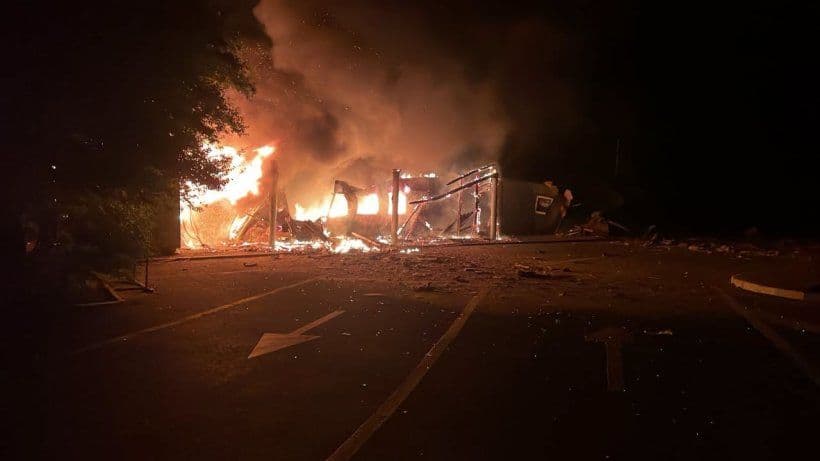
Imagine your only road out of town gets bombed — not once, but three times in two weeks. That’s what’s happening at Ukraine’s border crossings into Moldova.
Overnight Tuesday, a Russian Shahed-type drone — the slow, cheap, exploding drones Russia buys from Iran’s design and now builds by the thousands — struck the Vynohradivka border crossing in Odesa Oblast, forcing officials to suspend traffic and reroute vehicles to other checkpoints. Ukraine’s foreign minister, Andrii Sybiha, called it “a clear pattern,” accusing Russia of “deliberately trying to disrupt connectivity” between Ukraine and its neighbor. It’s the third such strike on a Ukraine-Moldova crossing since August 20 alone.
There’s a reason this keeps happening at these particular crossings, and it isn’t random. War analysts tracking the pattern say Russia is targeting the ground routes Ukraine relies on to move exports and imports through Moldova and Romania into the rest of Europe — the same goal as Russia’s separate campaign against Ukrainian sea ports, which is aimed at choking off Ukraine’s grain exports by water. Hit both the roads and the harbors, and you squeeze Ukraine’s economy from two directions at once, while also sending a message to Moldova and Romania: helping Ukraine carries a cost.
Moldova, a small country that only recently began its own path toward EU membership, has increasingly found itself caught in the blast radius of a war it isn’t fighting. The border crossing struck this week has reopened before, after previous attacks. It’s likely to reopen again — until the next strike.
The War Doesn’t Stay Inside Ukraine’s Borders
This war has a way of reaching past Ukraine’s own borders, and this week gave two fresh reminders of that.
At the United Nations, Poland’s deputy ambassador reminded the Security Council that a Russian cruise missile crashed 55 miles inside Polish territory during a mass strike on Ukraine back in July — one of a growing list of incursions into Polish, Romanian, and Latvian airspace. In late May, a Russian drone injured two civilians in the Romanian city of Galati, the first time that’s happened. NATO countries are starting to respond with force rather than just statements: allied jets have shot down four intruding drones in recent weeks, destroyed one naval drone near a Black Sea gas platform, and downed at least three more over the Baltic states since May. “These cases cannot be accepted as the ‘new normal,'” the Polish diplomat said.
Then there’s the sabotage angle. Slovak police detained three foreign nationals accused of plotting to burn down a Ukrainian-owned factory in Slovakia that builds Skyeton surveillance drones — the same kind of drones flying reconnaissance missions over the front line. Investigators seized a homemade napalm mixture, a hand-drawn map of the facility, and other plotting materials; about 70 workers were on site at the time. It’s the latest in a string of similar incidents across Europe this year, including an arson attack on a Ukrainian thermal-imaging company in the Czech Republic and one targeting an Estonian drone manufacturer that supplies Ukraine. Western officials increasingly describe these as coordinated, Russian-linked hybrid attacks — deniable, low-cost ways to slow down Ukraine’s weapons pipeline without firing a single missile.
Fifteen Deadlines to Take Donbas — and Counting
Here’s a number worth sitting with: since Russia’s full invasion began in 2022, Vladimir Putin has set at least 15 separate deadlines for capturing Donbas — the eastern Ukrainian region his own military commanders keep promising him is almost won. Every single one has slipped.
President Zelensky has been keeping the receipts. In 2022 alone, Russia missed self-imposed deadlines of March 31, May 9, June 1, September 15, and December 31. It missed two more in 2023, two more in 2024, and three more in 2025 — including a promise, made to try to convince President Trump the war was nearly over, that Ukraine would “supposedly fall” by Christmas. This year, the deadline has already slipped from March 31 to September 1, to its current target of December 31.
According to the Institute for the Study of War, Russia now controls 79.89% of Donetsk Oblast — meaning the “almost won” region is still, functionally, not won. Russian troops gained just 88 square kilometers of ground in the most recent reporting period. Sources close to Russia’s own defense ministry told Bloomberg that some military officials privately consider Putin’s goals unrealistic and expect the fight for Donbas to drag into 2027.
None of this means Ukraine is winning outright. A senior fellow at the Carnegie Russia Eurasia Center cautioned that it’s still too early to say Kyiv has decisively turned the battlefield in its favor, even with its deep strikes into Russia piling up. What the numbers do show is that Putin’s war has become a war of missed deadlines — and that each one costs both sides more than the last.
The First Briton to Die Fighting for Russia
Bradley Townsend called himself “a normal, working-class Yorkshire lad.” In June, he became the first known British citizen to die fighting for Russia’s army in this war.
Townsend, 33, left the U.K. in April, telling his family he was headed to Romania. Instead, he traveled to Russia and enlisted — with no prior military training — reportedly explaining his decision in a video by saying the Soviet Union had supported striking coal miners in Yorkshire back in the 1980s, and he wanted to repay the favor. He was killed on June 10 by an FPV drone — a small, camera-guided drone a pilot steers like a video game but armed with a real explosive — near the town of Lyman in Donetsk Oblast. A fellow fighter, using the call sign “Badger,” confirmed his death on social media. Britain’s Foreign Office confirmed it is in contact with his family.

Multiple British citizens have died fighting for Ukraine over the course of this war. Townsend’s death marks the first time one has died fighting on the other side. A British lawmaker called his decision to join Russia’s army “unbelievably stupid.” Two other British nationals seen alongside Townsend in a recruitment video, Ben Stimson and Aiden Minnis, reportedly received Russian citizenship for their service — one of them, Stimson, had previously served a five-year prison sentence in the U.K. for joining pro-Russian separatists back in 2015.
It’s a small story next to refineries and missile deals. But it’s a reminder that this war pulls people in from very far away, for reasons that rarely make sense from the outside — and that it kills them just the same, on either side of the line.
Closing
Back in Moscow, the plane that carried America’s spy chief was gone by evening, the same quiet way it arrived — no statement, no confirmation, just a convoy of cars with diplomatic plates disappearing into traffic. Back in Ukraine, the fires at three Russian refineries were still burning, and in Chernihiv, glass was still being swept from apartment floors. Somewhere between the missile Ukraine can now build itself and the fifteenth deadline Russia has now missed, this war keeps finding new ways to stay exactly where it’s been: violent, unresolved, and quietly reshaping itself in the dark, one flight nobody will talk about at a time.
A Prayer for Ukraine
1. For the Twenty-Five in the Chernihiv High-Rise
Lord, we bring before You the twenty-five people injured when a strike tore through their apartment building in Chernihiv — ordinary residents in ordinary rooms, their windows shattered, their walls exposed to the night. Be near to them now, in hospital beds and in homes suddenly unfamiliar. Steady the hands of those who care for them. Let the ordinary mercy of a roof and four walls be restored to them soon and let no family in that city have to learn again, so casually, how fragile home can be.
2. For the Children of Mena and Sumy
Father, we lift up the four teenagers hurt in Mena when a drone struck the building where their neighbors worked, and the fourteen-year-old girl injured in Sumy the same night. They did not choose this war, and they should not have to carry its wounds into whatever comes next. Guard their bodies as they heal and guard their hearts from growing numb to violence too young. Give them, somehow, still, room to be children — and give the adults around them strength to protect what’s left of that.
3. For Those Weighing Missiles and Meetings
God of wisdom, we pray for the leaders carrying decisions too heavy for any one person — for those deciding which weapons to send and which strikes to pause, for those flying into rooms nobody will explain afterward. Give them clarity where they must judge quickly and humility where they cannot see the whole picture. Protect them from trading a stranger’s safety for a convenient headline. And where secrecy serves cowardice rather than wisdom, bring it, in Your time, into the light.
4. For the Ones Holding the Line at Borova
Lord of hosts, we pray for the soldiers who counterattacked this week along the Ridkodub-Nove line, fighting to slow an advance measured in meters and hold ground that costs so much to keep. Watch over them in trenches and in drone-hunted fields where movement itself has become dangerous. Give them courage that doesn’t calcify into recklessness, and rest when rest is possible. Bring them home — whole, if You can manage it; alive, at the very least — to the families still waiting on the other side of this.
5. For an Ending Worthy of What’s Been Endured
God of justice, fifteen deadlines have come and gone for a war that was never Ukraine’s to start, and still no ending. We ask You to look plainly at what a “peripheral mobilization” would cost, at fires still burning in border towns and refineries alike, at every family — Ukrainian, Russian, British, and beyond — pulled into this by force or by folly.
In Your mercy, in Your justice, in Your time — bring this war to its end and let the ending be worthy of what Ukraine has endured.