
August 26, 2026
Prepared by Diana Bozhyk
Newly released wiretaps allegedly capture Ukraine’s intelligence chief and presidential chief of staff, Kyrylo Budanov, discussing bribes and control of a state bank with figures at the center of Kyiv’s largest corruption scandal, even as Russia pressed offensives on both ends of Ukraine’s Fortress Belt in Donetsk Oblast. President Zelensky announced a restructured eastern command under two of Ukraine’s most storied brigade commanders, while CIA Director John Ratcliffe made an unannounced trip to Moscow that required Ukraine to pause strikes on the Russian capital. Russian drones killed a mother and her four-year-old daughter in Chernihiv, and Lukoil confirmed every major refinery it owns in Russia is now offline because of Ukrainian strikes.
THE DAY’S RECKONING
For months, Ukraine’s corruption scandal circled around a Zelensky associate and a fired deputy chief of staff. Today it reached someone far harder to dismiss: Kyrylo Budanov, the intelligence officer turned presidential chief of staff whose name is now allegedly on tape, discussing a state bank’s cash flows with men accused of running a corporate-raiding scheme. If the recordings hold up, this isn’t a scandal at the edges of power anymore. It’s one at the center.
Everything else about the day moved with its own gravity. Russia is pressing two separate offensives at once against Ukraine’s most fortified defensive line, and Zelensky answered by restructuring the command meant to hold it. A CIA director quietly flew to Moscow, and Ukraine was asked to hold its fire on the Russian capital while he was there. A mother and her four-year-old daughter died in Chernihiv, killed by a drone that had nothing to do with any front line. And Lukoil, one of Russia’s oil giants, confirmed something remarkable: every major refinery it owns inside Russia is now offline. Different scales, same exhausted country, still absorbing all of it at once.
A CORRUPTION TAPE REACHES ZELENSKY’S OWN SPY CHIEF
Ukraine’s biggest corruption scandal in years just widened to include one of President Zelensky’s closest and most powerful officials: Kyrylo Budanov, the former military intelligence chief now serving as presidential chief of staff.
According to court materials cited by the outlet Hromadske, audio recordings gathered by anti-corruption investigators allegedly capture Budanov’s voice directly, including a moment where former deputy chief of staff Iryna Mudra puts him on speakerphone with a suspect in the case and he thanks him for his work. In other alleged exchanges, Mudra describes Budanov instructing Sense Bank’s management to funnel its cash flows through him at the request of Timur Mindich, a Zelensky associate at the center of a separate, larger corruption case. “They’re ready to do anything,” Mudra allegedly said of the bank’s leadership. “Wherever Kyrylo tells them to bring the money, they’ll do whatever he says.” In one exchange, when Mudra allegedly told Budanov she wanted to fight corruption properly, he reportedly replied: “That’s the wrong approach. Corruption needs to be systematized and controlled.”
Mudra and former lawmaker Maksym Mykytas were charged last week with laundering roughly $3.4 million through Sense Bank and with illegally seizing real estate through forged documents and bribed judges. The President’s Office has not yet responded to requests for comment on Budanov’s alleged role. If the recordings are authenticated, they mark the first time this scandal has directly implicated a sitting member of Zelensky’s innermost circle, rather than officials once or twice removed from the president himself.
UKRAINE RESTRUCTURES ITS EASTERN COMMAND
President Zelensky traveled to the front line in the Oleksandrivka sector today, meeting with Commander-in-Chief Mykhailo Drapatyi and a lineup of senior commanders to announce a reorganization aimed squarely at Ukraine’s most contested ground: the Fortress Belt cities of Donetsk Oblast.
Two new formations will be built around Brigadier General Andriy Biletsky, commander of the 3rd Army Corps, and Brigadier General Denys Prokopenko, commander of the National Guard’s 1st Azov Corps — two of the most recognized names in Ukraine’s military, both with roots in the volunteer Azov Battalion Biletsky founded in 2014. Prokopenko survived the siege of Mariupol and Russian captivity before returning to command; Biletsky fought in the defense of Kyiv, the liberation of Kherson Oblast, and the battles for Avdiivka. Neither man’s exact new troop allocation was disclosed. Both formations will reinforce some of the war’s most heavily contested sectors, including Dobropillya and Lyman, where Russian forces have spent months trying to break through.
Zelensky’s visit also underscored how urgent the underlying problem is. “Thank you to everyone working for Ukraine. We are doing everything to strengthen our positions,” he wrote, specifically flagging the need to better protect Zaporizhzhia city, which sits roughly 25 miles from the front and absorbs regular Russian air attacks. The reorganization comes directly on the heels of Drapatyi’s own proposal for a broader headquarters restructuring specifically to support the defense of Donetsk Oblast — a tacit acknowledgment that Ukraine’s current command structure isn’t holding the line as effectively as the moment demands.
RUSSIA’S TWO-PRONGED ASSAULT ON THE FORTRESS BELT
Russia is running two coordinated offensives at once against opposite ends of Ukraine’s Fortress Belt — the chain of fortified cities anchoring Ukraine’s defense of Donetsk Oblast — and both are showing real, if incremental, movement.
At the northern end, Russian forces are intensifying efforts to reach Slovyansk from the east and southeast, having largely failed to break through from the north through Lyman earlier this year. Slovyansk’s military administration head said Russian forces have begun using Smerch and Tornado-S multiple-launch rocket systems alongside glide bombs and strike drones, hitting the city with at least five glide-bomb strikes in a single morning and damaging 13 residential buildings. The bombardment isn’t incidental — it’s designed to turn parts of the city into rubble that Russian infiltrators can later use for cover, the same tactic Russia used to grind through Kostyantynivka before it.
At the southern end, Russian forces continue infiltrating Kostyantynivka itself, though Ukrainian military observer Kostyantyn Mashovets reported Russian main-body units still haven’t entered most of the city to consolidate the footholds smaller infantry groups have made. Ukrainian forces have withdrawn their main body from the city’s southeastern edge to the eastern bank of the Kryvyi Torets River but continue operating in central and southeastern sections as far south as Ivanopillya. Russian forces have held Kostyantynivka since October 2025 without fully capturing it — nearly ten months of grinding, contested fighting the Kremlin claimed to have already won back in July.
INDEPENDENCE DAY: ALLIES GATHER, A DRONE CARRIER DEBUTS
Two days ago, Ukraine marked its 35th Independence Day with a wave of diplomatic visits and one genuinely novel piece of military hardware revealed in public for the first time.
A Ukrainian naval drone manufacturer unveiled the Magura MV11 during a sail-by on the Dnipro River — the world’s first purpose-built drone aircraft carrier, a 23-foot remote-controlled boat capable of launching swarms of first-person-view attack drones from its own deck while carrying nearly 5,000 pounds of payload and operating autonomously for up to a week. It’s a significant evolution of the Magura-series boats that have already sunk or damaged numerous Russian warships since 2023, effectively turning a kamikaze naval drone into a mobile launch platform for aerial ones as well.
The same day brought the Coalition of the Willing’s latest gathering in Kyiv, where Ukraine signed a new AI defense partnership with the UK granting British researchers access to Ukraine’s battlefield-data platform, and UK Prime Minister Andy Burnham committed to giving Ukraine technical access to assemble British-designed SCALP cruise missiles domestically. Separately, First Lady Olena Zelenska hosted the Sixth Summit of First Ladies and Gentlemen, bringing together representatives from dozens of countries to discuss societal resilience under sustained crisis — a fittingly reflective note for a nation marking independence in the middle of its fifth year of full-scale war.
THE CIA DIRECTOR’S SECRET TRIP TO MOSCOW
CIA Director John Ratcliffe made an unannounced visit to Moscow this week — the first known trip to Russia by a sitting CIA director during the current US administration — and Ukraine was reportedly asked to hold off striking the Russian capital and St. Petersburg while he was there.
According to Politico, Ratcliffe’s primary purpose was to warn Russian officials directly against any escalatory action targeting NATO’s Baltic members — Estonia, Latvia, and Lithuania — following US intelligence assessments that Vladimir Putin could test the alliance’s resolve with a limited attack as early as this fall. He reportedly also pressed Russia to scale back military and economic support for Iran. Kremlin spokesperson Dmitry Peskov confirmed contacts took place with Russian intelligence services but said Ratcliffe did not meet Putin directly, describing the exchange as a “positive development” between the two countries’ intelligence agencies. President Trump downplayed the visit as “semi-routine” when asked about it, while acknowledging it was connected to broader efforts to end the war.
Ukraine had not received a promised briefing on the substance of the meetings as of this report. The episode underscores an uncomfortable dynamic Kyiv has learned to live with throughout the war: even as Ukraine fights for its survival, some of its most consequential diplomatic and intelligence conversations happen entirely without it in the room.
ALL OF LUKOIL’S REFINERIES ARE NOW OFFLINE
Ukrainian drones struck the NORSI oil refinery in Nizhny Novgorod overnight, and the resulting halt in operations means something remarkable: every major refinery Lukoil owns inside Russia is now offline, according to Reuters.
NORSI — Russia’s fourth-largest refinery and second-largest gasoline producer, with an annual processing capacity of 17 million tons — has now been forced offline by Ukrainian strikes for the third time since June, each time taking longer to fully repair as sanctions choke off replacement parts. Ukraine’s General Staff confirmed the strike and resulting fire; the facility sits nearly 500 miles from the border. Russia’s response reveals how strained its fuel supply has genuinely become: Kazakhstan’s energy minister announced the country will begin processing Russian crude domestically and sending 70 percent of the resulting diesel and gasoline back to Russia specifically to help ease the shortage — a striking role reversal for one of the world’s major oil producers, effectively outsourcing part of its own refining capacity to a neighbor.
Ukraine’s strike campaign also resumed against Wildberries after a stretch focused on rival retailer Ozon, hitting a logistics hub in Kotovsk, Tambov Oblast, and injuring two employees, according to the regional governor, who said the facility was completely destroyed by fire despite partial interception of the attacking drones.
MEANWHILE, AT THE FRONT: ADVANCES AND REFUTED CLAIMS
Away from the two main Fortress Belt battles, the rest of the front produced a familiar split: genuine Ukrainian gains in some sectors, and a fresh round of Russian claims that don’t survive scrutiny.
Ukrainian forces advanced southwest of Dvorichna, north of Kupyansk, and in the Dobropillya direction, where geolocated footage confirmed Ukrainian positions in Vodyanske and Krasnopodillya despite Russian claims of having seized the same ground. Southeast of Borova, even Kremlin-aligned military commentary acknowledged Ukrainian counterattacks were putting Russian forces near Shandryholove at risk of encirclement. In northern Sumy Oblast, Russia’s defense ministry claimed to have seized the village of Pysarivka, publishing flag-raising footage researchers assess was likely AI-altered; Ukraine’s Kursk Grouping of Forces flatly refuted the claim, and a separate Russian claim of capturing nearby Novokostiantynivka drew the same denial a day earlier.

A farmer attaches a fire extinguisher to agricultural machinery in a farm field in Sumy Oblast, Ukraine. Farmers of Sumy region continue to work in the border area, despite massive shelling from Russia. (BrightBird / Global Images Ukraine via Getty Images)
The most brazen claim came from the Oleksandrivka direction, where Russian sources asserted forces had “recaptured” the villages of Yalta and Zaporizhzhia — territory Ukraine already liberated back on August 12, during the eight-month counteroffensive that became one of the war’s clearer Ukrainian successes this year. Independent researchers assess the claim as part of a deliberate campaign to erase that counteroffensive from the public record. Elsewhere, Russian forces continued pressing without confirmed gains near Hulyaipole, where one Ukrainian brigade commander said his troops are now using up to ten drones against single Russian soldiers — a striking ratio that reflects both drone abundance and how little ground movement Russia is managing to trade for it.
A DOUBLE-TAP ON RESCUERS, A DOUBLE-TAP ON SHOPPERS
Russia’s double-tap tactic — striking a target, then striking again once rescuers or a second wave of victims arrive — claimed two more scenes today, on opposite ends of the country.
In Kramatorsk, Russian forces struck a nine-story residential building, and when State Emergency Service crews responded, a first-person-view drone hit their armored ambulance directly. No rescuers were hurt, but it marked the second attack on emergency responders in the city in a single week. The broader Kramatorsk strike injured 26 people over the day and damaged 37 high-rise buildings, three schools, and one infrastructure facility. “Despite the danger, emergency services continue to help people and deal with the aftermath of Russian strikes,” the service said in its statement, a line that reads less like triumph than exhaustion.
In Lozova, Kharkiv Oblast, a Russian Geran-type drone struck a shopping center, and a second drone hit the same building roughly 40 minutes later, injuring at least 10 people who had gathered in the aftermath of the first strike — an echo of the deadlier double-tap that killed 16 people at a Kryvyi Rih mall days earlier. The pattern is now well-documented enough that Ukrainian officials no longer describe it as an anomaly: it’s a deliberate tactic, repeated with enough consistency that survivors and rescuers alike now have to calculate, in the middle of an emergency, whether staying to help is itself a risk.
TWO FOILED PLOTS: A BOMB IN KYIV, ARSON IN SLOVAKIA
Ukrainian and allied security services disrupted two separate Russian-linked plots today, each aimed at a different kind of target: a person, and a factory.
Ukraine’s SBU said it prevented an FSB assassination attempt against the head of a Kyiv defense company, arresting a 63-year-old pensioner from occupied Luhansk Oblast who’d been instructed to plant explosives beneath the intended victim’s car. The device — a kilogram of hexogen, roughly equivalent to two kilograms of TNT — was rigged with a camouflaged phone positioned nearby to give Russian handlers a live video feed to trigger the detonation remotely. After planting the bomb, the suspect fled by bus toward Poland, intending to continue on to Russia via Belarus, but was arrested by Polish authorities en route; Ukraine has requested his extradition.
Separately, Slovak police detained three foreign nationals — two in Slovakia, one arrested in Germany under a European warrant — over an alleged plot to firebomb a Slovak factory belonging to Ukrainian drone manufacturer Skyeton, using a homemade napalm-like mixture of gasoline and polystyrene. Roughly 70 people were on-site at the time the attack was allegedly planned, at a facility valued in the tens of millions of euros. It’s the latest in a growing pattern of sabotage and arson attempts against Ukrainian and allied defense manufacturers across the EU, following similar incidents this year at a Czech thermal-imaging plant and an Estonian robotics company that supplies Ukraine.
THE OVERNIGHT TOLL: A MOTHER AND DAUGHTER IN CHERNIHIV
Overnight, Russia launched 163 drones at Ukraine; Ukrainian forces intercepted 132, with the rest striking 18 locations and debris landing at three more.
The deadliest single strike hit an ordinary family in Chernihiv Oblast, where a Russian drone killed a 39-year-old woman and her four-year-old daughter, part of a broader wave of 28 separate attacks on the region that injured 14 more people. Elsewhere, the toll spread wide: Kherson Oblast lost one person with 12 injured; Kharkiv Oblast counted 23 injured, including two children; Zaporizhzhia Oblast reported nine injured after 935 individual strikes hit 47 settlements in a single day; Dnipropetrovsk Oblast saw six injured; and Donetsk Oblast, beyond the Kramatorsk toll already noted, lost one more person with eight injured elsewhere in the region.
The Chernihiv strike stands out precisely because of how little strategic sense it makes — a mother and a four-year-old girl, killed by a drone in a region with no meaningful front-line proximity to explain the target. It’s the kind of death that resists any framing beyond the plainest one: a child who will never grow up, and a mother who won’t be there for any of it, added to a list that keeps growing regardless of how the war’s larger strategic questions eventually resolve.
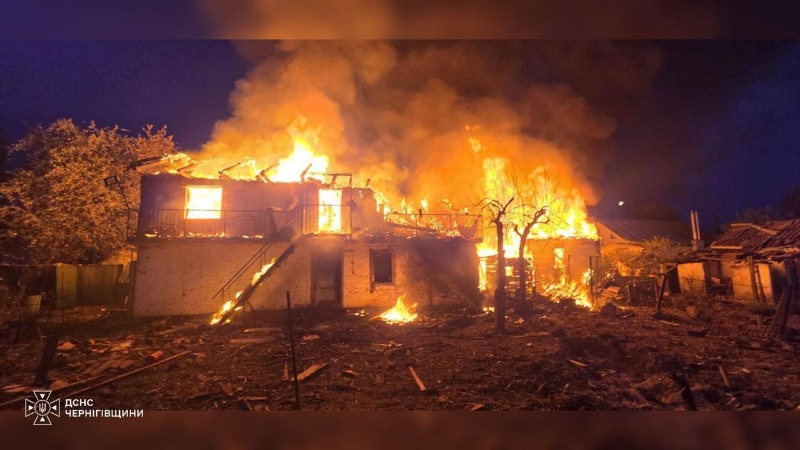
A house on fire after Russian attacks on Chernihiv Oblast. (The State Emergence Service / Telegram)
HUNGARY’S REMARKABLE TURN
In a shift that would have seemed unthinkable a year ago, Hungary’s government has formally described Russia as a “threat to Europe and the global order” in briefing materials prepared for its delegation to next month’s UN General Assembly, according to Der Spiegel.
The language marks a dramatic break from the stance Hungary held under former Prime Minister Viktor Orban, long regarded as one of Europe’s most Russia-friendly leaders, before Peter Magyar’s government defeated him in elections earlier this year. “Hungary condemns Russian military aggression and fully supports Ukraine’s sovereignty and territorial integrity within its internationally recognized borders,” the document states, adding that Russia’s behavior threatens Hungary directly, not just the wider region. It’s the latest in a string of conciliatory steps between Budapest and Kyiv this year, following Hungary’s closure of a money-laundering investigation into a Ukrainian bank convoy last week and its earlier decision to lift a nine-month ban on Ukrainian media imposed under Orban.
For a relationship that spent years defined by Hungarian obstruction of EU aid packages and sanctions votes, the shift matters beyond symbolism — Hungary’s cooperation played a direct role in clearing the way for the EU to open its first cluster of accession talks with Ukraine and Moldova back in June, after a separate agreement on minority rights resolved a longstanding sticking point between the two governments.
CONFIRMED: RUSSIA’S GRU BUILT THE LEIPZIG AIRPORT DRONE
US intelligence officials have concluded that an explosive-rigged drone found near a Ukrainian cargo plane at Germany’s Leipzig airport earlier this month was built by Russia’s military intelligence agency, the GRU, according to ABC News.
The drone’s structure and the explosives it carried were “typical” of GRU-linked devices, unnamed US officials said, adding weight to earlier Wall Street Journal reporting that reached a similar conclusion. The device, found August 5 near an Antonov cargo aircraft loaded with ammunition, carried military-grade explosives, but its detonator had been disconnected before discovery and it never went off. German investigators later found a third drone and a separate cache of explosives in a field near the airport on August 25, though it remains unclear what role that device played in the plot. Leipzig has recorded 18 separate drone-related disruptions to air traffic since January alone.
German Chancellor Friedrich Merz declined to confirm the drone’s origin publicly but said German agencies were finalizing their own findings. The incident has already prompted German officials to describe Russian sabotage, espionage, and hybrid operations as a “constant reality” rather than an occasional threat — language that increasingly matches how other European governments have started describing the same pattern of drone incursions, arson plots, and cyberattacks traced back to Moscow this year.
ARMING UKRAINE QUIETLY, AND A PUSH FOR FROZEN ASSETS
Two developments today illustrated very different approaches to keeping Ukraine’s air defenses funded — one deliberately kept quiet, the other a renewed diplomatic push.
Italy has secretly agreed to send Ukraine four next-generation SAMP/T NG air-defense batteries, Aster 30 interceptor missiles, and seven long-range radars by year’s end, a nearly $3.5 billion package Rome chose to announce only as a shipment of civilian generators, according to Italian outlet La Repubblica — a deliberate move to avoid reigniting domestic political conflict over continued military support for Kyiv. France and Italy have separately agreed to let Ukraine produce Aster 30 interceptor missiles domestically, building on a July agreement between Presidents Macron and Meloni. The quiet framing stands in some tension with a parallel fight playing out in Brussels: France is separately pushing to limit how much of Ukraine’s EU-funded defense spending can go toward non-European suppliers, including US-made Patriot interceptors and Chinese drone components — a restriction nine other EU countries, including Germany and Poland, are actively resisting in the name of keeping Ukraine’s options open.
Meanwhile, Sweden, the Netherlands, Poland, and Spain are jointly pressing the EU to revisit using roughly $233 billion in frozen Russian financial assets to directly fund Ukraine, after a previous attempt collapsed in 2025 over Belgian concerns about legal risk. The renewed push reflects a hard fiscal reality: the EU’s existing $105 billion loan package was only ever meant to cover two-thirds of Ukraine’s financing needs through 2027, leaving a gap allied governments still haven’t fully agreed how to close.
LOOSE ENDS: AN EMBASSY, A DEATH, A DISASTER ABROAD
Several smaller but genuinely significant stories rounded out the past two days.
Former Foreign Minister Dmytro Kuleba has emerged as the leading candidate to become Ukraine’s next ambassador to Washington, a post vacant for weeks after Olha Stefanishyna’s resignation amid a corruption investigation; it’s unclear whether Kuleba actually wants the job, and Deputy Presidential Office Head Pavlo Palisa remains a second option under consideration. Separately, British national Bradley Townsend, believed to be the first UK citizen killed fighting for Russia rather than Ukraine, died near Lyman on June 10; he’d told his family he was traveling to Romania before joining Russian forces, citing a debt he felt Russia was owed for Soviet support of striking Yorkshire miners in the 1980s.
Ukraine’s foreign ministry confirmed 53 Ukrainian citizens, including a 46-person tour group, are missing following catastrophic flash floods and landslides near the Nepal-China border that have killed more than 150 people; embassies in India and China are coordinating search efforts. And in Kyiv, Ukraine’s parliament formally rejected any plan to mobilize women into military service, responding directly to comments from former US envoy Keith Kellogg, who’d argued days earlier that Ukrainian women should be conscripted given their demonstrated capability in combat roles. “Statements by individual speakers publicly speculating on this subject do not reflect actual legislative work,” the parliamentary defense committee said, urging the public not to be misled.
A TAPE, A REFINERY, A CHILD IN CHERNIHIV
By nightfall, the day’s weight settled unevenly across very different kinds of loss. A recording that may implicate the president’s own chief of staff. A refinery network so degraded that Russia is now importing its own fuel back from Kazakhstan. A four-year-old girl who won’t see another birthday, killed by a drone that had no target worth naming.
Two brigade commanders with roots in 2014 are about to inherit responsibility for holding a line that’s cost Russia hundreds of thousands of casualties and yielded it only rubble. A CIA director came and went from Moscow without Ukraine ever fully learning what was said. And somewhere in Brussels, four foreign ministers are drafting a letter about frozen billions that might, eventually, help pay for all of it. Nothing today resolved. Everything today added one more thread to a war that keeps refusing to simplify.
A PRAYER FOR UKRAINE
1. For the Mother and Daughter in Chernihiv
Lord, a mother and her four-year-old daughter are dead tonight, killed together by a drone that found them somewhere far from any front line. We cannot make sense of a war that takes a child this young, alongside the parent who should have had decades left to raise her. Receive them together, comfort whatever family remains, and let their deaths be remembered as a family lost, not simply two more names in tomorrow’s count.
2. For the Rescuers Who Keep Showing Up Anyway
Father, we lift up the emergency crews in Kramatorsk who keep responding to strikes even knowing a second one might be aimed at them specifically. Protect every rescuer who walks toward danger today, tomorrow, and every day this war continues. Give them courage that doesn’t waver, and give Ukraine a way to shield the people whose entire job is shielding others.
3. For Honesty to Reach Wherever Power Actually Sits
Lord of truth, we pray for Ukraine’s ongoing reckoning with corruption now reaching into its highest offices. Give investigators courage to follow evidence without fear of who it implicates, no matter how close to power that evidence leads. Give Ukraine’s leaders humility to accept scrutiny rather than resist it. Let truth-telling strengthen this country’s institutions rather than simply exhaust a public already carrying so much weight from every other direction.
4. For the Soldiers Inheriting an Impossible Line
God of the steadfast, we pray for every soldier now defending Ukraine’s Fortress Belt, and for the commanders just handed responsibility for holding it. Give them wisdom to protect their own troops even under pressure to hold ground at any cost. Let the sacrifice already made there not be wasted, and let those still fighting feel genuinely supported by decisions made far above them.
5. For Clarity in Conversations Happening Without Ukraine Present
God of nations, we pray for wisdom in every negotiation and quiet exchange happening about this war in rooms where Ukraine itself isn’t always present. Give those deciding on Ukraine’s behalf the integrity to represent its actual interests. And give Ukraine’s own leaders patience and resolve as they wait, again, to learn what was decided about their country’s future somewhere else.
In Your mercy, in Your justice, in Your time — bring this war to its end, and let the ending be worthy of what Ukraine has endured.