
Ukraine Daily Briefing | April 29, 2026 | Day 1,526 of the Full-Scale Invasion
Ukrainian drones struck deep into the Ural Mountains overnight — hitting a Transneft oil dispatch station near Perm, 1,400 kilometers from the border, and an oil refinery in Orsk — while a sanctioned shadow fleet tanker was hit in the Black Sea and helicopters were destroyed on a field airstrip in Voronezh Oblast in a single night that ISW assessed as part of at least 18 oil infrastructure strikes and 41 military strikes across 19 Russian federal subjects in April alone. As Ukraine’s drones reached Russia’s industrial heartland, Vladimir Putin called Donald Trump, falsely described the war as won, proposed a May 9 Victory Day truce — which Trump said he supported — and warned against military action in Iran. Tuapse’s oil continues to spread across the Black Sea, benzene in the air exceeds safe limits, and a Krasnodar Krai resident told independent media: “People once envied us for living by the sea, but now no one does.”
The Day’s Reckoning
The night of April 28 to 29 was the longest arm Ukraine has ever thrown. Drones crossed more than 1,400 kilometers of Russian territory to find a Transneft pipeline dispatch station in Perm Oblast — the Ural Mountains, far enough east that Moscow considers it unreachable, close enough to the Perm Oil Refinery to matter enormously for Russian fuel supply. Almost all the oil storage tanks at the station caught fire. In Orsk, a thousand kilometers away in a different direction, Ukraine’s drones found the Orsknefteorgsintez refinery, one of Russia’s largest, designed to process 6.6 million tons per year and listed by Ukrainian intelligence as a direct supplier to Russian armed forces.
In the Black Sea, Ukrainian naval drones found the Marquise — a sanctioned shadow fleet tanker flying a Cameroonian flag, carrying no cargo because it was waiting offshore to be loaded from another vessel. Two kamikaze drones hit it 210 kilometers southeast of Tuapse. On the ground in Voronezh Oblast, 150 kilometers from the front line, four Russian helicopters were refueling at a field landing site when Ukrainian long-range drones arrived. Two were hit — an Mi-28 and an Mi-17. At least one maintenance specialist was killed.
On the same day, Vladimir Putin called Donald Trump. The call lasted ninety minutes. Putin told Trump that Russia holds the strategic initiative, that Russian victory is inevitable, and that he proposed a ceasefire for May 9 — Victory Day. Trump said a deal was “almost there” and that he had asked Putin about a truce. Ukraine, which recorded more than 400 Russian ceasefire violations during the last announced truce on Orthodox Easter, was not a party to the conversation. No call with Zelensky was scheduled.
In Tuapse, oil from the burning refinery had reached the beaches 57 kilometers away. Benzene levels exceeded safe limits. Residents posted photos of black hands, black puddles, streets where your feet stick to the road. Russia’s tour operators were still promising an unaffected summer season. The fire is visible from a ski resort a hundred kilometers away.
Perm, Orsk, and the 1,400-Kilometer Strike: Ukraine Reaches Russia’s Industrial Core
The Security Service of Ukraine’s Alpha special forces unit confirmed on April 29 that long-range drones had struck the Transneft Perm Linear Production Dispatch Station in Perm Oblast — a strategic hub in Russia’s national oil pipeline network that distributes crude oil in four directions, including to the Perm Oil Refinery. Geolocated footage published on April 29 showed fires at the station. The SBU reported that nearly all oil storage tanks at the facility were ablaze. Perm Krai Governor Dmitry Makhonin confirmed the strike, reporting workers had been evacuated and no casualties.
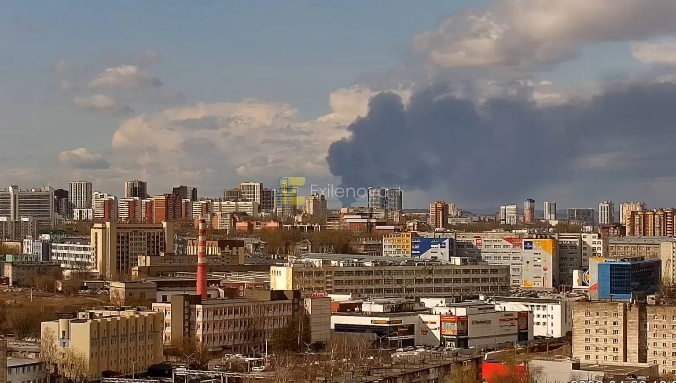
A photo showing the consequences of a Ukrainian attack on Russia’s Perm Krai. (Exilenova Plus / Telegram)
Transneft is Russia’s pipeline monopoly, handling more than 80 percent of the country’s crude oil output. The company had already warned oil producers in September 2025 that they may need to cut output following previous Ukrainian drone strikes on its infrastructure. A strike reaching the Perm dispatch station — which sits at the junction of pipelines running in four directions across Russia’s interior — is not a blow to one facility. It is a blow to the distribution network itself.
In Orsk, Orenburg Oblast — approximately 1,300 kilometers from the Ukrainian border — the Orsknefteorgsintez oil refinery was struck on the same night. The facility has an annual capacity of 6.6 million tons and is identified by Ukrainian military intelligence as directly supplying Russian armed forces. Local residents reported the attack; Orenburg Oblast Governor Yevgeny Solntsev claimed four drones were downed in the oblast. The full extent of damage at both sites remained under assessment on April 29.
ISW assessed on April 29 that Ukrainian forces had conducted at least 18 strikes against Russian oil infrastructure and at least 41 strikes against Russian military assets in at least 19 Russian federal subjects in April 2026 — and that the campaign will continue to intensify as Ukrainian domestic drone production scales up and Russian air defenses remain overstretched across an attack surface too large to adequately cover.
Zelensky stated on April 29 that Ukrainian strikes have left the port of Primorsk operating at 13 percent below capacity; the port of Novorossiysk at 38 percent below capacity; and the port of Ust-Luga at 43 percent below capacity. These three ports are among Russia’s primary petroleum export terminals. Their degraded throughput is the oil campaign’s balance sheet.
The Shadow Fleet Tanker: Marquise Struck in the Black Sea
Ukraine’s General Staff reported on April 29 that the Ukrainian Navy struck the sanctioned shadow fleet tanker Marquise using two kamikaze unmanned surface vehicles in the Black Sea, approximately 210 kilometers southeast of Tuapse. The vessel was operating without an AIS signal — the maritime equivalent of turning off a phone’s location — and was traveling empty, waiting offshore to be loaded from another vessel via ship-to-ship transfer.
The Marquise is a Cameroonian-flagged vessel with a carrying capacity of over 37,000 tons, operated by Lidoil DMCC of the UAE. Ukraine’s military intelligence portal War & Sanctions documents that since December 2023, the tanker has been engaged in the export of Russian-origin oil and petroleum products, operating in the Kerch Strait and at ports in Russian-occupied Crimea. It has been sanctioned by Ukraine, the United Kingdom, the European Union, Switzerland, New Zealand, and Canada. The ship continued operating through all of it — until April 29.
The damage assessment was still being conducted when the General Staff made its announcement. The strike is part of Ukraine’s naval drone campaign against the shadow fleet — the network of vessels that Russia uses to export oil in defiance of Western sanctions, generating the revenue that funds the war in Ukraine.
Voronezh: Helicopters Destroyed at a Field Refueling Site
Ukraine’s 414th Separate Unmanned Strike Aviation Systems Brigade — Magyar’s Birds — reported on April 29, with video footage, that Ukrainian long-range drones struck four Russian helicopters conducting rapid refueling and technical checks at a field landing site in Voronezh Oblast, approximately 150 kilometers from the front line. Two helicopters were hit: an Mi-28 Havoc attack helicopter and an Mi-17 transport and utility helicopter. At least one Russian helicopter maintenance specialist was killed.
The Mi-28 is Russia’s primary attack helicopter, designed for anti-tank and fire support operations. The Mi-17 is a versatile transport platform used for troop movement, medevac, and logistics. Destroying both at a forward refueling point — before they can return to operational use — removes assets from Russia’s aviation inventory at a point in the war when Russian helicopter losses have already reached 350 since February 2022, according to the Ukrainian General Staff’s April 29 count.
The strike reflects a pattern visible across the April 29 reporting: Ukraine is no longer limiting its long-range campaign to oil infrastructure. It is reaching helicopters in Voronezh, radar stations in Crimea, logistics hubs 154 kilometers behind the front, and ammunition depots 136 kilometers from the line. The rear is not safe.
Crimea: Radar Destroyed, Ammunition Depot Struck, Oil Depot Hit
Ukrainian forces conducted a series of strikes against military assets in occupied Crimea on the night of April 28 to 29, confirmed by the General Staff on April 29. The Ukrainian General Staff reported that forces struck a Russian MR-10 radar station, an air defense command post, and a 1L22 Parol-4 ground-based radar interrogator at the occupied Kacha airfield, approximately 223 kilometers from the front line. An ammunition depot near occupied Pervomaiske, approximately 136 kilometers from the front line, was also struck. The TES oil depot near occupied Simferopol, approximately 206 kilometers from the front line, was hit as well.
Major Brovdi additionally published footage on April 29 showing Ukrainian forces striking a pumping station of the Bitumne oil depot and an ammunition depot in occupied Crimea on April 28. Geolocated footage posted on April 28 showed strikes on the Iskander-M ballistic missile storage site south of Ovrazhky, Crimea — previously reported as the April 28 strike — with the April 29 publication confirming the ongoing campaign.
The Kacha airfield strikes are significant: Kacha is a military air base on Crimea’s western coast that has historically hosted Russian aviation assets. Destroying its radar interrogator — a device that identifies friendly aircraft — and its air defense command post creates gaps in Russia’s ability to coordinate air defense over the peninsula and complicates the operation of any aircraft still based there. A Russian milblogger noted on April 27 that Ukrainian drones are penetrating Crimean airspace with increasing frequency and questioned the depth of Russia’s SAM missile magazines.
Zaporizhzhia: Two Tor Air Defense Systems Destroyed
Ukrainian forces struck two Russian Tor air defense systems in occupied Zaporizhzhia Oblast. Major Brovdi reported on April 29 that the first Tor-M2 was struck between April 27 and 28. The Ukrainian General Staff reported on April 29 that a second Tor air defense system near occupied Tykhonivka, approximately 76 kilometers from the front line, was struck between April 28 and the night of April 29.
The Tor is a short-range surface-to-air missile system designed to intercept low-flying aircraft, cruise missiles, and drones. Each system destroyed is a gap in Russia’s protective umbrella over its forces and occupied territory — and a degraded ability to intercept Ukrainian drones on their approach to rear targets. The destruction of two systems in two days in the same oblast reflects the scale of Ukraine’s systematic air defense attrition campaign.
171 Drones, Five Killed, Twenty-Three Wounded: The Night of April 28 to 29
Russian forces launched 171 drones against Ukraine overnight on April 28 to 29. Ukrainian air defenses intercepted 154 of them. Twelve struck 10 locations; debris fell on 12 more. Power outages were reported by grid operator Ukrenergo in Donetsk, Sumy, Kharkiv, Chernihiv, Odesa, and Zaporizhzhia oblasts as a result of the strikes.
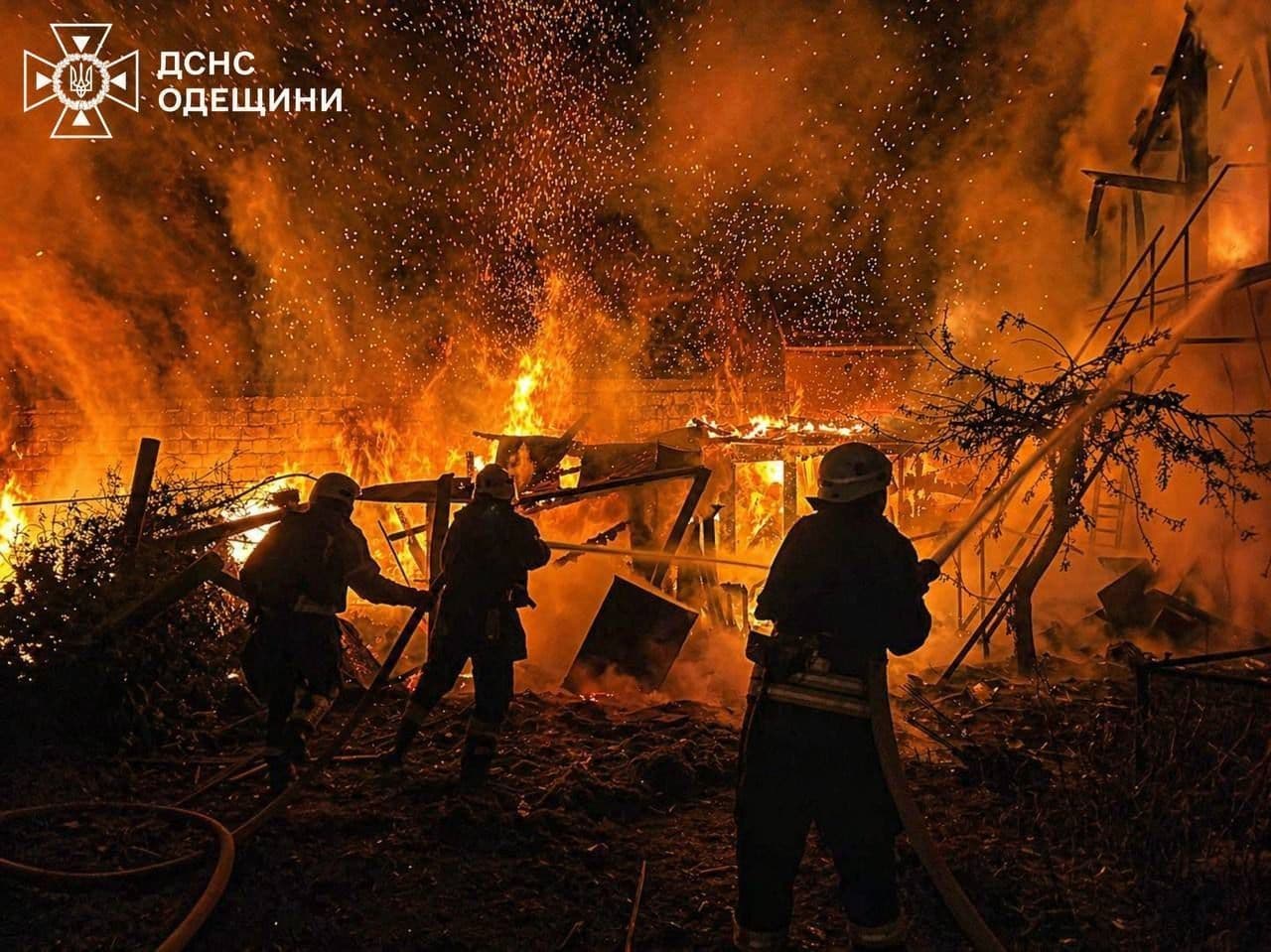
The aftermath of a Russian attack on Odesa Oblast, Ukraine, posted by the regional State Emergency Service. (State Emergency Service/Telegram)
At least five people were killed and 23 others injured across Ukraine over the reporting period. In Kharkiv Oblast, two men — aged 74 and 54 — were killed and seven people injured across 12 settlements, including the city of Kharkiv, where six apartment buildings, 25 houses, railway infrastructure, cars, buses, a tractor, and a shopping center were damaged. In Donetsk Oblast, Russian attacks killed two people and injured three. In Sumy Oblast, a 65-year-old woman was killed in the Shostkynska community and two others were injured. In Kherson Oblast, seven people were injured across 37 attacked settlements. In Zaporizhzhia Oblast, two men — aged 40 and 45 — were injured in Zaporizhzhia city, and one more person was injured elsewhere in the oblast.
In Odesa Oblast, Russian drones struck the south of the oblast overnight, injuring a 47-year-old man and a 56-year-old woman and damaging civilian infrastructure in several districts — residential buildings, a hotel, warehouse facilities, and port infrastructure. Governor Kiper also reported that a district hospital was struck and its emergency room completely destroyed, with the internal medicine, cardiology, and surgery departments and the ultrasound and X-ray rooms sustaining significant damage. Medical staff and patients were in shelters at the time; there were no casualties at the hospital. A fire was also reported on the territory of the Danube Biosphere Reserve, a UNESCO-recognized ecological site.

A man sitting near the ambulance in Odesa Oblast, after the Russian drone attack overnight. (Oleh Kiper / Telegram)
Putin Calls Trump: Cognitive Warfare by Phone
Vladimir Putin called Donald Trump on April 29 in a conversation that lasted approximately 90 minutes. The Kremlin’s readout, delivered by presidential aide Yuriy Ushakov, described Putin as having briefed Trump on the current state of the war — claiming Russia holds the strategic initiative, that it is pushing back Ukrainian positions, and that it will achieve its war goals “in any case” but prefers to do so diplomatically. Putin also proposed a temporary ceasefire for May 9, Russia’s Victory Day, which Trump indicated he supported.
Trump confirmed the call from the White House. “I think we’re going to come up with a solution relatively quickly. I hope,” he said. “I suggested a little bit of a ceasefire, and I think he might do that.” Trump said he believed Putin was ready to make a deal “a while ago” and that “some people made it difficult for him to make a deal” — without naming who. A source close to the Ukrainian Presidential Office said no call between Trump and Zelensky was scheduled “at the moment, but that can change the next minute.”
ISW’s assessment is direct: the premise of Putin’s claims is false. Ukrainian forces have largely stymied Russian advances across the front line, blunting the Russian Spring-Summer 2026 offensive. Russia’s priority objective — Donetsk Oblast — has not produced operationally significant advances. Ukraine has conducted significant counterattacks in southern Ukraine since January 2026. Putin is using the call to push Trump to pressure Ukraine into capitulation in a way that Russia’s military has failed to achieve on the battlefield.
The proposed May 9 truce fits a documented pattern. Russia has declared unilateral ceasefires repeatedly — for Victory Day in 2025 and for Orthodox Easter on April 11 to 12. Ukraine recorded over 400 Russian violations during the Easter ceasefire within the first 12 hours, including 63 assault operations, 176 drone strikes, and 10 airstrikes using guided bombs. Russia also stockpiled long-range drones and missiles during the ceasefire and launched two large strike series within 48 hours of its end.
The Kremlin also used the call to address Iran: Ushakov reported that Putin warned Trump of “inevitable, extremely dire consequences” if the U.S. and Israel “resort to force again” against Iran. Putin described a ground operation in Iran as “completely unacceptable and dangerous.” Moscow has been supplying Iran with satellite imagery to assist Iranian strikes against American and Israeli targets — a detail that received less attention in the readout than the Ukraine discussion.
Victory Day Without Hardware: May 9 Parade Stripped to Its Bones
Russia’s Defense Ministry issued its full confirmation on April 29: the 2026 Victory Day parade in Moscow will not include military equipment, the participation of students from the Suvorov and Nakhimov military schools, or cadets. Kremlin spokesman Peskov described the parade as occurring in a “truncated format” to minimize the danger from potential Ukrainian strikes — which he called “terrorist attacks.” The parade will be limited to approximately 40 minutes, with attendance reduced from several thousand to a few hundred guests.
This will be the first year since 2007 that the annual parade has not featured Russian military hardware. BBC Russian Service reported that at least 10 Russian cities and eight federal subjects plan to scale back or cancel their Victory Day events entirely, including fireworks and the Immortal Regiment march. The Kremlin reportedly plans to restrict mobile communications in Moscow and along the Moscow Ring Road on May 5, 7, and 9. Russian forces have not begun rehearsals despite being within the two-week window normally used for them.
The absence of tanks from Red Square is not incidental. Russia cannot afford to withdraw operational vehicles from the front line for a ceremonial parade. The parade that Putin has used for years to project strength and portray himself as a victorious wartime leader will this year project something different — and he knows it. The Kremlin’s stated concern about Ukrainian drone strikes is real, but it is also a convenient explanation for a decision made necessary by a war it cannot afford to show.
Tuapse: Oil in the Sea, Benzene in the Air, Tourists Expected Anyway
The Tuapse Oil Refinery has been burning since April 16. As of April 29, petroleum products had spread along the Black Sea coast, with traces detected in waters 57 kilometers from Tuapse near the resort towns of Dzhubga and Arkhipo-Osipovka. Local authorities confirmed that 2,500 cubic meters of contaminated soil and a mixture of water and fuel oil had been removed over the previous day. Benzene levels in the air had exceeded safe limits, according to independent Russian outlet Astra.
Residents reported black puddles, blackened hands, and surfaces covered in oily residue. Two oil-contaminated rainfalls had occurred since the fires began, coating the city’s streets. The fire spread to a nearby apartment building overnight on April 29 — residents were evacuated in time and the blaze was extinguished. Emergency Situations Minister Kurenkov acknowledged on April 28 that while the spill was “contained,” measures to fully eliminate it remained “insufficient.”
Putin said at a security meeting on April 28 that there were “No serious threats” and that “People were managing the challenges they face on the ground.” Russia’s Association of Tour Operators, meanwhile, was still assuring clients that the resort towns “dozens of kilometers” from Tuapse would have clean water and no smoke this summer.
Frontlines on April 29: Ukrainian Advances, Russian Manpower Shortages
Ukrainian forces advanced in the Kostyantynivka-Druzhkivka tactical area, western Zaporizhzhia Oblast, and in the Pokrovsk, Oleksandrivka, and Hulyaipole directions on or around April 29, according to ISW’s assessment. Geolocated footage published on April 28 shows Ukrainian forces holding positions on the southwestern outskirts of Kostyantynivka — indicating a recent advance. Footage also shows Ukrainian forces maintaining positions in Chasiv Yar, contradicting Russian claims of having seized the settlement. In Pokrovsk, geolocated footage published April 29 indicates Ukrainian forces recently advanced north of the city. In Hulyaipole, Ukrainian forces advanced along the T-04-01 highway.
Russian forces continued offensive operations across all axes on April 29 but made no confirmed advances. In the Kharkiv direction, a Ukrainian brigade commander reported that Russian forces face difficulties crossing the Siverskyi Donets and Vovcha rivers — and that Russian command is deploying Kenyan mercenaries to compensate for manpower shortages. In the Slovyansk direction, a Ukrainian brigade commander reported that Russian forces are suffering from a lack of replacements, deploying previously wounded servicemembers and African mercenaries in assaults, and transferring unmotivated logistics and artillery personnel into assault units. In the Kupyansk direction, geolocated footage shows Ukrainian forces striking a Russian infiltration mission in northern Kivsharivka.
In western Zaporizhzhia Oblast, Ukrainian military observer Mashovets reported on April 29 that Ukrainian counterattacks have effectively halted Russian advances toward Orikhiv and Zaporizhzhia City. Russian forces only maintain limited positions in southern Prymorske and small infantry groups near the Mala Tokmachka railway station. ISW also noted a possible Russian redeployment to the Orikhiv direction, with elements of the 47th Motorized Rifle Division, 45th Spetsnaz Brigade of the VDV, the 136th Separate Motorized Rifle Brigade, and the Chechen 78th Sever-Akhmat Regiment potentially moved to reinforce the Russian 58th CAA.
The Russian MoD claimed on April 29 the seizure of Novodmytrivka southeast of Sumy City, and a milblogger noted Russian forces advanced southwest of Korchakivka north of Sumy City — both unconfirmed. In the Donetsk Oblast, the Russian MoD claimed the seizure of Novodmytrivka east of Kostyantynivka; a milblogger noted that full control of the area remains impossible without first seizing Ukrainian positions between Chasiv Yar, Chervone, and Mykolaivka. Ukrainian forces struck a drone control point near Tetkino in Kursk Oblast. Ukrainian forces additionally struck a Russian truck with an anti-aircraft system in occupied Luhansk Oblast.
Zelensky Signs Belarus Sanctions: 16 Individuals, 11 Entities, Artillery Shell Producers
President Zelensky announced on April 29 that he had signed a new Ukrainian sanctions package targeting entities linked to Belarus. The measures cover 16 Belarusian citizens and 11 legal entities connected to Russia’s war effort. Among the sanctioned companies are Olsa, the Minsk Thermoplast Plant, and the Heavy Forging Plant — all of which manufacture components for 122mm and 152mm artillery shells used by Russian forces.
Among the individuals sanctioned are Viktor Sheiman — a longtime Lukashenko associate and former senior government official accused of facilitating shadow business operations and sanctions evasion — and Lukashenko’s sons, Viktor and Dmitry, accused by Ukrainian authorities of helping export goods in circumvention of international sanctions, including the supply and reexport of dual-use items through Belarus.
“Belarus must not be drawn into this war. There must be no operations against other European countries. And Russia’s war against Ukraine must end in a dignified peace,” Zelensky said. He added that Ukraine will inform international partners about intelligence showing Moscow continues to develop plans for operations beyond Ukraine and is working to draw Belarus more deeply into implementing Russian military objectives. The sanctions package is, in his words, “a signal to many of our partners about where pressure should be applied to reduce the scale and intensity of this war.”
EU Ambassadors Back Special Tribunal: The Vote Is Set for May 5
Ambassadors of all 27 EU member states agreed at a meeting on April 29 that the European Union should sign up to the Council of Europe Special Tribunal dedicated to prosecuting Russia’s leadership for the crime of aggression against Ukraine. The decision now passes to national ministers, who are expected to take the final vote at a meeting of economy ministers on May 5. The European Parliament is expected to vote on April 30 to endorse the EU joining the tribunal in its own right.
The tribunal has now passed the threshold of 16 Council of Europe countries required for it to become operational. Foreign ministers of the 46 Council of Europe member states are scheduled to meet on May 15 in Chisinau, Moldova, where they are expected to conclude an Agreement on the Management Committee of the tribunal — at which point the selection of judges can begin. Ukraine expects the tribunal to be fully operational in 2027.
The crime of aggression falls outside the ICC’s jurisdiction for states not party to the Rome Statute — meaning Putin and other Kremlin officials who ordered the invasion cannot be prosecuted there. The Special Tribunal is being constructed specifically to close that gap, building on the Nuremberg precedent of prosecuting political leaders who ordered aggressive wars, not only the soldiers who carried out their atrocities. The April 29 ambassadorial agreement is the last major institutional step before the final vote.
Japan Invests in Ukrainian Drones: Terra Drone Backs WinnyLab
Japanese drone firm Terra Drone announced on April 29 a second strategic investment in a Ukrainian defense technology company — partnering with WinnyLab to scale the Terra A2, a long-range fixed-wing interceptor drone capable of flying more than 40 minutes, covering 75 kilometers, and reaching a top speed of 312 kilometers per hour. The announcement came one week after Japan lifted its postwar ban on lethal weapons exports.
Terra Drone CEO Toru Tokushige told the Kyiv Independent: “Going forward, we expect broader opportunities for more direct collaboration with partners such as WinnyLab and Amazing Drones. In modern warfare, where speed of development can be decisive, this is a major advantage.” Previously, Terra Drone had to route its Ukraine-related projects through a Dutch unit to circumvent Japanese regulations restricting direct supply of technology for military-related products.
The Terra A2 works alongside the Terra A1 — a rocket-type interceptor that destroys Shahed drones on close approach — to create what Terra Drone calls a layered defense system: the A2 for wide-area surveillance and early threat detection, the A1 for rapid base protection. The investment is the second in a month by the same firm, which also backed Kharkiv-based Amazing Drones. Russia summoned the Japanese ambassador in Moscow on April 8 to protest the first deal. The second deal proceeded anyway.
Belarus Confirms: Russian Draftees Cannot Leave Through Its Territory
Belarusian authorities confirmed on April 29 that Russian citizens who have received military draft notices will be barred from leaving via Belarusian territory. The Belarusian State Border Committee confirmed to independent outlet Belsat that Belarus and Russia share conscription databases, giving Belarusian security services access to Russian draft records and allowing them to detain or turn back individuals listed in them.
The significance extends to occupied Ukrainian territories. Ukrainians forcibly issued Russian passports under occupation are automatically entered into Russian military registries. The primary humanitarian exit route from Russian-occupied territories — through the Mokrany-Domanove crossing at the Belarusian-Ukrainian border — is now effectively closed to anyone Russia considers a draft-eligible male. A Ukrainian official warned on April 29 that the risk of detention or being turned back at the Belarusian border has significantly increased for anyone holding a Russian passport.
US Pledges $100 Million for Chornobyl’s Damaged Radiation Shield
The U.S. State Department announced on April 29 that the United States is committing up to $100 million — 20 percent of the G7’s estimated $500 million cost — to rehabilitate the New Safe Confinement arch at the Chornobyl nuclear power plant. A Russian drone struck the NSC in February 2025, damaging the containment structure that was built in 2019 to seal the destroyed fourth reactor. Without repairs, the State Department said, the structure “can no longer provide adequate protection, creating the specter of a dangerous leak of highly radioactive material in Europe.”
The United States has provided more than $365 million in total funding toward Chornobyl nuclear safety since the 1990s. The April 29 pledge leads the G7 effort, framed by the State Department as consistent with American leadership on nuclear safety and non-proliferation. The announcement came three days after Ukraine commemorated the 40th anniversary of the Chornobyl disaster on April 26.
Peter Magyar Meets EU Leaders in Brussels; Parliament Advances Reforms
Hungary’s incoming Prime Minister Peter Magyar visited Brussels on April 29 for his first meeting with EU leadership before taking office, holding talks with European Commission President Ursula von der Leyen. Magyar said he was “very optimistic and hopeful” and aimed to reach a deal by late May to free up approximately €10 billion in frozen COVID-19 recovery funds. He is also seeking to unlock €18 billion frozen over rule-of-law concerns under Orban and €16 billion in preferential defense loans held up by the standoff with Budapest.
EU officials described the speed of Magyar’s engagement as unprecedented for a government not yet in office. On Ukraine, Magyar repeated his intention to meet Zelensky in June and said he aims to open a new chapter in Hungarian-Ukrainian relations — while conditioning the reset on Ukraine revising language education laws he frames as discriminatory against ethnic Hungarians in Zakarpattia Oblast. Hungary’s European counterparts are also pushing Magyar to lift Orban’s veto on Ukrainian EU accession progress.
Ukraine’s parliament advanced two reform laws in the first reading on April 29, connected to the EU Ukraine Facility — changes to civil service rules and renewable energy investment permits, with deadlines of December 2026. However, lawmakers failed by three votes to pass the final version of a public procurement law tied to a $3.35 billion World Bank loan, falling short of the required 226. The parliament also did not address any of the new taxes required under the IMF’s $8.1 billion program. Ukraine is lagging on almost 20 indicators required for EU Facility funding.
Ireland Phases Out Ukrainian Refugee Housing; EU Commission Boycotts Venice Biennale
Ireland’s Cabinet committee on migration agreed on April 29 to a phased six-month plan beginning in August to end the use of commercial accommodation — primarily hotels — for Ukrainian refugees who arrived before March 2024. Approximately 16,000 people will be affected. Only those deemed “highly vulnerable” or unable to live independently will continue to qualify. The Accommodation Recognition Payment scheme supporting roughly 42,000 people hosting Ukrainians will also be wound down, with full termination by March 2027. Affected refugees will receive at least three months’ notice.
The decision triggered sharp political backlash in Ireland. Labour TD Ged Nash called it “immoral and unethical,” warning it undermines solidarity with Ukrainians fleeing war. The Social Democrats warned of increased pressure on Dublin’s already strained rental market — where a newly listed two-bedroom apartment costs an average of €2,241 per month, among the highest in Europe. The Irish Refugee Council warned the move risks pushing people into homelessness. Sinn Féin and Aontú welcomed the decision.
The EU’s culture commissioner Glenn Micallef told members of the European Parliament on April 29 that he will not attend the May 9 opening of the Venice Biennale because of the event’s decision to invite Russian participation — despite ongoing Ukrainian cultural destruction. The European Commission has been moving to suspend a €2 million grant to the Biennale; the organizers have until mid-May to respond. Twenty-two countries signed a letter calling on the Biennale to exclude Russia, warning that the invitation “sends a deeply troubling signal.”
Ukraine Formally Requests Israel Seize the Panormitis; Israel Says It Will Examine
Ukraine’s Prosecutor General Ruslan Kravchenko confirmed on April 29 that Ukraine has sent a formal request for international legal assistance to Israel, asking Israeli authorities to seize the Panama-flagged bulk carrier Panormitis — which Ukraine says is carrying 6,200 tons of stolen wheat and 19,000 tons of stolen barley looted from Russian-occupied Ukrainian territory — conduct a search of the vessel, and interrogate the crew. “A request for international legal assistance has already been sent to the competent authorities of the State of Israel,” Kravchenko said. “Today, our documents are already there.”
Ukrainian Foreign Minister Sybiha stated on April 29 that Ukraine had addressed Israel through official diplomatic and legal channels and expected Israel to take the request seriously. Israeli Foreign Minister Sa’ar subsequently confirmed that “the request is now being examined by the relevant authorities” — a shift from his earlier dismissal of Ukraine’s appeals as “Twitter diplomacy.” The Foreign Ministry confirmed on April 29 that other countries — including Turkey, Egypt, and Algeria — have also accepted deliveries of stolen Ukrainian grain, signaling that the Panormitis is not an isolated case.
Ukraine Bans 11 Anti-Ukrainian Publications; Mindich Case Recordings Leak
Ukraine’s State Committee for Television and Radio Broadcasting announced on April 29 that it had expanded its list of anti-Ukrainian publications by 11 new titles identified as promoting Russian aggression and undermining Ukraine’s sovereignty. The decision followed joint monitoring with the SBU tracking publishing activity in Russia, Belarus, and occupied Ukrainian territories. Among the newly banned titles: a Japanese-language book repeating Kremlin narratives about an alleged “internal conflict” in Ukraine, a pseudohistorical work denying Ukrainian identity, and a text glorifying the Wagner PMC. The total list of banned anti-Ukrainian publications now stands at 668 titles.
Separately, recordings were leaked on April 29 in the ongoing Mindich corruption case — this time implicating former Defense Minister Rustem Umerov. The case involves allegations of corrupt dealings in Ukraine’s defense sector. The leak added to the political pressure surrounding Ukraine’s defense institutional reform effort at a moment when the Defense Ministry is also managing the fallout from supply failures at the front and the dismissal of brigade and corps commanders.
Ukraine’s Electricity Tariff Frozen Through October; Three Judges Shoot Down a Drone
Prime Minister Svyrydenko announced on April 29 that Ukraine’s Cabinet of Ministers has extended the current household electricity tariff of Hr. 4.32 per kilowatt-hour until October 31, 2026. Households using electric heating or not connected to gas or centralized heating will continue to benefit from a preferential rate of Hr. 2.64 per kWh during the heating season for consumption up to 2,000 kWh per month. The extension is designed to reduce the financial burden on households, particularly those dependent on electricity for heating during a war in which Russian strikes have repeatedly destroyed energy infrastructure.
A feature published on April 29 detailed the volunteer air defense barge unit Mriya, which operates along the Dnipro River in Kyiv. On April 26, three members of the unit — anti-corruption court judge Evhen Kruk, Supreme Court justice Viktor Kechun, and Constitutional Court justice Vitaly Zuiev — shot down a Russian Shahed drone using an M2 Browning .50 caliber machine gun mounted on a Soviet-era barge. The barge also carries four Maxim machine guns in a quad mount — one of them dated to 1930, manufactured at the Tula Arms Factory in Russia. Between 100,000 and 300,000 Ukrainian civilians volunteer in the Territorial Defense Forces; Mriya is one 500-member formation made up of Kyivites serving two 24-hour shifts per month. A British former Army officer volunteers alongside Ukrainian crews.
The Weight of the Day
The drones flew 1,400 kilometers and found a Transneft station in the Urals. Oil is spreading across the Black Sea from a refinery that has been burning since April 16. A 74-year-old man was killed in Kharkiv. A 65-year-old woman was killed in Sumy. A district hospital’s emergency room was completely destroyed in Odesa Oblast. Three judges shot down a drone from a barge with a 1930 machine gun while off duty from the courts.
Putin called Trump and told him Russia is winning. Trump said a deal was almost there. No one called Zelensky. The parade on May 9 will have no tanks — not because the Kremlin is modest, but because it cannot afford to move them from the front. The fire in Tuapse is visible from a ski resort 100 kilometers away, and local tour operators are still promising clean water and unaffected beaches.
The Perm dispatch station sits at the junction of four oil pipelines running into the interior of Russia. The shadow fleet tanker was sitting offshore waiting to be secretly loaded. The Mi-28 was refueling. Everything Russia counted on being out of reach — reached.
A Prayer for Ukraine
1. For the Two Men Killed in Kharkiv and the Woman Killed in Sumy
Lord, a 74-year-old man and a 54-year-old man were killed in Kharkiv Oblast on April 29. A 65-year-old woman was killed in Sumy. They are people whose ages we know because someone recorded them. We do not yet know their names, but you do. Receive them with the fullness of your mercy. And hold the seven injured in Kharkiv, the two injured in Sumy, the two people killed in Donetsk Oblast, the seven in Kherson, the six in Zaporizhzhia city — all of them people living in their homes when the strikes arrived.
2. For the Hospital Destroyed in Odesa Oblast
Father, an emergency room was completely destroyed on April 29. The internal medicine department. The cardiology ward. The surgery wing. The ultrasound room. The X-ray room. These are rooms where people go when they are most frightened, most vulnerable, most in need of the certainty that someone will help them. The staff and patients were in shelters; no one died this time. But the rooms are gone. In a region already at the edge of endurance, a hospital is not a building — it is the difference between the wounded surviving and not. We ask that repairs come quickly, that supplies follow, and that the people who work there find the strength to continue.
3. For the Volunteers on the Barge
God of the ordinary and the extraordinary, three judges spent their days off on a barge on the Dnipro River in April, operating a .50 caliber machine gun from 1930 alongside legal colleagues who make up the air defense crew for their district of Kyiv. On April 26 they shot down a drone. They serve two 24-hour shifts a month, unpaid, because the alternative is to watch the city burn. Hold in your care all 100,000 to 300,000 people who volunteer in the Territorial Defense Forces — the taxi drivers and roofers and justices on the rooftops and riverbanks of Ukraine who decided that their shift at the court or the office is not a reason to leave the city undefended.
4. For the People of Tuapse — All of Them
Lord, the residents of Tuapse did not choose to live next to a refinery that supplies an invasion. They live by the sea, in a city where oil now falls as rain and petroleum products cover the streets. A resident said that people once envied them for living by the sea. We do not ask you to adjudicate the justice of the strikes — we ask that you be present with the people breathing the air, washing black off their hands, watching the fire that has not stopped burning for two weeks. They are your people too. The geometry of war made them adjacent to a legitimate target. Their lungs don’t know the difference.
5. For Those Who Weren’t Called
God of justice, Putin called Trump on April 29 and Trump said a deal was almost there. No one called Zelensky. The people dying in Kharkiv and Sumy and the hospital rooms in Odesa Oblast are the ones whose futures are being discussed without them. We do not ask you to make the powerful wise — history suggests that is slow work. We ask that the people not in the room be held in some part of the awareness of the people who are. And we ask that the ceasefires proposed to consolidate military positions not be mistaken for the peace that would let a 74-year-old man in Kharkiv grow old. In Your mercy, in Your justice, in Your time — bring this war to its end, and let the ending be worthy of what Ukraine has endured.