
Ukraine Daily Briefing | April 28, 2026 | Day 1,525 of the Full-Scale Invasion
Ukrainian drones struck the Tuapse Oil Refinery for the third time in April overnight — this time forcing a state of emergency, a mass evacuation of residents, and a personal response from Vladimir Putin, who dispatched his emergencies minister to the site in an admission that the strikes can no longer be ignored. In Crimea, Ukrainian Special Operations Forces destroyed a concealed Iskander missile storage facility near Simferopol, while a radar station of Russia’s air defense network was struck on the peninsula’s western heights. In Washington, King Charles addressed a joint session of Congress and called for “unyielding resolve” in defense of Ukraine — as the acting U.S. ambassador to Kyiv announced she is retiring, leaving America’s most important diplomatic post in the war zone vacant at the worst possible moment.
The Day’s Reckoning
The Tuapse Oil Refinery has been burning, in one form or another, since April 16. Ukrainian drones struck it that night, struck it again on April 19 to 20 — destroying 24 storage tanks and suspending operations at the refinery’s only processing unit, which has an annual capacity of 12 million tons — and struck it again on the night of April 27 to 28. This time the fires reached a part of the refinery that the previous two strikes had left intact. Residents were evacuated. Krasnodar Krai declared a state of emergency. And Vladimir Putin, who has consistently declined to acknowledge Ukrainian strikes on Russian territory with anything more than classified denials, sat down with his emergencies minister and told him to go to Tuapse personally.
Kremlin spokesman Dmitry Peskov confirmed the strike on April 28 and criticized Ukrainian attacks on oil infrastructure as destabilizing to global energy markets. The Kremlin does not usually do this. That it did on April 28 — that the strike forced a personal response from Putin and a public statement from his spokesman — is itself the story. The refinery’s suspension since April 20 has already removed 12 million tons of annual processing capacity from Russia’s energy sector. The April 28 strike extended the damage further north into the facility.
While Tuapse burned, Ukrainian Special Operations Forces published footage confirming they had struck a Russian Iskander ballistic missile storage site in occupied Crimea — missiles capable of reaching Ukrainian cities within minutes of launch. A Ukrainian drone hit Kyiv in the middle of the afternoon, a rare daytime strike on the most heavily defended city in Ukraine, damaging a building under construction and a cemetery. Two people were injured. And in Washington, a British king stood before a joint session of Congress and said that the same resolve that won two world wars is needed now, for Ukraine.
Tuapse: The Third Strike Forces Putin’s Hand
Ukrainian drones reached the Tuapse Oil Refinery for the third time in April on the night of April 27 to 28. Geolocated satellite footage published on April 28 showed multiple fires and smoke plumes at the oil depot and refinery complex. NASA thermal anomaly data confirmed heat signatures in the northern section of the facility — an area that, according to BBC Russian Service reporting, had not been affected by the two previous strikes.
An open-source intelligence assessment counted at least four storage tanks damaged in the April 27 to 28 attack. Krasnodar Krai authorities declared a state of emergency in Tuapse Municipal Okrug. Governor Veniamin Kondratyev cited the head of the Tuapse District as confirming that evacuations were underway for residents living near the refinery. Local social media showed a towering column of smoke and reports of black rainfall — combustion byproducts coating surfaces and forming dark puddles in the streets.
Putin met with Civil Defense, Emergencies, and Disaster Relief Minister Alexander Kurenkov on April 28 and instructed him to travel to Tuapse personally to oversee the Russian response. Kremlin spokesman Peskov acknowledged the strike — a departure from standard Kremlin practice of either ignoring Ukrainian strikes on Russian territory or attributing fires to drone debris rather than direct hits — and framed Ukrainian attacks on Russian oil infrastructure as further destabilizing global energy markets. The Kremlin characterized the fire as caused by “fallen drone debris.” The satellite imagery and thermal data told a different story.
The significance of April 28’s forced acknowledgment extends beyond the refinery. Ukraine has been escalating strikes against Russian oil infrastructure throughout April — the Sheskharis oil terminal, a frigate near Novorossiysk, pumping stations in Krymsk and Tikhoretsk, the port in Yeysk, and now Tuapse three times. The Kremlin’s decision to respond publicly on April 28 is an involuntary admission that the campaign has reached a threshold it can no longer absorb in silence.
Crimea: Iskander Storage Destroyed, Radar Struck
Ukraine’s Special Operations Forces reported and published footage on April 28 confirming a strike overnight against a concealed Iskander-M ballistic missile storage facility near the village of Ovrazhky, approximately 40 kilometers east of Simferopol in occupied Crimea. NASA thermal data showed heat anomalies at the site on April 28. The SSO stated that underground members of Ukraine’s Resistance Movement had repeatedly documented missile launches from the base prior to the strike.
The Iskander-M is a short-range ballistic missile system with a range of up to 500 kilometers, capable of carrying both conventional and nuclear warheads. It is designed for high-precision strikes, can maneuver during flight to evade interception, and can reach Ukrainian front-line areas or rear cities within minutes of launch. Destroying storage sites reduces the number of missiles Russia can fire in any given salvo — a direct contribution to Ukrainian air defense capacity.
Separately, the Ukrainian General Staff reported on April 28 that Ukrainian forces struck a Russian radar station belonging to the Ai-Petri Radio Engineering Battalion — likely of the 3rd Radio Engineering Regiment of Russia’s Aerospace Forces — near occupied Okhotnyche in Crimea, approximately 260 kilometers from the front line. The Ai-Petri heights are among the highest points on the Crimean peninsula; a radar station there provides surveillance coverage over a wide arc of the Black Sea and western Crimea. Its destruction degrades Russia’s early warning capability over the peninsula’s western approaches — the same corridors through which Ukrainian naval drones and long-range strike drones have been transiting to reach Sevastopol and the peninsula’s interior.
Kyiv in Daylight: A Rare Afternoon Strike on the Capital
At 2:08 p.m. on April 28, air raid sirens sounded across Kyiv. Twelve minutes later, at 2:20 p.m., Kyiv Independent reporters on the ground heard explosions in the city center. Mayor Vitali Klitschko reported that falling debris from drones intercepted by Ukrainian air defenses struck two districts of the capital — Shevchenkivskyi and Solomianskyi.
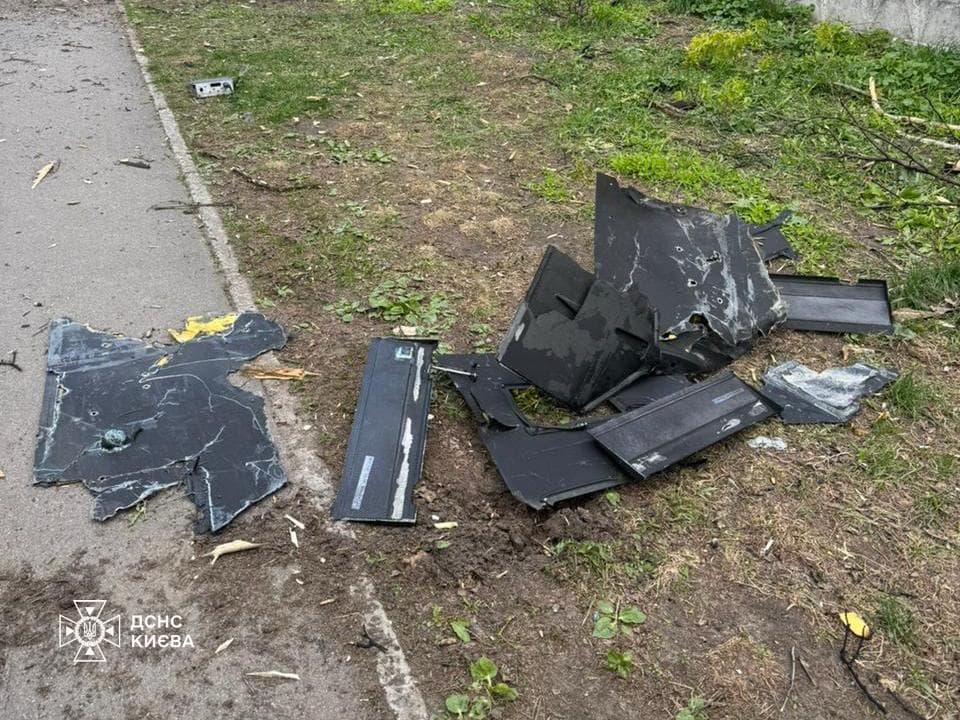
Debris from a Russian drone fell on Kyiv during a Russian daytime drone attack on the capital. (State Emergency Service/Telegram)
In Shevchenkivskyi district, the facade and part of the roof of a building under construction were damaged; two minor fires were extinguished. In Solomianskyi district, drone debris landed on the grounds of a cemetery and ignited a fire in trash that was later put out. Two people were injured — one treated on-site, one pedestrian hospitalized after a car accident caused by the explosion. Klitschko attributed the damage to debris from intercepted drones rather than direct hits.
Daytime strikes on Kyiv are rare. Russian forces have repeatedly tested different approach vectors, timing, and drone types to find gaps in the capital’s air defenses — the most extensive in Ukraine. A 2:08 p.m. attack represents a deliberate tactical experiment: most Ukrainian air defense operators and civilian alert systems are calibrated for overnight mass drone waves. An afternoon strike on a weekday, when streets are populated and buildings occupied, is designed to find a different kind of vulnerability.
123 Drones, Two Dead, Twenty Wounded: The Night’s Toll
Russian forces launched 123 drones toward Ukraine overnight on April 27 to 28 — roughly 80 Shahed-type, plus Gerbera and Italmas variants — from Kursk, Oryol, Smolensk Oblast, Rostov Oblast, Krasnodar Krai, and occupied Crimea. Ukrainian air defenses downed 95 of them. Nineteen struck 16 locations; debris fell on four more. Russian forces struck agricultural, commercial, and residential infrastructure in Kyiv, Mykolaiv, and Zaporizhzhia cities, and Chernihiv, Dnipropetrovsk, and Sumy oblasts.
At least two people were killed and 20 injured across Ukraine over the combined overnight and daytime strikes of April 28. In Kryvyi Rih, a series of Russian strikes killed a 40-year-old man and wounded five others — men aged 31, 32, 41, 45, and 57. In Chuhuiv in Kharkiv Oblast, a morning drone attack killed one person and wounded a 74-year-old man. In Sumy Oblast, Russian guided bomb attacks wounded four people, including women aged 75 and 78 and men aged 56 and 74. In Zaporizhzhia city and surrounding area, four people were wounded. In Kherson Oblast, six were wounded by drone attacks. In Chernihiv Oblast, a Russian drone struck agricultural facilities in a village, destroying sheds containing grain and equipment.
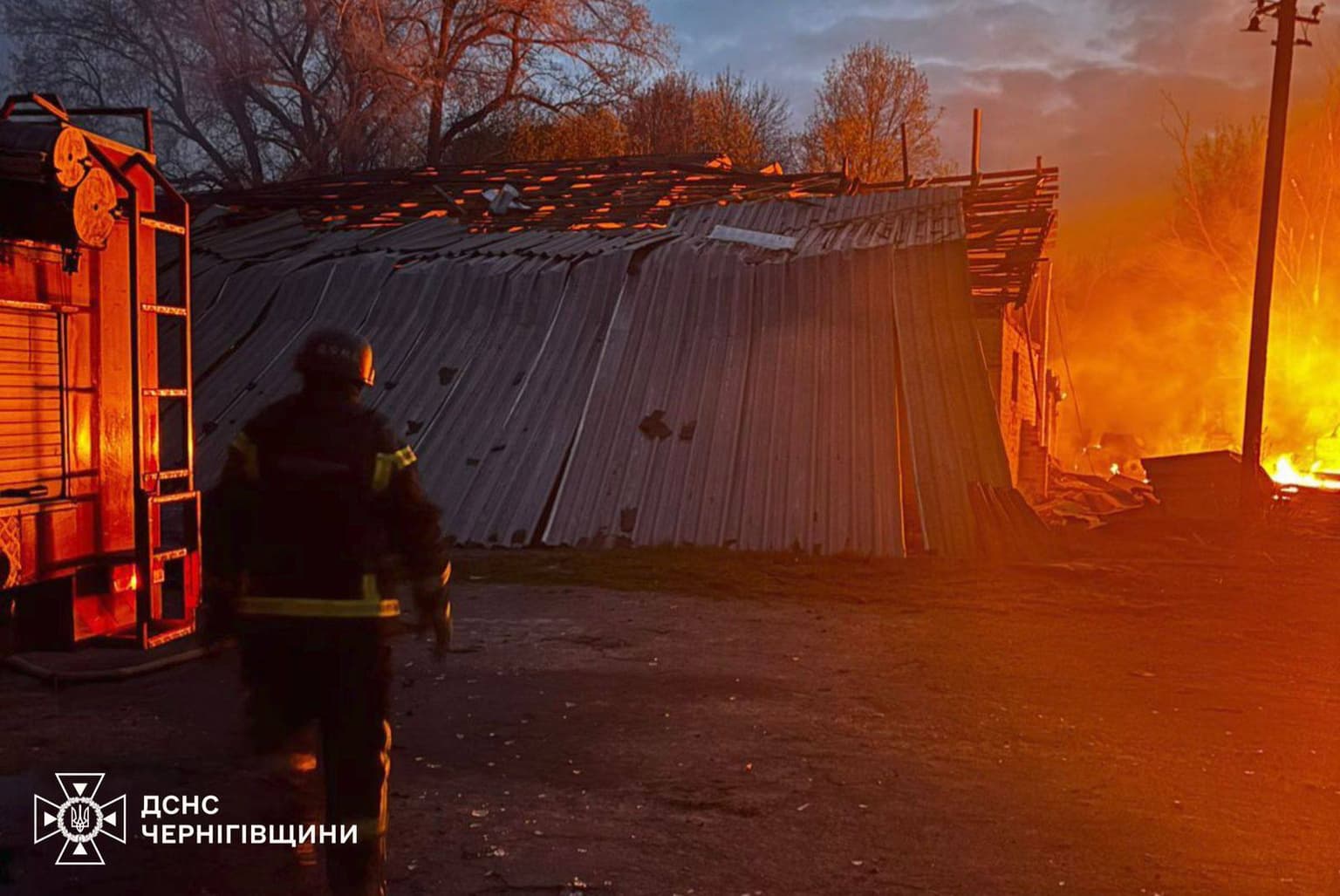
The aftermath of a Russian attack on Chernihiv Oblast, Ukraine, posted by the regional State Emergency Service. (State Emergency Service/Telegram)
Mesh Drones in the Deep Rear: Beskrestnov’s Warning from the Hospital
Serhii “Flash” Beskrestnov — the Defense Ministry drone and electronic warfare advisor who survived a Russian assassination attempt on April 20 — reported from recovery on April 28 that Ukrainian forces are observing a new Russian tactic: long-range drones equipped with mesh modems flying deeper into the Ukrainian rear than previously observed.
A mesh network is a wireless system in which a cluster of drones equipped with radio modems maintain signal among themselves, eliminating dependence on a single ground control station that can be jammed or disrupted. Beskrestnov stated that mesh networks extend the operational range of Russian drones to 220 kilometers, allowing guided drone flights to reach Kyiv from the north, Poltava from the west, and Dnipro, Kryvyi Rih, Odesa, and Mykolaiv from the south — targets that were previously at or beyond the effective guidance range for controlled drone operations.
Electronic warfare countermeasures that suppress satellite navigation — the standard Ukrainian defense against drone guidance — are not effective against mesh networks when pilots manually control the drones using independent navigation devices. Beskrestnov assessed that Russian forces have approximately 40 experienced pilots and specialists from the Alabuga Special Economic Zone operating mesh network drone systems against Ukraine. He also reported separately on April 28 that Russian forces are again deploying long-range BM-35 drones in the Sumy direction.
The mesh drone development is strategically significant: it means the electronic warfare advantage Ukraine has built around GPS jamming is being neutralized for a growing category of Russian drone operations. Beskrestnov is reporting this from a hospital bed, nine days after four Shaheds destroyed his home. The work continues.
The Frontlines on April 28: Advances, Infiltrations, and a Logistics Network Hit
Ukrainian forces recently advanced in the Kharkiv and Orikhiv directions, according to ISW’s April 28 assessment. In the Kharkiv direction, geolocated footage published April 27 shows Russian forces striking a Ukrainian position in the southern outskirts of Vovchansk — indicating Ukrainian forces hold positions there. The Russian MoD claimed on April 28 that elements of the 69th Motorized Rifle Division seized Zemlyanky, northeast of Kharkiv City. In Velykyi Burluk direction, Russian forces conducted limited attacks on April 28 but did not advance as Ukrainian forces counterattacked. In the Kupyansk direction, Russian forces continued intensified pipeline infiltration missions and limited ground assaults on April 28 but did not advance.
In Donetsk Oblast, the Russian MoD claimed the seizure of Illinivka, southwest of Kostyantynivka, crediting the 10th Tank Regiment and 77th Separate Motorized Rifle Regiment. A Ukrainian battalion commander operating in the Kostyantynivka direction reported on April 28 that Russian forces are continuing infantry and motorized assaults without using sabotage and reconnaissance groups, and have increased drone deployment in the direction since fall 2025 — but have not gained fire control of Ukrainian ground lines of communication despite deploying sleeper drones. Russian forces continued offensive operations in the Slovyansk, Dobropillya, Pokrovsk, Novopavlivka, and Oleksandrivka directions on April 28 but did not advance. In the Oleksandrivka direction, a Ukrainian brigade spokesperson reported that Russian ground assaults and infiltrations have declined to a minimum as Russian forces conduct rotations.
Ukrainian mid-range strikes on April 27 and overnight into April 28 targeted confirmed military assets: a troop concentration near occupied Velyka Novosilka in Donetsk Oblast (roughly 24 kilometers from the front line); geolocated footage confirmed an April 25 Ukrainian drone strike against a Russian locomotive pulling a fuel and lubricant train on the Donetska Railway north of occupied Menchuhove, roughly 71 kilometers from the front line. In occupied Luhansk Oblast, geolocated footage published April 27 confirmed an April 25 strike on a Russian logistics hub in occupied Voznesenivka (154 kilometers from the front line) and an April 24 strike on an ammunition depot in occupied Lysychansk (30 kilometers from the front line).
In Zaporizhzhia Oblast, Ukrainian forces struck Russian command and observation posts near occupied Molochansk, Kokhane, Uspenivka, and Stulneve; an equipment depot near Kyrylivka (117 kilometers from the front line); and a troop concentration near Starobohdanivka on April 27. Ukrainian forces also struck a Russian drone control point near occupied Hola Prystan in Kherson Oblast. In the Orikhiv direction, geolocated footage published April 27 shows Russian forces striking Ukrainian positions in northern Novodanylivka — indicating Ukrainian forces recently advanced in the area.
Intelligence Briefing: Russian Documents Confirm Moscow Cannot Meet Its Own Objectives
President Zelensky stated on April 28, following a briefing by Defense Intelligence chief Oleh Ivashchenko, that Ukraine has obtained internal Russian military documents in which Russia’s General Staff acknowledges its inability to meet objectives set by the Kremlin. Zelensky said Ukraine’s Defense Forces are inflicting irrecoverable losses on Russian troops approaching 60 percent of total losses — a figure that, if accurate, means that for every ten Russian soldiers put out of action, six cannot return to the fight.
Despite these losses, Zelensky said Russia’s political leadership continues planning further offensives and preparing additional manpower through expanded mobilization. “Accordingly, Ukraine’s task is to further increase the share of irrecoverable losses inflicted on the occupier,” he said, announcing that Kyiv will intensify drone deployment along the front line and scale up long-range strikes targeting weapons production and the oil sector.
Zelensky also said Ukraine will brief international partners on intelligence showing that Moscow continues to develop operational plans against NATO countries and is working to draw Belarus more deeply into implementing Russian military objectives — a signal aimed at NATO allies who have been debating the scope and urgency of their collective defense posture.
Russia Recruits 18,500 Foreigners: HUR Exposes the Mobilization Numbers
Ukraine’s Military Intelligence agency HUR disclosed on April 28 that Russia plans to recruit at least 18,500 foreign nationals into its Armed Forces in 2026. The Kremlin has set specific mobilization targets for military commissariats: between 0.5 and 3.5 percent of foreign nationals in each region, recruited through 97 contract service selection points distributed across military districts, with the largest concentration — 30 points — in the Central Military District.
Russia’s primary recruitment targets are citizens of Central Asian countries: Kazakhstan, Kyrgyzstan, Uzbekistan, and Tajikistan. Recruitment abroad is also underway in Bangladesh, Chad, Sudan, Burundi, and other low-income countries in Africa and Asia. Pseudo-private military structures controlled by Russian intelligence — including Redut, Konvoy, Wagner-2, Potok, Russian Fighting Brothers, Fakel, Patriot, Plamya, Sokol, and Veterany — are conducting regional enlistment alongside official recruitment centers.
HUR documented the coercion mechanisms in detail: Russia is deliberately engineering legal vulnerabilities for migrants — expired visas, inability to extend residency, administrative detention for migration violations — and then offering an “alternative” of military service or prison sentences of up to eight years. “A trip to Russia is a real chance to end up in an assault unit of ‘suicide bombers’ and ultimately die on Ukrainian soil,” HUR warned.
As of March 30, Ukraine’s Coordination Headquarters for the Treatment of Prisoners of War had identified 27,407 foreign nationals fighting for Russia — recruited from at least 135 countries, up from more than 18,000 in November 2025. The April 28 HUR disclosure names the planned 2026 target and exposes the infrastructure behind it.
May 9 Without Tanks: Russia Strips Its Victory Parade
Russia’s Defense Ministry announced on April 28 that the May 9 Victory Day parade in Red Square will not include military vehicles — no tanks, no armored personnel carriers, no missile launchers, none of the hardware that has been the centerpiece of the annual showcase of Russian military power since 1945. Officials cited “the current operational situation” without elaboration.
The parade will proceed with a foot column of servicemen from military educational institutions and an aerial segment. The broadcast will include footage from Russia’s invasion of Ukraine. The event will conclude with Su-25 jets trailing smoke in the colors of the Russian flag.
The absence of hardware from the parade carries two simultaneous messages. The first is practical: Russia does not have enough operational vehicles to display that it is willing to remove from active use for ceremonial purposes. The second is political: the Kremlin is managing expectations before a May 9 that falls during a war it has not won, against a country it said would fall in days, while its largest oil refinery in the south burns for the third time in a month.
King Charles Before Congress: “Unyielding Resolve” for Ukraine
King Charles III addressed a joint session of the U.S. Congress on April 28 — only the second time a British royal has done so — in a speech that carefully threaded diplomatic protocol and substantive urgency. Alluding to longstanding Anglo-American defense cooperation, the King invoked NATO’s Article 5 invocation after September 11, two World Wars, the Cold War, and Afghanistan before arriving at the present.
“Today, that same unyielding resolve is needed for the defence of Ukraine and her most courageous people — it is needed in order to secure a truly just and lasting peace,” Charles said. He added: “The commitment and expertise of the United States Armed Forces and its allies lie at the heart of NATO, pledged to each other’s defence, protecting our citizens and interests, keeping North Americans and Europeans safe from our common adversaries.”

King Charles III speaks as U.S. President Donald Trump listens during a state dinner in the East Room of the White House in Washington, DC. In his first visit to the U.S. as the British monarch, King Charles III addressed a joint meeting of Congress as part of a multi-day trip to the nation’s capital, New York City, and Virginia celebrating the United States of America’s 250th anniversary of its independence. (Andrew Harnik/Getty Images)
Trump called the address “fantastic.” Zelensky, in his evening statement on April 28, offered a more grounded read of where American attention stands: “We understand how the war in Iran is affecting the mindset of the American team. The Americans are focused on something else — not this war here in Europe.” The gap between the symbolism of a royal address to Congress and the operational reality of diminished U.S. engagement with Ukraine was visible in a single day.
U.S. Ambassador to Ukraine Resigns: A Vacancy at the Worst Moment
The acting U.S. ambassador to Ukraine, Julie Davis, announced on April 28 that she will retire from the Foreign Service and depart Kyiv in June 2026, ending a nearly three-decade diplomatic career. Her departure will leave the U.S. Embassy in Kyiv without a permanent ambassador for the second time in little over a year.
Davis arrived in Kyiv on May 5, 2025, to replace Bridget Brink, who resigned in April 2025 publicly criticizing the Trump administration’s approach to Ukraine — accusing it of pressuring Kyiv rather than confronting Moscow, and saying remaining in her role would have made her complicit in policies she viewed as immoral. The State Department disputed that Davis is stepping down over policy differences, describing her as “a steadfast proponent of the Trump Administration’s efforts to bring about a durable peace.”
The departure leaves a critical diplomatic post vacant at a moment when peace negotiations are stalled, Russia is preparing a possible summer offensive, and Ukraine’s relationship with Washington is navigated through a combination of formal channels and the kind of institutional continuity that career diplomats provide. No successor has been named.
Zelensky Escalates on Stolen Grain: Sanctions Threatened Against Israel
President Zelensky publicly condemned Israel on April 28 for allowing vessels carrying grain stolen from Russian-occupied Ukrainian territories to dock and unload at Haifa port. The Israeli Ambassador to Ukraine, Michael Brodsky, was summoned to the Ukrainian Foreign Ministry on April 28 and handed a formal protest note.
“Purchasing stolen goods in all normal countries is an act that entails legal liability,” Zelensky said. “The Israeli authorities couldn’t have not known which ships and with what cargo arrived at the country’s ports.” He added that Ukraine is “preparing an appropriate sanctions package that will cover both those who directly transport this grain and those individuals and legal entities who try to profit from such a criminal scheme” — and that Ukraine will coordinate with European partners to include relevant individuals in EU sanctions regimes.
The EU joined the pressure on April 28: a European Commission spokesperson confirmed that Brussels is ready to sanction individuals and entities in third countries involved in illegal shipments of stolen Ukrainian grain. “We condemn all actions that help fund Russia’s illegal war effort and circumvent EU sanctions, and remain ready to target such actions,” the spokesperson said. Ukrainian Foreign Ministry spokesperson Tykhyi confirmed on April 28 that Kyiv is aware of additional cases of illegal shipments beyond the Abinsk and Panormitis vessels, and that Israel has been notified of all of them.
Israeli Foreign Minister Sa’ar pushed back, maintaining that allegations are not evidence and that diplomatic matters should not be conducted through social media. The gap between Ukrainian and Israeli positions narrowed to a formal protest note delivered on April 28 and a sanctions package under preparation.
Arms Network Dismantled: Pushilin Sent “Prize” Weapons to Kim Jong-un, Seagal, and Lavrov
Ukraine’s National Police announced on April 28 the dismantling of an illegal arms trafficking network that sourced weapons from temporarily occupied Ukrainian territories and through illegal imports from Slovakia, then distributed them as “prize” weapons on behalf of Denis Pushilin, the Russian-installed head of occupied Donetsk Oblast.
The list of recipients named by police is striking: Kim Jong-un, Bashar al-Assad, Dmitry Medvedev, Sergey Sobyanin, Sergey Lavrov, Ramzan Kadyrov, Steven Seagal, Yulia Chicherina, Vladimir Solovyov, Alexander Sidyakin, and Vladimir Saldo. Seagal — a U.S.-born actor and Russian citizen who has publicly supported the invasion of Ukraine — received weapons through a network that was simultaneously smuggling arms across European borders.
The investigation, launched in January, uncovered an organized criminal group involved in smuggling and modifying weapons between Russian-occupied Ukraine and Europe. Several suspects were detained in cooperation with Polish authorities at the border. Follow-up raids in April across Kyiv, Zakarpattia, and Sumy regions seized dozens of firearms, large quantities of ammunition, and documents. Indictments have been sent to a Polish court. The investigation is ongoing in coordination with international partners including Europol.
The Prisoner Exchange and Butyagin: Ukraine Objects
A U.S.-facilitated five-for-five prisoner exchange at the Polish-Belarusian border on April 28 freed three Polish nationals — including journalist Andrzej Poczobut, who had spent more than 1,800 days in detention under Lukashenko’s regime — and two Moldovan citizens held in Belarus. In exchange, Poland released Russian archaeologist Alexander Butyagin, who had been detained at Ukraine’s request while transiting Poland in December 2025.
Ukraine condemned the exchange on April 28. Butyagin had been arrested for conducting archaeological excavations in Russian-occupied Crimea following the 2014 annexation, causing damages that Ukrainian prosecutors assess at over 200 million hryvnias ($4.5 million). A Polish court had approved his extradition to Ukraine; that process was preempted by the swap.
“It is evident that the Russian side will cynically use this political and legal episode to justify the occupation of Crimea,” Ukrainian Foreign Ministry spokesperson Tykhyi said. Ukraine stated it would continue pursuing “all national and international mechanisms” to bring Butyagin to justice. U.S. Special Envoy John Coale, who facilitated the exchange, thanked Poland, Moldova, and Romania, and noted President Lukashenko’s “willingness to pursue constructive engagement with the U.S.”
Slovakia Sues the EU Over the Russian Gas Ban
Slovakia confirmed on April 28 that it has filed a legal challenge with the European Court of Justice against the EU’s Repower EU regulation — which phases out the import of Russian natural gas by November 2027. Slovakia filed the case on April 24. The country has a Gazprom supply contract running until 2034 and currently sources approximately 86 percent of its oil from Russia, making it one of the two EU member states most dependent on Russian energy alongside Hungary.
Slovak Prime Minister Robert Fico argued that an energy ban constitutes a sanctions measure requiring unanimity among EU leaders, not the qualified majority used to adopt the Repower EU regulation as a trade policy decision. “We are convinced that in the given case it was a sanctions regime,” he said. “Such a procedure may disrupt the balance of competences within the EU and weaken the position of Member States in decision-making on fundamental issues.”
The case follows a similar challenge filed by Hungary under Viktor Orban, though it is now unclear whether the incoming pro-European Magyar government will maintain that filing. Slovakia’s lawsuit is the latest in a pattern of Central European legal challenges to EU energy policy designed to preserve Russian gas dependency — a dependency that has funded the war in Ukraine since 2022.
Belarus at the SCO, Hungary’s New PM, and Ukraine’s Civil Code
Belarusian Defense Minister Viktor Khrenin met Indian Defense Minister Rajnath Singh and Iranian Deputy Defense Minister Brigadier General Reza Talaei-Nik at the Shanghai Cooperation Organization defense ministerial summit on April 28, continuing the Belarus-China-Iran-Russia axis networking that has characterized the summit.
Hungary’s incoming Prime Minister Peter Magyar announced on April 28 that he wants to meet Zelensky in early June in Berehove, western Ukraine, to address the situation of ethnic Hungarians in Zakarpattia Oblast. Magyar said bilateral relations with Ukraine would depend in part on Ukraine revising language education laws he described as discriminatory against the Hungarian community — while also signaling a desire to place the relationship “on new foundations” after years of Orban-era obstruction of Ukraine’s EU accession. Kyiv has not yet responded to the offer.
The Ukrainian parliament passed a new Civil Code in a first reading on April 28 with 254 votes in favor. The bill — seven years in preparation — drew criticism from approximately 30 civil society organizations for provisions they say contradict EU standards and Ukraine’s accession commitments, including a definition of marriage as exclusively between a man and a woman and a mandatory six-month reconciliation process before divorce. A provision that would have lowered the marriage age to 14 for girls with early pregnancies was removed before the vote. Lawmakers have until the second reading to submit amendments.
Frontline Supply Crisis: Ministry Orders Inspections by May 20
Ukraine’s Defense Ministry issued a formal statement on April 28 acknowledging cases of insufficient food supply to certain frontline units and ordering inspections. Commander-in-Chief Syrskyi directed commanders of all operational groupings and corps to inspect supply conditions for troops along the entire front line by May 20. The ministry warned that distorted or inaccurate reporting on the battlefield situation would lead to direct consequences for responsible officials.
The ministry cited a “demonstrative” case in the 14th Mechanized Brigade — whose commander has been removed — and noted that supply shortfalls have also been reported in the 30th Mechanized Brigade, 128th Mountain Assault Brigade, and 108th Territorial Defense Brigade. Supply lines near Kupyansk have been badly degraded by Russian strikes on river crossings; troops are currently being supplied by boats and heavy drones, which the General Staff has acknowledged is limited and dangerous. The ombudsman’s finding from April 27 — that soldiers stop caring whether they survive after 40 days on the line — and the Ministry’s April 28 order on supply inspections are two sides of the same institutional crisis.
The Weight of the Day
Tuapse has been burning since April 16. On April 28, the fire reached a part of the refinery it had not yet touched — and the Kremlin, which had been pretending not to notice, sent its emergencies minister south and told the world it was drone debris. It was not drone debris. It was a campaign, systematic and deliberate, and on April 28 it was large enough that Moscow could no longer absorb it in silence.
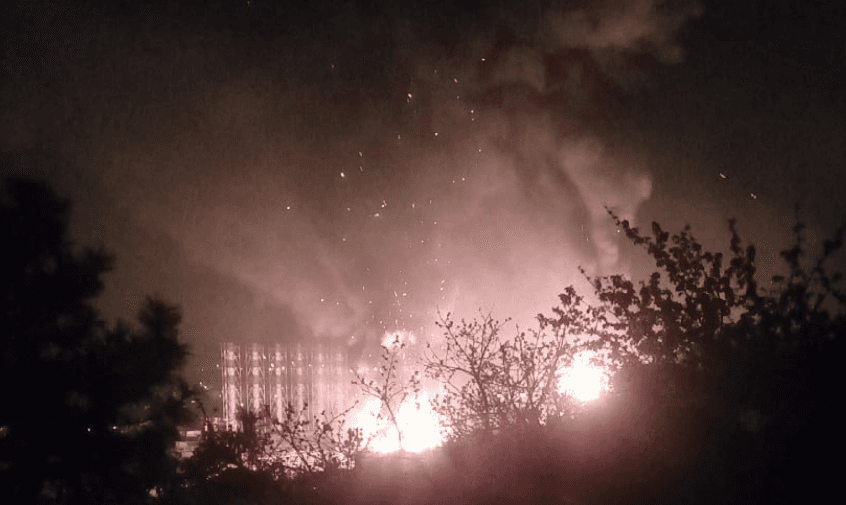
What purports to be oil storage tanks burning at an oil refinery in Tuapse, Krasnodar Krai, Russia overnight. (ExilenovaPlus/Telegram)
In Crimea, a storage site for ballistic missiles that can reach Ukrainian cities in minutes was struck and set ablaze. In Kyiv at 2:20 in the afternoon, a drone found a building under construction and a cemetery. Two people were hurt. Daytime strikes on Kyiv are experiments — Russia testing a door to see if it opens.
A king stood before Congress and said unyielding resolve is needed. An American ambassador said she is leaving. The resolve is needed. The ambassador is leaving. Both things are true on the same day, and the distance between them is the distance Ukraine has to cross every morning.
A Prayer for Ukraine
1. For the Man Killed in Kryvyi Rih and the Soldier Killed in Chuhuiv
Lord, two people died on April 28 in cities that are not on the front line — a 40-year-old in Kryvyi Rih, a person in Chuhuiv whose name we do not yet have. They were not soldiers in the first case, not in positions anyone chose. They were people in cities that drones found. We ask that you receive them with the gentleness their deaths lacked. And hold the five men wounded in Kryvyi Rih, the 74-year-old wounded in Chuhuiv, the four elderly people struck by guided bombs in Sumy: a woman of 75, a woman of 78, a man of 56, a man of 74. Their ages are in the record. Their lives are in your hands.
2. For the People of Tuapse — and the People Whose Cities This Refinery Fueled
God of complicated mercies, on April 28, residents near the Tuapse refinery were evacuated as fires burned through a facility that has been supplying fuel for a war that has killed tens of thousands of people. We do not ask you to take sides in the arithmetic of destruction. We ask that you hold the ordinary people in Tuapse who live near an industrial facility they did not choose and breathe air they cannot escape — and that you hold, in the same prayer, the Ukrainian cities that have been struck by missiles fueled by facilities like this one. All of them are your people. The war made them enemies. You did not.
3. For Andrzej Poczobut, Released After 1,800 Days
Father, a journalist spent more than 1,800 days in a Belarusian prison for doing his work. He is free on April 28. We do not know what he feels walking out — relief, grief, disorientation, the particular dislocation of a person returning to a world that kept moving without them. Be with him in the reentry. Be with all those still inside: in Belarusian prisons, in Russian detention facilities, in occupied Ukrainian territory where people are held for refusing to collaborate or for simply being who they are. 1,800 days is a long time to hold a person for telling the truth.
4. For the Soldiers Being Supplied by Boat and by Drone
Lord, the supply lines near Kupyansk have been struck so many times that troops are now being fed by boats crossing rivers and by heavy drones carrying what boats cannot reach. This is dangerous. The generals know it. The ministry knows it. The men eating whatever arrives know it most of all. We ask that you sustain them in the cold calculation of getting through each day — and that you move those with the power to fix the systemic failures to act before the May 20 inspection deadline, not after.
5. For Those Making Decisions in Distant Rooms
God of justice, on April 28 a king asked a Congress for resolve, and a president called the American attention elsewhere. Missiles are stored in Crimea until they are not. Oil refineries burn until they don’t. Ambassadors leave and are not replaced. Documents are exchanged in protocol rooms while soldiers live on drone deliveries. We do not ask you to make any of this simple. We ask that you be present in the rooms where decisions are made — and that the people making them carry, in some corner of their awareness, the faces of those sleeping near the front. In Your mercy, in Your justice, in Your time — bring this war to its end, and let the ending be worthy of what Ukraine has endured.