
October 3, 2026
Prepared by Diana Bozhyk
Five Russian munitions, including Banderol loitering missiles, crashed across Moldova on Saturday morning, the largest single incursion of Moldovan airspace so far, while Russian drones struck Kyiv’s Northern Bridge, bringing the total to six hits on the capital’s two main Dnipro crossings in three days. Russia’s Foreign Ministry formally urged foreign diplomats and citizens to leave Kyiv and warned of continued long-range strikes, as Russian attacks killed at least eight civilians and injured 83 nationwide, including five killed in Kharkiv Oblast and three in Sumy Oblast. President Zelensky told Reuters that Ukraine will respond to Putin’s “new doctrine” of civilian strikes by hitting Russian refineries harder, while the UN’s human rights chief said an average of more than 400 Ukrainian civilians have been killed or injured every week this year.
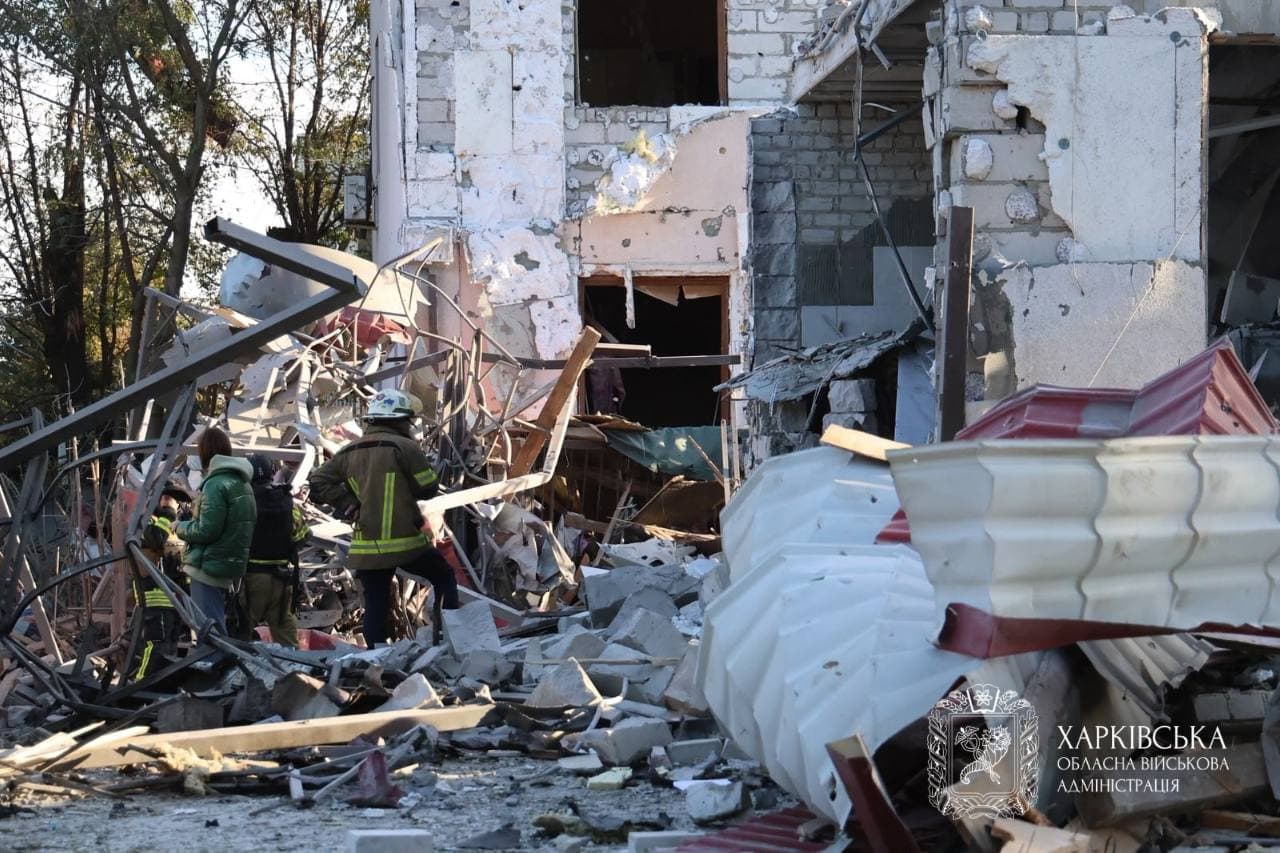
The aftermath of the latest Russian attack on Kharkiv Oblast. (Governor Oleh Syniehubov / Telegram)
THE DAY’S RECKONING
Moldova’s president said it in one sentence: “Russia’s war is dangerously reaching Moldova.” Five munitions fell across at least ten villages in a country that isn’t at war and isn’t a NATO member, the biggest single incursion yet in a pattern that’s now seven violations in two months. Nobody was hurt. That’s luck, not policy.
In Kyiv, the bridges kept coming under attack. The Northern Bridge took a jet-powered drone that severed trolleybus wires and closed the span. Six strikes on two bridges in three days now, and Ukraine’s transport minister announced the capital will build pontoon crossings and weigh a tunnel under the Dnipro. Russia’s Foreign Ministry, meanwhile, formally told diplomats to leave. The embassies, on the record, said they’re staying. Behind the scenes, a Western diplomat described the situation as “deteriorating fast.” Nothing today resolved cleanly. Everything today measured how deliberately Russia is trying to cut a capital in half.
FIVE RUSSIAN MUNITIONS CRASH IN MOLDOVA IN A RECORD INCURSION
Five Russian “air attack weapons,” including Banderol loitering munitions, violated Moldovan airspace and crashed on Moldovan territory on Saturday morning, President Maia Sandu said. “Russia’s war is dangerously reaching Moldova,” she wrote on X. “Moscow is putting lives at risk across Europe and must be stopped.” Defense Minister Anatolie Nosatyi told journalists “we have five cases, three missiles and two drones.” Moldova’s Foreign Ministry reported debris falling in the Causeni, Hincesti, Anenii Noi, and Stefan Voda districts and near Crocmaz, while the army separately tracked another object that entered Moldovan airspace near Udobne in Odesa Oblast, crossed toward Palanca, and exited after one minute. Explosions were reported near more than a dozen villages. No casualties or damage were reported.
The incursion exceeds the scale of every previous violation: most earlier incidents, including the September 30 crash near Hirbovat in Anenii Noi district, involved a single Geran- or Gerbera-type drone. At least 20 violations have occurred since February 2022, seven of them since August alone. The Institute for the Study of War continues to assess the increasingly frequent and intense incursions into Moldovan and NATO airspace as part of a deliberate Kremlin effort to normalize airspace violations by making them routine, steadily eroding the threshold at which targeted countries treat them as genuine attacks requiring a formal response.
RUSSIA HITS KYIV’S NORTHERN BRIDGE AS STRIKES REACH SIX IN THREE DAYS
A Russian jet-powered drone struck Kyiv’s Northern Bridge on Saturday morning, damaging the roadway, severing the overhead trolleybus power lines, and injuring two people, Mayor Vitali Klitschko said. The Air Force had warned at roughly 6:37 a.m. of a jet-powered drone heading directly toward the bridge, minutes before heavy detonations echoed across the capital. Videos posted online appeared to show a large explosion on the span as vehicles passed. Municipal authorities closed vehicular transit between the left and right banks, rerouting buses over the Podilskyi Bridge toward Poshtova Ploshcha metro station and European Square.
The strike marks the sixth separate hit on Kyiv’s Southern and Northern bridges since the afternoon of October 1, according to ISW, which assesses Russia is attempting to physically split the capital and degrade traffic across the Dnipro to disrupt Ukraine’s economy and daily civilian life. The Southern Bridge was fully closed to road traffic Friday after repeated hits damaged its roadway and the protective barriers shielding the Green Line metro crossing. Kyiv City Military Administration announced new movement restrictions across the bridges during air-raid alerts. Emergency services said the capital endured 56 air-raid sirens lasting more than 87 hours in total this week alone, a relentless rhythm that has left residents struggling to maintain anything resembling a normal daily routine.
RUSSIA TELLS DIPLOMATS TO LEAVE KYIV; EMBASSIES DENY PLANS TO GO
Russia’s Foreign Ministry issued a warning today recommending foreign citizens and diplomats leave Kyiv and explicitly stating that Russian forces will continue long-range drone and missile strikes against Ukraine. The warning followed a Guardian report citing anonymous senior Western diplomats who said contingency plans were being drafted to relocate embassy staff to Lviv or eastern Poland if Russia begins deliberately targeting foreign diplomatic facilities. One diplomat cautioned that “the situation is obviously deteriorating fast,” alleging Moscow seeks “to freeze Kyiv out, to throw it back into the stone age.”
Ukraine’s Foreign Ministry flatly denied the reports. “If any diplomatic missions intend to move, they inform us in advance as prescribed by standard procedures,” spokesperson Heorhii Tykhyi said, adding that as of Friday evening no such notice had been received. The US State Department, while maintaining its Level 4 “Do Not Travel” advisory, reaffirmed that the US Embassy in Kyiv remains open, staffed, and operational. The Guardian’s diplomats noted missions publicly maintain their presence because an evacuation would hand Moscow a symbolic propaganda victory. Embassies have remained in Kyiv continuously since returning in mid-2022, despite Russian strikes that have repeatedly damaged diplomatic buildings across the capital, including the Azerbaijani, Albanian, and EU missions.
MESH RELAYS LET RUSSIA STEER DRONES ONTO KYIV’S BRIDGES
Presidential defense technology adviser Serhii “Flash” Beskrestnov reported that Russian forces used one or more mesh-network repeaters to provide a temporary local connection through which drone operators adjusted trajectories during the strikes on Kyiv’s bridges. The devices work as gateways, receiving commands over the internet and converting them into radio-frequency signals for a nearby drone, letting operators maintain live control without needing signal-repeating drones or mesh ground stations in the vicinity. Beskrestnov said Russia used a similar device during the failed September 4 assassination attempt on SBU chief Oleksandr Poklad.
The disclosure helps explain how Russian jet-powered drones have managed repeated, precise strikes on a few specific structures in a heavily defended capital: instead of flying a preprogrammed route and hoping for a hit, operators appear to be steering drones in real time using relays placed, presumably by Russian-recruited agents, close to the target area. Ukrainian officials have warned the same technique could be turned against other high-value infrastructure. ISW assesses Russia is likely sustaining the bridge campaign as part of its wider winter strike plan, though it’s unclear whether Moscow can maintain the strike tempo needed to render a reinforced structure like the Southern Bridge unrepairable. The relay technology also helps Russian operators work around Ukrainian electronic warfare, since a gateway on the ground can maintain a stable control link even when conventional radio signals are being jammed in the surrounding area.
KYIV PLANS PONTOON CROSSINGS AS 600,000 DAILY CARS FACE CLOSED BRIDGES
Ukraine’s Infrastructure Minister Mykola Kalashnyk said Kyiv will build pontoon crossings across the Dnipro as emergency alternatives to the damaged bridges. “Urgent solutions are a dam and a pontoon crossing, which are being built quickly,” he told Suspilne. “This work has already begun. A corresponding coordination meeting was held with the president.” Kalashnyk said the pontoon crossings could take up to three months to build, and that plans for an underground tunnel beneath the Dnipro are also under consideration, though construction could “cost tens of billions of hryvnias.”
Roughly 600,000 cars cross between Kyiv’s left and right banks each day, Kalashnyk said, and the goal is to maintain that throughput, so construction locations are being chosen accordingly. He outlined four priorities: prevent strikes, protect the existing bridges, rapidly repair damage, and only then build alternative crossings. “Our first task is to provide protection from the sky, which we are doing in coordination with the military,” he said. Zelensky separately told the Financial Times Ukraine will be able to produce up to 400 interceptor drones by the end of October, one of five interceptor models currently in testing against Russia’s jet-powered drones. Ukrainian forces currently destroy about 57 percent of Russia’s jet-powered drones, compared with 85 to 90 percent of conventional ones, a gap interceptor production is meant to close before the strike campaign peaks in November.
ZELENSKY: UKRAINE WILL HIT REFINERIES IN RESPONSE TO PUTIN’S “NEW DOCTRINE”
President Zelensky told Reuters Ukraine will increase strikes on Russian energy infrastructure in response to what he described as a new Putin doctrine permitting broader attacks on Ukrainian civilian targets this winter. “We saw documents and we know that they allow them to attack infrastructure, logistics, roads, schools, hospitals, to pressure people to leave the capital, leave different cities,” Zelensky said. “With their attacks on our energy, we have to respond on their energy. First of all, oil refineries: what gives money to them for this war. But we will not respond, of course, just like them, on any civilian objects.”
Zelensky said he has also asked missile manufacturer Fire Point for a longer-range follow-up to the FP-7 ballistic missile that debuted in combat October 1. “I said to them, where is my FP-9? We need the FP-9. And the FP-9 will be ready this autumn, I’m sure,” he said. He confirmed Ukraine has already struck a facility in Russia’s Samara region and an Iskander missile system in Bryansk Oblast in response to the strikes on Kyiv: “It is important to note that our soldiers always find ways to respond justly to these attacks and to return the war to where it came from.” For weeks, Trump has pressed both sides to halt energy strikes to lower oil prices, a push that has gained little traction in Moscow.
UN RIGHTS CHIEF: MORE THAN 400 CIVILIANS KILLED OR INJURED EVERY WEEK
UN High Commissioner for Human Rights Volker Turk told the Human Rights Council in Geneva that an average of more than 400 civilians were killed or injured every week in Ukraine during the first eight months of 2026, a 55 percent increase from the same period last year. His office documented 15,280 civilian casualties across that span. Nearly 2,500 civilians were killed or injured by Russian aerial glide bombs on the front lines alone, 62 percent more than in 2025. “The war in Ukraine is a human rights catastrophe that is growing and intensifying by the week, causing unfathomable pain to civilians,” Turk said, urging “states with influence” over Russia to push for peace before “the tragedy becomes even worse.”
Turk’s office also released findings on conflict-related sexual violence, documenting 1,004 verified cases between February 2022 and July 2026 against civilians and prisoners of war, 89 percent attributed to Russian forces and 11 percent to Ukrainian forces, with threats comprising almost half of the latter. It interviewed prisoners of war from 36 countries held by Ukraine, many of whom said they’d been deceived into joining Russian forces. Foreign Minister Andrii Sybiha said Turk’s call “must be acted upon,” adding: “While Russia cannot achieve any of its goals on the frontline, it is killing and injuring more Ukrainian civilians.”
EIGHT KILLED, 83 INJURED ACROSS UKRAINE
Russian attacks killed at least eight civilians and injured 83 over the past day, regional authorities reported. Ukraine’s Air Force said Russia launched 157 Shahed and Gerbera drones, 45 of them jet-powered, plus Parodiya decoys; 131 were intercepted, with hits at 12 locations. Kharkiv Oblast bore the heaviest toll: five people killed and 49 injured, including two killed and 42 injured when glide bombs struck three areas of the city of Kharkiv, Governor Oleh Syniehubov said. Sumy Oblast lost three people with 10 injured in artillery, glide-bomb, and drone attacks. Donetsk Oblast reported nine injured. In Dnipro, a strike on a residential building injured four women aged 55, 62, 77, and 88, and the city’s business center was hit for the second time that week.
In Mykolaiv Oblast, three men aged 21, 47, and 62 were injured in a mass attack involving Shahed drones and an Iskander-M ballistic missile, two of them hospitalized in serious condition. Kherson Oblast reported four injured; Zaporizhzhia Oblast reported two injured amid 737 attacks on 55 settlements. Near Odesa, Russia struck a Liberian-flagged civilian cargo ship in the Black Sea, killing a motor engineer and injuring three crew members, with 13 more evacuated. “This is yet another deliberate attack by Russia on civilian shipping,” Ukraine’s Sea Ports Authority said. In Kyiv, a ballistic missile and drone attack earlier in the day killed one man and injured two.
A PHARMACEUTICAL WAREHOUSE NEAR KYIV BURNS AGAIN
Russia struck a major pharmaceutical warehouse belonging to distributor Venta near Kyiv overnight, igniting a fire at one of Ukraine’s largest medicine logistics sites, according to Kyiv Post, in a strike reported alongside Russian drone attacks on Hostomel that Moscow’s Defense Ministry claimed targeted “a logistics center.” Venta is Ukraine’s third-largest pharmaceutical distributor, and the Hostomel strike follows an earlier evening attack on the same area that injured four people, including an eight-year-old girl wounded by shrapnel.
The strike fits what the UN rights office described as a “sharp increase” in attacks on commercial properties like supermarkets and food companies that will continue to cause pain for civilians, who face temporary shortages of dairy and food items as winter approaches. Ukraine’s largest pharmaceutical manufacturer, Darnytsia, has been struck three times in six days, and Russian military bloggers now openly claim at least 27 Ukrainian data centers have been hit since September 20 — though even they acknowledge the damage caused only local and temporary disruption. The cumulative pattern suggests a deliberate effort to degrade ordinary commerce and medical supply chains rather than any narrowly military objective. Ukrainian health officials have not yet said whether the Venta strike will cause shortages of specific medicines, though pharmacies nationwide have previously reported temporary gaps following earlier strikes on distribution hubs serving large regions simultaneously.
TRUMP’S ENVOYS WEIGH A MULTIBILLION-DOLLAR LUKOIL DEAL
The Trump administration’s peace negotiations with the Kremlin now include discussions of a multibillion-dollar deal involving Lukoil assets, the New York Times reported, citing business executives with ties to US envoys Jared Kushner and Steve Witkoff who are pursuing a potential arrangement covering the company’s refineries, oil fields, and gas stations around the world. Putin raised the idea during Kushner and Witkoff’s September 5 visit to Moscow as a way to show Russians they can still do business with the United States, and the envoys reportedly agreed to work on it as a goodwill gesture. Any deal would require approval from both Washington and the Kremlin.
Lukoil, Russia’s second-largest oil producer, accounts for roughly two percent of global oil output and has been under US sanctions since October 2025. In January it agreed to sell most of its foreign assets to American investment firm Carlyle, a deal still awaiting US government approval. A deal could ease global oil prices, which have soared amid America’s war with Iran, but would also lift sanctions on Lukoil assets and potentially increase their value — an outcome that sits awkwardly beside Congress’s recent passage of the Graham sanctions bill, which Trump signed last month specifically to tighten pressure on countries financing Russia’s war economy.
DRONES HIT THE POWER PLANT FEEDING ZAPORIZHZHIA NUCLEAR STATION
The International Atomic Energy Agency said the Zaporizhzhia Thermal Power Plant, whose switchyard helps supply electricity to the Russian-occupied Zaporizhzhia Nuclear Power Plant, was targeted in a series of drone attacks on September 19, 20, and 27, damaging transformers considered vital for maintaining the nuclear plant’s off-site power. The IAEA didn’t specify who carried out the attacks. A September 22 attack also reportedly disabled an off-site radiation monitoring station, reducing the nuclear plant’s ability to monitor radiation levels nearby, while other strikes hit buildings in Enerhodar, where many plant staff live, reportedly killing one person.
IAEA Director General Rafael Grossi is now negotiating a new localized ceasefire to enable repairs at the thermal plant, which would be the eighth IAEA-brokered ceasefire aimed at securing the nuclear plant’s power supply. The facility, Europe’s largest nuclear power plant, has faced repeated external power outages since Russia seized it in 2022. The IAEA warned in May that increased drone activity near the site raised the risk of a nuclear accident, and in August reported a drone explosion at a bus stop used by plant workers that killed one person and injured 15. Each localized ceasefire has been narrow and temporary, allowing technicians to repair damaged lines under a brief pause rather than resolving the underlying danger of operating Europe’s largest nuclear plant in the middle of an active war zone.
LUKASHENKO CALLS HIMSELF AND PUTIN “CO-AGGRESSORS”
Belarusian leader Alexander Lukashenko joked that he and Vladimir Putin debate which of them qualifies as the greater “co-aggressor” in Ukraine, Kyiv Post reported, asserting Belarus’s alignment with Moscow. He repeated his long-standing line that Minsk would “never allow anyone to shoot Russia in the back,” defining the Belarus-Russia union as an indivisible territory extending “from Brest to Vladivostok,” and suggested other members of the Eurasian Economic Union could choose whether to integrate deeper into that perimeter.
The remarks follow Lukashenko’s mid-September balancing act, when he warned of military readiness checks “up to and including mobilization” while insisting that attacking neighbors would be “tantamount to death” for Belarus. Western analysts view the dual rhetoric as calibrated to deter foreign pressure while avoiding the deployment of Belarusian ground forces into Ukraine. Yet Belarus remains Moscow’s primary operational facilitator: it allowed Russian forces to launch the 2022 assault on Kyiv from its territory, hosts Russian radar and electronic-warfare facilities, and stages Russian tactical nuclear weapons, prompting NATO’s northeastern members to reinforce their own borders. Belarus shares fortified borders with Ukraine to the south and with NATO members Poland, Lithuania, and Latvia to the west and north, leaving Minsk’s rhetoric a recurring factor in regional security calculations.
UKRAINE STRIKES AN ISKANDER LAUNCHER AND A JET-DRONE BASE
Ukrainian forces struck an Iskander ballistic missile launch system in Russia’s Bryansk Oblast on October 2 or 3, Zelensky said, and hit a Russian strike-drone launch complex near Tsymbulovo, Oryol Oblast, roughly 175 kilometers from the border, on the night of October 2 to 3, Ukraine’s Strategic Communications Center reported. NASA fire-detection data showed heat anomalies near Tsymbulovo, one of Russia’s largest dedicated unmanned aviation hubs and a key site for the jet-powered Geran drones now striking Kyiv nightly. Zelensky said Ukraine also used long-range missiles against a facility in Samara Oblast.
The strikes target the launch infrastructure behind Russia’s winter strike campaign rather than the missiles and drones themselves, part of a sustained Ukrainian effort to degrade the platforms that deliver Moscow’s attacks. Ukraine’s General Staff also reported striking a Mokri Yaly River crossing near occupied Novoocheretuvate, about seven kilometers from the front, likely to disrupt Russian logistics on the western bank. Ukraine’s ongoing strikes on Crimean power plants and substations have separately forced the peninsula’s occupation operator to enact power restrictions across Crimea, while reservoir volumes fell by 11 million cubic meters in September. The outages have in turn disrupted water-pumping stations, compounding a summer of repeated blackouts that Russian occupation authorities have struggled to explain beyond vague references to technical problems.
KAZAKHSTAN DETAINS A UKRAINIAN GRANDMOTHER COLLECTING AN ABDUCTED GRANDSON
Kazakh authorities detained Ukrainian citizen Liubov Rozhanska at Astana airport on October 1 at the request of Russian authorities, her lawyer Alexei Pryanishnikov told The Insider on October 2. She had traveled to Kazakhstan to collect her eight-year-old grandson and bring him back to his father in Odesa under an agreement reached in advance with the boy’s Russian relatives. The boy is on Ukraine’s list of children abducted by Russia, and Ukraine’s Supreme Court ruled in 2025 that he should be handed over to his father. The Russian request was reportedly conveyed through the Collective Security Treaty Organization, a Moscow-led security alliance that includes Kazakhstan.
The case dates back to 2021 and illustrates the legal and diplomatic obstacles Ukrainian families face in recovering children taken into Russia’s orbit, even when Ukrainian courts have ruled in their favor. It also adds Kazakhstan to a list of third countries whose cooperation with Russian law-enforcement requests has become a vector for pursuing Ukrainians abroad, a form of transnational pressure that Ukrainian officials and human-rights groups have increasingly flagged as more countries host Russian-linked security cooperation frameworks. Ukrainian officials said they were working through diplomatic channels to secure Rozhanska’s release, though Kazakhstan’s government hasn’t publicly commented on the detention or said whether it intends to honor the Russian request.
MEANWHILE, AT THE FRONT
Russian forces recently advanced southeast of Sumy City, with geolocated footage showing a Ukrainian strike on a Russian position north of Novodmytrivka indicating Russian forces consolidated positions there. Elsewhere along the front, neither side made confirmed advances. Near Kupyansk, a source reporting on Russia’s Northern Grouping said Russian forces still operate inside the city but find it “almost impossible” to receive reinforcements, while Russian sources acknowledged Ukrainian counterattacks near Zapadne and Kindrashivka. Russia’s Defense Ministry claimed it seized Nova Kozacha north of Kharkiv, a claim ISW hasn’t confirmed.
A non-commissioned officer in a Ukrainian brigade near Kostyantynivka reported no Russian groups are currently using armored vehicles there, since constant Ukrainian reconnaissance and logistics strikes make it nearly impossible for Russia to covertly accumulate them. Russian sources reported continued Ukrainian counteroffensive activity along the Zherebets River near Yampil and Zarichne, east of Lyman, and a Russian platoon-sized mechanized assault west of Hulyaipole was met with Ukrainian strikes on its vehicles. Russian milbloggers noted heavy Ukrainian drone presence preventing advances into central Omelnyk, northeast of Orikhiv. Russian forces also continued limited offensive operations toward Oleksandrivka and Kherson without confirmed advances, while Russian airborne elements reportedly gained a foothold south of Novoyakovlivka, a claim ISW couldn’t independently verify from the available evidence.
SIX BRIDGE STRIKES, FIVE MUNITIONS IN MOLDOVA, ONE CITY DECLARED UNSAFE
By nightfall, today’s threads pulled toward the same uneasy pattern this war keeps sustaining: a Kremlin escalating on every axis at once while insisting publicly that it’s only responding to provocation. Five munitions fell across a neighboring country that never asked to be part of this. A bridge carrying hundreds of thousands of commuters daily took another hit, its trolleybus wires hanging severed over the Dnipro.
Eight civilians died elsewhere in Ukraine, five in Kharkiv Oblast alone. Moscow told foreign diplomats to leave a capital where, for now, none are going. And a grandmother sat detained in Astana because she went to bring a stolen child home. Nothing today ended. Everything today measured how thoroughly this war has stopped respecting the borders it was supposed to stay inside.
A PRAYER FOR UKRAINE
1. For the Eight Lost and the Eighty-Three Wounded
Lord, eight people died today across Kharkiv, Sumy, and the Black Sea coast, and eighty-three more were hurt, in a day that hardly made one single headline of its own. We grieve every name this war counts only as part of a larger number. Receive each of them, comfort the grieving families left behind, and hold every community still absorbing this kind of violence without any real warning at all.
2. For the Citizens of a Capital Cut in Two
Father, we pray for the millions of Kyiv residents now navigating a city whose bridges are targets, whose daily commutes are dangerous, whose ordinary life keeps narrowing a little more each day. Protect every driver and rider who crosses, repair what’s been broken, and give the city’s leaders wisdom to keep it whole. Let Kyiv never be divided by those who wish it broken.
3. For Moldova and Every Neighbor Caught in Range
Lord of the vulnerable, we lift up Moldova, a country at peace yet struck by five weapons it never invited, and every neighboring nation now watching foreign drones cross its own sky. Protect its people from harm they never chose, and give the wider world the resolve to answer these incursions before they stop being treated as simple accidents and become something far worse.
4. For the Grandmother Waiting in Astana
God of the separated, we pray for Liubov Rozhanska and every family trying to bring a stolen child home against every obstacle placed in their path. Open the doors that remain closed to her, soften whatever hearts now hold her, and let this child one day return safely to a father who has waited far too long for him to come home.
5. For a Winter Not Yet Come, and the People Preparing for It
God of mercy, we pray for every Ukrainian facing a winter deliberately planned to cut off power, heat, and water from millions of ordinary homes. Give repair crews speed, give leaders wisdom, and give this whole nation the strength to endure what’s already been announced against it. Let Russia’s own plans be undone before they harm those they’ve been aimed so deliberately at.
In Your mercy, in Your justice, in Your time — bring this war to its end, and let the ending be worthy of what Ukraine has endured.