
October 2, 2026
Prepared by Diana Bozhyk
Russian glide bombs struck two districts of Kharkiv this afternoon, killing two women aged 66 and 80 and injuring 36 more, while Kyiv’s Southern Bridge took another hit overnight and a strike on a Darnytskyi district high-rise killed one person. President Zelensky told the Financial Times that Putin ordered commanders to abandon previous constraints on aerial attacks, quoting intercepted communications as saying “there are no rules now,” as the New York Times reported Russia is planning a winter campaign to cut electricity and heat by 90 percent in Kyiv, Kharkiv, and Odesa, potentially forcing Ukraine’s nuclear plants offline. Putin claimed at the Valdai forum that Russian forces seized 1,301 square kilometers in September alone — more than seven times what independent trackers confirmed — while Kyiv Mayor Vitali Klitschko warned the capital “can no longer pretend” it can function as it did before the war.
THE DAY’S RECKONING
A president quoted his own country’s intercepted intelligence today and said the quiet part out loud: Putin told his commanders there are no rules now. Two elderly women in Kharkiv, 66 and 80 years old, died this afternoon under exactly that kind of rule-free strike. Kyiv’s main bridge over the Dnipro took yet another hit overnight, the latest in a campaign city officials say is deliberately timed to break the ordinary rhythm of life in the capital before winter even properly begins.
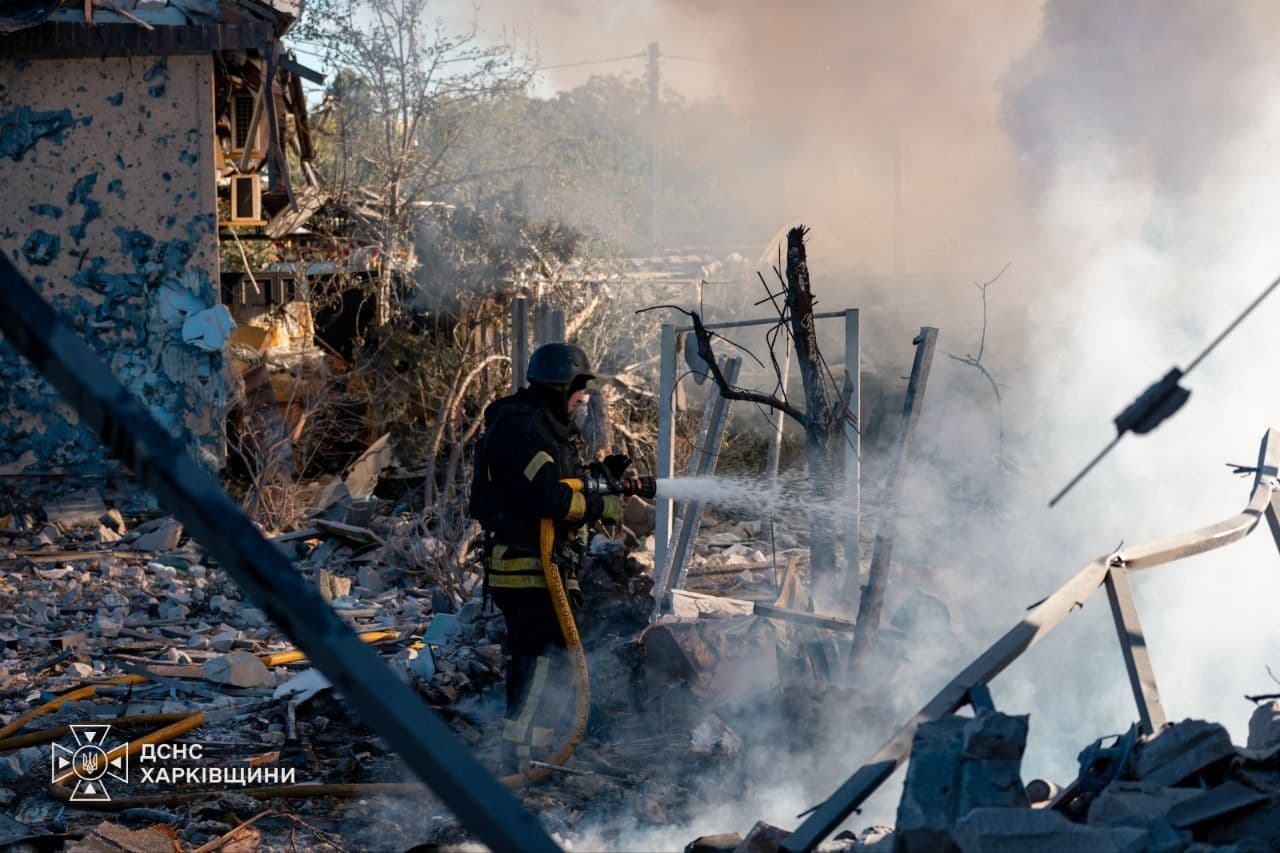
An emergency worker fights a fire in the aftermath of Russian glide bomb strikes on Kharkiv. (Photo by State Emergency Service of Ukraine in Kahrkiv, via Telegram)
Russia, for its part, kept describing a war that doesn’t match anything independent trackers can confirm. Putin told an audience in Sochi that Russian forces seized seven times more territory in September than actually happened. A New York Times investigation detailed a Russian plan to cut 90 percent of power and heat to three major Ukrainian cities this winter, potentially forcing nuclear plants offline in the process. Two Zaporizhzhia teenagers were arrested for allegedly agreeing to murder Ukrainian soldiers for FSB cash. A Russian fighter jet shot down a Russian helicopter by mistake. Nothing today resolved cleanly. Everything today measured how thoroughly this war has learned to blur the line between deliberate cruelty and simple chaos.
TWO ELDERLY WOMEN KILLED AS GLIDE BOMBS HIT KHARKIV
Russian forces struck Kharkiv’s Slobidskyi and Nemyshlyansky districts with three glide bombs this afternoon, killing two women aged 66 and 80 and injuring 36 people, including three children, regional administration head Oleh Syniehubov said. One bomb “completely destroyed” a residential building, Kharkiv Mayor Ihor Terekhov said. The Russian guided bombs, known in Ukraine as KABs, are repurposed free-fall munitions fitted with wings and GPS, laser, or infrared guidance, letting Russian Su-34 jets release them dozens of kilometers from target and well outside the range of Ukrainian air defenses; warheads range from roughly 300 kilograms up to three metric tons, enough to level a multistory building in a single hit.
The Kharkiv strike landed the same day Russian attacks hit apartment buildings in Kramatorsk and Sumy, with Zelensky confirming additional strikes across Dnipro, Odesa, Kharkiv, Kyiv, Poltava, and Rivne oblasts. “In Kyiv, ‘Shaheds’ struck the Pivdennyi Bridge several times. In the morning, a residential high-rise was hit… In Kherson, the Russians ‘defeated’ a kindergarten; in Kharkiv, they attacked a grocery store, and an institute and critical infrastructure were damaged,” Zelensky said. In Kyiv’s Darnytskyi district, an overnight strike on a 25-story residential building killed one person and injured two more. Kherson Oblast reported seven injured; Kharkiv Oblast reported six more injured beyond the glide-bomb toll; Dnipropetrovsk Oblast reported four injured in Pavlohrad; Sumy Oblast reported two injured; Donetsk Oblast reported one killed and four injured; and Zaporizhzhia Oblast absorbed 741 separate attacks on 51 settlements with no casualties reported.
ZELENSKY: PUTIN TOLD COMMANDERS “THERE ARE NO RULES NOW”
President Zelensky told the Financial Times in an interview published today, conducted from inside the bomb shelter of a Kyiv school struck by a Russian drone the previous day, that Putin ordered military commanders to abandon any previous constraints on aerial attacks and intensify strikes on civilian sites. “He said there are no rules now,” Zelensky said, citing intelligence Ukrainian agencies obtained, including what the FT described as intercepted communications between Kremlin officials; Kyiv hasn’t publicly released the intercepts, and their contents couldn’t be independently verified. Zelensky said the order was issued in September, as Russia intensified attacks on Kyiv and increasingly struck schools, hospitals, telecommunications facilities, and data centers.
Speaking separately to Spain’s El País near the same struck school, Zelensky said Russia’s strategy aims not just to damage Kyiv but to drive out its population entirely, deliberately timing the escalation around the US midterm elections to maximize political pressure. He said Moscow is repeating tactics from February 2022, when Russian forces first tried to seize or paralyze the capital and collapse Ukraine’s government outright. The school itself, Solomianskyi’s School No. 12, survived only because 104 students and 60 teachers reached the underground shelter before the drone’s 50-kilogram warhead struck — a warhead that pierced the building’s floor without detonating.
RUSSIA PLANS TO CUT 90% OF POWER, HEAT, AND WATER THIS WINTER
Russia is planning a campaign of strikes intended to cut electricity, heating, and water to Ukraine’s largest cities this winter, according to a Russian-language document dated August that Ukrainian officials shared with European partners, the New York Times reported. Energy Minister Denys Shmyhal presented the document, described as an intercepted Russian plan, to European partners in Paris two weeks earlier. The plan targets Kyiv, Kharkiv, and Odesa specifically, aiming to cut electricity supplies by 90 percent, reduce heating by 90 percent, and severely disrupt sewage systems using up to 1,000 missiles, drones, and bombs against substations, hydroelectric and thermal plants, and boiler houses.
Among the plan’s most consequential elements: forcing all three of Ukraine’s operating nuclear power plants offline by striking the electrical substations connecting them to the national grid, located less than a mile from the reactors themselves — targeting the grid connections rather than the reactors directly, but risking exactly the kind of cascading safety failure nuclear regulators have warned about throughout the war. The Economist separately reported the campaign is expected to peak in November, framed explicitly as retaliation for Ukraine’s own strikes on Russian oil refineries, with the stated goal of crippling the Ukrainian capital before winter fully arrives.
PUTIN’S “HALLUCINATORY” TERRITORIAL CLAIMS AT VALDAI
Vladimir Putin claimed at the Valdai Discussion Forum today that Russian forces brought 1,301 square kilometers of Ukrainian territory under control in September alone — 2.5 times the rate of previous months — offering no independently verifiable evidence for the figure. The Institute for the Study of War’s own mapping instead recorded Russian forces losing a net 80.81 square kilometers in September, falling to a net loss of 175.18 square kilometers once Russian infiltrations into uncontrolled territory are factored in; Putin’s claim exceeds ISW’s confirmed Russian gains for the month by more than sevenfold. ISW said it cannot determine whether Putin genuinely believes the inflated figures or is simply repeating fictional data passed up a chain of command long known for dishonest reporting.
Putin used much of the same speech to insist Russia “is not threatening anyone” and has no plans to attack “in 2029, 2030, or 2050,” while simultaneously warning that nuclear weapons would “inevitably and immediately” return to Russia’s agenda if Europe attacked Kaliningrad or other Russian territory. The contradiction fits a pattern of Kremlin messaging researchers describe as deliberate cognitive warfare: portraying Russia as the victim of Western aggression while continuing to issue direct threats against European capitals, a strategy that’s included Medvedev’s May 2024 warning of strikes on Washington, Paris, and London, and a Russian Duma defense committee member’s June 2026 call for nuclear strikes on European capitals.
CHINA TRAINS ALONGSIDE RUSSIA IN DRONE WARFARE EXERCISES
Russian Defense Minister Andrey Belousov confirmed today that a Chinese “military contingent” is participating directly in Russia’s Center-2026 strategic exercises at the Chelyabinsk training ground, running September 28 through October 3, involving roughly 700 pieces of equipment, more than 600 drones, and over 60 unmanned ground vehicles. Russian and Chinese forces practiced joint deployment and maneuvers together, marking a shift from China’s prior posture: Chinese forces observed last year’s Zapad 2025 exercises but didn’t actively participate.
The exercises give China’s military direct, hands-on exposure to some of the most advanced drone and counter-drone techniques refined through more than four years of combat in Ukraine — launching and defending against FPV drone strikes, operating ground robotics, applying electronic-warfare countermeasures, and running the small-group assault tactics that have come to define the war’s tactical character. For a Chinese military that’s observed but never fought a war of this scale and technological intensity, the exercises represent a genuine, practical transfer of battlefield lessons Russia paid for in Ukrainian blood — knowledge China now gets largely for free, deepening a military relationship that continues expanding well beyond the rhetorical neutrality Beijing maintains in public. Western officials have watched the growing cooperation with increasing concern, since lessons drawn from a European land war could just as easily inform Chinese planning around Taiwan or other regional flashpoints entirely unrelated to Ukraine itself.
KLITSCHKO: KYIV IS FIGHTING FOR SURVIVAL
Kyiv Mayor Vitali Klitschko warned today that keeping the capital functioning under repeated Russian attacks has become a matter of “safety and survival,” following a meeting of the city’s Defense Council. “The capital is in a very dramatic situation. We can no longer pretend that we can live as we would in peacetime,” Klitschko said, calling for the same public unity shown at the start of the full-scale invasion in February 2022. “Now is not the time for populism,” he added, urging city agencies to coordinate honestly with residents rather than offer false reassurance. “Kyiv will withstand this. But only through joint efforts.”
The warning followed another overnight strike on the Southern Bridge, which city authorities fully closed to road traffic Friday morning alongside restrictions on two other Dnipro crossings. Klitschko said restoring Green Line metro service across the bridge during yellow-level alerts now depends on a formal structural assessment from research institutes the infrastructure ministry has engaged, with the metro operator ready to resume service only once that conclusion arrives. Beyond the bridge itself, Klitschko described mounting pressure on nearly every category of city function — infrastructure, logistics, housing, and public facilities — compounded by Russia’s renewed targeting of the energy sector specifically.
SBU FOILS A TEEN ASSASSINATION PLOT USING A DATING-APP HONEYPOT
Ukraine’s Security Service said it arrested two Zaporizhzhia men, aged 18 and 19, on September 10 as they conducted reconnaissance for a planned assassination of Ukrainian servicemen, after Russia’s FSB recruited them through a Telegram post offering an “easy way to make money.” The pair first proved themselves by setting fire to servicemen’s vehicles on their handler’s orders before being tasked with the killings directly: one was instructed to lure soldiers into ambushes by posing as a young woman on dating sites, while the other would film the murders as “proof” for their FSB handler. Investigators found a hunting knife, a live hand grenade, a gas pistol, and phones containing messages from the handler during follow-up searches.
The suspects had been told to purchase a fresh “set” of a knife, a change of clothes, and rubber gloves before each planned killing, then dispose of the items immediately afterward — a level of operational detail suggesting experienced FSB handling rather than improvised local planning. SBU chief Major General Oleksandr Poklad personally coordinated the operation, the agency said. Both men face charges of high treason and conspiracy under martial law, carrying potential life imprisonment and asset confiscation if convicted, adding to a growing list of FSB-run plots against Ukrainian military and public figures uncovered throughout the year.
HUR WARNS RUSSIA IS TARGETING EUROPEAN STARLINK STATIONS
Ukraine’s military intelligence directorate warned partner nations today that Russian special services have been tasked with increasing hybrid operations across EU and NATO territory, specifically flagging Starlink satellite ground stations as likely targets. “The special services of the aggressor state of Russia have been tasked with increasing activity on the territory of the European Union and NATO states — this involves preparing for hybrid operations aimed at undermining aid to Ukraine and weakening the Alliance’s capabilities,” HUR said, warning Moscow plans to use GRU- and FSB-recruited agents to strike military facilities, infrastructure, and communications systems.
The warning follows a September 23 fire at a Starlink ground station in Wola Krobowska, Poland, which Deputy Prime Minister Krzysztof Gawkowski said may have been deliberate sabotage aimed at disrupting the Exatel-operated hub that carries internet traffic through Poland, including to Ukraine; the investigation remains open. Starlink, built and operated by SpaceX, underpins much of Ukraine’s military communications. The alert adds to a documented pattern of suspected Russian sabotage and espionage across Europe this year, including August’s attempted drone-based attack on Ukrainian cargo aircraft at Leipzig Airport, which Germany formally attributed to Russia on September 1. European governments are stepping up preparations in response, with officials across the continent increasingly warning that Moscow could use drones, missiles, sabotage, and cyberattacks together to deliberately test NATO members and pressure them over their continued support for Ukraine.
A RUSSIAN JET SHOOTS DOWN ITS OWN HELICOPTER
A Russian Su-35 fighter jet mistakenly shot down a Russian Mi-8 helicopter over Voronezh Oblast on October 1, killing all three crew members, according to multiple Russian and Ukrainian Telegram channels; Russian authorities haven’t publicly confirmed the cause. The helicopter crashed in the Anninsky district, roughly 80 kilometers from the regional capital, while Russian forces were reportedly responding to a suspected Ukrainian drone incursion. Ukrainian channel Exilenova Plus said the Su-35 crew misidentified the Mi-8 as a drone and opened fire, killing the pilot, navigator, and onboard gunner.
The reports, while unverified by Russian officials, fit a pattern of increasingly jumpy Russian air-defense responses as Ukraine’s deep-strike campaign and drone operations have pushed further into Russian territory throughout the year, raising the baseline tension level at which Russian crews are operating even over their own soil. A friendly-fire loss of this scale — an entire helicopter crew killed by Russia’s own air force — would mark a notable, if unintentional, illustration of exactly the kind of strained, trigger-ready air-defense posture Russia’s own escalating drone-interception demands have increasingly forced onto crews across multiple regions simultaneously. Neither Russian military bloggers nor official channels have offered a competing explanation for the helicopter’s loss, leaving the friendly-fire account as the only version currently circulating.
G7 RELEASES 100 MILLION BARRELS OF OIL AS PRICES SPIKE
G7 leaders agreed today to release up to 100 million barrels of crude oil and diesel reserves over the next four months to curb soaring fuel prices, with the release beginning immediately, starting with diesel stocks. “We agreed that there would be no export restrictions or export bans between G7 members,” French President Emmanuel Macron said, denying Europe had been pressured into the move by the threat of a US diesel export ban: “The tone of our discussion was not one of threats; it was constructive.” Trump wrote on Truth Social that European countries had agreed to make a major contribution, saying “the process will begin immediately.”
The emergency release follows weeks of rising global fuel prices that Trump has repeatedly, and misleadingly, blamed primarily on Ukraine’s refinery-strike campaign against Russia, even though America’s own war with Iran and the resulting Strait of Hormuz disruption has caused considerably larger supply shocks. Macron said the agreement mattered specifically because speculative trading earlier in the day had already driven prices higher, suggesting the G7’s coordinated response was aimed as much at calming markets psychologically as at addressing any genuine physical shortage. The statement didn’t specify exactly which countries would supply the released reserves, leaving open how the burden of the commitment will ultimately be distributed across G7 members in the months ahead.
SCHRÖDER TAKES A RUSSIAN BUSINESS POST
Former German Chancellor Gerhard Schröder, a longtime Putin ally, has joined Russian retailer Hyperglobus in a new business role, days after the Kremlin floated him as a possible mediator in Ukraine peace talks. The appointment continues a pattern of Moscow promoting Kremlin-friendly Western figures into visible roles even as it simultaneously pressures European businesses still operating inside Russia, following Putin’s recent decrees placing the Russian assets of Nestlé, Auchan, and other Western companies under state “temporary management.”
Schröder has faced years of criticism in Germany for his continued business ties to Russian state energy interests, including his chairmanship roles tied to Nord Stream and Rosneft, relationships that cost him his pension-linked office privileges and most of his remaining political standing within his own Social Democratic Party. His latest appointment, arriving just as the Kremlin was publicly testing his usefulness as a potential Ukraine mediator, underscores how Moscow continues treating sympathetic former Western officials as both genuine business assets and convenient diplomatic props whenever the opportunity arises. Western officials have greeted the mediator suggestion with open skepticism, given Schröder’s decades-long financial entanglement with exactly the Russian state interests any genuine mediation effort would need to treat with complete impartiality. German commentators noted the irony bluntly: a man already distrusted for his closeness to Moscow accepting a Russian corporate post does little to rehabilitate his standing as any kind of credible neutral broker going forward.
NEARLY 244,000 WAR CRIMES CASES, 749 CHILDREN KILLED
Ukraine’s National Police has opened 243,982 criminal proceedings tied to crimes committed by Russian servicemen and their accomplices since the full-scale invasion began, including 226,766 classified as war crimes under Ukraine’s criminal code, 9,412 involving violations of territorial integrity, 4,781 involving collaboration, and 452 involving treason. The total has risen by more than 7,400 cases since late August alone, reflecting how steadily new proceedings continue accumulating more than four years into the war. Investigators have separately opened 153 criminal proceedings specifically involving sexual violence by Russian military personnel, though officials say the true scale likely runs considerably higher given how many victims remain in occupied territory or unable to safely report abuse.
The toll on Ukrainian children remains especially severe: as of today, official data shows 749 children killed and 2,924 wounded since the invasion began, with 2,365 still listed as missing and 20,651 recorded as deported to Russia. Ukraine has managed to return 2,651 of those deported children, while 59,462 have been located according to the Children of War database, though locating a child doesn’t always mean securing their actual return. Police say the figures remain incomplete because investigators cannot fully verify cases in active combat zones or occupied territory, and the meticulously documented database is being built specifically to support both domestic prosecutions and future international tribunals.
FORTY-ONE UKRAINIANS RETURN AS OLESHKY’S POPULATION COLLAPSES
Forty-one Ukrainian citizens, including four children and five teenagers, returned from Russian-occupied territory through the Mokrany-Domanove crossing in Volyn Oblast during August and September, Parliamentary Human Rights Commissioner Dmytro Lubinets said today. Among them was a family reunited after the father’s release from Russian captivity; their eldest son had also been held captive since April 2022, while the mother and younger son had been confined and subjected to forced medical treatment by occupation authorities under the pretext of care. A young medical worker was also returned shortly before she would have been mobilized into Russia’s armed forces.
Lubinets again highlighted the collapsing situation in occupied Oleshky, Kherson Oblast, where Russian forces continue blocking Ukrainian and international humanitarian access entirely. The town’s population has fallen from roughly 24,000 before the war to approximately 2,000 as of this spring, according to Ukraine’s Foreign Ministry, as residents report critical food shortages with only a small number managing to evacuate. Ukraine estimates up to 16,000 citizens remain missing nationwide, with thousands more still believed trapped across occupied territory under conditions Ukrainian officials have repeatedly described as deliberately engineered to be unsurvivable. Lubinets said the Volyn crossing, bordering Poland and Belarus, remains one of the few viable routes home for Ukrainians fleeing occupation, since no safe way currently exists to cross the front line directly.
THE EU SENDS €2.9 BILLION AS A US FUND SIGNS ITS FIRST MINERALS DEAL
The European Union disbursed €2.9 billion to Ukraine today after Kyiv passed several reforms required under the Ukraine Plan, including changes to judges’ integrity declarations, the appointment of a new electricity market operator, and new traffic-safety laws. “European solidarity means concrete support. Europe will stand by Ukraine’s side for as long as it takes,” European Commission President Ursula von der Leyen said. Zelensky called the payment “very timely support” for Ukraine’s macro-financial stability. Prime Minister Serhii Koretskyi said more reforms are expected when parliament reconvenes October 12, potentially unlocking over €20 billion more in support still available for the year.
Separately, the joint US-Ukraine Reconstruction Investment Fund signed its first-ever critical minerals deal today, a roughly $30 million “joint investment platform” with BGV Group, a firm founded by Ukrainian billionaire Hennadii Butkevych, to identify rare earth, beryllium, and zirconium deposits across the country. The fund, established under last year’s minerals agreement with Washington, also announced two new energy investments ahead of winter: additional capital access for a previously announced $97 million loan to DTEK, Ukraine’s largest private energy firm, and an equity stake supporting a 200-megawatt battery storage system already powering roughly 600,000 homes across Kyiv and Dnipropetrovsk oblasts. The combined announcements reflect Washington’s continued wartime bet on Ukraine’s private sector even as broader US-Russia diplomatic talks over a potential settlement continue without any confirmed breakthrough.
HUNGARY RENEWS ITS EU BLOCKADE, A PHARMACEUTICAL WAREHOUSE BURNS
Hungary is again withholding support for Ukraine’s EU accession bid, this time demanding Kyiv pass a new law expanding Hungarian-language education rights for the roughly 80,000 ethnic Hungarians living in Zakarpattia Oblast before Budapest will lift its veto. The draft legislation would grant special status to schools where more than half of pupils study in a minority language, while the bill’s text is specifically worded to avoid extending the same protections to Russian. Zelensky has downplayed the resulting rift, expressing hope the law’s passage could help restart Ukraine’s stalled bid to open all six EU accession clusters, which the European Commission has said Ukraine is technically ready for despite Hungary’s continued political objections.
Separately, a Russian drone attack struck Hostomel, Kyiv Oblast, this evening, hitting warehouses and injuring four people, including an eight-year-old girl wounded by shrapnel in her leg, regional administration head Tymur Tkachenko said. Among the targets was a warehouse belonging to Venta LTD, Ukraine’s third-largest pharmaceutical distributor, adding another entry to Russia’s monthslong campaign against Ukraine’s commercial medical supply chain. At least one victim was hospitalized, with the full extent of injuries still being assessed. The strike adds Hostomel, a town already associated with some of the war’s earliest and fiercest fighting in February 2022, to the list of communities absorbing Russia’s expanding campaign against civilian commercial infrastructure well beyond the capital itself.
MEANWHILE, AT THE FRONT
Ukraine’s 3rd Army Corps continued Operation Vivaldi in the Lyman sector, with Brigadier General Andrii Biletsky’s forces having reclaimed 176 square kilometers, liberated five settlements, and captured more than 250 Russian soldiers across the operation’s first three phases — figures Ukraine kept deliberately unconfirmed for months specifically to preserve operational security, a secrecy ISW says will likely keep complicating precise month-to-month territorial assessments going forward. Zelensky confirmed Ukraine is preparing a fourth phase of the counteroffensive.
Russian forces struck a fire-and-rescue unit in Zaporizhzhia Oblast with a drone today, wounding one rescuer as emergency workers prepared to respond to an unrelated call — part of the same pattern of strikes deliberately timed against responders that’s defined much of Russia’s campaign against frontline and near-frontline Ukrainian communities throughout the year, treating emergency services themselves as acceptable targets rather than protected personnel under any meaningful interpretation of the laws of war. Along the broader front, Russian forces continued offensive operations across multiple sectors without confirmed major advances, while Operation Vivaldi’s ripple effects continued complicating Russian plans toward Slovyansk specifically, according to Ukrainian military observers tracking the sector. Russian milbloggers themselves increasingly acknowledge the strain, with some describing reorganized logistics and reduced attack tempo toward both Slovyansk and Kramatorsk as a direct consequence of Ukraine’s sustained pressure from the Lyman area.
TWO WOMEN LOST, A BRIDGE STRUCK AGAIN, A WINTER PLAN REVEALED
By nightfall, today’s threads pulled toward the same uneasy pattern this war keeps sustaining: a president’s own words confirming what the day’s violence had already made plain, and a Kremlin still describing a battlefield that simply doesn’t exist. Two elderly women in Kharkiv won’t see tomorrow, killed by bombs dropped from a safe distance precisely because distance is the only thing Ukraine’s air defenses still can’t fully close.
A winter plan aimed at three of Ukraine’s biggest cities is now public knowledge, nuclear plants included. Putin claimed gains seven times larger than anything verified. And somewhere in Voronezh Oblast, a Russian jet shot down a Russian helicopter, three of Moscow’s own crew killed by their own side’s mistake. Nothing today ended. Everything today measured how completely this war has stopped distinguishing between deliberate cruelty and simple, grinding chaos.
A PRAYER FOR UKRAINE
1. For the Two Women Lost in Kharkiv
Lord, two women — sixty-six and eighty years old — died today under bombs dropped from a distance that made them utterly defenseless. We grieve lives that had already survived so much, ended in an afternoon neither chose. Receive them gently, comfort the thirty-six injured and their families, and protect every elderly resident still living where this war keeps reaching without warning.
2. For Every Child Sheltering From a War With No Rules
Father, we pray for the children of Kyiv, Kharkiv, and every city now facing a winter deliberately engineered to break them. Protect them from strikes aimed at breaking their parents’ resolve through their own suffering. Give Ukraine’s leaders wisdom to shield what can still be shielded, and give the world urgency to stop a war its own architect now admits has no remaining limits.
3. For Every Family Still Trapped in Oleshky
Lord of the forgotten, we lift up the roughly two thousand residents still trapped in a town that’s lost ninety percent of its population to war and blockade. Find a way for aid to reach them despite every obstacle Russia keeps placing in its path. And give the forty-one who made it home today a welcome worthy of what they survived to receive.
4. For Wisdom Among Nations Weighing How Hard to Push Back
God of justice, we pray for the leaders responding to a Kremlin that threatens even as it claims innocence, that escalates even as it denies escalation. Give them clarity to see through contradiction, and give them resolve to answer threats against embassies, infrastructure, and civilians with consequences that actually land and actually matter. Let deterrence hold firm where diplomacy alone cannot.
5. For an End Before Winter Finishes What Autumn Started
God of mercy, we pray against a winter deliberately planned to cut off power, heat, and water from millions of people who did nothing to deserve it. Give Ukraine’s engineers and defenders the strength to protect what can be protected, and give this war’s architects a conscience that arrives before the cold does. Let this be the winter that finally breaks the pattern, not the people living through it.
In Your mercy, in Your justice, in Your time — bring this war to its end, and let the ending be worthy of what Ukraine has endured.