
October 5, 2026
Prepared by Diana Bozhyk
Three Russian glide bombs tore through Kharkiv’s Slobidskyi district this afternoon, killing six people and wounding 59, including three children, while Russian drones sank a Turkish-owned grain ship in Romania’s economic zone and a projectile at a Ukrainian-Moldovan border crossing injured a Moldovan border guard. Ukraine’s Air Force said AI-guided machine-gun turrets had downed their first jet-powered drones, as military intelligence reported that a rebuilt Geran-4 now carries a warhead designed for bridges. Zelensky held calls with leaders in Paris, Warsaw, and The Hague on air defense and peace talks, while Brussels signaled that Ukraine and Moldova could open new EU accession clusters as soon as next week.
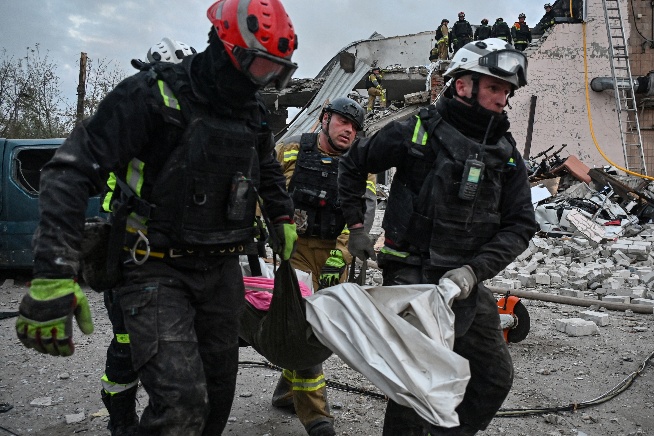
Ukrainian rescuers carry the body of a victim at the site of a Russian air strike in Kharkiv. (SERGEY BOBOK/AFP via Getty Images)
THE DAY’S RECKONING
Kharkiv spent the evening counting. The toll from three guided bombs dropped on the Slobidskyi district climbed hour by hour, from three dead to five and then six, as rescuers dug through rubble and fires burned across almost 15,000 square meters. An 11-year-old girl remained in serious condition. Far to the southwest, a grain ship that had left the Danube port of Izmail went down in Romania’s exclusive economic zone with its captain dead, and a projectile at the Moldovan border ricocheted into a bus and a control booth, wounding a border guard.
The rest of the day’s news came from engineers and diplomats rather than rescuers. Ukrainian intelligence described a Russian drone rebuilt with a Russian engine and a warhead meant for bridges, while the Air Force described AI turrets knocking jet drones out of the sky. Zelensky called Paris, Warsaw, and The Hague and asked partners for anti-ballistic defenses. In Brussels, the EU’s enlargement commissioner said no country is delivering more than Ukraine. And in Kyiv, the opposition European Solidarity party expelled one of its best-known lawmakers over his plan for ending the war.
KHARKIV: THREE GLIDE BOMBS, SIX DEAD, 59 WOUNDED
Russian forces struck Kharkiv’s Slobidskyi district with three guided aerial bombs this afternoon, hitting an industrial area and the ground near a residential high-rise. Oleh Syniehubov, head of the Kharkiv Regional Military Administration, first reported three men killed, two of them aged 62 and one aged 35. One died inside a residential building; the other two were killed by falling fragments of the bombs.
The toll kept rising through the evening. By 9 p.m. Kyiv time, Kyiv Post reported six dead and 59 wounded after rescuers found the remains of another victim under the rubble. Figures differed between sources: ISW, citing Syniehubov, reported five killed and 59 injured, while the Kyiv Independent reported at least five dead and 53 injured, including children.
Three children were among the wounded. An 11-year-old girl remained in serious condition, a 15-year-old boy suffered moderate injuries, and a 15-year-old girl was treated for an acute stress reaction.
“The enemy attacked Kharkiv with at least three glide bombs,” Mayor Ihor Terekhov wrote on Telegram, warning that warehouse buildings were on fire and that people might be trapped under the rubble of a residential building that had been hit.
The strikes damaged dozens of residential buildings, a civilian enterprise, and at least 20 private vehicles. The State Emergency Service said the bombs sparked two large fires, at a warehouse and at a production facility, and Syniehubov put the total area of the fires at almost 15,000 square meters. Rescuers pulled two people out alive and recovered the bodies of two others, while police went door to door through the damaged buildings checking whether anyone needed medical help.
The attack followed a run of strikes on the city. On Sunday evening, three Banderol jet-powered munitions killed one person and injured eight in Kharkiv.
A TURKISH-OWNED GRAIN SHIP SINKS OFF ROMANIA
A cargo ship carrying corn sank in Romania’s exclusive economic zone today after a fire broke out on board, and President Volodymyr Zelensky said two Russian drones had struck it. The Royad Mammadov, a 140-meter vessel, had left the Danube port of Izmail bound for Ravenna, Italy, according to Romanian media. Shipping records list Turkey-based MG Shipping 5 Co Ltd as its registered owner. Kyiv Post reported that it sailed under the flag of Saint Kitts and Nevis, while ISW described it as Turkish-flagged.
Zelensky said the crew were citizens of Azerbaijan and India and that the strike killed the captain; Kyiv Post, citing his statement, reported that the fate of another crew member remained unknown. Romania’s Interior Ministry said 11 crew members were rescued and two dead were identified. Three injured sailors were airlifted for emergency treatment, broadcaster Digi24 reported. The ship sank while the rescue was still underway.
Accounts of the location also differed. Kyiv Post placed the incident about 30 nautical miles south of the coastal village of Sfântu Gheorghe. Digi24, cited by the Kyiv Independent, put the ship about 20 nautical miles from the coast and roughly 9 nautical miles southeast of OMV Petrom’s Pescarus offshore platform.
Romanian authorities have officially confirmed only a fire and have not attributed it to Russia. Hours earlier, Romania’s Defense Ministry said radar had detected an airborne target near the border, east of the Ukrainian town of Vylkove. Two Spanish F-18s deployed for NATO air policing were scrambled, but the target did not enter Romanian airspace, and officials have not linked it to the ship. Russia did not comment directly, though its Defense Ministry said it had struck two cargo vessels, the BBC reported.
“Russia consistently chooses terror and sinking civilian ships instead of normal navigation,” Zelensky said.
SYBIHA: NAVIGATION CANNOT DEPEND ON MOSCOW’S CHOICE
Foreign Minister Andrii Sybiha condemned the strike on the Royad Mammadov and said civilian shipping routes urgently need stronger protection. “Freedom of navigation cannot depend on whether Moscow decides to observe it on one day or another,” he said in a statement published on the Foreign Ministry’s website.
Sybiha warned that attacks on vessels carrying Ukrainian agricultural exports could have devastating consequences for communities in Africa, Asia, and the Middle East that depend on imported food, potentially leading to acute food insecurity, malnutrition, or famine. Ukraine, he said, had repeatedly offered concrete steps to make Black Sea navigation safer, and Russia had responded by widening the reach of its attacks. The trend, he said, would continue “until the price of escalation becomes higher than the benefits” Moscow expects.
He described the strike as particularly cynical given Turkey’s efforts to de-escalate tensions in the region. Since late June, at least 25 Turkish-owned or Turkish-operated merchant vessels have been damaged or caught in the crossfire in the Black Sea, Kyiv Post reported. In August, Ankara began restricting commercial transits through the Dardanelles toward the Black Sea, including routes to Russia’s port of Novorossiysk, and a month later sent Kyiv and Moscow a draft memorandum on halting strikes on commercial shipping and port infrastructure. Moscow has so far rejected all ceasefire proposals. Bloomberg reported on Oct. 1 that Turkey and the UN had arranged new talks in early October.
The sinking came two days after a Russian strike on a Liberian-flagged cargo ship in Odesa Oblast killed one person and injured three, according to Ukrainian port authorities cited by Reuters. The International Maritime Organization has warned that the war poses a “serious and immediate threat” to crews and vessels in the Black Sea and the Sea of Azov.
A RUSSIAN STRIKE WOUNDS A MOLDOVAN BORDER GUARD
A projectile fell on the grounds of the Palanca-Mayaky-Udobne crossing on the Ukrainian-Moldovan border at 9:38 a.m. local time, ricocheted off the ground, and struck a passenger bus and a control booth, Moldova’s Border Police said. A Moldovan border guard was lightly injured. ISW described it as the first confirmed Moldovan injury caused by Russian drones. The think tank said it was unclear whether the drone hit Ukrainian or Moldovan territory, though geolocated imagery indicates it ricocheted into Moldova.
Moldova’s General Police Inspectorate closed the crossing for the duration of its investigation and urged drivers to avoid the area, NewsMaker reported. Palanca borders Ukraine’s Odesa Oblast, which Russia regularly attacks with drones and missiles.
“The security environment around Moldova has become more difficult,” Prime Minister Vasile Tofan told a press conference in Brussels. “Russian drones and missiles pose a serious risk to our population and infrastructure.” Kaja Kallas, the EU’s High Representative for Foreign Affairs, called Russian violations of Moldova’s airspace “completely unacceptable,” saying Moscow’s aim was “to create fear and paralyze our decision making.”
The incident followed a series of violations. On Saturday, five Russian air attack weapons, including Banderol missiles and drones, entered Moldovan airspace and exploded on the country’s territory, President Maia Sandu said. Drones entered Moldova’s airspace three separate times on Sept. 30. ISW counted at least 20 violations of Moldovan airspace between February 2022 and July 2026 and 10 more since August.
The think tank said Russian forces have been increasingly targeting Ukraine’s border crossings with Moldova, Romania, and Poland in recent weeks, and assessed that Russia likely intends these strikes and incursions to intimidate NATO into abandoning its support for Ukraine and to normalize airspace violations.
205 DRONES OVERNIGHT, CARS ABLAZE IN PECHERSKYI
Russia launched 205 drones against Ukraine overnight into Monday, including 49 jet-powered Shahed-type models, Ukraine’s Air Force said. The attack also involved Gerbera strike drones, Banderol loitering munitions, and Parodiya decoys. Air defenses downed or suppressed 172 of them; strikes were recorded at 13 locations, and debris fell at three others.
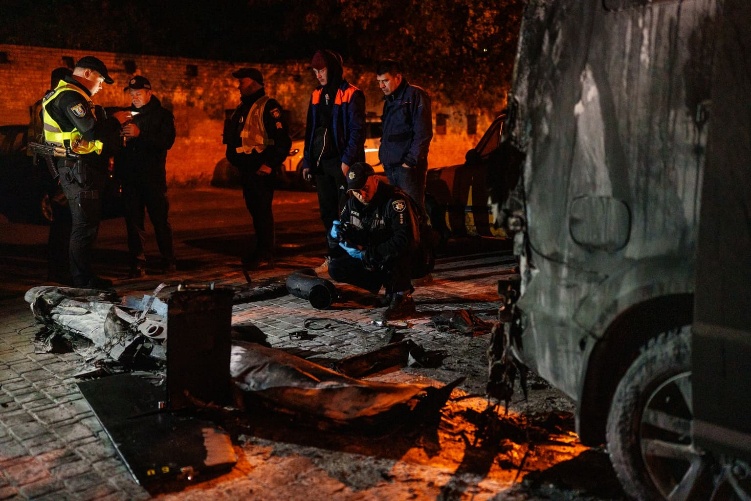
Debris from a Russian drone fell into the residential area of Kyiv’s Pechersk district after it was intercepted by Ukrainian air defense. (Serhii Korovayny / The Kyiv Independent)
According to ISW, the drones were launched from the directions of Oryol and Kursk; Shatalovo in Smolensk Oblast; Millerovo in Rostov Oblast; Primorsko-Akhtarsk in Krasnodar Krai; occupied Donetsk; and occupied Hvardiiske in Crimea. Ukrainian officials reported hits on residential, agricultural, communications, civilian, industrial, energy, and port infrastructure in Chernihiv, Dnipropetrovsk, Kharkiv, Kyiv, Mykolaiv, Poltava, and Odesa oblasts.
Kyiv faced repeated drone alerts throughout the day. Drone debris first fell on open ground near private homes in the Solomianskyi district, the Kyiv City Military Administration said, with no casualties. Late in the evening, after the Air Force warned that a jet-powered drone was flying over the capital, debris fell in the courtyard of a residential building in the Pecherskyi district and set parked vehicles on fire. The State Emergency Service said two passenger cars were destroyed and a third was damaged. No one was hurt.
In Zaporizhzhia, Russian forces struck an apartment building in the evening, injuring five civilians, local authorities said. A 63-year-old man was hospitalized in serious condition, a 37-year-old woman suffered thermal burns and was treated at the scene, and emergency workers evacuated three people from the eighth floor.
With Kyiv’s Northern and Southern bridges hit repeatedly over the past week, Reconstruction, Infrastructure, and Transport Minister Mykola Kalashnyk told public broadcaster Suspilne that “urgent solutions are a dam and a pontoon crossing, which are being built quickly.”
AI TURRETS DOWN THEIR FIRST JET DRONES
Automated machine-gun turrets that use artificial intelligence to aim have shot down their first Russian jet-powered drones, Air Force spokesperson Yurii Ihnat said on national television. “There are already cases of shooting down even jet UAVs, even ‘Geran-5’ from those very turrets,” he said. “The use of innovative technologies — artificial intelligence — has eliminated human error. Machine vision is used in the shooting down.”
A day earlier, Zelensky said 12 such turrets had been installed where Russian jet drones are particularly active, including around Kyiv. Presidential Advisor on Defense Technologies Serhiy “Flash” Beskrestnov said more would be added, ISW reported. Jet-powered Geran-4 and Geran-5 drones are too fast for most existing interceptor drones, and the Kyiv Independent reported that producing jet-powered interceptors at scale is held back by the lack of Western supply chains for cheap jet engines. Better automatic aiming, the outlet noted, lets small arms such as U.S.-made Browning heavy machine guns join the air-defense network.
In his evening address, Zelensky said Ukraine is preparing new contracts for air-defense systems and missiles. He gave no details but said “there may be some positive steps.” He appealed for more anti-ballistic capabilities: “We need more anti-ballistic capabilities to protect infrastructure specifically. This is the main challenge right now.”
Zelensky also pressed domestic producers. “We expect manufacturers to move quickly on interceptors. The tasks have been defined, and the funding is available,” he said. Ukraine is “sourcing munitions for F-16s virtually all over the world,” he said, with packages already on the way.
The push follows the 15 agreements worth more than €8.5 billion that Ukraine and Germany signed on Sunday. Kyiv Post reported that Ukraine has previously signed contracts for approximately 1,000 Patriot missiles.
RUSSIA’S REBUILT DRONES TARGET BRIDGES AND LOCOMOTIVES
Ukraine’s Main Military Intelligence Directorate (GUR) reported that Russia has modified the optical navigation, compass, and warhead of its Geran-4 long-range strike drone. According to ISW, the new variant includes autonomous navigation components, among them a U.S.-manufactured, high-precision magneto-inductive sensor that presumably helps the drone navigate and target autonomously under electronic warfare conditions. Russia has also replaced the variant’s Chinese-origin jet engine with a new Russian engine made at the Alabuga Special Economic Zone, which ISW said Moscow has used to indigenize drone production rather than rely on Iranian or Chinese components.
The GUR confirmed that the new variants carry a specialized cumulative-cutting payload warhead, known by the Russian acronym KRSN, designed to destroy hardened steel and concrete targets and to damage cable-stayed bridges. ISW linked it to the intensified strikes on Kyiv’s Northern and Southern bridges. Separately, Ukraine’s 8th Army Corps said its forces intercepted a new Molniya-13 reconnaissance drone, reportedly one-and-a-half times larger than earlier versions and fitted with four engines.
The strikes are also hitting the railways. Agrarian Policy and Food Minister Taras Vysotskyi said Ukraine has nearly exhausted its reserve of locomotives because of Russian attacks on rolling stock and rail infrastructure, and that officials are negotiating with European countries using the same track gauge to obtain more. The head of private port operator TIS said Russian forces had struck three locomotives near the Pivdennyi port terminal in Odesa Oblast alone and that the shortage is becoming a weak point in port logistics. According to ISW, Russia damaged or destroyed more than 500 locomotives between February 2022 and mid-September 2026.
ISW assessed that Russia may seek to field more resilient strike-drone variants before Ukraine can counter them at scale, in order to degrade energy and logistics ahead of the winter.
ZELENSKY CALLS PARIS, WARSAW AND THE HAGUE
Zelensky held a series of calls with European leaders as Ukraine braces for a new wave of Russian attacks. After speaking with French President Emmanuel Macron, he said France is preparing new defense assistance, with a package expected “soon.” “Ukrainian pilots will soon begin training on French Rafale aircraft in France. This is a significant step forward for Ukraine’s combat aviation,” Zelensky said.
The two sides are also “continuing to work on localizing the production of French missiles and aerial bombs in Ukraine,” Zelensky said, and he underscored France’s commitment to Freyja, the joint European anti-ballistic missile defense project led by Ukrainian manufacturer Fire Point. He said the two presidents would discuss details in person.
In a separate call, Zelensky briefed Polish Prime Minister Donald Tusk on preparations for trilateral talks among Ukraine, the United States, and Russia. “There are no obstacles on our part, but it is important that the U.S. side prepares on its end and ensures Russia’s readiness,” he said. On Sunday, Zelensky said Washington was proposing a technical-level trilateral meeting by the end of October. The two leaders also discussed winter preparations and agreed to meet soon; they last met at the Carpathian 8 Summit on Sept. 18.
Later, Zelensky spoke with Dutch Prime Minister Rob Jetten about air defense and the peace process. “A significant share of (Russian) drones are shot down specifically by the F-16s that the Netherlands transferred to Ukraine,” he said.
In Washington, Secretary of State Marco Rubio said the United States has no current plans to withdraw its diplomats from Kyiv despite Russian warnings. “If a threat arises that we feel needs to be addressed by a change in posture, we’ll do so. We haven’t done that up to this point there,” he told reporters at Joint Base Andrews.
EUROPEAN SOLIDARITY EXPELS HONCHARENKO OVER HIS PEACE PLAN
Ukraine’s opposition European Solidarity party expelled lawmaker Oleksiy Honcharenko from its parliamentary faction, citing ideological differences over his proposals for ending the war. In a statement, the party said Honcharenko’s views on Ukraine’s future security had diverged from its foundations. “Compromises can be part of the path to ending the war,” the statement read. “But Ukraine’s independence, its European future, questions of national identity and the right to determine its own security system are not subject to compromise.”
The expulsion followed days of public debate. In social media posts on Friday, Honcharenko argued that Ukraine was losing the war and should seek agreements with Russia wherever possible. In a column for Ukrainska Pravda on Sunday, he proposed parallel negotiations on separate issues instead of a single comprehensive deal. Under his plan, Turkey would guarantee shipping safety, the International Atomic Energy Agency would oversee nuclear safety, the Vatican, the United Arab Emirates, and Qatar would help return prisoners and deported children, and China would guarantee an end to ground combat.
He also proposed gradually lifting restrictions on Russian energy in exchange for an end to long-range strikes, unblocking the Black Sea, and limiting hostilities to the Donbas. The Donbas, he wrote, should be addressed only once other agreements work, with options including freezing the front line without legal recognition of the occupation, a neutral zone, or a UN-controlled zone. He suggested Ukraine could negotiate a neutral status while continuing to cooperate with NATO. Kyiv Post noted that Ukraine’s constitution enshrines its course toward EU and NATO membership.
The party said responsibility for Ukraine’s negotiating position lies with the authorities holding a single-party majority, and called on the government to begin an honest conversation with citizens about a realistic path to a ceasefire and a just peace.
NEW RULES PUT SURVIVORS AT THE CENTER OF SEXUAL-VIOLENCE CASES
Ukraine’s law enforcement agencies adopted new interagency rules for investigating conflict-related sexual violence that place survivors at the center of the process, Interior Minister Ivan Vyhivskyi announced. The document will guide investigators from the National Police and the Security Service of Ukraine, as well as prosecutors.
“Today, we took an important step in this direction,” Vyhivskyi said, describing the survivor-centered approach as the document’s key principle. “When interacting with the justice system, a person must receive safety, respect for their dignity and the necessary support.” The signing took place in the presence of British Ambassador to Ukraine Neil Crompton, and the rules comply with international and European standards for protecting victims, including directives of the European Parliament and the European Council. The next stage, the minister said, is coordinated implementation, including systematic training of investigators and prosecutors, unified procedures, and interagency cooperation.
The rules come less than three weeks after a UN report on the issue. Between Feb. 24, 2022, and July 31, 2026, the UN Human Rights Office recorded 1,004 cases of conflict-related sexual violence, of which 892, or 89 percent, were attributed to Russian authorities, including the armed forces, law enforcement agencies, and the FSB. The report documented 725 male victims, most of them Ukrainian prisoners of war and civilian detainees, along with 151 women and 16 children; female victims ranged in age from 4 to 82. At least 155 Ukrainian prisoners and retained medical personnel were subjected to electric shocks from a Soviet-era field telephone.
The remaining 112 cases were attributed to Ukrainian authorities, mostly involving mistreatment of Russian prisoners. Danielle Bell, head of the UN Human Rights Monitoring Mission in Ukraine, said Ukraine had granted UN investigators unrestricted access to its detention facilities. Russia has not.
ESTONIA MOVES ITS MAIN BRIGADE TOWARD THE RUSSIAN BORDER
Estonia’s 1st Brigade, the main combat-ready element of its land forces, will relocate from its base in Tapa to the town of Johvi, less than 50 kilometers from the Russian border and just west of Narva, according to comments by the unit’s commander, Tarmo Kundla, published in the Financial Times. ISW, citing the FT, reported that Estonia is also building a new military facility in Narva capable of housing up to 1,000 personnel.
Kundla said the move reflects a shift in strategic thinking for a military that has relied on NATO airpower in the region and the deterrent of Article 5. “We have to start from the border and win from the first battles,” he said, explaining that the new posture of “active defense” would allow immediate return strikes on targets deeper inside Russia in the event of an invasion. “We are in the process of changing everything,” an official at Estonia’s defense ministry told the FT. “Russia is already planning to double its forces across our border.”
According to the FT, as summarized by ISW, Estonian military and intelligence chiefs assess that Russia does not want a full-scale war with NATO in the next two years, while a senior official said the period between about 2027 and 2030 is the most critical for the Baltic states to fix failures in their earlier deterrence strategy.
Moscow responded quickly. United Russia State Duma Deputy Alexander Asafov claimed the deployments show the Baltic states are leading NATO’s “escalation” against Russia. Andrei Kolesnik of the Duma Defense Committee called Estonian and Finnish troop deployments to their borders “provocative actions” and said Russia would take unspecified countermeasures. ISW assessed that Russian officials are framing legitimate NATO defensive measures as unprovoked escalation as part of a cognitive warfare effort.
GERMANY’S SPY CHIEF WARNS OF A “SHADOW WAR” AS NATO DRAFTS ITS PLAN
Germany is in a “shadow war” with Russia and risks being drawn into a violent conflict with Moscow, Martin Jaeger, head of the BND foreign intelligence service, told lawmakers at a public hearing of the Parliamentary Control Committee. “No other country currently poses such a direct, comprehensive, and concrete threat to Germany,” Jaeger said, referring to the attempted Russian drone attack at Leipzig airport on July 31.
Jaeger warned of further sabotage and nuclear intimidation intended to stop Berlin and other European capitals from acting against Russia and to halt arms deliveries to Ukraine. He called Russia’s intelligence services “highly professional and reckless” and said the threat of Russian attacks on targets in Germany remains “real and present.” The BND does not currently see signs of a large-scale attack on NATO territory, he said, but warned of low-level Russian military activity, especially in the Baltic region. Sinan Selen, head of the BfV domestic intelligence service, said Russia was willing to carry out sabotage and assassinations, and Martina Rosenberg of the MAD military intelligence service said the armed forces face enemies from outside and within. All three called for reforms allowing their agencies to act more offensively.
NATO, meanwhile, is preparing a plan to defend its eastern flank that integrates drones and AI, Bloomberg reported, citing a draft and unnamed officials. Supreme Allied Commander Europe, U.S. General Alexus Grynkewich, is set to present the strategy, called Theory of Victory, in Poland on Oct. 12. A NATO official confirmed the plan’s existence to the Kyiv Independent. According to Bloomberg, it would combine land forces with drones and AI-powered targeting to repel an incursion, then seek to destroy Russian command and control, while avoiding provocations. NATO has not commented publicly on its contents.
BRUSSELS SIGNALS NEW ACCESSION CLUSTERS FOR KYIV AND CHISINAU
Ukraine and Moldova could open their next two EU accession clusters as soon as next week, Enlargement Commissioner Marta Kos said at a press conference in Brussels after the 10th EU-Moldova Association Council, provided Ukraine’s parliament passes its law on national minorities. The bill, which addresses Hungary’s concerns about Ukraine’s Hungarian minority, is expected to go to a vote on Oct. 12. “We hope that the law will pass the (Verkhovna) Rada,” Kos said. “This really is the autumn of enlargement.”
The two countries’ bids have been politically coupled, and in June and July they opened the first two of six clusters. A dispute with Budapest has blocked the clusters on economic topics, while concerns over the size of Ukraine’s agricultural and transport sectors are holding up the remaining sectoral ones.
Asked by a Ukrainian journalist how Ukraine’s reform pace compares with Moldova’s, Kos said both are “in the frontrunner group of four.” “We should never forget the country is fighting for its survival,” she said of Ukraine. “There is no other country in the world who is delivering more than Ukraine at this moment.” In September, Kos co-signed a letter to the Rada listing reforms it must complete by year’s end to unlock more than €20 billion in financial support. Her remarks came a day before the EU is expected to unveil proposals on the future of enlargement, including membership roadmaps for Ukraine, Moldova, Albania, and Montenegro.
Moldovan Prime Minister Vasile Tofan said Chisinau hopes to complete the technical work for membership by the start of 2028 and join by 2030. Kallas said Moldova had “taken major strides towards membership,” and Kos told Tofan accession “could happen during your mandate.”
TRUMP OFFERS RUSSIA HELP WITH PLAGUE; PUTIN CLEARS UNICREDIT SALE
U.S. President Donald Trump said Washington will help Russia manage its plague scare. Asked by reporters about the situation, Trump said he was aware of it and that the United States would “help them.” “I hate to see them having it; it’s a rough disease,” he said. “We’ll help anybody that has that kind of problem.”
Russian officials and media had reported a day earlier that an aluminum plant and several hospitals in Irkutsk Oblast introduced quarantines and mask mandates after the death of Darya Shipilova, a lab technician at the Irkutsk Anti-Plague Research Institute in Shelekhov. She is alleged to have broken a test tube containing the pathogen that causes pneumonic plague about a week before she died on Oct. 2. Regional authorities have referred to “pneumonia of unknown origin,” and the Kyiv Independent could not verify Russian media reports of hospital quarantines. Trump’s remarks follow bipartisan pushback on Sept. 29 over reports that his administration was considering possible sanctions relief for Russia in exchange for the release of political prisoners.
In Moscow, Putin allowed Italy’s UniCredit to reorganize its Russian subsidiary and sell the new unit, according to an official decree. Russia bars companies from countries it labels “unfriendly,” including Italy, from selling or transferring shares in Russian businesses without government approval. UniCredit, one of the few European banks still active in Russia, announced in May that it plans to sell most of UniCredit Bank Russia to a private investor from the United Arab Emirates while keeping its payments arm, and aims to complete the deal by the first half of 2027. The approval comes weeks after Putin signed a decree confiscating the assets of Nestle and Auchan, and the Kremlin took control of the Russian subsidiary of Germany’s Metro AG.
MEANWHILE, AT THE FRONT
Ukrainian forces cleared Russian infiltrators from roughly 10 square kilometers east of Vovchansk in northern Kharkiv Oblast, ISW reported. A Ukrainian brigade published footage and said it had liberated a forested area northeast of Vovchanski Khutory, clearing three Russian infiltration groups since June 10, though ISW said the footage also indicates Russian advances and infiltrations in other parts of the same area.
Occupation officials kept amplifying claims ISW described as blatantly false. Donetsk People’s Republic head Denis Pushilin claimed Russian forces had seized several settlements near Dobropillya and were fighting inside Oleksiievo-Druzhkivka and Druzhkivka. ISW said the nearest point of Russian advance is at least seven kilometers from Dobropillya’s eastern outskirts and roughly 13 kilometers from Druzhkivka, though footage showed one Russian soldier in southwestern Dobropillya during an infiltration mission. Pushilin also said Slovyansk and Kramatorsk would likely be the last territory Russia takes in Donetsk Oblast, which ISW read as an implicit acknowledgment that Ukraine’s Operation Vivaldi had curtailed the Russian offensive from the north. Russian sources also published footage of a flag-raising near Samiilivka, about 16 kilometers beyond the furthest Russian advance, which the Russian Defense Ministry used to claim the village; ISW saw no evidence of a Russian presence there.
Russian attacks near Kupyansk, Lyman, Kostyantynivka, Hulyaipole, and Orikhiv produced no confirmed advances, while Ukrainian forces continued counterattacks around Lyman. Satellite imagery reviewed by ISW indicated that Ukraine’s strike on the Khanskaya Airbase in Adygea destroyed a Su-34 and a Su-35, and that recent strikes damaged three processing units at the Ilsky refinery and tanks at an oil station near Prosvet in Samara Oblast. In Kherson Oblast, a Ukrainian marine said drone operators were delivering food, medicine, and hygiene products to occupied Oleshky without losing drones.
A SHIP, A CITY, A BORDER
By nightfall, the day had produced six dead in Kharkiv, a sunken grain ship off the Romanian coast, and the first confirmed Moldovan injury from a Russian drone. Each landed in a different place: a residential district, a shipping lane outside Romania’s territorial waters, a border booth on the edge of the EU.
In the same hours, Ukraine reported AI turrets hitting jet drones, sought anti-ballistic defenses abroad, and moved a step closer to opening new EU accession clusters. In Kyiv, an opposition party drew a line around what it says cannot be traded for peace. Tomorrow begins with Kharkiv still searching its rubble.
A PRAYER FOR UKRAINE
1. For the Six Lost in Kharkiv
Lord, three bombs fell on Kharkiv this afternoon, and six people did not come home. Two men of sixty-two and a man of thirty-five were among them. Receive every soul taken from the Slobidskyi district, comfort the families waiting by the rubble, and strengthen the rescuers and police who went door to door through the evening. Heal the fifty-nine wounded, and hold close the eleven-year-old girl still fighting for her life.
2. For the Crew of the Royad Mammadov
Father, a ship carrying corn to feed others went down in the Black Sea today, and its captain died at his post. We pray for the sailors from Azerbaijan and India, for the injured carried away by air, and for the crew member whose fate is still unknown. Comfort the families who will hear the news far from the sea, and protect every crew that sails these waters for bread rather than war.
3. For the Wounded in Zaporizhzhia and at the Border
God of mercy, we lift up the five people hurt when a strike hit an apartment building in Zaporizhzhia, especially the sixty-three-year-old man in serious condition and the woman treated for burns. We pray for the Moldovan border guard wounded at Palanca, and for every family living near a border this war no longer respects. Grant them healing, and grant their neighbors courage.
4. For Those Who Guard the Sky
Lord, we pray for the turret crews, the pilots of the F-16s, and the mobile teams who watched through another night of two hundred drones. Steady their hands and their judgment, keep them alert through endless alerts, and protect them from the strikes aimed at them. Give the engineers building new interceptors wisdom and speed, and let every partner who can help close Ukraine’s skies do so before the winter comes.
5. For Survivors Waiting for Justice
God of justice, we pray for every man, woman, and child who has endured sexual violence in this war, in occupied towns and in prison camps. Let the new rules signed today bring them safety, dignity, and respect when they finally speak. Give investigators patience and integrity, give survivors the support they were long denied, and let no crime committed in the dark remain hidden forever.
In Your mercy, in Your justice, in Your time — bring this war to its end, and let the ending be worthy of what Ukraine has endured.