
October 6, 2026
Prepared by Diana Bozhyk
Aerial and naval drones struck two merchant ships inside Bulgaria’s exclusive economic zone today, sinking one, as a Russian drone killed a steward aboard a Marshall Islands-flagged vessel off Odesa and Zelensky denied any Ukrainian role in the Bulgarian attack. Overnight, some 650 drones flew toward Moscow, and footage showed a fire at the region’s largest oil depot, while Russian strikes across Ukraine killed at least 13 people and hit a Kryvyi Rih hospital. By evening, Zelensky warned of fresh intelligence pointing to a massive Russian strike, and the Air Force reported three Tu-160 bombers airborne.
THE DAY’S RECKONING
Two cargo ships were hit by drones roughly 70 nautical miles off the Bulgarian coast, inside the economic zone of a NATO member, in what Euronews called the first such attack; one sank with its crew still missing, and the other burned while a Bulgarian ferry pulled 18 sailors from it. Off Odesa, a steward died aboard a ship carrying rapeseed oil. Sofia said the drones were “either Russian or Ukrainian.” Kyiv said they were Russian.
On land, the day’s count reached at least 13 dead and 104 wounded, with Banderol munitions striking the grounds of a hospital in Kryvyi Rih and a bridge in Zaporizhzhia closed after a drone hit. Ukrenergo brought back scheduled power cuts. Overnight, Moscow faced what Russian state media called the largest drone attack on the region in two years. Lithuania’s parliament took a first step toward lifting its ban on nuclear weapons, and by nightfall Zelensky was urging Ukrainians to take shelter seriously.
DRONES SINK A SHIP INSIDE BULGARIA’S ECONOMIC ZONE
Drones struck two merchant ships inside Bulgaria’s exclusive economic zone in the Black Sea today, sinking one of them. The vessels were identified as the Togo-flagged Alfa Watan and the Palau-flagged Able. Vessel-tracking data from VesselFinder showed the Alfa Watan heading toward Romania’s port of Sulina, with its last known position about 70 nautical miles off the Bulgarian coast shortly after 2 a.m. local time.
Bulgarian Prime Minister Rumen Radev said the ships were hit by both a maritime and an aerial drone. The northbound ship sank, and Bulgarian authorities did not have information on what it was carrying; the second vessel, traveling south, was carrying wheat. According to Bulgarian broadcaster Nova, cited by the Kyiv Independent, the Alfa Watan suffered severe structural damage and went down. The fate of its crew remains unknown: life jackets were spotted near the vessel, but no people had been found. ISW, citing Radev, reported that the sinking killed the ship’s crew.
The Able caught fire, and all 18 people aboard abandoned it, said Rumen Nikolov, who leads rescue operations in Varna, as cited by public radio BNR. The Bulgarian ferry Dioscuria picked up the crew. Nova reported that two sailors were seriously injured, one with severe burns and the other with a head injury, and that the crew were Indian and Turkish nationals.
Accounts of the distance differed. Nova put the site about 112 kilometers off the coast, ISW placed it roughly 70 nautical miles east of Byala, and Radev spoke of 130 kilometers. Euronews described the strike as the first such attack inside the economic zone of a NATO member state, and the Kyiv Independent reported it is believed to be the first drone attack on commercial shipping in Bulgaria’s zone.
SOFIA SAYS “RUSSIAN OR UKRAINIAN”; KYIV BLAMES MOSCOW
Radev convened an emergency meeting of state institutions and called the attack a “gross violation of international law,” warning of growing risks to Black Sea shipping, higher insurance costs, and further complications for maritime transport. He said Sofia had not yet determined who launched the drones. “We have yet to try to establish where the attack came from, but it is clear: they are either Russian or Ukrainian,” he told reporters, calling the situation “extremely worrying.”
He said the incident could not be grounds for invoking NATO’s Article 4 or Article 5. “We have much more serious attacks inside territorial waters. Keep in mind that this is 130 km from our coast; it falls within our exclusive economic zone, but these are considered neutral waters,” Radev said. Still, he warned of a broader pattern: “When a war is not stopped in time, it expands its geographic reach.”
In his evening address, Zelensky denied Ukrainian responsibility. He said the Ukrainian Navy had been in contact with its Bulgarian counterparts and established that the ships were hit in a combined Russian strike using maritime and aerial drones, while intelligence and special services were still gathering details. “The Ukrainian Defense Forces conducted no operations in this part of the sea,” he said. “This latest tragedy involving civilian vessels is part of Russia’s ongoing attempt to make the western Black Sea completely unsuitable for navigation.” He ordered the armed forces, the Defense Ministry, and intelligence agencies to cooperate as closely as possible with partners against such attacks.
Radev, a former president seen as pro-Russian, won the April 2026 parliamentary election, and his government has said it would halt all weapons deliveries to Ukraine, Kyiv Post reported.
A STEWARD KILLED OFF ODESA, A TANKER ABLAZE NEAR SOCHI
A Russian drone struck a merchant vessel flying the Marshall Islands flag in the Black Sea, killing a steward and injuring seven other crew members, Odesa Oblast Governor Oleh Kiper said. The ship was carrying rapeseed oil, and a fire broke out in its superstructure. “By deliberately targeting civilian shipping and port infrastructure, Russia is grossly violating the norms of international law, thereby posing a threat to global food security,” Kiper said.
The strike followed others in recent days. On Saturday, a Russian attack on a Liberian-flagged cargo ship at a port near Odesa killed one person, and on Monday the Turkish-owned grain carrier Royad Mammadov sank off Romania. Dmytro Barinov, president of the Ukrainian Ports Association Ukrport, told the Kyiv Independent that Odesa’s ports “are almost blocked.” Since mid-July, the outlet reported, Russia has intensified attacks on the ports and nearby infrastructure, and fewer ships now dare to enter.
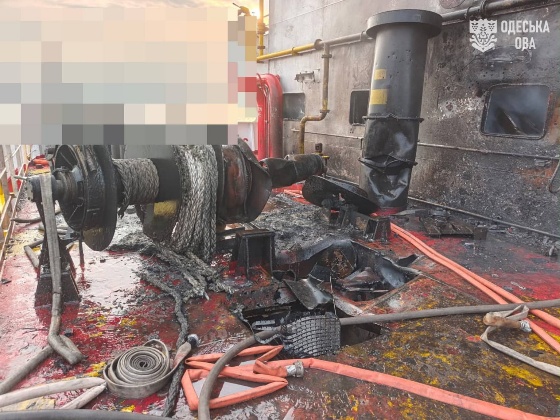
Aftermath of a Russian drone strike on a merchant vessel which was flying the Marshall Islands flag in the Black Sea. (Oleh Kiper / Telegram)
On the opposite shore, a ship was burning in the Black Sea near the Russian port city of Sochi, Russian independent outlet Novaya Gazeta Europe reported, citing Russian Telegram channels. The outlet said the vessel might have been attacked by naval drones, while videos on social media showed fire and thick black smoke above the city. Russian authorities did not comment. The Telegram channels suggested the ship could be the Liberia-flagged tanker Aframax Rea, which MarineTraffic last located near the Russian-Georgian border, close to Nizhneimeretinskaya Bay. The tanker was added to Ukraine’s sanctions list as part of Russia’s shadow fleet on Feb. 12, 2026. The reports could not be independently verified.
Sochi, about 650 to 700 kilometers from the Ukrainian border, has increasingly come under Ukrainian drone attack over the past year, with strikes on its port and an oil depot reported in September alone.
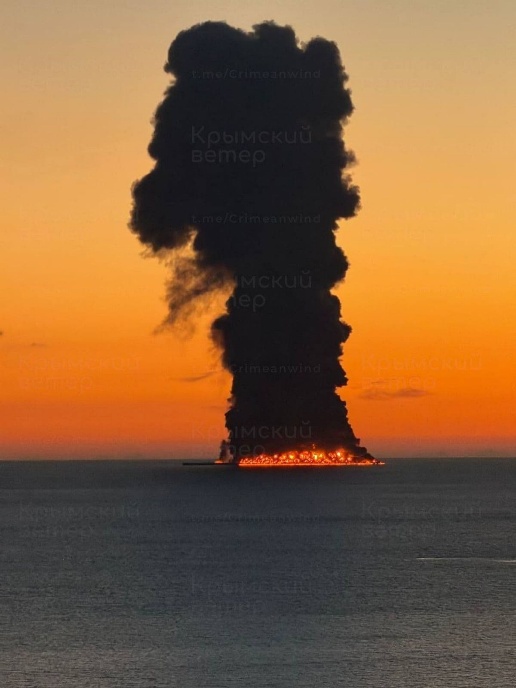
A burning ship on the Black Sea near the Russian city of Sochi. (Photo via Telegram channel Крымский ветер)
650 DRONES TOWARD MOSCOW AND A FIRE AT ITS LARGEST OIL DEPOT
Ukraine launched a massive overnight drone attack on the Moscow region, Kyiv Post reported. Moscow Mayor Sergey Sobyanin said 650 drones flew toward the capital between Monday evening and Tuesday morning, with most destroyed at a distance and 105 downed on the approaches to the city. Moscow Oblast Governor Andrei Vorobyov said 185 drones were intercepted over the region, that more than 10 private homes were damaged in Istra, the village of Lobanovo, and the settlement of Radumlya. “Six people were injured. Unfortunately, there is one fatality,” he said.
One apparent target was the Volodarskaya Linear Production and Dispatch Station near the village of Konstantinovo, about 40 kilometers from central Moscow. Russian investigative outlet Astra described it as the largest oil depot in the Moscow region. Operated by Transnefteprodukt, part of state-owned Transneft, it handles up to 3 million metric tons of petroleum products a year and supplies fuel to Vnukovo, Domodedovo, and Sheremetyevo airports. Geolocated footage showed a large fire at the site, ISW reported; the Kyiv Independent said it could not immediately verify the reports.
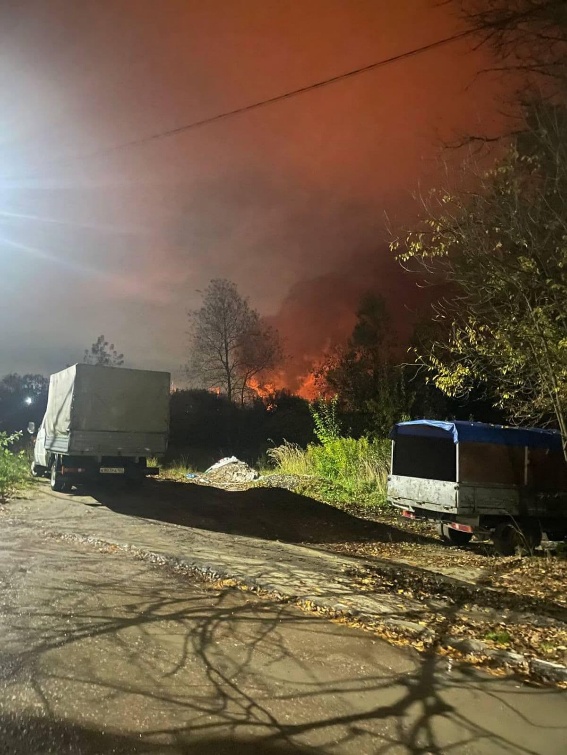
The Volodarsk Linear Production and Dispatch Center near the village of Konstantinovo appears to be on fire after a Ukrainian drone attack. (Supernovaplus/Telegram)
On Monday, U.S. President Donald Trump again blamed Ukrainian strikes on Russian refineries for high gasoline prices. “What’s driving up Gasoline is no longer the Strait of Hormuz,” he wrote on Truth Social, pointing instead to Russian refineries “being blown up by Ukraine.”
Russia’s Finance Ministry, meanwhile, announced on Monday that it will increase funds for buying foreign currency and gold fivefold from Oct. 7 to Nov. 6, a daily increase of 10.2 billion rubles, and said oil and gas revenues fell 10.04 billion rubles short of the baseline at the end of September. ISW assessed the move is likely meant to weaken the ruble to offset falling energy revenue.
A BRIDGE CLOSED IN ZAPORIZHZHIA; 137 DRONES OVERNIGHT
A Russian drone struck one of the bridges over the Dnipro River in Zaporizhzhia during the overnight attack. The Zaporizhzhia City Council said the bridge was closed and traffic rerouted, without naming which crossing was hit; photos from the scene showed damage to the road surface. Zaporizhzhia Oblast Military Administration Head Mykhailo Semikin said traffic along the bridge was temporarily halted. Five people in the region, including two members of the Red Cross, were injured overnight and were receiving medical help, the Kyiv Independent reported.
ISW assessed that Russia’s intensified campaign against bridges, until now focused on Kyiv’s Northern and Southern bridges, has expanded to Zaporizhzhia. The city sits at the crossroads of several critical ground lines of communication and serves as a key transport node for military logistics in Zaporizhzhia Oblast and southern Ukraine, the think tank said, adding that the strikes are also meant to disrupt civilian life and the domestic economy.
Overnight, Russia launched 137 drones against Ukraine, including 49 jet-powered Shahed-type models, alongside Gerbera strike drones, Banderol or Dan-T loitering munitions, and Parodiya decoys, the Air Force said. They came from the directions of Oryol and Kursk; Shatalovo in Smolensk Oblast; Millerovo in Rostov Oblast; Primorsko-Akhtarsk in Krasnodar Krai; occupied Donetsk; occupied Hvardiiske in Crimea; and from over the Sea of Azov. Ukrainian forces downed or suppressed 114 drones. Strikes were recorded at 17 locations, and debris fell at four others.
Later in the day, Zelensky said the government and regional authorities had prepared additional measures in response to what he described as a Russian operation against Ukraine’s logistics, with the most urgent tasks already underway.
KRYVYI RIH HOSPITAL HIT AS RUSSIAN STRIKES KILL AT LEAST 13
At least 13 people were killed and 104 injured in Russian attacks across Ukraine over the past day, local authorities said. Russian forces struck the grounds of a hospital in central Kryvyi Rih with two Banderol loitering munitions. “The enemy attacked the city center with two Banderols,” wrote Oleksandr Vilkul, head of the city’s Defense Council. A female hospital employee was seriously wounded and taken into surgery, and an injured man was in moderate condition. Vilkul later reported a third victim, a woman in moderate condition undergoing surgery. “She was simply walking her dog,” he wrote. Regional Governor Oleksandr Hanzha put the number injured at four, including two medical workers.
Zelensky said Russian forces had attacked several hospitals in Kramatorsk and Kryvyi Rih over the preceding 24 hours.
Elsewhere in Dnipropetrovsk Oblast, Russian attacks killed one person and injured three, Hanzha said. In Kharkiv Oblast, Governor Oleh Syniehubov reported seven people killed and 70 injured over the past day, including children; the figure includes Monday’s glide-bomb strike on Kharkiv. In Donetsk Oblast, three people were killed and 11 injured, Governor Vadym Filashkin said. In Sumy Oblast, Russian drone strikes killed a 49-year-old man and injured four. In Kherson Oblast, one person was killed and four injured, Governor Oleksandr Prokudin said. In Zaporizhzhia Oblast, Russian forces carried out 955 attacks on 58 settlements, injuring eight people.
POWER CUTS RETURN AND KYIV’S SHELTER PLAN SHRINKS
Scheduled power cuts returned to parts of Ukraine from 3 p.m. until the end of the day, national grid operator Ukrenergo said, citing damage from Russian attacks on energy infrastructure. Hourly outage schedules covering up to one consumer group at a time applied to households, with separate limits on industrial consumers. “Because of damage caused by Russian shelling and in order to prevent equipment overload, power restrictions will be applied in some regions,” the company said, without naming them. Russian attacks caused new outages in the Kharkiv, Sumy, Zaporizhzhia, and Dnipropetrovsk regions by the morning, and repair crews worked wherever security allowed. Consumption at 9:30 a.m. was 2.9 percent higher than a day earlier, which Ukrenergo partly attributed to cloudy weather reducing household solar output. Scheduled cuts left parts of Kyiv in darkness in the evening, Kyiv Post reported.
Oleh Popenko, head of Ukraine’s Union of Utility Consumers, warned that Kyiv could face outages of 14 to 16 hours if Russia keeps attacking facilities supplying the capital, a possible scenario rather than an approved schedule. Ukrenergo said the situation could change depending on further attacks.
In Kyiv, a promise on mobile shelters fell short. Mayor Vitali Klitschko said on Sept. 12 that “40 or 50” would be installed at transport stops within a month. The Kyiv City State Administration told Slidstvo.info today that only 14 will arrive by the end of the year, to be bought by transport company Kyivpastrans for about 54.2 million hryvnias once its financial plan is approved. Only four mobile shelters, installed by private organizations, currently operate in the city, which the administration said needs at least 620 mobile and 7,894 conventional shelters. Of the capital’s 4,385 civil-protection facilities, 397 need work to meet readiness requirements.
ZELENSKY WARNS OF A MASSIVE STRIKE AS TU-160S TAKE OFF
Ukraine received fresh intelligence that Russia is preparing a massive strike, Zelensky said after an afternoon coordination meeting with government officials, military commanders, and emergency services. “We received updated intelligence today regarding Russian preparations for a massive strike. We are preparing countermeasures,” he said. The defense minister and the Air Force commander briefed him on the distribution of air-defense assets and the protection of key facilities.
Zelensky said Ukraine was securing ammunition for its F-16s, interception capabilities, and interceptor missiles, but singled out ballistic defense. “The most difficult issue is defending against ballistic missiles, and the availability of these supplies depends entirely on our partners,” he said. “We are working with them daily.” Officials and regional authorities had also prepared additional logistics measures in response to what he called a Russian operation against Ukraine’s logistics, with deadlines set and the most urgent tasks already underway.
Separately, Zelensky chaired a meeting of the Staff of the Supreme Commander-in-Chief. He said electronic warfare systems neutralize a significant share of Russia’s Shahed drones and that the most effective approaches will be scaled up. The meeting also set priorities for supplying long-range drones next year, with the goal of giving Ukraine the ability to respond in kind to Russian strikes.
In his evening address, Zelensky urged citizens to take shelter when alerts sound. “A lot depends on our partners – every leader and every country in the world that has the defensive capabilities we need and can provide them to us,” he said. Hours later, the Air Force reported that three Russian Tu-160 strategic bombers had taken off from Belaya air base in Irkutsk Oblast, warning that any cruise missiles they launched could reach Ukrainian airspace after 3 a.m. local time.
AIR FORCE: RUSSIAN JET DRONES COULD REACH 900 KM/H
Russia could eventually push the speed of its jet-powered attack drones to 800-900 kilometers per hour, Deputy Air Force Commander Col. Yurii Cherevashenko told a parliamentary Temporary Investigative Commission, according to Suspilne. Current Russian jet drones fly at around 600 kilometers per hour. “We have not seen such [speeds] yet, but we forecast them,” he said.
Cherevashenko said Russia has rapidly increased its use of jet-powered drones since July. They now make up about 40 percent of the drones used against Ukraine and up to 60 percent on some axes. “We forecast that around 80% of the drones used in strikes will be jet-powered,” he said.
The Air Force is working with around 20 Ukrainian companies developing high-speed interceptors. Fourteen have begun test flights, six have destroyed jet-powered drones, and three have produced systems the Air Force considers particularly promising. Two models, including one called Predator, or “Khyzhak,” have passed military codification. Existing interceptors reach about 460-500 kilometers per hour, while some manufacturers claim up to 700. Ukraine is testing five high-speed models, one of which is expected to reach production of about 400 units by the end of October, but Cherevashenko said interceptors in the quantities the Air Force needs are not expected before the end of November.
“F-16s are among the most effective means of countering jet-powered UAVs,” he said, adding that the aircraft’s service life is being used up “at an exceptionally high rate” and that keeping them ready requires partners’ help. Kyiv is seeking large quantities of 20-millimeter cannon ammunition as a cheaper alternative to AIM-9 and AIM-120 missiles. Cherevashenko also pointed to strikes on launch sites, known as droneports; several have been hit, he said, though many are heavily fortified with concrete.
HOW RUSSIA STEERS ITS DRONES: SATELLITE TERMINALS AND A SPOTTER IN KYIV
Russian aerospace company Bureau 1440, which is developing the Rassvet satellite internet constellation, presented three models of ground terminals that connect users to the network. The company said the models differ in size, connection speed, and ability to keep fast-moving vehicles connected without interruption. ISW said the lack of mobile terminals currently limits Russian forces’ use of Rassvet, and assessed that broad adoption, together with an expanded constellation, would let Russian operators control drones at ranges limited only by satellite coverage and make them more precise and more resistant to electronic warfare.
For now, Russian forces rely on mesh radio networks, built around decentralized repeaters that let drones and ground stations share control signals in real time, ISW and Kyiv Post reported. On Oct. 3, presidential adviser Serhiy “Flash” Beskrestnov said the increased precision of strikes on central Kyiv suggested mesh repeaters located inside the capital, pointing to well-resourced collaborators.
The Security Service of Ukraine (SBU) and the National Police said on Monday that they had detained a suspected collaborator allegedly hired by Russia’s FSB. According to the SBU, the man was suspected of “collecting data on defense facilities and critical infrastructure to adjust massive attacks on Kyiv” between Sept. 21 and 24. Case materials say he tracked potential targets for four days to direct Geran-5 jet drones and ballistic missiles at the capital.
The detention comes after Russian jet-powered drones hit Kyiv’s Southern and Northern bridges, two of the main crossings over the Dnipro, several days in a row. Kyiv Post reported that the daytime jet-drone attacks on the capital have become notorious both for being hard to intercept and for their precision.
HERO OF UKRAINE FOR A FALLEN “GHOST OF KYIV” PILOT
Zelensky posthumously awarded the title of Hero of Ukraine, together with the Order of the Golden Star, to Marat Mambetov, a 25-year-old MiG-29 pilot killed in combat. The decree, signed today, cited “personal courage and heroism demonstrated in the defense of Ukraine’s state sovereignty and territorial integrity, and for selfless service to the Ukrainian people.”
Mambetov was a flight commander with the 40th Tactical Aviation Brigade, known as the “Ghost of Kyiv,” and a Crimean Tatar from the Melitopol area, according to the Ukrainian Air Force. Despite his age, he had flown around 200 combat sorties in the MiG-29, destroyed dozens of Russian aerial targets, carried out missile and bomb strikes on Russian positions, and provided air cover for Ukrainian ground forces. He had already received the Order for Courage, second and third classes.
He was killed on Oct. 1 during another combat mission. According to the Air Force, he had successfully struck Russian positions when his MiG-29 was hit by a Russian missile. He managed to eject but suffered injuries incompatible with life. “He defended Ukraine until his last breath,” the Air Force said when it announced his death.
Ukraine’s combat aviation has been central to the fight against Russia’s jet-powered drones in recent weeks. On the same day as the decree, the Air Force’s deputy commander told lawmakers that Ukrainian aircraft are being used at an exceptionally high rate and that keeping them combat-ready requires steady support from partners.
BROVDI: DRONE-INFLICTED RUSSIAN CASUALTIES UP NEARLY 40 PERCENT
Russian casualties attributed to Ukrainian drone strikes rose sharply in the first five days of October, Unmanned Systems Forces commander Robert “Magyar” Brovdi said on Telegram. Between Oct. 1 and Oct. 5, his forces recorded 2,699 Russian troops killed or wounded, compared with 1,931 in the same period of September, an increase of 39.7 percent. Compared with the first five days of August, when the figure was 1,529, the rise was 76.5 percent.
The largest increase came in the area of responsibility of the National Guard’s 1st “Azov” Corps, covering the Dobropillia-Pokrovsk sector of Donetsk Oblast. There, drone operators recorded 1,268 Russian troops killed or wounded in the first five days of October, compared with 884 in the same period of September, a 43 percent rise, and 664 in early August, a 91 percent rise. The figures cover only casualties attributed to the Unmanned Systems Forces and could not be independently verified.
Ukraine’s General Staff said on Oct. 1 that Russian forces suffered an estimated 46,230 personnel losses in September, the highest monthly figure it has recorded in 2026.
Separately, a source reporting on Russia’s Western Grouping of Forces claimed that at least 8,000 servicemen have deserted its area of responsibility, which stretches from Kupyansk to Lyman, and that the grouping has suffered more than 1,000 casualties a week for the past six months because of Ukrainian counterattacks, ISW reported. The same source said Russian forces are struggling to repel Ukrainian counterattacks southeast of Borova near Kolodyazi, Myrne, Ivanivka, and Novolyubivka and toward the Zherebets River. These claims could not be independently verified.
LITHUANIA VOTES TO LIFT ITS NUCLEAR WEAPONS BAN
Lithuania’s parliament advanced a constitutional amendment that would remove the country’s ban on deploying nuclear weapons, approving it in a first reading by 106 votes to 18, with six abstentions. The measure would repeal Article 137 of the constitution, approved by referendum in 1992, which prohibits weapons of mass destruction and foreign military bases, including NATO’s, on Lithuanian soil. A second and final vote cannot take place for at least three months and requires at least 94 of 141 lawmakers; Parliament Speaker Juozas Olekas said it could be held on Jan. 12, 2027.
“By addressing the legal exceptions that Lithuania had compared with other EU and NATO countries, they will be gone and we will be equal,” Olekas said. Defense Minister Robertas Kaunas pointed to Russia and Belarus: “We are responding to Russia’s aggression. If Russia had not started the war in Ukraine, we probably would not be having the discussions we are having today.” Opposition was led by the populist Nemunas Dawn party, with 14 of its members voting against. Lithuanian authorities say no nuclear weapons are headed to the country for now, and the repeal would not itself authorize a specific deployment.
Kremlin spokesman Dmitry Peskov, asked about the vote and reports that Washington is weighing a permanent U.S. base in Lithuania, said Moscow would treat either as escalation. “The same applies to the deployment of nuclear weapons on the territory of a neighboring country,” he said, according to LRT, repeating that Russia would take “all necessary measures to guarantee its security.” On Sept. 11, Dmitry Medvedev had threatened that Lithuania would “disappear from the map of the world” if it lifted the ban.
ARMED ESCORTS ON LATVIA’S BORDER, PATRIOTS FOR LUBLIN
Armed individuals on the Belarusian side who escorted 20 migrants threatened Latvian soldiers and pushed the group toward Latvia, Interior Minister Janis Dombrava said. “The escorts of the illegal migrants, who were located on the Belarusian side, were armed, issued threats to (Latvian) soldiers, and also actively urged and drove the migrant group toward Latvia,” he wrote on X. Several hours later, masked people crossed into Latvia, damaged a distribution cabinet, and stole cameras before returning to Belarus. Dombrava warned Minsk that such incidents could have “serious consequences.”
Lithuanian Prime Minister Mindaugas Sinkevičius warned Europe against war fatigue. “We cannot have war fatigue. We are not the ones at war. They are, and they are fighting for Europe’s peace,” he said, according to Politico. In comments to Germany’s WELT on Monday, he said Russian activities once seen as a threat to NATO’s eastern members are spreading across the continent, citing drone incursions, GPS interference, sabotage, and the weaponization of migration through Belarus. “NATO is trying to address it politically. What we need is a concrete plan for how the Alliance reacts,” he said, warning that a Russian victory in Ukraine could push Moscow toward “other directions.”
In Poland, Defense Minister Wladyslaw Kosiniak-Kamysz announced on Monday that Patriot air-defense batteries will be stationed in the Lublin region bordering Ukraine to protect Lublin airport and reassure residents, and that new formations, including unmanned systems forces, will be created there, Polish Radio reported. The same day, Prime Minister Donald Tusk said his government will adopt a 2027-2031 civil defense program worth 102.4 billion zlotys, including 30 billion for regional authorities, to fund shelters, equipment, rescue bases, stockpiles, warning systems, and water and energy security.
SEOUL SAYS KYIV’S APOLOGY FALLS SHORT; RUBIO PRESSES MOSCOW ON PLAGUE
South Korea has received an apology from Kyiv over the disclosure of the transfer of two North Korean prisoners of war, but it fell short of Seoul’s expectations, Foreign Minister Cho Hyun said, according to Yonhap. Cho said the apology was among messages he received from Foreign Minister Andrii Sybiha. “But there is a difference from the level we expect, so we intend to take firm measures,” he said, adding that options under consideration include recalling South Korea’s ambassador to Ukraine, an idea a lawmaker proposed.
Zelensky angered Seoul by disclosing the transfer of the two POWs during his Sept. 23 speech at the UN General Assembly. South Korea said this breached a non-disclosure agreement; the Presidential Office in Kyiv said no such agreement existed. On Oct. 2, South Korean President Lee Jae Myung warned of “additional measures” if Kyiv did not apologize. During a parliamentary audit today, Cho said the arrangement was meant to protect the soldiers and their families and that the Ukrainian side had first raised the idea of non-disclosure. Sybiha has called the episode a “diplomatic misunderstanding.”
In Iceland, U.S. Secretary of State Marco Rubio said Russia should share more information about the death of an employee at a plague research laboratory in Siberia. “I think it’s incumbent upon Russia to obviously share more information with the world,” he told reporters. “We’re watching it very closely, hour by hour.” Darya Shipilova, a technician at the Irkutsk Anti-Plague Research Institute in Shelekhov, died after a suspected case of pneumonic plague; independent Russian media reported she may have broken a test tube containing the bacteria on Sept. 25, which Russian authorities have not confirmed. Irkutsk Oblast Governor Igor Kobzev said on Monday that the region’s sanitary and epidemiological situation was stable.
OLESHKY: OVER 60 LEFT IN SEPTEMBER, TWELVE GOT OUT
More than 60 people left the occupied city of Oleshky in September, but only 12 reached Ukrainian-controlled territory, Tetiana Hasanenko, the exiled head of the Oleshky City Military Administration, told the Kyiv Independent. The others walked to the neighboring village of Radensk, about 15 kilometers away, to find food and return, or stayed in other occupied towns in Kherson Oblast.
“Most (of those who left the city in September) are still in the occupied territory. Some people have no documents, and most of them were forced to return to Oleshky because they have relatives there who cannot get about on their own, or they have children whom they simply cannot lead through a minefield,” Hasanenko said.
Evacuation volunteers told the outlet that organized evacuation has become impossible because of the risk of Russian attacks and mines. In spring, they could still help residents leave on multi-day trips through Russia and Belarus. In recent weeks, some residents have begun walking out alone or in pairs on roads mined by Russian forces. Hasanenko said on Sept. 30 that four people trying to leave were injured by a mine and a man collecting nuts was killed by another.
The local hospital is operating without basic supplies, electricity, or running water, with four elderly former staff doctors still working. “The only thing they can do is stop the bleeding. There are no medicines,” Hasanenko said. Ukraine’s Foreign Ministry said around 2,000 people, including nearly 50 children, remain in the town. Oleksandr Tolokonnikov, deputy head of the Kherson Regional Military Administration, said Russian forces have placed guns, mortars, and mines in and around residential neighborhoods. Oleshky lies less than 4 kilometers from Kherson across the Dnipro.
MEANWHILE, AT THE FRONT
A span of the Chonhar road bridge linking occupied Crimea with occupied Kherson Oblast has collapsed, according to satellite imagery analyzed by Dnipro OSINT and cited by ISW and Kyiv Post. Images dated Sept. 26 showed at least three large holes in the bridge and an adjacent crossing, and an image dated Sept. 30 showed a collapsed span. Dnipro OSINT attributed the damage to new attacks and said traffic had become significantly more difficult.
Russian forces maintained their highest offensive tempo in the Dobropillya direction, where geolocated footage showed Ukrainian strikes on Russian positions in southern Dobropillya and southern Shevchenko after infiltration missions. ISW said Russian milbloggers were inventing Ukrainian counterattacks northeast of the city to support false claims of a Russian salient there. A Kremlin-affiliated milblogger claimed Ukrainian forces began counterattacking toward Rusyn Yar in the Kostyantynivka direction in early October, and ISW reported intensified fighting near Kupyansk-Vuzlovyi.
In the Oleksandrivka direction, a Ukrainian brigade spokesperson said Russian forces are using former Ukrainian fortifications and building new underground concrete ones, and may turn to mechanized assaults as leaf cover disappears. Russian sources published footage of a flag-raising in Holubkove, about 19 kilometers beyond the furthest assessed Russian advance, and the Russian Defense Ministry claimed its capture; ISW saw no evidence of Russian advances there. In western Zaporizhzhia Oblast, footage indicated Ukrainian forces hold positions near Novoselivka and in northern Novoandriivka despite Russian claims. A Ukrainian regiment said it struck the Snizhne Machine Building Plant, which produces gas turbine engine parts, in occupied Donetsk Oblast. Ukrainian forces also hit two Russian mobile communications stations along the E-105 highway in occupied Kherson Oblast, while Russian milbloggers’ claims of advances near Potapivka in Sumy Oblast and east of Rublene in Kharkiv Oblast remained unconfirmed.
A SEA THAT IS NO LONGER NEUTRAL
By evening, the drones had reached a NATO member’s waters, a hospital yard in Kryvyi Rih, a bridge in Zaporizhzhia, and an oil depot outside Moscow. Sofia was still asking whose they were. Kyiv answered that they were Russian.
The night ended with Zelensky’s warning of a massive strike, three strategic bombers in the air, and parts of Kyiv already dark under scheduled power cuts. In Oleshky, a minefield still stood between most residents and the way out.
A PRAYER FOR UKRAINE
1. For the Sailors of the Black Sea
Lord, we pray for the crew of the Alfa Watan, still missing in the waters off Bulgaria, for the steward killed aboard the ship off Odesa, and for the seven wounded beside him. Watch over the burned and injured sailors from India and Turkey carried to safety by a passing ferry. Comfort every family waiting for news from the sea, and protect all who sail to carry grain and oil rather than war.
2. For the Wounded in Kryvyi Rih
Father, a hospital should be a place of healing, yet today its grounds were struck. We lift up the hospital worker taken into surgery, the man injured beside her, and the woman who was simply walking her dog. Guide the hands of the doctors operating on them, give strength to the medical staff who keep working under fire, and protect every patient lying in a ward this war refuses to spare.
3. For the Thirteen Lost Across Ukraine
God of mercy, at least thirteen people died across Ukraine today, in Kharkiv, Donetsk, Sumy, Kherson, and Dnipropetrovsk regions. Among them was a man of forty-nine in Sumy. Receive each of them in Your peace, comfort the families now facing empty rooms, and heal the more than one hundred wounded. Strengthen the rescuers and energy workers who keep going out into danger so others may live.
4. For Those Who Defend the Sky
Lord, we give thanks for Marat Mambetov, a young pilot of twenty-five who flew two hundred missions and gave his life for his country. Hold his family close in their grief. Protect the pilots, gunners, and engineers who face jet drones and ballistic missiles night after night, and give Ukraine’s partners the will to provide what is needed before the strike Zelensky warned of arrives.
5. For the People of Oleshky
God of the forgotten, we pray for the two thousand people still trapped in Oleshky, among them nearly fifty children. Guard the feet of those who walk out across mined roads, sustain the four elderly doctors who can only stop the bleeding, and open a safe way for food, medicine, and freedom to reach them. Let no family be forced to choose between staying behind and crossing a minefield.
In Your mercy, in Your justice, in Your time — bring this war to its end, and let the ending be worthy of what Ukraine has endured.