
Ukraine Daily Briefing — July 12, 2026
Three Russian glide bombs fell on Sumy in the middle of the day, killing five people — one of them a 13-year-old girl near a public transport stop — and wounding forty-three more. At sea, Ukraine’s drones pushed their week-long rampage against Russia’s shadow fleet to ninety vessels — one strike every 112 minutes — while in Kyiv, Prime Minister Yulia Svyrydenko stunned her own party by resigning, and in Washington, classified briefings on Ukraine’s deep strikes have reportedly turned Donald Trump into something his allies barely recognize: a believer.
The Day’s Reckoning
Picture a street in Sumy, forty kilometers from the Russian border. A road, a public transport stop, people going about an ordinary Saturday. Then three guided bombs — half-ton munitions with pop-out wings, released from Russian jets too far away for most Ukrainian air defenses to reach — glide down out of the summer sky.
One of them lands near the bus stop. A 13-year-old girl dies there. Four others die with her, and forty-three more are carried to hospitals.
The same weekend, a very different arithmetic was unfolding on the Sea of Azov, where Ukrainian drones were sinking Russia’s sanctions-busting fleet at a rate of one vessel every 112 minutes. In Kyiv, the Prime Minister resigned and no one — not even her own party — seemed to know exactly why. In Rome, police rolled up a Russian spy ring paying cash for the secrets of Ukraine’s air defenses. And in Washington, the man who once told Zelensky he had “no cards” was reportedly studying intelligence briefings on Ukraine’s deep strikes with something like admiration.
A war of guided bombs and burning tankers, of resignations and conversions. The question of the day: which side is running out of answers faster?
The Bus Stop in Sumy: Three Bombs, Five Dead, One Girl Who Was Thirteen
The bombs came in daylight. Three of them — Russian guided aerial bombs, the kind released from aircraft flying safely beyond the reach of most Ukrainian air defense systems, gliding dozens of kilometers on stubby wings before falling onto their targets. Two struck a busy stretch of Sumy near a road and a public transport stop. The third hit an infrastructure facility.
A 13-year-old girl was killed at the bus stop. Three men died alongside her, and a fifth victim died later in the hospital. Forty-three people were injured, five of them seriously, according to Regional Governor Oleh Hryhorov. Prosecutors immediately opened a war crimes investigation — the target was not a military position but the ordinary machinery of civilian life.
The attack was not an aberration. It came just hours after Russia launched six ballistic missiles, six other missiles, and 121 attack and decoy drones at Ukraine overnight — a barrage that, combined with other strikes over the previous day, killed at least ten people and injured at least eighty nationwide. And it followed a grim local precedent: only a week earlier, six guided bombs hit downtown Sumy, killing a five-year-old child and three others.
Russia has leaned increasingly on these glide bombs to pound cities near the front line — Sumy, Kharkiv, and the towns of Donetsk Oblast above all. They are cheap, accurate enough, and nearly impossible to intercept. For the people waiting at bus stops in Ukraine’s border cities, that combination has turned every ordinary errand into a calculation of odds.
One Every 112 Minutes: Ukraine’s Drones Turn the Sea of Azov into a Hunting Ground
Somewhere in the dark waters of the Sea of Azov, overnight into July 12, fourteen more Russian vessels met Ukrainian drones — ten tankers and four ferries, according to Robert “Madyar” Brovdi, the commander of Ukraine’s Unmanned Systems Forces. That brought the week’s total to a staggering ninety vessels destroyed. Brovdi offered the arithmetic himself: for seven days, a Russian tanker, tugboat, cargo ship, or ferry was hit every 112 minutes.
These are the workhorses of Russia’s “shadow fleet” — aging, often uninsured vessels that haul oil and petroleum products around international sanctions, converting crude into the cash that funds the war. The tugboats, dry cargo ships, and specialized vessels in the tally serve Russian military logistics and port infrastructure. A day earlier, after Ukrainian forces hit twenty-one tankers and a cluster of support vessels, traffic through the Kerch Strait simply stopped.
The campaign, which began in earnest on July 6, is more than harassment. Analysts at the Institute for the Study of War assess it as a new phase in Ukraine’s effort to isolate occupied Crimea — a maritime squeeze designed to prevent Russia from adapting to Ukrainian strikes on land-based logistics that have already caused severe gasoline shortages on the peninsula. Cut the roads, cut the rails, and now cut the sea lanes. Crimea, the crown jewel of Putin’s war, is slowly being wrapped in a blockade built of drones.
Eight Hundred Kilometers to Syzran: The Refinery War Deepens
On the night of July 11, explosions lit up Syzran, a city in Russia’s Samara Oblast roughly 800 kilometers from the front line. Ukrainian drones had found the Syzran Oil Refinery — a facility that processes about 8.5 million tons of crude per year into gasoline, diesel, and the aviation fuel that keeps Russian jets flying. Geolocated footage showed fires and smoke plumes rising over the plant; Samara’s governor, Vyacheslav Fedorishchev, conceded only that drones had struck an unspecified “industrial facility.”
The strike was one data point in a campaign whose cumulative damage Ukrainian officials spelled out the same day. The General Staff reported that a July 10 strike on the Novatek Ust-Luga refinery in Leningrad Oblast — some 1,100 kilometers from the border — damaged its oil refining unit. Fresh satellite imagery confirmed that a July 9 attack on the Tverskaya Neftobaza oil depot in Tver, 510 kilometers deep, destroyed three fuel tanks outright.
Taken together, the geography tells the story: Samara, Leningrad, Tver. No refinery, depot, or terminal in European Russia now sits beyond Ukraine’s reach. Each fire forces the Kremlin into the same corrosive choice — spend resources repairing what burned or defending what hasn’t burned yet — knowing it cannot afford to do both.
Operation Hell: Four Moves to Kill a Fuel Base
The 1st Azov Corps named it Operation Hell, and it unfolded like a chess combination. For years, Russian forces had been quietly building a network of fuel bases across occupied Donetsk Oblast, confident the locations were safe from Ukrainian strikes. One of the key nodes sat at Novoamvrosiivske, roughly 110 kilometers behind the front line, fed by rail.
Ukrainian Hornet drones dismantled it in sequence. First, they struck the railway crane Russian forces used to clear damaged track — removing the repair capability before the damage even began. Then they hit a diesel locomotive, severing the rail connection to the base. Then the electrical substation that powered the facility. Only then, with the node blind, dark, and cut off, did the drones turn to the fuel tanks and storage infrastructure themselves.
Geolocated footage published July 12 confirms strikes on a transformer station in Amvrosiivka and a fuel depot west of Novoamvrosiivske. According to the Azov Corps, the operation has already forced Russian troops to abandon the Novoamvrosiivske logistics node entirely and reroute part of their supplies back into Russia itself.
It is a template as much as a victory: don’t just blow up the fuel — first destroy the means of repairing, resupplying, and powering it. Russian logistics officers across the occupied territories now have to ask which of their “safe” bases is next on the list.
Lights Out in the Occupation: From Volnovakha to Sevastopol
While Operation Hell burned out a fuel hub, a parallel Ukrainian campaign was switching off the occupation’s power grid. Mariupol mayoral advisor Petro Andryushchenko reported a strike on the Zorya-300 substation near occupied Afiny and Kalchyk, about 100 kilometers behind the lines. Geolocated footage showed electrical substations burning in Volnovakha and Yenakiieve. Near Tokmak, just 25 kilometers from the front, Ukrainian forces hit a Russian train hauling fuel and lubricants, damaging its locomotive.
The effects rippled south into Crimea. Utility companies across the occupied peninsula reported cascading water and power outages following Ukraine’s July 10 strikes on electrical substations. The occupation energy operator Krymenergo confirmed blackouts in Dzhankoi, Yany Kapu, Armyansk, and four surrounding districts, and imposed energy restrictions on Simferopol, Yalta, Sudak, Yevpatoriya, Saky, and three more raions. On July 12, Sevastopol’s occupation head Mikhail Razvozhaev introduced power limits on the city itself — home to Russia’s Black Sea Fleet.
Add it up with the tanker campaign and the picture sharpens: gasoline shortages, blacked-out cities, rationed electricity in the fleet’s home port. Ukraine is not storming Crimea. It is unplugging it.
‘Blatant Carelessness’: Russia’s War Bloggers Turn on Their Own Air Defenses
The most damning assessments of Russia’s air defenses this weekend came not from Kyiv or Washington, but from Russia’s own military bloggers. One prominent milblogger complained on July 12 that Ukrainian strikes are producing a genuine crisis across western Russia, blaming officials’ “blatant carelessness” and warning that the problems cannot be quickly fixed: the navy cannot reliably protect vessels in the Sea of Azov because of bureaucratic inertia, and Russia cannot rapidly rebuild the refineries and substations it keeps losing.
A Kremlin-affiliated blogger echoed the alarm, admitting Russia is struggling to shield its tankers from Ukrainian drones because no unified shipping-protection system exists — just a patchwork of separate agencies. He called for a single command overseeing mobile fire groups in ports and aboard tankers, constant route surveillance, and dispersed convoys. A third blogger diagnosed the deeper disease: Russia still relies on a Soviet-era air defense model built to stop heavy missile salvos, not swarms of small, low-flying drones.
The complaints matter because they confirm what the satellite imagery already suggests — the offense-defense race that has defined this war’s strike campaigns is one Russia is currently losing. Ukraine’s drones adapt in weeks. Russia’s air defense doctrine, by its own propagandists’ admission, is still fighting the last war.
The Resignation Nobody Saw Coming: Svyrydenko Steps Down
The political earthquake of the day struck not on the front line but in Kyiv’s government quarter. Yulia Svyrydenko confirmed on July 12 that she is stepping down as Ukraine’s Prime Minister — just a year after taking the job — following President Zelensky’s announcement of a sweeping government reshuffle.
Even Zelensky’s own Servant of the People party was caught flat-footed. “It’s a strange situation,” one lawmaker admitted anonymously, noting that cabinet resignations are usually a last resort saved for the fall political season. “Maybe there are some extraordinary reasons for the reshuffle… It looks like a preemptive move.” The lawmaker could see no obvious cause for her removal.
Zelensky framed it as strategy, not scandal: Ukraine, he said, is restructuring so that each priority foreign-policy direction is overseen by a single experienced figure responsible for delivering on leader-level agreements — including the new American license for Ukraine to produce Patriot interceptors and a joint European anti-ballistic defense project. Svyrydenko will move to a new role leading cooperation with key partners and wrote that she would continue serving the state.
Parliament must still approve the change, and Zelensky’s party meets July 14 to weigh the personnel moves. The names circulating as successors: Naftogaz chief Serhii Koretskyi, Energy Minister and former Prime Minister Denys Shmyhal, Defense Minister Mykhailo Fedorov, and Kharkiv Mayor Ihor Terekhov. Whoever takes the chair inherits a government being rebuilt around one mission — converting diplomatic promises into weapons.
‘Expressly Prohibited’: Heads Roll at Ukroboronprom Over the Vyshneve Disaster
Six days after Vyshneve burned, the accountability began. On July 12, Ukroboronprom — Ukraine’s state-owned defense conglomerate of roughly 100 enterprises building missiles, drones, and armored vehicles — dismissed the heads of two of its state enterprises, along with other officials, after a preliminary investigation confirmed they had violated Ukrainian law and ammunition storage regulations.
The firings trace back to the night of July 6, when a Russian drone and missile barrage on the Kyiv suburb of Vyshneve struck an ammunition warehouse, triggering secondary explosions that tore through the town. Seven people were killed and twenty-nine injured. Zelensky revealed on July 9 that the depot belonged to Ukroboronprom and ordered a criminal investigation; by July 11 he was blunt about the legal reality. “There are designated locations in Ukraine for storing weapons and ammunition — all of which are specified to be located away from residential buildings,” he said, adding that the state’s position is that every responsible official “must be held fairly accountable.”
The SBU has identified the main culprits, and Zelensky ordered inspections of similar enterprises nationwide to ensure no other town is living next to an unmarked bomb. It is a rare wartime spectacle: a government prosecuting its own defense industry, in the middle of a war, for endangering the civilians it exists to protect.
Street by Street: The Battle Inside Kostyantynivka
In Kostyantynivka, the war has narrowed to the width of individual streets. Ukrainian military observer Kostyantyn Mashovets mapped the fighting with brutal precision: Russian forces have gained a foothold in the city’s east, from Teatralna Street to Bulgakov Street and along Minska Street and have pushed north of the railway station. Combat is raging around Metalurh Park and the Metalurh Stadium in the city center. In the west, Russian assault groups are operating along Yemelyanova Street, near the Motto gas station and City Hospital No. 1.
Ukrainian defenders are holding on — anchored in an industrial zone between the Kryvyi Torets River and Pravoberezhna Street in the center, and clinging to a small bridgehead on the river between the Kvarsit enterprise and the Svinets plant in the west. But the terrain itself is turning traitor. Mashovets notes that summer foliage and the rubble of collapsed buildings give Russian infantry concealment that blunts the effectiveness of Ukrainian drone crews — the very weapon that has anchored Ukraine’s defense for two years.
Overhead, Russian aviation is pounding the city with guided glide bombs in an intense air support campaign. Mashovets’s forecast is grim in its specificity: the battle for Kostyantynivka will grind on at least through the end of July, and most likely deep into August. Another Donbas city is being decided one building at a time.
Infiltrators and Glide Bombs: The Quiet Grind Along the Rest of the Front
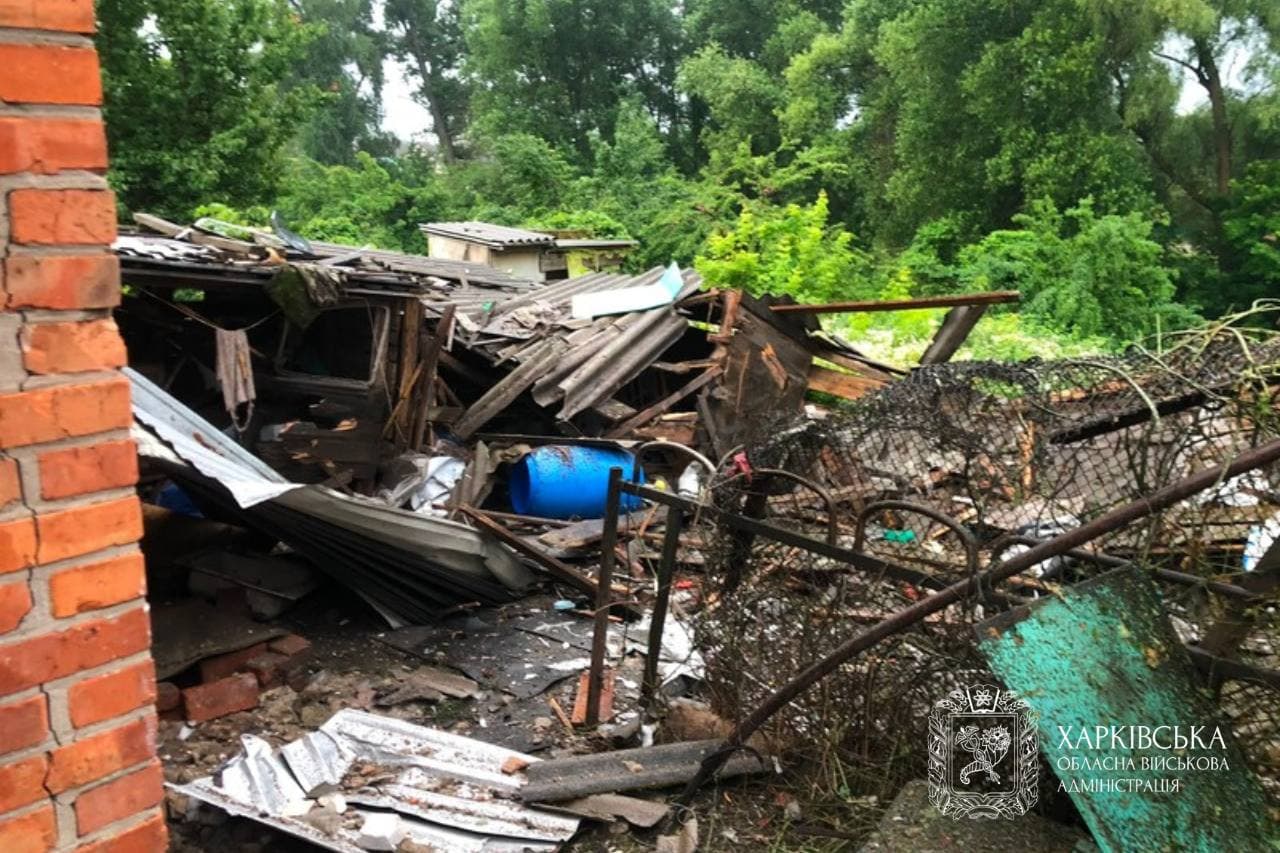
Damaged building following Russian attacks on Kharkiv Oblast. (Governor Oleh Syniehubov / Telegram)
Away from Kostyantynivka, the front moved in inches — where it moved at all. In northern Sumy Oblast, Russia’s Defense Ministry claimed on July 11 to have seized the border village of Bachivsk; a Ukrainian military spokesperson refuted the claim, and geolocated footage showed Ukrainian forces striking Russian positions in the village’s north after yet another infiltration attempt. Milbloggers claimed Russian gains near Andriivka and Pysarivka, north of Sumy City.
The infiltration pattern repeated across northern Kharkiv Oblast: small Russian groups slipping into Kozacha Lopan and Bilyi Kolodyaz, only to be struck in the buildings they occupied, while Russian aircraft dropped FAB-500 glide bombs on Ukrainian positions near Zakharivka and a drone launch point near Rublene. Southeast of Shevyakivka, in the Velykyi Burluk direction, another infiltration met the same fate.
In the Slovyansk direction, a milblogger claimed fighting inside Shchurove, while even a Kremlin-affiliated voice conceded that Russian claims of reaching Mykolaivka were unconfirmed — small infantry groups, he admitted, do not equal control. Russian strikes targeted the logistics keeping Slovyansk alive: a glide bomb on an embankment crossing near Mayaky, drone strikes on a Slovyansk gas station and a Kramatorsk gas distribution station. Near Kramatorsk, Ukrainian forces struck infiltrators southeast of Vasyutynske.
And everywhere else — Kupyansk, Borova, Dobropillya, Pokrovsk, Oleksandrivka, Hulyaipole — Russian offensive operations continued without a single confirmed advance. The Novopavlivka and Kherson directions reported no ground activity at all. Russia is still attacking almost everywhere. It is succeeding almost nowhere.
A Weekend Under the Drones: Kryvyi Rih, Kharkiv, Chernihiv Count Their Dead
The overnight sky into July 12 filled once again with Russian metal: nine Kh-59/69 cruise missiles, four Kh-31 anti-radar missiles, and 115 strike and decoy drones launched from six directions. Ukrainian air defenses downed seven missiles and 95 drones — but what got through struck twelve locations, and each impact point had a name and an address.
In Kryvyi Rih, Zelensky’s hometown, a Shahed drone hit an industrial enterprise on Sunday morning, killing two people. Near Nikopol, drones killed a 66-year-old man and shredded homes, an administrative building, and a truck. In Dnipro, a food industry facility took severe damage. In Kharkiv, drones injured twelve people — among them a 16-year-old girl — damaged more than twenty residential buildings and set a garage cooperative ablaze; a day earlier, an Italmas drone had injured seven at a civilian enterprise.
Saturday brought its own toll. In Sloviansk, three FAB-250 guided bombs killed a 67-year-old man pulled from the rubble of his own home and injured three others. In Izium, a strike on an apartment block injured four. In Zaporizhzhia, glide bombs destroyed private homes and injured three women aged 58, 64, and 78. And in a village near Koriukivka in Chernihiv Oblast, a drone found a residential courtyard, killing a 44-year-old man and wounding a 12-year-old girl with shrapnel. Strikes on Chernihiv’s energy grid left more than 23,000 consumers without power.
The official ledger for twenty-four hours: at least five killed, thirty-five injured. The unofficial ledger is harder to tally — the girl with shrapnel wounds, the women in their seventies, the man under his own roof.
Hunting Buses and Firefighters: Kherson’s Morning, Bohodukhiv’s Rescuers
At eight o’clock on Sunday morning in central Kherson, a passenger minibus was making its rounds when a Russian drone dove onto it, leaving the driver concussed and a bystander hospitalized. At 9:50, another drone struck a public transport stop in the Central district, wounding a man and three women with blast trauma and shrapnel. A subsequent strike injured an elderly woman. In the village of Charivne, a 50-year-old man took shrapnel to his abdomen and leg at nine in the morning. Overnight, a drone had dropped an explosive directly onto civilians, killing one person and injuring two.
Fifteen people were injured across Kherson and its region in twenty-four hours — in attacks that targeted hospitals, public transport, homes, and ambulances. This is the tactic Ukrainians have come to call the “human safari”: drones with cameras, operated by pilots who can see exactly what they are aiming at, choosing buses and bus stops.
The safari extends to those who respond. In Bohodukhiv, in Kharkiv Oblast, a Molniya attack drone struck the grounds of a State Emergency Service fire and rescue station, injuring three rescuers — two of them hospitalized. The men whose job is to run toward the fires are now targets before they can even leave the station. Under the laws of war, every one of these strikes is a crime. Under Russia’s apparent doctrine, they are the point.
From ‘No Cards’ to Convert: What Ukraine’s Deep Strikes Did to Donald Trump
Seventeen months ago, in a bruising Oval Office confrontation, Donald Trump told Volodymyr Zelensky that Ukraine had “no cards” to play. This weekend, the Wall Street Journal reported what has changed his mind: the cards Ukraine built itself. According to the Journal, Trump has been regularly briefed on Ukraine’s domestically produced long-range drones and has been genuinely impressed — both by the ingenuity of Ukraine’s defense sector and by the measurable damage its deep strikes are inflicting on Russian military and industrial targets.
The shift crystallized at the recent NATO summit in Ankara, where European officials described Trump’s conduct as “decent and serious” and came away optimistic. The tangible proof arrived on the summit’s sidelines: Trump announced the US would license Ukraine to domestically manufacture Patriot interceptor missiles — a capability that Chatham House’s Orysia Lutsevych noted could eventually neutralize Russia’s ballistic missile threat. “It’s hard to believe, correct, from the Oval Office to now… I think we’ve developed a very good relationship,” Trump said after meeting Zelensky.
The same intelligence reportedly shows the strikes reshaping Russia itself, with a growing share of the public eager for the war to end. “We have a lot of pressure on President Putin. I don’t think he likes what’s going on,” Trump observed, suggesting Moscow’s terms were “getting a little bit better.” US officials are divided — some believe Putin could negotiate on acceptable terms by year’s end; others remain skeptical. But officials in both Kyiv and Washington, from the State Department’s Ian Bateson to presidential office deputy Serhiy Kyslytsia, agree on the mechanism: Ukraine bombed its way to a better hearing in Washington.
Dead Drops in Rome, Hacked Doorbells on the Aid Routes: Russia’s Shadow War in Europe
The tradecraft was old-school: lists of questions passed at clandestine meetings, microSD cards left in a dead drop in a wall, €4,000 in cash per package. Italian police this week dismantled a Russian espionage network in Rome run by Mikhail Astakov, a GRU officer working under cover as a military attaché. His recruiter-in-chief was Gavino Piras, a 59-year-old former Italian intelligence employee, arrested alongside another ex-intelligence worker; five suspected informants inside the Italian military are under investigation.
What Moscow wanted reads like a targeting list for Ukraine’s air shield: data on the Samp-T system already defending Ukrainian skies, the CAMM-ER missile Ukraine plans to assemble domestically, and Leonardo’s Michelangelo Dome air defense system, scheduled for testing in Ukraine in November. Astakov also sought Italy’s Storm Shadow purchase plans, EU rearmament priorities, and details on Ukraine’s long-range missile development. Piras allegedly told his handler that British — not Italian — intelligence assists Ukraine’s strikes on Russian oil facilities. Italy expelled Astakov and a second attaché; Foreign Minister Antonio Tajani called it what it is: hybrid warfare against the West.
The digital front is just as busy. Dutch intelligence services revealed that Russian state hackers compromised internet-connected security cameras and even home intercoms across NATO countries and Ukraine — exploiting factory-default passwords and unpatched firmware — to monitor the routes carrying Western military aid to Kyiv. And a joint investigation reported that Russia and China have discussed plans to disrupt Starlink itself. The war’s supply lines are being watched through hacked doorbells.
The Currency of Experience: Ukraine’s Battlefield Becomes the World’s Classroom
In the scrublands of Queensland, Australia, soldiers of the 2nd Cavalry Regiment spent the Southern Jackaroo exercises flying a drone whose real education happened in Ukraine. The Vector AI, built by Germany’s Quantum Systems, is an electric vertical take-off reconnaissance aircraft with a 2.8-meter wingspan that needs no runway — and its onboard artificial intelligence, which maps terrain and autonomously detects and tracks targets, was refined through thousands of combat flight hours against Russian electronic warfare. As Corporal Harrison Hinson put it, the drone means fewer soldiers walking forward into danger to see what’s there.
The learning is being industrialized. US data-labeling firm Enabled Intelligence just released an AI training dataset containing 500,000 hours of drone footage recorded in the Ukraine war — pre-labeled, unsimulated combat imagery for aerial object detection and vehicle classification, available to approved users in the US, Ukraine, and NATO states. Ukraine’s war is literally training the West’s next generation of military AI.
And that experience has become a bargaining chip. Polish Defense Minister Władysław Kosiniak-Kamysz confirmed Poland is ready to help modernize MiG-29 fighters for Ukraine — if Kyiv or its allies pay — as part of negotiations in which Warsaw wants access to Ukrainian drone and missile technology in exchange for the jets, which Poland is retiring for F-16s and FA-50s. He called it “reciprocity and genuine solidarity.” Three years ago, Ukraine begged for weapons. Now its expertise is the price of admission.
By nightfall, the fires in Syzran had been contained and the tally boards updated: ninety ships, five dead in Sumy, one prime minister gone. In Kherson, the buses still had to run in the morning, and someone would have to drive them. In Bohodukhiv, the injured rescuers’ colleagues restocked the trucks and waited for the next call.
And somewhere near a Sumy bus stop, a family began learning how to live in a world with a thirteen-year-old-shaped hole in it — on the same day Washington finally decided Ukraine was holding cards after all. The war keeps two ledgers, and only one of them can ever be balanced.
A Prayer for Ukraine
1. For the Five Who Waited at the Bus Stop
Lord, You saw the street in Sumy before the bombs did — the road, the transport stop, the girl of thirteen who stood there on an ordinary Saturday. Receive her, and the four who died with her, into the arms their families cannot reach. Be near the forty-three who woke in hospital beds, and the five who fight for their lives tonight. You count what the war only tallies.
2. For the Girl of Koriukivka
Father of mercy, a twelve-year-old girl in a Chernihiv village carries shrapnel wounds from a drone that found her family’s courtyard, and a man who stood outside his own home is gone. Heal her body and guard her mind from the fear that outlasts the wound. For every child in Kharkiv, Kherson, and Sumy learning to read the sky for danger — restore to them the ordinary safety of a summer evening.
3. For the Woman Who Laid Down Her Office
God of wisdom, we pray for Yulia Svyrydenko, stepping away from the Prime Minister’s chair, and for Volodymyr Zelensky, rebuilding a government in the middle of a war. Give discernment to those who must choose new leaders by week’s end, and integrity to whoever takes up the burden. Let this reshuffling serve the people who wait at bus stops — not the ambitions of those who never will.
4. For the Pilots Over the Azov Sea and the Rescuers of Bohodukhiv
Lord of hosts, sustain the drone crews who fly night after night over dark water, choking the commerce that funds this war, and the soldiers holding the streets of Kostyantynivka building by building. And be a shield to the rescuers of Bohodukhiv — three of them wounded at their own station — who run toward every fire the enemy sets. Keep their courage from hardening into despair.
5. For Justice, From Sumy to Vyshneve
God of justice, You have seen the war crimes files opened in Sumy and the officials dismissed for storing ammunition beside the homes of Vyshneve. Let no atrocity be forgotten and no negligence excused — not by the enemy, and not within Ukraine’s own house. Strengthen every investigator, prosecutor, and honest official who insists that the truth be told.
In Your mercy, in Your justice, in Your time — bring this war to its end and let the ending be worthy of what Ukraine has endured.