
October 13, 2026
Prepared by Diana Bozhyk
Russian ballistic missiles struck Kyiv’s CHP-4 power plant and a nine-story apartment building late tonight, killing at least three people, after Ukraine received no early warning from its partners for the second night in a row. Trump denied that Washington had stopped sharing intelligence, a drone wrecked a university building in Rivne, and drones hit two ships in Bulgaria’s economic zone. In Luxembourg, Ukraine and Moldova opened the EU’s two largest accession clusters, while 12 U.S. senators urged Trump to rescind his diesel deal with Putin.
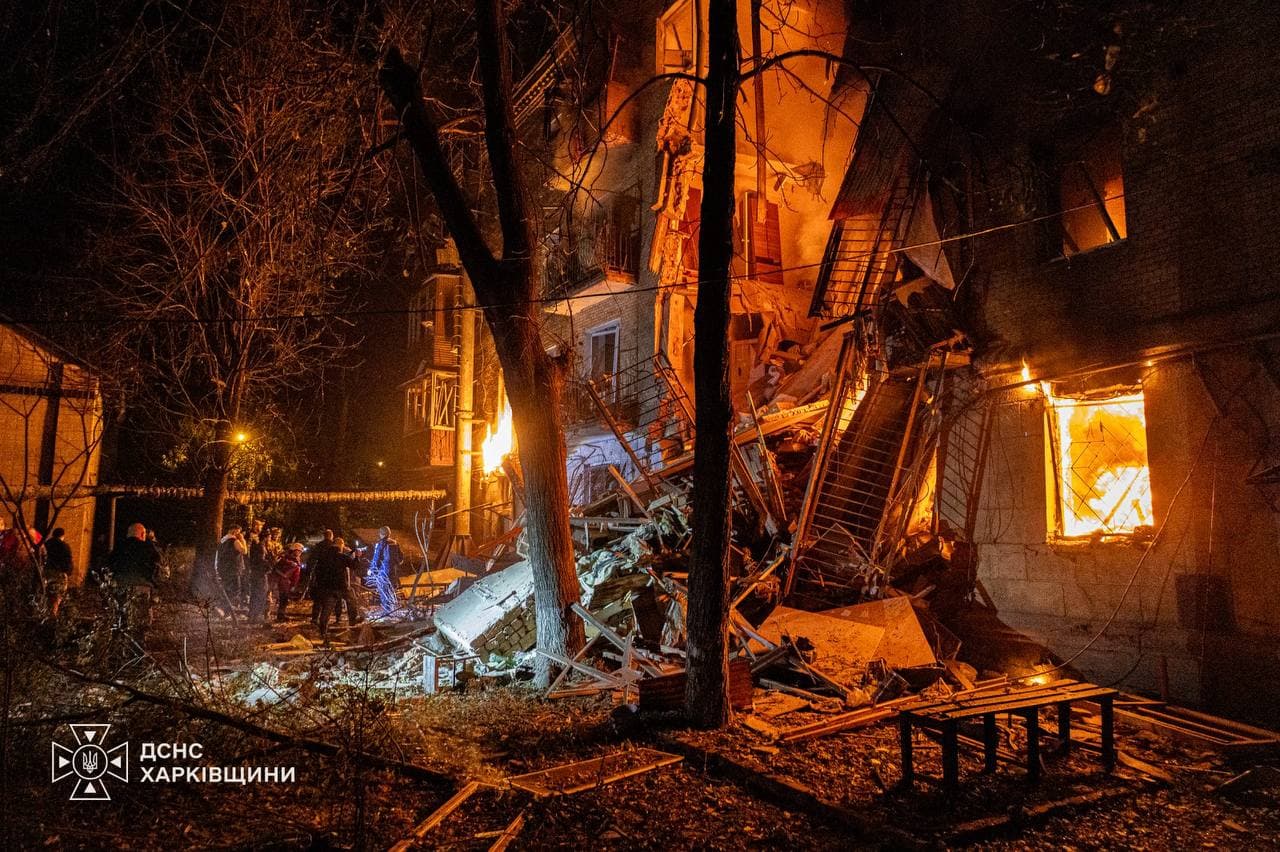
A residential building damaged in a Russian attack on Kharkiv. (State Emergency Service of Ukraine/Telegram)
THE DAY’S RECKONING
The missiles reached Kyiv at about 10:40 p.m., and the Air Force saw them only as they approached the city. One hit CHP-4, one of the capital’s main power plants; another set a nine-story apartment building in Desnianskyi ablaze from the first floor to the eighth. By morning, three people were dead and more than two dozen injured. It was the second night without advance notice from Ukraine’s partners, and the question of why hung over a day in which Trump said “No, we haven’t” stopped intelligence sharing and Sybiha said cooperation continues.
Earlier, a jet-powered drone gutted the music faculty of a university in Rivne, injuring 30 people. Off Bulgaria, three drones hit a Ukrainian-owned cargo ship and another vessel reportedly sank. Zelensky said Ukraine had held off striking Russian energy for two days after Trump’s announced truce while Russia kept attacking. In Luxembourg, the EU opened two more accession clusters; in Kyiv, the president and the mayor traded accusations over the capital’s winter readiness.
KYIV: BALLISTIC MISSILES HIT CHP-4 AND A NINE-STORY BUILDING
Russian ballistic missiles struck Kyiv at approximately 10:40 p.m. Zelensky said the main target was CHP-4, one of the capital’s most important energy facilities, and confirmed that missiles had hit it. “These missiles were detected by our system practically as they were approaching Kyiv,” he said.
In the Desnianskyi district, a missile struck a nine-story apartment building, starting a fire that spread through apartments from the first to the eighth floor. Firefighters extinguished a blaze covering 400 square meters and recovered two bodies by 1:30 a.m. Wednesday, Mayor Vitali Klitschko said. In a 7 a.m. update, the State Emergency Service (DSNS) said three people had been killed in the attacks on the capital. In the Holosiivskyi district, one person was killed and another injured when a non-residential building was hit, Kyiv Post reported, while the Kyiv Independent, citing the Kyiv City Prosecutor’s Office, said three women were killed in the residential building. The number of injured rose through the night: Kyiv Post later put it at 26, including an eight-year-old child; the prosecutor’s office counted 24, including a seven-year-old girl. Sixteen were hospitalized, four in serious condition, Klitschko said.
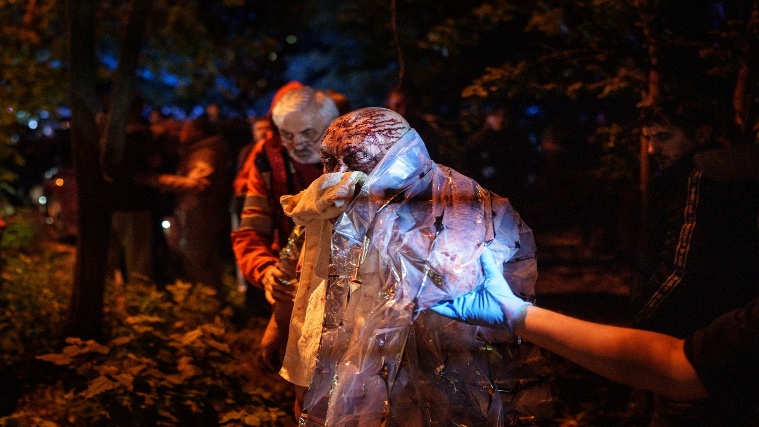
First responders look after a victim from a residential building struck by Russian missile fire in Kyiv, Ukraine. (Serhii Korovayny / The Kyiv Independent)
A repeat attack started a fire in a disused building in the Dniprovskyi district, firefighters put out a grass fire at a stadium in Darnytskyi, and a strike on a disused single-story building in Shevchenkivskyi caused a small fire.
Zelensky said Ukrainian intelligence indicated that Russia was preparing more ballistic attacks and urged residents to stay vigilant through Wednesday. “Ukraine supported the energy ceasefire. Russia is targeting yet another power plant and the lives of our people,” he said. “It is important that the world does not remain silent about this.” He said Ukraine was working to replenish its air defenses with interceptor missiles.
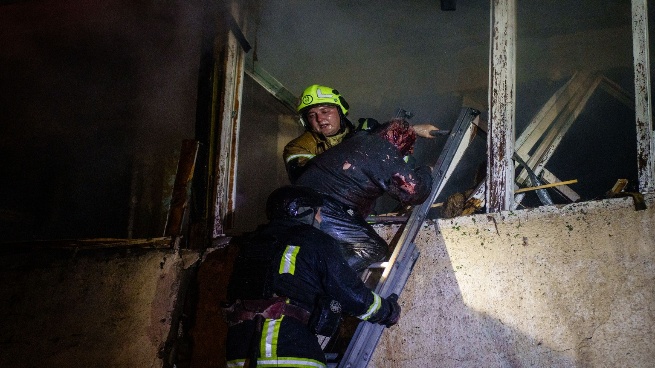
First responders help a victim down a ladder after a Russian missile struck a residential building in a fatal attack in Kyiv, Ukraine. (Serhii Korovayny/The Kyiv Independent)
NO WARNING FROM PARTNERS FOR A SECOND NIGHT
The Air Force said it received “no information from partners regarding missile launches from enemy territory” before the late-night strike or the previous night’s attack, and detected the missiles only by radar. Air Force spokesperson Yurii Ihnat said U.S. and NATO satellite-derived intelligence on Russian launches had not reached Ukraine in time, likely because of technical failures or other unspecified issues. Presidential adviser Dmytro Lytvyn called the missing notices unusual and said military and intelligence services were investigating.
Earlier in the day, Zelensky wrote that there had been no warning from partners before a “particularly cowardly” strike on Kyiv on Monday night, when about six ballistic missiles hit transport and warehouse facilities. “Having a warning about ballistic missiles is precisely what helps prevent killings,” he said. At the Warsaw Security Forum, Foreign Minister Andrii Sybiha said intelligence cooperation with the United States continues. “You are probably asking me if we are receiving intelligence data from the American side. Yes, we continue this cooperation,” he said, attributing Monday’s late alert to “the special type of weaponry used by the Russian side.”
Speaking to reporters in Alaska, Trump denied that Washington had halted intelligence support. “No, we haven’t,” he said. “We are helping them.” U.S. Ambassador to NATO Matthew Whitaker said there had been “no change” to arms deliveries through the PURL mechanism, under which allies buy U.S. weapons for Ukraine.
The questions followed reports that U.S. envoys had warned Kyiv in Miami that intelligence sharing could be cut over refinery strikes, and a Reuters source said PURL was also raised. “They called all the top military officials with threats,” a Ukrainian official told the Kyiv Independent. “They’re telling everyone that they’re going to turn off both the intelligence sharing and PURL.””
AN OVERNIGHT BARRAGE AND A NATIONWIDE TOLL
Overnight into Tuesday, Russia launched five Iskander-M or S-400 ballistic missiles from Bryansk Oblast, 108 Shahed-type and Gerbera drones, including 74 jet-powered models, Parodiya decoys, and nine Banderol or Dan-T loitering munitions, the Air Force said. Air defenses downed or suppressed 88 drones, including 58 jet-powered ones. Drones and missiles struck 17 locations, and debris fell at seven. All nine Banderol munitions were launched against Kharkiv. “From the evening until now, the Russians have attacked Ukraine with more than a hundred different means of attack: jet drones, loitering munitions and ballistic missiles,” Zelensky said in the morning, adding that a significant number were intercepted, but not all.
Russian attacks across Ukraine killed 10 people and injured 80 over the past day, regional authorities said. In Kharkiv, a strike on Monday evening killed four people and injured 41, including an emergency responder. Governor Oleh Syniehubov said Russia used 10 Banderol-type munitions. A strike destroyed an entire section of a four-story residential building in the Kholodnohirskyi district and damaged at least 10 nearby houses; in the Shevchenkivskyi district, another hit a five-story building, setting a ground-floor bank and six vehicles on fire. Among the seriously injured were a 19-year-old man admitted to a burn unit and another man in surgery. Rescuers pulled four people from the rubble.
In Kyiv, Russian missile and drone attacks from Monday into Tuesday killed two women and injured nine people, Kyiv Post reported, after a Shahed hit a residential high-rise on Monday; the city health department counted at least 12 injured in Monday’s attacks, including a 17-year-old.
In Rivne Oblast, Russian drones damaged a non-residential building in Rivne on Monday night without casualties, and civilian infrastructure, dormitories, and homes in Sarny district, Governor Oleksandr Koval said.
A DRONE GUTS A UNIVERSITY’S MUSIC FACULTY IN RIVNE
A Russian drone struck a building of Rivne State Humanitarian University in the city center in the morning, injuring 30 people and nearly destroying the premises of its Faculty of Musical Arts. Governor Oleksandr Koval first reported extensive damage and casualties. The Air Force had warned of a jet-powered drone over Rivne region; the Kyiv Independent said the warning came at around 10:35 a.m. after an air alert at 10:10 a.m., while Kyiv Post put it at 9:35 a.m.
The toll rose through the day. By 3:24 p.m., the National Police said 25 people had been hurt and three more were being examined, with two in serious condition undergoing surgery. After rescuers cleared the rubble, the State Emergency Service put the number of injured at 30. Sixty-four rescuers and 13 emergency vehicles worked at the scene, along with police and the Security Service of Ukraine (SBU).
According to the university, all students were in shelters during the attack, and several members of its administrative staff were among the injured. The strike damaged the building’s second floor and set it ablaze; firefighters put out the fire, but Education Minister Andrii Butenko said the building can no longer be used for in-person classes and will have to be rebuilt. Windows were blown out in neighboring academic buildings.
“Russia continues to deliberately attack education institutions. This is deliberate terror against the civilian population and yet another attempt to disrupt the educational process in the country,” Butenko wrote. The university is considering moving all classes online through the end of the week. “Our priority is the safety of people and ensuring conditions for continued learning. Students and university staff must receive the necessary support,” the minister said.
PAVLOHRAD, NIKOPOL, DNIPRO: ONE KILLED, FIVE INJURED
A Russian drone attack on Pavlohrad in Dnipropetrovsk Oblast killed one person and injured two in the evening, Governor Oleksandr Hanzha reported at around 6:51 p.m., adding that the strike started a fire in the city center. It was not immediately clear who the victims were or what was hit.
Earlier, Hanzha said Russian forces had attacked four districts of the region almost 40 times with drones and artillery. The Nikopol area bore the brunt, with Nikopol and the Marhanets and Pokrovske communities hit, damaging apartment blocks, private homes, and vehicles; a 31-year-old man and a 73-year-old woman were injured and treated as outpatients. Attacks caused fires in Dnipro, damaged a private house in the Solone community, infrastructure in the Malomykhailivka community of Synelnykove district, and a home in the Zelenodolsk community near Kryvyi Rih.
Earlier still, Russian forces attacked Dnipro with guided aerial bombs, damaging apartment buildings, vehicles, and transport infrastructure and injuring a 64-year-old man, Kyiv Post reported. In total, Russian attacks killed one person and injured five in the region during the day.
In the Kupyansk area of Kharkiv Oblast, Ukraine’s Khartiia Corps said Russian forces led a group of civilians, including two women and a child, toward the Shebelinka-Ostrohozhsk gas pipeline as human shields and that the group then came under mortar and artillery fire from the Russian-held eastern bank of the Oskil River. Drone footage showed casualties, the corps said, adding that Ukrainian troops did not fire and that it would hand the materials to war crimes investigators. The Joint Forces grouping separately said Russian forces had struck a column of civilians leaving Kupyansk during what it called a forced evacuation, with casualties still being established. The claims could not be independently verified.
DRONES HIT TWO SHIPS OFF BULGARIA AGAIN
Drones struck two civilian vessels in Bulgaria’s exclusive economic zone overnight, a week after a similar attack. The Malta-flagged Chelsea 3, owned by a Ukrainian company, was hit by three drones at about 1:30 a.m. roughly 18 nautical miles off the coast near Byala, Prime Minister Rumen Radev said, according to Bloomberg. The Bulgarian Security Council said a second vessel was struck and sunk about 17 nautical miles off the village of Krapets. Bloomberg reported that the Chelsea 3’s crew survived and were rescued, while Foreign Minister Andrii Sybiha said Ukrainian and Azerbaijani citizens were injured.
Radev called the attacks “absolutely unacceptable” and said Bulgaria would summon Russian Ambassador Eleonora Mitrofanova, but stopped short of assigning blame. “We lack solid, clear evidence to level accusations against any specific party,” he said, while suggesting that the outcome of such strikes “benefits Russia.” He spoke with European Commission President Ursula von der Leyen and NATO Secretary General Mark Rutte after the strikes.
Sybiha blamed Russia, saying the attacks demonstrated Moscow’s disregard for civilian lives and for shipping safety. “The Black Sea is a vital artery of global food security,” he said. “Russia is attacking it to weaponize hunger and hold the world hostage.” He urged partners to increase pressure on Russia, impose additional sanctions, and protect freedom of navigation.
A Kremlin-affiliated Russian milblogger claimed there have been nine strikes on cargo ships off the coasts of Bulgaria and Romania in recent months. ISW assessed that the strikes were likely carried out by Russian drones and that they show Russia’s growing acceptance of risk, extending from airspace incursions over Europe to kinetic events at sea. Russian drones previously struck two vessels in Bulgaria’s economic zone on Oct. 6.
“THEY AGREED BECAUSE I SAID THEY AGREED”
Trump declined to say whether Russia had violated the energy ceasefire he announced on Sunday. Asked whether Moscow had broken it, he said: “I’ll let you know about that later.” To another question, he replied: “Well, Ukraine hit many sites the day before.” He added: “We are working with them and Russia on getting the war to end.” On Monday, before departing for Ohio, he told reporters: “They agreed because I said they agreed, and that thing has to get settled.”
Neither Kyiv nor Moscow confirmed an agreement. Zelensky said Ukraine had not struck Russian oil refineries or energy facilities in the two days since the announcement. “But Russia did not heed,” he wrote. “Ukraine is ready for reciprocal de-escalation steps, and effective pressure on Russia is needed to bring about that de-escalation.” He said in a separate comment that “Putin does not read Truth Social, and his ‘Shahed’ drones follow a different set of instructions.” On Monday, he told the Warsaw Security Forum that a truce limited to refineries makes no sense because Ukraine has “just one oil refinery,” which Russia damaged long ago.
According to the Kyiv Independent, Russia struck Kharkiv’s CHP-5 power plant hours after Trump’s Sunday announcement, and Zelensky said Russia attacked six energy facilities that day, injuring 33 people, and carried out more than 200 strikes on electricity and transmission facilities over the past week. On Monday, Kremlin spokesperson Dmitry Peskov said Russia wants “long-term peace” without addressing the truce.
Zelensky said that obstacles to defending against ballistic missiles, delays in aid, and support for Russia undermine efforts to achieve peace, and called for continued support from the United States, Europe, and other partners.
MOSCOW SAYS IRAN, NOT KYIV, DRIVES DIESEL PRICES
Peskov said the diesel agreement is a mutually beneficial part of bilateral cooperation between the United States and Russia and denied any direct link to Russia’s negotiating position on Ukraine. Deputy Prime Minister Alexander Novak met with the Energy and Transport ministries and oil companies on the domestic fuel market and instructed them to intensify measures to ensure regional supplies and respond to price fluctuations.
On Monday, Novak said “problems in the Strait of Hormuz” had reduced global refining capacity and destabilized U.S. and global diesel markets, and that exports to the United States under the deal would not disrupt Russia’s domestic market. He said diesel exports could return to 3 million to 3.5 million tons a month by year-end, Reuters reported. Deputy Foreign Minister Georgy Borisenko said the key to stable U.S. fuel supplies is “a resolution of the conflict around Iran,” and Kirill Dmitriev, head of the Russian Direct Investment Fund, said some Western officials oppose the deal because they understand its benefit for the “world and for peace.”
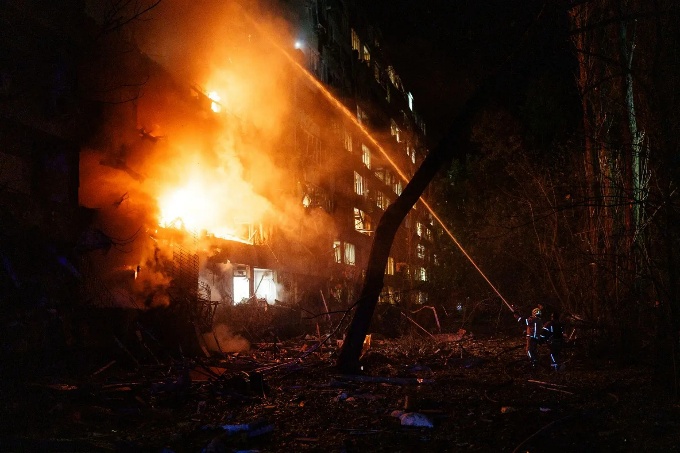
The aftermath of a Russian missile strike on a Kyiv residential building. The latest large-scale attack on the capital killed at least three people and injured 22 others. (Serhii Korovayny/The Kyiv Independent)
ISW noted that Kremlin officials’ acknowledgment of the Iran war as the main driver of diesel shortages contrasts with Trump’s claims that Ukrainian refinery strikes are to blame. It assessed that Moscow repeatedly offers Washington economic incentives it says are unrelated to Ukraine in order to extract concessions on the war, and that Russia, which relies heavily on oil revenue, would benefit disproportionately if Washington forced Kyiv to stop striking refineries. The think tank also assessed that Russia will likely prioritize the U.S. deal over its domestic fuel market after months of shortages this summer.
Russia’s September seaborne diesel and gasoil shipments fell 28 percent from August to 144,000 barrels a day, the lowest in more than a decade of Vortexa records, Kyiv Post reported.
TWELVE SENATORS: “A GIFT TO OUR ADVERSARY”
A bipartisan group of 12 U.S. senators, six Republicans and six Democrats, signed a letter urging Trump to rescind his diesel agreement with Putin. “This deal is a gift to our adversary and a betrayal of our Allies; it should be rescinded,” they wrote. The letter was led by Democratic Senator Richard Blumenthal, and its signatories included Thom Tillis, Susan Collins, Lisa Murkowski, John Cornyn, Jeanne Shaheen, Richard Durbin, Sheldon Whitehouse, and Jack Reed.
The senators targeted the Treasury Department’s General License No. 135, which lifted sanctions on Russian diesel exports immediately after the deal. The license, they wrote, “only provides Putin with more fuel to finance his war machine and enables Russia to continue its brutal attacks on Ukrainian civilians.” While acknowledging the pressure on U.S. fuel prices from the war with Iran, they said Russian diesel would offer “limited to no relief” to Americans.
They reminded Trump that he signed the Lindsey O. Graham Sanctioning Russia and Iran Act of 2026 after it passed both chambers with broad bipartisan support, and that it requires significant economic pressure on Russia and its main backers, particularly China. “Putin is a tyrant. Withdraw from this agreement, rescind General License No. 135, and execute the authorities provided under the Lindsey O. Graham Sanctioning Russia and Iran Act of 2026,” they wrote.
Blumenthal said Putin’s response to Trump’s proposed energy truce would be the first test of peace efforts. “Once again, he’s playing Trump for a fool & hoping to weaponize a freezing, starving, bloody winter against Ukraine,” he wrote on X. Oct. 18 is the deadline for many initial measures under the Graham law, which gives the president substantial discretion through waivers and tariff decisions.
EUROPE KEEPS ITS SANCTIONS; FRANCE BOARDS A SHADOW TANKER
European governments pushed back against the diesel deal on Monday. “For Germany and for Europe, such a decision is out of the question,” German Chancellor Friedrich Merz said, according to Anadolu, arguing that Russia’s continued attacks justified stronger restrictions. At the EU foreign ministers’ meeting in Luxembourg, Sweden’s Maria Malmer Stenergard said: “I very much regret this. I hope it will not go into force.” The European Council formally adopted sanctions against 1,569 individuals and entities, 826 Russian companies and 743 executives, with more than half of the listings concerning the ballistic missile production chain, EU foreign policy chief Kaja Kallas said. “A ceasefire cannot work if only one party honors it,” she said of an energy truce.
On Monday morning, the French Navy boarded the sanctioned tanker DF Peak more than 450 nautical miles south of Réunion. “France is determined to fight the shadow fleet, everywhere in the world,” President Emmanuel Macron wrote. The vessel, sailing under a Benin flag that French authorities suspect may be invalid, is under U.S., EU, U.K., and Ukrainian sanctions; Ukraine’s military intelligence links it to Sovcomflot. Armed Forces Minister Catherine Vautrin said the Navy was escorting it for further inspections; France has not said whether it will confiscate the ship or its cargo.
Finnish Foreign Minister Elina Valtonen called on Monday for an EU-wide ban on tourist visas for Russians. “As long as Russia continues its invasion, Russian citizens should not be issued tourist visas,” she said. Schengen countries issued Russians close to 500,000 tourist visas in 2025, according to Finland’s Foreign Ministry. Prime Minister Petteri Orpo said he would present the proposal at next week’s European Council meeting.
LYTVYN: THE “FOUR-POINT PLAN” IS NOT A U.S.-EUROPEAN PROPOSAL
Ukraine rejected the description of a reported four-point peace proposal as a joint U.S.-European plan. Responding to a Washington Post column by David Ignatius, presidential communications adviser Dmytro Lytvyn told journalists: “It is not ‘the US and European countries.’ This is an outline of the vision of some members of the US team at the meeting in Florida, which was attended by Americans, Ukrainians and Europeans. Good PR by the Americans.” He did not say whether Ukraine accepted or rejected any of its elements.
According to the column, which cited an unnamed U.S. official, the ideas were discussed at the six-hour meeting on Oct. 9 at the Shell Bay Golf Club in Hallandale Beach, Florida. The four components it described were a framework for financing Ukraine’s reconstruction, reportedly involving the World Bank and BlackRock; Article 5-style security guarantees from the United States and European countries; an energy agreement integrating the Ukrainian, Russian, and European economies, possibly including a pipeline carrying Russian oil and gas to Europe with shared profits, and a timetable for lifting sanctions; and a ceasefire along the current front, described as a “line of control,” under which Russia would keep the territory it holds without necessarily gaining legal recognition.
“We need to make the problem and the solution bigger to help both sides see what the postwar situation would be – and then make concessions,” the official was quoted as saying. According to the column, negotiators asked Kyiv for detailed estimates of its financial needs and assurances that reconstruction funds would be protected from corruption.
The proposal has not been published as an official document, approved by the participating governments, or accepted by Russia, Kyiv Post noted.
THE EU OPENS CLUSTERS 2 AND 3; THE RADA PASSES THREE BILLS
Ukraine and Moldova opened the EU’s internal market and competitiveness clusters at a ceremony in Luxembourg, the two largest by number of policy files. “We welcome the continued momentum on Ukraine’s candidacy, now the majority of clusters are open, following a prolonged period without movement,” said Ireland’s Europe Minister Thomas Byrne. “Behind these technical names will be real benefits for Ukrainians,” said Enlargement Commissioner Marta Kos. “Ukraine is fully committed to the reforms required for membership and intends to move through this work as quickly as possible,” said Deputy Prime Minister for European Integration Vsevolod Chentsov.
The step came a day after the Verkhovna Rada passed a law strengthening the rights of the Hungarian-speaking minority, which Hungary had demanded. Two clusters remain, covering sectors such as agriculture and transport; the Commission and the Irish presidency hope to open them by the end of 2026, and France and Poland reiterated their support for opening all six.
In Kyiv, lawmakers backed three bills in first reading linked to IMF and Ukraine Facility funding: capping borrowing costs, restricting courts’ access to bank secrecy, and simplifying VAT administration. A bill on the Single Euro Payments Area was pulled after it became clear it lacked support. “I think it’s absolute nonsense (not to vote for the bill). It’s a European directive in every detail,” lawmaker Mykyta Poturaiev said. Delays put €29.5 billion in funding at risk, and parliament must pass around 30 bills by year’s end. Voting continues on Wednesday.
ZELENSKY SAYS KYIV LAGS ON WINTER READINESS; KLITSCHKO HITS BACK
Zelensky criticized the capital’s preparations for Russian attacks for the second time in a week, saying Kyiv is behind the rest of the country in implementing its resilience plan. “As of mid-October, virtually across the entire country — even in border and frontline regions — the implementation of resilience plans is further advanced than in Kyiv,” he said after a meeting of the Staff of the Supreme Commander-in-Chief on Monday. “And Kyiv residents certainly feel it — when even isolated hits by Shaheds cause electricity and water outages across large parts of the capital.”
Zelensky said he had begun consultations on urgent security and administrative measures, meeting representatives of the security sector, business, and local government, among them Lt. Gen. Vasyl Malyuk, former head of the Security Service of Ukraine; Ivan Fedorov, head of the State Agency for Restoration and Infrastructure Development; Kharkiv Mayor Ihor Terekhov; businessman and politician Kostiantyn Yefymenko; and former lawmaker Maksym Yefimov. “Protection of energy facilities, critical infrastructure in Kyiv, carrying out tasks together with the government and the military, understanding people’s needs and a rational change in the algorithms for managing Kyiv – we are preparing decisions,” he said. He gave no timeline and did not say what changes to the city’s management were under consideration.
Mayor Vitali Klitschko rejected the accusations. “Unfounded accusations are being made about an alleged failure of the heating season, spread by outlets linked to the central government,” he wrote on Telegram. He accused the central authorities of trying to undermine local self-government by removing community leaders on what he called fabricated grounds. “The people elected me, and I am working, doing everything possible under extremely difficult conditions to justify the trust of Kyiv residents and keep the city functioning amid constant devastating enemy attacks,” he said.
UKRAINE HITS AN ISKANDER REPAIR BASE; A FIRE IN AKSAY
Ukrainian forces struck a repair base for Iskander-M launchers and transporter-loader vehicles near Kondrinka in Kursk Oblast, roughly 150 kilometers from the front, the General Staff said. Russia has launched more than 500 ballistic missiles at Ukraine since the start of 2026, and Ukrainian military intelligence estimates Russia can produce more than 200 cruise and ballistic missiles a month, with the Iskander-M among its priorities, the Kyiv Independent reported. Ukrainian forces also hit a radar station near Shkryabino in Bryansk Oblast and, in occupied Luhansk Oblast, a fuel and lubricants depot, an ammunition depot, and a logistics facility.
A large fire broke out at warehouses of the Aksaykardandetal plant in Aksay, near Rostov-on-Don, spreading across 9,000 square meters, Russia’s Emergency Situations Ministry said. The plant makes drive shafts and metal components for agricultural and specialized machinery. A warehouse wall collapsed, and 98 emergency workers were deployed. The cause is unclear.
In Rostov-on-Don, the fire at the oil-loading terminal hit on Oct. 10 flared up again on its fourth day. At least eight of its 12 tanks have been put out of service, according to an OSINT analysis by ASTRA; satellite imagery reviewed by ISW showed at least seven damaged. The reports could not be independently verified.
Alexey Chadayev, head of the Russian defense company Ushkuynik, said Yandex had relied on outdated assumptions and protected only its sites after strikes on Wildberries and Ozon warehouses.
Off Russia’s Black Sea coast, oil-covered seabirds were found on beaches dozens of kilometers from the Aframax Rio, the tanker hit near Sochi on Oct. 6, wildlife groups reported, contradicting official statements that no significant pollution had occurred. Russian Greenpeace said the tanker had spilled oil, and footage showed the charred ship listing near Novorossiysk.
A REPORTED GERAN-6 AND A WARNING ABOUT RASSVET
Russia may be developing a new Geran-6 jet-powered strike drone with features of a ballistic missile, a Ukrainian open-source intelligence source reported. According to the source, Russian design bureaus have been tasked with a drone able to fly a ballistic trajectory, in variants with 300- or 600-kilogram warheads and a range covering all of Ukraine, with possible first deployment as early as June 2027 and full-scale production scheduled for mid-2028. ISW called the report unconfirmed but said that, if true, the Geran-6 would resemble a quasi-ballistic missile and suggest Russia is seeking a cheaper way to penetrate Ukrainian air defenses, as it increasingly relies on ballistic missiles to exploit Ukraine’s interceptor shortage.
Maj. Gen. Ilya Pavlenko, deputy chief of military intelligence from 2015 to 2020, told Interfax-Ukraine that Russia’s Rassvet satellite network could eventually let operators control long-range drones in real time. “For Europeans, this is a direct threat,” he said, warning that a drone with a compact Rassvet terminal launched from a civilian vessel or a rented trailer in Europe could strike London or Paris. He said Russia launched two batches of 16 Rassvet-3 satellites in 2026 but that not all work as intended. Jamming the system would require detailed knowledge of its frequencies and protocols, he said, and Ukrainian intelligence believes Russia registered it on frequencies overlapping with Iridium, used by the Pentagon. He also claimed that 90 percent of the Russian defense sector’s settlements run through the yuan and Chinese banks, a figure that could not be verified.
On Monday, Zelensky told the Financial Times that China is helping Russia build a Starlink-like system. “They are getting closer, and they are passing it on to Russia,” he said.
POLAND BLAMES RUSSIA FOR A STARLINK ARSON AND PROBES A PLOT
Polish authorities blamed Russian intelligence services on Monday for a Sept. 23 arson attack on a Starlink ground station in Wola Krobowska, Masovian Voivodeship, and said two Turkish citizens had been detained in Germany as suspects. Prime Minister Donald Tusk said the two were arrested on Oct. 10 on behalf of Polish services and called the attack “another act of hybrid warfare.”
“We have no doubt that Russian intelligence services are behind this act of sabotage,” said Tomasz Siemoniak, the minister coordinating Polish special services, according to AP. “It is worth adding that Russian services are increasingly turning to individuals linked to the criminal underworld,” he said, according to Deutsche Welle. The station is operated by state-owned telecom company Exatel and serves as an internet hub carrying traffic through Poland, including to Ukraine. In September, Deputy Prime Minister Krzysztof Gawkowski said the fire may have been a deliberate attempt to disrupt internet access used by Ukrainian forces.
Polish authorities are also investigating an alleged assassination plot against Tusk and Defense Minister Wladyslaw Kosiniak-Kamysz, intelligence services spokesperson Jacek Dobrzynski said on Sunday. Police received numerous reports of a possible attempt, prompting a meeting of the Interior Ministry, the State Protection Service, and the Internal Security Agency. “We are taking this matter very seriously,” Kosiniak-Kamysz said.
At the Warsaw Security Forum, Whitaker said U.S. weapons continue to flow to Kyiv through PURL. “The United States continues to sell our equipment and munitions to our European and Canadian allies that then provide it to Ukraine. I know of no change to that program,” he told AFP on Monday. He acknowledged that air defense “largely is in high demand, and the availability is probably not as good as we would like,” but called it “a short-term challenge.”
MEANWHILE, AT THE FRONT
Ukrainian forces recently advanced in southeastern Yunakivka, northeast of Sumy, according to geolocated footage, ISW reported. In the Oleksandrivka direction, Ukrainian forces advanced southwest of Fedorivka as they continued counterattacks toward the Mokryi Yaly River, and a Russian milblogger said they were pushing toward Fedorivka and Komar through Perebudova.
Joint Forces Group spokesperson Col. Viktor Trehubov said Russian forces are trying to hold their bridgehead on the western side of the Oskil River and that losing the bridgehead near Dvorichna, or having it cut off, would significantly degrade Russian efforts in Kupyansk. Russian forces attacked toward Lyman and north of it toward Kolodyazi without advancing, as Ukrainian forces continued counterattacks. Russian attacks in and west of Kostyantynivka, southwest of Druzhkivka, and in northern Kharkiv Oblast also made no confirmed gains.
Russian forces conducted infiltration missions into eastern Klynove, northwest of Chasiv Yar, and western Matyasheve and Svitle, south of Dobropillya, where Ukrainian forces struck them. The Russian Defense Ministry repeated claims that Ukrainian forces are encircled in Dobropillya and that Russian troops thwarted a breakout attempt by a platoon with armored vehicles; ISW said it has seen only limited Russian infiltration into southern Dobropillya. Near Prydniprovske, east of Kherson, Russian forces unsuccessfully tried to cross the Dnipro in an inflatable boat. A milblogger’s claim of operations to envelop Orikhiv from the west and northwest was not confirmed.
TWO NIGHTS WITHOUT WARNING
Overnight, firefighters in Desnianskyi put out the blaze in the nine-story building, and rescuers were carrying residents down ladders. In Rivne, a university was preparing to teach online. In Luxembourg, officials had signed off on two more chapters of Ukraine’s path to the EU.
In Washington, the president said intelligence still flowed; in Kyiv, the Air Force said the warnings had not. Zelensky said more ballistic attacks were being prepared and asked people to stay alert through Wednesday.
A PRAYER FOR UKRAINE
1. For Kyiv in the Night
Lord, missiles fell on Kyiv tonight without warning, on a power plant and on a nine-story home where families were preparing for sleep. Receive the three who were killed, comfort those who loved them, and heal the wounded, among them a young child. Strengthen the firefighters who climbed through smoke from floor to floor, and keep the people of the capital safe through the hours ahead.
2. For Kharkiv and Its Wounded
Father, we pray for the four killed when bombs tore through homes in Kharkiv, for the forty-one wounded, and for the rescuer hurt while saving others. Heal the young man in the burn unit and every person still in surgery. Comfort the families who lost their homes in Kholodnohirskyi and Shevchenkivskyi, and give the people of Kharkiv courage for another night.
3. For the University in Rivne
God of mercy, a place of music and learning in Rivne was set on fire today, and thirty people were hurt. We thank You that the students were in shelters, and we pray for the staff who were injured, for the two in serious condition, and for every teacher and student who must now learn amid ruins. Let music return to that place, and let knowledge outlast the war.
4. For Civilians Used as Shields
Lord, near Kupyansk, women, a child, and men were driven toward a pipeline and then fired upon. We pray for every one of them, for the wounded and the dead, and for all who live under occupation without protection. Guard the innocent, expose those who use them as shields, and bring justice for every life treated as a tool of war.
5. For Sailors and Defenders
God of justice, we pray for the crew of the Chelsea 3 and the vessel lost off Krapets, for the sailors from Ukraine and Azerbaijan who were hurt, and for all who carry grain across dangerous waters. Protect the air defenders who must find missiles without warning, give them clear sight and steady hands, and let help reach them in time.
In Your mercy, in Your justice, in Your time — bring this war to its end, and let the ending be worthy of what Ukraine has endured.