
August 2, 2026
Prepared by Diana Bozhyk
New reporting revealed that Saturday’s restaurant bombing in Moscow was likely an assassination attempt against Colonel General Alexander Chayko, the Russian Aerospace Forces commander who oversaw the units responsible for atrocities in Bucha in 2022 — the blast has now killed five people. In Odesa, a gunman opened fire on Ukraine’s own military recruiters, wounding four, part of a mobilization crisis that has seen attacks on draft officers rise from five cases in 2022 to hundreds each year now. Russian drones struck a Rozetka warehouse for the second time in 24 hours, a Kharkiv postal terminal burned, and a fresh Zaporizhzhia glide bomb killed one woman and wounded 31 more — on a day when Ukraine’s own strikes reached an air base, three oil refineries, and a Wildberries hub deep inside Russia.
THE DAY’S RECKONING
The story Moscow first told about Saturday’s restaurant explosion was vague on purpose: an unnamed woman, an improvised device, a gas leak rumor quickly denied by the chef himself. By Sunday, the real shape of it was harder to hide — military-plated vehicles parked outside, a birthday party for a Russian general, and a name Russian journalists kept repeating: Alexander Chayko, the officer who commanded Russian forces in Kyiv Oblast in the earliest, bloodiest weeks of the invasion, including in Bucha. The death toll climbed to five. In Odesa, a different kind of violence broke out entirely — a man opened fire on his own country’s recruitment officers, four wounded, the latest entry in a rising column of attacks by Ukrainians against the system trying to draft them. Kyiv’s Rozetka warehouse burned for the second time in a day. A Kharkiv mail terminal caught fire. And deep inside Russia, Ukrainian drones reached an airfield that launches the bombers hitting Ukrainian cities and three refineries that keep Russia’s war economy running. Nobody paused this weekend. Both sides simply kept adding names to lists that were already too long.
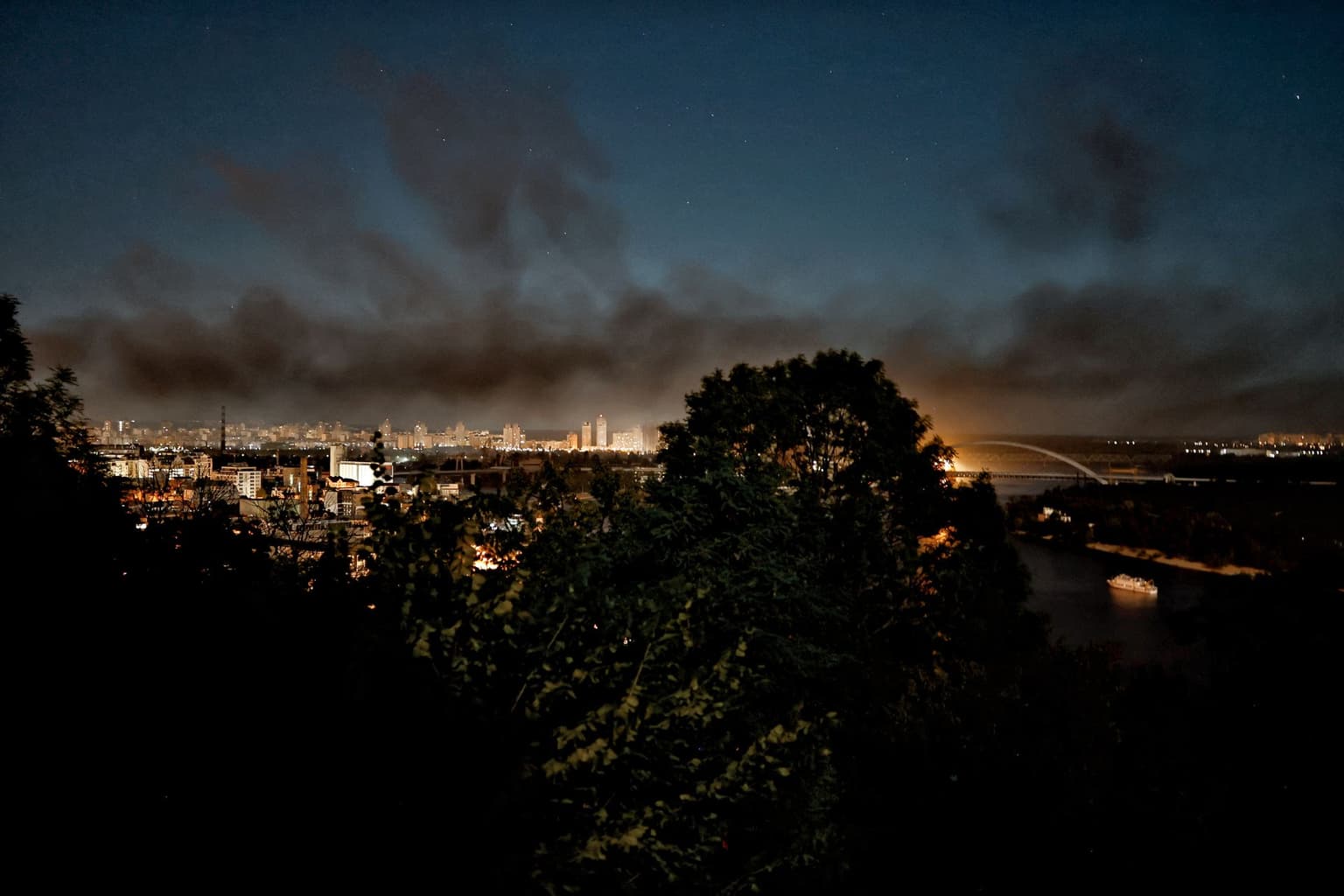
Black smoke rises over the city following a Russian missile attack in Kyiv, Ukraine. (Yan Dobronosov/Global Images Ukraine via Getty Images)
THE RESTAURANT BOMBING TARGETED A GENERAL WHO COMMANDED BUCHA
New reporting sharpened what happened at Saturday’s explosion in central Moscow considerably. The blast, at the upscale Balzi Rossi restaurant on Kudrinskaya Square, has now killed five people and injured 21 — the toll rose after two of the injured died in hospital, with more than six others still in critical condition. Russian officials continue describing it only as an unattributed improvised explosive device carried in by an unidentified woman, stopped by a security guard who died alongside her and one patron. But Russian journalists and Telegram channels close to the security services have converged on a different story: the restaurant was hosting a private birthday celebration, heavily attended by FSB officials, Duma deputies, and defense ministry generals, for Colonel General Alexander Chayko, commander of Russia’s Aerospace Forces, who turned 55 that day.
Chayko’s service record makes him a plausible target for almost anyone with a grievance against this war. He commanded Russia’s Eastern Military District from the war’s first day until May 2022, overseeing the failed attempt to encircle Kyiv and, during that same window, the units responsible for the killings in Bucha. He later commanded Russian forces in Syria through the fall of the Assad regime, before returning to take charge of the VKS in May 2026 amid domestic criticism of Russia’s air defense failures. Neither Russian nor Ukrainian officials have confirmed his status following the blast. It’s the latest in a pattern of violence against senior Russian military figures inside Russia itself — following a June car bombing in Balashikha that killed Colonel Damir Davydov, a defense ministry official who supplied ammunition to the front, just a kilometer from where Lieutenant General Yaroslav Moskalik died in an almost identical bombing the year before.
A SECOND ROZETKA STRIKE, AND KHARKIV’S POSTAL TERMINAL BURNS
Russian Shahed drones struck Rozetka’s largest warehouse in Brovary for the second time in 24 hours overnight, following Saturday’s deadly daytime attack on the same facility that killed 61-year-old employee Volodymyr Melnychenko and injured seven others. “This is the second attack on our warehouse in 24 hours. It is definitely not an accident, but a targeted strike,” the company said, confirming no one was hurt this time and that operations would continue on schedule regardless.
In Kharkiv, a Russian strike on a postal terminal in the city’s suburbs killed at least one person and ignited a large fire, tearing through cargo trucks, shipping containers, and terminal equipment. “Unfortunately, as a result of the enemy strike on the suburbs of Kharkiv, one person died. My deepest condolences to the family and friends,” regional head Oleh Syniehubov wrote, as rescuers swept the area for further casualties. Overnight drone strikes had already hit three other Kharkiv districts, leaving a 74-year-old man, an 8-year-old girl, and a 13-year-old boy in acute stress reactions after a Molniya-type loitering munition struck nearby. In Sloviansk, a Russian FAB-250 glide bomb hit the city’s center and Railway micro-district around 11 a.m., destroying an administrative building and a dozen private homes and leaving one 61-year-old man in surgery.
THE REGIONAL TOLL: SIX DEAD, EIGHTY-ONE WOUNDED, AND A SECOND ZAPORIZHZHIA STRIKE
Russian attacks killed at least six people and wounded 81 more across eight regions over the day, regional authorities reported. Kherson Oblast took the heaviest toll — one killed and 31 wounded as Russian forces struck 35 settlements, including the regional capital itself. Donetsk Oblast lost two in Druzhkivka, with four more wounded regionwide; Dnipropetrovsk Oblast lost one, with 11 more wounded and eight additional injuries, including a 16-year-old boy, when a Russian strike hit a passenger bus near Nikopol. Kharkiv Oblast reported 10 wounded including three children, Sumy Oblast eight including a 12-year-old boy, Mykolaiv Oblast five as drones targeted port and transport infrastructure, and Zaporizhzhia Oblast one killed and one wounded. In Chernihiv Oblast, a driver was wounded when a Russian FPV drone struck a mail truck near Novhorod-Siverskyi.
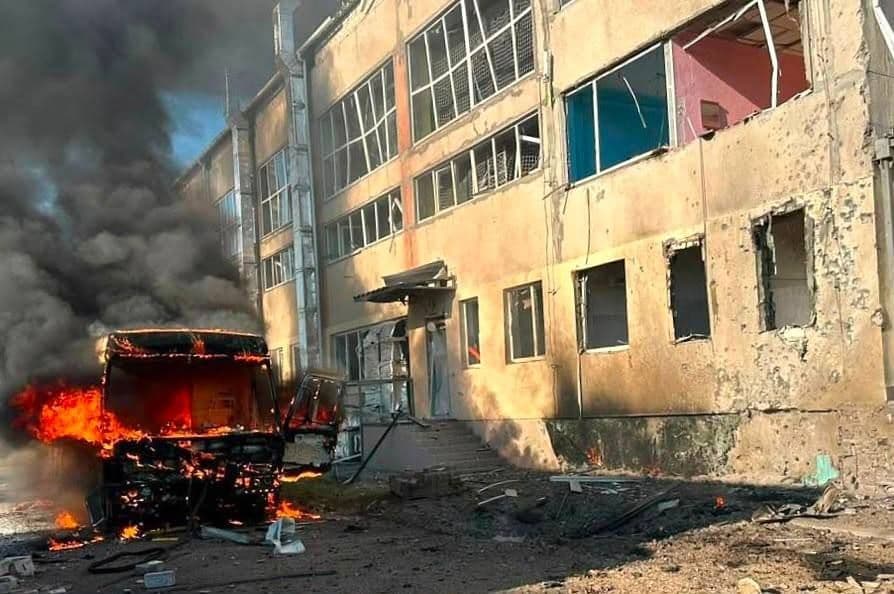
The aftermath of a Russian attack on the southern city of Mykolaiv, Ukraine. (Heorhii Reshetilov/Telegram)
Hours after that roundup was compiled, Zaporizhzhia absorbed a second, far worse strike: a Russian glide bomb hit the lower floors of a multi-story residential building in the city, killing one woman and wounding 31 more as rescue crews searched the partially collapsed structure into the evening. Governor Ivan Fedorov reported additional damage to the “private sector” without further detail. It was the city’s latest entry in what has become close to a daily occurrence — Zaporizhzhia sits just 20 kilometers from the front line, near enough for Russia to reach with almost anything in its arsenal.
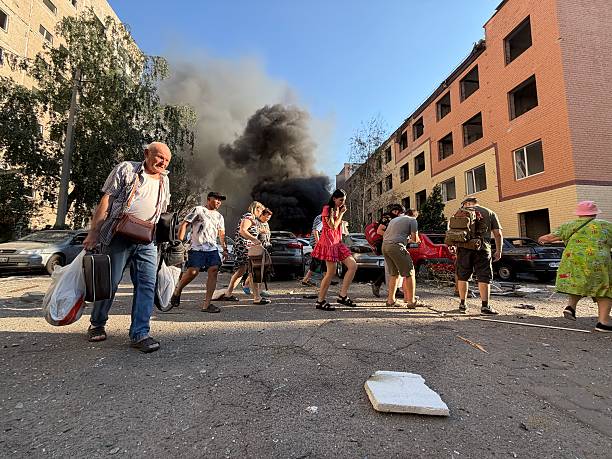
People walk in front of heavy smoke rising at the site of a Russian airstrike in Zaporizhzhia. (Darya Nazarova / AFP via Getty Images)
A GUNMAN OPENS FIRE ON UKRAINE’S OWN RECRUITERS
A 32-year-old man opened fire with a pistol on employees of a Territorial Recruitment Center in Odesa’s Cheremushky neighborhood around 7:30 p.m., wounding four — one hospitalized with a serious back wound, three others treated and released. Police detained the suspect and confiscated his weapon for examination; the circumstances remain under investigation.
It’s the latest and most violent entry in a fast-worsening pattern. Attacks on Ukraine’s own enlistment officers have climbed from five reported cases in 2022 to 341 in 2025, with 118 more logged in just the first four months of 2026, according to National Police figures. Three officers have been killed since the war began, including one earlier this year, stabbed in the neck in Lviv. Many of the targeted officers are former front-line soldiers themselves, reassigned to recruitment duty after being wounded in combat — men who survived Russia’s war only to become targets of their own countrymen’s fury at being drafted into it. The shooting came less than a month after a routine street document check in Lviv escalated into a mass demonstration that saw military vehicles and draft officers attacked outright — two data points in the same widening crisis over how Ukraine keeps its army staffed four years into a war nobody asked for.
AIR FORCE DAY: THE NUMBERS BEHIND A SHRINKING SHIELD
Marking Ukraine’s Air Force Day, acting Defense Minister Yevhen Khmara said Ukrainian air defenses have destroyed more than 445,000 Russian aerial targets since the invasion began — Kinzhal, Kalibr, and Kh-101 cruise missiles, Iskander-M ballistic missiles, and tens of thousands of Shahed and Lancet drones among them — across more than 38,000 combat sorties. He acknowledged directly what the numbers alone don’t show: an urgent, ongoing need for more advanced interceptors to keep pace with what Russia keeps throwing.
July’s own statistics explain why. Russia launched a record 377 missiles at Ukraine that month, and Ukraine’s overall interception rate fell to roughly 50 percent. The gap was worst against exactly the threat Ukraine can least afford to miss: of 126 ballistic missiles fired, only 36 were intercepted, a rate of just 29 percent. Cruise missiles fared much better at 69 percent, and drones better still at 87 percent of 4,955 launched — a lower monthly drone count than spring, but one Russia is compensating for with faster, harder-to-stop weapons instead.
DEEP STRIKES: ENGELS, SARATOV, AND THREE REFINERIES IN UFA
Ukraine’s General Staff confirmed strikes on Russia’s Engels airbase in Saratov Oblast — home to the Tu-95MS and Tu-160 strategic bombers that launch missiles at Ukrainian cities — and on the nearby Saratov Oil Refinery, one of Russia’s largest, sparking fires at both sites; Saratov’s governor said two people were killed. It’s at least the 15th strike on that refinery alone since the full-scale war began. The same overnight wave hit the Lyudinovskaya oil depot in Kaluga Oblast and a drone storage and launch site near Navlya in Bryansk Oblast.
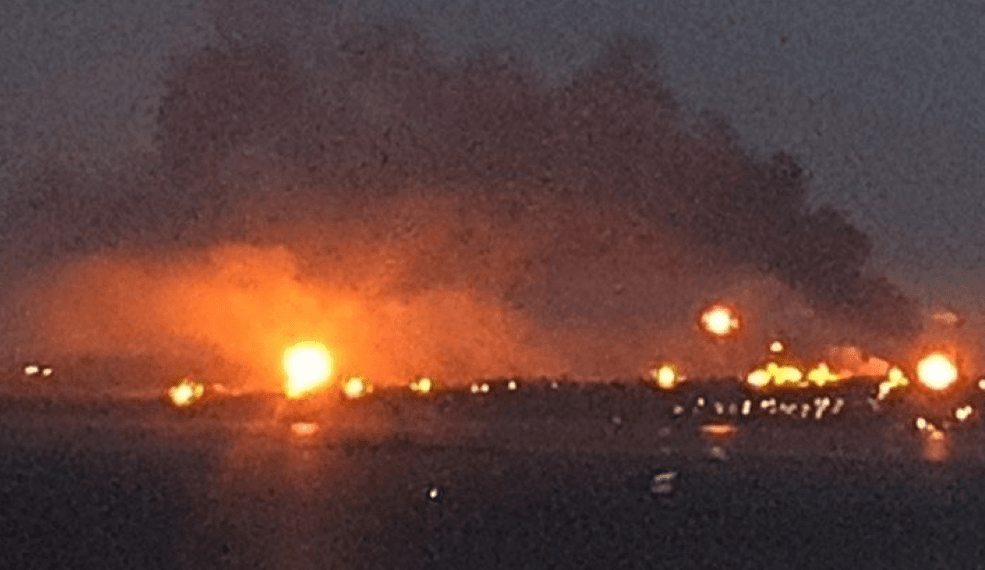
What purports to be the aftermath of a reported Ukrainian attack on a Russian oil refinery in the city of Saratov overnight. (Exilenova Plus/Telegram)
Commander Robert “Magyar” Brovdi reported Ukrainian forces separately struck all three refineries of the Bashneft cluster in Ufa, Bashkortostan — Ufaneftekhim, Novoil, and UNPZ — together representing one of Russia’s largest refining complexes with a combined annual capacity of 23.5 million tons, more than 1,700 kilometers from Ukraine’s border. A Wildberries logistics hub in Novosemeykino, Samara Oblast, caught fire the same night, the latest of at least 18 strikes on the retailer’s supply chain in two weeks, now totaling roughly 38 percent of its major warehouse capacity destroyed or damaged. In Krasnodar Krai, Ukrainian forces destroyed a Tor-M2 air defense system and seven radar stations in a single coordinated strike more than 270 kilometers behind the front line, aimed at clearing the way for continued strikes on Russian airfields and drone launch sites.
BELARUS BUILDS ANOTHER BRIGADE
Belarus is completing the formation of a new 37th Separate Airborne Assault Brigade near Gomel, roughly 40 kilometers from the Ukrainian border, Belarusian special forces commander Colonel Alexander Ilyukevich announced — one battalion already formed, a second underway, alongside artillery, anti-aircraft, and reconnaissance units. It adds to three existing Belarusian airborne brigades and follows months of new training-ground construction along the same border that Ukrainian intelligence has been tracking since early July.
Belarusian leader Alexander Lukashenko has continued insisting Minsk has no intention of entering the war, even while instructing his defense minister to send “underperforming officials and agricultural workers” to guard the southern border: “Anyone who fails to carry out orders should be sent to the army. Let them serve there. They can sit in the forest.” Ukrainian intelligence maintains that Moscow keeps pressuring Belarus to expand its own military commitments regardless of what Minsk says publicly — pressure that, brigade by brigade, keeps showing up on the ground either way.
COUNTING THE DEAD: TWO ARMIES, TWO SETS OF NUMBERS
Ukraine’s General Staff now puts Russia’s total losses since February 2022 at roughly 1,449,120 troops — killed, wounded, missing, and captured combined — after a record 42,860 casualties in July alone, the first monthly total this year to cross 40,000 and well above June’s previous high of 39,290. The figure lines up closely with the Washington-based Center for Strategic and International Studies, which independently estimates 1.4 million Russian battlefield casualties through June, including up to 450,000 killed. Independent outlet Mediazona, working with BBC Russian, has now confirmed the identities of 236,066 individual Russian dead by name — 86,600 volunteers, 26,200 recruited prisoners, 19,600 mobilized soldiers, and 7,465 officers among them — while cautioning the real total almost certainly runs higher, since their count relies on public obituaries and local reporting rather than any official Russian source.
Zelensky, in a Fox News interview two days earlier, put Ukraine’s own losses at roughly 50,000 killed and 400,000 wounded — a lower killed-in-action figure than the 55,000 he cited five months ago, without explaining the revision. Whatever the precise numbers, every independent tally now agrees on the same basic shape: Russia is losing people at a rate its own recruitment can no longer keep pace with, which is precisely the pressure Ukrainian officials believe is pushing Moscow toward a fresh mobilization this autumn.
EUROPE KEEPS BOARDING RUSSIA’S SHADOW FLEET
Italy’s navy led a joint EU boarding of the Toa Payoh, a sanctioned Russian shadow fleet tanker sailing under a Cameroonian flag, in international waters west of Pantelleria — the fourth such vessel intercepted under Operation IRINI since the mission expanded its focus beyond its original Libya arms-embargo mandate. The tanker’s captain initially refused to cooperate with the boarding party before eventually providing documentation; Italy’s defense ministry hasn’t said whether the ship will be formally detained. France, Sweden, Belgium, and the UK have each carried out similar boardings in their own waters in recent months, and the EU’s newly finalized 21st sanctions package now lets member states sell oil, grain, and other cargo seized from these ships outright, so long as proceeds never reach Russian hands.
ROMANIA, AGAIN
Romania scrambled two F-16 fighter jets after a drone crossed into its territorial waters near the Danube border during a Russian attack on southern Ukraine — the country’s second aerial alert in a single day, following a morning warning over a drone detected near the same border. The drone spent roughly 20 minutes inside Romanian territory before turning back into Ukraine, where Ukrainian forces shot it down; fragments fell in the village of Periprava without causing casualties or damage. It’s at least the fourth such incursion in little more than a week, part of a pattern Romanian officials increasingly describe as testing rather than accident.
FRONTLINE: KOSTIANTYNIVKA’S FAMILIAR PATTERN
Neither side made confirmed advances anywhere along the front. Russian forces continued limited attacks in the Kostiantynivka, Dobropillya, Sloviansk, Novopavlivka, Hulyaipole, and Kharkiv Oblast directions without gaining ground, while a Russian milblogger claimed advances near Vasyutynske and Pershomarivka north of Kostiantynivka that remain unconfirmed. ISW separately assessed that Russia’s own Northern Grouping of Forces is likely exaggerating its gains in northern Ukraine to Moscow, sustaining a narrative of continuous advance across a front line that has barely moved in nearly two years. Ukrainian forces, meanwhile, kept up intermediate-range strikes on Russian supply routes and energy infrastructure in occupied Donetsk, Zaporizhzhia, and Kherson oblasts, hitting substations, fuel tankers, and drone control points from Mariupol to Melitopol to Henichesk — the unglamorous, unrelenting work of making occupied territory harder to hold, one strike at a time.
BORIS JOHNSON GOES “INTO UKRAINE’S KILL ZONE”
Former British Prime Minister Boris Johnson released a new documentary this week, “Into Ukraine’s Kill Zone,” following 72 hours he spent near the front line in Zaporizhzhia with Channel 5 in February 2026 — his fourth visit to the country but the first time as prime minister or otherwise that he traveled beyond Kyiv. He meets a mobile anti-aircraft unit tracking Shahed drones, calling the soldiers “heroes” fighting with equipment “some of which was designed more than 100 years ago,” and visits the 65th Mechanized Brigade near Hulyaipole and Komyshuvakha, where he describes neighborhoods “blown to smithereens” and a supermarket still operating as a quiet act of defiance. His final stop is a burnt-out passenger train hit in a Russian strike that killed six civilians and wounded two more, which he calls proof Russia is acting like “barbarians.”
Russia’s response to the producers, included in the film’s credits, accuses Johnson of persuading Ukraine to abandon the spring 2022 Istanbul talks and of ignoring Ukrainian strikes on Russian civilian infrastructure. Critical reception has split sharply along familiar lines: The Guardian gave it one star, calling Johnson a “self-serving narcissist” who “undermines the honor of every brave fighter he meets,” while The Telegraph gave it four, praising a “sober, no-frills film.” Britain’s government used the moment to restate its own commitment — £21.8 billion in total assistance, including more than 150,000 drones and 350 air defense missiles supplied to Ukraine to date.
WHAT THIS WEEKEND ADDED UP TO
By the time Sunday’s fires burned down to embers, Moscow was still pretending not to know who its restaurant bomb was really meant for, and Odesa was counting four more wounded recruiters in a war some Ukrainians are now fighting against their own draft board. Rozetka’s warehouse burned twice in a day. A Zaporizhzhia apartment building lost a woman to a bomb that arrived hours after the morning’s toll was already tallied. Neither army moved the line. Both kept moving everything else — money, missiles, blame — exactly where it’s been heading all along.
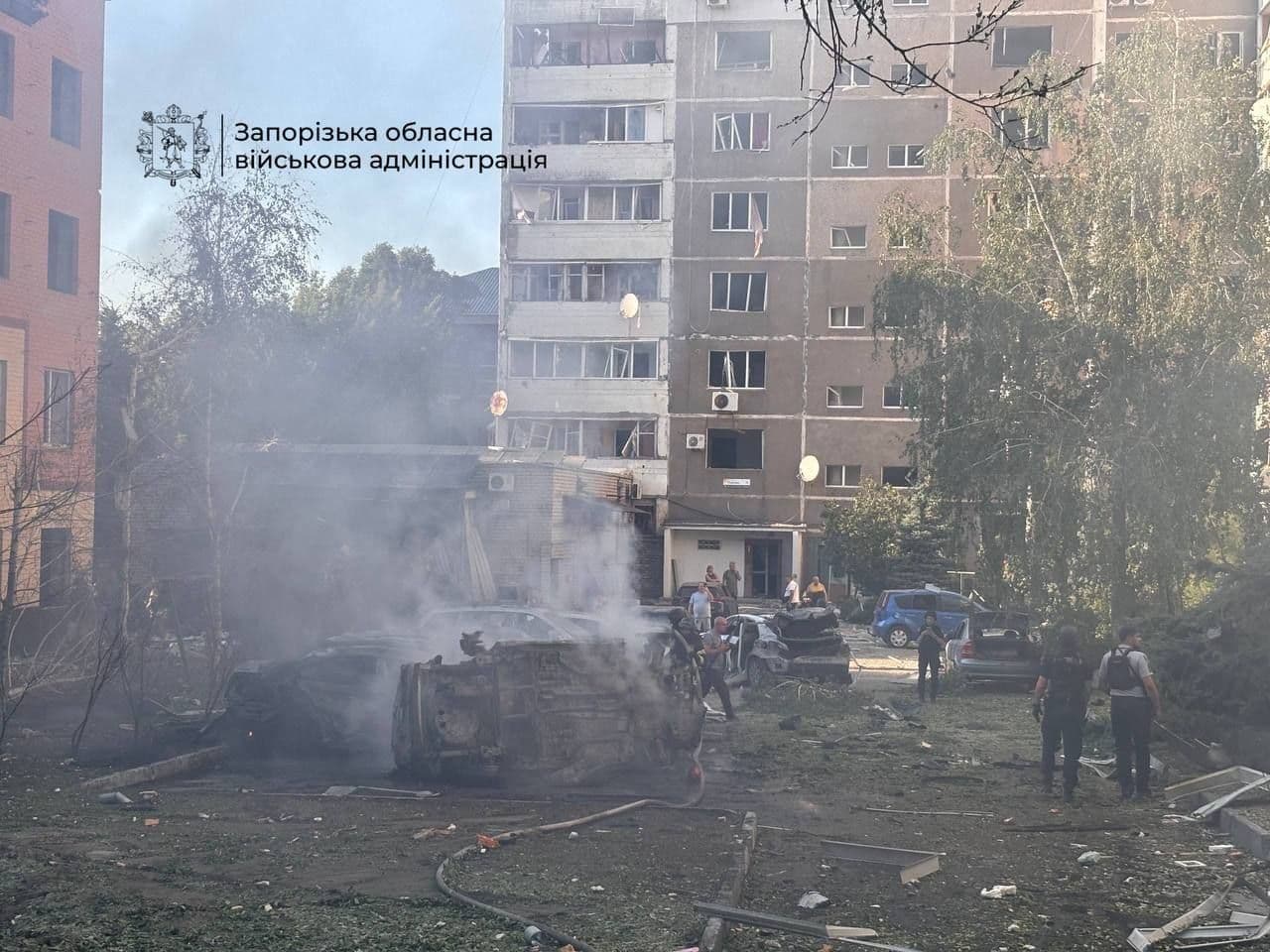
The aftermath of a Russian glide bomb attack on Zaporizhzhia. The attack killed one person and injured at least 31 others. (Zaporizhzhia Oblast Military Administration/Telegram)
A PRAYER FOR UKRAINE
1. For Every Name Kharkiv Added Today
Lord, a mail terminal burned, a bakery truck was hit, and a residential roof took a drone strike, all in the same city on the same ordinary Sunday. Hold everyone left in acute shock by strikes that didn’t kill them but didn’t spare them either. Comfort the family of the one person who did not survive, and steady the hands of the rescuers still searching.
2. For the Woman of Zaporizhzhia’s Second Strike
Father, a bomb found a residential building hours after the morning’s count was already finished, killing a woman whose name arrived too late for anyone’s official tally. Receive her fully, even though the news moved on before her name did. Hold the thirty-one wounded beside her, and this city that absorbs this kind of morning and afternoon both, again and again.
3. For a Country Divided Against Its Own Draft
Lord of wisdom, a gunman opened fire on his own country’s recruiters today, one entry in a rising list of Ukrainians turning violence against the system trying to send them to fight. Comfort the wounded officers, many of whom already carry wounds from the front themselves. Give this country wisdom to hold both truths at once — the real fear driving resistance to conscription, and the real need for soldiers who defend it — without more violence deciding the argument.
4. For Whoever Was Truly Meant to Die in Moscow
God of justice, an explosion in a Moscow restaurant may have been aimed at a man with a great deal of innocent blood already on his hands, and instead took a security guard and a stranger who happened to be eating dinner nearby. We do not know how to pray simply for an outcome here. Hold the ordinary people caught in violence never meant for them, on every side of every war this one keeps touching.
5. For Two Armies Still Counting Their Dead in Different Currencies
God of mercy, tonight both sides add names to lists that keep growing regardless of who is technically winning — hundreds of thousands confirmed, more still unnamed, families on both sides of this border learning the same grief in different languages. Comfort every parent, spouse, and child doing that arithmetic tonight, whichever flag their soldier fought under. Let the counting stop being necessary long before either side runs out of numbers to add to it.
In Your mercy, in Your justice, in Your time — bring this war to its end, and let the ending be worthy of what Ukraine has endured.