
August 3, 2026
Prepared by Diana Bozhyk
A source confirmed to the Kyiv Independent that Saturday’s Moscow restaurant bombing did target General Alexander Chayko, the Russian Aerospace Forces commander who oversaw the units responsible for atrocities in Bucha — and that investigators haven’t ruled out a link to last month’s near-assassination of a Ukrainian corps commander in Kharkiv. President Zelensky carried out another sweeping reshuffle of Ukraine’s diplomatic corps, dismissing longtime US Ambassador Olha Stefanishyna and moving security council chief Rustem Umerov to head foreign intelligence. In Dnipropetrovsk Oblast, Russian strikes killed four people, including an 8-year-old boy who died alongside his rescue-worker father, and Russia’s own defense ministry confirmed a new bombing campaign aimed at isolating Sloviansk and Kramatorsk ahead of a future offensive.
THE DAY’S RECKONING
A source close to Ukraine’s intelligence services told reporters plainly what Moscow had spent two days dancing around: Saturday’s restaurant bombing really was aimed at General Alexander Chayko, the man who commanded Russian forces into Bucha in 2022 and now runs Russia’s Aerospace Forces. The same source raised something stranger still — investigators haven’t ruled out a connection between that bombing and the assassination attempt on Ukrainian commander Ihor Obolienskyi in Kharkiv just days earlier, an attack an unnamed handler pretending to be Ukraine’s own security service had orchestrated. In Kyiv, President Zelensky kept reshaping his government around the edges, dismissing his ambassador to Washington and shuffling his security council leadership for the second time in a month. In Shyroke, a town in Dnipropetrovsk Oblast, a rescue worker and his 8-year-old son died together at a gas station Russian forces struck — one of four killed in the region that day. And in occupied Russia’s own defense ministry, officials confirmed something ISW had already assessed independently: a bombing campaign aimed squarely at cutting off Sloviansk and Kramatorsk, the same slow grinding tactic that leveled Pokrovsk and Hulyaipole a year ago, now aimed at Donetsk Oblast’s next targets.
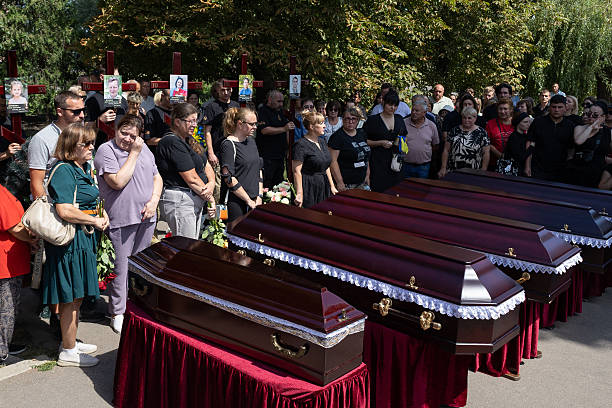
Mourners stand beside the coffins of family members who were killed in a missile strike on July 30, 2026, during a funeral ceremony in Kryvyi Rih. Officials previously reported that six family members were killed in the strike. (Serhii Okunev / AFP via Getty Images)
CHAYKO CONFIRMED AS TARGET, POSSIBLY TIED TO A KHARKIV PLOT
A source familiar with the matter confirmed to the Kyiv Independent that Russian Aerospace Forces Commander Alexander Chayko was indeed the target of Saturday’s bombing at Moscow’s Balzi Rossi restaurant, which killed five people and injured 21. Chayko had reportedly been celebrating his 55th birthday there — one image from the event, since circulated on Russian Telegram channels, showed the words “Alexander 55” displayed on stage. His condition remains unknown; Russian officials have called it a terrorist attack without publicly naming who it was meant for.
The source went further, saying investigators haven’t ruled out a link between the bombing and an assassination attempt on Ukrainian Khartiia Brigade commander Ihor Obolienskyi in Kharkiv in late July — an attack in which a recruited local man, convinced by Russian intelligence posing as Ukraine’s own security service that Obolienskyi was a “traitor,” approached with a pistol that jammed before it could fire. The source called Chayko’s bombing the third such incident in “recent times” targeting Russians connected to the war effort, following a July 29 assassination attempt on Andrey Cherezov, a Tula-based drone manufacturer, and one more attempt that has not been made public. Separately, Russian outlet Verstka reported that Chayko’s own daughter, 25-year-old Maria, was hospitalized with a traumatic brain injury from the same blast, and that her husband, 27-year-old Danylo Peredriy, may have been killed in it.
ZELENSKY’S AMBASSADOR PURGE: STEFANISHYNA OUT, UMEROV MOVED, KLYMENKO IN
Zelensky dismissed Olha Stefanishyna from her post as ambassador to the United States, part of a broader rotation that also removed Ukraine’s ambassadors to Brunei, Kyrgyzstan, Tajikistan, Austria, and Libya in a single day. Stefanishyna, in the role since August 2025, framed her exit as a personal decision: “Representing Ukraine in Washington while the country is fighting for its very existence has been the greatest honor of my life,” she wrote, crediting her tenure with securing US support “in legislation that will outlast any change in administration.” Her departure comes amid an ongoing National Anti-Corruption Bureau investigation into irregularities at Ukraine’s Asset Recovery and Management Agency, tied to contracts her former husband’s companies received; she has not been charged. Zelensky had reportedly hoped to install recently dismissed Prime Minister Yuliia Svyrydenko in the post instead, but she declined the offer.
In a separate pair of decrees, Zelensky moved National Security and Defense Council Secretary Rustem Umerov to head Ukraine’s Foreign Intelligence Service, replacing acting chief Oleh Luhovskyi, while installing former Interior Minister Ihor Klymenko as the council’s new secretary. Umerov will keep leading Ukraine’s stalled trilateral negotiations with Russia and the US, and continue securing drone agreements with Middle Eastern partners — “he has greater capacity to deal with these issues simultaneously,” Zelensky said. Umerov’s own record carries its own baggage: he served as defense minister from 2023 to 2025 through a run of procurement scandals and abuse-of-power allegations, and was questioned, though never charged, in Ukraine’s biggest corruption case of Zelensky’s presidency. It’s the latest ripple from the reshuffle that began July 12, one more name shifted into a different chair rather than out of government entirely.
DNIPROPETROVSK’S DEADLIEST DAY: FOUR KILLED INCLUDING A CHILD
Russian forces killed four people, including a child, and wounded 15 more across four districts of Dnipropetrovsk Oblast, carrying out more than 60 strikes with drones, artillery, and bombs. The Kryvyi Rih district took the worst of it — three dead, including the child, and 11 wounded — after Russian forces struck a gas station in the town of Shyroke, killing a rescue worker and his 8-year-old son together at the scene, and damaging vehicles, a private home, farm buildings, and a fire station. It’s the same district where an entire family of ten died in the village of Radushne just four days earlier.
Nikopol district, among the most consistently bombarded areas of the entire war, absorbed strikes across five communities, wounding four more, including a 33-year-old woman hospitalized in moderate condition. Near Synelnykove, strikes damaged more than two dozen private homes, several vehicles, a farm, a gas station, and a combine harvester. In the city of Dnipro itself, a warehouse and a wheat field caught fire — though the governor noted separately that some of the night’s explosions there were actually the sound of Ukraine’s own air defenses intercepting incoming threats, not impacts.
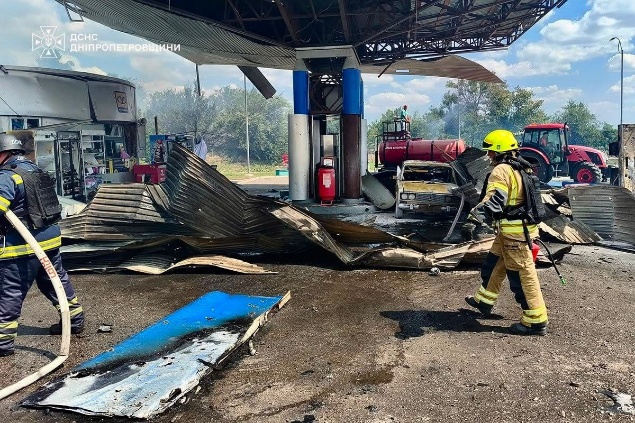
Rescue workers extinguish fire at a gas station in central-eastern Dnipropetrovk Oblast, which had suffered from a Russian attack. (State Emergency Service / Telegram)
THE REGIONAL TOLL BEYOND DNIPROPETROVSK
Elsewhere, Russian attacks killed six more people and wounded at least 65 across six other regions over the same 24 hours. Zaporizhzhia Oblast bore the heaviest additional toll: eight guided aerial bombs hit the regional capital, killing one person and wounding 31, and a follow-up strike the next morning knocked out power to 45,000 households, with 23,000 still dark by mid-morning. Donetsk Oblast lost two people with 12 wounded; Kherson Oblast lost one with six wounded; Sumy Oblast lost one with five wounded; Kharkiv Oblast lost one with one more wounded; Mykolaiv Oblast reported two wounded. In southern Odesa Oblast, a strike on transport infrastructure wounded 13 people, four hospitalized, one critically, as Russia continued a broader campaign against Ukraine’s ports — 67 seaport facilities, 35 civilian vessels, and 22 ships in Ukraine’s sea corridor struck in July alone, with five more port facilities and three more vessels hit in just the first three days of August.
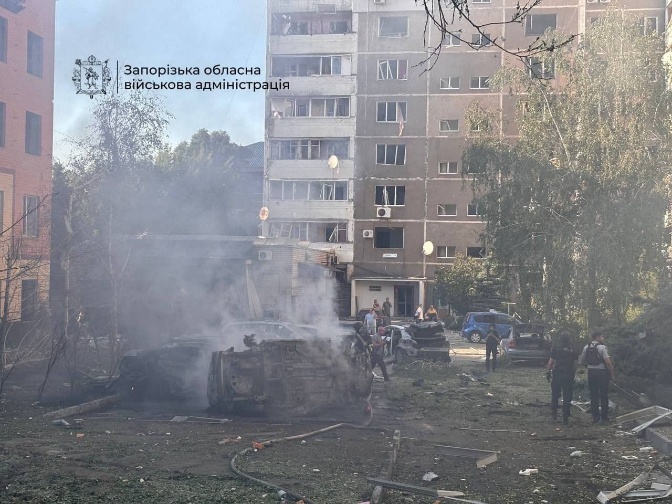
Russian forces attacked the city of Zaporizhzhia with eight guided aerial bombs on the evening, killing one person and injuring 31 others. (Zaporizhzhia Oblast Ivan Fedorov/Telegram)
In Chernihiv Oblast, a three-drone strike destroyed a Nova Poshta cargo branch in Pryluky and hit two warehouses storing agricultural machinery, wounding one man with shrapnel; the company said all staff and customers had reached shelter in time and promised to compensate customers for lost shipments.
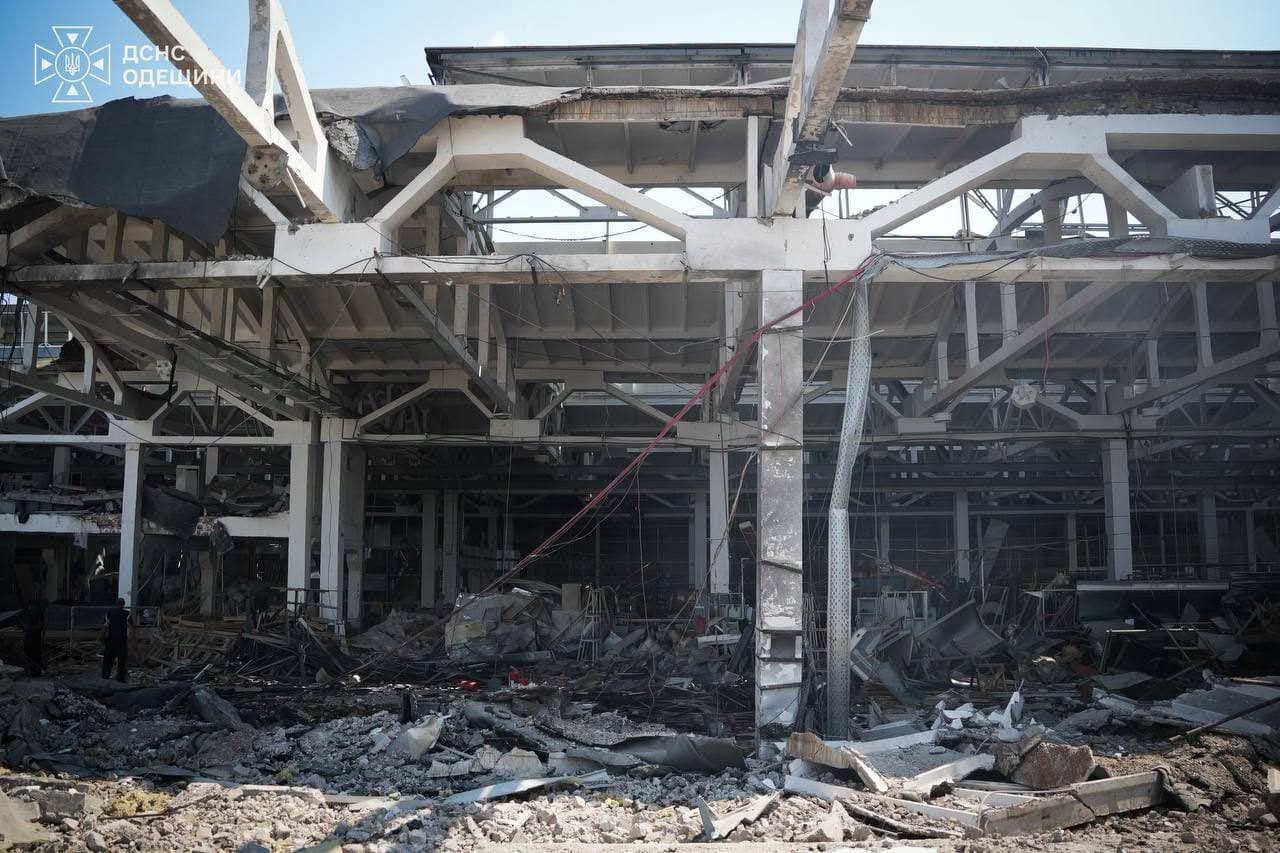
The aftermath of a Russian attack on a transport infrastructure in southern Odesa Oblast. (Odesa Oblast Governor Oleh Kiper / Telegram)
FRONTLINE: UKRAINE’S QUIET GAINS NEAR OLEKSANDRIVKA
Away from the headlines, Ukrainian forces have been steadily advancing in the Oleksandrivka direction since mid-July, according to military observer Kostyantyn Mashovets — reaching the western bank of the Mokri Yaly River near Hrushivske, likely liberating the settlements of Myrne and Rybne, and pushing Russian infiltration groups largely out of the Filiya area entirely. Ukrainian troops are now operating within roughly 1.5 kilometers of Komyshuvakha’s western outskirts. It’s a rare stretch of the map moving in Ukraine’s favor, even as DeepState’s own broader tally shows Russia capturing more territory nationwide in July than Ukraine reclaimed — 36 square kilometers gained against smaller Ukrainian counter-advances, though DeepState cautioned the real Russian figure could reach 88 square kilometers once delayed reporting catches up, and that two additional, still-unannounced Ukrainian advances covering a combined 132 square kilometers hadn’t yet been factored in.
Elsewhere the line held its familiar shape: Russian forces made unconfirmed claims of gains near Kupyansk, Bilyi Kolodyaz, and Hulyaipole that Ukrainian sources dispute, while ISW again assessed that Russia’s own Northern Grouping of Forces is likely exaggerating gains to the Kremlin to sustain a narrative of advance across a front line that has barely moved in nearly two years.
THE FORTRESS BELT UNDER PRESSURE: RUSSIA’S NEW BOMBING CAMPAIGN
Russia’s Defense Ministry confirmed what ISW had already been tracking: a deliberate bombing campaign against Sloviansk and Kramatorsk, the northern anchor of Donetsk Oblast’s “Fortress Belt,” designed to isolate Ukrainian logistics ahead of a future offensive. Russian forces have damaged a key bridge over the Kazennyi Torets River in eastern Sloviansk with rocket fire, struck at least 15 homes and started fires in Kramatorsk, and reportedly received 1,000 new Molniya loitering munitions specifically to intensify strikes on logistics routes between the two cities. It mirrors the campaign Russia ran against Pokrovsk and Hulyaipole through late 2025 — strikes on supply lines and rail rather than direct assault, aimed at making the cities impossible to hold rather than simply attacking them outright.
Kostiantynivka, just south, remains what it’s been for weeks: infiltrated but not held, with Russian troops now pushing infiltration attempts north toward Oleksiievo-Druzhkivka. Analysts expect fighting to continue there for weeks as Russian forces try to consolidate scattered gains rather than launch any single decisive push.
DEEP STRIKES: BELGOROD’S DRONE UNIVERSITY, VLADIMIR’S WILDBERRIES, CRIMEA BURNS AGAIN
Ukrainian drones struck Belgorod State Technological University, reportedly home to development of an automated drone control system built around a Russian “Milandr” microprocessor, sparking a large fire that destroyed one building; Russian authorities haven’t confirmed the strike. A separate strike hit a Wildberries logistics hub in Russia’s Vladimir region — a 58,500-square-meter facility slated to expand to 175,000 square meters this year — forcing an evacuation. It’s one of at least 18 Wildberries facilities struck in two weeks, with roughly 60 percent of the company’s major warehouse capacity now targeted in some form, according to Russian outlet Agentstvo.
Crimea absorbed another overnight wave: explosions in Saky, Feodosia, Simferopol, and Kerch, an oil depot hit near Feodosia, a fire near Kerch’s central market, and the Crimean Bridge briefly closed to traffic. Ukraine’s General Staff confirmed strikes on a Russian artillery brigade’s logistics warehouse and repair base near Nove Zhyttia, along with logistics sites near Okunivka and Naumivka and a communications hub near Artemivka. Ukraine’s GUR intelligence agency separately reported that 1.4 million Crimean residents went without power for stretches between July 14 and 20, with some towns experiencing outages lasting more than 10 consecutive days and gasoline available only once every two or three days at most stations.
MAGURA DRONES REACH ONTO LAND
Ukraine’s military intelligence agency said its Group 13 unit used Magura naval drone platforms to launch first-person-view drones against Russian ground targets in occupied Crimea for the first time — striking a command vehicle for a Podlet radar system and a Parol-4 identification radar near the coast. “From now on, our Maguras threaten the Russian occupiers on land as well — this fundamentally shifts the fight into a new dimension,” HUR said. The same unit has previously destroyed nine Russian vessels, damaged five more, destroyed three helicopters and two fighter jets, and damaged another helicopter using the naval versions of the same platform.
IRAN SAYS IT NEARLY STRUCK UKRAINE
A senior adviser to Iran’s supreme leader claimed Tehran had prepared strikes on three sites inside Ukraine before canceling the operation following what he described as an apology from Kyiv — retaliation, he said, for Ukraine’s July 25 strike on a vessel moving military cargo between Iran and Russia in the Caspian Sea. Mohsen Rezaei offered no evidence and didn’t specify the alleged targets; his claims haven’t been independently verified. Ukraine’s SBU has said the struck vessel was evading international sanctions. Foreign Minister Andrii Sybiha described a “frank conversation” with his Iranian counterpart days after the strike, saying Ukraine’s actions were aimed solely at defending against Russian aggression and were never intended to target civilians — a de-escalation that appears to be holding for now, even as Rezaei’s public claim suggests the dispute hasn’t fully cooled beneath the surface.
NEW SANCTIONS, AND A FAMILIAR SHORTAGE
Ukraine imposed new sanctions on 23 individuals and 20 entities tied to Russia’s defense industry, including the Morozov Explosives Plant, which produces components for Iskander-M missiles, and Belarusian air-defense manufacturer Kidma Tek. Zelensky separately told a gathering of Ukrainian ambassadors that most of the 17 key Russian companies producing ballistic missiles can still evade sanctions through foreign jurisdictions and offshore financial structures, some running through China, which hasn’t joined Western restrictions at all. “Each company that loses access to components, technologies, or financing will produce fewer ballistic missiles, drones, and other weapons for the war,” presidential sanctions adviser Vladyslav Vlasiuk said.
The interceptor shortage those sanctions are meant to eventually ease showed no sign of closing this week. US Ambassador to NATO Matthew Whitaker said flatly that no agreement on Ukrainian Patriot production exists yet, and that a long-term deal “will not be concluded before this winter” — a more blunt timeline than Trump’s own wavering promise from the July 8 NATO summit. Whitaker pointed instead to “co-production opportunities” with Ukraine and European partners, and to Ukraine’s own Freya interceptor program, which Fire Point hopes could achieve its first successful test intercept by the end of the year. Zelensky called every Ukrainian ambassador’s job now to include arms diplomacy directly: “You must bring weapons. This must become a key performance indicator for our embassies.”
A CHURCH BURNS, AND CRIMEA’S RUINS MAKE WAY FOR A RESORT
A Russian drone destroyed the nearly 300-year-old Holy Vvedenska wooden church in Beryslav, Kherson Oblast — built in 1726 by Poltava Cossacks without a single metal nail, carried piece by piece along the Dnipro River in 1785, and one of the last religious sites in liberated Kherson to have survived the war undamaged until now. It’s part of a documented pattern: more than 1,700 Ukrainian cultural heritage sites and 2,500 cultural infrastructure facilities have been damaged since the invasion began, over 500 of them destroyed outright, following June’s strike on the UNESCO-listed Kyiv-Pechersk Lavra.
In occupied Crimea, the destruction runs the opposite direction — deliberate rather than incidental. Russian occupation authorities shrank the protected perimeter around a medieval Genoese archaeological site in Sevastopol, clearing roughly 245 square meters of protected ground to build a luxury hotel tied to Russian billionaires Boris and Arkady Rotenberg, longtime allies of Putin. One government erases heritage by accident, through bombs aimed at something else. The other erases it on purpose, with paperwork and bulldozers, to build something new for the people already running the war.
NADEZHDIN’S ESCAPE
Russian opposition politician Boris Nadezhdin announced he had fled Russia, posting a video filmed in front of the Eiffel Tower after weeks of mounting pressure: barred from leaving the country on July 16, labeled a foreign agent days before that, and detained earlier still for sharing a video referencing the late Alexei Navalny. “I have some good news. I’m alive and free — just not in Russia, unfortunately,” he said, without confirming his next steps. Nadezhdin was never a particularly radical figure — the only anti-war candidate briefly allowed to seek the 2024 presidency before being barred from the ballot, tolerated at first because the Kremlin didn’t see him as a serious threat. That he ultimately had to run anyway says something about how little space even mild dissent is now given inside Russia.
WHAT MONDAY CONFIRMED
By the time Monday’s fires were finally out, Ukraine had a rescue worker and his son to bury in Shyroke, an ambassador reassigned in Washington, and new evidence that a Moscow bombing may have been aimed at a war criminal by people connected, however loosely, to Ukraine’s own defenders. Russia confirmed its own plan to isolate two more cities the way it isolated Pokrovsk. A church that survived three centuries didn’t survive this one. Nothing about the war’s shape changed today. It simply kept adding names, buildings, and reshuffled titles to lists that were already too long before Monday started.
A PRAYER FOR UKRAINE
1. For the Rescue Worker and His Son
Lord, a father who spent his life helping others in danger died together with his eight-year-old boy, both of them lost to the same strike at a gas station in Shyroke. There is no way to make that loss make sense, and we do not try to. Hold whoever remains of their family, and hold this district that has already buried an entire family from the same stretch of road just days ago.
2. For Every Household Waiting on Power in Zaporizhzhia
Father, forty-five thousand homes went dark after this morning’s strikes, and by mid-morning twenty-three thousand of them still had no light. Hold every family cooking by candle, charging phones in cars, checking on elderly neighbors without power. Let the lines be restored soon, and let this city’s patience not run out before the electricity does.
3. For a Three-Hundred-Year-Old Church, and Everything Ordinary That Burns Unnoticed
Lord of every quiet, sacred thing, a wooden church built by Cossack hands centuries ago survived empires and wars it was never meant to outlast, and burned this week anyway. Grieve with the people who tended it, prayed in it, and now have only its memory. Let what still stands of Ukraine’s history be protected, and let what’s lost be remembered rather than forgotten.
4. For Whoever Truly Meant to Die in Moscow, and Everyone Caught Near Them
God of justice, a bombing meant for one man with real blood on his hands instead struck a security guard, a stranger at dinner, and possibly a young couple who had nothing to do with any of it. We do not know how to pray simply for an outcome here. Hold every person caught in violence never meant for them, wherever this war’s edges keep reaching.
5. For a Country Still Waiting on the Weapons It Was Promised
God of provision, tonight Ukraine hears again that the interceptors it needs will not arrive before winter, while ambassadors are told their new job is simply to keep asking on every embassy’s behalf. Move the hearts of those with the power to send what’s needed, and give this country patience for a wait that keeps stretching further than any promise has yet matched. Let the asking, someday soon, finally be enough.
In Your mercy, in Your justice, in Your time — bring this war to its end, and let the ending be worthy of what Ukraine has endured.