
September 18, 2026
Prepared by Diana Bozhyk
A Ukrainian drone killed Elena Astanina, a Russian-installed election council chief in occupied Tokmak, Zaporizhzhia Oblast, on the eve of Russia’s three-day State Duma vote, while Ukrainian strikes on power infrastructure cut electricity to 150,000 customers in occupied Kherson and forced officials there to count ballots by hand. President Zelensky launched a new Carpathian Eight regional cooperation format with Poland, Romania, Serbia, Slovakia, Czechia, and Austria, unveiling $10.7 billion in joint infrastructure projects. Vladimir Putin signed a decree nationalizing 16 more foreign-linked companies, including Russian subsidiaries of Nestlé, Auchan, and Leroy Merlin, and Ukrainian drones struck Rostov Oblast for a third consecutive night. Slovak Prime Minister Robert Fico said he’d try to keep his country out of any NATO Article 5 response, while Lithuania and Poland separately prepared civilian evacuation routes should a wider conflict reach the Baltic states.
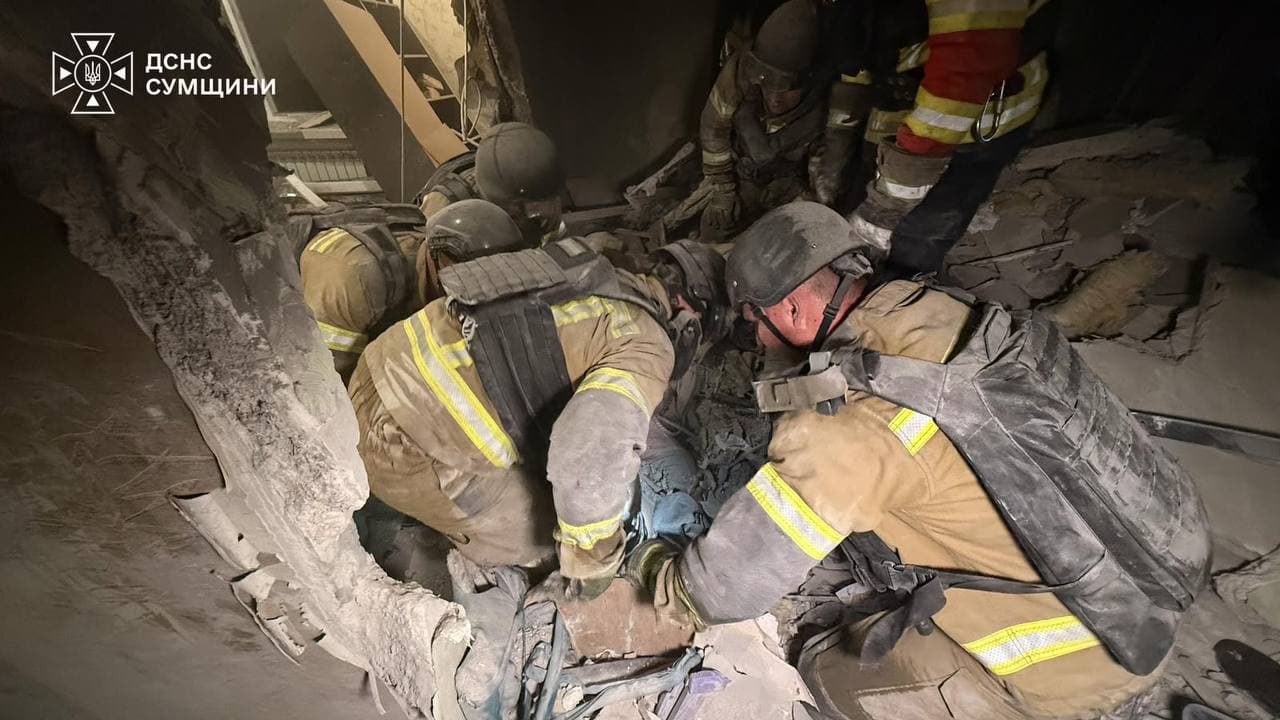
Emergency workers work at the sity of Russian attack in Sumy. (State Emergency Service / Telegram)
THE DAY’S RECKONING
Russia opened its three-day parliamentary election today with the kind of theater it’s spent months preparing: a predetermined result, an antiwar party barred from the ballot, and a Central Election Commission publishing instructions for what to do if a Ukrainian drone happens to fly overhead mid-vote. Ukraine answered with exactly the kind of message that theater couldn’t absorb quietly — a drone killed the woman running a polling site in occupied Zaporizhzhia, and strikes cut power to 150,000 people in occupied Kherson, forcing election workers there back to pen and paper.
Everywhere else, the war kept reshaping itself into new formats. Zelensky launched an entirely new regional bloc with six European neighbors, betting on infrastructure and cooperation rather than just weapons and sanctions. Putin nationalized more Western companies that never fully left Russia. A Slovak prime minister said, in public, that his country might simply sit out NATO’s core promise if it were ever actually invoked. Lithuania quietly drew evacuation routes out of its own capital. Nothing today ended cleanly. Everything today measured how many different shapes this war keeps finding to test.
UKRAINE KILLS AN ELECTION COLLABORATOR AS VOTING BEGINS
A Ukrainian drone killed Elena Astanina, chief of a Russian-installed election council in occupied Tokmak, Zaporizhzhia Oblast, on Wednesday, the eve of Russia’s State Duma vote, while she helped prepare a polling site. Astanina had served as a council member for Russian occupation authorities since 2022. Independent Russian outlet SOTA and later Kremlin-controlled TASS confirmed her death; Zaporizhzhia occupation chief Sergei Obertas praised her as a “Russian patriot” and pledged state assistance to her family. Russian Foreign Ministry spokeswoman Maria Zakharova accused Ukraine of deliberately targeting the vote itself, framing the strike as terrorism against a civilian rather than an attack on someone actively running an illegitimate occupation government’s election apparatus.
The strike landed alongside a separate disruption in occupied Kherson Oblast, where Ukrainian strikes on electrical transformers cut power to roughly 150,000 customers, forcing occupation-run polling stations to track ballots by hand rather than electronically. Russia-run local utility Khersonenergo blamed the outage on an unspecified “technical problem” rather than acknowledging the strikes. Russia’s Defense Ministry claimed its forces shot down 629 Ukrainian drones nationwide overnight — a figure that, if accurate, would rank among the four or five largest single-night drone totals of the entire war, underscoring how directly Ukraine’s long-range campaign is now intersecting with the Kremlin’s carefully staged election calendar.
ZELENSKY LAUNCHES THE CARPATHIAN EIGHT
President Zelensky announced a new regional cooperation initiative today called the Carpathian Eight, bringing together Ukraine, Poland, Romania, Serbia, Slovakia, Czechia, and Austria, with Hungarian representatives expected to join the summit later. Zelensky said the format would create “another strong element of interaction at the EU level,” focused on security, energy, expanded logistics, cross-border economic cooperation, and support for local communities. He personally welcomed the presidents of Romania and Serbia and the prime minister of Poland to the inaugural summit.

The Czech Senate’s First Deputy Chairman Jiri Drahos, Polish Prime Minister Donald Tusk, Romanian President Nicusor Dan, First Lady Olena Zelenska, President Volodymyr Zelensky, Serbian President Aleksandar Vucic, and President of the Austrian Federal Council Christine Schwarz-Fuchs (left to right) during the Carpathian 8 Summit in Huta, Ivano-Frankivsk Oblast, Ukraine. (Presidential Office/Telegram)
Serbian President Aleksandar Vucic, attending at Zelensky’s direct invitation, said Serbia could cooperate with Romania, Hungary, Ukraine, and Poland specifically on transport and infrastructure: “We have much to offer — from railway lines and roads to more open borders.” The summit’s investment program presented 90 projects totaling $10.7 billion, the largest share consisting of 33 energy projects worth roughly $7.28 billion, alongside transport, industrial, agricultural, healthcare, and tourism initiatives. Polish Prime Minister Donald Tusk’s participation came just a day after he warned publicly that Russia could use drones or missiles in attacks specifically designed to test NATO’s unity — a concern the new format is partly designed to address through deeper regional integration rather than relying solely on the alliance’s own collective-defense mechanisms.
PUTIN NATIONALIZES 16 MORE FOREIGN COMPANIES
Vladimir Putin signed a decree placing 16 more Russian companies under indefinite “temporary management,” including Russian subsidiaries of French retailers Auchan and Lemana PRO — formerly Leroy Merlin — and of Swiss food giant Nestlé. The decree, based on an April 2023 order authorizing Russia to seize property from entities tied to countries Moscow designates “unfriendly,” effectively nationalizes the companies’ assets with no expiration date specified. Rather than assigning the seized firms to Rosimushchestvo, Russia’s standard state property agency, Putin named a little-known entity called L.E.V. Management as administrator — identified by independent outlet Novaya Gazeta Europe as run by retired Major General Andrei Krayushkin, a former deputy head of the Interior Ministry’s migration department.
The seizure fits a broader pattern researchers have tracked for months: Putin appears to be laying deliberate groundwork for wider nationalization of both foreign and eventually domestic private assets as Russia’s war costs continue climbing and traditional revenue sources keep shrinking under sanctions and Ukraine’s refinery campaign. Nestlé and Auchan had both remained in the Russian market after 2022 while scaling back operations, a strategy that’s proven no more protective against expropriation than a full exit would have been — a lesson other Western companies still operating in Russia are increasingly being forced to absorb.
RUSSIA HIT AGAIN IN ROSTOV FOR A THIRD STRAIGHT NIGHT
Ukrainian forces launched a large-scale drone attack against Rostov Oblast overnight, with more than 50 drones reportedly intercepted across Rostov-on-Don, Taganrog, Bataysk, and five other districts, according to regional Governor Yuri Slyusar. No injuries were reported, but falling drone debris damaged homes, vehicles, gas infrastructure, and power lines; five private homes and four vehicles were damaged in the city of Azov alone, with gas pipeline damage disrupting supplies to some residents. A Ukrainian monitoring channel claimed an airbase near Rostov may have been the actual target, with footage circulating showing air-defense fire and explosions over the city, though the reports couldn’t be independently verified.
The strike follows Ukraine’s Security Service confirming a September 17 attack that damaged three military aircraft and three helicopters at Rostov-Central Airfield, including an An-12 transport plane and two An-26 aircraft, sparking a fire in the aircraft parking area followed by explosions. Ukraine has increasingly targeted Russian military assets in Rostov Oblast since at least June, part of a sustained effort to degrade Russian air-defense and strike capabilities in a region that sits close enough to the front to matter operationally, but has historically been treated by Moscow as reasonably insulated from the war’s direct consequences.
OLESHKY: “WAITING FOR DEATH” AS RUSSIA BLOCKS AID
Conditions in Russian-occupied Oleshky, Kherson Oblast, continue deteriorating as Russian authorities keep blocking humanitarian access and evacuation for a town where thousands remain trapped, gardens are emptying, shops are shuttered, and the roads out are mined. The town’s plight, first detailed by Ukraine’s Parliamentary Human Rights Commissioner earlier this week, hasn’t improved despite an evacuation arrangement Ukrainian forces had specifically paused fighting to enable — an arrangement Russian authorities simply never honored, leaving residents describing their own situation as waiting for death rather than for rescue.
The humanitarian crisis in Oleshky illustrates a pattern that’s repeated across multiple occupied Ukrainian communities throughout the war: Russian authorities agreeing in principle to humanitarian access, then failing in practice to actually deliver it, while international monitors and aid organizations remain unable to independently verify conditions on the ground given how tightly occupation authorities restrict outside access. For the estimated 6,000 residents still believed trapped in the town, including roughly 200 children, the gap between diplomatic promises and physical reality keeps widening with each passing week of the war’s fifth year.
UKRAINE’S COMMAND RESTRUCTURING TAKES FORMAL SHAPE
Ukraine’s military confirmed additional details today of the eastern command reorganization first announced last week. Joint Forces Group Spokesperson Colonel Viktor Trehubov said the Ukrainian 3rd Army Corps and responsibility for the Lyman direction are transferring from the Joint Forces Group to the newly formed Center Grouping of Forces, which now covers the area running from Lyman through the Kramatorsk-Kostyantynivka Fortress Belt. The Joint Forces Group will retain responsibility over the Kupyansk and South-Slobozhansk directions specifically. The separately formed Azov Grouping of Forces will oversee the Dobropillya tactical area to the south.
Ukraine’s Operational Command East confirmed that Major General Viktor Nikoliuk, who’d commanded the now-disbanded Eastern Grouping of Forces, has returned to the Operational Command East structure directly, following his announcement last week that he was stepping down from frontline command. The restructuring places both new groupings under commanders — Brigadier Generals Andrii Biletskyi and Denys Prokopenko — whose reputations were built entirely within this war, part of a broader pattern of Commander-in-Chief Mykhailo Drapatyi replacing senior officers with battlefield-tested leadership as Russia’s pressure on Donetsk Oblast continues intensifying heading into fall.
UKRAINE FORTIFIES ITS ENERGY GRID BEFORE WINTER
Energy Minister Denys Shmyhal said today that Ukraine is planning to restore and build more than 10 gigawatts of power capacity while modernizing and integrating its energy system more closely with Europe’s, specifically in anticipation of an intense Russian winter strike campaign against the grid. Shmyhal said Ukraine is simultaneously building a more decentralized and flexible system, though he didn’t specify a concrete timeline or progress metrics for the broader modernization effort.
The push follows Polish Prime Minister Donald Tusk’s warning that Russia plans to destroy road and rail border crossings in Ukraine, and potentially on the Polish or Moldovan sides of the border, specifically to prevent partner countries from delivering relief supplies to support Ukraine’s energy infrastructure once winter strikes intensify. Russia attempted a similar strategy last winter, trying to split Ukraine’s grid along a west-east axis to create isolated “energy islands” cut off from both domestic generation and international electricity deliveries. Deeper integration with Europe’s grid and continued decentralization are both intended to build the kind of redundancy that would make a repeat of that strategy considerably harder to execute this time around.
THE EU CONFIRMS €100 BILLION FOR UKRAINE THROUGH 2034
EU ambassadors confirmed during a Committee of Permanent Representatives meeting this week that the bloc’s 2028-2034 budget framework will allocate €100 billion specifically for Ukraine, part of a broader financial commitment EU leaders are set to discuss further with Zelensky at an October 15-16 Brussels summit covering budgets, enlargement, competitiveness, migration, and defense. It remains unclear whether Zelensky will attend those October discussions in person or remotely.
The long-term commitment lands the same week the EU disbursed a separate €3.3 billion to Ukraine for missile and drone procurement, funded through remaining capacity in the bloc’s roughly €150 billion SAFE defense initiative, following a phone call between Commission President Ursula von der Leyen and Zelensky. Von der Leyen and Zelensky separately agreed to meet again in New York on the sidelines of next week’s UN General Assembly session, continuing a pattern of overlapping bilateral and multilateral engagement that’s kept Ukraine’s financing needs visible on Europe’s agenda even as attention periodically shifts toward other crises.
MELONI AND FICO DIVERGE ON HOW TO ANSWER RUSSIA
Italian Prime Minister Giorgia Meloni said today that Putin is deliberately seeking to escalate tensions with Europe specifically to mask Russia’s own battlefield failures in Ukraine, urging European governments to appoint a single unified envoy to coordinate the continent’s response rather than continuing with the current patchwork of national initiatives. Her comments reflect a broader European anxiety that’s built steadily since a string of drone incursions, sabotage attempts, and the September 13 strike on a train carrying Western officials near the Polish border.
Slovak Prime Minister Robert Fico offered a starkly different response the same day, saying he’d actively try to keep Slovakia out of any military conflict arising under NATO’s Article 5 collective-defense clause, publicly questioning why Slovak soldiers should be sent to fight in a scenario triggered by Russian aggression elsewhere in the alliance. The contrast between Meloni’s call for unified European resolve and Fico’s open skepticism about honoring NATO’s core mutual-defense commitment illustrates a genuine and widening split among European governments over how seriously to treat Russia’s escalating hybrid pressure campaign — a split Russia’s own strategy of “accidental” strikes and incursions appears specifically designed to exploit.
LITHUANIA PLANS EVACUATION ROUTES, POLAND PREPS A CORRIDOR
Vilnius municipal officials confirmed this week that the city’s civilian evacuation plan includes a designated route toward Poland in the event of a military threat or broader crisis, alongside separate routes leading north and west through Lithuania itself. “One of the evacuation directions from the capital should be Poland,” said Zygimantas Solovjovas, head of the municipality’s Civil Protection Department, adding that authorities intend to coordinate departures rather than allow uncontrolled movement, and that residents would need to leave before any danger became immediate rather than attempting to flee mid-attack.
Poland’s Podlaskie region, in the country’s northeast, is separately preparing a possible transit corridor specifically for people evacuating from Lithuania and other Baltic states, involving coordination across multiple local authorities to ensure Poland could receive evacuees and manage their onward travel during an actual military crisis. Officials stressed the preparations reflect contingency planning rather than any current evacuation order, but the timing — following closely on Lithuania’s own confirmed drone incursion and a string of similar incidents across the Baltic states this year — underscores how seriously regional governments are now treating scenarios that would have seemed largely theoretical just two or three years ago.
MEANWHILE, AT THE FRONT
Neither Russian nor Ukrainian forces made confirmed advances anywhere along the front today. Russian forces continued unsuccessful offensive operations in northern Sumy Oblast, where a Russian milblogger noted footage of strikes against Ukrainian personnel near Zapsillya suggests Ukrainian forces are actively counterattacking, while another blogger complained that Ukrainian positions on elevated terrain near Psyarivka and Ivolzhanske are forcing Russian assault groups to cross roughly 15 kilometers of open terrain under fire. In Kharkiv Oblast, Ukrainian forces counterattacked north of Kharkiv City, and Ukrainian officials confirmed Russian forces control most of Vovchansk but that Ukrainian troops still hold the town’s southeastern section, with Russian attempts to expand operations in the area remaining limited.
Russian milbloggers continued making unsubstantiated claims of an encirclement forming near Vovchansk in northeastern Kharkiv Oblast, a claim researchers say still has no supporting evidence nearly two weeks after it first surfaced. Near Kupyansk, Russian forces conducted a fresh infiltration attempt into central Tyshenkivka, with geolocated footage showing Ukrainian forces striking the resulting Russian position directly. Russian forces separately claimed a Kh-39 tactical missile strike against a Ukrainian ground-drone control station near Lyptsi, part of Russia’s continued effort to degrade the drone infrastructure that’s increasingly defined Ukraine’s defensive advantage across the northern axis.
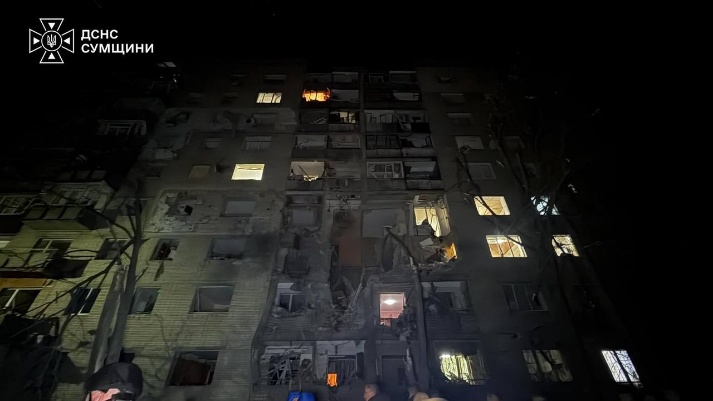
Russian guided aerial bombs struck an apartment building in Sumy late. (State Emergency Service / Telegram)
THE KREMLIN DENIES MOBILIZATION AS OFFICIALS QUIETLY MOVE MONEY ABROAD
Kremlin spokesperson Dmitry Peskov repeated today that Russian authorities have no plans for a covert mobilization following this week’s elections, part of a now-familiar denial pattern likely aimed at discouraging Russian citizens from fleeing the country preemptively. Bloomberg reported the same day, however, that Russian government and military recruitment officials themselves have been quietly attempting to open foreign bank accounts, move personal assets abroad, and encourage their own relatives to leave Russia — behavior that suggests even officials closest to the recruitment apparatus don’t fully trust their government’s public denials.
Analysts assess Russia will likely have to adopt some form of involuntary reserve call-up over the medium term regardless of what Putin ultimately decides, given that Russian casualties continue exceeding recruitment by thousands each month even as the war effort keeps falling short of its own operational and strategic objectives. Putin has shown no inclination to accept a ceasefire or scale back his military’s assigned goals, meaning today’s denials most likely reflect concern about domestic political backlash rather than any genuine decision against mobilization — the same calculation that shaped Russia’s messaging in the weeks before its only prior mobilization in September 2022.
A GUIDED BOMB KILLS TWO CITY EMPLOYEES IN SUMY
A Russian guided aerial bomb struck a nine-story residential building in Sumy late Friday, killing two Sumy City Council employees and injuring eight civilians, including two children, Mayor Artem Kobzar said. The bomb hit between the third and fourth floors, triggering fires and trapping residents beneath the rubble; rescuers pulled four people out alive, including a seven-year-old boy. The two killed were identified as a 52-year-old man and a 45-year-old woman, both members of the city council’s executive committee. At least three of the eight injured were reported in serious condition, and the strike damaged at least four additional apartment buildings in the city’s Kovpakivskyi district.
Separately, Russian forces struck the Zaporizhstal steel plant with two ballistic missiles at dawn on September 17 — the fourth strike on the facility in just over a month, according to owner Metinvest. The attack damaged production equipment, workshop buildings, utility networks, and internal rail infrastructure; one worker who hadn’t reached shelter in time was pulled from rubble with shrapnel injuries and a concussion. Metinvest said Russia has now fired 17 ballistic missiles at Zaporizhstal since August, with the repeated strikes reflecting a deliberate effort to prevent repairs and destroy Ukrainian industrial capacity even though the plant has sat idle since an August 11 attack killed eight workers. The plant reported a net loss of $23.7 million in the first half of 2026, compared with a $30.7 million profit the year before.
Kyiv Post separately reported that Russia has increasingly converted older RM-48U training missiles into live weapons, which now account for more than half of Russia’s recent ballistic and hypersonic launches — a shift that lets Moscow sustain its strike tempo while preserving more accurate munitions. The less-precise missiles still force Ukraine into a costly calculation: intercepting them consumes scarce interceptors needed against more advanced threats, while letting them through risks civilian casualties regardless of accuracy.
RUSSIA’S ELITE DRONE UNIT RETREATS FROM OPERATION VIVALDI
Ukraine’s 3rd Army Corps said today that Russia has pulled units of Rubicon, its elite unmanned systems formation, off the front line in northern Donetsk Oblast after suffering heavy losses during Ukraine’s ongoing Operation Vivaldi counteroffensive. “3rd Corps fighters disabled Rubicon’s command system: they destroyed its logistics, ammunition depots, drone launch sites, newly formed units, and experienced UAV operators,” the unit told Ukrainska Pravda, adding that “the Russians lost the ability to quickly replenish the unit with resources and trained personnel.”
Rubicon serves as the core of Russia’s recently formed Unmanned Systems branch, specializing in cutting off Ukrainian logistics, hunting Ukrainian drone teams on the ground, and intercepting high-value reconnaissance and strike drones — the kind of unit that, when deployed effectively, can make a sector’s “kill zone” significantly deeper and deadlier for the opposing side. 3rd Corps spokesperson Oleksandr Borodin said the unit was “systematically attrited” during both the lead-up to Vivaldi and its early stages: “Most specialized drone units in the area suffered significant losses among qualified personnel and material and technical resources. One of these units was the ‘notorious Rubicon,’ and it was this unit that was withdrawn from our zone of responsibility in the most difficult hours for the enemy, probably due to the trends of a rapid decline in its combat potential.” The withdrawal adds another concrete data point to Operation Vivaldi’s operational success, beyond the territorial gains Ukraine has already confirmed.
AN ELECTION COLLABORATOR KILLED, A NEW COALITION FORMED, A COUNTRY STILL WAITING
By nightfall, today’s furthest edges pulled toward the same uneasy pattern this war keeps repeating: violence and diplomacy advancing on entirely separate tracks, rarely touching each other directly. A drone found an occupation official on the eve of a vote designed to look inevitable. A new eight-country coalition launched with real money attached. Sixteen more companies became Russian state property by decree.
Thousands in Oleshky are still waiting for an evacuation that keeps not arriving. Lithuania has already mapped the road its own capital might one day need to empty through. And in Moscow, officials denying mobilization in public are reportedly moving their own money out of the country in private. Nothing today ended. Everything today measured how many different, overlapping realities this war has learned to sustain at once.
A PRAYER FOR UKRAINE
1. For the Thousands Still Trapped in Oleshky
Lord, we lift up every person still waiting in a town its own residents describe as waiting for death. We grieve promises of evacuation that keep going unmet. Move whatever obstacles stand between these families and genuine safety, and give the world enough attention to keep demanding what’s already been promised but never delivered.
2. For Wisdom Among Allies Weighing How Far to Commit
Father, we pray for the nations navigating real disagreement over how seriously to answer this war’s spillover into their own territory. Give leaders like Meloni the resolve to press for unity, and soften hearts like Fico’s toward the shared commitments that protect everyone, including those most reluctant to be tested.
3. For Every Family Mapping an Escape They Hope Never to Use
Lord of refuge, we pray for the families in Lithuania and Poland now living with evacuation routes drawn on real maps, hoping never to need them. Give their governments wisdom in preparation and restraint in alarm, and give ordinary people peace even while living beside contingency plans built for a danger they didn’t choose.
4. For Truth to Reach Even a Vote Built on Silence
God of justice, we pray for the Russians voting this week in an election with no real choice, and for clarity to eventually reach a country whose own government fears what an honest census would reveal. Let truth find whatever cracks remain, and let those quietly protecting themselves against their government’s likely next move find whatever safety they’re seeking.
5. For a Region Choosing Cooperation Over Isolation
God of unity, we give thanks for the leaders who gathered today to build something constructive together, even amid so much reason for fear. Bless the partnerships forming across borders that have known real conflict, and let cooperation, however imperfect, keep proving a stronger answer to aggression than isolation ever could.
In Your mercy, in Your justice, in Your time — bring this war to its end, and let the ending be worthy of what Ukraine has endured.