
The Ukraine Daily Briefing · Wednesday, November 18, 2026 · Day 1,729 of the Full-Scale War
Prepared by Diana Bozhyk
The Day’s Reckoning
Polish officials revealed on Wednesday that Russian intelligence had prepared an attack from Polish soil into Kaliningrad, disguised as Ukrainian, to turn Europe against Kyiv, and that a quiet security operation on the border may have stopped it. In Shenzhen, Vladimir Putin opened the Asia-Pacific summit by casting the war as one item in a great-power bargain with Washington and Beijing, while Ukraine pressed for a seat in any talk of Europe’s future and Brussels proposed a further €45 billion for Kyiv. Russia hit Odesa’s center three times in one morning and struck the rescuers who came, killed four in Donetsk Oblast and set a market ablaze in Zlatopil, as the United Nations reported that civilian casualties in October nearly doubled from a year earlier. Ukraine struck two refineries in Krasnodar Krai, a bridge in occupied Luhansk and a repair base in Kursk, and Reuters reported that Russia’s refining has fallen by 45 percent. Along the front, neither side gained ground, though Russian troops used fog and rain for heavier assaults toward Slovyansk.
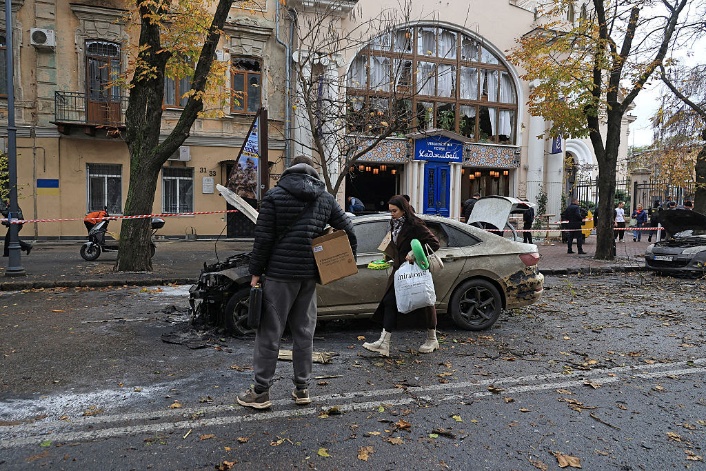
A man and a woman pick up salvageable goods from the booth of a car damaged by a drone attack in central Odesa. (Nina Liashonok/Ukrinform/NurPhoto via Getty Images)
“Something Like the Gleiwitz Incident”
The plan, as Polish officials described it to the newspaper Rzeczpospolita, was to cross the border from Poland into Russia’s Kaliningrad exclave, stage an attack on a facility there and make it look like the work of Ukrainians. Russian planners expected heavy casualties. “It was supposed to resemble something like the Gleiwitz incident,” one source said, recalling the 1939 raid on a German radio station that Nazi Germany staged as a pretext to invade Poland. “The goal was to halt aid to Ukraine.”
According to the report, the operation was planned for late October or early November. Polish analysts grew alarmed after noticing an influx of Russian intelligence officers into Kaliningrad, and allied services warned Warsaw, Vilnius, Riga and Tallinn. On November 2, Poland launched a special security operation in the Warmian-Masurian and Podlaskie regions, sending about 180 riot police officers, a counter-terrorism unit and extra Internal Security Agency personnel to the border, while the special forces units GROM, NIL and AGAT held exercises nearby. Shortly after midnight on November 3, border guards saw “disturbing movement” on the Kaliningrad side, including people with flashlights.
Tomasz Siemoniak, Poland’s coordinator of special services, would not confirm the plot itself. “If we took certain steps, it is because we determined that there was a real threat,” he said. The Institute for the Study of War (ISW), a Washington think tank, assessed that Prime Minister Donald Tusk’s increasingly specific warnings since September, including a “fairly precise report” from the CIA, likely referred to this plan, and that public disclosure and the border deployment probably deterred or disrupted it. Such an attack, ISW wrote, would have let Moscow accuse NATO of backing Ukrainian strikes on Russia and deepen existing friction between Warsaw and Kyiv.
In Kyiv, police detained a 19-year-old woman suspected of poisoning a 32-year-old Colombian veteran of Ukraine’s army on the orders of a Russian intelligence handler, who allegedly paid her $1,000 and spent more than a month courting the victim through her Telegram account. In California, the US Justice Department charged Russian national Igor D’iu with spying on employees of a Palo Alto defense company that supplies Ukraine, including following one woman for 30 miles.
Shenzhen, Day One
Xi Jinping went to the tarmac himself to greet Donald Trump. Vladimir Putin, arriving in Shenzhen for the Asia-Pacific Economic Cooperation summit, was met by Politburo Standing Committee member Cai Qi, a contrast ISW read as a sign of Russia’s lower standing in Beijing. Putin used the summit’s first day to present Russia as a leading architect of a “multipolar” world and to treat the war as one piece of wider relations among Moscow, Beijing and Washington. Kremlin aide Yuri Ushakov said Putin and Xi discussed the Abu Dhabi talks and efforts to end the war, and Kremlin spokesman Dmitry Peskov said Putin and Trump could discuss Ukraine one-on-one. The two shook hands during the leaders’ group photograph.
President Volodymyr Zelensky used his evening address to restate Kyiv’s line before the Coalition of the Willing met in Berlin. “Issues concerning Ukraine must be resolved with Ukraine’s participation, and issues concerning Europe must be resolved with Europe’s participation,” he said. “That is the only approach that will be taken.” He said US representatives had promised to brief him on Shenzhen, and that Berlin should bring more air defense and energy support.
The European Commission adopted proposals for a new loan of up to €45 billion for 2027: up to €25 billion for military aid and €20 billion in budget support tied to rule-of-law and anti-corruption reforms, to be repaid only once Ukraine receives Russian reparations. It would cover two-thirds of Ukraine’s estimated €70 billion gap next year, Commission President Ursula von der Leyen said; member states must still approve it. The Commission also formally created a dedicated sanctions office, to be led from February by Swedish diplomat Lars Danielsson, succeeding David O’Sullivan.
Ombudsman Dmytro Lubinets said Kyiv and Moscow, through US mediation, are negotiating a second humanitarian mission like the one in Oleshky, where conditions are close to “a humanitarian catastrophe.” Talks with Russia, he said, are “difficult” and “quite cynical,” but “we are ready to move forward.” A second mission would focus first on Kherson Oblast, with Zaporizhzhia Oblast still under discussion. He said Putin’s proposal for Kostyantynivka was never discussed with him and is not feasible under current battlefield conditions.
Odesa, Three Times Before Noon
Rescuers and police had already reached a damaged street in central Odesa on Wednesday morning when a second Shahed drone struck the same spot. It was the third Russian strike on the city center that morning, Governor Oleh Kiper said. Four people were killed and nine injured; a three-story administrative building was destroyed, rescuers found three people trapped in their apartments, and a psychologist from the emergency service sat with a frightened child. “A harsh and deliberate blow simply to people, to life,” Zelensky said. “And another proof of what the Russians really want and how they really feel about diplomatic efforts.”
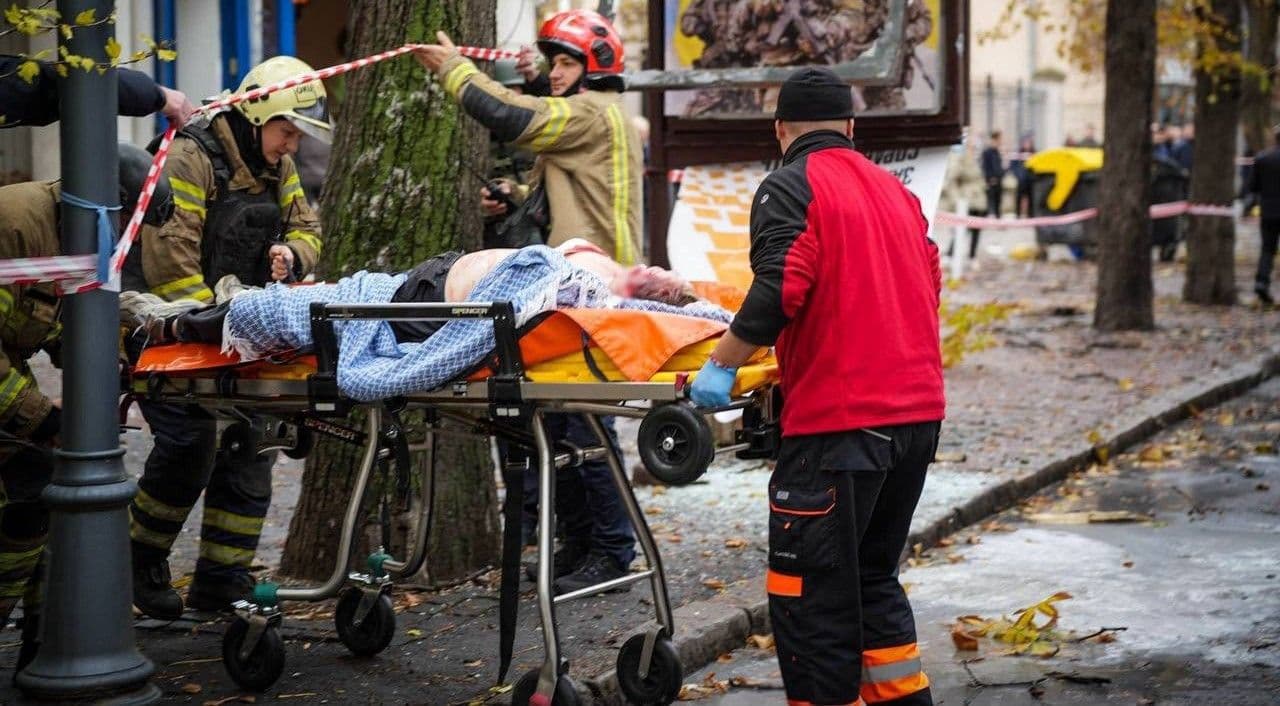
An injured person is being carried away by Emergency Service workers after a Russian strike on the city center of Odesa, Ukraine. (Emergency Service of Ukraine/Telegram)
In Zlatopil, south of Kharkiv, a drone hit the town market, spreading fire across 500 square meters of stalls and injuring at least 11 people, including an 11-year-old; it was the second strike on the town in a week. In Kyiv, drone debris hit the 11th floor of a 28-story apartment building in Pechersk and set trucks ablaze at a business, injuring three people, and four people, including a child, were hurt in Novi Petrivtsi outside the city. Drones injured six people in Dnipro, including a 15-year-old boy. In Donetsk Oblast, two people were killed in Sloviansk and two in Shabelkivka and Yasnohirka; one person was killed in Kharkiv Oblast, and Sumy Oblast endured nearly 50 attacks. Russia hit energy facilities in the Bila Tserkva and Boryspil districts, an agricultural warehouse in Mykolaiv Oblast and a power site that cut electricity to 80 settlements in Rivne Oblast. The Air Force said Russia launched 141 drones, 73 of them jet-powered, and downed 126.
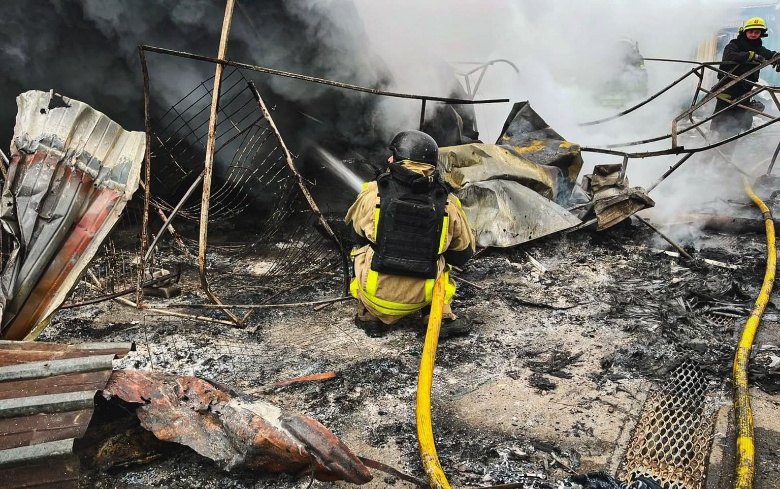
An emergency worker at the site of a Russian attack on a market in Zlatopil, Kharkiv Oblast, Ukraine. (Emergency Service of Ukraine/Telegram)
The UN Human Rights Office reported that at least 372 civilians were killed and 1,981 injured in October, a 95 percent rise on October 2025. Long-range drones and missiles caused 55 percent of the casualties, and glide bombs 18 percent. Lawmaker Fedir Venislavskyi, citing intelligence, said Russia is testing the Geran-6, a drone-missile that reaches 1,000 kilometers per hour with a “fairly large” warhead. Three sources told the Kyiv Independent that the November 3 strike on the grid caused the worst water outage in Kyiv of the full-scale war, leaving most districts without water for more than 24 hours. Overnight, Romania’s strongest earthquake since 2018, of magnitude 5.7, was felt in Kyiv, Odesa and six other Ukrainian oblasts.
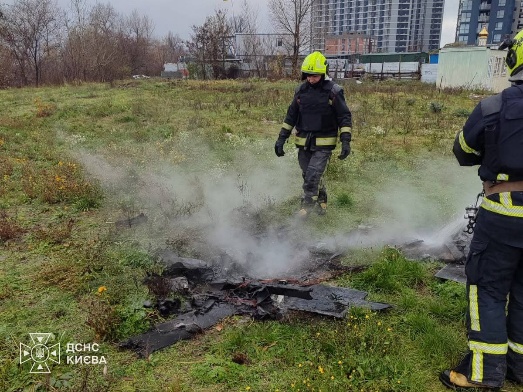
State Emergency Service workers extinguish debris from a Russian drone that fell in the Darnytskyi District of Kyiv, Ukraine. (State Emergency Service of Ukraine/Telegram)
The Line
“The alternative route runs overland, along the front line — where our drones are waiting to greet the cargo. Final stop. Please vacate Crimea,” Ukraine’s Defense Ministry wrote of the Crimean Bridge, the “war conveyor belt” it said had broken down. Russian military bloggers agreed that supplies will now shift to the R-280, the road through occupied southern Ukraine from Rostov-on-Don to Crimea, and one counted at least four bridges or road sections Ukraine has hit along the Azov coast. Emil Kastehelmi of Finland’s Black Bird Group said most heavy traffic had already moved to the land route; the bridge’s value was as an emergency route, “but of course, that option is now gone.”
On the ground, ISW recorded no advances by either side. A soldier from a brigade near Slovyansk said Russian forces are using poor weather to mount relatively larger assaults, sometimes with armor and motorized vehicles, aiming to reach Mykolaivka, east of the city, and begin infiltrating Slovyansk to force urban combat, where ruined buildings and basements suit their tactics. A Ukrainian source said troops still hold infantry and drone positions inside Kostyantynivka, while Ukrainian strikes in the city and in Mykolaipillia pointed to new Russian infiltrations. A Russian blogger’s claim to have taken Rohanske, northeast of Dobropillia, placed Russian troops some 13 kilometers beyond their nearest confirmed advance.
A Ukrainian source said gains near Dachne, southeast of Novopavlivka, could disrupt Russian logistics there. Near Kupyansk, a Russian source said Ukrainian troops are counterattacking near Kurylivka and that intensified drone strikes make it harder for Russian forces to hold ground around Kupyansk-Vuzlovyi, where Russia is fielding more fiber-optic Molniya-2 drones. Ukrainian forces advanced in northwestern Vilcha, a Russian source acknowledged, and counterattacked near Borova, northwest of Hulyaipole and southeast of Orikhiv. A Russian source claimed Ukraine had taken Novyi Put, a Kursk Oblast village less than a kilometer from the border; ISW could not confirm it. Drone operators of Russia’s 41st Unmanned Systems Brigade appeared in the Hulyaipole direction for the first time. A Russian blogger claimed an advance northeast of Kamianske, southwest of Orikhiv, which ISW did not confirm; Russian attacks southwest of Oleksandrivka made no progress, and the Kherson direction was quiet.
Manpower remains Moscow’s strain. Russia’s Defense Ministry claimed it has met 89.3 percent of its recruiting plan for 2026 and 98.7 percent for its drone forces, figures ISW called likely inflated: economist Janis Kluge counted about 263,000 contracts in the first nine months, nearly 10 percent fewer than in 2025, even as signing bonuses climbed to about 2.34 million rubles. Ukraine’s General Staff puts Russian casualties this year at more than 420,000, averaging 2,269 a day in November.
Refineries and a Bridge in Luhansk
Ukraine’s General Staff said its forces hit oil tanks at the Ilsky refinery and a refining unit at the Afipsky refinery in Krasnodar Krai, whose fuel routes to the front are the shortest of any Russian plant. “Every fire at (these refineries) means less diesel and gasoline for the Russian army and fewer oil rubles,” it said. Reuters, citing two industry sources, reported that strikes over the past 20 days have disrupted 15 of Russia’s 35 major refineries and cut crude processing from 700,000 to about 400,000 tons a day, down 45 percent.
The General Staff also reported a strike on a road bridge over the Siverskyi Donets at Stanytsia Luhanska, about 115 kilometers behind the front, used to move ammunition, fuel and equipment, and on a military repair facility near Khomutovka in Kursk Oblast. It said the November 10 strike on the 123rd Aircraft Repair Plant in Staraya Russa damaged three military transport planes, one Il-76 severely.
At the Kerch Strait, a video shot from a passing train showed the bridge’s roadway fully collapsed and its debris in the water, while Russia’s Transport Ministry said trains were running and road traffic stayed closed. Occupation officials announced a free passenger boat service between Port Krym and Port Kavkaz from November 20, warning that storms could halt it several times a week and banning gasoline canisters aboard. Fire Point, the maker of the Flamingo missile, said the operation against the bridge involved more than 16 strikes, and Ukraine’s General Staff congratulated Lisbon’s Vasco da Gama Bridge on becoming “the longest bridge in Europe.”
Also Today
Call-center case. The High Anti-Corruption Court ordered Andrii Osipov, a central suspect in the “Operation Carthage” scam call-center case, held without bail until January 16; investigators say his group, allegedly led by Khimprom founder Yehor Burkin, kept contact with Russia’s FSB and discussed an acid attack on journalist Denys Bihus.
Influencer arrested. Italian police in Rimini arrested Ukrainian influencer Oleksandr Slobozhenko, founder of Traffic Devils, wanted in Ukraine on charges of evading €4.3 million in taxes and money laundering.
The Closing
From a train window on the Crimean Bridge, a passenger filmed the gap where the road had been and the debris in the water below. In central Odesa, emergency crews kept working at the destroyed administrative building despite the threat of further strikes.
A Prayer for Ukraine
1. For Those Who Defend
Lord, keep watch over the soldiers near Slovyansk who face armor moving through fog, and over those who hold their ground inside Kostyantynivka. Bless the drone crews waiting along the roads to the south, and the defenders of Kupyansk, Vilcha and Dachne. Give them strength through the cold, healing for the wounded and a swift return for every prisoner of war.
2. For the Wounded and the Grieving
Merciful God, receive the four killed in Odesa’s center and the dead of Sloviansk, Shabelkivka, Yasnohirka and Kharkiv Oblast. Heal the eleven hurt at Zlatopil’s market, the boy of fifteen in Dnipro and the child wounded near Kyiv. Comfort the rescuers struck while they came to help, and stay with every family that lost someone this day, holding them close in the long nights ahead.
3. For Those Who Lead and Negotiate
Lord of wisdom, give Ukraine’s leaders steady voices as great powers meet without them, and let no decision about Ukraine be made without Ukraine. Strengthen Europe’s resolve, bless those who fund Ukraine’s defense, and expose every plot built on lies. Guard Poland and its neighbors from provocations meant to divide friends, and let truth outlast every deception planned in the dark.
4. For Cities, Grids and Water
God of light, protect the substations of Kyiv, Rivne and Mykolaiv, and the workers who restore power and water to millions. Shield the markets, apartment towers and administrative buildings where ordinary life goes on, and keep warm the homes that face a long winter. Let every family who lost water and light this autumn find them restored, and let warmth return quickly after every strike.
5. For a People Who Keep Standing
Faithful Lord, on the one thousand seven hundred twenty-ninth day, sustain a people who return to their markets and streets after every strike. Strengthen the families of Oleshky and the occupied towns who wait for a road to safety, and keep hope alive in every home. Lead Ukraine toward the day when no one fears a second blow.
In Your mercy, in Your justice, in Your time — bring this war to its end, and let the ending be worthy of what Ukraine has endured.