
Ukraine Daily Briefing | June 23, 2026 | Day 1,581 of the Full-Scale Invasion
Prepared by Dayana Bozhyk
Putin told ambassadors on June 23 that Russia is ready to negotiate — on the basis of a 2022 framework that would have permanently barred Ukraine from NATO, limited its military to 85,000 troops, and banned Western arms deliveries. Ukrainian strikes destroyed the North Crimean Canal railway bridge for the second time in two days, knocked out half of Crimea’s power grid, and forced the Kerch Bridge closed for five and a half hours overnight. A Russian Iskander-M loaded with cluster munitions struck Kryvyi Rih in daylight, killing three civilians including a 54-year-old woman. An investigation published June 23 found that at least 26 Ukrainian recruits died of non-combat causes in a single assault regiment — linked to inadequate medical care and allegations of violence. South Korea said it will accept all North Korean POWs held by Ukraine who wish to defect. Russia’s budget deficit has reached 6 trillion rubles for the year’s first five months.
THE DAY’S RECKONING
Putin’s “offer” to negotiate arrived on June 23 with a full address attached: not a ceasefire on current lines, not a mutual concession, but a return to the 2022 Istanbul Protocols — the framework that would have turned Ukraine into a landlocked demilitarized buffer state, prohibited from NATO, forbidden from receiving Western weapons, with an army one-sixth the size of Russia’s. “Ready for negotiations,” in Kremlin language, means “ready for your surrender.” Lavrov, for his part, called Zelensky a “Fuehrer” in front of a room full of ambassadors.
While the diplomatic theater played out, Ukraine’s drones were doing the talking in Crimea: the railway bridge across the North Crimean Canal, struck for the first time the previous night, was struck again on the night of June 22 to 23 — this time together with the repair crews sent to fix it. The SSO announced: “The railway bridge across the North Crimean Canal in Crimea no longer exists.” Approximately half of Crimea was left without power. The Kerch Bridge was closed for five and a half hours.
In Kryvyi Rih, a Russian Iskander carrying cluster munitions struck in daylight and killed three people at distances up to 200 meters apart — proof of why cluster munitions are banned by 111 countries. In an assault regiment called Skelia, an investigation found 26 recruits dead of non-combat causes after mobilization — most attributed on paper to illness, some with evidence of violence.
PUTIN’S NEGOTIATING OFFER: UKRAINE’S CAPITULATION, WRAPPED IN DIPLOMATIC LANGUAGE
Putin told a government video conference on June 23 that Russia is ready to negotiate with Ukraine — “on the basis of the agreements that were reached back in Istanbul,” plus his June 2024 speech to the Russian foreign ministry, plus what he calls the “Anchorage understandings” from the August 2025 Alaska summit with Trump. Each element of this framework means the same thing. The 2022 Istanbul Protocols, negotiated under starkly different battlefield conditions when Russia was advancing on Kyiv, would have permanently prohibited Ukraine from joining NATO, imposed a military ceiling of 85,000 personnel on Ukraine, and banned Western military assistance — while placing no restrictions on Russia’s own forces. Putin’s June 2024 speech required Ukraine to completely withdraw from Ukrainian-controlled portions of all four oblasts Russia claims to have annexed — before talks could begin. The “Anchorage understandings” have never been publicly documented by either side; the Kremlin invokes them regularly to imply that commitments were made without having to defend them.
Putin claimed Russia is advancing “on all areas of the frontline” and that Russian forces are “practically reaching” Kostyantynivka, dismissing Ukrainian official statements that it remains a contested gray zone. He acknowledged Ukrainian drone strikes on Russian energy infrastructure but framed them as an attempt to “divide society” and “disrupt the tourism season,” ordering the government to take unspecified additional countermeasures. He pointedly did not mention the Moscow Oil Refinery, which was struck three times in the preceding eight days. Putin’s approval rating has fallen to a wartime low, and Russian milbloggers have noted that Moscow’s air defenses are failing even in areas of increased protection. The “negotiation” offer, timed precisely as the Kremlin faces growing domestic pressure from fuel shortages and airspace failures, is ISW’s assessed negotiating tactic: portray Ukrainian lines as collapsing so that Kyiv and its partners capitulate to Russian demands out of fear of further offensives.
Foreign Minister Lavrov amplified the message at a roundtable at the Diplomatic Academy of the Russian Foreign Ministry on June 23, telling ambassadors Russia is “ready to resume negotiations at any time from where they left off.” Lavrov sharply criticized Zelensky for presenting “boorish and unrealistic” conditions, accused the United States of abandoning the role of “objective mediator” by backing G7 sanctions and air defense for Ukraine, and called Zelensky a “Fuehrer” in front of the assembled diplomats — invoking the long-standing Kremlin propaganda frame that equates Ukraine’s government with Nazism to justify the invasion. Lavrov also warned that Russia is prepared to use the “full range of measures” under the Russian-Belarusian Union State collective security treaty in response to Ukrainian requests that Belarus dismantle relay stations, and reiterated the standing Kremlin threat that its warning for all foreign embassies to evacuate Kyiv remains in effect. Kremlin spokesperson Peskov separately claimed Russia’s economy is “macroeconomically stable” — even as Russia’s budget deficit reached 6 trillion rubles ($80 billion) over the first five months of 2026, with Urals crude down to roughly $65 per barrel from a recent peak near $120, and as Deputy Prime Minister Novak acknowledged to Putin in a separate meeting that the fuel situation is “challenging.” Russia has now banned gasoline and jet fuel exports and is considering banning diesel exports as well. Fuel sale restrictions are in place across at least 15 Russian regions, stretching as far east as Kamchatka.
CRIMEA: RAILWAY BRIDGE DESTROYED, HALF THE POWER GRID DARK, KERCH BRIDGE CLOSED FIVE HOURS
The night of June 22 to 23 produced the most concentrated single-night effect on Crimea’s infrastructure since the interdiction campaign began. Ukraine’s Special Operations Forces struck the railway bridge across the North Crimean Canal near Rozdolne on the night of June 21 to 22 for the first time, destroying part of the rail line and collapsing one bridge span. When Russian rail repair equipment arrived at the site, SSO drones struck the equipment and the remaining bridge sections again on the night of June 22 to 23. “The railway bridge across the North Crimean Canal in Crimea no longer exists,” the SSO stated. The bridge had been a key route for Russian heavy cargo and military supply transport on the Kerch-Dzhankoi railway line. Separately, Unmanned Systems Forces Commander Brovdi reported strikes on over 60 Russian military targets in Crimea overnight: three Orion reconnaissance drones, a Nebo-U radar station, a Pantsir-S1 air defense system, an S-300 launcher, a ZU-23 anti-aircraft autocannon near Kurortne, fuel reservoirs at the Kerch Thermal Power Plant, the Simferopol gas distribution station, and the West Crimea 330/110 kV electrical substation near Karierne.
The power substation strike left approximately half of Crimea without electricity, occupation authority spokesperson Oleg Kryuchkov confirmed on June 23, announcing rolling blackouts. Krymenergo reported widespread outages in Yevpatoriia, Saky, Dzhankoi, and Krasnoperekopsk, attributing them to “technical faults.” The Kerch Bridge was closed to vehicle traffic from around 11:30 p.m. on June 22 and remained shut for more than five and a half hours, reopening at 5:10 a.m. on June 23. Fires were reported at the Port Kavkaz oil terminal across the strait, at the Yuzhna railway station in Kerch, and at the TES-Terminal oil products complex in Kerch, which was continuing to burn days after its initial strike. Satellite monitoring by Crimean Wind showed a smoke plume from the Kerch Thermal Power Plant stretching approximately 47 kilometers. Black Sea Fleet families are reportedly trying to leave Crimea for Novorossiysk; traffic jams were reported in both directions on the Kerch Bridge. Russian Security Council Secretary Shoigu acknowledged that Ukraine’s strikes are posing a real challenge and that Russian countermeasures are being coordinated across multiple ministries. Ukraine’s Defense Ministry officially declared Crimea’s beach season “closed,” with a statement reading: “Weather forecast for tourists: unfavorable.”
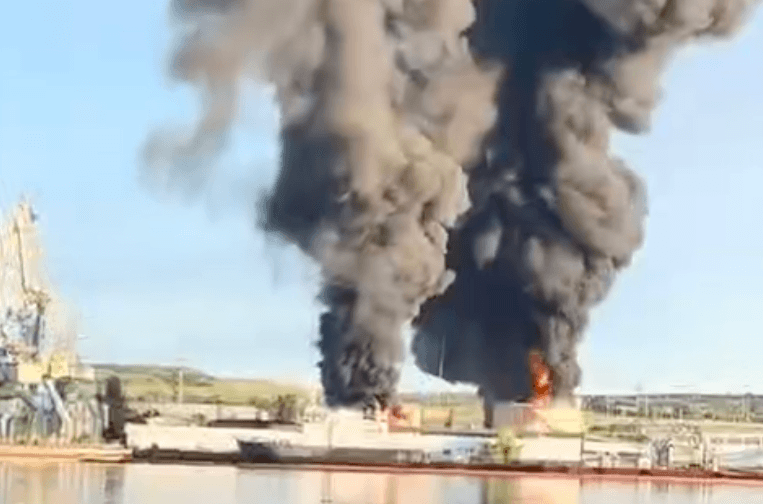
Smoke rises over the Kerch Thermal Power Plant in Russian-occupied Crimea after fuel reservoirs were struck in a large-scale Ukrainian attack overnight. (Exilenova+/Telegram)
ISKANDER WITH CLUSTER MUNITIONS KILLS THREE IN KRYVYI RIH
A Russian Iskander-M ballistic missile equipped with cluster munitions struck a civilian infrastructure facility in Kryvyi Rih, Dnipropetrovsk Oblast, at approximately 11 a.m. local time on June 23, killing three people and injuring 25. The three victims were identified as a 25-year-old man, a 34-year-old man, and a 54-year-old woman; they were killed up to 200 meters apart — reflecting the wide-area dispersal of cluster submunitions that is precisely why 111 countries have banned the weapon under the Convention on Cluster Munitions. Of the 25 injured, 20 remain hospitalized; four are in serious condition and a boy and an elderly woman are critical. Fires broke out at the impact site and were extinguished by 1:30 p.m. City authorities declared June 24 a day of mourning. Since the start of the full-scale war, Russian attacks have killed 118 Kryvyi Rih civilians, including 16 children.
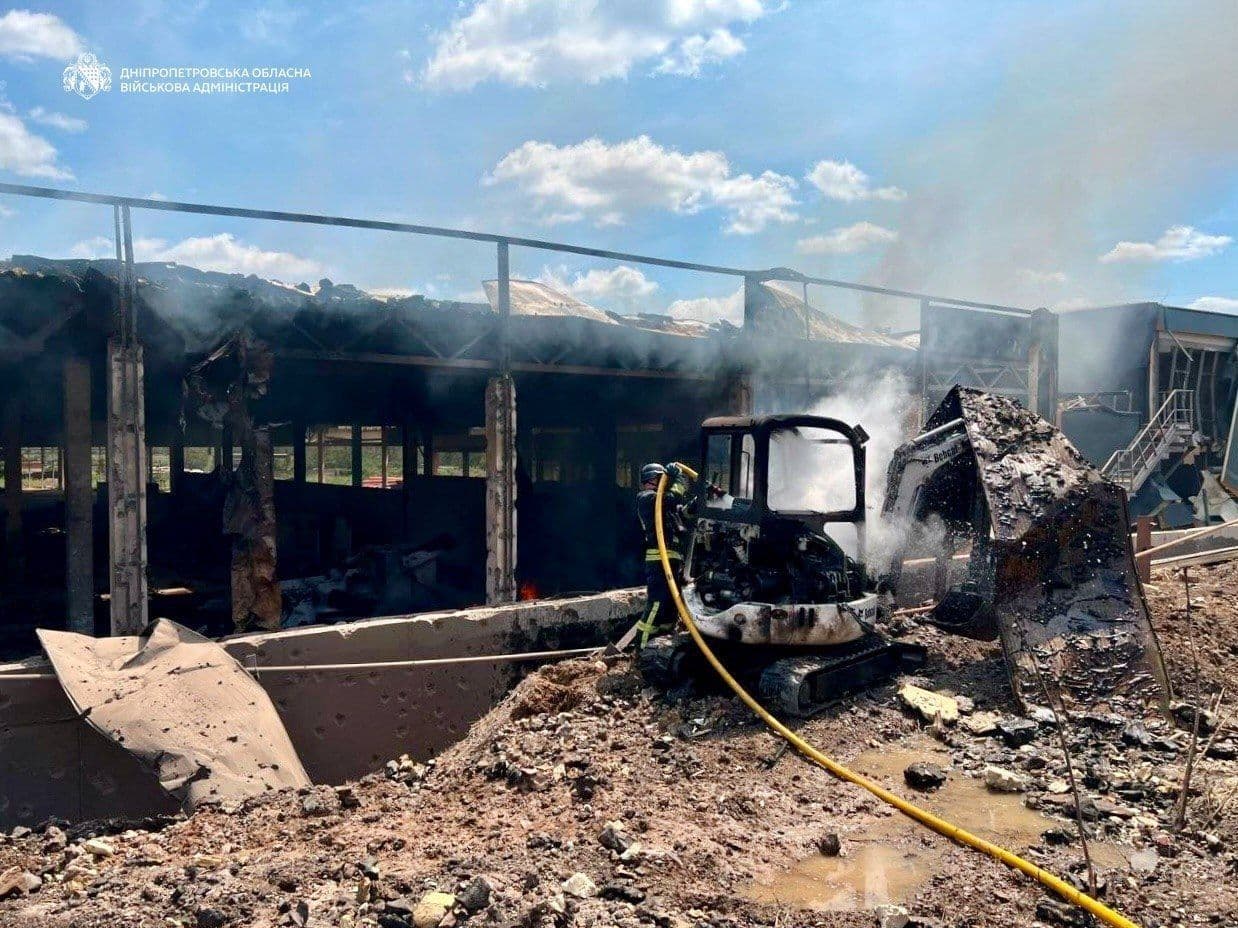
Aftermath of a Russian strike on Kryvyi Rih. (Dnipropetrovsk Oblast Military Administration/Telegram).
Zelensky responded: “Every such day and every Russian strike prove that the pressure on the aggressor over this war is insufficient. It is important that the world not remain silent about the fact that Russia has still taken no real step toward ending this war.” The May 2026 monthly casualty report from the UN Human Rights Monitoring Mission confirmed the worst context for this strike: May was the deadliest month for Ukrainian civilians since April 2022, with at least 274 deaths and 1,763 injuries verified during the month alone.
OVERNIGHT AND DAYTIME STRIKES: 135 DRONES, 5 KILLED, 49 INJURED ACROSS UKRAINE
Russian forces launched 135 Shahed, Gerbera, and Italmas-type drones and Parodiya decoys overnight on June 22 to 23 from Oryol, Kursk, Bryansk, Primorsko-Akhtarsk, and Millerovo. Ukrainian air defenses downed 118; 13 drones struck 11 locations, with debris at three more. Strikes targeted energy infrastructure in Odesa Oblast and a gas station in Zaporizhzhia; DTEK reported a strike on an energy facility in Dnipropetrovsk Oblast causing power outages; the Energy Ministry reported outages in Zaporizhzhia, Sumy, Kharkiv, and Chernihiv oblasts.
Russian attacks across Ukraine killed at least five civilians and injured 49 others over the 24-hour period, separate from the Kryvyi Rih ballistic missile strike counted above. In Donetsk Oblast, three people were killed — one in Sloviansk and two in Druzhkivka — and one injured in Bilenke; the region was struck 18 times. In Kharkiv Oblast, a 40-year-old man was killed and eight others injured as Russian attacks struck Kharkiv and 16 other settlements. In Kherson Oblast, a drone struck a bus stop at around 7 a.m., injuring a 40-year-old man; across the oblast 12 more people were injured and Russian forces damaged a cultural institution, gas stations, a public building, a cellular tower, and civilian vehicles. In Dnipropetrovsk Oblast, one person was killed and 10 injured across 50+ attacks in four districts. In Zaporizhzhia Oblast, at least eight people were injured including a 23-year-old woman wounded in a drone strike on a gas station in Zaporizhzhia City; Russian forces launched approximately 1,050 strikes against 56 settlements across the oblast. In Sumy Oblast, nine people were injured across nearly 50 attacks on 23 settlements. In Belgorod Oblast, geolocated imagery confirmed a possible Ukrainian strike on the Alekseyevsky Building Materials Plant in Alekseyevka, roughly 128 kilometers from the border.
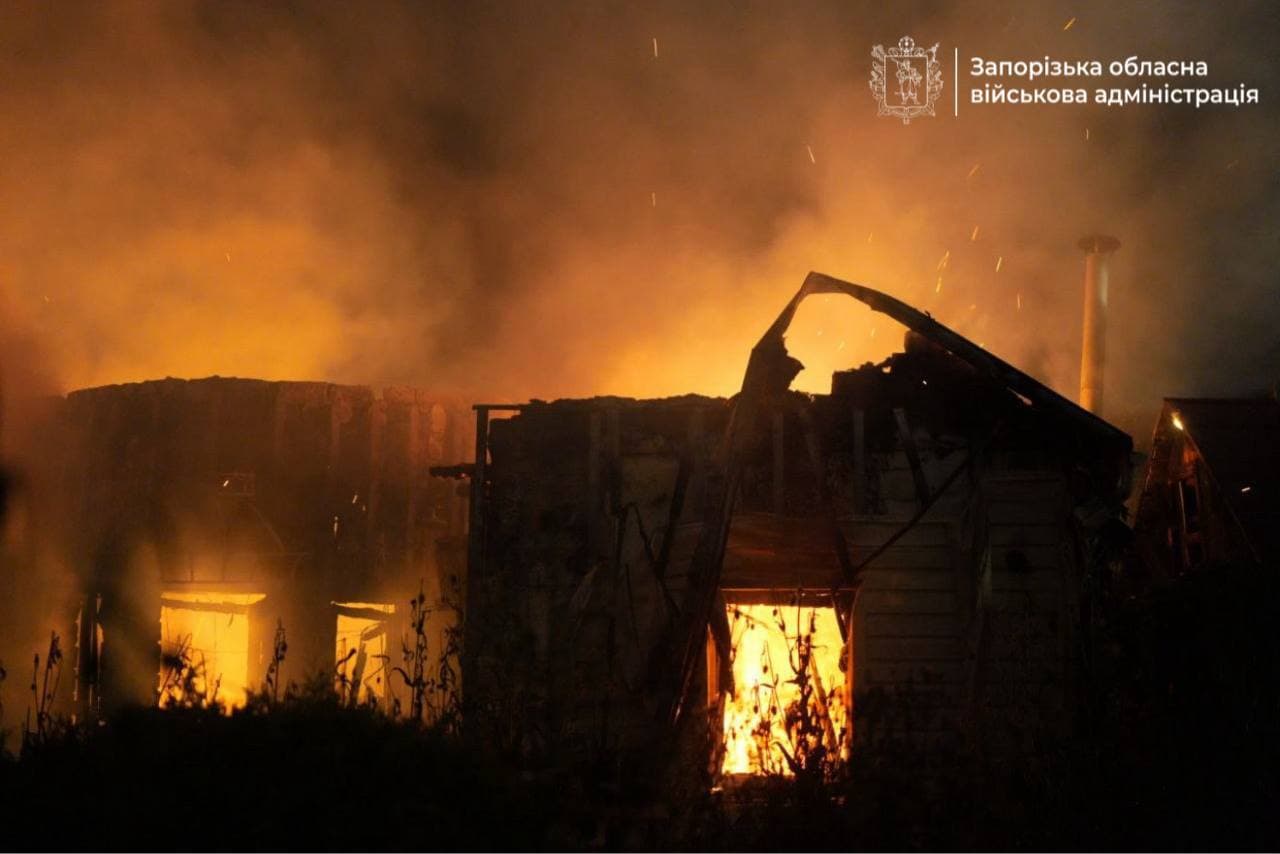
The aftermath of a Russian attack in Zaporizhzhia Oblast, Ukraine. (Zaporizhzhia Oblast Military Administration/Telegram)
Russian forces also conducted a double-tap strike against rescue workers responding to an earlier Russian strike in Nikopol, Dnipropetrovsk Oblast — a deliberate targeting of first responders that constitutes a war crime under international humanitarian law. And on the Black Sea coast, a Russian drone struck the Odesa coastline, killing a 26-year-old woman near Otrada Beach and injuring a 39-year-old man. Emergency crews were still assessing whether additional casualties had occurred along the shore when the report was filed.
KOSTYANTYNIVKA: UKRAINE CLEARS SOUTHERN POSITIONS; 53 RUSSIAN LOSSES PER DAY VS THREE UKRAINIAN
The Ukrainian 19th Army Corps Deputy Commander Yuriy Madyar reported on June 23 that Ukrainian forces cleared areas south of Kostyantynivka, leaving a “minimum” number of Russian servicemembers in the area, and that operations are now beginning to push Russian forces from central and western parts of the city. Madyar stated that Russian forces in the direction are suffering roughly 53 losses per day compared to roughly three Ukrainian losses daily, that Russian forces must walk 20 to 30 kilometers to approach Kostyantynivka due to Ukrainian drone strikes on surrounding areas, and flatly denied Russian claims that Ukrainian forces have been encircled, noting that Ukrainian servicemembers significantly outnumber Russians inside the city. A Russian milblogger acknowledged that Russian forces are struggling to resupply positions in northern Kostyantynivka and are relying on drone drops for logistics. Russian MoD claimed on June 23 that elements of its 25th Combined Arms Army are advancing in southern and southwestern Lyman — ISW assessed the footage as likely AI-altered, consistent with the cognitive warfare campaign it has documented since June 13. Russian forces continued infiltration missions in Kupyansk, with geolocated footage showing flag-raising in northeastern and eastern Kupyansk and north of Kupyansk-Vuzlovyi after assessed infiltration missions, and Ukrainian forces counterattacking northeast and southeast of Velykyi Burluk.
FRONTLINE: LYMAN FUEL SHORTAGES BEGIN; KHARKIV ANTI-DRONE NETS; LOGISTICS CAMPAIGN EFFECTS
Ukrainian Joint Forces Task Force Spokesperson Colonel Viktor Trehubov reported on June 23 that Russian forces in the Lyman direction are beginning to face fuel supply issues due to Ukrainian drone strikes against Russian logistics lines, with Russian forces intensifying attacks to advance before fuel and supply shortages generate more severe effects. The 4th Tank Division prohibited unarmored vehicle movement within 25 kilometers of the frontline. In the Hulyaipole direction, a Ukrainian regiment commander reported that Ukrainian strikes on southern supply routes — including the Chonhar Bridge — have significantly reduced Russian supplies from Crimea, forcing Russian troops to carry ammunition on foot over 50 kilometers, with Russian drone reconnaissance in the direction down by two-thirds. Brovdi confirmed strikes on a drone pilot training ground of the Russian 4th Separate Motorized Rifle Brigade near Debaltseve, a fuel tanker near Horlivka, and logistics vehicles on the H-20 Donetsk-Mariupol highway and in Kherson Oblast. Ukrainian forces also struck a logistics vehicle in occupied Pryazovske in Zaporizhzhia Oblast and a road bridge near Vasylivka used for Russian troop transfers.
In Kharkiv Oblast, Administration Head Synehubov reported that Ukrainian authorities are installing anti-drone nets in and near Kharkiv City to counter fiber optic drones now reaching 30 kilometers in range; Russian forces conducted over 9,000 drone strikes against Kharkiv Oblast between May 1 and June 22, including 130 drone types still unidentified by Ukrainian authorities. Ukrainian forces struck a Russian command and observation post near Ilek-Penkovka in Belgorod Oblast. Leningrad Oblast Governor Drozdenko announced one-time payments of 250,000 rubles ($3,356) to new mobile fire group recruits and 100,000 ruble ($1,342) bonuses for each Ukrainian drone intercepted — a reflection of how much Russia is scrambling to fill the gap in its air defense network created by Ukraine’s sustained strike pressure.
RUSSIA USES STARLINK-ENABLED NAVAL DRONES IN BLACK SEA; STOLEN MARIUPOL GRAIN CONTINUES
Ukrainian Defense Ministry technology advisor Serhii “Flash” Beskrestnov reported on June 23 that Russian forces attempted to strike Ukraine’s southwestern Black Sea coast using unmanned surface vessels equipped with Starlink satellite systems — Russia’s only available long-range control mechanism after SpaceX’s February 2026 whitelist cut off Russian Starlink access on the frontline. Ukrainian forces detected and destroyed all vessels at sea before they reached the coast. The use of Starlink-guided naval drones is part of a broader Russian pattern: shadow fleet tankers use Starlink, deep-strike Shaheds have been fitted with Starlink terminals since early 2025, and Russian troops seek workarounds on the frontline despite the formal ban. Russia’s exploitation of commercial satellite infrastructure it is formally prohibited from using represents one of the war’s most glaring enforcement gaps.
Mariupol’s city council in exile reported on June 23 that Russia has shipped 88,800 metric tons of wheat through the Russian-occupied port of Mariupol since the start of 2026, with 12 vessels transporting looted grain over the past five months. Russia harvested roughly 30 million metric tons of grain and oilseeds from occupied territories in the first three years of the full-scale invasion, with the total potentially reaching 50 million metric tons through the first half of 2026 according to Ukraine’s Deputy Economy Ministry. Ukraine publicly accused Israel and Egypt earlier in 2026 of accepting shipments of looted grain; a Ukrainian court separately obtained the seizure of the cargo vessel Caffa in Sweden in early June at Ukraine’s request. The Mariupol port’s operations were disrupted by a Ukrainian missile strike in early June that hit substations, radar systems, a control tower, and fuel storage, though the port’s current operational status remains unclear.
HUNGARY BLOCKS NEXT EU ACCESSION STEP; UKRAINE RECOVERY CONFERENCE TO PROCEED WITHOUT NAWROCKI
Hungary delayed a procedural step in Ukraine’s EU membership process on June 23, blocking the sending of a joint letter to the European Council and Commission that would reflect all 27 member states’ positions and advance the opening of further accession clusters. Hungarian Prime Minister Peter Magyar told reporters the bloc should not open all six clusters simultaneously, partly because “the ink on the first one isn’t even dry.” EU diplomats said the matter would be revisited the following week. The delay puts Kyiv’s stated goal of completing all six negotiating clusters by mid-July at risk.
Prime Minister Svyrydenko confirmed on June 23 that she, not Zelensky, will lead the Ukrainian delegation to the Ukraine Recovery Conference in Gdansk on June 25 to 26, following the ongoing diplomatic dispute with Poland over the UPA military unit name. The Polish Presidential Office confirmed President Nawrocki will not attend after not receiving an invitation from Prime Minister Tusk. “Our team has a clear task — to achieve concrete agreements that will enhance Ukraine’s defense capability and resilience, and expand economic cooperation with our partners,” Svyrydenko said, noting that Ukraine expects to sign agreements on energy sector cooperation.
A joint appeal published on June 23 by six Polish and Ukrainian media outlets — Gazeta Wyborcza, OKO.press, Ukrainska Pravda, European Pravda, Espreso TV, and Slawa TV — warned that the escalating crisis between Kyiv and Warsaw risks “playing into Russia’s hands.” The outlets called on politicians on both sides to “show wisdom” and find a path out of the crisis, writing: “The time for a serious conversation about the past, acknowledgment of guilt, and reconciliation will come when Ukraine — with the support of its allies — defeats the aggressor.” A separate EU-Ukraine joint report on Russian disinformation published June 23 confirmed that a Russian Matryoshka bot network had run fake social media posts on June 22 deliberately exploiting the Kyiv-Warsaw dispute, using false Euronews and Der Spiegel logos and fabricating quotes from Polish and Estonian officials to amplify the narrative that Ukraine’s government is “Nazi.” Of 500 Russian foreign information manipulation incidents investigated by the EU between January 2025 and May 2026, 80 targeted Ukraine’s EU accession specifically.
SOUTH KOREA WILL ACCEPT ALL NORTH KOREAN POWs WHO CHOOSE TO DEFECT
South Korea’s Foreign Ministry announced on June 23 that Seoul will accept all North Korean prisoners of war held by Ukraine who wish to defect to South Korea, opposing any forced return to Russia or North Korea. The announcement covers the two North Korean soldiers currently held by Ukraine — captured in Kursk Oblast in early 2025 after Pyongyang deployed an estimated 14,000 to 15,000 troops to fight alongside Russian forces — both of whom have expressed their intention to go to South Korea. The UN High Commissioner for Human Rights has said the non-refoulement principle applies to their case, prohibiting their return to a country where they face persecution or serious harm. South Korean and Ukrainian foreign ministers are scheduled to meet in Seoul on June 30. North Korean troops deployed to Russia suffered roughly 6,000 killed or wounded by early 2026, according to South Korean intelligence. North Korea has been promoting the “heroic actions” of soldiers who killed themselves rather than be captured.
UKRAINIAN ASSAULT REGIMENT SKELIA: 26 NON-COMBAT DEATHS, ALLEGATIONS OF ABUSE
An investigation published June 23 by Ukrainian media outlet Babel found that at least 26 recruits died of non-combat causes in Ukraine’s 425th Separate Assault Regiment (Skelia) between late 2025 and spring 2026. The investigation, based on testimonies of current and former service members, relatives, medical records, court documents, and forensic examinations, found that most deaths were attributed on paper to illnesses — pneumonia, cardiovascular disease — that developed shortly after mobilization, with multiple families reporting their relatives received no timely medical treatment despite severe symptoms. Several forensic examinations documented rib fractures, chest trauma, and extensive bruising in some of the deceased, and some families have sought criminal investigations.
Skelia is one of Ukraine’s largest assault units with more than 10,000 personnel, routinely assigned to the highest-risk missions on the most heavily contested frontline sectors. It consistently receives more newly mobilized recruits than any standard maneuver brigade. The regiment’s press officer rejected claims of systemic violations, saying each case must be considered individually; the unit acknowledged the article “raised serious issues requiring examination.” Officials from Ukraine’s Military Ombudsman’s Office told Babel that Skelia has a higher proportion of non-combat deaths than other units and accounts for 5.1 percent of all service member complaints — the highest share attributable to a single unit. The true number of deaths may be higher than the 26 confirmed by journalists. Defense Minister Fedorov, who has called for an audit of battlefield losses, is understood to be at odds with Commander-in-Chief Syrskyi over his leadership of the Armed Forces; Syrskyi created specialized assault regiments like Skelia as part of his push to build dedicated assault formations. The Babel investigation notes that balancing the distribution of new draftees between units has been on the Presidential Office’s agenda since December 2025 with little evidence of progress to date.
RUSSIA TARGETS RAILWAY INFRASTRUCTURE SYSTEMATICALLY; ZELENSKY MARKS SBU ALPHA ANNIVERSARY
A Kremlin-affiliated milblogger documented on June 23 that Russian forces conducted 21 strikes against Ukrainian rolling stock between May 16 and June 20 to 21, noting that Russian forces are increasingly prioritizing attacks on locomotives and trains — particularly in western Ukraine and near Belarus — because static infrastructure can be quickly repaired while rolling stock shortages are expensive and slow to resolve. The milblogger noted that Russian forces destroyed more than 20 locomotives in Zhytomyr Oblast between May 31 and June 6 alone, exploiting Belarusian relay stations to guide precision drones against moving targets in Ukraine’s rear. This is directly linked to Zelensky’s ultimatum to Lukashenko: the relay stations are not theoretical — they are actively enabling precision strikes against train infrastructure that Ukraine cannot quickly replace.
Zelensky marked the 32nd anniversary of the SBU’s Special Operations Center “Alpha” on June 23, presenting state awards to active soldiers and personally delivering a posthumous distinction to the family of a fallen operator. “The SBU, over the years of our full-scale defense, has become one of the most powerful special services in the world — a truly combat special service,” Zelensky said. A second suspect in the Russian-backed assassination plot against HUR representative Andrii Yusov was also charged on June 23: a 34-year-old former serviceman who acted as intermediary between Russian handlers and a 38-year-old man arrested on June 8 who had received a $22,000 cryptocurrency advance and detailed surveillance information on Yusov’s residence and daily routine. The operation was part of the broader Russian “Enigma 2.0” plot to assassinate prominent Ukrainians identified in February. The case marks Russia’s second publicly known attempt to kill Yusov within months.
SAVE UKRAINE RESCUES 42 CHILDREN FROM OCCUPIED TERRITORIES
Save Ukraine, a Ukrainian humanitarian NGO, reported on June 23 that it has returned 42 children and teenagers from Russian-occupied territories to Ukrainian-controlled areas over the preceding weeks. Among those rescued was 13-year-old Sofia, who had hidden at home every day to avoid occupation authorities who sought to enroll her in a Russian-curriculum school under threat of being placed in a boarding institution. Seventeen-year-old Dmytro was rescued despite having a serious heart condition — he had been forced to register for military service in the Russian army and had witnessed Russian soldiers in Ukrainian uniforms terrorize children at his school with mock executions. At least 20,000 Ukrainian children are documented in Ukraine’s Children of War database as having been abducted and taken to Russia or Russian-controlled areas since February 2022; Ukraine’s Ombudsman estimates the true figure could be as high as 150,000, with other officials suggesting 200,000 to 300,000. The Bring Kids Back UA initiative has brought back children with the help of international partners; 1.6 million children remain under Russian occupation.
NETHERLANDS FIGHTER LION: 7,000 TROOPS TRAIN WITH UKRAINE’S ANTI-DRONE METHODS
Nearly 7,000 Dutch troops are conducting Exercise Fighter Lion in the Bergen-Hohne training area in Germany through early July, rehearsing how to halt a Russian-style NATO invasion using battlefield lessons directly imported from Ukraine. The exercise installs covered vehicle lanes built from fishing nets and camouflage frames — a Ukrainian invention for evading FPV drone targeting — alongside Ukrainian-style anti-drone tunnels over roads. Individual soldiers carry umbrella-style anti-drone screens and personal nets. The scenario involves a fictional state called Murinus crossing the Oder River westward — unmistakably modeled on Russia’s eastern flank threat. A new Dutch army unit called “Tech Dev,” formed April 1 as one of NATO’s first dedicated drone warfare formations, flies attack and surveillance drones against the Dutch ground forces as part of the opposing force, giving troops realistic experience against threats Ukrainian soldiers face daily. “This year’s difference is that brigades are now practicing handing off an active battle to one another, without stopping,” the Dutch Defense Ministry said.
SOUTH OSSETIA LEADER RESIGNS TO BECOME PUTIN ADVISOR; LATVIAN INTELLIGENCE WARNS OF HYBRID ATTACKS
South Ossetia’s de facto president Alan Gagloyev resigned on June 23 to become an advisor in Putin’s Presidential Administration, weeks after Russia ratified an integration agreement with the breakaway Georgian region. Gagloyev said Putin personally proposed the role to help implement the May 9 Treaty on Deepening Allied Interaction, which commits South Ossetia to gradually align its legislation with Russia’s while Moscow provides social guarantees. While Putin framed the treaty in economic terms, Gagloyev described it as a step toward formally joining Russia — what Georgia and its opposition describe as de facto annexation. Prime Minister Kambolov was named interim president.
Latvian intelligence officials told Fox News Digital on June 23 that Russia may be preparing hybrid provocations against the Baltic states or Poland — drones, missiles, or other hybrid actions designed to signal: “stop supporting Ukraine, or you will have your own problems.” Officials stressed there is currently no direct military threat and Russia would need three to five years to rebuild conventional attack capability even if the Ukraine war ended today. The primary concern is “miscalculation,” with Latvian intelligence noting that Russian state institutions tell Putin what he wants to hear, creating a “dangerous cycle of foolish and senseless decisions.” Latvia’s Constitution Protection Bureau separately warned that Russia is preparing a complaint against the Baltic states at the International Court of Justice over alleged discrimination against Russian speakers, and is studying Iran’s legal challenges against Western sanctions as a model to adopt against Western governments.
June 23, 2026 ended with Putin’s “offer to negotiate” sitting next to a destroyed railway bridge, a power grid that is half dark, and a daytime cluster munitions strike on a civilian facility in Kryvyi Rih. Lavrov called Zelensky a Fuehrer. Russia’s budget is 6 trillion rubles in deficit. Twenty-six Ukrainian recruits died in a single regiment without seeing the front. And South Korea is waiting to take in the North Korean soldiers who crossed half the world to fight for Russia and would rather defect than go home. The gap between what this war sounds like in Moscow’s diplomatic language and what it looks like from Kryvyi Rih keeps widening, one cluster munition at a time.
A PRAYER FOR UKRAINE
1. For the Three Killed in Kryvyi Rih
Lord, a 25-year-old man, a 34-year-old man, and a 54-year-old woman were killed in Kryvyi Rih on June 23 by a Russian ballistic missile loaded with cluster munitions. They were killed up to 200 meters apart — the weapon’s radius, the reason 111 countries have banned it, the reason the International Criminal Court would call it what it is. We do not have their names yet. You do. Receive them. Comfort the families who are waking up to a June 24 day of mourning in their city. And let the 20 still hospitalized, including a boy and an elderly woman in critical condition, recover fully and find their way back to their lives.
2. For Sofia, Who Hid From Russian School Officials
Father, a 13-year-old girl named Sofia hid at home in occupied territory every day so that Russian authorities would not take her away for refusing their schools. Her family received threats that she would be institutionalized. She is safe now, rescued by Save Ukraine and returned to Ukrainian-controlled territory. We thank You for her rescue. We pray for the thousands of children still hiding, still trapped, still being told they are Russian. We ask that each one finds a path home — and that the world’s institutions find the will to enforce the arrest warrants already issued for the people responsible for taking them.
3. For the Families of the 26 Who Died in Skelia
God of justice, 26 Ukrainian recruits died in a single assault regiment between mobilization and the front. Most were attributed to illness. Some had fractured ribs and chest trauma. Their families are asking for criminal investigations. We pray for these families: for the wives, parents, and children who sent someone off to defend Ukraine and received a death certificate with a medical cause that may not be true. We ask that their cases be investigated honestly — that Ukraine’s justice system can hold its own institutions to account even in the middle of a war. The country being defended cannot be worth more than the people defending it.
4. For the North Korean Soldiers in Ukrainian Captivity
Lord, two young men from North Korea are held as prisoners of war in Ukraine. They were sent across the world to fight for a country that is not theirs, for a government that told them to die rather than be captured. They want to go to South Korea. They are waiting. We pray for their safety and for a process that protects them under the law. We pray for the thousands of North Korean soldiers who did not survive to make a choice — six thousand killed or wounded, young men sent to die for Putin’s war, sent by a government that will honor them only as martyrs. Let those who can still choose, choose freely.
5. For Every Locomotive Driver in Western Ukraine
God of the ordinary, June 23 confirmed that Russia has been systematically destroying Ukrainian locomotives — more than 20 in Zhytomyr Oblast in two weeks, guided by relay stations in Belarus. The locomotive drivers who are still running these trains know this. The rail workers who repair the lines know this. They keep going anyway. The trains that still run are carrying evacuees, supplies, hope. We pray for everyone moving through the Ukrainian railway system tonight: the drivers, the conductors, the maintenance crews, the families on platforms. Give them the protection that the sirens and the nets and the anti-drone measures are trying to provide — and give them the knowledge that what they are doing matters.