
Ukraine Daily Briefing | June 22, 2026 | Day 1,580 of the Full-Scale Invasion
Prepared by Dayana Bozhyk
Ukrainian drones struck the Dubna Space Communications Center in Moscow Oblast overnight on June 21 to 22 — the fourth strike against Moscow’s rear in a week — while a precision air-launched cruise missile hit the Voronezh Semiconductor Devices Plant that produces components for Russian Iskander missiles, Kh-101 cruise missiles, and Pantsir-S1 systems, killing five people. Russia struck back overnight with 89 drones and a ballistic missile, killing at least 10 civilians: a father, his 13-year-old son, and his 73-year-old mother died in a single drone strike on their home in Sumy Oblast. In London, British Prime Minister Keir Starmer announced his resignation — a political earthquake for one of Ukraine’s most committed European supporters. Belarusian opposition handed Zelensky a 30-page report documenting eight areas in which Lukashenko is preparing for war. The Kremlin Bridge briefly closed. All children’s camps in occupied Crimea were suspended. Russia’s own air defenses shot down only 79 of 89 drones it launched — at Ukraine.
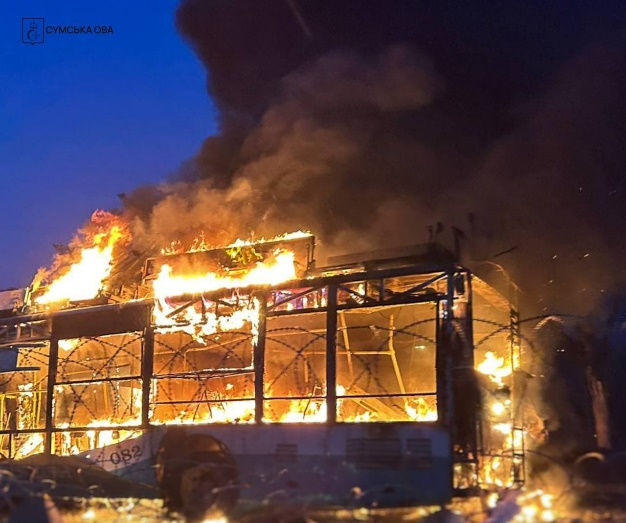
A trolleybus is destroyed following Russian guided bomb strikes near the city of Sumy. (Oleh Hryhorov/Telegram)
THE DAY’S RECKONING
June 22 falls on the anniversary of Nazi Germany’s invasion of the Soviet Union in 1941 — a date that Zelensky has long used to draw historical parallels to Putin’s own war. This year the parallel came with photographs: drones over Moscow Oblast, smoke rising above a semiconductor plant in Voronezh, and a nighttime drone that found a house in Sumy Oblast and killed three generations of a family sleeping inside it. “Perhaps Russia wants to wait until this war lasts longer than World War II,” Zelensky wrote. “But the world certainly does not want that, and it can prevent it.”
In London, Keir Starmer stood outside 10 Downing Street and announced his resignation — the man who had commanded the boarding of a Russian shadow fleet tanker, ordered sanctions on nearly 600 Russian vessels, and stood beside Zelensky at summit after summit as one of Ukraine’s most active European defenders. In Warsaw, Poland’s president confirmed he had not been invited to the Ukraine Recovery Conference in Gdansk in three days’ time. In Minsk’s mirror, the exiled Belarusian opposition delivered a 30-page document to Zelensky’s foreign minister cataloguing eight dimensions of Lukashenko’s preparations for war. The Kremlin Bridge was briefly closed to traffic.
It was, in every sense, a day shaped by proximity to catastrophe — the kind of day this war produces as a matter of routine now, in its 1,580th iteration.
DUBNA SPACE COMMUNICATIONS HUB STRUCK; MOSCOW’S AIR DEFENSES REINFORCED AT FRONTLINE’S EXPENSE
Ukrainian forces struck the Dubna Space Communications Center in Dubna, Moscow Oblast, overnight on June 21 to 22 — roughly 120 kilometers north of Moscow City and about 540 kilometers from the Ukrainian border, making it the fourth Ukrainian strike against the Moscow region in a week. The center is a major ground hub that connects satellites with terrestrial communication networks and manages satellite links across Russia and abroad. Geolocated footage published on June 22 showed smoke rising over Dubna. The State Space Communications Company, the center’s parent body, acknowledged a large-scale Ukrainian drone strike but claimed it did not disrupt television broadcasts or communications. Moscow Mayor Sergei Sobyanin stated that Russian forces downed 84 drones en route to Moscow in the preceding day and that the strikes caused no damage — a claim at odds with the smoke footage and the satellite company’s own acknowledgment.
Russia has been rushing to reinforce Moscow’s air defenses, but the reinforcements are coming from the front. Open-source analysts assessed on June 20 that satellite imagery from June 4 suggests Russia began constructing a new S-400 installation at the Moskvoretsky Historical and Nature Park west of Moscow City in late May 2026, sited on one of the highest elevation points west of the capital. The Telegraph separately reported that Russia redeployed a Pantsir air defense system from an unspecified frontline area and installed it on a tower near the Moscow Oil Refinery; analysts noted the system carries only two of the standard six launch missiles on one side, consistent with the S-300 and Pantsir interceptor missile shortage that CBS News reported citing Ukrainian intelligence sources. ISW assessed that Ukraine’s intensifying long-range and intermediate-range strikes are imposing competing requirements for air defense across Russia’s rear, forcing difficult allocation decisions as disabled radar stations compound the inability to repel strikes even in areas of increased protection.
VORONEZH SEMICONDUCTOR PLANT STRUCK: FIVE KILLED, COMPONENTS FOR ISKANDER AND KH-101 DESTROYED
Ukrainian forces struck the Voronezh Semiconductor Devices Plant in Voronezh City on June 22 using high-precision air-launched cruise missiles, according to the General Staff. The plant produces electronic components for Russia’s Iskander-K and Iskander-M ballistic and cruise missiles, Kh-101 air-launched cruise missiles, and the Pantsir-S1 air defense system. Geolocated footage published within an hour of the strike showed large plumes of smoke rising above the plant. Voronezh Oblast Governor Alexander Gusev acknowledged that Russian air defenses downed 18 drones and several unspecified high-speed aerial targets over the city, and confirmed that a production facility was damaged; he later reported that five people were killed and dozens injured. Voronezh Oblast directly borders eastern Ukraine, with the regional capital about 200 kilometers from the nearest Ukrainian-held territory in Kharkiv Oblast.
Russian sources speculated about the weapon used: one milblogger raised the possibility of a Ukrainian-adapted Storm Shadow, while another suggested the U.S.-supplied Extended Range Attack Munition (ERAM), a system the U.S. Air Force began procuring in 2024 specifically to provide Ukraine with affordable, mass-producible long-range strike weapons; a Foreign Military Sale to Ukraine approved in August 2025 allotted up to 3,350 ERAMs. ISW was unable to confirm the specific weapon at this time. The General Staff stated: “The destruction of the facility’s capabilities will significantly impair Russia’s ability to produce new missiles.” Zelensky confirmed the operation, saying Ukraine’s long-range weapons are “forcing the war back onto Russian territory” and that “the new Fire Point drones recently struck targets up to 2,070 kilometers deep” with future capability to reach 3,000 kilometers.
UKRAINE’S STRIKE CAMPAIGN: DEPTH, SCALE, AND WHAT IT IS DOING TO RUSSIA’S LOGISTICS
Open-source analysis published June 22 captures the full scope of what Ukraine’s strike campaign has become. Russian opposition outlet Meduza analyzed geolocated strike data from GeoConfirmed and found that Ukrainian forces greatly increased their median strike depth in May and June 2026 to several tens of kilometers from several kilometers in previous months, with particular focus shifting westward from the Hulyaipole and Oleksandrivka areas toward occupied Kherson Oblast and Crimea. French analyst Clement Molin confirmed at least 500 Ukrainian strikes on Russian trucks and vehicles in occupied Ukraine between May 1 and June 18. ISW observed geolocated evidence of at least 210 intermediate-range strikes in occupied Ukraine in May 2026 and 145 thus far in June. On June 22 specifically, Ukrainian forces struck and damaged a road bridge near Vasylivka southwest of Orikhiv that Russian forces use to transfer troops and supplies, with geolocated footage showing glide bombs destroying the Karachokrak River crossing along the E105 highway; fires broke out at the main railyard in occupied Berdyansk roughly 100 kilometers from the frontline; and logistics trucks continued to burn across occupied Donetsk Oblast along the H-20 Donetsk-Mariupol highway.
Russia’s response to the logistics squeeze is revealing its scale. The commander of the Russian 20th Combined Arms Army has rerouted supply lines in the Lyman direction, extending them roughly 140 kilometers from the frontline and requiring armored three-person crews per truck. The 4th Tank Division has prohibited unarmored vehicle movement within 25 kilometers of the frontline. Crimea’s occupation head suspended all children’s camps on the peninsula until September 1, with children who had already crossed the Kerch Bridge turned around and sent home; Russian passenger rail operator Grand Service Express terminated all Crimea-bound trains at Kerch. Russia briefly closed the Kerch Strait Bridge on June 22, likely due to nearby Ukrainian strikes, while simultaneously diverting freight traffic to the M-14 highway, which Ukraine has been striking systematically. Fuel shortages prompted Russia to also temporarily close the Uspenka checkpoint on the Rostov-occupied Donetsk border, and Peskov publicly acknowledged on June 22 that Russian fuel prices are rising, while claiming the Cabinet of Ministers is working on a solution.
As the fuel crisis deepens, some Russian officials and industry figures are proposing shifts to “mini refineries” to compensate for lost capacity — an option that a Kremlin-affiliated milblogger acknowledged would not cover Russia’s domestic demand and would force a return to long-defunct AI-76 and AI-80 gasoline grades rather than replacing the current standard fuels. Russia extended a government waiver on June 15 allowing refineries to sell gasoline and diesel below Euro-5 environmental standards, permitting sulfur levels up to 15 times the legal limit, as shortages have spread to at least 53 regions.
Aviation fuel shortages are now affecting Russia’s general aviation sector. Russian aircraft operators have begun substituting automobile gasoline for aviation fuel as prices rise and supplies tighten: light aircraft operators can only access aviation gasoline at major airports through partners in Ufa and Volgograd, leading Russia’s An-2 Operators Association to petition the Transport Ministry for state price regulation. Russia had restricted jet fuel exports from June 1 through November 30 but wholesale prices have continued to climb. With Ukraine conducting at least 33 long-range strikes on Russian oil infrastructure in May alone and 28 already in June, the structural damage to Russia’s refining capacity — estimated at 30 percent offline — is now cascading through civilian aviation and forest firefighting operations as well as the fuel supply to occupied territories.
OVERNIGHT STRIKES: A FAMILY KILLED IN SUMY, 10 DEAD AND 48 INJURED ACROSS UKRAINE
Russian forces launched one Iskander-M ballistic missile from occupied Crimea and 88 Shahed, Gerbera, Italmas, and Banderol-type drones and Parodiya decoys overnight on June 21 to 22, from Kursk, Oryol, Bryansk, Millerovo, Shatalovo, Primorsko-Akhtarsk, occupied Hvardiiske, and occupied Donetsk City. Ukrainian air defenses downed 79 drones; the ballistic missile and five drones struck six locations, with debris falling at nine more. Russian strikes damaged civilian, energy, and educational infrastructure in Chernihiv, Mykolaiv, Odesa, Zaporizhzhia, and Sumy oblasts; the Energy Ministry reported power outages in Donetsk, Kherson, Sumy, Kharkiv, Mykolaiv, Chernihiv, and Zaporizhzhia oblasts.
Ten civilians were killed and 48 injured nationally over the 24-hour period. The day’s most shattering single strike was in Sumy Oblast, where a Russian drone hit a private home and killed a 36-year-old father, his 13-year-old son, and his 73-year-old grandmother. A 10-year-old boy was injured in the same strike; the boy’s 31-year-old mother and a 13-year-old sister were left in critical condition. Across Sumy Oblast, three people including one child were killed and nine including three children were wounded over the day; a Russian guided bomb separately struck and destroyed a trolleybus in Sumy City, seriously injuring the 57-year-old driver who was alone inside the empty vehicle — doctors performed resuscitation. In Zaporizhzhia Oblast, three people were killed and 10 injured including an 11-year-old boy; Russian forces launched around 899 strikes against 42 settlements across the region. In Kharkiv Oblast, one person was killed and 13 injured as Russian attacks struck Kharkiv and 29 other settlements. In Kherson Oblast, one person was killed and one injured as Russian forces targeted residential neighborhoods, a farm, and civilian vehicles. In Donetsk Oblast, one person was killed and seven injured in Sloviansk, Kramatorsk, and Druzhkivka. In Dnipropetrovsk Oblast, Russian forces killed one person and injured 14 others across 50+ attacks in four districts: a 77-year-old woman was killed in the Nikopol district; a postal office, college, and gas station were damaged; anti-drone tunnels covering 14 kilometers of road are now under construction in Nikopol and Marhanets. In Chernihiv Oblast, a Gerbera drone struck a home in Borzna injuring a 45-year-old man, damaging a railway station, a sawmill, and a school.
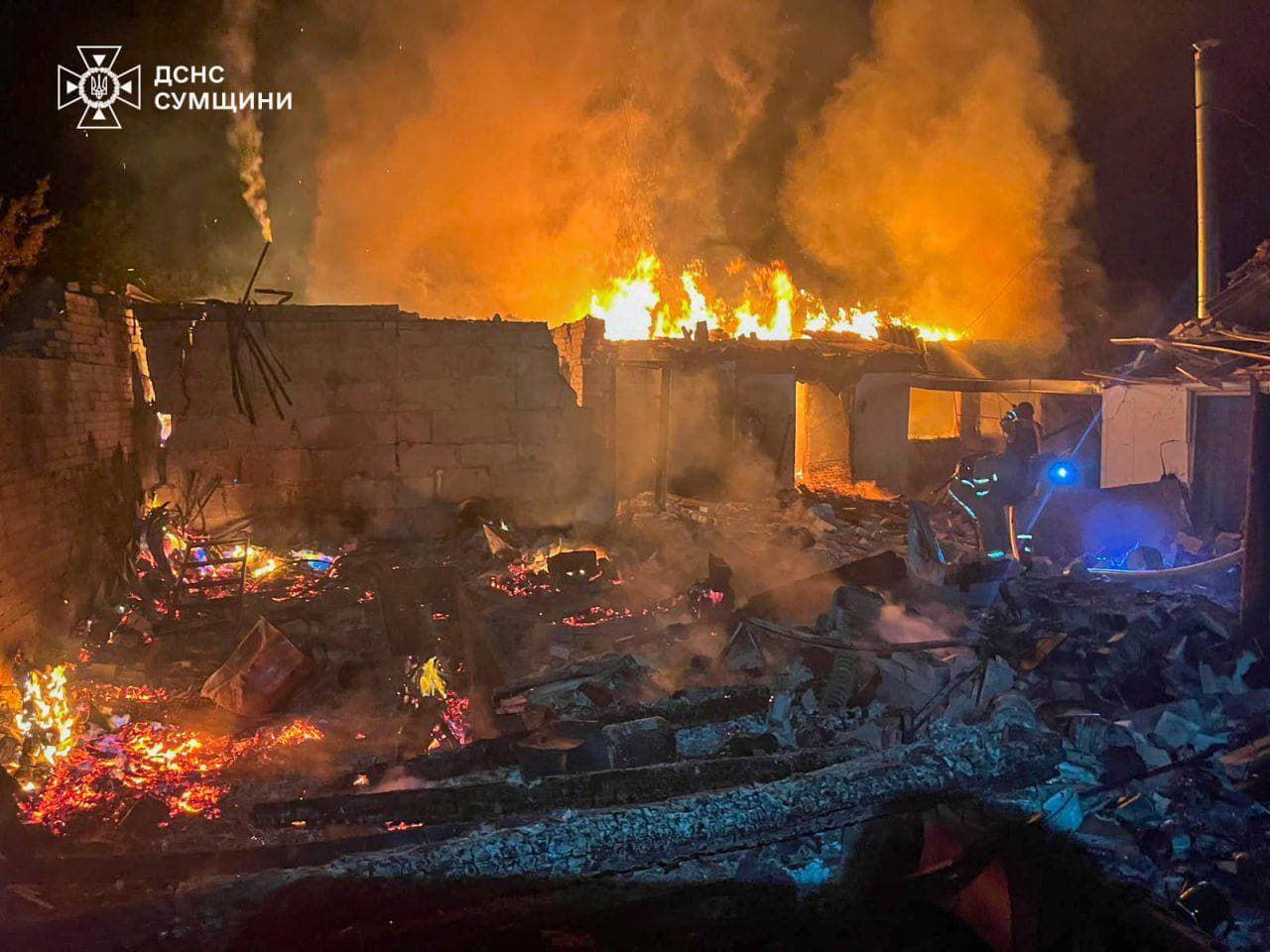
The remains of a residential home destroyed in a Russian drone strike are seen in Sumy Oblast, Ukraine. (State Emergency Service of Ukraine Sumy Oblast/Telegram)
RUSSIA STRIKES CIVILIAN SHIPPING AGAIN: EGYPTIAN COOK KILLED, TURKISH SAILORS INJURED
Russian drones struck three foreign-flagged civilian cargo vessels in the Black Sea overnight on June 21 to 22. The Turkish-owned, Panama-flagged bulk carrier Victress was worst hit: a Russian drone sparked a large fire on the bridge and killed a 58-year-old Egyptian cook aboard; two Turkish crew members were also injured. Turkey’s Foreign Ministry condemned the attack, stating it “threatens Turkey’s interests in the Black Sea and regional security,” and said it had contacted both Ukraine and Russia. Ukrainian Navy crews evacuated the remaining Turkish and Indian crew members. Two other vessels — one flying the flag of Belize and one of Palau — were also struck but sustained minor damage and were able to continue their journeys. “A clear demonstration that Russia’s words cannot be trusted,” Foreign Minister Sybiha said. “Russia remains the main threat to Black Sea security and prosperity.” The attack came four days after Turkish Foreign Minister Fidan had met Lavrov in Moscow to discuss Black Sea shipping safety.
A Russian drone separately struck a truck parking area in Odesa Oblast overnight, killing one person and injuring four others and setting fire to empty fuel and gas tankers. Ukraine’s 26-year-old woman killed by drone shrapnel on an Odesa beach on June 21 — a 39-year-old man also wounded, emergency crews continuing to assess additional casualties along the Black Sea coast — underscores that Russia’s maritime drone campaign now extends to Odesa’s civilian coastline.
GENERAL CHERRY DRONE FACTORY STRUCK BY RUSSIA
A Russian strike damaged a production facility of General Cherry, one of Ukraine’s largest drone manufacturers, co-founder Yaroslav Gryshyn reported on June 22. Gryshyn said all employees were safe and that production has not been suspended, with the company operating under an enhanced regime while assessing the extent of damage; he described the company as prepared for such events. Founded in September 2023, General Cherry produces the Bullet anti-Shahed interceptor drone, the General Cherry AIR counter-reconnaissance drone, and a range of FPV systems, assembling approximately 50,000 drones per month with more than 600 employees, about 20 percent of them military veterans. The company had participated in the U.S. Pentagon’s “Gauntlet” program for Drone Dominance Program contracts and signed an agreement with Wilcox Industries to produce drones in New Hampshire in March 2026.
FRONTLINE: RUSSIAN ADVANCE CONFIRMED IN KUPYANSK; VOVCHANSK DRONE DENSITY RECORD; POKROVSK BUILDUP
A source reporting on the Russian Western Grouping of Forces stated on June 22 that Russian forces recently seized Radkivka north of Kupyansk — the day’s one confirmed territorial change. Geolocated footage published on June 20 and 22 also shows Ukrainian forces striking Russian positions in northern Kupyansk and northern Kurylivka southeast of Kupyansk after assessed Russian infiltration missions there. In the Vovchansk direction northeast of Kharkiv, a Ukrainian drone operator reported on June 22 that the area now has one of the highest densities of drones per square kilometer on the entire front — with Russian forces using the Vovchansk sector specifically to test new systems including fiber optic drones, motorcycle assaults, and infiltration tactics. A source monitoring the Russian Northern Grouping claimed Russian forces regularly send only a few soldiers at a time toward Kozacha Lopan to simulate activity without achieving advances, having made no gains beyond the settlement’s northern outskirts since late April. Russian milbloggers separately claimed forces entered Nova Sich and Kyianytsia north of Sumy City, claims ISW could not confirm.
In Donetsk Oblast, three Ukrainian servicemembers told the BBC’s Russian Service that the situation in Kostyantynivka is serious but not catastrophic: Russian infantry are advancing from the south and east and operating on the northern outskirts, but are advancing less than 100 meters per day due to Ukrainian drone strikes, and the city remains a contested gray zone rather than under Russian control. Russian drone operators’ main priority is identifying and striking Ukrainian drone crews to allow infantry to move through kill zones undetected — the same tactic used to seize Pokrovsk. The Russian MoD continued its AI-altered footage cognitive warfare campaign, publishing purported flag-raising footage in Lyman and Kostyantynivka that ISW assessed as likely AI-generated. The 7th Rapid Reaction Corps reported that Russian forces are attempting to advance toward Dobropillya from two directions — through Rodynske and Bilytske, and through Pokrovsk and Hryshyne — while a Ukrainian battalion commander reported Russian FPV drone strikes reaching 20 to 30 kilometers behind Ukrainian lines to interdict logistics in the Pokrovsk direction. Ukrainian forces struck a Russian drone operator training ground near Myrnohrad and a command post near Pokrovsk, and geolocated footage documented the debut of the Russian Ratibor Unmanned Systems Battalion of the 80th Tank Regiment striking positions near Hrushkivske in the Oleksandrivka direction.
In western Zaporizhzhia, Ukrainian forces counterattacked in the Hulyaipole direction and struck a bridge over the Karachokrak River near Vasylivka used for Russian troop and supply transfers. Russian forces conducted infiltration missions in northern Mali Shcherbaky and eastern and western Stepnohirsk west of Orikhiv, while the Russian MoD struck a purported Ukrainian fuel storage facility with Geran drones near Vysokohirne north of Kantserivka. Russian forces also continued offensive operations in Borova direction with Ukrainian counterattacks southeast of Borova, and continued limited operations in Novopavlivka direction without confirmed advances. In Belgorod Oblast, Ukrainian forces struck a Russian command and observation post near Ilek-Penkovka roughly three kilometers from the international border.
KEIR STARMER RESIGNS AS UK PRIME MINISTER
British Prime Minister Keir Starmer announced his resignation on June 22, citing a loss of internal party support following a series of scandals, cost-of-living concerns, and policy reversals that had cratered his popularity since taking office in 2024 after a landslide Labour victory. Starmer said he would remain in office until a new Labour leader is chosen, with nominations opening July 9 and a successor expected before parliament returns from summer recess in September. Andy Burnham, Starmer’s Labour rival who recently won a parliamentary by-election, is widely discussed as a likely successor. Reform leader Nigel Farage called for an immediate general election.
Starmer’s departure is a significant development for Ukraine. Under his leadership, the UK became one of Ukraine’s most active European defenders: he co-led the Coalition of the Willing with Macron, signed a 100-year UK-Ukraine partnership agreement in January 2025, ordered the Royal Marines boarding of the Russian shadow fleet tanker Smyrtos in the English Channel, sanctioned nearly 600 Russian shadow fleet vessels, and led UK delivery of 150,000 drones pledged at Ramstein. In his resignation speech, Starmer listed “standing with Ukraine” and rebuilding European alliances as among his government’s primary achievements. Zelensky thanked him warmly: “Keir, thank you for all our cooperation, your support, and the joint decisions that have helped make our Europe and our protection of life stronger. I wish the United Kingdom and all British people every success. We have confidence in Britain.” Starmer’s government had also faced internal criticism for failing to provide sufficient defense resources, a rift that had already cost him Defence Secretary John Healey, who resigned earlier in June. Trump, commenting before the announcement, said Starmer “failed badly” on immigration and energy. The E5 European military leadership group — UK, France, Germany, Italy, and Poland — met in Berlin on June 25; Starmer remained in office for that meeting.
BELARUSIAN OPPOSITION DELIVERS WAR WARNING TO ZELENSKY; KREMLIN SAYS PUTIN AND LUKASHENKO WILL MEET
The United Transitional Cabinet of Belarus, the principal executive body of the Belarusian democratic opposition established by Sviatlana Tsikhanouskaya, delivered a 30-page report to Ukrainian Foreign Minister Sybiha on June 22 documenting eight areas in which it assesses Lukashenko is shifting toward a wartime posture. The report identifies: constitutional amendments removing Belarus’ status as a neutral, non-nuclear state; a new 2024 military doctrine permitting preemptive strikes in response to a “direct threat” and allowing Belarusian troop deployments abroad; a roughly 50 percent increase in contract soldiers since 2022; a fivefold increase in defense spending; the formation of a Southern Operational Command along the Ukrainian border with potential troop levels exceeding 80,000; a “people’s militia” that could reach 150,000; new guidelines for wartime healthcare operations and inspections of 5,000 bomb shelters in Minsk; and a doubling of mandatory fuel stockpiles. More than 4,000 new pieces of military equipment were commissioned in 2024 alone, and Belarusian arms industry production has been absorbed into Russia’s military supply chain.
Ukraine’s National Guard commander Oleksandr Pivnenko stated on June 22 that a potential Russian offensive from Belarusian territory would require at least 70,000 troops to repeat a northern approach on Ukraine. Ukrainian drone commander Brovdi previously warned that the first 500 targets to be struck inside Belarus were “already pencilled down” if Minsk enters the war. On the diplomatic side, a Ukrainian Telegram channel linked to local officials reported that Ukrainian forces recently destroyed relay towers used to guide Shahed drone attacks; Belarus has not confirmed this. Lukashenko apologized to Zelensky earlier in June for previous harsh rhetoric and said Belarus has no intention of joining the war. The Kremlin announced on June 22 that Putin and Lukashenko will meet “in the foreseeable future” to discuss Zelensky’s ultimatum regarding the relay stations, with Peskov calling the ultimatum “utterly aggressive” interference in Belarus’ sovereignty. Zelensky’s deadline for Lukashenko to remove the equipment remains June 26.
POLAND-UKRAINE DISPUTE DEEPENS; NAWROCKI EXCLUDED FROM GDANSK RECOVERY CONFERENCE
The diplomatic rupture between Poland and Ukraine over the UPA military unit naming widened on June 22. Polish Senate Deputy Speaker Michal Kaminski returned two Ukrainian state awards he had received for his work on Ukraine’s EU accession, writing that he could not retain honors from a country whose leadership had “not brought themselves to unequivocally condemn the perpetrators of the Volyn massacres.” A senior aide to President Nawrocki explained publicly why Mussolini and Schroeder have not been stripped of the Order of the White Eagle: historical figures are not stripped posthumously, and Schroeder, while his Kremlin ties must be condemned, “has never insulted the Polish nation as overtly as the Ukrainian president did” — adding that sending the medal by courier “adds insult to injury.”
Nawrocki confirmed on June 22 that he has not received an invitation to the Ukraine Recovery Conference in Gdansk, scheduled for June 25 to 26, because Prime Minister Tusk did not send him one; a senior presidential aide accused Tusk of focusing on “raising money for Zelensky” rather than Polish interests. The Ukrainian Presidential Office said the invitation matter is Poland’s internal affair. Zelensky said on June 21 that he is considering whether to attend in person. Ukraine had separately canceled a scheduled meeting between the two presidents in Warsaw, offering a distant alternative date that Poland described as a sign Zelensky is “not interested in real dialogue.” Prime Minister Tusk called the dispute a “strategic mistake” and urged de-escalation; the dispute comes one year before Polish parliamentary elections in which Tusk’s government faces a conservative challenge.
UKRAINE DRONE FOUND IN ESTONIA; RUSSIANS FORCIBLY RECRUITED IN PENZA; RUSSIA PLANS MILITARY TRAINING FROM GRADE 5
Estonian public broadcaster ERR reported on June 22 that a drone with a 5-kilogram warhead was found in a field in Voru county, bordering Latvia and Russia, by a local resident approximately two weeks earlier; Estonian officials assessed it may be one of the drones that entered the area during a Ukrainian strike against northwestern Russia on June 3. The Estonian military had initially reported no drones found on June 3; authorities received information of the discovery on June 10 but did not report it publicly due to a large-scale military exercise underway. This follows a stray Ukrainian drone hitting a power plant chimney in Estonia in March and a NATO jet shooting down another Ukrainian drone over Estonian airspace on May 19. Estonian Defense Minister Pevkur urged Kyiv to exercise better control over its drones, while simultaneously announcing the arrival of Estonia’s first IRIS-T SLM medium-range air defense system at Amari Air Base — capable of intercepting aircraft, helicopters, and cruise missiles at ranges up to 40 kilometers. Estonia spent 3.42 percent of GDP on defense in 2025, among NATO’s highest shares, with spending expected to rise to 5.4 percent by 2029.
Inside Russia, Atesh partisan network reported that Russian authorities have issued strict directives to regional authorities to increase contract soldier recruitment, targeting men with large debts in bailiff databases and former prisoners under administrative supervision, detaining them and pressuring them into signing contracts under threat of new criminal charges. Residents of Penza created a Telegram channel tracking the raids; the regional military commissar publicly insisted the raids are routine. Women were filmed confronting uniformed men near a military registration office. Meanwhile, First Deputy Chairman of the State Duma Committee on CIS Affairs Viktor Vodolatsky proposed introducing compulsory military training for children from fifth grade — currently it begins in tenth grade — saying Russia must prepare its youth “to defend the Fatherland” by 2030, citing a potential NATO confrontation as the rationale. The State Duma Chairman echoed the framing, describing 2030 as a “relevant milestone” for a potential Russian attack on NATO.
June 22, 2026: the 85th anniversary of Operation Barbarossa, and a day on which a satellite communications hub near Moscow went dark, a missile factory in Voronezh caught fire, a British prime minister resigned in London, and a family of three was killed by a drone at home in Sumy Oblast. The war that Zelensky said has already outlasted World War I keeps accumulating its days. “Russia may want this war to last longer than World War II,” he wrote. “But the world certainly does not want that.” Whether the world’s wants are enough to stop it is the question this war has been asking since February 24, 2022.
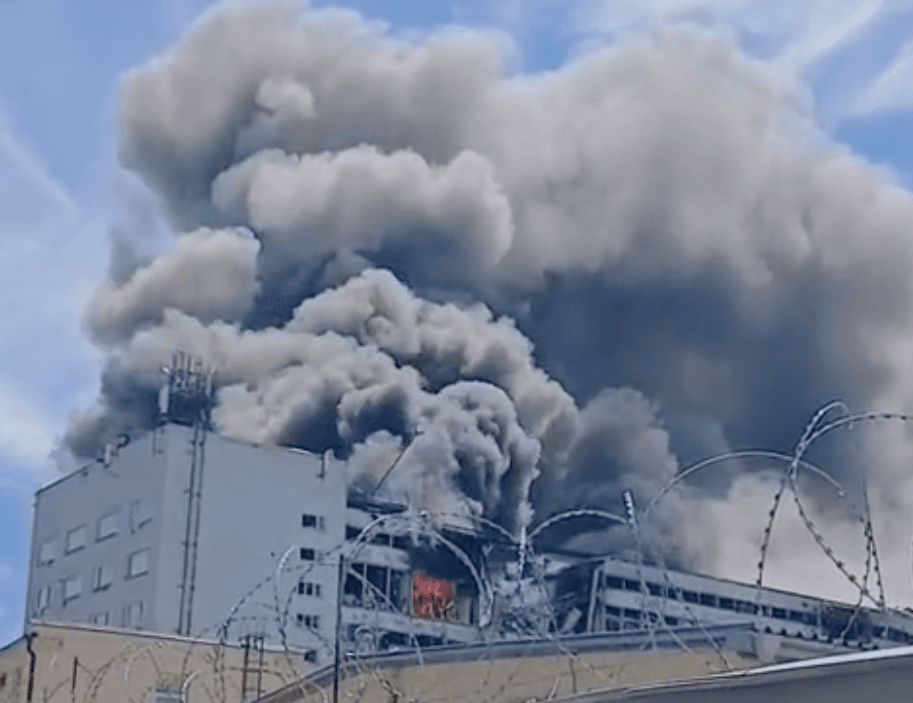
A photograph reportedly showing heavy damage to the Voronezh Semiconductor Plant after being struck by Ukrainian forces. (Exilenova+ / Telegram)
A PRAYER FOR UKRAINE
1. For the Father, the Son, and the Grandmother in Sumy Oblast
Lord, a drone found a house in Sumy Oblast on the night of June 21 to 22 and killed a father, his 13-year-old son, and his 73-year-old grandmother. A 10-year-old boy was injured. The mother and a 13-year-old daughter were left in critical condition. Three generations, in one house, on one night. We do not have adequate words for this. We only ask that You receive the three who died, that the two in critical condition survive and find their way to some kind of life after this, and that the 10-year-old boy has someone beside him who can hold what he cannot yet hold alone. This family had nothing to do with this war except to be Ukrainian and to live in a region Russia has decided to destroy.
2. For the Egyptian Cook Aboard the Victress
Father, a 58-year-old Egyptian cook was working aboard a civilian cargo ship in the Black Sea when a Russian drone found it and set it on fire. He was not a combatant. He was feeding people. He was far from home. We do not know his name. His family in Egypt is learning tonight what happened to him in a sea between Turkey and Ukraine, in a war that has nothing to do with Egypt. We pray for them. We pray for the Turkish and Indian sailors who evacuated into the dark water and were rescued by Ukraine’s Navy. We pray for every merchant mariner still navigating the Black Sea because the world’s food supply depends on grain moving through a corridor that Russia has turned into a combat zone.
3. For Keir Starmer, and for What Comes After Him
God of all nations, a man who stood with Ukraine longer and more consistently than most Western leaders resigned today. He did not leave office because he stopped believing Ukraine should win; he left because of domestic pressures that had nothing to do with Kyiv. We pray for the people of the United Kingdom in the uncertainty ahead, and we pray for Ukraine, whose security is now bound to decisions made by a Labour Party choosing a new leader in the middle of a war. Let the commitment hold. Let the weapons already promised arrive. Let the coalition Starmer helped build survive the transition. And let whatever government follows him know what he knew: that this war’s outcome shapes the security of every democracy on the continent.
4. For the Driver of the Sumy Trolleybus
Lord, a 57-year-old man was alone in an empty trolleybus in Sumy City when a Russian guided bomb destroyed it around him. Doctors performed resuscitation. He is fighting for his life. He was doing his job — moving an empty vehicle, ending a shift or beginning one, on a street in a city that has been struck so many times its governor warns of glide bombs the way other cities warn of rain. We ask for his recovery. We ask for the doctors working to save him. And we ask that the city of Sumy, which absorbs strike after strike in near-silence in the international press, not be forgotten.
5. For June 22, and What It Means to Remember
God of history, today is the anniversary of the day Nazi Germany invaded the Soviet Union — a day that carries, for Ukrainians and Russians both, an enormous weight of loss and survival and memory. Zelensky invoked that memory today to say: we are living it again. The comparison is imperfect and contested. What is not contested is the body count, which grows every day, or the fact that a 13-year-old boy died in Sumy Oblast tonight in the same way that millions of people died across this continent eighty-five years ago: because a government decided that its imperial aims were worth more than their lives. Lord, let this war end before it accumulates the years that war did. Let the world mean it when it says ‘never again.’