
August 13, 2026
Prepared by Diana Bozhyk
Vladimir Putin set foot on the disputed Kuril Islands for only the second time in Russian history, needling Tokyo just as Ukrainian drones hit a Baltic Sea oil port a thousand miles from the war. Ukrainian strikes also knocked out a refinery deep in Bashkortostan and permanently darkened one in Orsk, while a bomb hidden in a Sevastopol trash can killed a Russian officer who once served Ukraine. Zelensky, meanwhile, offered something rare — a truce, at least on the Black Sea — even as Poland revealed it had just stopped a Russian plot to assassinate an American citizen on NATO soil.
THE DAY’S RECKONING
Picture a Russian president stepping onto an island Japan has never stopped calling its own, flanked by admirals and border guards, daring Tokyo to do something about it. That’s Vladimir Putin, visiting the Kuril Islands for only the second time any Russian leader has bothered in over a decade. It’s a small gesture with a big message: occupation, once achieved, doesn’t need to be justified — just visited, casually, like checking on property.
The rest of the day ran the same logic in reverse. Ukrainian drones reached farther than usual, hitting an oil port on the Baltic Sea nearly a thousand miles from the nearest front line, while two more Russian refineries went dark — one facing repairs measured in months, not days. A bomb hidden in a Sevastopol trash can killed a Russian officer who’d once served Ukraine. Poland revealed it had just stopped an assassination aimed at an American citizen. And in the middle of it all, Kyiv floated something rare: an actual peace gesture, a proposed truce on Black Sea attacks. Nobody has said yes yet.
 A resident walks among the rubble of destroyed and charred warehouses as a fire still burns following a Russian airstrike in Kramatorsk, Donetsk Oblast. (Francisco Richart/Anadolu via Getty Images)
PUTIN PLANTS A FLAG WHERE NONE IS NEEDED
Quick geography lesson: the Kuril Islands are a chain of volcanic islands stretching between Russia’s Kamchatka Peninsula and Japan’s northern coast. The Soviet Union seized them in the final days of World War II, and Russia and Japan have never signed a peace treaty because of the dispute that followed — 80 years and counting.
Putin visited the largest island, Iturup — which Japan calls Etorofu — becoming only the second Russian leader ever to set foot there, after Dmitry Medvedev in 2010. He met with a lineup that told its own story: the regional governor, the commander of Russia’s Pacific Fleet, a border-security chief, and the acting commander of an army corps that’s currently fighting Ukraine in the Oleksandrivka direction — a not-so-subtle reminder that the same military apparatus spans both fronts.
The trigger was Japan’s newly published defense policy, which for the first time formally named Russia as a critical threat. Putin called the designation unwarranted and insisted Russia has no hostile intentions toward Tokyo — while standing on land Japan considers stolen. Japanese Prime Minister Sanae Takaichi condemned the visit outright. Medvedev, never one for subtlety, posted online that the islands “were, are, and will remain Russian land,” warning that anyone who disagreed would face “monstrous consequences.”
Ukraine’s foreign minister drew the obvious parallel: Russia, he said, uses the identical playbook everywhere — occupy, militarize, threaten the neighbors, then dare the world to accept it as permanent.
WAR THROUGH SABOTAGE: A BOMB IN SEVASTOPOL, A PLOT IN WARSAW
Not every strike in this war comes from a drone. Some arrive in a trash can.
In occupied Sevastopol an improvised bomb — hidden inside a garbage bin beside a park bench — killed a Russian officer as he walked down a staircase with a colleague. Witnesses said the blast was loud enough that some assumed a drone had hit a nearby building. Russia’s security service confirmed a military officer had died and detained a Russian woman, born in 1994, accusing her of acting on instructions from Ukrainian intelligence. Ukraine has not commented.
The dead man’s identity, reported by Telegram channels close to Russian security services, adds a layer of irony: Robert Shageev once commanded Ukraine’s only submarine, the Zaporizhzhia, before defecting to Russia after Moscow’s 2014 seizure of Crimea. He went on to help run a Russian submarine capable of firing Kalibr cruise missiles — the same weapon type that regularly kills Ukrainian civilians. Ukraine had charged him with treason.
Fifteen hundred miles away, in Warsaw, Polish Prime Minister Donald Tusk revealed a different kind of plot. Polish security services, working with American counterparts, had detained a Russian citizen on August 7 accused of planning to assassinate a dual US-Ukrainian national on Russian intelligence’s orders — the first known attempt by Moscow to kill an American citizen on the soil of another NATO country. “We must proceed from the assumption that Putin’s regime will try to eliminate people who are inconvenient,” Tusk said, warning more attempts are likely. The plot follows a June killing in Poland of a Russian dissident cartoonist and an earlier scheme, disrupted by US and German services, to assassinate the CEO of a major German arms manufacturer.
THE NIGHT RUSSIA’S REFINERIES BURNED AGAIN
Ukraine’s long-range strike campaign didn’t pause for a night. Overnight overnight, Ukrainian forces struck the Gazprom Neftekhim Salavat oil and petrochemical complex in Russia’s Bashkortostan Republic — a facility roughly 800 miles from the border capable of processing up to 10 million tons of crude a year, one of Russia’s larger refineries by any measure. Footage published the same day showed fire at the site. The regional governor confirmed drone debris had fallen in an industrial zone nearby.
Ukrainian drones didn’t stop at oil. The same strike package hit a Wildberries logistics center near Chishmy, also in Bashkortostan — Wildberries being Russia’s dominant online retailer, roughly the equivalent of Amazon, and increasingly a target because its warehouses double as staging and storage points tied to the broader war economy. Local officials confirmed two people were injured.
The financial toll of Ukraine’s campaign against Wildberries specifically is starting to come into focus. A Forbes Russia analysis, citing a research firm called Data Insight, estimated the company will need to spend between $1.77 and $2.68 billion just to rebuild the warehouses already destroyed. A Russian retail-industry association put the fuller number — including losses to Wildberries’ third-party sellers — at $7.2 to $9.6 billion. Separately, Ukrainian estimates put total destroyed inventory at roughly $12 billion.
Two refineries, one warehouse network, one night. This is what a deep-strike campaign against an economy looks like when it’s working: not a single knockout blow, but a slow accumulation of fires that Russia can’t put out fast enough to matter.
A NEW FRONT: DRONES REACH THE BALTIC SEA
Here’s a distance worth sitting with: Ust-Luga, a Russian port on the Baltic Sea just west of St. Petersburg, sits nearly 700 miles from the nearest point of Ukrainian-controlled territory — and Ukrainian drones hit it anyway overnight overnight.
Ust-Luga isn’t a random target. It’s one of Russia’s largest ports, home to a major oil terminal that ships crude and refined petroleum products to buyers around the world, generating real revenue for the Russian state budget in the process. The regional governor confirmed a fire broke out at the port amid what he called a wide-ranging drone attack, and officials claimed 51 Ukrainian drones were shot down over the surrounding Leningrad Oblast — though neither the extent of the damage nor the specific target struck could be independently confirmed.
This wasn’t Ust-Luga’s first visit from Ukrainian drones; the port was struck repeatedly in March and April of this year as part of the same campaign. What makes the return notable is the message it sends about reach: if Ukraine can credibly threaten a port nearly 700 miles from any front line, there is effectively no piece of Russia’s oil export infrastructure that can be considered safe by distance alone. That reality is precisely what’s forcing Moscow into gasoline import deals, price controls, and refinery repair bills that stretch into next year.
ORSK GOES DARK FOR SIX MONTHS
Some strikes cause a fire that gets patched within days. This one won’t be patched before spring.
Russian officials confirmed that the Orsknefteorgsintez oil refinery in Orsk — roughly 800 miles from Ukraine’s border, with an annual processing capacity of around 6 million tons — has completely halted operations following a Ukrainian strike on August 11. The regional governor, Yevgeny Solntsev, said the damaged equipment is imported machinery that can’t easily be replaced under current sanctions, meaning repairs could take up to six months. “The plant has been completely shut down,” he said bluntly.
The ripple effects are already visible on the ground. Solntsev said the region is “preparing for the worst-case scenario,” expecting to lean on imported fuel and reconfigured supply logistics — and that of the region’s 287 gas stations, only 80 percent are currently operating. It’s a strikingly plain admission, for a Russian official, that a single drone strike has meaningfully dented regional fuel supply.
Zoom out, and a pattern comes into focus: this is not an isolated hit but one entry in a long and growing list. Ukraine has spent much of 2026 methodically working through Russia’s refining capacity — striking depots, disrupting production runs, and in a rising number of cases, taking facilities offline for months rather than days. Each strike alone might read as a single data point. Together, they explain why Russia banned fuel exports outright earlier this year and why gasoline shortages are now showing up in ordinary Russian towns, not just headlines about the war.
UKRAINE OFFERS MOSCOW A TRUCE — ON THE BLACK SEA, AT LEAST
In a war with almost no diplomatic movement to speak of, this counts as news: Ukraine has proposed, through a third party, that both sides halt attacks on civilian targets in the Black Sea. As of Russia hadn’t responded.
The offer didn’t come out of nowhere. Ukraine had already quietly paused its drone strikes on oil tankers using Russia’s Novorossiysk port — the same port Ukraine devastated with a naval strike just two days earlier — after the Financial Times reported that US Vice President JD Vance personally pressed Kyiv to stop. Washington’s concern: those strikes were hitting tankers carrying Kazakh crude bound for a pipeline terminal partly owned by American oil companies, and disrupting a supply route the US considers a useful alternative to Russian energy. Ukraine agreed to spare that specific infrastructure, with one condition — it won’t extend the same courtesy to vessels already under Ukrainian sanctions.
The stakes go well beyond oil markets. Black Sea strikes from both sides have been disrupting grain shipments for weeks, and officials on both ends of the supply chain are warning of a food-price shock reminiscent of 2022, when Russia’s initial blockade of Ukrainian ports sent global grain prices spiking. Turkey’s foreign minister has separately urged both countries to stop targeting ships altogether and offered to mediate — a role Ankara has played, with mixed success, since the war’s early months.
Whether Moscow takes the offer seriously is another matter. Russia has spent four and a half years showing little appetite for concessions that don’t come with territory attached.
133 DRONES AND TWO TRAIN DRIVERS WHO NEVER GOT TO STOP
Overnight overnight, Russia launched 133 Shahed-type attack drones and decoy drones at Ukraine from five separate points along its own territory and occupied Crimea. Ukrainian air defenses shot down 111 of them; the rest struck 15 locations outright, with falling debris landing at 16 more.
One of those strikes carried a particular cruelty. In Odesa Oblast, a Russian jet-powered attack drone deliberately targeted the locomotive of a passenger train that was pulling into a station — its crew trying to get passengers off after a drone threat had already been detected. The train driver and his assistant didn’t have time to fully stop and evacuate themselves before the drone hit. Both were killed. No passengers were hurt. “This is a terrible daily terror and a targeted attack on civilians,” Ukraine’s national railway chief said afterward — a plain description of what it means to attack the people whose job is keeping trains, and the passengers on them, moving safely through a war zone.
Casualties piled up elsewhere across the map. In Kherson Oblast, strikes on 28 settlements — including the regional capital — killed three and injured 19. Donetsk Oblast lost two people, with six more hurt. One person died and four were injured in Zaporizhzhia Oblast. Sumy Oblast counted seven wounded. Kharkiv Oblast reported eight injuries, including a 15-year-old boy. In Chernihiv, a 10-year-old girl was hurt in a drone strike. Dnipropetrovsk Oblast saw five people injured across more than ten separate drone and artillery attacks. By day’s end, at least eight dead and 50 injured — the ordinary math of an ordinary Wednesday night turned Thursday morning.
MEANWHILE, AT THE ACTUAL FRONT
Away from headline strikes, the ground war kept grinding through its familiar geography, mile by contested mile.
Around Vovchansk, in Kharkiv Oblast, Russian assault groups pushed across the international border along several routes but largely failed to break through toward their main objective south of the city; some infiltrated troops further southwest are now struggling simply to get resupplied. Near Kupyansk, Russian armor — elements of a tank division — reached a river crossing point and consolidated new positions over the past two days, part of a deliberate effort to split Ukraine’s defensive foothold in the area into two halves that can be dealt with one at a time. Ukraine, meanwhile, kept up its own intermediate-range strikes against Russian fuel depots, power infrastructure, and transport links in occupied Luhansk Oblast.
Around the city of Lyman in Donetsk Oblast, Russian forces have seized a patch of forest between Lyman and a nearby town, using the tree cover to mass troops for infiltration missions, while Ukrainian counterattacks elsewhere are constraining Russian progress. Both sides are increasingly using glide bombs rather than artillery in this sector — Russian officers privately admit their artillery keeps getting hunted down by Ukrainian drones, so bombs dropped from a distance are safer. Near Kostyantynivka, Russian infiltration groups have shrunk from four or five soldiers to just one at a time, now navigating by drone imagery instead of paper maps. Russian sources also published what appear to be AI-manipulated videos claiming to show a flag-raising in a captured village — part of an increasingly common information-warfare tactic to exaggerate real advances.
In occupied Crimea, Ukrainian strikes hit a Saki Airfield control tower, a drone relay station, and a Russian early-warning radar near Sevastopol, while Sevastopol’s own occupation authorities admitted the strikes damaged the city’s power grid.
ZELENSKY PUSHES FOR A BIGGER AMERICAN ROLE
Ukraine has quietly submitted a new round of proposals aimed at ending the war, President Zelensky said in a CNN interview aired that day — though their contents remain undisclosed. His central ask wasn’t for a specific concession from Moscow. It was for Washington to simply do more. “We need more involvement from the American side in the peace plan,” Zelensky said. “Putin does not want to stop this war, and there is not enough pressure on him now.” The announcement comes as senior US negotiators are expected to travel to both Kyiv and Moscow in the coming days.
Zelensky was equally clear about what Ukraine won’t accept: any deal requiring Ukrainian forces to withdraw from the parts of the Donbas region they still hold. For Kyiv, the sticking point isn’t only territory — it’s whether any agreement would actually stop Russia from simply rebuilding its military and invading again once a ceasefire bought it time. “Why wouldn’t he come again with one or two additional million soldiers after a long pause?” Zelensky asked. He said credible international security guarantees, not just a signed piece of paper, would be essential to any lasting settlement.
Zelensky also confirmed he’d recently spoken by phone with US Vice President JD Vance, though he declined to say what was discussed — a call that comes amid separate reporting that Vance has pressed Kyiv on its Black Sea tanker strikes. And in a comment likely to unsettle NATO’s eastern flank, Zelensky said he agreed with Western intelligence assessments that Putin could eventually look beyond Ukraine entirely, targeting a smaller NATO member — potentially in the Baltics — if he believes he could secure a fast, decisive win there.
WASHINGTON TAXES THE DRONES IT’S LEARNING TO FEAR
In an unrelated but pointed coincidence of timing, President Trump signed a proclamation imposing steep new tariffs on imported drones — up to 100 percent on models the US considers especially sensitive for national security, 25 percent on smaller consumer-style drones, and tiered rates of 10 to 15 percent on drones from close allies including the European Union, Japan, South Korea, and the United Kingdom. The White House framed the move as protecting national security and jump-starting domestic drone manufacturing; the tariffs take effect in 21 days.
The timing is notable because just one day earlier, the Wall Street Journal had reported that Ukrainian drone operators, invited to a NATO training exercise in Germany, had decisively outperformed a US Army armored brigade in simulated combat — the latest in a string of similar results at NATO exercises over the past two years. Separately, the Washington Post reported that the United States has lost roughly a quarter of its MQ-9 Reaper drone fleet during its ongoing war against Iran, underscoring just how strained American drone inventories already are.
None of this directly threatens the drone-purchase agreement Presidents Trump and Zelensky struck earlier this summer, reportedly worth up to $30 billion and built around the US buying combat-proven Ukrainian drone technology. But it’s a reminder of a pattern that’s become familiar in Kyiv: American promises on hardware — from Patriot licenses to drone deals — have a habit of arriving with asterisks attached.
CLEANING HOUSE: A BRIBERY BUST AND A NOTORIOUS REGIMENT REASSIGNED
Two separate developments pointed to the same underlying problem: how Ukraine manages the people fighting its war. In Mykolaiv Oblast, Ukraine’s Prosecutor General announced the arrest of the regional draft office’s chief, caught accepting a $10,000 installment of a $15,000 bribe to let three men avoid mandatory military service. The same investigation found he’d taken a separate $5,000 payment to redirect a recruit toward another medical exam instead of deployment. It’s one more entry in a growing list — Ukrainian police say 76 draft office workers have now been charged across 428 corruption cases since the war began, and just a day earlier, the head of a separate recruitment office in Zakarpattia Oblast was suspended amid a similar investigation. Draft evasion and the corruption it enables remain one of the most persistent sources of public anger in wartime Ukraine.
Meanwhile, Ukraine’s controversial 425th Assault Regiment, known as Skelia, was formally reassigned under the command of the 1st Azov Corps, its spokesperson confirmed. The regiment had ballooned in size under the patronage of Ukraine’s previous commander-in-chief, receiving a disproportionate share of newly mobilized soldiers before an internal investigation uncovered dozens of non-combat deaths during training — a scandal that contributed to public protests and, eventually, the commander-in-chief’s dismissal. The regiment’s own commander remains suspended pending that investigation; an acting commander has taken his place. New Commander-in-Chief Mykhailo Drapatyi ordered the reassignment as part of a broader audit of how Ukraine allocates its increasingly scarce mobilized manpower.
THE COST OF STAYING OPEN
War has a way of putting a dollar figure on things that used to just exist. two of them landed on the same day.
In Kyiv, Iryna Chechotkina, co-owner of Ukraine’s largest online retailer, Rozetka — the country’s rough equivalent of Amazon — told a meeting of business leaders that the warehouse complex destroyed in a Russian ballistic missile strike on August 5 was worth $70 million on its own, before counting the goods inside. The high-capacity Brovary facility had processed more than 100,000 orders a day before three missiles hit it during a broader assault on Kyiv and the surrounding region. Chechotkina said insurance companies aren’t currently equipped to cover losses of that scale, and she’s asking the government for tax deferrals just to keep the company able to rebuild. Rozetka, which employed over 1,000 people at the site, is now restructuring around its marketplace platform rather than direct warehousing.
Four thousand miles away, near Rome, a large explosion tore through an ammunition factory in the Italian town of Colleferro . The plant, run by a subsidiary of the European defense firm KNDS, manufactures 155mm artillery shells — the exact caliber Ukraine depends on daily and receives through European partners. The blast, which local officials said started in the plant’s gunpowder-processing unit, caused no casualties, and the company has opened an investigation into the cause. No one has publicly linked the explosion to Russian sabotage, but it lands in an already tense context: just over a week earlier, a drone rigged with explosives was found next to a Ukrainian cargo plane at a German airport, an incident US intelligence has attributed to Moscow.
BRINGING THE DEAD HOME
Two very different repatriations marked that day — one from this war, one from a struggle nearly a century old.
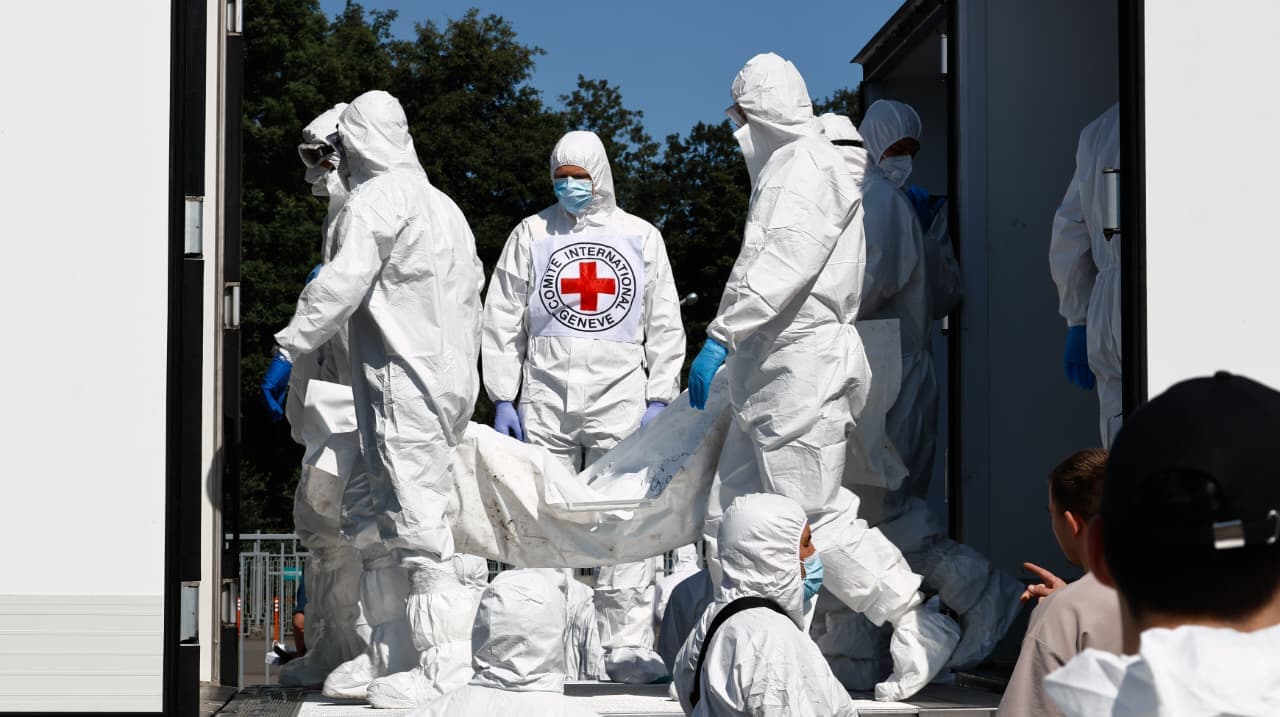
Ukraine received the remains of 261 people that Russia says are fallen Ukrainian servicemen, part of an ongoing exchange facilitated by Ukraine’s Coordination Headquarters for the Treatment of Prisoners of War and assisted by the International Committee of the Red Cross. Investigators will now run forensic identification on every set of remains — a process Ukraine has learned, painfully, to treat with caution, after previous exchanges turned up explosive devices hidden among returned bodies, and after Russia was found, on past occasions, to have quietly returned the bodies of its own soldiers alongside Ukraine’s, reportedly to avoid paying state compensation to their families.
 A resident walks among the rubble of destroyed and charred warehouses as a fire still burns following a Russian airstrike in Kramatorsk, Donetsk Oblast. (Francisco Richart/Anadolu via Getty Images)
Separately, the remains of Yevhen Konovalets — founder of the Organization of Ukrainian Nationalists and a central figure in Ukraine’s early-20th-century independence movement — were brought back to Ukraine and given full state and military honors. Konovalets spent his life in exile organizing Ukraine’s independence movement before a Soviet agent, posing as an ally, assassinated him in Rotterdam in 1938 with a bomb hidden inside a box of chocolates. He’ll be reburied at Ukraine’s National Military Memorial Cemetery outside Kyiv, part of a broader government effort to formally honor historical figures tied to the country’s long fight for independence — a fight this generation of Ukrainians recognizes as, in some form, still ongoing.
GRAIN ROUTES AND A PARTY THAT WON’T GO QUIET
Two smaller stories rounded out the day — one about keeping trade moving, the other about refusing to be silenced.
Moldova agreed to transit 600,000 metric tons of Ukrainian food products by rail through the end of 2026, Moldovan Prime Minister Vasile Tofan announced. It’s a modest but real lifeline: Ukraine has been unable to move agricultural exports through its own Black Sea ports for weeks because of escalating Russian attacks, and Moldova’s railways offer one more route around the blockade. Ukraine’s foreign minister thanked Moldova for what he called genuine solidarity. The volume covers just over 1 percent of Ukraine’s expected grain and oilseed exports this year — a reminder of how far alternate routes still fall short of what the Black Sea ports alone can carry. Ukraine’s agriculture minister has warned the country will start running out of storage space by October if the blockade continues.
Meanwhile in Moscow, Nikolai Rybakov, leader of Yabloko — Russia’s only registered anti-war party, barred earlier this month from September’s parliamentary elections — said he has no plans to leave the country despite the ban. “I am in Russia and will remain in Russia,” he told reporters at his Moscow headquarters, arguing that real political change can only be pushed from inside the country. Yabloko is appealing the court ruling that excluded it from the vote. Rybakov’s public defiance doesn’t change the party’s exclusion, but it signals that Russia’s small anti-war opposition — however marginalized — isn’t disappearing quietly.
AN ISLAND, A PORT, A TRUCE OFFER
By nightfall, the day had covered more distance than most: an island Japan hasn’t recognized as Russian in eighty years, a Baltic port a thousand miles from the front, a Sevastopol trash can, a Warsaw safehouse. Different geographies, same war.
Two train workers died trying to get passengers to safety. A recruit’s freedom was bought and sold for five thousand dollars in a Mykolaiv office. A century-old revolutionary finally came home to a cemetery that didn’t exist when he died fighting for the same idea Ukraine is still fighting for. And somewhere between Kyiv and Washington, a truce offer sits unanswered, waiting to find out whether this is the year an actual pause becomes possible, or just one more proposal that quietly disappears.
A PRAYER FOR UKRAINE
1. For the Train Driver and His Assistant
Lord, two men died today doing an ordinary job — trying to bring a train full of strangers safely to a stop before a drone found them first. They ran out of time by seconds, not minutes. We do not know their names, only their duty, faithfully carried out until the very end. Receive them, Lord, and comfort the families who will now wait for trains that no longer carry the people they loved home.
2. For the Ten-Year-Old Girl in Chernihiv
Father, a child was injured today in a drone strike on Chernihiv, one more young life touched by a war she never chose and cannot yet understand. We ask for her full healing, in body and in whatever fear now lingers in her sleep. Protect the children of this war from becoming numbers we recite without feeling. Let her grow up knowing more peace than she has known war.
3. For a Regiment’s Wounded and a Nation’s Missing
God of the lost, we lift up the men remembered today only as bodies coming home, and the soldiers whose worth was measured too cheaply by those meant to protect them. We pray for every recruit sent to fight without proper care, and for every family still waiting for a name to be confirmed. Give Ukraine leaders who count their soldiers as more than numbers on a roster, Lord, and grant rest to those returning at last.
4. For a President Asking the World for More
Lord of nations, we pray for the man carrying his country’s case to Washington and beyond, asking not for pity but for enough resolve from allies who could give more than they have. Give him wisdom in every difficult phone call, and give those he calls the courage to answer generously. Let the gap between promises made and promises kept grow smaller, not wider, as winter comes.
5. For Justice Across Every Border
God of justice, we pray for safety for those Russia has marked for death simply for opposing it — in Warsaw, in Sevastopol, in every city where this war reaches quietly, without warning. We pray for the diplomats, investigators, and ordinary citizens standing between the Kremlin and its targets. Let no hidden plot succeed, and let truth outlast every effort to bury it.
In Your mercy, in Your justice, in Your time — bring this war to its end, and let the ending be worthy of what Ukraine has endured.