
A Russian missile tore through the city of Dnipro during morning hours, killing five civilians and sending a 40-year-old man to the morgue while ten of the wounded fought for their lives in critical care — and that same night, 129 drones and four Kh-59/69 cruise missiles fanned out across Ukraine from Crimea to Kursk, striking a port in Odesa, a medical clinic in Kherson, and apartment balconies in Kharkiv. Against that backdrop, Zelensky flew to Berlin and then Oslo in a single day, signing a €4 billion German defense package and a Norwegian drone-production declaration that together represent the most significant European military commitment to Ukraine in months.
The Day’s Reckoning
Picture a Monday morning in Dnipro. Someone’s commute. Coffee still warm. Then the air raid sirens, the distant crack of a missile breaking the sound barrier — and at 11:30 a.m., an impact that killed five people, injured 27 more, and set a gas station ablaze while emergency workers pulled the living from rubble.
The strike on Dnipro happened to fall on the same day Volodymyr Zelensky was sitting across from German Chancellor Friedrich Merz in Berlin, signing a €4 billion defense agreement. Within hours he flew to Oslo and signed another. The juxtaposition was not accidental — it was the war’s central rhythm: Kyiv building tomorrow’s defenses while Russia burns today’s cities.
Overnight, the scale of the Russian aerial campaign came into focus: 129 drones and four cruise missiles — around 90 of them Iranian-designed Shaheds — struck from six directions simultaneously. Ukrainian defenses downed 115 of them, but 12 hit their marks across eight locations. A Panamanian-flagged cargo ship burned in Odesa’s port. A medical clinic in Kherson was hit during working hours. Chernihiv’s residential towers were damaged during morning rush.
Elsewhere: Russian forces tried crawling through a Soviet-era gas pipeline into Ukrainian lines in Sumy Oblast and were killed. The Russian State Duma passed a law authorizing Putin to deploy troops abroad to “protect” Russian citizens facing international prosecution — language so vague it could justify almost anything. And Viktor Orbán, the Kremlin’s most reliable European ally, lost power in Hungary. The day’s central tension: Russia striking civilians and passing laws to expand its reach, while the coalition around Ukraine quietly, steadily, grows stronger.
Dnipro Bleeds: The Missile That Landed During Morning Hours
The explosion in Dnipro came at 11:30 in the morning. Not at midnight, not during a declared military operation — during the working day, when people were on the street and in their cars. Ukraine’s Air Force had warned of a missile inbound, but warnings do not move fast enough for everyone.
By early afternoon, Dnipropetrovsk Oblast Governor Oleksandr Hanzha reported five dead and 27 injured, with 21 hospitalized and 10 in serious condition. One victim — a 40-year-old man — died of his wounds as doctors worked. The strike damaged civilian infrastructure, destroyed several vehicles, and detonated a nearby gas station, sending a fireball visible from blocks away.
The attack was a Kh-59/69 cruise missile — a precision-guided air-launched weapon designed to strike specific targets. The target in this case was civilian infrastructure. Russia launched overnight follow-on drone strikes toward the city as well, causing severe damage to an administrative building and a newly constructed nine-story apartment building, injuring three more people.
The strike came less than 48 hours after the expiration of Russia’s self-declared Easter ceasefire — a 32-hour window that Russian forces violated 10,721 times, according to Ukraine’s General Staff. The truce ended. The missiles followed.
The Night Sky Filled: 129 Drones, Four Missiles, Eight Targets Hit
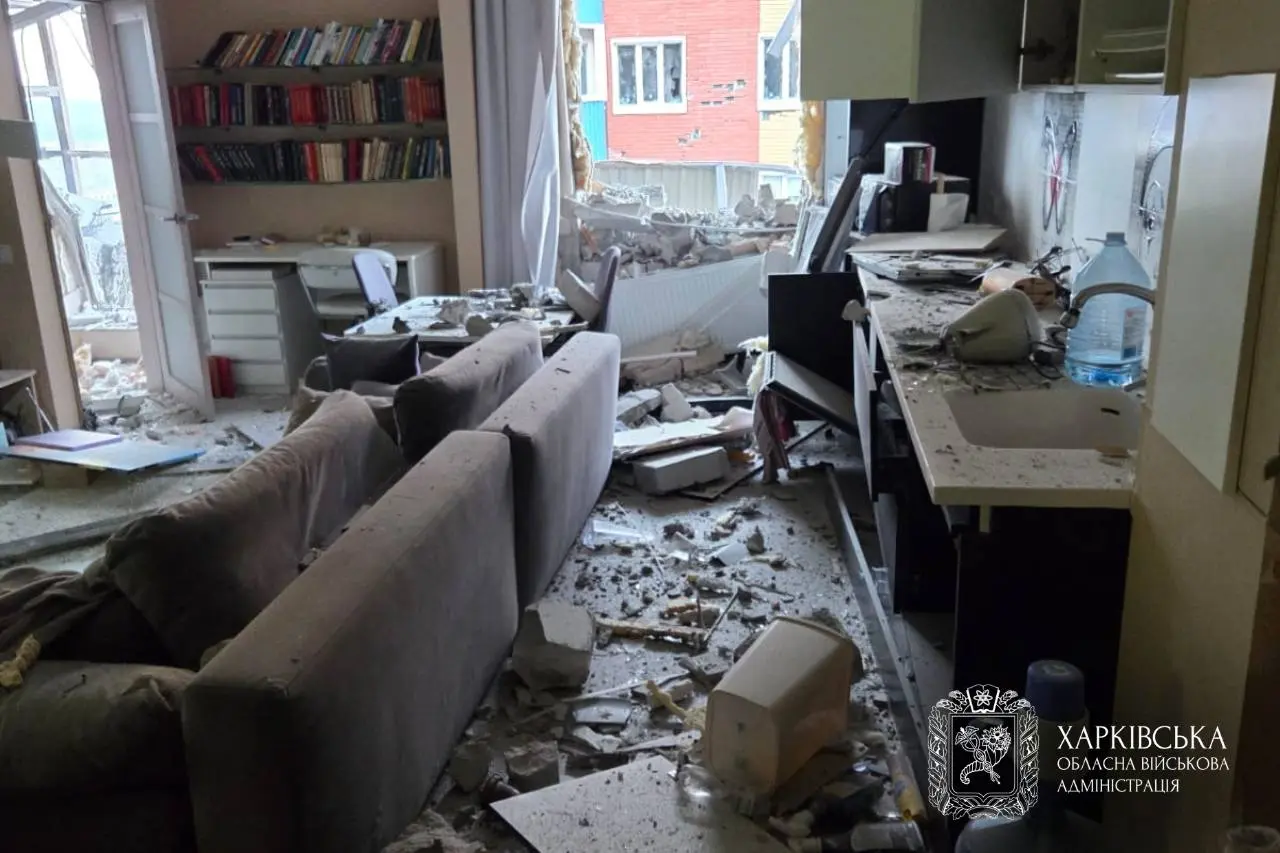
Aftermath of a Russian overnight attack in Kharkiv Oblast. (Local authorities)
Russia’s overnight campaign on April 13–14 was one of the war’s larger single-night aerial assaults. One hundred twenty-nine drones and four Kh-59/69 cruise missiles launched simultaneously from six directions: Kursk, Oryol, and Bryansk oblasts; Primorsko-Akhtarsk in Krasnodar Krai; occupied Donetsk City; and Cape Chauda in occupied Crimea. The coordination itself was a message — Russia’s aerial reach remains vast.
Ukrainian air defenses — aviation, missile batteries, electronic warfare units, and mobile fire teams — downed 114 drones and one cruise missile. Twelve drones got through, striking eight locations. Three missiles remained unaccounted for as of morning reporting. Among the drones were approximately 90 Shahed-type weapons: the Iranian-designed loitering munitions that have become Russia’s most prolific terror instrument. They were accompanied by Gerbera-type and Italmas-type variants — increasingly diverse drone families that challenge Ukrainian countermeasures.
The geographic spread of damage told the story: Chernihiv’s residential towers hit during morning rush hour. Kharkiv’s apartment balcony destroyed, its owner hospitalized in shock. Odesa’s port struck, a Panamanian-flagged cargo ship burning at its berth alongside pier equipment and a barge. In Kherson, a drone hit a medical clinic during working hours, injuring four staff members aged between 39 and 67. In Zaporizhzhia, an 86-year-old woman and a 17-year-old girl were wounded. Russian forces also attacked Kryvyi Rih twice in a single day.
Two people were killed and 14 injured in Kherson Oblast alone from drone strikes, artillery, and airstrikes on the same day. The breadth of the campaign — stretching from Odesa on the Black Sea coast to Chernihiv near the Belarusian border — was designed to overwhelm, disperse, and demoralize.
Targeting the Dam: Russia’s Attempted Flood Weapon Near Kharkiv
There is a moment in spring when the Pechenihy Reservoir, east of Kharkiv, reaches its fullest. Snowmelt flows in from the north; the water climbs toward its seasonal peak. Russian military planners apparently know this. On April 14, six guided glide bombs — unpowered but precision-steered munitions dropped from high-altitude aircraft — struck the area of the Pechenihy Dam in Kharkiv Oblast’s Chuhuiv district.
Four bombs struck the ground near the hydraulic structures. Two hit the water in the reservoir. None breached the dam itself. Ukraine’s 16th Army Corps conducted controlled discharges to reduce pressure on the structure, and the dam held. But the intent was clear: destroy it at peak water level, trigger flooding, and cut the ground lines of communication that Ukrainian forces use in northern Kharkiv Oblast. Succeed, and Russian forces advancing from the northeast gain a natural barrier on their own terms while Ukrainian supply lines drown.
When the bombs failed to cause physical damage, Russia launched an information operation. Pro-Russian Telegram channels — some purporting to originate in Kharkiv Oblast — spread false claims about a dam breach and emergency water releases. The Ukrainian military named it disinformation and pushed back publicly. The Pechenihy Reservoir supplies water to Kharkiv city and its surrounding communities. This was not the first attempt; ISW has previously assessed that Russian strikes on the dam are part of a deliberate battlefield air interdiction campaign.
Berlin and Oslo in One Day: The €4 Billion German Deal and Norway’s Drone Pact
Volodymyr Zelensky landed in Berlin while Dnipro was still burning. What he signed there — a €4 billion (∼$4.7 billion) defense cooperation package with German Chancellor Friedrich Merz — was among the most consequential bilateral agreements of the year. Ten cooperation agreements in total. A strategic partnership formalized.
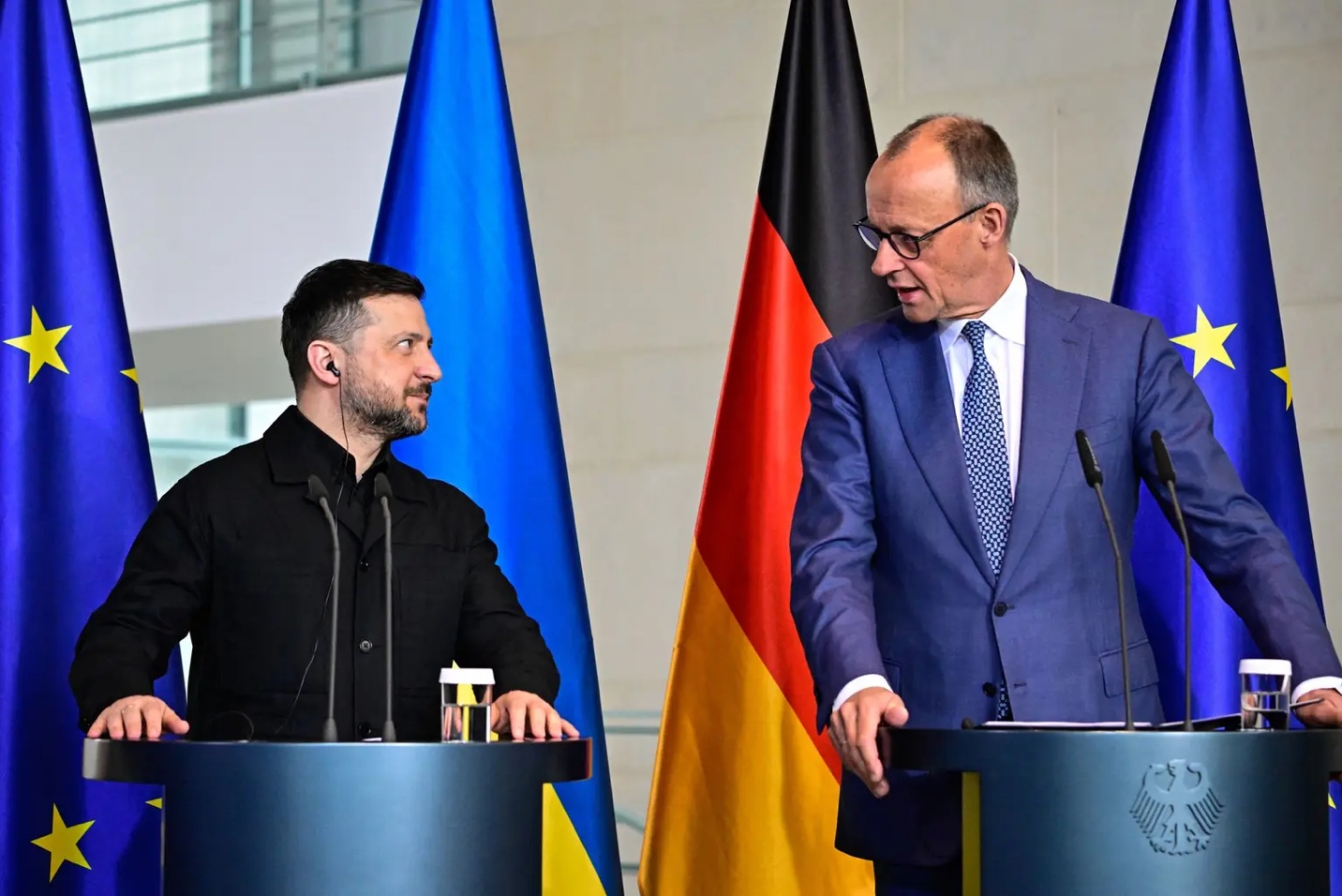
German Chancellor Friedrich Merz (R) and President Volodymyr Zelensky in Berlin. (Tobias Schwarz / AFP via Getty Images)
The specifics matter. Germany will finance a Raytheon contract with MBDA Deutschland worth €3.2 billion (∼$3.7 billion) for several hundred GEM-T missiles for Patriot air defense systems — the interceptors Ukraine needs most against the kind of missiles that hit Dnipro that morning. Germany will also provide 36 IRIS-T air defense system launchers, invest €300 million (∼$354 million) in Ukrainian long-range strike weapons production, and launch joint production of AI-guided mid-range drones. A memorandum of understanding on exchanging electronic military data was also signed.
From Berlin, Zelensky flew to Oslo. With Norwegian Prime Minister Jonas Gahr Støre, he signed a Joint Declaration on Enhanced Defense and Security Cooperation, centering on drone production, electronic warfare, maritime security, and military data sharing. Norway will support drone production inside Ukraine, and Ukrainian drones will also be manufactured on Norwegian soil. Norway has committed roughly $28 billion in support between 2023 and 2030 and plans €7.66 billion ($8.4 billion) in aid for 2026 alone — most of it military. Støre confirmed Norway is part of the “Coalition of the Willing” working on security guarantees alongside Britain, France, and Germany.
Ukrainian Defense Minister Mykhailo Fedorov noted that Ukraine produces most of its own weapons but could produce twice as much with adequate investment. Zelensky said the same. The deals in Berlin and Oslo were a direct response to that gap.
The Pipeline Gambit: 29 Russian Soldiers Crawl Toward Sumy and Die
They chose a gas pipeline. A Soviet-era tube running beneath the border, wide enough for a man in kit, long enough to bypass the minefields and drone surveillance that make open-ground infiltration suicidal. Twenty-nine Russian soldiers — roughly a platoon — crawled through it toward Ukrainian rear positions in Sumy Oblast, exploiting heavy weather and low visibility.
Ukraine’s 71st Separate Airmobile Brigade detected them and killed them all. The brigade noted this was not the first such attempt using the same route, and that Russian forces had “sustained heavy losses” there before. “The real goal of the occupiers appears to be ‘self-demilitarization,’” the brigade wrote with dark irony.
The tactic itself is not new. Russian forces used large pipelines during the final stages of the Battle of Avdiivka, during their operation in Sudzha in Kursk Oblast, and more recently near Kupyansk in Kharkiv Oblast. The pipelines are built to survive decades underground; they resist destruction even when Ukrainian forces know they’re being used. That Russia keeps attempting the same approach after repeated losses in the same pipe suggests either a shortage of better options or a command willing to spend lives on long-odds infiltration.
The broader pressure on Sumy Oblast remained significant. Russian forces probed near Myropilske, Yunakivka, and Andriivka, and Ukrainian forces on April 13 withdrew from positions near Myropilske to more defensible lines. The border area has become what analysts describe as a contested grey zone, with Russian forces deploying FPV drones — first-person view kamikaze drones — capable of striking closer to Sumy city itself.
Ukraine Strikes Back: Radar Stations, Drone Depots, and Caspian Oil Platforms
While Russia bombed cities, Ukraine was systematically dismantling Russia’s ability to see and shoot. On April 13, Ukrainian forces struck a Russian airspace control radar station near Nikolayevka and a Kasta-2E radar station near Lubyanoye-Pervoye, both in Russia’s Belgorod Oblast — 43 and 80 kilometers respectively from the Ukrainian border. The Kasta-2E is a mobile radar used for low-altitude aircraft detection; destroying it opens corridors for Ukrainian drones and aircraft.
Ukrainian forces also struck a Russian Nebo-U long-range radar station in Feodosia, occupied Crimea — roughly 240 kilometers from the front — and a Tor-M1 surface-to-air missile system near Lozove in occupied Luhansk Oblast. The Tor-M1 is a short-range air defense system; knocking it out reduces Russian capacity to intercept incoming Ukrainian strikes in that sector. Separately, Ukrainian forces conducted a SCALP-EG cruise missile and GBU-39 guided bomb strike against a Russian strike drone storage facility near Donetsk Airport in occupied territory — roughly 110 kilometers from the front line — with geolocated footage confirming multiple explosions.
In occupied Zaporizhzhia Oblast, Ukrainian forces struck a Russian ammunition depot in Azovske (94 kilometers from the front), a logistics hub, and a tanker truck — geolocated footage confirmed the truck strike near occupied Osypenko. In Crimea, explosions were reported in Simferopol, Feodosia, and Kerch overnight; a fire broke out at an electrical substation in Melitopol following a drone strike, cutting power to parts of the city.
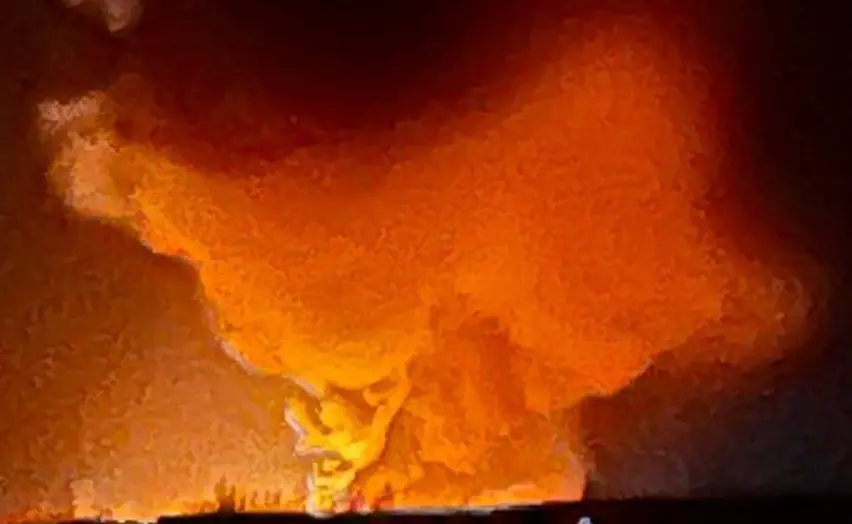
What purports to be an explosion at a substation in occupied Melitopol, Zaporizhzhia Oblast, following a drone strike. (Exilenova Plus/Telegram)
Perhaps the most strategically striking disclosure: on April 10, Ukrainian forces struck two Russian offshore oil-drilling platforms in the Caspian Sea — the LSP-1 and LSP-2 at the Yuri Korchagin and V. Grayfer fields, nearly 1,000 kilometers from the front. That distance implies the drones either transited third-nation airspace or launched from undisclosed forward positions. It also signals that Russia’s energy infrastructure has no true sanctuary.
Novorossiysk Still Limping: Ukraine’s April 5 Port Strike Holds Russia’s Oil Hostage
Nine days after Ukrainian strikes hit the Sheskharis oil terminal at the Russian port of Novorossiysk on the Black Sea, the damage was still visible in the data. Bloomberg reported on April 14, citing satellite imagery and shipping sources, that the two largest berths at the terminal had still not resumed oil loadings. Russia’s own sources had claimed on April 9 that loadings resumed after a week-long suspension, but satellite imagery told a different story.
Novorossiysk is Russia’s most important Black Sea export terminal. The Sheskharis terminal handles a significant portion of Russia’s oil exports to global markets. Every day those berths sit idle is a day Russia’s oil revenues contract — revenues that fund the war. Ukrainian strikes against export infrastructure have become one of the most economically damaging elements of Kyiv’s long-range campaign, hitting Russia where sanctions can’t always reach: at the physical point of export.
The Drone Famine Comes to Russia’s Own Forces: Moscow Centralizes Control
Russia’s drone war is getting a new bureaucracy — and frontline units are not happy about it. A prominent Russian military blogger reported on April 13 that the Russian Ministry of Defense has issued what he called a “new rule”: drones will no longer flow directly to all frontline units. Instead, they will be funneled exclusively through the newly established Unmanned Systems Forces (USF), with distribution personally overseen by USF Commander Lieutenant Colonel Yuri Vaganov.
The blogger, whose claims ISW could not independently verify, accused Vaganov of involvement in military corruption and warned that the new arrangement would create a drone “famine” among regular combat units. The analysis has strategic logic behind it: Russia has spent years building an informal, volunteer-driven drone procurement network where civic organizations, regional governments, and crowdfunding campaigns supplied drones directly to the troops. Centralization kills that agility.
ISW’s assessment: centralized control may allow Russian command to concentrate drones more heavily in priority sectors, but it also creates a state monopoly ripe for corruption and erodes the decentralized innovation that made Russia’s drone program adaptable. Ukraine, by contrast, has built its drone industry on speed, competition, and battlefield feedback loops. If Russia’s new system slows that feedback, it pays a price in battlefield effectiveness.
Putin’s New Law: The Kremlin Gives Itself Permission to Send Troops Anywhere
The Russian State Duma passed a law on April 14 that, on its surface, sounds administrative. In practice, it is an open-ended authorization for military intervention anywhere in the world. The law allows President Putin to deploy Russian armed forces overseas to “defend Russian citizens” being prosecuted in international or foreign courts — but only courts operating without Russian participation, or international bodies whose authority does not derive from Russian treaties or UN Security Council Chapter VII resolutions.
BBC’s Russian Service noted the phrasing is deliberate in its vagueness. The law does not apply to every Russian citizen abroad — only those prosecuted by bodies Russia considers illegitimate. That category, in Moscow’s framework, includes the International Criminal Court (which issued a warrant for Putin himself) and the Special Tribunal for the Crime of Aggression against Ukraine, which is currently being assembled within the Council of Europe.
The law appears designed primarily as a deterrence signal: Russia is telling the international legal community that prosecuting Russian officials carries military risk. Whether Putin would actually deploy troops to, say, The Hague, is almost certainly not the point. The point is to make signatories to the tribunal think twice. The passage of this law on the same day Iceland and Poland announced support for the Ukraine aggression tribunal was almost certainly not a coincidence.
The Tribunal Advances: 17 Nations Move Toward Prosecuting Russia’s War of Aggression
On the same day Russia passed its preemptive military deterrence law, Ukraine’s Foreign Minister Andrii Sybiha announced that Iceland and Poland had confirmed they would join the agreement to launch the Special Tribunal for the Crime of Aggression Against Ukraine. At least 17 European countries are now prepared to commit — meeting the minimum threshold required to bring the proposal to a vote at the Council of Europe’s May session.
The tribunal fills a specific legal gap. The International Criminal Court in The Hague can investigate war crimes committed during the conflict and has already issued arrest warrants for Putin and other Russian officials. But the ICC lacks jurisdiction over the crime of aggression in this case — the decision to launch the invasion itself. The Special Tribunal would hold that jurisdiction, targeting the senior political and military leadership who ordered the war.
Lithuania was the first country to sign the foundational agreement in November 2025. Austria, Denmark, the Netherlands, and Costa Rica — the only non-European signatory — followed. Sybiha was direct about the stakes: “Criminals in Moscow must realize that justice is inevitable.” The tribunal needs a host country and sufficient funding commitments before it becomes operational. The May vote will be a significant test of European political will.
Orbán Falls: Hungary’s Pro-Kremlin Era Ends in a Landslide
Viktor Orbán — the Hungarian prime minister who blocked EU aid packages, maintained warm ties with Moscow, and turned Budapest into a diplomatic outpost for Kremlin interests inside NATO — lost power in a landslide election with record voter turnout. European leaders greeted the result with barely concealed jubilation. Hillary Clinton called it “a resounding defeat for Putin.” The Kremlin, with characteristic revisionism, told its own media it had “never been friends” with Orbán.
Zelensky congratulated the opposition leader, and Ukraine lifted its travel advisory for Hungary. But the incoming prime minister’s early signals were mixed: he indicated he would still oppose Ukraine’s fast-track EU accession, would not immediately rule out Russian oil imports, and would likely push the EU to unblock the €90 billion ($103 billion) in frozen Ukraine aid rather than simply releasing it. The Kremlin’s most reliable veto inside the EU has been removed, but the successor’s positions on Ukraine remain cautious.
A curiosity on the same weekend: Slovenia’s parliamentary speaker proposed a referendum to leave NATO. Analysts noted the timing. Whether coincidence or coordination, the timing fed the suspicion that Russia’s influence operations in European politics did not end with Orbán.
The Fortress Belt: Why Russia Cannot Simply Win Its Way to Victory
Neither Russian nor Ukrainian forces made confirmed territorial advances on April 14. That stasis — unremarkable on any single day — accumulates meaning over time. ISW released a detailed terrain analysis placing the current frozen front in stark strategic context: the “Fortress Belt,” a 50-kilometer corridor of four large fortified Ukrainian cities in Donetsk Oblast, represents a defensive line that Russia cannot easily crack.
The numbers are sobering for Moscow. It took Russian forces nine months to seize Bakhmut, a city of 71,000 people. It took 22 months to take Pokrovsk, population 60,000. The four cities of the Fortress Belt average 93,000 residents each, with Kramatorsk and Slovyansk exceeding 100,000. The combined urban area is more than four times larger than Bakhmut, seven times larger than Pokrovsk. The belt sits atop elevated terrain with steep slopes that favor defenders. Its northern flank is anchored by the Siverskyi Donets and Oskil rivers.
ISW’s conclusion: even under optimistic assumptions favoring Russia, its forces could not capture the Fortress Belt before late 2027 at the earliest — and that estimate assumes continued international support for Ukraine. Russian forces advanced at 15 square kilometers per day on average in 2025; that rate dropped to 5.5 square kilometers per day in the first quarter of 2026. The trajectory is moving the wrong direction for Moscow. Russia’s negotiating strategy — demanding Ukraine surrender the Fortress Belt as part of a political settlement — is a demand for victory without winning it.
Ukraine Opens a Food Hub in Ghana: Soft Power and Hard Economics
Ukraine opened its first food processing and distribution center in Ghana on April 14, a move that quietly advances two objectives simultaneously: feeding people and winning a geopolitical contest with Russia for influence across Africa. Ghana spends $400 million annually importing wheat it cannot grow domestically. Food instability has reached a decade high in the country, affecting over 2 million people.
Ukraine is the world’s fifth-largest wheat exporter and fed roughly 400 million people annually before the war. The Ghana facility will process Ukrainian wheat and other foods into local distribution, with the opening marked by the delivery of 4,000 food kits to Ghanaian widows. Prime Minister Yuliia Svyrydenko described it as a “new format of our presence in the world, where humanitarian support is combined with the development of partnerships.”
The African market purchased $2.8 billion in Ukrainian agricultural goods last year. Following the resumption of EU trade quotas last summer, Ukrainian farmers pivoted aggressively toward Asia and Africa. Industry voices noted that a Ghana hub could serve as a gateway to West and Central African markets. The Grain from Ukraine program has delivered 324,000 tons of humanitarian food aid to 19 countries. The Ghana facility is the program’s evolution into permanent infrastructure — a physical stake in the continent’s food future.
The Ceasefire That Wasn’t: 10,721 Violations in 32 Hours
Russia’s Easter ceasefire lasted 32 hours in name and zero hours in practice. Announced by Putin after he had previously rejected Ukrainian calls for a similar pause, the truce ran from the evening of April 11 to the night of April 13. According to Ukraine’s General Staff, Russian forces violated it 10,721 times. Frontline clashes continued across multiple axes. Ukrainian troops in the Hulyaipole direction reported that Russian forces specifically targeted Ukrainian soldiers attempting to evacuate the bodies of their fallen comrades during the ceasefire — a war crime under the Geneva Conventions.
There were also reports that Russian forces executed four Ukrainian prisoners of war on the Sunday of the ceasefire, just one day after a major prisoner exchange. The ceasefire ended. Within hours, the drones were airborne again, and the missile that killed five people in Dnipro followed shortly after.
The Easter ceasefire’s failure was not a surprise — it was a demonstration. Russia was not offering peace; it was performing the language of peace for an international audience while maintaining its operational tempo. The American mediation effort continues, but Zelensky in Oslo noted pointedly that it would be “fair” for US envoys Steve Witkoff and Jared Kushner to visit Kyiv, after repeated trips to Moscow. The invitation was not accepted by the time reporting closed.
Closing
The man who died in Dnipro at 40 years old did not know, when he woke that morning, that his city was on Zelensky’s diplomatic itinerary. He did not know that €4 billion in Patriot missiles was being signed for in Berlin at roughly the same hour the missile was being loaded onto its plane. The weapons that might have saved him are now on order. They will arrive in months.
That is the gap the war lives in — the space between what is being built and what is needed today. Russia fills that gap with drones crawling through pipelines, bombs aimed at dams at peak flood, missiles sent to morning cities. The coalition fills it with agreements, launchers, and interceptors. The gap is closing. The question is how many more will die before it closes.
A Prayer for Ukraine
1. For the Five Who Did Not Come Home from Dnipro
Lord, a missile came at 11:30 in the morning — not at the hour of war, but at the hour of ordinary life. Five people who had woken up with plans for that day did not finish them. Among them, a 40-year-old man whose name we do not yet know. Be near to those who loved them, who are now learning how to hold the absence. Be present in the hospitals where ten people remain in critical condition, fighting to stay in the world. Let none of them fight alone.
2. For the Four Staff of a Kherson Clinic, and the 17-Year-Old in Zaporizhzhia
Father, a drone found a medical clinic during working hours. Four people who had come to heal others were themselves wounded. And in Zaporizhzhia, a 17-year-old whose life had barely begun was caught in the blast radius of a war he did not start. Extend your mercy over the healers who keep working after they themselves have been struck. Hold the young who carry wounds they should never have had to carry. Do not let their suffering be erased in the arithmetic of daily casualty reports.
3. For the 29 Who Went Through the Pipeline, and the Soldiers Who Stopped Them
God of justice, twenty-nine men crawled through a pipe in the dark toward men who were waiting for them. Both sides were following orders. Both sides knew the risk. The Ukrainians who held that line did not choose this war. Grant them something to return to when it ends. For the Russian soldiers who died in that pipe — men sent into a known kill zone for a cause the world has judged — grant them whatever mercy their commanders denied them in life. And be near to the brigade that stands watch tonight, still in the grey zone, still waiting for the next attempt.
4. For the Decision-Makers Carrying Impossible Weight
Lord, Zelensky flew from a signing ceremony to an overnight attack on his own people. He moved between rooms where history was being made and screens where the dead were being counted. Give wisdom to those who must sign agreements for weapons that will arrive too late for today’s victims but may save tomorrow’s. Give courage to the judges and diplomats assembling the tribunal that may one day reckon with this war’s architects. And grant discernment to those in Washington, Brussels, and Oslo who hold leverage they are still deciding whether to use.
5. For Justice, and for the Ending
God of history, seventeen nations moved today toward a tribunal that would name what this war is: aggression. A crime. Not a security operation, not a special military measure, but a decision made by named people who bear responsibility for every body pulled from rubble. May the tribunal come. May the indictments follow. May the reckoning be proportionate to what Ukraine has endured. And may the gap — the terrible gap between the weapons being signed for today and the missiles landing today — close before more names are added to the count.
In Your mercy, in Your justice, in Your time — bring this war to its end, and let the ending be worthy of what Ukraine has endured.