
UKRAINE DAILY BRIEFING
Tuesday, April 15, 2026 · Day 1,147 of the Full-Scale Invasion
Russia launched its largest drone-and-missile barrage in months overnight — 324 Shahed drones and three Iskander ballistic missiles — killing at least seven Ukrainians, including an eight-year-old boy in Cherkasy, while Ukrainian drones struck a petrochemical plant in Bashkortostan, 1,500 kilometers inside Russia, destroying the country’s only facility producing neodymium synthetic rubber for its military. At the Berlin arms summit, allies pledged the United Kingdom’s largest-ever drone package — 120,000 systems — alongside a German deal for hundreds of Patriot missiles, even as U.S. Vice President JD Vance declared that cutting Ukraine aid was among the Trump administration’s proudest achievements.
The Day’s Reckoning
Somewhere over Ukraine, in the small hours before dawn, the skies filled with engines. Three hundred and twenty-four Shahed drones — cheap, Iranian-designed, relentless — converged from six directions simultaneously: from Kursk, from Orel, from Millerovo, from the Krasnodar coast, from a Smolensk airfield, from occupied Crimea. Three Iskander ballistic missiles came with them. In Cherkasy, a city that rarely sees heavy bombardment, an eight-year-old boy died. In Dnipro, five people burned at a gas station hit by a missile on Monday evening. In Odesa, a man in his sixties died when his apartment building took a direct hit.
Ukrainian air defenses downed 309 of the drones — a 95 percent interception rate that is both a genuine achievement and a reminder of what gets through. The ballistic missiles were not intercepted at all. They never are. And while Kyiv’s defenders fought in the dark, Ukrainian forces were threading their own long-range drones through Russian airspace toward a target in Bashkortostan, 930 miles from the front line. The Sterlitamak Petrochemical Plant produces jet fuel additives and is Russia’s only manufacturer of a specialized synthetic rubber critical to military applications. By morning it was on fire.
In Berlin, more than fifty nations gathered for the 34th Ukraine Defense Contact Group meeting. The United Kingdom announced 120,000 drones — its largest-ever package. Germany confirmed hundreds of Patriot missiles. Norway, Belgium, Spain followed with pledges of their own. But the Patriot missiles won’t arrive until 2027 at the earliest, and the man who once led American weapons policy toward Ukraine called cutting off that aid one of the things he is proudest of. The gap between what Ukraine needs tonight and what will arrive in two years is where people die.
The Night the Sky Filled: Russia’s 327-Weapon Barrage

A residential building in Dnipro was damaged during overnight Russian strikes. (Dnipropetrovsk Oblast Military Administration)
Imagine driving past a gas station in Dnipro at the wrong moment on Monday evening. The Iskander-M comes in near-vertically, at Mach 6, with no warning audible until after impact. Five people died at that station. Twenty-seven others were injured. The same night — extending into the predawn hours of April 15 — Russia launched what the Ukrainian Air Force described as 324 Shahed-type and Italmas-type drones from six directions at once, a deliberate attempt to saturate Ukrainian air defenses by forcing them to track and engage from every compass point simultaneously.
Ukrainian air defenses performed at remarkable efficiency, destroying 309 of the drones — roughly 95 percent. But the three ballistic missiles were not touched. Patriot systems are among the only weapons capable of intercepting them, and Ukraine’s supply is critically short. Defense Minister Mykhailo Fedorov disclosed at the Berlin summit that from November 2025 through March 2026, Russia fired 462 ballistic missiles at Ukraine. He notably declined to give an interception rate for that category — the silence itself was the answer.
The breadth of what struck Ukraine across both nights was staggering. Dnipro was hit twice. Cherkasy — rarely targeted — received an unusually heavy drone barrage that killed an eight-year-old boy and injured 16. Kherson Oblast absorbed strikes that killed one and injured 13. Kharkiv Oblast was hit by glide bombs north of the city, injuring five. Port and residential infrastructure in Odesa was struck. Kyiv Oblast escaped casualties. In Odesa a residential building lost three apartments to direct impact and a fourth to fire; a man approximately 60 years old did not survive.
1,500 Kilometers Deep: The Sterlitamak Strike
The Sterlitamak Petrochemical Plant sits in the Republic of Bashkortostan, east of the Ural Mountains, deeper inside Russia than Ukrainian drones have routinely reached. At approximately 11 a.m. local time on April 15, a Ukrainian Antonov-made Liutyi long-range drone — captured on video — struck the facility and set it on fire. Ukraine’s Unmanned Systems Forces Commander, Major Robert “Magyar” Brovdi, confirmed the strike and described its purpose in terms that went beyond the material target.
“Not just to chip away at the enemy’s military-industrial complex,” Brovdi wrote, “but to shatter the very illusion of security regarding the depth of the enemy’s rear, right down to its densest jungles.” The Sterlitamak plant is significant on both counts. It produces jet fuel additives critical to Russian aviation, and it is the only Russian manufacturer of neodymium synthetic rubber — a material used in specialized military systems. Russian regional governor Radiy Khabirov claimed drones were shot down over the industrial zone and that only debris fell on the plant. Geolocated video of the drone striking the facility directly contradicted that account.
A fire department driver was killed in the attack, according to Khabirov’s own subsequent Telegram post — a detail that undermined the official narrative of a successful interception. The strike was part of a broader campaign: Ukraine’s Unmanned Systems Forces damaged 76 Russian targets in March alone, including 15 oil-refining facilities. The same overnight period saw Ukrainian forces strike a Russian S-400 air defense radar near Krasnohirske, an equipment depot near Rybynske, a drone depot near Hirne, and — in occupied Mariupol — a Tor-M1 air defense system and railway fuel tankers. Ukraine’s campaign to degrade Russian military infrastructure now spans thousands of kilometers of Russian territory.
Guns and Gunpowder: Mysterious Explosions at Russian Weapons Factories
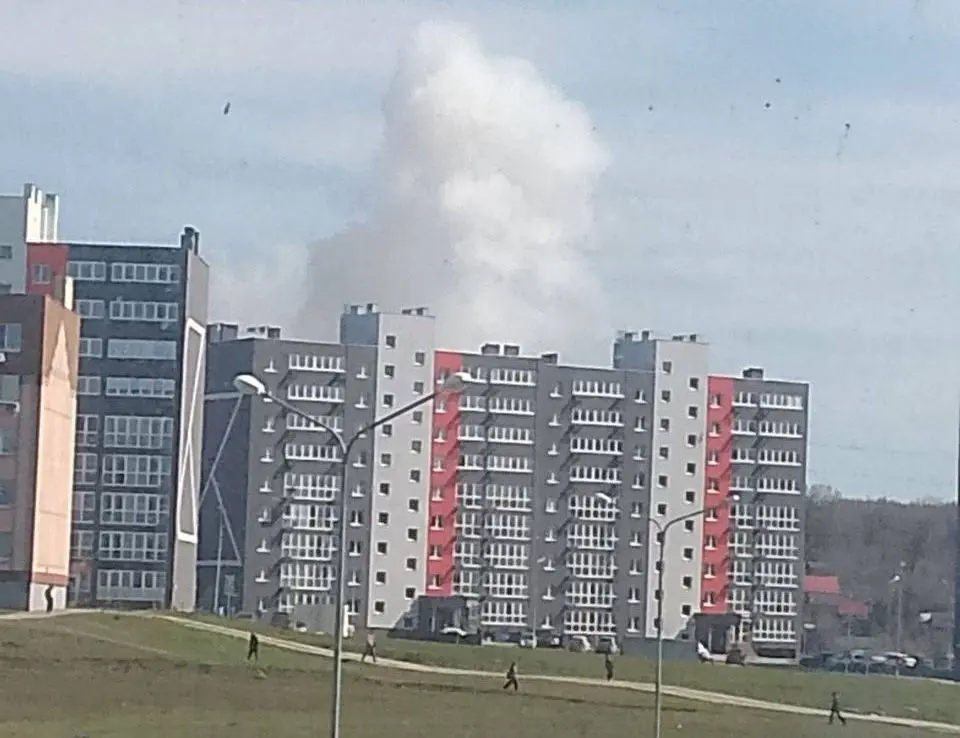
A column of smoke rises above the site where a gunpowder factory is reportedly located in the city of Samara, Russia, following an explosion. (Exilenova+/Telegram)
Two Russian military manufacturing facilities erupted in explosions and fire on April 14 and 15, and neither incident has been claimed by Ukraine — which is itself a form of ambiguity that Kyiv has learned to cultivate. The first blast struck the Kazan Gunpowder Plant in Tatarstan on the evening of April 14, killing one person and hospitalizing two others with burns. Russian authorities attributed the explosion to a malfunctioning pressure relief valve and said a building had partially collapsed. The facility produces gunpowder for small arms and artillery — the same artillery that fires tens of thousands of rounds per day along the eastern front.
The following afternoon, an explosion and fire broke out at the Kommunar plant in Petra Dubrava, Samara Oblast — a state-owned facility that produces ammunition and gunpowder components for the Russian defense complex. The regional governor confirmed the fire but reported no casualties. Russian-language independent outlet Astra reported on both incidents, noting their significance to the defense industrial supply chain.
Whether these were Ukrainian strikes, sabotage operations, or industrial accidents born of the breakneck production pace Russia has maintained since 2022 remains unconfirmed. What is certain is that Russia has been running its defense factories at extraordinary tempo — and that tempo creates its own dangers. Each disruption to gunpowder production, however brief, compounds pressure on a supply chain already straining to sustain a war that consumes ammunition at industrial scale.
The Berlin Summit: Drones and Promises, Missiles and Delays
More than fifty nations gathered at the 34th Ukraine Defense Contact Group meeting in Berlin — the Ramstein group, as it is commonly known — and by any measure of headline numbers, the pledges were significant. The United Kingdom announced its largest-ever drone package for Ukraine: 120,000 systems in 2026, including long-range strike drones, reconnaissance drones, logistics drones, and maritime capabilities, with deliveries already underway this month. German Defense Minister Boris Pistorius confirmed a 4-billion-euro ($4.7 billion) package signed the previous day, anchored by hundreds of Patriot air defense missiles. Norway pledged a major drone cooperation framework in which Ukraine will share battlefield data and production knowledge in exchange for Norwegian funding of drone manufacturing on Ukrainian soil.
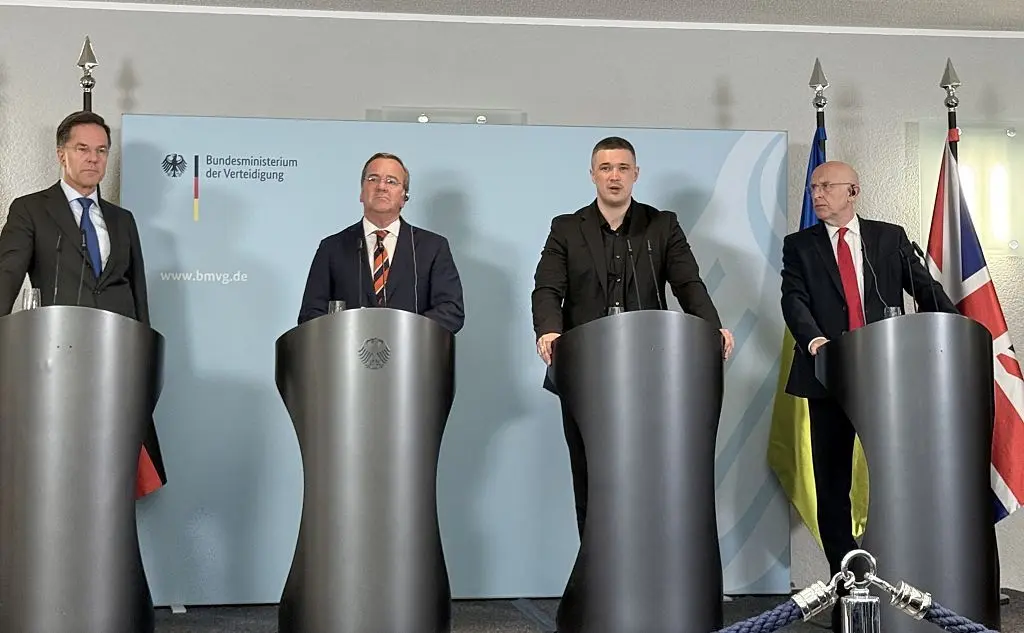
German Defense Minister Boris Pistorius (2nd from L), NATO Secretary General Mark Rutte (1st from L), British Defense Minister John Healey (1st from R), and Defense Minister Mykhailo Fedorov hold a joint press conference following the Ukraine Defense Contact Group meeting held in Berlin, Germany. (Erbil Basay/Anadolu via Getty Images)
The problem is the calendar. Ukrainian Defense Minister Mykhailo Fedorov disclosed at the Berlin press conference that the German Patriot missiles are scheduled to arrive between 2027 and 2029. Ukraine is being struck by ballistic missiles tonight. Fedorov acknowledged that Ukraine’s cruise missile interception rate has reached 80 percent and drone interception 90 percent — genuine achievements — but pointedly did not cite a ballistic missile interception rate, because the answer would be close to zero. Patriot systems are the only reliable defense against ballistic missiles, and every month without them is a month of uncountable losses.
Raytheon simultaneously announced a $3.7 billion contract, funded by Germany, to produce Patriot Advanced Capability-2 GEM-T missiles inside Germany for Ukraine. NATO Secretary General Mark Rutte said allies “can do even better” in burden-sharing. UK Defence Secretary John Healey said that Putin “wants us to be distracted” by the Middle East and that Britain would not be. When reporters pressed Rutte on whether U.S. deliveries through NATO’s Prioritized Ukraine Requirements List (PURL) would continue — after reports that the Pentagon was considering diverting weapons to its own stockpile — he said the flow continues, then said both sides need to refill stockpiles, then offered no specifics. The ambiguity was not reassuring.
Vance’s Pride: America Steps Back, Europe Steps In
JD Vance said the quiet part loudly. Speaking at a Turning Point USA event in Athens, Georgia on April 14, the U.S. Vice President described cutting off military aid to Ukraine as “one of the things I’m proudest that we’ve done in this administration.” He framed it as a principled transfer of responsibility: Europe wants to support Ukraine, so Europe can buy the weapons. “The United States is not buying weapons and sending them to Ukraine anymore,” Vance said. “We are out of that business.”
He also recounted a confrontation with a Ukrainian-American voter during his Senate campaign, a man who pleaded with him to support Ukraine. Vance said he replied: “Sir, with all due respect, if you’re an American, your country is the United States of America, not a place that you immigrated from.” The anecdote was offered as a point of pride. In Berlin the same day, European allies were spending billions to fill the gap that pride had created.
President Zelensky, in a separate interview with German ZDF broadcast April 14, was careful in his characterization of Trump but direct about the consequences. “If the U.S. does not put pressure on Russia, then they will no longer be afraid,” Zelensky said. He described Trump as staying “in the middle” — neither supporting Ukraine nor Russia — and suggested that posture alone hands Moscow an advantage. The Patriot shortage Zelensky described as being in “such a deficit it could not be any worse” is a direct consequence of policies Vance is proud of. The seven Ukrainians killed overnight are downstream of that pride.
Drone Assault Units: Ukraine’s New Model of Warfare
On the same day Russia was launching 324 drones at Ukrainian cities, Ukraine’s Defense Ministry announced a new battlefield doctrine: drone assault units that combine aerial drones, ground drones, and infantry into a single integrated system. The announcement was not theoretical. The ministry said the units have already produced results in the south, where territory has been liberated since February specifically through their deployment.
Commander-in-Chief Oleksandr Syrskyi reported that Ukrainian forces regained nearly 50 square kilometers of territory in March alone, with Russian personnel losses increasing 29 percent, largely due to strikes by Unmanned Systems Forces. Zelensky had previously noted that Ukrainian drones carried out more than 22,000 front-line missions over three months. “A robot went into the most dangerous zones instead of a soldier,” Zelensky said. “This is about high technology protecting the highest value: human life.”
The shift reflects an adaptation that Ukraine has driven faster than any other military in the world: the integration of unmanned ground vehicles with aerial systems and infantry into coherent combined-arms units. Syrskyi also highlighted a tactical innovation — Ukraine’s Air Assault Forces are now using underground routes to move troops and equipment, reducing vulnerability to the Russian drone surveillance that has made above-ground movement lethal. The ministry said tens of thousands of unmanned ground systems have already been produced. Norway’s drone cooperation deal, signed the previous day, will accelerate delivery of these systems to the front.
The Kostyantynivka Grinder: Russia Pressures Its Own Commanders
The city of Kostyantynivka sits in central Donetsk Oblast, a fortified urban node that Russia’s summer-fall 2026 offensive has been designed to capture. Russian forces have reached its eastern outskirts and are contesting a “gray zone” in the southeast. What they have not done is break through. Ukrainian military observer Kostyantyn Mashovets reported on April 15 that the Russian military command is pressuring field commanders to accelerate the rate of advance — a sign that Moscow’s timeline is slipping.
Russian forces are attempting to push Ukrainian defenders northward through persistent pressure near Ivanopillya and Pleshchiivka, trying to infiltrate rather than frontally assault. But Mashovets assessed that Russian forces have not yet reached a position from which they could meaningfully threaten Kramatorsk — the next major city and the strategic prize — from the south. Doing so is a prerequisite for the offensive’s broader goals, and Russia is incurring what Mashovets described as “high casualties” without achieving it.
Around 2,500 civilians remain trapped in Kostyantynivka. Oblast head Vadym Filashkin reported that Russian strikes along the frontline have made evacuation nearly impossible. ISW has assessed that Russian forces are deliberately using FPV drones to target civilians — not as collateral damage, but as an intentional tool of war. Elsewhere along the eastern front, Ukrainian forces recently advanced in central Zakitne northeast of Slovyansk and made marginal gains east of Kostyantynivka and in southern Berestok. Neither side is breaking through. The war grinds at the cost of lives that cannot be replaced.
The Grain Ship and the Stolen Harvest: Ukraine Appeals to Israel
On April 14, Ukrainian Foreign Minister Andrii Sybiha called his Israeli counterpart Gideon Sa’ar about a ship. The Russian bulk carrier Abinsk had docked at the Israeli port of Haifa on April 12, carrying nearly 44,000 tons of wheat. Ukrainian investigators say the grain was taken from occupied Ukrainian territories — seized from farms Russia now controls in Zaporizhia or Kherson Oblast, loaded onto the vessel through ship-to-ship transfers at Russia’s Port of Kavkaz in Krasnodar, and exported to global markets via what Ukraine calls Russia’s shadow fleet.
The Abinsk had idled near Israeli shores since March 23 before receiving permission to dock — three weeks in which Ukraine shared its intelligence findings with Israel. By April 15 the ship had departed and was sailing toward the Dardanelles, carrying its cargo toward new buyers. Sybiha called the export of stolen agricultural products “part of Russia’s broader war effort” that “must not be allowed.” Ukraine’s Prosecutor General met the Israeli ambassador in Kyiv the same day to request formal international legal assistance.
The incident illuminates a dimension of Russia’s war rarely visible: the systematic looting of Ukrainian agriculture at scale. Ukraine’s economy ministry has said Russia’s attacks on ports and logistics infrastructure have reduced monthly shipping volumes by 20 to 30 percent, leaving a surplus of 10 million tonnes of unsold grain in 2025. Russia steals what Ukraine cannot export. Israel, which has carefully maintained working relationships with Moscow to protect its military freedom of action in Syria, has not provided Ukraine with military aid. The Abinsk incident may test whether that balance has limits.
Grain Corridor Under Fire: Russia Strikes Merchant Ships in the Black Sea
Russia struck a Liberia-flagged grain vessel in the Black Sea on Tuesday morning with a drone, setting the ship on fire. The vessel was sailing toward Odesa ports to load corn when it was hit. Its crew extinguished the fire and the ship continued to its destination — but the message was deliberate. The same night, a Panama-flagged ship at the port of Izmail in the Odesa region was struck multiple times, with documented hits on port infrastructure. Ports were reported operational afterward, with restoration work underway.
These attacks follow a pattern that Ukraine’s exporters have been documenting for months. In March, Ukrainian companies reported that Russia’s repeated strikes on ports, railways, and energy infrastructure had doubled transport costs, disrupted export planning, and forced constant cargo rerouting. The maritime corridor through the Black Sea is the most economically critical export route Ukraine has. Each strike against it is not merely an act of military harassment — it is an act of economic warfare against a country whose agricultural exports fund its defense.
Fancy Bear in the Files: Russian Hackers Target Ukrainian Prosecutors
A Russian military hacking group known as Fancy Bear — the same outfit linked to the 2016 U.S. election interference — compromised more than 284 email inboxes belonging to Ukrainian prosecutors and investigators between September 2024 and March 2026, cybersecurity researchers Ctrl-Alt-Intel reported on April 15, with Reuters citing the findings. The targets were not random. The hackers specifically penetrated the Specialized Prosecutor’s Office in the Field of Defense — the body responsible for prosecuting corruption and identifying Russian spies within the Ukrainian military.
They also targeted the Asset Recovery and Management Agency, which administers assets confiscated from criminals, and the Specialized Anti-Corruption Prosecutor’s Office. Named victims included the acting head of the asset recovery agency and a deputy head of the Prosecutors’ Training Center. The likely goal, according to Chatham House associate fellow Keir Giles, was either intelligence on Russian spies under investigation or compromising materials on Ukrainian senior officials.
The operation extended beyond Ukraine, targeting prosecutors in NATO countries and the Balkans as well — suggesting a broader effort to map the legal and intelligence infrastructure that Western nations are building to document Russian war crimes and enforce sanctions. The SAPO spokesperson said no evidence of data theft has yet been found, which is either reassuring or reflects the limits of what can be verified after a 17-month intrusion campaign.
Cuba’s Soldiers in Russia’s War: The State Department Speaks
In an unclassified five-page report sent to congressional committees on April 8, the U.S. State Department concluded that Cuba’s government knowingly facilitated the flow of its citizens to fight in Russia’s war against Ukraine. The report estimated that between 1,000 and 5,000 Cuban nationals are fighting for Russia at any given time, with Ukrainian intelligence suggesting several thousand are deployed directly to frontline positions. “Cuban nationals have emerged as one of the largest identifiable groups of foreign fighters supporting Russian military operations in Ukraine,” the report stated.
The department stopped short of saying Cuba officially dispatched all fighters but said there are “significant indicators” that Havana “knowingly tolerated, enabled, or selectively facilitated the flow.” Cuba’s government launched a nominal criminal investigation in 2023 when the presence of Cuban fighters was first widely reported, but the State Department said Cuba’s judicial system is too opaque to verify those claims. Cuban President Miguel Díaz-Canel has responded to U.S. pressure with defiance: “We’ll defend ourselves, and if we need to die, we’ll die.”
Russia has increasingly turned to foreign fighters and mercenaries as the war demands more manpower than domestic mobilization can quietly provide. In July 2025, Putin signed a decree formally allowing foreigners to serve in the Russian Armed Forces, removing a previous restriction that limited foreign service to declared emergencies. Analysts describe this as an effort to replenish Russian ranks while avoiding the political cost of a second mass mobilization. The Cuban pipeline — whether state-directed or state-tolerated — provides Moscow with a supply of fighters who have few other economic options.
The Economics of Russian Corruption: Bribes to Avoid Death
A soldier named Mikhail joined the Russian military to pay for his sick mother’s treatment. When he arrived at the front, his commander told him he would be sent on a “meat assault” — a human wave attack with little tactical purpose and high expected casualties — unless he provided money for an all-terrain vehicle. Mikhail paid. He handed over his debit card and was charged one million rubles — roughly $11,000 at current rates. His mother remains ill. He is alive, at least for now.
Meduza, the independent Russian-language news outlet, published an investigation documenting systematic extortion within the Russian military that appears to be near-universal. Bribes for leave range from 50,000 to 500,000 rubles. Avoiding “meat assault” assignments costs up to one million. Obtaining a fake wound certificate — which qualifies a soldier for leave and compensation — can cost six million rubles, approximately $67,000. A second soldier, Ilya, told Meduza that commanders themselves were saving to buy wound certificates. “They just don’t want to fight,” he said.
Soldiers who cannot or will not pay are moved closer to the front to increase the probability of their death. “Either you agree to pay, or you know the consequences.” Terminating a contract is, by multiple accounts, essentially impossible regardless of injury. The system is self-sustaining: enlistment bonuses create cash, commanders extract that cash, the cash funds the corruption, and men die in assaults that their officers have paid to avoid. This is the internal machinery of Russia’s military. It is currently fighting, and losing men, across hundreds of kilometers of front.
Russia’s Sanctions Catastrophe: The Numbers Leak Out
Latvia’s Security Service published an assessment on April 15 based on Russian internal documents revealing the true economic cost of Western sanctions — figures that diverge sharply from Moscow’s public claims of economic resilience. Russia has spent approximately $130 billion over four years attempting to circumvent sanctions and procure restricted Western goods through intermediary networks. Additional projected losses through 2030 reach another $136 billion. In the energy sector alone, a full EU embargo on Russian energy exports could cost $216.5 billion.
The sectoral damage already visible in the data is severe. Iron ore exports are down 40 percent. Ferrous metals down 20 percent. Chemical products down 35 percent. Wood and cellulose down 50 percent. Behind these numbers are higher logistics costs, falling corporate profitability, reduced budget revenues, and what Latvian analysts describe as long-term structural distortions that will not be reversible soon. These are not temporary shocks that adjust back to equilibrium. They are the compounding consequences of an economy reorganized around war and cut off from the technology and markets it depends on.
Russia’s Foreign Intelligence Service findings, separately cited by Ukrainian intelligence, also show that internal Russian assessments acknowledge a broader economic decline despite public claims of adaptation. The Latvian analysis is particularly pointed on one implication: any easing of sanctions is expected only to accelerate Russian remilitarization and strengthen its support for anti-Western regimes globally. The pressure is working. Releasing it early would be a gift to the Kremlin that sanctions were designed to prevent.
Orban Falls, Magyar Rises, and Trump Shrugs
Viktor Orban — who hosted JD Vance in Budapest last week in a last-ditch campaign appearance — lost the Hungarian parliamentary election on April 12 in what observers called a resounding defeat. His rival, Peter Magyar of the center-right Tisza party, secured a parliamentary supermajority. Orban had governed Hungary for 16 years, spending that era systematically dismantling democratic institutions, deepening economic ties with Russia, and blocking EU measures to support Ukraine — including the 20th sanctions package, currently stalled in Budapest.
Trump, who had endorsed Orban and sent his vice president to campaign for him, told ABC News journalist Jonathan Karl on April 15 that he was not particularly troubled. “I think the new man’s going to do a good job — he’s a good man,” Trump said of Magyar. He added that he wasn’t sure his own presence in Budapest would have changed the outcome since Orban “was behind substantially.” The performance suggested Trump’s relationship with Orban was transactional rather than ideological — valuable when winning, easily discarded when not.
Magyar has pledged to root out the corruption of the Orban era and normalize Hungary’s relationship with the EU. He is also viewed as a conservative with a strict immigration stance — making him palatable to EU skeptics within the center-right. He met Hungary’s president on April 15 after calling for a swift transfer of power, aiming to take office by early May. The most immediate consequence for Ukraine: the EU’s blocked 20th sanctions package against Russia may find a path forward once Budapest changes hands. Zelensky, in Rome for talks with Italian PM Giorgia Meloni the same day, specifically raised the issue.
Zelensky in Rome: Drones, Diplomacy, and an Uncomfortable Dinner
Zelensky landed in Rome on April 15 for talks with Italian Prime Minister Giorgia Meloni at the Chigi Palace, continuing a diplomatic sprint that took him through Oslo and Berlin on April 14. In the Berlin stop he signed a strategic partnership with Germany and secured the Patriot deal. In Oslo he signed a defense declaration on drone cooperation with Norway. In Rome the agenda centered on drone production partnerships, air defense integration, Ukraine’s EU membership path, and the €90 billion EU macro-financial assistance package.
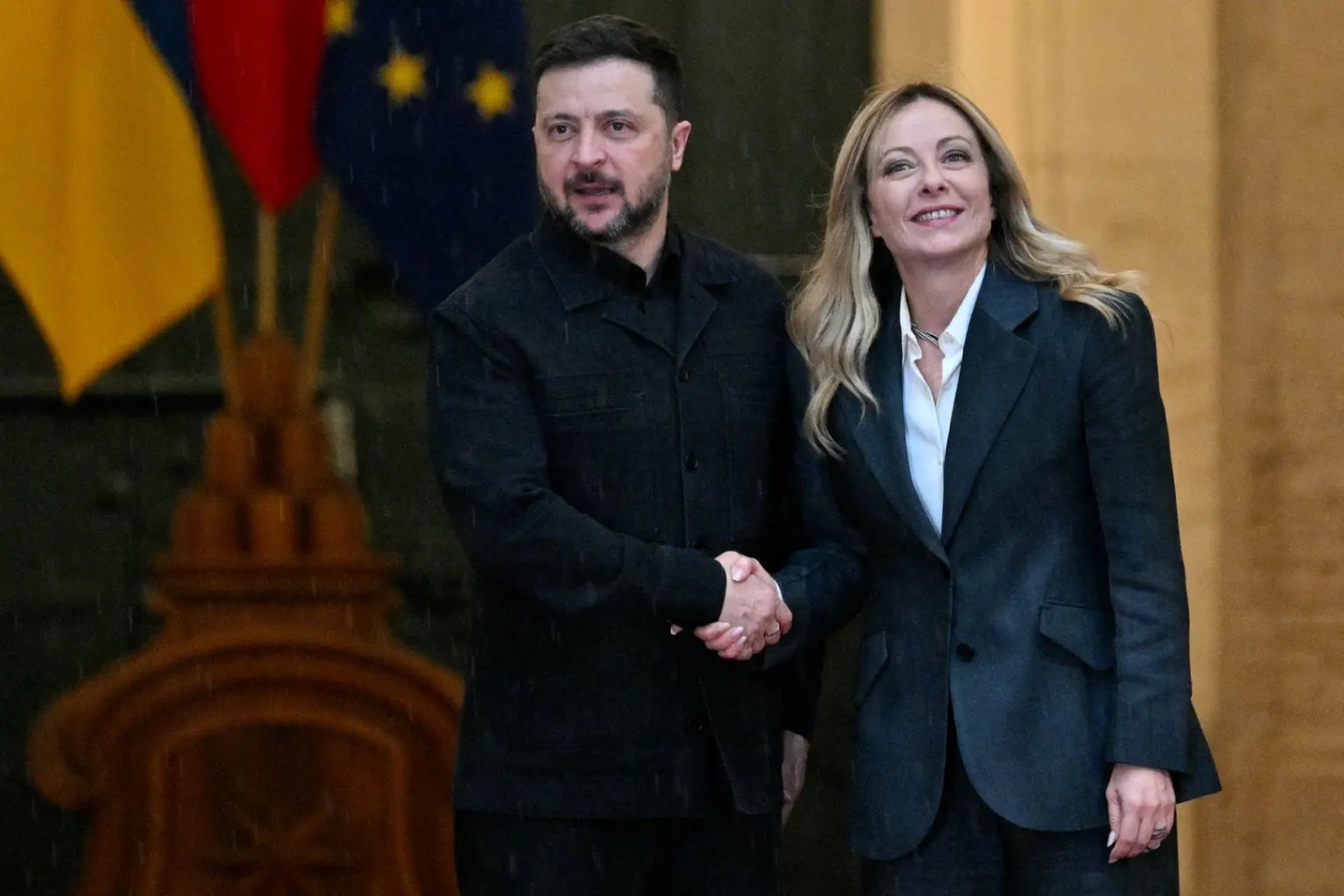
Italy’s Prime Minister, Giorgia Meloni, welcomes Ukraine’s President Volodymyr Zelensky at Palazzo Chigi prior to their meeting in Rome. (Tiziana Fabi / AFP via Getty Images)
Meloni expressed interest in joint drone production and voiced support for the EU’s 20th sanctions package against Russia — the one currently blocked by Orban’s Hungary. “War has changed,” Zelensky told the joint press conference. “We all need a truly effective defense system that can protect against any threats.” Ukraine, having spent four years developing anti-drone systems and doctrine against Iranian-designed Shaheds, is now offering that expertise to Middle Eastern partners as well, including Gulf states that have signed 10-year defense partnerships with Kyiv.
The diplomatic backdrop is complicated by the relationship between Meloni and Trump, which has become publicly strained after Trump criticized Pope Leo XIV and Meloni distanced herself from his remarks, prompting Trump to call her comments “shocking.” Meloni is trying to maintain ties with Washington while holding firm on Ukraine — a balance that is becoming geometrically more difficult as U.S. policy diverges from European consensus. Zelensky also met Italian President Sergio Mattarella, who affirmed the “deep friendship” between the two nations.
Peace Talks Frozen: Witkoff and Kushner Consider the Trip They Haven’t Made
A U.S. official confirmed to reporters on April 15 that the Trump administration is discussing a potential visit to Kyiv by envoys Steve Witkoff and Jared Kushner — the men who lead U.S. peace mediation between Ukraine and Russia. If it happens, it will be the first time either envoy has visited Ukraine. Both have traveled to Moscow multiple times to meet Vladimir Putin. Zelensky noted the asymmetry publicly, saying it would be “only fair” for them to see Kyiv after multiple Moscow trips.
The discussions are preliminary. No dates have been confirmed. The envoys’ schedules are complicated by their simultaneous involvement in U.S.-Iran peace negotiations, which have consumed Washington’s diplomatic bandwidth in recent weeks. The peace process itself has stalled: Russia continues to demand that Ukrainian forces withdraw from parts of Ukraine’s Donbas currently under Kyiv’s control, a position Kyiv considers non-negotiable. Moscow has not moved from maximalist demands. Ukraine’s position has been that any settlement requires security guarantees capable of actually deterring future Russian aggression — the kind Washington is unwilling to provide and Europe cannot deliver alone.
Zelensky, asked about the expected visit, said it was “difficult to say” whether it would occur and whether talks might instead happen in a third location. He described Trump as staying “in the middle” — and suggested that this neutrality itself constitutes a form of Russian advantage. A mediator who refuses to apply pressure to the aggressor is not, functionally, a mediator. The war continues while the calendar fills with meetings that haven’t happened yet.
Russia’s Threat: European Drone Makers Are Legitimate Targets
Russia’s Defense Ministry issued a warning on April 15 that it has identified and published the names and addresses of European companies involved in manufacturing components for Ukrainian drones. The ministry named cities including London, Munich, Prague, and Riga as production centers, and claimed that European support for Ukraine’s drone capabilities could lead to “unpredictable consequences.” Russia accused these countries of becoming part of Ukraine’s “strategic rear” — a framing that implies potential military targeting.
The threat arrives as the UK’s 120,000-drone package — funded largely through British companies Tekever, Windracers, and Malloy Aeronautics — is entering delivery. It also follows Ukraine’s formal announcement of its drone assault unit doctrine, which integrates these systems into combined-arms frontline operations. Russia’s message is not subtle: build weapons for Ukraine, and you may become a target. The message is intended to intimidate European defense manufacturers into self-censorship — to make them calculate whether a defense contract is worth the risk.
NATO Secretary General Rutte’s response at the Berlin summit was to call for even greater European defense production. The UK’s Healey explicitly named the Middle East distraction and said Britain would not be deterred. But the threat does reveal how meaningfully Ukraine’s industrial drone campaign has shifted the battlefield calculus — enough that Moscow feels compelled to warn the manufacturers directly. Russia fired approximately 6,500 one-way attack drones at Ukraine in March. Ukraine is building the capacity to answer in kind, at scale, across thousands of kilometers.
Russia Pays Azerbaijan: The Airliner Moscow Downed
Russia and Azerbaijan issued a joint statement on April 15 confirming that Moscow has agreed to pay compensation for the December 25, 2024, crash of an Azerbaijan Airlines flight that killed 38 people. The plane, traveling from Baku to Grozny, was damaged by Russian air defense fire and crashed in Kazakhstan. Russia spent nearly a year not fully acknowledging what happened — Putin accepted responsibility only in October 2025, more than nine months after the incident.
The statement acknowledged the crash resulted from “an unintentional strike by an air defense system in the airspace of the Russian Federation.” The compensation amount was not disclosed. The Kremlin claimed Russian forces were tracking Ukrainian drones in the area that day — a claim that established neither justification nor excuse, only context. The settlement closes, at least formally, a diplomatic rupture between Moscow and Baku that had strained a partnership Russia relies on for economic and political support in the South Caucasus.
For Ukraine, the incident is a reminder of what Russia’s air defense does when it panics: it fires at whatever it can track. The same systems that killed 38 passengers on a civilian airliner are the systems Russia deploys in its own territory when Ukrainian drones penetrate its airspace. The Sterlitamak strike is partly a test of whether Russia will shoot down its own people, its own infrastructure, in the attempt to intercept. The evidence suggests these are not clean calculations.
The Weight of the Night
An eight-year-old boy in Cherkasy will not see April 16. A man in his sixties in Odesa will not see his apartment building repaired. Five people in Dnipro died at a gas station on a Monday evening, and their families are learning now what it means to grieve someone killed by a weapon designed to be uninterceptable. Three hundred and nine drones were shot down by defenders who worked through the night. Three Iskander missiles were not.
In Bashkortostan, a petrochemical plant burned and a fire department driver died in the response. In Kazan and Samara, gunpowder factories exploded under circumstances that may never be fully explained. In Berlin, fifty nations promised drones and missiles and cooperation, with delivery timelines extending to 2029. In Washington, a vice president said cutting off aid was something to be proud of.
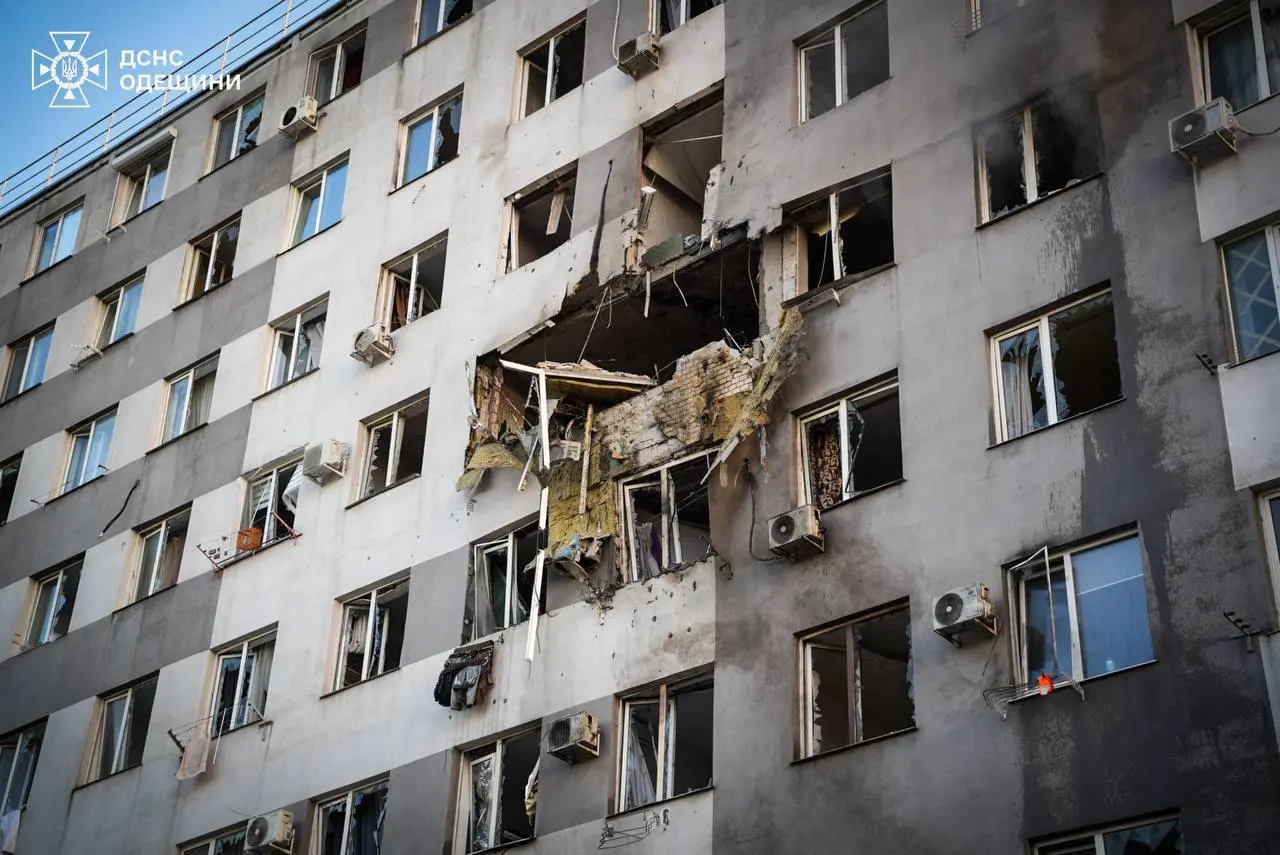
A residential building is damaged following a Russian attack on Odesa. (State Emergency Service/Telegram)
The gap between what is needed and what is promised is where the war lives. Ukraine is fighting in that gap with extraordinary ingenuity — drone assault units, underground troop movements, 1,500-kilometer strikes, 95 percent interception rates on the weapons it can intercept. What it cannot intercept are the ballistic missiles, the political decisions made in distant capitals, and the indifference of a great power that has concluded its war is over here.
It is not over. The skies will fill again tonight.
A Prayer for Ukraine
1. For the Boy Who Did Not See Morning
Lord, an eight-year-old boy died in Cherkasy in the dark. He was not a soldier, not a symbol, not a statistic — he was a child in the wrong place at the wrong hour of a war he did not choose. We do not know his name yet. We know only that he is gone, and that those who loved him will carry this night for the rest of their lives. Grant them the grace to survive what cannot be survived. Hold what we cannot hold. Let the people who made this decision understand, someday, what they took.
2. For the Man in Odesa and All Who Open Their Doors to the Dark
Father, a man approximately sixty years old died when his apartment was struck. He may have heard the air raid siren. He may have decided to stay. We do not know the calculations people make when sirens become routine, and basements are cold and the war has lasted a thousand days. Whatever he decided, he did not deserve this. We pray for those who live in buildings that are targets — for every family that sleeps near a window and wonders whether tonight is the night. Give them shelter. Give them time.
3. For the Air Defenders Who Held Through the Night
God of justice, 309 drones were shot down overnight by men and women who did not sleep, who tracked 324 objects across six directions simultaneously, who made decisions in seconds that determined who lived and who did not. They intercepted 95 percent of what was sent. They could not intercept the ballistic missiles — no one can without the systems that have not arrived. We pray for those defenders: for their clarity in darkness, their endurance across years of this, and for the day when what they need is actually in their hands.
4. For the Negotiators Carrying the Impossible
Lord, Zelensky moved through Oslo, Berlin, and Rome in a single day, searching for weapons and allies and some arrangement of words that might eventually stop the dying. The envoys who could carry a proposal to Moscow have visited Moscow several times and Kyiv not once. The promises made in Berlin are genuine, but their delivery is years away. We pray for those who must make consequential decisions with inadequate tools and hostile time: for wisdom that outpaces despair, for allies who understand that courage delayed is courage wasted, for negotiations that begin with honesty about what this war is.
5. For Justice, Whose Arrival Is Not Yet
God of the long arc, a Russian grain ship carried 44,000 tons of stolen Ukrainian wheat across the Mediterranean while prosecutors’ emails were plundered by Fancy Bear and gunpowder factories burned in Tatarstan for reasons that may never be confirmed. The people responsible for 38 deaths on an Azerbaijani airliner paid an undisclosed sum and issued a statement. Justice is slow, partial, and never fully sufficient. But we pray for it still — for accountability that does not disappear into ambiguity, for the evidence being gathered to reach the tribunals that must receive it.
In Your mercy, in Your justice, in Your time — bring this war to its end, and let the ending be worthy of what Ukraine has endured.
Ukraine Daily Briefing · April 15, 2026 · All source material derived from publicly available reporting.