
The Ukraine Daily Briefing · Friday, November 6, 2026 · Day 1,717 of the Full-Scale War
The Day’s Reckoning
Russia’s bombs this week have found the people who come to help.
In the front-line village of Komyshuvakha, the death toll from Russia’s Nov. 2 bombing of an aid center kept rising as the search went into its fifth day. In Kyiv, power and water failed again after another night of Russian drones, the President and the mayor traded blame, and Volodymyr Zelensky warned that intelligence shows a larger attack is coming, aimed at the grid and the bridges over the Dnipro.
Ukraine answered by doing the opposite. Thirteen children were brought home from Russian occupation. Ground robots kept the front supplied where trucks can no longer go, and the line held almost everywhere, though Russia used a recent truce to mass troops near Kherson. Ukrainian drones set a major Russian refinery on fire. And five days before peace talks in Abu Dhabi, Foreign Minister Andrii Sybiha said no deal about Ukraine or Europe will be made without them.
Fifty-Three, and Still Counting
On Nov. 2, the people of Komyshuvakha went to the school building to collect humanitarian aid.
Russian jets bombed the school with guided aerial bombs; heavy bombs fitted with guidance kits so they can be released from a distance. One was a FAB-3000, which carries more than 1,000 kilograms of explosives.
Police officers and rescue workers ran to the building to help the wounded. Then nine more bombs fell on a shelter where civilians and rescuers had taken cover, President Zelensky said. The tactic is called a double tap: strike once, wait for help to arrive, strike again. Two rescue workers and a military medic were among those killed.
On Nov. 6, Zaporizhzhia Oblast Governor Mykhaylo Semikin said the death toll had reached 53. It is the deadliest Russian attack on the region since the full-scale invasion began. The final toll is still unknown, and dozens of people remain missing.
Olha was one of them until Nov. 5. Her family had not been able to reach her since the bombing and feared she was under the rubble. Police found her alive.
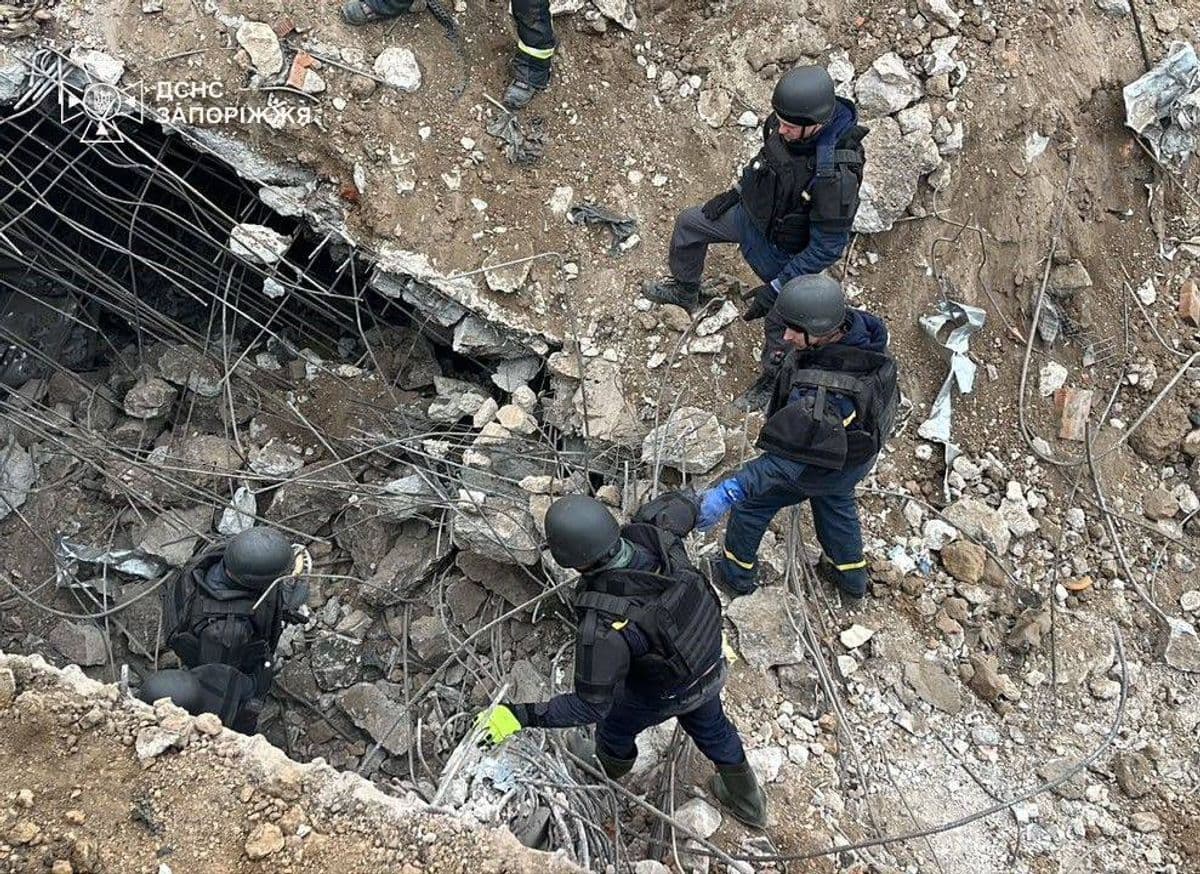
Rescuers continue clearing the rubble at the site of a Russian strike on a school in the village of Komyshuvakha, Zaporizhzhia Oblast. (Ukraine’s State Emergency Service)
Komyshuvakha had about 5,000 residents before the war. As the fighting drew closer over the past six months, the last children were evacuated in June. The adults who stayed depended on the aid handed out at that school. Zelensky said Russian forces could not have been unaware that civilians regularly gathered there, and he called the strike “exceptionally horrific.”
The day before the bombing, a US-brokered truce around Russian-occupied Oleshky, in neighboring Kherson Oblast, came to an end. While it held, hundreds of civilians got out. Zelensky said it proved calm is possible whenever Moscow wants it.
“It is necessary for Russia to decide that the time for war is over,” he said.
The truce ended on Nov. 1. The bombs fell on Nov. 2.
A Capital in the Dark
One woman in Kyiv has had electricity for a single hour in three days. On the morning of Nov. 6, she and other residents walked into a street and blocked it in protest.
Overnight, Russia had launched 227 long-range attack drones at Ukraine, many of them jet-powered and harder to shoot down. Air defenses brought down 196, the Air Force said. The rest hit targets across the country, and emergency power cuts spread through seven regions. Later in the day, an attack on an energy facility in Zhytomyr cut Kyiv’s supply further, and Mayor Vitali Klitschko said water pressure across the capital had dropped.
Ukraine is not short of electricity, energy analyst Oleksandr Kharchenko said. Its plants still generate enough to meet demand, and some power is even being sold to Europe. What Russia has damaged is the high-voltage network that carries power into Kyiv. Crews could repair the damaged substation equipment quickly, he said, but each new strike interrupts their work.
Klitschko said nearly 45% of the city’s residential buildings had heat as of Thursday. The rest are due by Nov. 12.
On Nov. 6, the President and the mayor blamed each other. Zelensky said Kyiv faces the worst utility crisis in the country and pointed to both Russian strikes and the city’s failure to carry out its own winter preparations. Klitschko said the government had left the city’s resilience plan unapproved for nearly six months. Then he went further: “In an attempt to get rid of Klitschko by any means, by constantly creating obstacles and not helping the capital, the central government is actually destroying Kyiv.” He closed by calling for the dispute to stop. “There will be time for conclusions later,” he said.
Zelensky said generators and cable are coming from Germany and Spain, and he asked energy companies to send more repair crews.
In his evening address, he warned that intelligence shows Russia preparing a new attack on Ukraine’s energy system, its bridges across the Dnipro River and other civilian infrastructure. Kyiv’s South and North bridges, which carry tens of thousands of people a day, have been struck repeatedly since Oct. 1. Maj. Artem Bilyk of the Armed Forces calls it Russia’s “small cuts” approach: hit a bridge hard enough to close it, then hit it again.
Ukraine’s military is preparing, Zelensky said, but it is “no easy task.” He named what it needs.
“We need interceptors for the Patriot systems,” he said. “Every agreement matters. Every day counts when it comes to deliveries.”
Thirteen Children, Three Names
In a Russian-run classroom in occupied Ukraine, 13-year-old Andrii was made to draw Russian soldiers.
He was there because occupation officials told his parents they would lose custody of him if he did not attend. At the school he was given propaganda and ideological tests. His town was one where Russian combat drones deliberately targeted civilians, according to Mykola Kuleba, founder of the charity Save Ukraine.
Nina is also 13. Her parents refused to send her to a Russian-controlled school, where students sang the Russian national anthem every day and wore St. George ribbons, a symbol of Russian military patriotism. For refusing, they were threatened with violence.
Luka is 18. Russian troops seized his home. At his school under occupation, teenagers were openly recruited into the Russian military. After he turned 18, he received a draft notice, despite serious health problems.
On Nov. 6, Kuleba announced that Andrii, Nina and Luka were among 13 children and teenagers returned to Ukraine over the past week through Zelensky’s Bring Kids Back UA initiative. They are now receiving psychological support and rehabilitation, and help restoring their documents.
They were three of many. In the last school year, more than 582,000 Ukrainian children studied in occupied territory under Russian school standards. Ukraine’s Justice Ministry has confirmed 20,610 cases of children deported or forcibly transferred to Russia, the crime for which the International Criminal Court issued an arrest warrant for Vladimir Putin in 2023.
“We will not stop as long as thousands of Ukrainian children remain trapped in a hostile system that seeks to break them every day,” Kuleba said.
Where the Trucks Can’t Go
Near the front line, an ordinary truck has become a target. Russian FPV drones, small explosive drones steered by a pilot watching through a camera, fill the air over a strip of ground soldiers call the “kill zone.” Vehicles that once carried ammunition forward and wounded soldiers back can no longer safely make the trip.
So, Ukraine sends robots. Its unmanned ground vehicles, remote-controlled machines that haul supplies and evacuate the wounded, completed a record 31,398 missions in October, the Defense Ministry said on Nov. 6. In January, the number was 7,511.
On Nov. 6, the front held almost everywhere. In northern Sumy Oblast, Ukraine’s military intelligence agency described an operation it had kept quiet for seven weeks. Code-named Cheburechna, it began with strikes on Russian supply routes. Ukrainian troops then moved deep into the forests, set ambushes and pushed Russian forces out of 642 hectares of woodland. False radio traffic kept Russian commanders from learning where the Ukrainians were or how large the attack was. The agency says the operation halted Russia’s offensive in northern Sumy.
Around Kupyansk, a source who reports on Russia’s own forces said Russian troops are struggling to supply their positions in the city and that some battalions of the 347th Motorized Rifle Regiment have lost about half their men. In Donetsk Oblast, Russian assaults toward Lyman, Slovyansk and Dobropillya made no confirmed gains, while Ukrainian forces counterattacked near Lyman and Slovyansk and advanced in northwestern Kostyantynivka. A non-commissioned officer near Slovyansk said Russian forces hit Ukrainian positions with glide bombs and drones first, then send infantry. Ukrainian air defenses, he said, keep Russian jets at least 20 kilometers behind the front when they release those bombs.
In the south, the danger is growing. During the Oleshky truce, when Ukrainian drones were not allowed to strike, Russia brought about 1,000 troops and their equipment onto the occupied left bank of the Dnipro River in Kherson Oblast, according to the Navy’s 34th Separate Marine Brigade. Yaroslav Moroz, who heads the brigade’s drone department, said his unit watched it happen.
“They arrived simply by car, as was the case in 2022, and then, when the cars left, we monitored it all, and much fewer cars left, much fewer personnel left,” he said.
Russian troops have moved back into positions Ukraine had pushed them out of over six months, about 20 kilometers closer to the front. The brigade also accuses them of storing ammunition in Oleshky’s hospital, where civilians are being treated, so that Ukraine will not strike it. The Kremlin denies using the truce to reinforce. Russian military bloggers said otherwise. One, Vladimir Romanov, counted four buses of civilians leaving Oleshky and 14 buses of supplies and personnel going in. He has not posted since, and some of his followers believe he was detained.
No large assault has come yet, Moroz said, and smaller Russian movements have been stopped.
“There are currently no massive assault actions,” he said. “But we are ready for them.”
The Long Arm and the Long Table
Overnight, Ukrainian drones flew about 375 kilometers past the front line to Krasnodar Krai in southern Russia. By morning, the Afipsky Oil Refinery, one of the largest in the region, was on fire. The Russian opposition outlet Astra said an eyewitness photo showed the refinery’s tank farm burning, and explosions were also reported near Krasnodar city and in neighboring Adygea. Regional officials said falling drone debris had started a fire at an unnamed business. Ukraine has hit Afipsky at least five times before this year, and the EU sanctioned it in April for its role in the war.
Closer to the front, the General Staff said Ukrainian forces hit two ammunition depots near Melitopol and Khliborobne in occupied Zaporizhzhia Oblast, a drone command post near Chasiv Yar and a fuel depot near Luhanske in Donetsk Oblast. In Crimea, Navy spokesperson Dmytro Pletenchuk said strikes on Russia’s Pantsir air defense systems had cleared the way to hit Russian drone launch sites near Hvardiiske airfield.
Zelensky said the refinery strikes will continue as long as Russia attacks Ukraine’s power, heat and water. “They have refused to take de-escalation steps,” he said. That evening he met the team that plans Ukraine’s long-range strikes. “Russia will face our response,” he said.
In Kyiv’s view, the strikes and the peace talks are connected. US, Ukrainian and Russian delegations meet in Abu Dhabi on Nov. 10–11, their first three-way talks since February. The Kremlin wants Europeans kept out unless they accept Russian terms. In Warsaw, Foreign Minister Andrii Sybiha, standing with EU foreign policy chief Kaja Kallas and Poland’s Radosław Sikorski, rejected that. “There can be no decisions about Ukraine without Ukraine, and there can be no decisions about the security of Europe without Europe,” he said. Ukraine’s priorities, he added, include security guarantees, an energy truce and the return of abducted children.
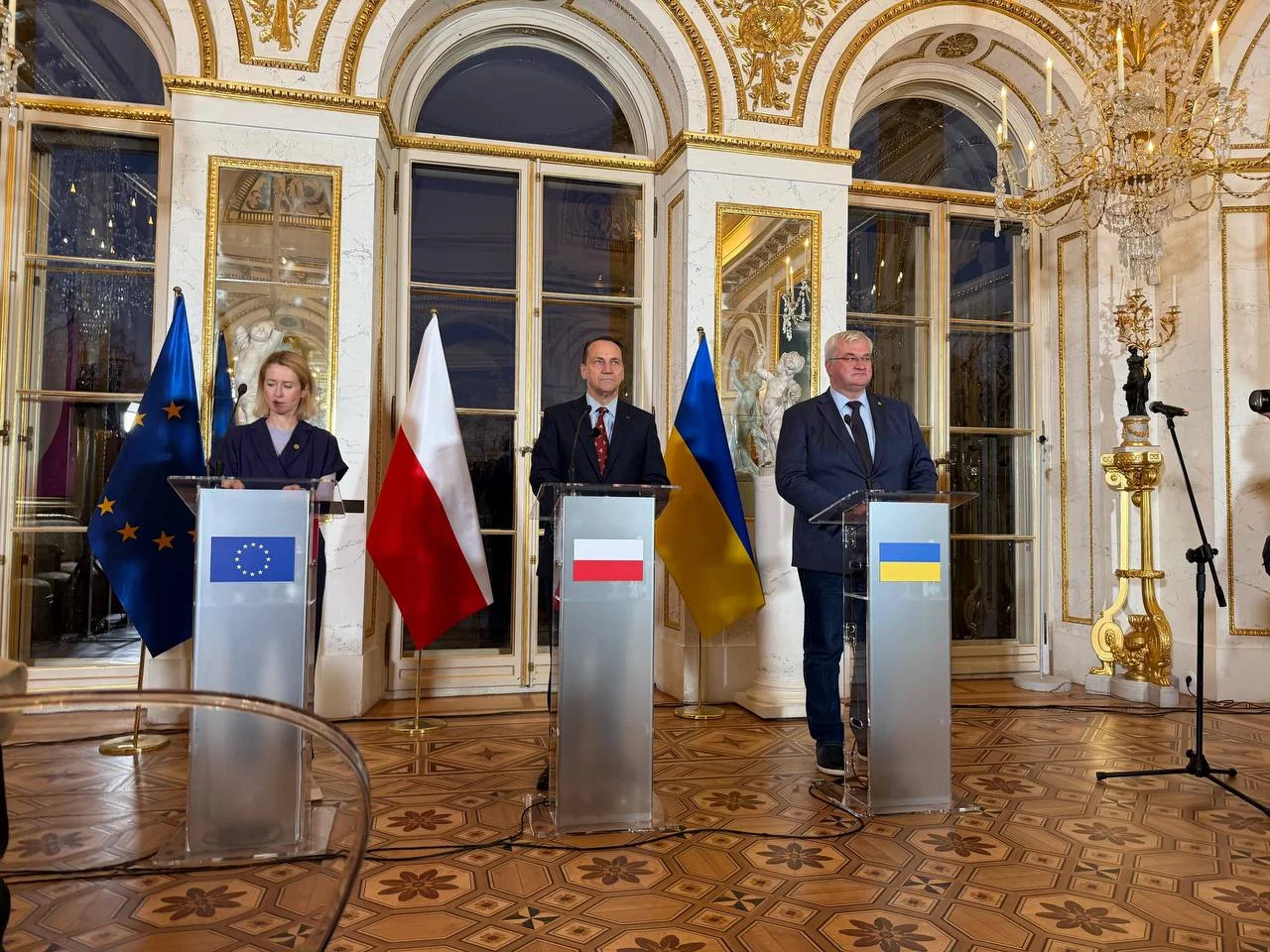
Ukraine’s Foreign Minister Andrii Sybiha speaks at a joint press conference alongside EU foreign policy chief Kaja Kallas and Polish Deputy Prime Minister and Foreign Minister Radosław Sikorski, following a ministerial meeting of the Council of the Baltic Sea States (CBSS) in Warsaw. (PHOTO: Ministry of Foreign Affairs of Ukraine / Telegram)
Jared Kushner, a former senior adviser to President Donald Trump, said on Nov. 5, after talks in Brussels, that NATO will stay central to Europe’s defense and every country keeps the right to choose its alliances. The Kremlin, as the Institute for the Study of War, a US think tank, points out, has just repeated its demand that NATO retreat to its 1997 borders.
Kallas and Sybiha said Russia lost more than 54,000 soldiers killed or seriously wounded in October alone, a figure that could not be independently verified. Kallas compared it to the capacity of Warsaw’s National Stadium. Sybiha said Ukraine’s front-line positions are the strongest they have been in three years, and he tied that strength to the talks ahead.
“We will continue our long-range campaign to bring the war back to Russian territory,” he said. “The further Ukraine is capable of striking, the closer we are to the end of the war.”
Also Today
The day’s wounded. Russian attacks killed one person and injured 23 over the past day. Glide bombs and drones killed one in Kramatorsk; the wounded included a child in Dnipropetrovsk Oblast, three people in a Kirovohrad Oblast apartment building and a man near Boryspil, while a 3-year-old girl in Kharkiv Oblast’s Ivanivka was treated for acute stress.
Elsewhere on the front. Russian attacks in northern Kharkiv Oblast, toward Novopavlivka and Oleksandrivka, and in western Zaporizhzhia Oblast gained nothing, and Ukrainian forces struck Russian troops after an infiltration northwest of Hulyaipole. A Russian blogger’s map conceded that Ukrainians still hold southern Bachivsk near Sumy, while Russian bloggers’ claims of gains at Sobolivka and Rai-Oleksandrivka remain unconfirmed.
More fires in Russia. The Ryazan oil refinery was reportedly targeted overnight on Nov. 5, and online retailer Ozon said a drone hit its logistics center in Adygea on Nov. 4.
Searches at Kyiv’s heating company. City-run Kyivteploenergo said police searched its offices and seized resilience-plan documents, calling it possible political pressure. Kyiv prosecutors said no offices were searched and nothing was seized, only the homes of two employees and contractors, under court orders, in a suspected scheme to inflate the cost of building materials.
Kyiv arms its own. The city delivered nearly 2,700 drones and a dozen ground robots to the 5th Separate Assault Kyiv Brigade, a day after its council added Hr 1 billion ($22 million) for the military.
Flying the wounded. Ukraine will resume medical evacuation flights by the end of 2026, Prime Minister Serhii Koretskyi said, cutting the 15-to-16-hour road trip from Kharkiv to the evacuation hub in Rzeszów, Poland, to two or three hours. The flights will also carry donor organs.
Names for the fallen. The government adopted a single set of rules for teams identifying the bodies of soldiers and civilians, plus a unified case-coding system, to speed answers for families; more than 26,000 bodies and remains have been returned from Russia, many still unidentified.
The Starshield clock. Ukraine’s contract for Starshield, the military version of SpaceX’s Starlink satellite network, expires in mid-2027, and talks on a new one are starting with the Pentagon, Deputy Ambassador Denys Sienik said. Kyiv still has no explanation for October’s sudden speed limits.
Musk and Zelensky. After Zelensky said on Nov. 5 that “there is too much power in the hands of one very wealthy person,” Elon Musk reposted, without comment, a post calling free Starlink service for Ukraine a “mistake.” The Pentagon’s watchdog has rejected a bipartisan request from US senators to investigate October’s Starshield disruption.
After the midterms. With Democrats now controlling both houses of Congress, analysts said the new Congress could put a floor under US support for Ukraine and may scrutinize Trump’s Russia policies, though overriding a veto takes two-thirds. Zelensky said $16 billion in previously agreed US aid was withheld: “Ukraine must fight — let no one in the US take offense.”
At the White House. First Lady Melania Trump, who brokered the Oleshky truce, hosted a rare meeting between Russian and Ukrainian officials on Nov. 5 and called for a “more enduring” ceasefire.
Warsaw and Kyiv, mending. Sybiha and Sikorski discussed air defense and drone cooperation and agreed to keep normalizing relations strained since May, when Ukraine named a military unit after the Ukrainian Insurgent Army, which Poland blames for the WWII-era Volhynia massacres.
Bomb hoaxes sweep Europe. Hoax bomb threats hit at least 18 planes and airports on Nov. 6, more than 50 this week, and 18 media outlets got a message signed “Mikhail Andropov” claiming responsibility. No explosives were found; European leaders call the campaign coordinated, and while no government has named a culprit, the Institute for the Study of War says it fits Russian methods.
Russia trims its bureaucrats. The State Duma will cut its staff by about 15 to 20% and the Federation Council by 10 to 15%, Duma sources said, as Moscow trims spending that does not feed the war.
Profiting from the maimed. At least 106 prosthetics companies have sprung up in Russia since the invasion, an investigation by the Russian-language outlet Vot Tak found, some tied to Putin’s inner circle, as state spending on assistive devices nearly tripled.
Turkey’s gas math. Turkey is buying less Russian gas because “Russia is extremely expensive,” Energy Minister Alparslan Bayraktar said on Nov. 5, though an analyst suggested it may be a bargaining message to Moscow.
Closing
Police found Olha alive after three days. On the fifth day, rescuers were still digging in Komyshuvakha, where two of their own died running toward the wounded. In Kyiv, repair crews went back to the lines Russia keeps hitting. In Warsaw, Ukraine asked again for its seat at the table. And Andrii, Nina and Luka are home.
A Prayer for Ukraine
1. For the Defenders on the Dnipro
Lord, You see the Marines of the 34th Brigade watching the far bank of the Dnipro, where an enemy used a truce to gather a thousand more soldiers. Keep their eyes sharp and their positions hidden. Guard the robot crews in the kill zone, the soldiers who cleared the forests of northern Sumy, and the defenders near Slovyansk who face glide bombs every day. When the attack comes, let them be ready, as they have promised, and bring them home.
2. For Komyshuvakha
Father of mercies, fifty-three people from Komyshuvakha came for bread and did not go home. Hold the families still waiting beside the ruins on this fifth day. Honor the two rescue workers and the military medic who ran toward the wounded and died there. Thank You for Olha, found alive. Comfort the wounded of Kramatorsk, Kharkiv, Kherson and Sumy, and the little girl in Ivanivka shaken by the blasts. Let those who dropped these bombs answer for them.
3. For Those Bound for Abu Dhabi
God of wisdom, the talks in Abu Dhabi are days away. Give Andrii Sybiha, President Zelensky and their team clarity and courage to hold to what Ukraine needs: real security, an energy truce, its children and its prisoners. Give the American delegation discernment to see through demands that cannot build a lasting peace and let Europe take its rightful place at the table. And let President Zelensky and Mayor Klitschko lay down their quarrel for the sake of the people they both serve.
4. For a City Without Light and Water
Lord of light, Kyiv waits in the dark while its taps run dry. Protect the repair crews splicing lines under the threat of a second strike, and the workers keeping water in the city’s pipes. Shield the South and North bridges and the damaged facility in Zhytomyr from the attack intelligence says is coming. Speed the Patriot interceptors Ukraine is pleading for. Bring heat to every building before the frost, and patience to every weary family.
5. For the Children Who Came Home
Faithful God, You brought Andrii, Nina and Luka home this week, with ten others, out of schools built to make them forget who they are. Heal what was done to them. Let medical flights soon carry the wounded in hours, not days, and let grieving families receive their fallen by name. Through bombs and blackouts and grief, Ukraine keeps reaching out its hand. Strengthen that hand.
In Your mercy, in Your justice, in Your time — bring this war to its end and let the ending be worthy of what Ukraine has endured.