
Ukraine Daily Briefing | May 26, 2026 | Day 1,553 of the Full-Scale Invasion
Prepared by Dayana Bozhyk
Belarus’s Security Council Secretary claimed Ukrainian drones made 116 border incursions in a week, setting informational conditions for Russia to launch “retaliatory” strikes against western Ukraine from Belarusian territory — while Ukraine’s USF Commander warned he had identified 500 targets inside Belarus. Russia banned civilian aircraft below 5,100 meters over the Moscow air zone starting June 1, an acknowledgment that Ukrainian drones have overwhelmed its capital’s air defenses. Russian Duma members walked back the Kremlin’s Kyiv strike threats even as an Iskander missile struck a UN World Food Programme warehouse in Dnipro for the second time. The Czech ammunition initiative shrank from 18 to 9 contributing nations, Ukrainian forces advanced in the Oleksandrivka and western Zaporizhzhia directions, and Russian unmanned surface vessels struck the Ukrainian Navy training ship Druzhba in Odesa port.
THE DAY’S RECKONING
The architecture of a new threat took shape across Monday. It did not announce itself with a missile. It announced itself with a statistic: 116. That is the number of Ukrainian drone incursions into Belarusian airspace that Belarusian Security Council Secretary Volfovich claimed his forces had recorded in a single week. Some of them, he said, were deliberate attempts to target Belarusian border infrastructure.
The claim is almost certainly fabricated or inflated. Ukrainian drones routinely cross into neighboring airspace — not by design but because Russian electronic warfare jams their navigation, redirecting them involuntarily. Latvia’s government collapsed over this exact issue when a Ukrainian drone struck a Latvian oil facility. But the intent of Volfovich’s statement is not evidentiary. It is operational. It establishes a public record of Ukrainian aggression against Belarus. It gives Russia a pretext. And the pretext is valuable: if Russia can launch drones from Belarusian territory, it can hit the M-06 highway in western Ukraine — the main supply route from Poland, the artery through which Western weapons flow — with the precision and payload that its current launch distances do not permit.
Ukraine’s response came from an unexpected direction. USF Commander Brovdi, callsign Magyar, told reporters that Ukrainian forces have identified 500 potential targets in Belarus. He did not specify what types. He did not specify under what circumstances they could be struck. He did not need to. The message was addressed to Lukashenko personally, and it said: the cost of entry is already calculated.
Meanwhile, Russia banned civilian aircraft from flying below 5,100 meters over the Moscow air zone starting June 1 — an area stretching from the Belarusian border to the edge of the St. Petersburg and Yekaterinburg flight zones. The stated reason was flight safety. The actual reason, confirmed by Russian milbloggers, was that Russian air defense systems have been shooting at Ukrainian drones with insufficient discrimination, threatening civilian aircraft. The capital of a nuclear-armed state can no longer safely share airspace with commercial aviation because of drone strikes launched from hundreds of kilometers away by a country it invaded four years ago.
BELARUS AS LAUNCH PLATFORM: THE PRETEXT BEING BUILT
Belarusian Security Council Secretary Volfovich’s claim of 116 Ukrainian drone incursions in a week — some allegedly targeting Belarusian border infrastructure — is the informational foundation for the next stage of Russia’s use of Belarusian territory. ISW assessed this clearly: Russia is unlikely to support a Belarusian ground invasion, and there is no verified buildup of Belarusian ground forces on the Ukrainian border. What Russia wants from Belarus is not infantry. It is launch points.
From Belarusian territory, Russian Shahed-type drones and cheaper Molniya models can reach the M-06 highway — the primary western supply corridor connecting Poland to Ukraine — with remotely controlled precision. Current Russian launch sites cannot reliably hit moving targets on this route with heavy payloads. From Belarus, they could. A Ukrainian freight train near Korosten, Zhytomyr Oblast, was struck by a Shahed operated by a Russian pilot based in Belarus on December 22, 2025 — the operational proof of concept already exists.
The pretext being assembled is not subtle. It mirrors the logic that preceded every previous escalation: claim Ukrainian aggression, announce measured Russian restraint, then act. Ukrainian officials have been warning for weeks that Russia is pressuring Lukashenko to either attack Ukraine directly with Belarusian forces or provide territory for Russian attacks. The Border Guard Service confirmed no troop buildup as of May 24. The intelligence services confirmed sustained Russian pressure. The distinction between those two facts is the entire question of what comes next.
USF Commander Brovdi’s warning was measured but unmistakable. Five hundred identified targets. No elaboration. No threats of immediate action. The message was not to the public. It was to Minsk: Ukraine has done the targeting work. Lukashenko should account for that before agreeing to the next Russian request.
MOSCOW BANS CIVILIAN FLIGHTS BELOW 5,100 METERS OVER ITS OWN CAPITAL
Russia’s Aircraft Owners and Pilots Association announced on May 25 that Russian authorities will prohibit civilian flights in the Moscow air zone below 5,100 meters starting June 1, 2026. The ban covers an enormous geographic area — from Russia’s western border with Belarus, north to the St. Petersburg zone boundary, east to the Yekaterinburg and Samara zone boundaries, and south to the existing Ukrainian border flight prohibition that has been in place since February 2022.
Exemptions exist for scheduled commercial aviation, charter flights, medical and evacuation flights, and certain government contracts. What is being restricted is general aviation — private pilots, small aircraft, unscheduled movements below 5,100 meters — in a zone over the Russian capital and its surrounding regions.
Russian milbloggers stated directly that the ban is a consequence of Ukrainian drone strikes and the failure of Russian air defenses to distinguish Ukrainian drones from civilian aircraft. The implication is serious: Russia’s air defense systems, operating over Moscow, are firing at low-altitude targets with insufficient discrimination. The solution is not to improve the discrimination. The solution is to remove the civilian aircraft. This is what strategic failure at the defensive level looks like when it reaches the capital.
KALININGRAD AIRPORT CLOSES FOR THE FIRST TIME OVER DRONE THREAT
Russian aviation regulator Rosaviatsia temporarily restricted arrivals and departures at Kaliningrad Airport on May 25, citing unspecified flight safety concerns. Local Kaliningrad outlet Klops confirmed that the city’s drone warning system was activated for the first time. Russian authorities have not identified the cause or made accusations. What is notable is the geography: Kaliningrad is a Russian exclave on the Baltic Sea, surrounded by Lithuania and Poland, with no land border with Russia proper. It is hundreds of kilometers from the Ukrainian frontline. That its drone warning system activated for the first time is either a false alarm or a demonstration of how far Ukraine’s operational reach now extends — or both.
RUSSIAN OFFICIALS QUIETLY WALK BACK THE KYIV STRIKE THREATS
State Duma Defense Committee Chairperson Kartapolov stated on May 26 that Russia is not actually threatening to strike the Verkhovna Rada or the Presidential Office — because those are not “real” decision-making centers. He claimed the actual centers are hidden in well-fortified locations outside central Kyiv. State Duma Deputy Wasserman claimed Russia could “liquidate” Ukraine by November 2026, but that Russia was “not rushing.”
ISW’s assessment of these statements: Russia’s officials are managing expectations downward in the domestic information space. The Foreign Ministry issued maximalist threats on May 25. By May 26, other officials are pre-explaining why those threats will not materialize as the Russian audience might expect. The threats served their purpose — generating international media coverage, testing allied resolve, attempting to accelerate diplomatic evacuation from Kyiv — without requiring Russia to actually strike the presidential compound of a country with which it is at war.
SYZRAN REFINERY: FULLY HALTED; REPAIRS OVER A MONTH AWAY
The Ukrainian General Staff confirmed on May 26 that the Syzran oil refinery in Samara Oblast has halted all operations following the May 20–21 drone strike. Reuters, citing two industry sources, reported the strike damaged the CDU-6 crude distillation unit — responsible for over 70 percent of the refinery’s capacity — and that repairs could take more than a month. The facility has a maximum capacity of 8.5 million metric tons per year, or 170,000 barrels per day, and in 2024 processed 4.3 million tons, producing 1.5 million tons of diesel, 800,000 tons of gasoline, and 700,000 tons of fuel oil. The refinery supplies the Russian Air Force and military units across central and southern Russia, and exports via the Volga River and Caspian Sea. It is the 11th major Russian refinery struck in May 2026.
THE ‘NOVOROSSIYA’ HIGHWAY EFFECTIVELY CLOSED; SECRET STRIKE DRONES DEPLOYED
Russia’s 412th Nemesis Brigade of Ukraine’s Unmanned Systems Forces announced on May 26 that Highway R-280 — which Russian occupation authorities call the “Novorossiya” route, running through occupied Mariupol, Melitopol, and Simferopol — has been effectively blocked for Russian military logistics following persistent Ukrainian drone strikes. The brigade stated that Russia has restricted heavy equipment movement on the highway, and that Ukrainian forces are now striking vehicles attempting to bypass it using dirt roads and field paths.
The brigade disclosed it has deployed a previously undisclosed “secret” strike drone — referred to as “wings” — developed in partnership with a Ukrainian manufacturer specifically for deep interdiction at operational depths. The system has not been shown publicly. The brigade claimed it has already destroyed dozens of trucks and fuel tankers. Geolocated footage published May 24–26 confirmed Ukrainian strikes along the M-14 highway northeast and north of Berdyansk, at roughly 88–89 kilometers from the frontline.
A Kremlin-affiliated milblogger acknowledged on May 26 that Ukraine’s drone interdiction campaign is disrupting Russian logistics to occupied Kherson and Zaporizhzhia oblasts and occupied Crimea, creating shortages of goods and fuel that are directly degrading Russian combat capability. Another Russian milblogger warned that Ukraine may begin using drones to remotely mine roads — a tactic that would make even bypass routes impassable.
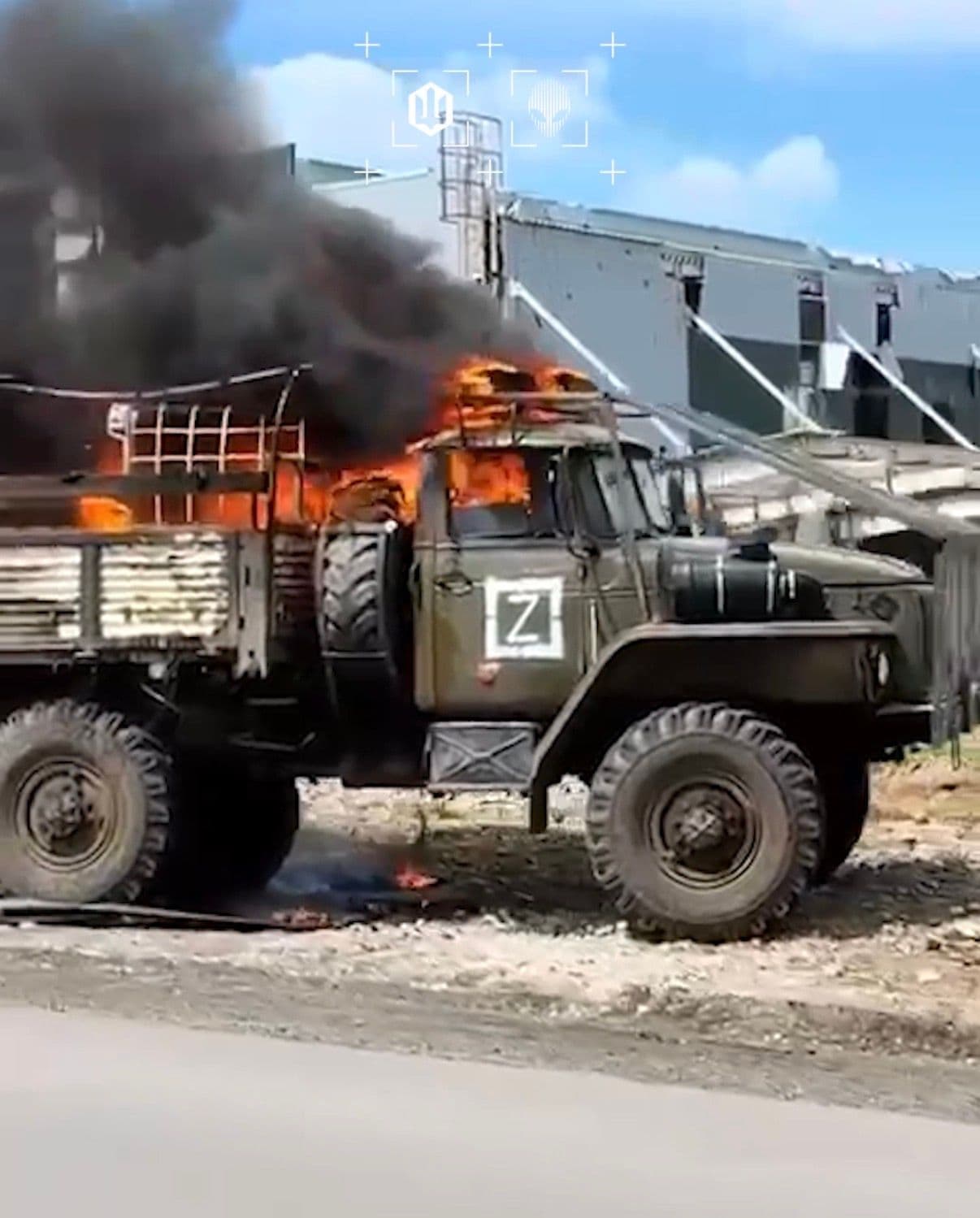
A screenshot from a video released by Ukraine’s Nemesis Brigade showing purported destruction after Ukrainian drone strikes on the “Novorossiya” logistics route (Telegram)
RUSSIA STRIKES A SECOND UN HUMANITARIAN WAREHOUSE; DRUZHBA HIT IN ODESA PORT
The UN World Food Programme reported on May 25 that Russian forces struck its humanitarian operations warehouse in Dnipro City with an Iskander ballistic missile. The facility held approximately $1.4 million in food assistance — enough to feed 130,000 people — at the time of the strike. No WFP staff were injured. WFP Director Reagan confirmed it was the second time the same warehouse had been struck, the first time being in November 2025. This followed a May 20 Iskander strike on a UNHCR warehouse in Dnipro City that killed two people, injured others, and destroyed 900 pallets of humanitarian aid and shelter materials valued at more than $1 million. Within one week, Russia struck two separate UN humanitarian warehouses in the same city with ballistic missiles.
Separately, geolocated footage published on May 26 showed two Russian unmanned surface vessels striking the Ukrainian Navy training vessel Druzhba in the port of Odesa. The naval attack followed an evening missile and drone strike on Odesa that killed one person and injured four others, damaging an infrastructure facility and nearby residential buildings.
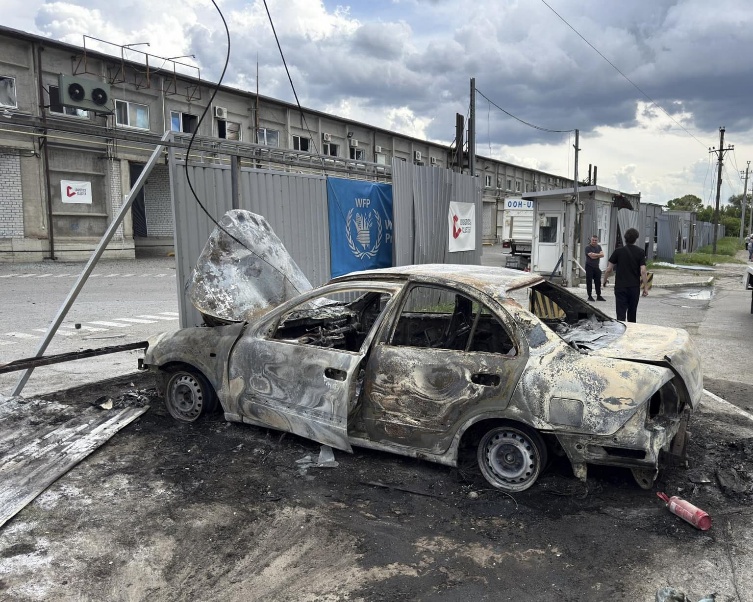
Aftermath of the Russian attack in Dnipro, during which a United Nations humanitarian warehouse was damaged. (The World Food Programme)
FRONTLINE: UKRAINIAN ADVANCES AT OLEKSANDRIVKA AND ZAPORIZHZHIA; LYMAN REASSESSED
Ukrainian forces recently advanced northeast of Oleksandrivka: a Russian milblogger confirmed that Ukrainian forces liberated Piddubne and are fighting in Zelenyi Hai. The presence of Ukrainian forces in those positions indicates prior liberation of Ivanivka to the north and advances east of Oleksandrohrad. In western Zaporizhzhia, a Kremlin-affiliated milblogger acknowledged on May 26 that Ukrainian forces largely control Plavni west of Orikhiv, reflecting continued counterattacks that have retaken several settlements west of Orikhiv since late April. Russian forces reported a deteriorating situation across the sector and cited drone shortages as the reason for surrendered positions.
ISW revised its assessment of the Lyman direction on May 26: Ukrainian forces likely hold more positions within and east of Lyman than previously assessed. A Russian Western Grouping source confirmed Ukrainian forces control the road between Lyman and Stavky, and geolocated footage from May 20, 25, and 26 shows Russian forces striking Ukrainian positions east of Stavky, within and north of Zarichne, in northwestern Lyman, and north of Lyman. The revised picture shows a more robust Ukrainian defensive posture in the direction than previous reporting indicated.
In the Borova direction, Ukrainian forces counterattacked south of Borova as Russian forces continued limited operations to the northeast. A Ukrainian brigade spokesperson confirmed Russian forces are conducting unsuccessful infiltration missions and targeting Oskil River crossings with glide bombs. In the Kupyansk direction, Russian forces continued limited operations without confirmed advances. In northern Sumy Oblast, Russian forces continued operations but did not advance; the Russian MoD claimed seizure of Zapsillya and Ryasne, both of which were immediately refuted by the Ukrainian 14th Army Corps and Kursk Grouping. Ukrainian forces also hold Myropillya, contrary to prior Russian claims.
UKRAINIAN MID-RANGE STRIKES: LUHANSK RADAR, DONETSK DEPOTS, OCCUPIED SETTLEMENTS
Ukrainian forces struck a Russian 1L125 “Niobium-SV” mobile radar station in occupied Yarsk, Luhansk Oblast — roughly 157 kilometers from the frontline — on May 24. Storm Shadow missiles struck a Russian command and communications post at an unspecified location in Luhansk Oblast. A fuel truck was struck near Yurivka, roughly 76 kilometers from the frontline.
In occupied Donetsk Oblast, Ukrainian forces struck a Russian command post in Ocheretyne; a drone control point in Novohrodivka; drone and logistics depots in Novopetryvka; a logistics depot in Donetsk City; and a railcar carrying fuel near Debaltseve — all between 16 and 52 kilometers from the frontline. A Mariupol-based Ukrainian partisan channel reported a drone strike on a Russian military personnel concentration in occupied Siedove, roughly 150 kilometers from the frontline. Ukrainian forces also struck an artillery control platoon near Troitske in occupied Zaporizhzhia Oblast.
OVERNIGHT STRIKE CAMPAIGN: 2 ISKANDERS, 124 DRONES; DNIPRO WFP WAREHOUSE HIT
Russian forces launched two Iskander-M ballistic missiles from Rostov Oblast and occupied Crimea, and 124 Shahed, Gerbera, Italmas, and Parodiya drones — including jet-powered Shaheds — overnight May 25–26. Ukrainian air defenses downed 111 drones. Nine drones and both Iskander-M ballistic missiles struck 11 locations; debris fell on three more. Russian strikes damaged agricultural, educational, energy, port, and residential infrastructure in Kharkiv, Poltava, Odesa, and Zaporizhzhia oblasts. In Chernihiv, a massive overnight attack produced around 15 explosions; one city enterprise was damaged with no reported casualties.
CZECH AMMUNITION INITIATIVE SHRINKS TO 9 COUNTRIES; HRW DOCUMENTS PROPERTY SEIZURES
Czech President Pavel stated on May 26 that participation in the Czech-led ammunition initiative for Ukraine has fallen from 18 contributing nations to 9 since Prime Minister Babis took office in December 2025. The initiative has delivered up to 50 percent of all large-caliber ammunition to Ukraine and has sent more than 3 million artillery shells since launch in 2024 — 1.5 million in 2024 and 1.8 million in 2025, with contracts for approximately 1 million more in 2026. Pavel stated the initiative remains operational but acknowledged its declining financial base. A Western military official told the Financial Times that Germany and several Nordic countries remain, but some countries find it “strange” to fund an initiative not supported by its lead country’s government. Babis had pledged not to make Czech citizens pay for weapons for Ukraine.
Human Rights Watch released a report on May 26 documenting Russia’s illegal property seizures in occupied Ukraine. Putin signed a December 2025 law enabling occupation authorities to declare Ukrainian-owned housing “ownerless” and seize it. Displaced Ukrainians face near-impossible conditions to reclaim property: they need a Russian passport, must navigate Russian courts, and cannot return to occupied territory from Ukrainian-controlled areas through normal crossing points. Over 8,000 property seizure cases were filed in 25 occupied territory courts between March 2024 and January 2026. Russia began evictions in occupied Mariupol in April 2026, with plans to put most apartments up for sale or allocate them as public-sector staff housing by June 1.
EU SUMMONS RUSSIAN DIPLOMAT; LATVIA: ‘RUSSIA HAS REJECTED EVERY CEASEFIRE OPPORTUNITY’
The EU summoned Russia’s top diplomat in Brussels on May 26, telling Moscow it must “stop hitting civilians.” EU spokeswoman Hipper called Russia’s threat to foreign citizens and diplomats to leave Kyiv “an unacceptable escalation.” Germany also summoned the Russian ambassador in Berlin over the threats and recent large-scale strikes on civilian infrastructure, stating it “will not be intimidated.”
At an EU foreign ministers gathering in Brussels, Latvia’s deputy foreign minister Ursulskis stated that Russia has rejected at least six or seven ceasefire or peace talk opportunities over the course of the war, every time that Ukraine and Europe were ready. “They are not ready to engage in meaningful peace talks,” he said. He described the Oreshnik deployment as a sign of Russian weakness rather than strength: “Oreshnik is a really great PR story in Putin’s mind. It’s not a great PR story in our mind.” EU foreign ministers are set to gather in Cyprus on May 28 to discuss conditions for future peace negotiations.
UN Secretary-General Guterres told the Security Council that Russia’s announcement of systematic strikes on Kyiv was deeply concerning and warned of “a dangerous erosion of respect for international law” globally. He described the UN Charter as a “survival guide” under profound strain, citing record global military spending, arms races, and new weapons technologies outpacing international regulation. China’s Foreign Ministry called on “relevant parties” to avoid escalation but declined to say whether it would evacuate its diplomats from Kyiv.
PUTIN SIGNS DEBT RELIEF FOR MILITARY RECRUITS; MOBILIZATION PRESSURE RISES
Putin approved a decree on May 26 offering debt relief of up to 10 million rubles ($138,500) for individuals signing defense ministry contracts of at least one year starting May 1, 2026. Eligible individuals and family members may be exempt from repaying overdue loans where court enforcement proceedings are underway. In the event of death or Group I disability, all credit obligations of family members are cancelled regardless of when the servicemember was mobilized or signed a contract. Putin introduced similar measures in November 2024 for pre-December 2024 loans.
Simultaneously, Russian anti-conscription groups reported a surge in mobilization orders being issued at military registration offices. Google Trends data shows searches for “mobilization orders” increased from under 10,000 in January 2026 to around 40,000 in April. Yandex searches followed the same pattern. Reservists are reportedly being summoned under the pretext of “updating military records” and pressured to accept mobilization orders or sign contracts once there.
Russia is building a pretext to strike Ukraine from Belarus. Moscow has banned civilian aircraft over its own capital because Ukrainian drones have overwhelmed its air defenses. Russian officials are walking back threats they made 24 hours ago. A second UN humanitarian warehouse was struck with a precision ballistic missile. The Czech ammunition initiative lost half its contributors. A secret Ukrainian strike drone is blocking the Novorossiya highway.
Ukraine has 500 identified targets in Belarus. Russia has 500 fewer civilian flights over Moscow starting June 1. The Syzran refinery is fully halted. Kaliningrad’s drone warning system activated for the first time. Latvia: Russia has rejected every ceasefire opportunity.
Day 1,553. The airspace over Moscow is no longer safe for civilian aircraft. That sentence was not possible four years ago.
A PRAYER FOR UKRAINE
1. For the 130,000 People Whose Food Was in That Warehouse
Lord, a WFP warehouse in Dnipro held $1.4 million in food assistance on May 25 — enough to feed 130,000 people. Russia struck it with an Iskander ballistic missile. This was not collateral damage. A ballistic missile is a precision weapon. It flew to that address. This is the second time the same warehouse has been struck — the first time was November 2025. We pray for the frontline communities that will not receive those rations. For the 130,000 who may have been one of those deliveries away from eating. For the WFP staff who will now spend weeks replacing what they spent months acquiring. And we ask that the nations with the power to demand accountability for targeted strikes on humanitarian infrastructure find the political will to do so — not in statements, but in sanctions, in tribunals, and in continued supply.
2. For the Crew of Druzhba
Father, the training vessel Druzhba was struck in Odesa port on May 26 by Russian unmanned surface vessels. Druzhba means friendship. It is a navy training ship — the vessel on which Ukrainian sailors learn their trade. We do not know who was aboard when it was hit. We pray for anyone on that ship when Russian remote-controlled boats found it, for the sailors who trained on its decks, for the Odesa naval base personnel who watched from the shore. And we pray for the city of Odesa, which received another strike the same evening, this time killing one person and injuring four others. Odesa has been struck hundreds of times since February 2022. Its harbor, its infrastructure, its people — all of it continues to hold. Hold those who hold it.
3. For the People Waiting for the Czech Ammunition
God of provision, Czech President Pavel confirmed on May 26 that the ammunition initiative supplying up to half of all Ukrainian large-caliber artillery shells has shrunk from 18 contributing nations to 9. The shells that will not be sent because governments changed are not abstract. They are the rounds that will not arrive at artillery positions along the Donetsk line, the Kharkiv border, the Zaporizhzhia front. The soldiers who will have to conserve ammunition are not abstract. They are people already enduring extremely difficult conditions who will now have one more constraint on their ability to defend their positions. We pray for the political leaders of the countries that have withdrawn. That they feel the weight of that decision in human terms, not only budgetary ones. And we pray that the nations that remain in the initiative hold, and that new ones join.
4. For the Displaced Ukrainians Whose Homes Have Been Declared Ownerless
Lord, Human Rights Watch documented on May 26 that Russia is systematically seizing Ukrainian homes in occupied territory under a December 2025 law that allows authorities to declare housing ‘ownerless’ when the owner has fled. Eight thousand court cases in 25 courts. Evictions in Mariupol in April. Apartments being allocated to Russian public-sector workers. For a 75-year-old woman from Sievierodonetsk who told researchers that no one can get through the filtration process to prove ownership: we pray for her, and for the tens of thousands like her. The destruction of homes during war is terrible. The legal annexation of those homes while their owners are still alive is something worse — it is an attempt to make return impossible. Sustain every Ukrainian who is preserving evidence of ownership, every legal team fighting asset seizures in foreign courts, every international body working to ensure that what Russia has stolen can one day be returned.
5. For Lukashenko, Who Still Has a Choice
God of history, Belarusian Security Council Secretary Volfovich is building a pretext. Ukrainian USF Commander Brovdi has identified 500 targets. The next decision belongs to Alexander Lukashenko. He is not a free man — he depends on Moscow for his political survival and knows it. But he is not yet a combatant in this war, and the distinction still matters. We do not pray for his comfort or his continuation in power. We pray for the Belarusian people who did not choose this alignment and who will bear the consequences of whatever he decides. We pray that whoever around him — generals, ministers, advisors, family — is capable of conveying to him what it would mean for Belarus to become a full participant in Russia’s war. And we pray that Brovdi’s list of 500 targets remains a deterrent and never becomes a target list.