
Ukraine Daily Briefing | May 27, 2026 | Day 1,554 of the Full-Scale Invasion
Prepared by Dayana Bozhyk
Ukraine struck the Taganrog Aircraft Repair Plant — which services Su-24 bombers, Su-25 attack jets, and military transport aircraft — along with Russia’s Baltimor Air Base in Voronezh, home to Su-34 fighter-bombers, and the Tuapse oil refinery on the Black Sea coast, extending its deep-strike campaign to three major military-industrial targets in a single night. Zelensky warned of intelligence showing Russia preparing an additional mobilization wave of ‘tens of thousands.’ Defense Minister Fedorov announced a ‘logistics lockdown’ program backed by an additional Hr 5 billion. Russian Deputy Prime Minister Novak held an emergency meeting on banning diesel and jet fuel exports following months of Ukrainian refinery strikes. In Kherson, Russian forces fired multiple-launch rockets at a children’s playground, killing a father and injuring a mother and her two daughters, aged three and six. The head of GCHQ cited new intelligence estimating nearly 500,000 Russian soldiers killed since February 2022.
THE DAY’S RECKONING
On the night of May 26 to 27, Ukraine struck three targets that together cover the entire chain of Russia’s military aviation and energy infrastructure in the western operational theater. At Taganrog, the 325th Aircraft Repair Plant — sanctioned by the EU, U.S., and Ukraine for servicing Su-24 bombers, Su-25 attack jets, An-12 and Il-76 transports, and Mi-8 and Mi-24 helicopters — was hit with what Ukrainian sources described as Storm Shadow or SCALP missiles. At Voronezh, the Baltimor Air Base — home to Russia’s Su-34 fighter-bombers, the primary platform for glide bomb strikes against Ukrainian cities — was struck, with thick black smoke visible over the city and the Voronezh governor acknowledging two high-speed targets. At Tuapse on the Black Sea coast, the oil refinery was hit again, continuing a pattern of strikes that has already shut down the Syzran refinery and halted production at nearly every major refinery in central Russia.
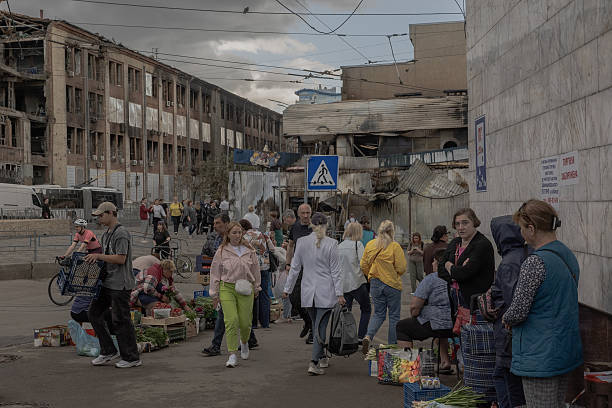
Pedestrians walk past street vendors selling fruits and vegetables next to a heavily damaged building and market following Russian strikes near the Lukianivska metro station in Kyiv. (Roman PILIPEY / AFP via Getty Images)
While Ukraine struck deep, Russia aimed low. Multiple-launch rocket systems fired into a children’s playground in Kherson’s Korabelnyi district at 5:30 in the afternoon, when families were outside. A 36-year-old woman and her daughters, aged three and six, were struck by shrapnel and blast waves. Their father was killed. A 50-year-old man nearby was also wounded.
In the intelligence and strategic layer: Zelensky disclosed that Ukrainian intelligence has received internal Russian information indicating preparations for an additional wave of involuntary mobilization — tens of thousands more personnel. The Kremlin’s voluntary recruitment campaign is failing: recruitment rates have fallen below battlefield casualty rates since December 2025. And in a measure of how much Ukraine’s refinery campaign is squeezing domestic fuel supply: Deputy Prime Minister Novak chaired an emergency meeting on whether to ban diesel and jet fuel exports entirely — because Russia no longer has enough refining capacity to supply both its military and its export market.
DEEP STRIKES: TAGANROG REPAIR PLANT, BALTIMOR AIRBASE, TUAPSE REFINERY
Ukrainian forces struck three high-value targets overnight May 26 to 27. At Taganrog Airbase in Rostov Oblast, geolocated footage confirmed an explosion and smoke plume. Russian opposition source Astra assessed that the strike hit the 325th Aircraft Repair Plant, a facility that services An-12 and Il-76 military transports, Su-24 bombers, Su-25 ground attack aircraft, Mi-8 utility helicopters, and Mi-24 attack helicopters. The plant is sanctioned by the EU, United States, and Ukraine for its direct role in sustaining Russia’s military aviation. Governor Slyusar acknowledged a Ukrainian missile strike against Rostov Oblast. Debris reportedly injured two women, one seriously.
At Voronezh, geolocated footage and Astra confirmed explosions and smoke near the Baltimor Air Base. An open-source assessment identified the struck area as the base’s training, repair, and technical maintenance section. The Russian 47th Guards Bomber Aviation Regiment, which operates Su-34 aircraft from Baltimor and regularly conducts glide bomb strikes against Ukraine, is stationed there. The Voronezh governor acknowledged two high-speed targets destroyed over the city, with debris damaging civilian structures but no reported casualties.
At Tuapse in Krasnodar Krai, geolocated footage showed a fire at the oil refinery. Ukrainian Center for Countering Disinformation Head Kovalenko implied Ukrainian forces struck the facility. Krasnodar Krai authorities confirmed a Ukrainian strike against Tuapse. The Tuapse refinery has been struck multiple times in recent weeks; the most recent prior confirmed strike was the night of April 30 to May 1.
UKRAINE STRIKES BLACK SEA FLEET NAVAL AVIATION HEADQUARTERS AND CONFIRMS BELBEK STRIKE
Ukrainian forces struck the Black Sea Fleet Naval Aviation headquarters on Hoholya Street in occupied Sevastopol on May 27. Russian opposition source Astra and the Crimean Wind Telegram channel confirmed a fire at the BSF headquarters. Occupation governor Razvozhaev acknowledged Ukrainian strikes, stating Storm Shadow missiles were used and one struck an administrative building near Hoholya Street. He also claimed a strike hit the Southern Directorate building of Russia’s Central Bank, igniting a roof fire and shattering windows in nearby residential buildings.
Geolocated footage published May 20 confirmed the SBU’s May 17 strike against Belbek Air Base in occupied Sevastopol. The strike destroyed a Pantsir-S2 air defense system, a hangar housing the radar for an S-400 system, an Orion drone control system, a Forpost UAV control system, a ground-to-air data transmission system, and a control tower and hangar. This confirmation reinforces Ukraine’s systematic SEAD campaign, which has now visually confirmed destruction of more than 107 Russian air defense systems and radars since November 2025.
ZELENSKY WARNS OF RUSSIAN MOBILIZATION PREPARATIONS; ISW ASSESSMENT
Zelensky stated on May 27 that Ukraine has received internal Russian information indicating preparations for an additional mobilization wave intended to increase the Russian contingent in Ukraine by tens of thousands of personnel and offset battlefield losses. He noted Ukraine also received intelligence on increased mobilization efforts, though it remains unclear whether this refers to expanded voluntary recruitment, crypto-mobilization, or processing of military reservists.
ISW’s assessment: Russia’s voluntary recruitment rate has fallen below its battlefield casualty rate since December 2025. Bloomberg reported in February that Russia sustained 9,000 more casualties than it could recruit in January alone. The Kremlin has expanded recruitment to new demographics — women and university students for Unmanned Systems Forces and rear area air defense — but recruitment continues to decline despite one-time signing bonus increases. Putin signed a debt relief decree on May 25 covering up to 10 million rubles for new recruits, a further sign of recruitment strain.
The strategic complication ISW identifies: even if Russia mobilizes additional reservists, delivering them to the frontline is now a serious operational problem. Ukraine’s intermediate-range strike campaign is actively interdicting Russian logistics and personnel transport routes. A Kremlin-affiliated milblogger confirmed on May 26 that Ukrainian drone reconnaissance and frontline strikes have undermined the infiltration missions on which Russian advances have depended. More soldiers cannot compensate for a supply and movement system that Ukraine is systematically dismantling.
UKRAINE’S ‘LOGISTICS LOCKDOWN’: HR 5 BILLION, COMPETITIVE TENDERS, SUMMER RESULTS PROMISED
Defense Minister Fedorov announced on May 27 that Ukraine is launching a formalized logistics lockdown of Russian forces, scaling its intermediate-range strike campaign through two mechanisms: performance-based procurement and centralized competitive tenders. The Defense Ministry and General Staff have allocated an additional Hr 5 billion ($112.3 million) for medium-range strike procurement. Funds will be distributed first to brigades with the highest scores in the military’s E-Points performance system, which awards points for verified frontline task completion. The first units have already received funding and begun procurement.
A second phase will involve centralized large-batch tenders for medium-range strike systems. Fedorov stated: “As early as this summer, the results of the centralized procurement of medium-range strike capabilities will be felt on the front line.” He added that Ukraine has quadrupled the destruction of Russian logistics, warehouses, equipment, command posts, and supply routes through medium-range strikes. The cost to Russia of territorial advance rose from 67 soldiers per square kilometer in October to 179 soldiers per square kilometer in April 2026. Russia’s rate of advance has slowed correspondingly, and Fedorov stated: “A clear pattern is already visible on the dashboard: the more Russian logistics are destroyed, the fewer assaults occur on the front line.”
RUSSIA CONSIDERS DIESEL AND JET FUEL EXPORT BAN AS REFINERY OUTPUT HITS 17-YEAR LOW
Russian Deputy Prime Minister Novak chaired an emergency meeting on May 26 to discuss a possible temporary ban on diesel and jet fuel exports. Interfax and RBK reported that sources described a potential ban lasting one to two months, pending Ministry of Economic Development approval. One source told Interfax only jet fuel would be restricted, with sufficient domestic diesel supply available. Novak stated publicly that the Russian government prioritizes domestic fuel markets.
Bloomberg reported on May 26 that data from analytics firm OilX shows average Russian oil refinery output in April 2026 fell to 4.69 million barrels per day — the lowest daily refining average since December 2009. Russia already imposed a temporary gasoline export ban from April 1 to July 31, 2026. If the diesel and jet fuel ban is implemented, Russia will have restricted three categories of petroleum product exports within a single year, all as a direct consequence of Ukrainian drone strikes on oil infrastructure. The Syzran refinery — fully halted since the May 20-21 strike — alone accounts for 170,000 barrels per day.
RUSSIA STRIKES A PLAYGROUND IN KHERSON; FATHER KILLED, MOTHER AND TWO DAUGHTERS WOUNDED
Russian forces fired multiple-launch rocket systems at a children’s playground in Kherson’s Korabelnyi district at approximately 5:30 p.m. on May 27. A father was killed. His wife, aged 36, and their daughters, aged three and six, suffered blast injuries and multiple shrapnel wounds and were hospitalized. A 50-year-old man nearby was also injured. City military administration head Shanko confirmed the strike. Kherson has been under persistent Russian attack since Ukrainian forces liberated it in November 2022. Since summer 2024, Russian drone attacks have intensified with deliberate targeting of civilians in what Ukrainian officials have called a human safari. Rocket strikes on a playground in the afternoon fall within the same systematic pattern.
GCHQ: NEARLY 500,000 RUSSIAN SOLDIERS KILLED; UKRAINE’S DRONE FORCE IN SCALE
GCHQ Director Anne Keast-Butler, in her inaugural public speech on May 27, cited new intelligence estimating that nearly 500,000 Russian soldiers have been killed since February 2022. She stated: “Russia is scaling up its daily hybrid activity against the UK and Europe, stretching from the seabed to cyberspace” and assessed that Putin is going backwards on the battlefield. Independent Russian media confirmed 221,206 identifiable Russian deaths through public records as of May 22. Ukraine’s General Staff total casualty figure — including killed, injured, captured, and missing — stood at approximately 1,358,950 as of May 27.
Ukraine’s drone force provides the operational context. The Armed Forces have approximately 80,000 personnel involved in drone operations, with the elite Unmanned Systems Forces comprising roughly 15,000. Frontline drone pilots across all service branches number an estimated 25,000 to 40,000 active operators — more than all NATO pilots in non-North American Europe combined. Ukraine’s nationwide drone flight school network, encompassing military-run, unit-run, and private institutions, can convert a person with no drone experience into a combat-ready pilot in roughly one to two months. The Skyfall company alone has trained more than 20,000 operators since 2023. A flight simulation program called FPV Battleground, built by BAZU software for $50,000, is now used across AFU units to rehearse strikes and plan combined arms maneuvers before committing forces to actual terrain.
FRONTLINE: UKRAINIAN ADVANCES IN SUMY, KHARKIV, AND BOROVA; ZAPORIZHZHIA FLAG INCIDENT
In northern Sumy Oblast, geolocated footage published May 26 shows Ukrainian servicemembers raising a flag in eastern Zapsillya northeast of Sumy City, indicating recent liberation. The Russian MoD claimed seizure of both Zapsillya and Ryasne; the Ukrainian 14th Army Corps refuted both claims. In northern Kharkiv Oblast, geolocated footage from May 21 confirmed Ukrainian forces cleared houses in western Shesterivka northeast of Kharkiv City. The Russian MoD falsely claimed seizure of Hraniv north of Kharkiv City; the Ukrainian 7th Rapid Reaction Corps confirmed Ukrainian control on May 27.
In the Borova direction, geolocated footage from May 26 confirms Ukrainian forces advanced north of Shyikivka east of Borova, with fighting ongoing within Nove southeast of Borova. In western Zaporizhzhia Oblast, Russia’s MoD claimed seizure of Vozdvyzhivka northwest of Hulyaipole and released footage of Russian soldiers planting flags. Separate geolocated footage shows Ukrainian servicemembers within the settlement removing those flags. Southern Defense Forces Spokesperson Voloshyn confirmed Russian claims are false: one unsuccessful Russian infiltration was conducted on the morning of May 27 after a long period of inactivity. A Ukrainian military intelligence source stated the original infiltrators from two to three weeks prior were eliminated or captured. ISW assessed that Ukrainian forces have cut off this infiltration route.
In the Pokrovsk direction, Russian forces recently advanced in western Rodynske north of Pokrovsk, though overall tempo near Myrnohrad has slowed, with few Russian infiltrators surviving missions. In Kostyantynivka, Russian forces continue small-group infiltrations but have not established permanent positions despite sustained attempts. A Ukrainian company commander reported Russian forces have decreased artillery use compared to 2025, assessing they may be running low on resources. In Kupyansk, a single Russian infiltrator was filmed operating in northern Kupyansk, reflecting the diminishing character of Russian operations in that direction.
UKRAINIAN MID-RANGE STRIKES ACROSS ALL THEATERS
In the southern theater, a Ukrainian USF brigade stated on May 27 it is conducting a large-scale campaign against M-14 highway logistics using previously undisclosed drone systems. Russian forces are attempting to bypass via field roads; Ukrainian forces are striking those routes as well. The Atesh partisan network in Crimea confirmed Russian authorities are urgently repositioning supplies beyond Mariupol to areas currently beyond Ukrainian drone range. Geolocated footage from May 26 confirmed strikes against Russian trucks on the M-30 Luhansk City highway in Yurivka, and against vehicles along the T-13-06 highway in Sievierodonetsk, both roughly 40 to 80 kilometers from the frontline. In Donetsk Oblast, Ukrainian forces struck command posts, drone control points, depot facilities, and a fuel railcar between 16 and 52 kilometers from the frontline.
OVERNIGHT DRONE STRIKE: 163 LAUNCHED, 150 DOWNED; POWER OUTAGES ACROSS FIVE OBLASTS
Russian forces launched 163 Shahed-type, Gerbera-type, Italmas-type, and Parodiya decoy drones overnight May 26 to 27, from Kursk, Bryansk, Oryol, Millerovo, and Shatalovo. Ukrainian air defenses downed 150 drones. Eight drones struck seven locations; debris fell on four more. Russian strikes damaged civilian, energy, and transport infrastructure in Chernihiv, Dnipropetrovsk, Odesa, and Zaporizhzhia oblasts. Ukrenergo reported power outages in Donetsk, Dnipropetrovsk, Zaporizhzhia, Sumy, and Kharkiv oblasts. In Odesa, a separate drone strike injured 11 people including two children aged 11 and 12, damaging residential buildings, a Nova Poshta branch, and a grocery store. Three victims remained in serious condition. In Chernihiv, overnight strikes damaged warehouse facilities, an administrative building, five summer houses, and shattered windows in six apartment buildings.
ZELENSKY WRITES TO TRUMP AND CONGRESS ON ANTI-BALLISTIC MISSILE SHORTAGE
President Zelensky sent urgent letters to President Trump and the U.S. Congress on May 27, warning of a worsening shortage of anti-ballistic missile capabilities. The letter stated: “When it comes to defending against ballistic missiles, we rely almost exclusively on the United States.” Zelensky requested additional Patriot PAC-3 missiles and systems, expressed concern over the pace of PURL program deliveries, and wrote: “The current pace of deliveries through the PURL program is no longer keeping up with the reality of the threat we face.” Ukraine’s Presidential Office confirmed the letters. Ambassador Stefanishyna distributed copies to the White House, House Speaker Johnson, and members of Congress.
COMMANDER BILETSKY: SIX MONTHS TO SEIZE THE INITIATIVE
Brigadier General Andriy Biletsky, commander of Ukraine’s Third Army Corps, told Reuters on May 27 that the next six months represent the most critical window in the war. “The lack of personnel no longer allows them to advance the way they did, for example, a year ago,” he said of Russian forces. He said Ukraine needs to secure strategic positions before entering negotiations, to negotiate from strength rather than weakness. Biletsky noted Ukraine currently leads Russia in unmanned ground vehicles and heavy bomber drones, credited the Starlink cutoff for Russian forces as a major factor in weakening Russian battlefield coordination, and said his corps aims for robotic systems to perform 30 percent of battlefield functions by 2027.
FRANCE-NORWAY NUCLEAR DETERRENCE AGREEMENT; UK-POLAND NORTHOLT TREATY
French President Macron and Norwegian Prime Minister Støre announced on May 27 that Norway will begin talks on joining France’s forward nuclear deterrence framework, signing a mutual defense agreement in Paris. Støre stated Norway’s primary security guarantee remains NATO but characterized French nuclear capabilities as part of the alliance’s overall deterrence posture. France has now established nuclear deterrence cooperation with Germany, Poland, the Netherlands, Sweden, Denmark, Belgium, Greece, and Norway.
UK Prime Minister Starmer and Polish Prime Minister Tusk signed the Northolt Treaty, a bilateral defense pact deepening air defense cooperation, joint action against Russian hybrid threats, and coordination on irregular migration. Ukrainian defense tech company BlueBird Tech was selected to join the Pentagon’s Drone Dominance Program, which targets procurement of more than 200,000 drones by 2027 with a budget of up to $1 billion. The company also completed first demonstration tests of its Beberdrone fixed-wing strike UAV, designed for targets up to 45 kilometers behind enemy lines.
WAR CRIMES: BOSNIAN-SERB MERCENARY NAMED; POPE LEO XIV SPEAKS
Ukraine’s SBU named Davor Savičić, a 46-year-old Bosnian-Serb mercenary, as a suspect in war crimes committed in Vyshhorod and Buchansk districts near Kyiv in February-April 2022. As commander of the Wolves sabotage unit under Redut PMC, he is accused of detaining and beating a civilian, confining him in a hole without food or water for seven days, and separately torturing the wife of a Ukrainian soldier while her husband’s body was later found in a nearby forest. Savičić is wanted by INTERPOL and Bosnian authorities for crimes in the Yugoslav civil war, is under UK sanctions, and currently recruits foreign fighters for the GRU from within Russia’s 1st Volunteer Reconnaissance and Assault Brigade.
Pope Leo XIV expressed solidarity with Ukraine on May 27, condemning the sharp intensification of Russia’s war. “Where missiles and drones fall, hopes also fall, homes and places of worship are destroyed, and innocent lives are shattered.” The Pope has previously offered the Vatican as a venue for peace negotiations; Zelensky has backed the proposal while Russia has rejected it.

Pope Leo XIV arrives to attend his weekly general audience at St. Peter’s Square in the Vatican. (Alberto Pizzoli / AFP via Getty Images)
KHARKIV BUILDS ITS FIRST UNDERGROUND KINDERGARTEN
Kharkiv Mayor Terekhov announced at the GLOBSEC Forum that the city is constructing its first underground kindergarten, following ten underground schools already built and a metro station converted into a learning facility. “I don’t want our enemy to take away from our children the opportunity to study. I don’t want our enemy to take away our children’s childhood.” A second underground school opened in Pechenihy southeast of Kharkiv, funded primarily by international partners at a cost of approximately $70,754. Many young children attending underground facilities are experiencing face-to-face education for the first time.
Ukraine struck a military aircraft repair plant, an air base where Su-34s are based, and an oil refinery on the Black Sea coast in a single night. Russia’s refining output fell to its lowest since 2009. A Deputy Prime Minister convened an emergency meeting on fuel export restrictions. The GCHQ director said nearly 500,000 Russian soldiers have been killed.
In Kherson, a father was killed on a playground at 5:30 in the afternoon and his three-year-old and six-year-old daughters were wounded. France added Norway to its nuclear deterrence framework. Kharkiv is building a kindergarten underground. Ukraine’s drone corps numbers more active pilots than all NATO air forces in non-North American Europe combined.
Day 1,554. The next six months are the most critical, said the brigadier general. The playground in Kherson says the same thing in different terms.
A PRAYER FOR UKRAINE
1. For the Family on the Playground in Kherson
Lord, at 5:30 in the afternoon on May 27, a father took his family to a playground in Kherson’s Korabelnyi district. His wife is 36. His daughters are three and six. Russian forces fired multiple-launch rockets into that playground. He was killed. His wife and daughters were injured by blast waves and shrapnel. A 50-year-old man nearby was also wounded. These are not casualties of war in any meaningful sense of that phrase. They are a murder in a park in the afternoon. Receive the father. Hold his wife and daughters in the days of treatment and grief that follow. And let the weight of this — a three-year-old and a six-year-old with shrapnel wounds — fall on every person with the power to end this war who has not yet found sufficient urgency to act.
2. For Ukraine’s 25,000–40,000 Drone Pilots
God of endurance, Ukraine has built, in four years, a drone corps that numbers more active combat pilots than all of NATO’s non-North American air forces combined. They came from every background: mechanics, engineers, teachers, gamers who decided to become something else because the war required it. They trained for one to two months and then flew into a war that has killed hundreds of thousands of their countrymen. The GCHQ director said nearly 500,000 Russian soldiers have been killed; a substantial portion of that accounting belongs to Ukraine’s drone operators. They carry that weight. Sustain them. Give them precision, reliable equipment, and the mental endurance to continue. And let the Hr 5 billion logistics lockdown program, the competitive tenders, and the new drone systems already in procurement reach them in time to matter.
3. For the Children Going to School Underground in Kharkiv
Father, Kharkiv’s mayor announced at an international security forum that the city is building its first underground kindergarten. He said: I don’t want our enemy to take away our children’s childhood. He is building schools in basements because the alternative is not building schools at all. In Pechenihy southeast of Kharkiv, children are attending face-to-face education for the first time — underground — because Russian strikes have made aboveground classrooms indefensible. These children will grow up knowing that their education took place in shelters. We pray that knowledge becomes a source of resilience rather than only grief. And we pray for the teachers who descend into those spaces each morning, the parents who send their children there, and the engineers who calculated how much concrete was needed to protect a classroom.
4. For Brigadier General Biletsky’s Six Months
Lord of history, a Ukrainian general told Reuters on May 27 that the next six months are the most critical window in this war. He said it from an underground location in Kharkiv Oblast, having commanded troops through some of the hardest fighting of 2026. He believes Ukraine can improve its position enough to negotiate from strength rather than weakness — but only if the window is used well, if the weapons arrive, if the international support holds, if the drone advantage is maintained. Six months is a short time. It is also an enormous amount of suffering. We pray for everyone who will live inside those six months — the soldiers holding the Fortress Belt, the civilians in Donetsk, Zaporizhzhia, Kharkiv, Sumy, Kherson, and Odesa, the families who will send letters and receive silence. Let the generals’ assessment be correct. Let the window be used. Let the six months end with Ukraine in a stronger position than it began them.
5. For the Father Who Will Not Be Named Today
God of the particular, we do not yet know the name of the man killed at the Kherson playground on May 27. His wife and daughters are in hospital. His name will appear in an official casualty report, a police file, perhaps eventually a memorial. But today he is unnamed in the public record — one of the hundreds of thousands absorbed into statistics and briefings and assessments. We name him here as a father. A man who was with his three-year-old and his six-year-old in the afternoon sunshine, doing what fathers do. Receive him. Let his daughters be healed. And let the world not become so habituated to the number of Ukrainian civilian dead that individual deaths no longer register as the full moral weight they carry.