
August 8, 2026
Prepared by Diana Bozhyk
US intelligence believes Russia is preparing a major strike campaign against Kyiv’s energy infrastructure timed to hit before Ukraine’s Independence Day on August 24, potentially drawing on missiles held in strategic reserve for maximum damage. Elon Musk is refusing to let Ukraine use Starlink to guide strikes against Russian missile batteries, telling Ukrainian officials it’s “time to make a deal” instead. Russian attacks killed at least 12 people and wounded 82 more overnight and through the day, including a grandmother, grandfather, and their 3-year-old grandson killed together in Brovary district for the second time this week. And Zelensky declared himself satisfied with a 40-day pressure campaign against Russian logistics that he says cost Moscow $12.2 billion.
THE DAY’S RECKONING
Ukraine’s Independence Day sits 16 days away, and American intelligence now believes Russia is quietly building toward it — not with a parade of its own, but with a missile campaign timed to darken Kyiv before Ukrainians can properly celebrate having survived another year. In Brovary, the same district that buried eight people on a train platform just two days ago, a missile found a grandmother, a grandfather, and their 3-year-old grandson in a single house, while the child’s parents and older brother were pulled wounded from the wreckage next door. In California, Elon Musk told Ukrainian officials pressing him for Starlink access to strike Russian missile batteries that it was “time to make a deal” instead — a business decision dressed up as diplomatic advice, delivered by a man Ukraine has no way to overrule. And in an interview taped for national television, Zelensky allowed himself something close to satisfaction: a 40-day campaign against Russian logistics, he said, had cost Moscow more than $12 billion. Two numbers sat uneasily next to each other today — one measuring what Ukraine took from Russia, the other measuring what Russia is still taking from Ukraine’s children.
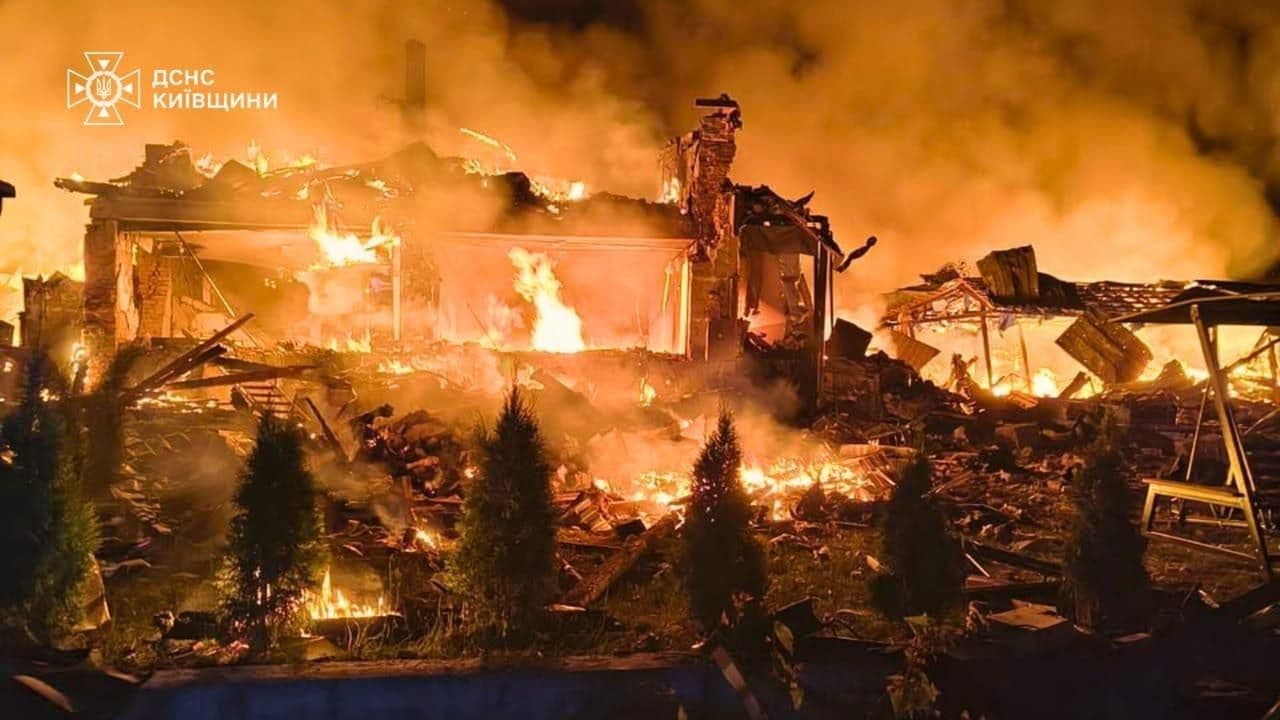
A fire engulfs a destroyed home in the aftermath of a deadly Russian attack in Kyiv Oblast overnight. (State Emergency Service/Telegram)
TWELVE KILLED, 82 WOUNDED: A THIRD DEADLY NIGHT FOR KYIV’S REGION
Russian forces launched six Iskander-M and S-400 missiles and 151 drones at Ukraine overnight; not a single missile was intercepted, and 135 drones were downed or jammed. The toll across the day reached at least 12 dead and 82 wounded nationwide. Brovary district absorbed the worst of it for the second time this week: in the village of Pukhivka, a grandmother, grandfather, and their 3-year-old grandson were killed together, while the child’s parents, his 15-year-old brother, and a neighbor who came to help were wounded and hospitalized. “Europe, the U.S., and Ukraine have long wanted to end the war,” Zelensky wrote. “Only Putin doesn’t want to, and is clinging to his ballistic missiles and drones to keep the war going.” In Kyiv itself, one person was killed and four wounded as fires broke out in the Holosiivskyi and Obolonskyi districts.
Elsewhere, Zaporizhzhia Oblast lost three people with four wounded; Kharkiv Oblast lost two men in their sixties in the front-line town of Izium, with seven more wounded regionally; Donetsk Oblast lost one in Sloviansk, with 15 wounded; Kherson Oblast lost two, with 26 wounded including a child; Sumy Oblast reported 19 wounded, 14 of them in the border community of Bilopillya; and Dnipropetrovsk Oblast reported one wounded across six districts struck more than 10 times. A Russian drone also hit the locomotive of a Sumy-to-Kyiv passenger train, though a timely evacuation prevented casualties there — the same kind of near-miss that didn’t hold two days earlier in Lozova, where a strike on a train platform killed two railway workers outright.
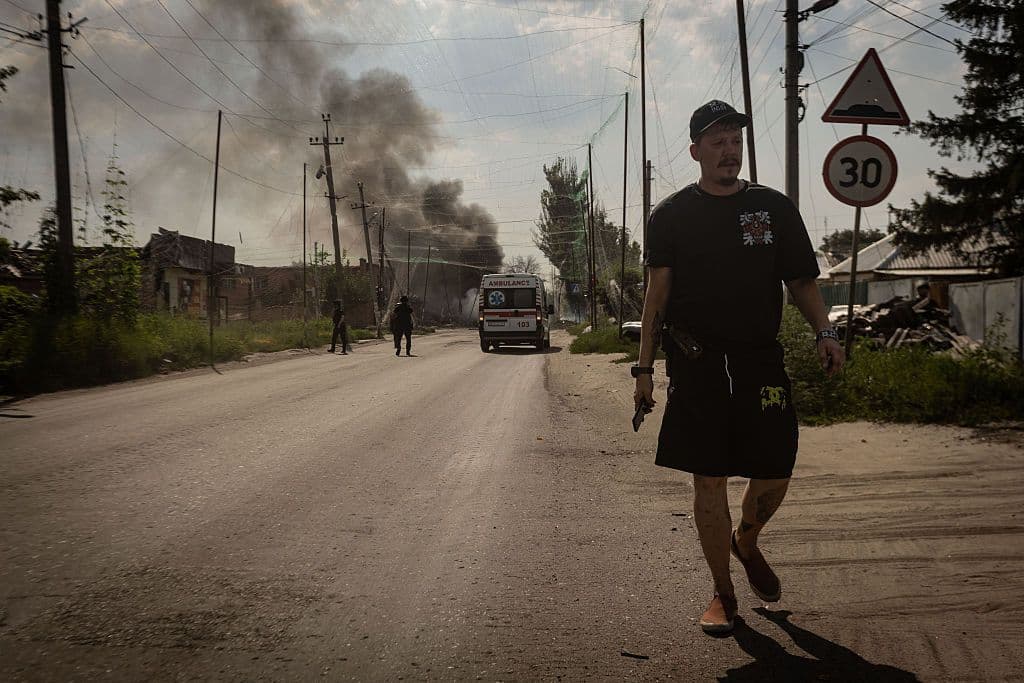
A resident walks along a road as a large column of smoke rises following a Russian airstrike in Sloviansk in eastern Donetsk Oblast, Ukraine. (Francisco Richart / Anadolu via Getty Images)
RUSSIA PLANS A STRIKE CAMPAIGN TIMED TO INDEPENDENCE DAY
Ukraine’s Strategic Communications Center reported, citing US intelligence, that Russia is preparing a large-scale strike campaign against Kyiv City’s energy infrastructure in the coming weeks, potentially drawing on its strategic reserve of ballistic missiles to maximize damage before Ukraine’s Independence Day on August 24. Russia typically begins its seasonal energy campaign in September; starting early this year would let Moscow exploit Ukraine’s current interceptor shortage and disrupt repair work on facilities damaged during last winter’s campaign, which cost $64 to 70 billion to fix and left Ukraine with a six-gigawatt shortfall covering roughly 80 percent of its power generation.
Striking now would also force Russia to choose between energy targets and its ongoing campaigns against Ukrainian gas stations, ports, and logistics — though Russia’s heavy reliance on cheaper Geran-type drones for those other campaigns means it could plausibly sustain both at once, freeing its limited ballistic missile stock specifically for Kyiv’s grid. Whether the timing is coincidence or design, a blackout landing squarely on Ukraine’s most symbolically important date would be difficult to read as anything but deliberate.
FRONTLINE: KUPYANSK’S INFILTRATION BATTLE, AND PUTIN’S RETREAT TO SIBERIA
Russian forces are increasingly trying to infiltrate Kupyansk from the north and east, attempting to cut off a Ukrainian bridgehead on the Oskil River’s left bank while reinforcing positions in Kupyansk-Vuzlovyi, according to Ukrainian military spokesperson Viktor Trehubov — a foothold that lets Russian drone operators pressure Ukrainian logistics more effectively the deeper they get. Ukrainian forces continued advancing or holding positions in the Sumy, Kharkiv, Slovyansk, and Borova directions despite the pressure, while a Ukrainian battalion deputy commander near Pokrovsk reported Russian forces increasing infiltration attempts after rotating in fresh units, expanding the area’s drone “kill zone” to 20 kilometers.
Putin, meanwhile, is increasingly avoiding Russia’s own European territory altogether, Russian outlet Agentstvo reported, favoring trips to Siberia and the Far East where Ukrainian drone strikes can’t reach. He’s expected in Novosibirsk next week — his fifth regional trip since June, only one of which touched vulnerable western Russia. The shift comes days after a drone crashed on a beach just 22 kilometers from Putin’s private Black Sea estate, reportedly aimed at a nearby retreat used by missile designers from a sanctioned defense firm, killing four people including a child when Russian defenses intercepted it over a crowded shoreline instead.
ZELENSKY’S 40-DAY RECKONING: $12.2 BILLION IN LOSSES
Zelensky declared himself “absolutely satisfied” with the results of a 40-day operation he ordered in late June to pressure Russia toward ending the war, telling Ukrainian television that Russian logistics losses from the campaign reached one trillion rubles — roughly $12.2 billion. “After they began striking our logistics, we found another logistical operation and responded to them,” he said, referring to the campaign that crippled Wildberries warehouses and dozens of shadow fleet tankers supplying Crimea. He signaled the pressure won’t stop simply because the 40-day window closed: “I would not advise Russia to continue striking Ukrainian logistics, because we have clearly studied what Russia’s logistics look like.”
Ukrainian officials familiar with the campaign’s planning have said its ambitions reached beyond the stated 40 days, aiming to make ordinary Russians feel the war’s cost directly enough to matter politically ahead of September’s elections — a slower, less measurable objective than any single strike, and one that won’t be judged a success or failure for months yet.
SHADOW FLEET PASSES 218, AND TURKEY CALLS FOR A TRUCE
Ukraine’s Unmanned Systems Forces reported striking 12 more Russian shadow fleet vessels over the past week, bringing the campaign’s total since July 6 to 218 ships — 134 in the Sea of Azov, 84 in the Black Sea. “Molochka Operation continues,” the force wrote, crediting Commander Robert “Magyar” Brovdi’s Birds Brigade alongside the K-2 Brigade and Raid Regiment. Russia has answered largely by striking foreign-flagged civilian vessels near Odesa instead, including Turkish-owned ships carrying grain and fertilizer; one attack on a Turkish fishing vessel near occupied Crimea killed one person and wounded four.
Turkish Foreign Minister Hakan Fidan called for both countries to accept a moratorium on Black Sea vessel attacks, saying Ukraine has already proposed one and Ankara is waiting on a Russian response. “At first, ports and warships were attacked. Now all commercial vessels are being attacked indiscriminately,” Fidan said. “The conflict has spread across the whole Black Sea.” An earlier US-brokered Black Sea ceasefire collapsed in 2025 after Russia conditioned its participation on lifting sanctions against its own food exporters — a precedent that leaves little reason to expect this appeal will fare differently.
The human and economic cost of that spreading conflict came into sharper focus this week. German outlet Bild reported that Russian drones struck the Liberian-flagged cargo ship Emil off Odesa, then struck it a second time as the crew was still evacuating — the same double-tap pattern Russia has used against rescuers on land. A separate strike hit the Guinea-Bissau-flagged Mera Queen as it carried wheat through the Black Sea. Bloomberg reported that Ukraine’s Agriculture Ministry now forecasts agricultural exports could fall 54 percent in the 2026-2027 marketing year, with wheat exports down as much as 53 percent; grain storage capacity may fill entirely by early November, and alternate routes through Romania, Slovakia, and Hungary can’t come close to replacing what Odesa’s ports once moved.
DEEP STRIKES: ILSKY AND SYZRAN BURN AGAIN
Ukraine’s General Staff confirmed direct hits on two major Russian refineries overnight: the Ilsky Oil Refinery in Krasnodar Krai, with a capacity of 6.6 million tons annually and products the General Staff says directly support Russian forces, and the Syzran Oil Refinery in Samara Oblast, one of Rosneft’s larger facilities at 8.5 million tons a year. Both caught fire. Russia’s Defense Ministry claimed 83 Ukrainian drones downed overnight without naming either region among them. Separately, Ukrainian naval forces struck a shadow fleet tanker off Gelendzhik, prompting local authorities to close nearby beaches over drone and air-defense risk.
MUSK SAYS NO, AND PATRIOT PRODUCTION SAYS NO TOO
Elon Musk is refusing to grant Ukraine permission to use Starlink to guide long-range strikes against the Russian missile batteries bombarding its cities, The Atlantic reported, despite Zelensky personally asking Trump to press the issue and continued informal outreach from Fedorov since leaving office. “At the moment, there is no positive decision,” one of Fedorov’s associates said. Musk reportedly keeps telling Ukrainian officials the risk of Russian escalation is too high, and that “it is time to make a deal” instead — Trump, for his part, gave no clear answer on whether he’d intervene.
The refusal lands alongside another closed door: US Ambassador to NATO Matthew Whitaker confirmed Washington won’t license Ukraine to build its own Patriot interceptors after all, walking back Trump’s own Ankara summit pledge. “Patriot interceptors are very controlled export-wise, and we do not allow anybody but US manufacturers to make those,” Whitaker said. Speaking alongside Vučić in Belgrade, Zelensky confirmed Ukraine still receives monthly Patriot shipments under the PURL program — allied-funded purchases from US manufacturers — but that 2026’s volumes run below 2025’s. “Are these missiles enough? No,” he said, adding that Germany, Poland, and Scandinavian countries remain Ukraine’s best hope for filling the gap.
ZELENSKY IN BELGRADE: VUČIĆ BACKS UKRAINE’S EU BID
On the second day of Zelensky’s first official visit to Serbia, President Aleksandar Vučić voiced public support for Ukraine’s EU accession — a notable gesture from one of the few European leaders who has refused to sanction Russia. “We want Ukraine to open all clusters as soon as possible, to close them as soon as possible,” Vučić said, calling it the wish of the Ukrainian people and leadership alike. The two governments signed a food-safety cooperation agreement, discussed joint infrastructure and railway projects, and Vučić invited Zelensky back to open a Serbian-Israeli drone factory. Serbia’s underlying relationship with Moscow — cheap gas, shared post-communist history, and a president who still travels to the Kremlin — hasn’t visibly shifted, but a public word of support on EU membership is more than Kyiv had going into the trip.

Serbian President Aleksandar Vucic (R) meets with President Volodymyr Zelensky (L), who is making his first visit to Serbia, at the Palace of Serbia in Belgrade, Serbia. (Stringer/Anadolu via Getty Images)
SEVENTY ATACMS FROM TURKEY
Congressional records made public this week show Ukraine has purchased 70 M39 ATACMS missiles, 12 M270 rocket launchers, more than 2,000 cluster munitions, and 47,000 howitzer rounds from Turkish and American defense firms, in a roughly $280 million deal expected to begin transferring in late August. The M39 is an older ATACMS variant with a range of about 165 kilometers, short of the 300-kilometer models Ukraine has used sparingly against Russian territory given its own severely depleted stockpiles — stockpiles Reuters has separately reported are strained further by the US war with Iran. Congress has two weeks to block the transfer; absent that, it proceeds automatically.
KIM JONG UN’S $22 BILLION WAR DIVIDEND
Bloomberg reported that North Korea earned up to $22 billion in foreign revenue between 2022 and 2025, nearly quadrupling the prior four-year period, driven overwhelmingly by artillery shipments and troop deployments to Russia. Pyongyang supplied up to half of Russia’s 122mm and 152mm shell needs by the end of 2025 and sent between 16,000 and 22,000 troops at roughly $2,000 per soldier monthly, with additional payments for soldiers killed in action. “North Korea is in a stronger position than at any time in the last 35 years,” said Korea Risk Group director Andrei Lankov. The windfall has funded accelerated nuclear development and new destroyer construction, even as Ukrainian intelligence confirms North Korea is now stationing missile crews directly inside Russia’s Voronezh Oblast, equipped with dozens of freshly delivered KN-23 and KN-24 ballistic missiles — the same missile type Zelensky says destroyed the Voronov family’s home in Radushne on July 30.
A PENTAGON GENERAL REMOVED WITHOUT EXPLANATION
The Pentagon abruptly relieved Lieutenant General Charles Costanza as commander of the US 5th Army Corps roughly two months before his scheduled departure, ABC News reported, without disclosing a reason. Costanza had led the corps — responsible for US ground forces in Europe and coordinating American assistance to Ukraine, headquartered forward in Poland — since April 2024; a source told ABC his removal wasn’t connected to Defense Secretary Pete Hegseth’s broader shake-up of military leadership, which has already dismissed or suspended more than two dozen senior officers without public explanation. His confirmed successor isn’t due to take over until October, leaving a two-month gap in one of NATO’s more consequential European commands.
EUROPE’S DRONE INCIDENTS MULTIPLY
Two drones circled a German military base in Mechernich that houses and repairs US Patriot systems, conducting six overflights overnight — one reportedly a VTOL surveillance drone approaching from 40 kilometers out. German officials haven’t attributed the incident to any specific actor, but it follows closely on a modified drone carrying Semtex explosive found beside a Ukrainian cargo plane at Leipzig airport, which the Wall Street Journal reported US intelligence now believes belonged to Russian intelligence. Germany’s interior minister has called the pattern a possible “hybrid attack scenario.” Separately, a Ukrainian Maya decoy drone exploded in a Bulgarian field near the Trans-Balkan gas pipeline, roughly 200 meters from a Romanian gas compressor station; Bulgarian officials said the blast appeared accidental rather than deliberate, and Ukraine’s foreign ministry said it never intentionally targeted Bulgaria, attributing any such incursion to Russia’s war itself rather than Ukrainian intent.
A BELGIAN FACTORY STILL FEEDS RUSSIA’S DRONE WAR
Belgian hygiene-products manufacturer Drylock Technologies continues operating inside Russia’s Alabuga Special Economic Zone — home to Russia’s largest Shahed drone factory — more than six months after an EU deadline required European companies to leave. Belgian regulators haven’t granted the company any formal exception, though it’s reportedly seeking one. The company’s Russian subsidiary has continued publicly voicing support for its employees serving in Russia’s military on Russian social media, including a recent “Happy Airborne Forces Day” post. “Alabuga is well known as the center of manufacturing for the Shahed drones,” EU sanctions envoy David O’Sullivan has said, calling continued operation there a sanctions circumvention issue for national authorities to enforce. More than six months past the deadline, enforcement still hasn’t caught up with the loophole.
WHAT SATURDAY CONFIRMED
By the time Saturday’s fires were finally out, Ukraine had a third deadly Brovary strike in a week, a satellite network still closed to its own defense, and a warning that worse is being planned for the date meant to celebrate its independence. Zelensky’s satisfaction with a $12 billion dent in Russian logistics sat uneasily beside a 3-year-old boy killed in his own home. Nothing about the war’s shape changed today. It simply kept confirming that both sides are still fully capable of hurting each other, and that neither one has found a reason yet to stop trying.
A PRAYER FOR UKRAINE
1. For the Grandmother, Grandfather, and the Boy Not Yet Four
Lord, three generations of one family died together in a single house, while the ones who loved them most lay wounded in the house next door. There is no way to make sense of a loss this complete, and we do not try to. Hold the parents and the fifteen-year-old brother now living with both grief and survival at once, and hold the neighbor who ran toward danger to help them.
2. For Izium’s Two Men, and Every Front-Line Town Still Standing
Father, two men in their sixties died in a town thirty kilometers from the fighting, close enough to feel like the front even when the maps call it something else. Hold their families, and hold every resident of Izium and towns like it who wake up each day still deciding whether staying is bravery or simply home. Protect them either way.
3. For a Capital Bracing for What August Might Bring
Lord of provision, intelligence suggests the very lights and heat of an entire capital may be targeted in the weeks ahead, timed to a day meant for celebration. Give wisdom to those preparing the city’s defenses, and courage to the people who will keep living there regardless of what comes. Let Independence Day still be marked with something worth celebrating, whatever Russia intends for it.
4. For a Decision Sitting in the Hands of One Man Far Away
God of justice, a war’s outcome partly depends tonight on the choice of a businessman deciding whether to share a tool that could save lives. Move his heart toward the people who need his decision most, and give Ukraine’s leaders patience and creativity for paths that don’t depend on him alone.
5. For Every Alliance Still Deciding How Much It’s Willing to Give
God of steadfastness, tonight Ukraine keeps hearing promises adjusted downward, permissions withdrawn, and generosity that arrives smaller than what was hoped for, from friends who mean well but keep finding reasons to hesitate. Soften whatever fear or caution keeps holding help back, and give Ukraine’s people patience for allies still learning what full solidarity actually costs. Let the support that does arrive be enough, even when it’s less than what was asked for.
In Your mercy, in Your justice, in Your time — bring this war to its end, and let the ending be worthy of what Ukraine has endured.