
On April 7, 2026, a Russian drone struck a civilian bus during morning rush hour in Nikopol, killing four people — the latest act in what analysts call a deliberate policy of hunting civilians. Overnight, 110 Russian drones hit cities from Odesa to Chernihiv, killing at least nine, while Ukraine struck Russian oil terminals near St. Petersburg for the fifth time in two weeks and debuted Swedish anti-ship missiles to destroy a Black Sea surveillance platform. Zelensky’s Easter ceasefire offer was answered with silence — and in Budapest, JD Vance campaigned for Kremlin-friendly Viktor Orban.
April 7, 2026 | Ukraine Daily Briefing
The Day’s Reckoning
It was rush hour in Nikopol. People were waiting at a bus stop in the city center — ordinary Ukrainians going to work, running errands, living ordinary lives — when the drone found them. The Russian FPV — first-person-view — streaked in at street level and detonated against the passenger bus as it pulled toward the stop. Four people died. Sixteen were wounded, three of them in critical condition. Men aged 58, 63, and 73, their bodies shredded by mine-blast injuries and shrapnel. Three weeks earlier, a Russian drone had struck a market in the same city, killing five and injuring 28.
Nikopol is not an isolated incident. It is a doctrine.
On April 7, 2026 — Day 1,503 of Russia’s full-scale invasion — that doctrine played out across multiple fronts simultaneously. While drone operators hunted bus passengers in Dnipropetrovsk Oblast, Russia launched 110 drones overnight, hitting Odesa, Chernihiv, Kherson, Donetsk, Zaporizhzhia, and Kharkiv. A child was killed in Odesa. A 14-year-old was wounded in Kherson. An 11-year-old boy died in a separate Dnipropetrovsk strike. A City Council building burned in Pryluky while officials were inside for a meeting.
Against this backdrop, President Zelensky reiterated Ukraine’s offer of an Easter ceasefire and a moratorium on energy infrastructure strikes — only to face the same Kremlin silence he has faced every time he has offered to stop the killing. Meanwhile, in Budapest, Vice President JD Vance stood shoulder-to-shoulder with Viktor Orban and accused Ukrainian intelligence of election interference — without evidence — five days before Hungary votes. And on the Black Sea, Ukraine debuted Swedish RBS-15 anti-ship missiles, destroying a Russian surveillance platform in a night action that announced a new weapon in Ukraine’s naval arsenal.
The day’s central thread: Russia kills civilians as policy, dismisses peace as weakness, and prepares for war that is metastasizing beyond Ukraine’s borders — while Ukraine keeps fighting and keeps innovating, one missile strike, one sabotage mission, one bus stop at a time.
‘Human Safari’: Russia’s War on Bus Stops, Markets, and Children
Imagine sitting on a city bus, watching the stop approaching. You don’t hear the drone coming. At speeds approaching 100 kilometers per hour, the FPV pilot — a Russian soldier watching a live video feed hundreds of kilometers away — guides the small aircraft into your vehicle like a guided spear.
That is what happened in Nikopol on the morning of April 7. The bus was approaching a stop in the city center. People were waiting on the pavement. The drone hit. Four died at the scene; sixteen more were wounded.
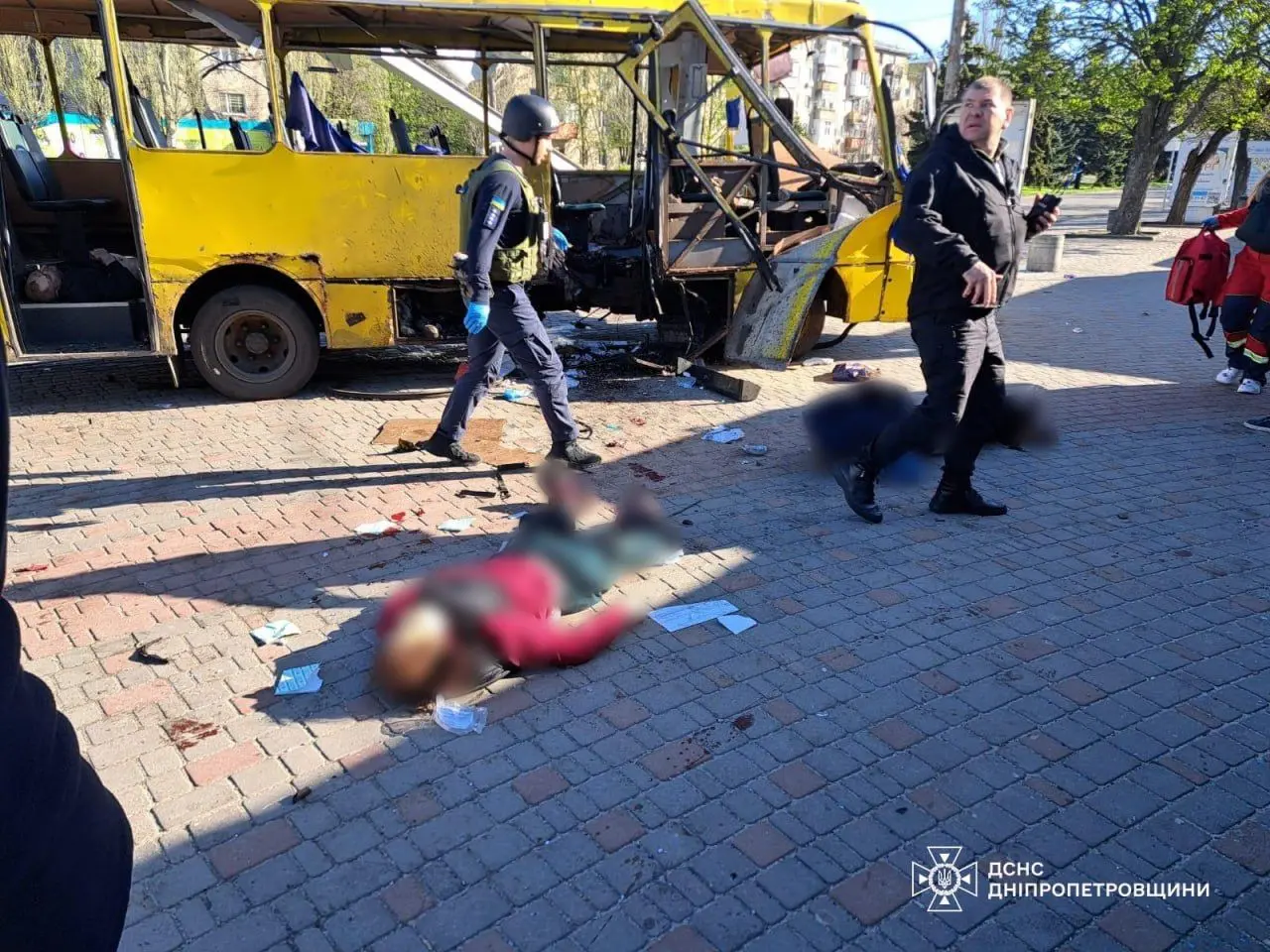
Military analysts at the Institute for the Study of War have a name for this: “human safari tactics.” The phrase sounds almost clinical, but the reality it describes is anything but. Russian drone operators, equipped with FPV systems that give them a first-person view of their targets, have been systematically hunting civilians across southern Ukraine — not as collateral damage, but as the mission itself. It is, ISW assesses, a deliberate strategy of using FPV drones to search for and strike civilian targets, specifically designed to make roads unusable by making any movement on them potentially fatal.
Traditional battlefield air interdiction targets military equipment and supply lines. Russia’s version targets grandmothers waiting for buses.
The same morning, Russian drones struck a second civilian bus in Chervonohryhorivka, east of Nikopol, injuring five more. In Kherson’s Korabelnyi district, shelling of residential buildings killed three civilians and injured seven during a 30-minute attack that damaged a shop and a pharmacy. In Stepanivka, three guided aerial bombs were dropped on the village center, destroying a school building and damaging a hospital. A 14-year-old boy was wounded; his father left in critical condition.
Overnight, the drone barrage widened. Russia launched 110 drones from multiple directions — Bryansk, Oryol, Krasnodar, Crimea — including Shahed-type, Gerbera-type, and Italmas-type platforms. Ukrainian air defenses downed 77 of them. But 31 got through, striking 14 locations across Ukraine. In Odesa, a residential high-rise was hit; three people, including a child, were killed and ten injured, with more possibly trapped in rubble. In Chernihiv, administrative buildings were set ablaze in Pryluky and Novhorod-Siverskyi. City officials fled burning rooms. In the Dnipropetrovsk region separately, an 11-year-old boy was killed by drone strikes across four districts.
“When such terror against people and life occurs daily, efforts to block new sanctions against Russia, ease existing restrictions, or resume trade look absurd.” — President Zelensky
After Nikopol, Zelensky wrote that “the killers will always try to go further. They must be stopped immediately and decisively.” He was reacting to a bus attack. He could have been writing about the entirety of Russia’s 2026 air campaign — which Ukrainian officials now expect to shift its primary targets from energy infrastructure to water supply and logistics infrastructure in the spring and summer months ahead.
Ukraine isn’t waiting passively. The State Agency for Infrastructure Restoration is constructing 17 hardened facilities at an undisclosed major regional center to protect heat and water supply. Protected pumping stations are being built on barges to draw water from the Dnipro and Dniester rivers in the event Russia destroys fixed water infrastructure. The preparations are grim evidence of what Ukrainian planners believe is coming.
Zelensky’s Easter Offer: A Gesture Into the Void
On the same day Russian drones were burning bus passengers, President Zelensky was making his most recent attempt to stop the killing — at least temporarily. Ukraine is prepared to halt strikes against Russian energy infrastructure if Russia reciprocates. Ukraine is prepared to observe a ceasefire over Orthodox Easter, on April 12. The United States has already transmitted the proposal to Russia and is working with Ukraine on formalizing the security guarantees that would accompany any energy moratorium.
The Russian answer, delivered not in words but in 110 drones and the silence of Kremlin officials, was unmistakable. Russian officials have rejected every Ukrainian ceasefire proposal, including this one. ISW assesses it is highly unlikely Russia will accept Zelensky’s offer.
Understanding why requires understanding what Moscow actually wants. Zelensky keeps offering concessions and compromise. The Kremlin keeps attacking. The asymmetry is not accidental — it reflects a fundamental Russian calculation that a ceasefire freezes a battlefield reality that currently favors Ukraine’s defense, while continued fighting creates conditions for Russian territorial consolidation. Until that calculation changes, Easter will be just another day of drone strikes.
Scorched Tanks and Burning Refineries: Ukraine’s Deep Strike Campaign
Eleven hundred kilometers from Nikopol’s bus stop, fires were still burning at the Ust-Luga oil terminal on the Gulf of Finland. Ukrainian drones had struck the Transneft-Baltika facility for the fifth time since March 24, damaging three oil storage tanks. Leningrad Oblast Governor Alexander Drozhdenko claimed Russian air defenses downed 22 drones over the oblast — but the footage published on April 7 showed clearly that fires at the port were real.
Ukraine’s Center for Countering Disinformation assessed that recent strikes have now damaged at least 30 percent of oil storage capacity at Ust-Luga. That is not a nuisance raid. That is a sustained campaign against one of Russia’s key Baltic export nodes.
The same overnight window saw Ukrainian drones strike the Minudobreniya chemical plant in Rossosh, Voronezh Oblast — one of Russia’s largest producers of ammonium nitrate, a key component in explosives, with annual capacity exceeding 550,000 tons. The main fertilizer storage building was damaged and caught fire, confirmed by open-source satellite imagery and acknowledged by the Voronezh governor himself.
Beyond new strikes, Ukraine also released updated battle damage assessments for recent operations. The April 4-5 strikes against the port of Primorsk, Leningrad Oblast, damaged three RVSP-20000 oil tanks — each holding 20,000 cubic meters — and ignited oil products. The same strikes damaged two primary crude processing units and a petroleum bitumen unit at the Lukoil-Nizhegorodnefteorgsintez refinery in Nizhny Novgorod Oblast. And satellite imagery published confirmed damage to the Tolyattikauchuk chemical plant in Tolyatti, Samara Oblast — specifically the BK-4 high-purity isobutylene production plant, disrupting its capacity to produce synthetic rubber.
The pattern is systematic: oil terminals, chemical plants, refineries, weapons-component facilities. Ukraine is not just punishing Russia’s economy. It is methodically degrading Russia’s industrial capacity to sustain a war.
The Sivash Platform Falls: Ukraine’s Newest Anti-Ship Weapon Debuts
Before the bus attack made headlines, before the overnight drones struck Odesa, the Ukrainian Naval Forces pulled off something remarkable — and revealed it only in a three-minute video posted late Monday evening.
The target was the Sivash, a self-elevating jack-up drilling platform sitting 60 to 80 kilometers northwest of Crimea, in the Black Sea. Russian forces had repurposed it as an airspace monitoring station, an electronic warfare platform, and an air defense node — a floating military installation with no civilian function. Ukraine attacked it with a combination of kamikaze maritime drones, FPV drones, and a weapon that was appearing in combat for the first time: the RBS-15 Gungnir anti-ship missile.
The RBS-15, designed by Sweden’s Saab Bofors Dynamics, is 4.35 meters long, weighs about 650 kilograms, and cruises at just below the speed of sound. It uses inertial navigation, GPS, and terminal active radar homing — and once launched, it needs no further input from the operator. In weapons development, that ‘fire-and-forget’ capability is enormously valuable: the launching platform can maneuver or withdraw immediately after firing. The missile finds its own way to the target. Built-in electronic counter-countermeasures make it highly resistant to jamming and spoofing.
The video showed the nighttime launch of two RBS-15s, followed by powerful explosions across the Sivash platform’s main deck. The platform, which had served Russia as a forward sensor post and air defense perch, was gone. Both Russian and Ukrainian military media confirmed the weapon identification.
How Ukraine obtained RBS-15s is not officially confirmed. Sweden, Finland, Germany, Poland, Croatia, Bulgaria, Algeria, and Thailand all operate the system. A 2024 deal between Ukraine and Sweden was reportedly signed, but transfers have not been publicly confirmed. Ukraine already operates the domestically developed Neptune anti-ship missile — which famously sank the Russian cruiser Moskva in April 2022 — but the Neptune is heavier, simpler, and less jamming-resistant than the RBS-15. The addition of a Swedish precision anti-ship weapon to Ukraine’s naval arsenal significantly expands its capability to threaten Russian Black Sea assets.
The Grinding Line: Pressure Without Breakthrough Across the Front
Across the 1,000-kilometer front line, April 7 looked like most recent days: Russian forces attacking across multiple sectors, Ukrainian forces defending and counterattacking in places, and no confirmed Russian advances anywhere.
In northern Sumy Oblast, Russian drone operators and the 56th Airborne Regiment continued striking Ukrainian positions near Kindrativka and the Sumy City approaches. In Kharkiv Oblast, near Vovchansk, Russian forces attacked at multiple points, while geolocated footage confirmed a Russian infiltration into Vilcha — a mission that ISW assessed did not change territorial control. In the Kupyansk direction, fighting continued within the city itself and to its south and east, with Ukrainian forces reportedly counterattacking in northern Kupyansk. Russian forces also attacked near Borova, near Novoserhiivka and Tverdokhlibove, without confirmed gains.
In Donetsk Oblast — the main Russian effort — the pattern was similar. Near the Slovyansk direction, Ukrainian forces appear to have recently advanced in Yampil, with Russian Akhmat Spetsnaz forces now shelling Ukrainian positions in the village center rather than its outskirts, a telling indicator. Near Kostyantynivka, Russian commanders have visibly changed tactics: instead of the coordinated assault groups of two to three soldiers that characterized their previous approach, they are now sending single soldiers to probe Ukrainian lines every 20 to 30 minutes. A Ukrainian battalion commander described this as a notable tactical adaptation — one born of Ukrainian drone dominance over the battlefield. If large assault groups get annihilated, you send individuals.
Near Pokrovsk, Russian forces continued pressure on multiple axes — northwest, north, east, and southwest of the city — but did not advance. A Russian infiltration mission southwest of Rodynske was identified and struck by Ukrainian forces before it could change the line. In the Oleksandrivka direction, Ukraine’s drone campaign has been particularly effective: Russian forces began the past three weeks using motorcycles and ATVs to charge Ukrainian defenses, backed by tanks. Ukrainian drone operators shredded those tactics. The Russians have now switched to small-group infiltrations.
In southern Zaporizhzhia Oblast, Ukrainian forces struck a Russian Pantsir-S1 air defense system at Melitopol Air Base, approximately 60 kilometers from the front line, confirmed by geolocated footage. The strike against an air defense system is strategically significant: Pantsir-S1 provides both point defense and drone intercept capability. Destroying one reduces Russia’s ability to protect its own forces from the same drone tactics it is using against Ukraine.
Behind Enemy Lines: Partisans Cut the Supply Line to Kharkiv
Deep inside Belgorod Oblast — Russian territory — two transformer cabinets exploded on the railway line between Stary Oskol and Urazovo. The pro-Ukrainian partisan network Atesh claimed responsibility, saying the sabotage disrupted the supply of ammunition, equipment, and provisions for Russian forces fighting in the Kharkiv direction.
The Atesh movement has been conducting operations inside Russia for months — railway sabotage, burning cellular towers equipped with electronic warfare antennas to create corridors for Ukrainian drone strikes, targeting an aircraft repair plant at Staraya Russa. These are not symbolic gestures. A railway transformer destroyed means trains don’t run, which means artillery shells don’t arrive, which means Russian assault units go hungry for ammunition at exactly the wrong moment.
Whether the Belgorod attack achieved the disruption Atesh claims cannot be immediately verified. But its strategic logic is sound: every Russian supply line disrupted behind the front is one fewer shell fired at Kupyansk or Kostyantynivka or Nikopol.
The Mercenary Empire: Cameroon’s Dead and the Expanding Recruitment Network
For the first time, Cameroon’s government formally acknowledged what many already suspected: Russian officials confirmed to Yaoundé that 16 Cameroonian nationals died fighting for Russia in Ukraine. The announcement, broadcast through Cameroonian state media on April 6, was the official opening of a door that had long been quietly ajar.
The true number is almost certainly much higher. A February 2026 report by the Geneva-based All Eyes on Wagner project documented at least 94 Cameroonians killed, from a pool of approximately 335 Cameroonian fighters — themselves part of a broader cohort of more than 1,400 Africans recruited by Moscow between January 2023 and September 2025. Of those 1,400 Africans, more than 300 are reported dead. Ukraine’s Foreign Minister Andrii Sybiha put a larger number on the table in February: at least 1,780 African citizens fighting for Russia, drawn from 36 countries.
How are they recruited? With promises: education, employment, high pay. The reality — according to Ukrainian officials — is diversion into combat units the moment they arrive in Russia.
The irony of this recruitment wave would be darkly comic if it weren’t so deadly. In March 2022, Vladimir Putin insisted conscripts wouldn’t fight in Ukraine, that no reserves would be called up, that Russia didn’t need outside help. Just three days later, as his forces stalled outside Kyiv, Putin publicly endorsed recruiting foreign volunteers — from Syria, from the Middle East, from wherever men could be persuaded to fight. The Kremlin calls them ‘volunteers.’ Russian law technically bans mercenaries. The word games required to navigate that contradiction are elaborate, but the bodies in Cameroon are real.
By early 2026, Western intelligence agencies and ISW assess that Russia’s casualty rate has outpaced its replacement capacity since January 2026. What the Kremlin once promised would be a quick professional operation has become a shadow mobilization that stretches across Africa, Asia, and Central America — while North Korea, the largest single foreign contributor, has already deployed 12,000 troops to Kursk Oblast.
Scapegoats and Governors: The Kremlin Rewrites Its Border Failures
Inside Russia, the political machinery is quietly preparing for September 2026 regional elections — and the Kremlin appears to be selecting its scapegoats. Three sources close to the Presidential Administration told business newspaper Vedomosti that authorities are discussing replacing three governors: Vyacheslav Gladkov of Belgorod Oblast, Alexander Bogomaz of Bryansk Oblast, and Sergey Melikov of the Republic of Dagestan.
All three regions carry political weight. Belgorod and Bryansk border Ukraine directly and have borne the brunt of Ukrainian cross-border operations and drone strikes for three years. Dagestan suffered devastating flooding. The Kremlin has already replaced the governor of Kursk Oblast following the Ukrainian incursion there in 2024. Replacing Gladkov and Bogomaz would complete a clean sweep of leadership in all three Russian oblasts bordering northern Ukraine.
The logic is Kremlin-standard: when local populations are angry and suffering, find a local official to blame. Redirect dissatisfaction away from Putin and United Russia. One Russian milblogger noted pointedly that the rumors around Gladkov’s potential resignation accelerated after he publicly criticized internet and Telegram shutdowns in the border zone — a criticism that touched the Kremlin’s information-control apparatus directly. Scapegoating an official who complained about Kremlin decisions about communications is itself a message.
Zakharova’s Warning: Russia Raises the Stakes Over Baltic Airspace
Russian Foreign Ministry Spokesperson Maria Zakharova announced that Russia has issued a formal warning to the Baltic states — Estonia, Latvia, and Lithuania — over their alleged decision to allow Ukrainian drones to transit their airspace. The warning threatened unspecified “retaliatory measures” if the Baltics didn’t comply.
Russian State Duma deputies went further, calling the alleged permission an act of aggression, claiming Russian forces would destroy any Ukrainian drones over Baltic airspace, and threatening unspecified “blockades.” ISW assessed the statements as potentially setting conditions for Russian military action in the airspace over one or more of the Baltic states.
The pattern is familiar. Russia regularly claims pre-emptive legal and moral justification for actions it then undertakes. The Baltics are NATO members. Any Russian strike on their territory or in their airspace would trigger Article 5 consultations. Whether Moscow is genuinely preparing escalation or conducting information operations to intimidate and divide NATO remains to be seen — but the warnings are recorded, and their pattern fits a playbook of pressure.
Vance in Budapest: American Power Backs Orban, Targets Kyiv
Five days before Hungarians vote, JD Vance flew to Budapest to campaign for Viktor Orban.
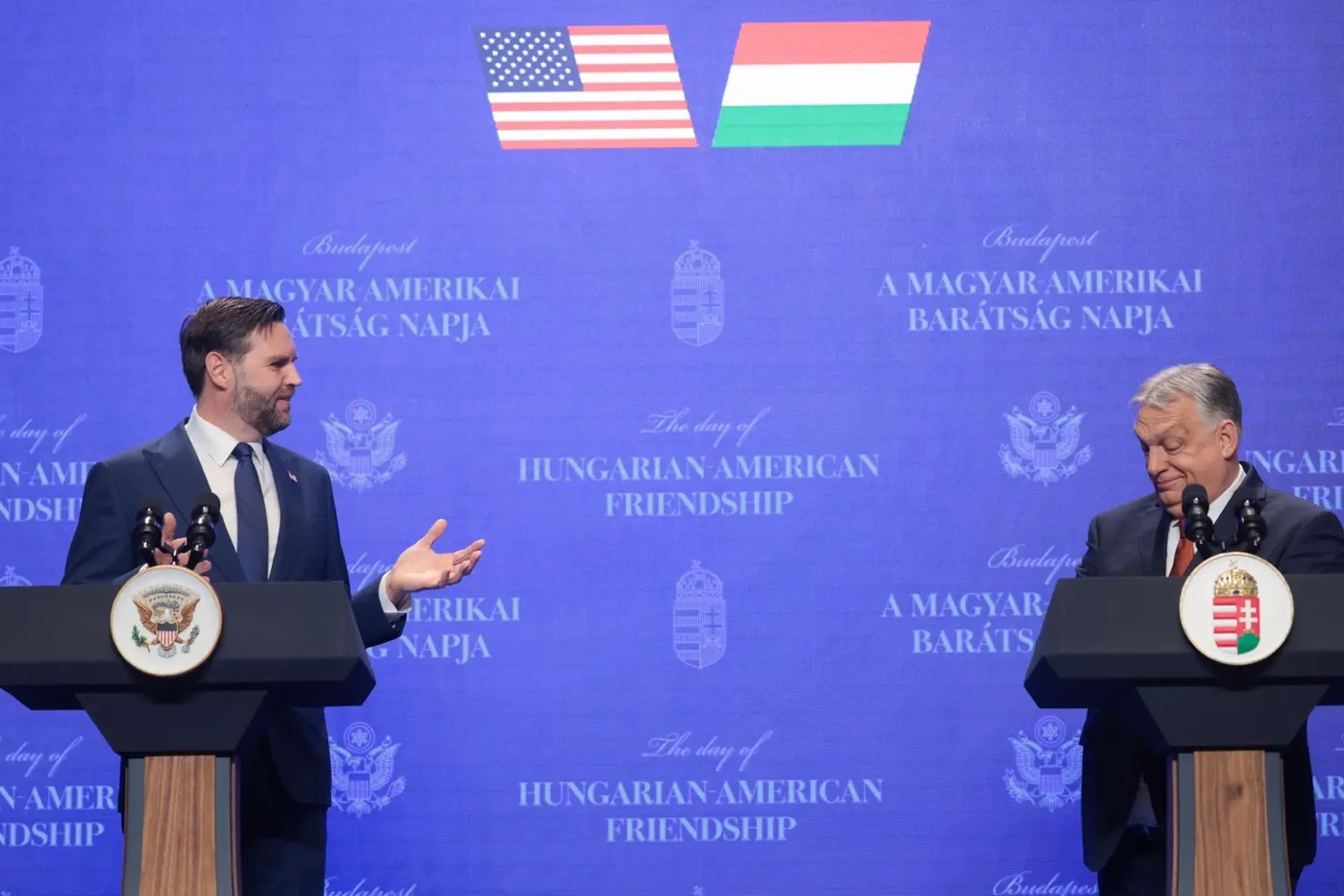
That is the simplest summary of events that Vance’s office would frame in diplomatic language — but the substance is unmistakable. The U.S. Vice President stood alongside a prime minister whose party trails by 19 percentage points in polls, called the visit “historic,” said he wanted to help Orban “as much as I possibly can,” and accused Ukrainian intelligence services — without providing evidence — of trying to influence American and Hungarian elections.
“There were people in the Ukrainian system who were campaigning with Democrats literally in the weeks before the presidential election,” Vance said, without naming anyone or providing documentation.
Meanwhile, the crowd also heard from Donald Trump — live, via Vance’s phone held up to a microphone. “I love that Viktor,” Trump said. “I’m with him all the way.” Hungary’s energy company Mol simultaneously signed a deal to purchase $500 million in U.S. oil — a transaction conveniently timed to coincide with the visit and with Orban’s campaign theme of energy security.
The political context is significant. Orban has blocked EU sanctions packages against Russia, blocked a 90-billion-euro loan for Ukraine, maintained close economic ties with Moscow throughout the war, and positioned himself as the Trump administration’s key European ally. The election in five days will determine whether his 16-year hold on power ends. The U.S. Vice President’s presence — and the accusation against Ukraine, delivered on Hungarian soil before the vote — is not neutral statecraft.
Opposition candidate Peter Magyar responded without subtlety: “No foreign country may interfere in Hungarian elections. Hungarian history is not written in Washington, Moscow, or Brussels — it is written in Hungary’s streets and squares.” His Tisza party leads Fidesz by 19 points.
Separately, a cross-party group of 56 Members of the European Parliament wrote an open letter demanding the removal of Daria Boyarskaya — a former personal interpreter for Vladimir Putin — from the OSCE election observation mission in Hungary. The OSCE’s Parliamentary Assembly President dismissed the concerns and suggested the signatories were engaged in a “targeted attack against staff.” MEP Daniel Freund, the letter’s lead signatory, called the response a miss: civil society and the opposition are refusing to meet with election observers while a close Putin associate is part of the team, making meaningful observation effectively impossible.
Pause in the Gulf: Trump’s Iran Ceasefire and What It Means for Ukraine
The war in Ukraine shared April 7 with a different crisis on the other side of the world. President Trump announced a two-week suspension of planned military strikes against Iran, conditional on Iran’s full reopening of the Strait of Hormuz. Iran’s Supreme National Security Council confirmed the Pakistan-brokered ceasefire. Iranian Foreign Minister Seyed Abbas Araghchi said Iran would coordinate safe passage through the Strait for the duration of the pause.
For Ukraine, the Iran-U.S. war matters in ways that aren’t immediately obvious. The Strait of Hormuz carries nearly 20 percent of the world’s oil. Its closure since the start of the U.S.-Iran war drove a global fuel price surge that affected every economy, including those supplying weapons and aid to Ukraine. The ceasefire, if it holds, reduces that pressure.
But there’s a more direct connection. The U.S.-Iran conflict has consumed American military resources — particularly THAAD interceptors. CSIS estimated in March that the U.S. fired approximately 150 THAAD interceptors during the June 2025 Israel-Iran war. Those stockpiles are now depleted, and replenishment takes time. Zelensky had called for THAAD systems as part of Ukraine’s security guarantees in any peace deal. Military analysts say the request faces three obstacles: THAAD cannot engage fixed-wing aircraft despite Zelensky’s suggestion; existing U.S. stockpiles are strained by Middle East usage; and the system’s annual production rate is only 96 interceptors. The funds, experts argue, would be better spent on Ukraine’s own missile programs.
Caught in Odesa: Ukraine Seizes a Ship from Russia’s Ghost Fleet
Ukraine’s Security Service (SBU) detained a foreign cargo ship in Odesa’s commercial port — a vessel belonging to Russia’s shadow fleet, the network of ships that uses constantly changing names, flags, and nominal ownership to evade sanctions and keep Russian oil and goods moving through global markets.

This particular ship had docked in Sevastopol at least seven times before Russia’s full-scale invasion, exporting Ukrainian grain from occupied Crimea. In January 2021 alone, it transported nearly 7,000 tons of grain from Crimea to North Africa. Its owner was under Ukrainian sanctions. The ship had repeatedly changed its name and nominal ownership through third countries. When it arrived in Odesa — under an African country’s flag, supposedly to load a shipment of steel pipes — Ukrainian investigators were waiting.
Seventeen crew members were aboard, all citizens of Middle Eastern countries. The ship was detained.
The seizure fits into a broader international pattern. France has intercepted multiple shadow fleet vessels since late 2025. Belgium and France jointly seized a sanctioned Russian tanker in early March. The United Kingdom announced new powers in late March allowing its military and law enforcement to board suspected shadow fleet ships in British waters. Ukraine has been urging partners to update legislation to allow such seizures — and the partnerships are beginning to deliver results.
Farewell to a Football Legend: Mircea Lucescu, 1945–2026
Amid the dispatches of war, Romania and Ukraine paused to mourn a different kind of loss. Mircea Lucescu, one of the most decorated coaches in football history, died in Bucharest at the age of 80 following a heart attack. He had stepped down as Romania’s national team coach just five days earlier.
His legacy is inseparable from Ukraine. As head coach of Shakhtar Donetsk — the club from the Donbas now playing its home matches in exile because Russian forces occupy its stadium — Lucescu won eight Ukrainian league titles, eight domestic cups, and, in 2009, the UEFA Cup. He later coached Shakhtar’s great rival, Dynamo Kyiv, winning the Ukrainian Premier League, Ukrainian Cup, and Ukrainian Super Cup. Across 35 titles won in his career, he ranked third among the most successful coaches in football history. He became, for many Ukrainians, something of an adopted son — a Romanian who loved Ukrainian football and helped it reach the world.
That the city his most famous club called home is now a Russian-occupied battlefield made his passing on this particular day carry an extra weight that required no explanation to anyone who understood the story.
What April 7th Revealed
The bus in Nikopol burned. The oil terminal in Leningrad Oblast burned. The Sivash drilling platform burned. The City Council building in Pryluky burned. On April 7, 2026, everything seemed to be on fire — and at the center of it all was the same question that has hung over every day of this war:
What April 7th revealed is that this war has no off switch that one side controls alone. Russia can kill civilians by policy, dismiss every peace offer, and recruit soldiers from three continents — and still not win. Ukraine can strike oil terminals near St. Petersburg, debut new weapons in the Black Sea, and hold a thousand kilometers of front line — and still not end it. The war persists because the cost of continuing has not yet exceeded the cost of stopping for the side that started it.
When one side offers to stop the killing and the other sends 110 drones in reply, the world must decide which side it stands with — and whether standing aside is its own kind of answer.
Day 1,503. The bus routes in Nikopol will run again tomorrow. The drone operators will be watching.
A Prayer for Ukraine
1. For the Four at the Bus Stop
Lord, they were waiting for a bus. Not soldiers. Not combatants. People going somewhere ordinary on an ordinary morning in Nikopol — and a drone found them. Four are dead. Three men, aged 58, 63, and 73, lie in critical condition. Receive the dead into Your mercy. Hold the wounded in Your care. And do not let the world grow so accustomed to this that it stops being outraged. Let the bus stop in Nikopol remain specific. Let those four people remain irreplaceable. Because they are.
2. For the Eleven-Year-Old Boy
Father, he was eleven years old. He died in Dnipropetrovsk Oblast in a drone strike that also wounded five others — one of dozens of attacks that morning, one name among many that will never make a headline. He had lived his entire conscious life inside this war. He deserved to live the rest of it in peace. Comfort those who grieve him. And let his name, unknown to us, be known to You.
3. For the Defenders Holding the Line
God of strength, across a thousand kilometers of contested ground — in Kupyansk, Kostyantynivka, Pokrovsk, Hulyaipole — Ukrainian soldiers held their positions today against an enemy that sent one soldier at a time, every twenty minutes, probing for a gap that did not come. They adapted their tactics under fire, destroyed drones with drones, struck an air defense system sixty kilometers behind Russian lines. Grant them courage that does not depend on certainty. Grant them rest they have not had. Bring them home.
4. For Those Who Must Decide
Lord, Zelensky offered a ceasefire for Easter and received silence. He carries the weight of a people who cannot afford to wait and a world that is growing distracted. Give him wisdom that outlasts exhaustion. Give those with the power to help the clarity to use it. And for the leaders who trade in theater rather than truth — who campaign for allies of aggressors and accuse the victims of interference — grant them, in Your mercy, a conscience that wakes before it is too late.
5. For the Long Arc of Justice
God of justice, this war is now 1,503 days old. Sixteen Cameroonians confirmed dead. An eleven-year-old in Dnipropetrovsk. Four at a bus stop in Nikopol. A 14-year-old in Kherson. A child in Odesa. The names accumulate and the world moves on. Do not let the record be lost. Do not let the perpetrators be laundered by time or diplomacy or the exhaustion of onlookers. Hold the evidence. Hold the witnesses. Hold the reckoning in reserve until the moment it can no longer be deferred.
In Your mercy, in Your justice, in Your time — bring this war to its end, and let the ending be worthy of what Ukraine has endured.