
Ukraine Daily Briefing | July 5, 2026 | Day 1,593 of the Full-Scale Invasion
Prepared by Dayana Bozhyk
Russia’s Ministry of Defense proposed a six-hour ceasefire in Kostyantynivka for July 6, ostensibly to retrieve fallen Ukrainian soldiers’ bodies, in what ISW assesses is a calculated move to portray Ukraine as the unwilling negotiator after Ukraine rejected the offer. The proposal followed a July 4 call in which Ukrainian officials say Putin used exaggerated claims of capturing the city to try to convince President Trump that Russia is winning the war. On the ground, Ukrainian forces cleared Prymorske and gained a foothold in Plavni in the Zaporizhzhia direction, effectively halting Russian advances there, while a Ukrainian strike destroyed a Russian drone training base in Pokrovsk. Ukraine struck Crimea’s Hvardiiske airfield and ten electrical substations, deepening blackouts across the peninsula. Overnight Russian strikes killed at least seven people and injured 39 more nationwide, and President Zelensky announced plans for a naval drone interceptor line to defend Odesa while confirming he will meet Trump at next week’s NATO summit in Ankara.
THE DAY’S RECKONING
Russia made Ukraine an offer on July 4: six hours of quiet in Kostyantynivka, so Russian soldiers could hand back the bodies of Ukrainians killed there. It sounds almost decent, until you remember Russia doesn’t actually control the city it’s offering a ceasefire over, and that the last time Putin tried this trick — outside Kupyansk and Pokrovsk last October — the encirclement he wanted journalists to “see” didn’t exist either. Ukraine said no. Russia is already telling the world Ukraine refused to retrieve its own dead, which was always the actual point.
While that theater played out, something quieter and more real was happening in Zaporizhzhia: Ukrainian forces cleared a village, took a road junction, got a foothold in another village, and pushed Russian forces onto the defensive in a sector Moscow has spent months trying to advance through. A drone base in Pokrovsk where Russian instructors trained pilots stopped existing. Ten more substations went dark in Crimea. None of it will show up in Putin’s next staged meeting with his generals. All of it is the actual shape of a war that a six-hour ceasefire proposal was designed to obscure.
A CEASEFIRE RUSSIA KNEW UKRAINE WOULD REFUSE
Russia’s Ministry of Defense proposed July 4 a localized ceasefire in Kostyantynivka from noon to 6 p.m. Moscow time on July 6, framed as a humanitarian pause to transfer the bodies of fallen Ukrainian soldiers, and claimed Ukraine had until 11 a.m. July 5 to respond. Russian state media claimed more than 20 foreign outlets had expressed interest in covering the transfer, then reported Ukraine rejected the proposal outright; Ukrainian officials have not issued a public response as of this writing. ISW assesses the timing is not coincidental: Russia proposed the ceasefire the day after staging Putin’s claimed capture of Kostyantynivka, and the offer functions as a no-lose bet — either Ukraine accepts and Russian forces use the pause to reinforce and consolidate infiltrated positions under cover of a humanitarian gesture, or Ukraine refuses and Russia gets to claim Kyiv won’t even retrieve its own dead. Putin used an identical tactic near Kupyansk and Pokrovsk in October 2025, offering a ceasefire to let journalists “see” an encirclement that did not exist at the time and has not existed since.
The pressure campaign extends beyond the battlefield. ISW assesses the Kremlin deliberately timed Putin’s aggrandized Kostyantynivka claims to reach President Trump directly: Russian aide Yuri Ushakov said Putin used a July 4 call with Trump to argue that Ukraine’s European allies have a “false perception” of the frontline and that Russian forces are advancing “across the entire theater,” while Medvedev separately claimed on Telegram that the city’s fall was a clear victory advancing Russia’s war aims. Ukraine’s 19th Army Corps released video from multiple Kostyantynivka districts to demonstrate continued Ukrainian control, calling Russia’s capture claim “an information fake” designed to mask heavy Russian losses, and ISW’s own assessment found the Russian presence in the city limited to small, dispersed infiltration groups rather than any consolidated control — consistent with the absence of any footage showing Russian vehicles, artillery, or armor actually operating inside the city.
NO ADVANCES, BUT UKRAINE PUSHES BACK NEAR ZAPORIZHZHIA
Neither side made confirmed advances anywhere along the front on July 5, but Ukrainian military observer Kostyantyn Mashovets reported a notable shift in the Zaporizhzhia direction: Ukrainian forces have essentially halted Russian advances there and forced Russian units into active defense in several areas. Ukrainian forces cleared Prymorske west of Orikhiv, seized the road junction between Prymorske and Stepnohirsk, and gained a foothold in Plavni to the south. Mashovets reported Russian forces have likely withdrawn their main strength from areas near Shcherbaky and Mali Shcherbaky and abandoned positions near Mala Tokmachka, Bilohirya, and Luhivske entirely, though scattered Russian infiltrators remain active near Stepove and toward Orikhiv itself. The shift builds on Ukraine’s earlier recapture of the Kinburn Spit, which controls sea access to the ports of Mykolaiv and Kherson and had been used by Russian forces to launch strikes across southern Ukraine before Ukrainian pressure forced a Russian withdrawal.
Elsewhere the line held without movement: Sumy, Kharkiv Oblast, the Oskil River, Borova, Slovyansk, Kostyantynivka-Druzhkivka, Dobropillya, Pokrovsk, Novopavlivka, Oleksandrivka, and Hulyaipole all saw Russian attacks turned back, and no ground activity was reported in the Kherson direction at all. Ukraine’s General Staff reported 295 combat clashes across the front as of the morning of July 5, with Russian forces firing two missiles, dropping 252 guided aerial bombs across 58 airstrikes, launching 8,799 kamikaze drones, and carrying out 2,775 shelling attacks on Ukrainian positions and settlements, including 46 with multiple-launch rocket systems; the heaviest fighting fell in the Hulyaipole direction (38 Russian attacks), the Pokrovsk direction (31, all repelled), and the Sloviansk direction (25). Ukraine’s General Staff put total Russian personnel losses since the start of the full-scale invasion at roughly 1,409,630, including 1,290 in the preceding 24 hours alone. Near occupied Mariupol, mayoral advisor Petro Andryushchenko reported Russian forces are now moving troops through the city in small groups under cover of civilian transport and mobile fire teams, a sign of how exposed Russian logistics have become to Ukrainian strikes even well behind the front.
Ukraine’s 7th Rapid Reaction Corps announced its forces destroyed a high-rise building in Pokrovsk that Russian forces had used as a base for drone operators, killing 10 to 15 personnel and destroying a communications node, ammunition, and up to two drone control points; the corps said Russian instructors from the elite Rubikon Center for Advanced Unmanned Technologies had been training pilots there, and that some stored ammunition contained toxic chemicals. Ukraine’s Security Service reported its Alpha special forces units conducted a week of precision strikes in the “middle strike” zone behind occupied territory, destroying a drone command post in Mykolaiv Oblast, fuel and lubricant depots in Crimea, a communications hub near Hulyaipole, and ammunition depots across Zaporizhzhia and Kherson oblasts. “The SBU daily reduces the combat potential of the Russian army — not only on the front line but also in the enemy’s rear,” SBU chief Yevhen Khmara said.
CRIMEA’S BLACKOUT DEEPENS
Ukraine’s General Staff reported striking the Hvardiiske military airfield in occupied Crimea overnight — a base for Russian operational-tactical and naval aviation — alongside two logistics bridges in Donetsk Oblast and ammunition depots across Donetsk, Luhansk, and Kherson oblasts. USF commander Robert “Magyar” Brovdi reported Ukrainian forces struck ten electrical substations across Crimea between July 1 and 5, including facilities in Kovylne, Stepne, Yany Kapu, Traktove, Nyva, Zymyne, Bakhchysarai, Saky, Karyerne, and Slovyanske, some more than 200 kilometers from the front line. Crimean occupation advisor Oleg Krychkov confirmed the strikes have caused outages across more than ten raions, and Russia’s occupation rail operator announced it is suspending the Bakhchysarai-Inkerman-1 rail line indefinitely, almost certainly because of the ongoing strikes. Ukraine’s General Staff separately reported hitting a Russian ammunition depot near occupied Dovzhansk in Luhansk Oblast, 141 kilometers behind the front, and Brovdi reported additional substation strikes in occupied Kherson Oblast, including one facility 116 kilometers from the front.
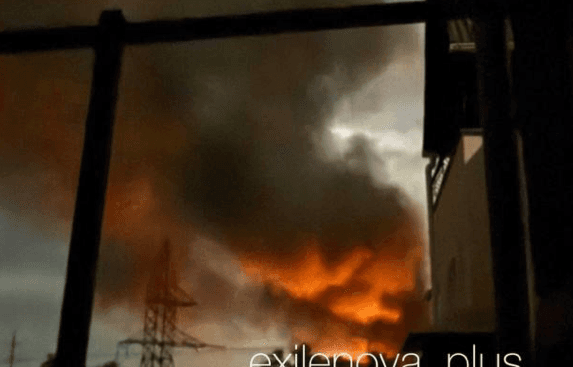
What purports to be the aftermath of a reported Ukrainian strike on an electric substation in Bakhchysarai, Crimea overnight. (Exilenova Plus/Telegram)
OVERNIGHT BARRAGE AND THE DAY’S TOLL ACROSS UKRAINE
Russian forces launched one Kh-31 anti-radar missile, three Kh-59/69 cruise missiles, and 125 Shahed-, Gerbera-, and Italmas-type drones overnight; Ukrainian air defense downed 112 drones and all three cruise missiles, while the Kh-31 failed to reach its target. Four drones struck three locations and debris fell on eight more, damaging transportation, commercial, and residential infrastructure in Dnipropetrovsk and Zaporizhzhia oblasts and gas stations in Kharkiv and Sumy. Regional officials reported at least seven people killed and 39 injured nationwide over the prior 24 hours: five killed and eight injured in Kharkiv Oblast, where strikes damaged homes, shops, and gas stations; one killed and 16 injured in Zaporizhzhia Oblast amid a staggering 912 recorded strikes with drones, artillery, and rockets; one killed and six injured in Donetsk Oblast; seven injured, including two teenage girls, in Sumy Oblast, where local officials said only three minutes of the entire day passed without an air raid alert; six injured in Kherson Oblast; two injured in Dnipropetrovsk Oblast after more than ten drone, artillery, and missile attacks; and two injured in Mykolaiv Oblast when a Shahed struck a milk processing plant.
The toll built on a violent Saturday evening, July 4: a FAB-250 guided bomb hit a Kramatorsk supermarket, and separate strikes hit a residential building in Zaporizhzhia, damaging its facade from the first to the fifth floor and injuring three people including a child, while a gas station fire in Sumy injured three women. Sunday brought more: a Russian drone strike on Bohodukhiv, northwest of Kharkiv, killed two men, and a separate drone strike on Kharkiv’s Kyivskyi district injured four more people.
ZELENSKY’S NUMBERS: A WEEK OF DRONES, BOMBS, AND MISSILES
Zelensky reported that Russia launched roughly 2,200 strike drones, more than 1,730 guided glide bombs, and 106 missiles — nearly half of them ballistic — against Ukraine in the week between June 28 and July 4 alone. Defense Minister Mykhailo Fedorov said separately that Ukraine’s own mid- and long-range strikes, hitting targets more than 50 kilometers behind the front line, had almost doubled over the course of June, with more than 200,000 total enemy targets struck for the month and roughly 28,000 Russian troops killed or seriously wounded. Fedorov said June also set records for Ukrainian strikes on Russian artillery, vehicles, and motorcycles, alongside intercepted drones and helicopters. “Destroying warehouses, transport and supply routes reduces the enemy’s ability to supply its units,” he said, tying the numbers directly to Crimea’s deepening fuel crisis.
RUSSIA’S MANPOWER SQUEEZE: GAZPROM GUARDS ITS OWN PIPELINES
Russian opposition outlet Echo reported that state energy giant Gazprom signed a contract with Russia’s Defense Ministry to form mobile fire groups specifically to protect gas infrastructure from Ukrainian strikes, offering recruits 200,000 rubles (about $2,600) monthly during a two-month training period on top of standard military pay, while letting them keep their civilian jobs — in exchange for a three-year mobilization-reserve commitment. Russia’s Nevsky Volunteer Reconnaissance-Assault Brigade is separately recruiting for similar anti-drone units, with elements of Russia’s 810th Naval Infantry Brigade already reported defending occupied Crimea against Ukrainian drones rather than fighting at the front. ISW assesses the recruitment reflects a genuine strategic bind: Russia cannot build the rear-area air defense umbrella it needs to stop Ukrainian strikes without pulling manpower from an already strained frontline force. Belarus, meanwhile, is easing the pressure on Russian fuel supplies specifically: Russian imports of Belarusian gasoline hit an all-time monthly high of 141,000 tons between June 1 and 25, 2.4 times May’s total and 141 times what Russia imported from Belarus in the same period last year — a stopgap that Russian business outlet Vedomosti says will ease but not resolve the country’s fuel crisis.
A LINE OF INTERCEPTORS FOR ODESA
Speaking with graduates and cadets of Ukraine’s Naval Forces Institute in Odesa, Zelensky announced plans to build a maritime defense line using drone interceptors launched from naval platforms to protect the city from Russian air and sea attack. “The know-how we need is to have a line of defense at sea and to deploy interceptor drones there from various platforms, so that we have a line that protects Odesa in the air,” he said, acknowledging that “launching interceptors from naval drones presents new technical challenges.” Zelensky said Ukrainian industry is already manufacturing hundreds of thousands of interceptor drones domestically and that the navy can now deploy 100 to 200 uncrewed surface vessels in a single operation, some of which have already been used to shoot down Russian helicopters.
WASHINGTON ON THE CALENDAR
A US official confirmed to Kyiv Post that Trump will meet Zelensky on the sidelines of next week’s NATO summit in Ankara, with Trump arriving July 7 and the two leaders expected to sit down the following morning to discuss “how we can end the war.” “The battlefield has clearly frozen over the last couple of months and neither side is making a lot of progress,” the official said. “The president feels a real sense of urgency to try to bring this to a stop.” The meeting follows Trump’s July 4 calls with both Zelensky and Putin; billions of dollars in defense-related agreements are also expected to be announced at the summit. In his evening address, Zelensky warned that Ukrainian intelligence again indicates Russia is preparing a new mass strike, calling the timing “typical of Putin: right after America’s Independence Day and before the NATO Summit in Ankara,” and renewed his appeal for allies to move Patriot missiles out of storage and into Ukrainian air defense units without further delay. “Any delay with missiles for our air defense means the loss of lives,” he said.
Kyiv’s own numbers from the July 2 catastrophe were finalized this week as rescue crews closed out their search: the confirmed toll from that attack stands at 31 dead and 102 injured, after crews spent two additional days clearing 42 cubic meters of debris and 53 tons of concrete from the wreckage of a single Darnytskyi apartment building.
By the end of July 5, Russia had made an offer it never intended to have accepted, and Ukraine had spent the same day taking back a village, a road junction, and a foothold in a sector Moscow has spent months trying to break through. Neither fact will feature in whatever Putin tells his generals next.
A PRAYER FOR UKRAINE
1. For the Two Men Killed in Bohodukhiv
Lord, two men in Bohodukhiv did not survive a Sunday morning drone strike that also left a young woman in acute shock and a town’s supermarket and furniture store in ruins. We ask for peace for whoever loved them, and rest for a town that has now learned what an ordinary Sunday can turn into.
2. For Every Region Where an Air Raid Siren Barely Stopped Today
God of the weary, in Sumy Oblast today, only three minutes passed without an air raid alert. We pray for everyone who spent this day moving between shelters and homes, unable to fully rest anywhere, and for the two teenage girls hurt there and the countless others across Kharkiv, Zaporizhzhia, Donetsk, Kherson, and beyond who did not get through the day unscathed.
3. For the Dead Still Waiting to Come Home
Father, Russia offered Ukraine six hours to retrieve the bodies of soldiers killed in Kostyantynivka — an offer built on a lie about who controls the city, made in a way Ukraine could not safely accept. We pray for the families of those soldiers, still waiting for their sons to come home for burial, held hostage by a ceasefire that was never really about them.
4. For the Village Ukraine Took Back Today
Lord, while the world watched a lie about Kostyantynivka, Ukrainian soldiers quietly cleared Prymorske and gained ground near Plavni in Zaporizhzhia. We pray for their safety in the hours after any gain, when the fighting to hold new ground can be as dangerous as the fighting to take it, and we give thanks for every meter reclaimed.
5. For the Diplomacy Still to Come in Ankara
God of nations, next week brings Ukraine’s president and America’s president to the same room in Ankara to talk about ending this war. We do not know what that conversation will produce. We ask only for wisdom for everyone at that table, urgency matched to the moment, and, in Your mercy, an outcome that finally protects the people who have carried this war the longest.