
Ukraine Daily Briefing | May 14, 2026 | Day 1,541 of the Full-Scale Invasion
Russia launched 1,623 drones and missiles over 36 hours in the largest aerial campaign of the war, deliberately exhausting Ukrainian air defenses with drones before sending missiles at night — a Kh-101 cruise missile collapsed a nine-story Kyiv apartment building, killing 24 including three children. Zelensky noted the missile was manufactured in Q2 2026, citing it as proof Russia continues evading sanctions, and instructed the military to prepare a response. Putin replaced Belgorod’s governor with a commander whose units executed Ukrainian POWs, Ukrainian strikes halted production at two major Russian energy facilities, and the Pentagon quietly cancelled a 4,000-troop Poland deployment without explanation.
The Day’s Reckoning
The missile came just after 3 a.m. on May 14. The building at Krasnopilska Street in Kyiv’s Darnytskyi district was nine stories tall. It held families in 18 apartments. Eyewitness Serhii Yatsura, already displaced from his village by the war, was looking out his window when the missile hit the building opposite: “I saw the missile flying, it hit around the third floor. I was thrown back, everything was broken. Everything was burning, people were screaming downstairs.”
The building’s structure failed. Floors pancaked. Eleven people were pulled from the rubble during the night. By morning the death toll stood at 12. By 6 a.m. on May 15, it had risen to 24 — including three children. Forty-seven were injured. Seventeen were still missing. Eight hundred cubic meters of debris were cleared. Dog handlers swept 2,800 square meters. Emergency crews worked through the night and into the next day. Kyiv Mayor Klitschko declared May 15 a day of mourning.
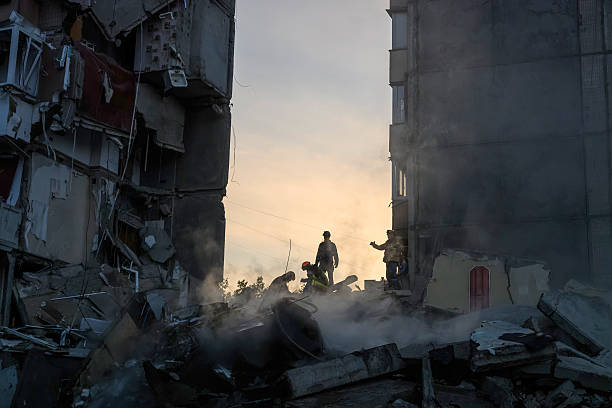
Firefighters work at the site of an apartment building damaged during a missile and drone strike in Kyiv, Ukraine. By May 15, the death toll has risen to 24, with a further 48 people injured in the attack. (Maxym Marusenko/NurPhoto via Getty Images)
The missile that destroyed the building was a Kh-101 cruise missile manufactured in the second quarter of 2026 — weeks before it was fired. Zelensky stated this explicitly in his evening address: “This means Russia is still importing the components, resources, and equipment necessary for missile production in circumvention of global sanctions.” He instructed Ukraine’s defense forces and intelligence services to prepare “formats for our response” and called on Western partners to intensify sanctions enforcement: “Sanctions must be more painful for Russia.”
Combined with the 892 drone-and-missile strikes of May 13, the 36-hour campaign from 6 p.m. May 12 to 8 a.m. May 14 totaled approximately 1,623 aerial weapons — the largest aerial attack of the war, shattering the previous 24-hour record of 948 set in March 2026. The drone intercept rate was 94 percent across the entire campaign. The missile intercept rate was 73 percent overnight — and only 7 percent for all 56 missiles across both nights combined, per Zelensky’s summary, because air defense ammunition had been exhausted by the preceding drone waves. This was the deliberate logic of the attack: drones first to exhaust interceptors, missiles at night when people sleep.
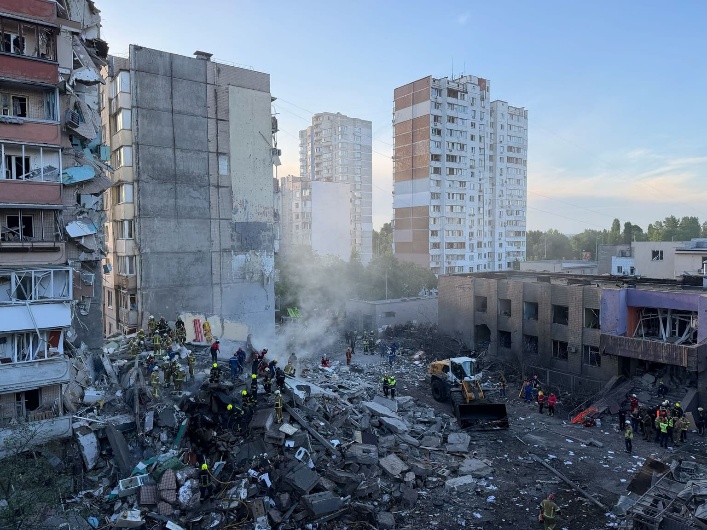
First responders search for victims trapped under the rubble of a residential building that partially collapsed as a result of a Russian drone and missile attack on Kyiv overnight. (Nick Allard/The Kyiv Independent)
The Overnight Attack: Kinzhals, Iskanders, Kh-101s, and 675 Drones
Ukraine’s Air Force confirmed Russia launched 731 aerial weapons from 6 p.m. on May 13 to 8 a.m. on May 14: three Kinzhal Kh-47 aeroballistic missiles, 18 Iskander-M/S-400 ballistic missiles, 35 Kh-101 cruise missiles, and 675 strike drones, decoy drones, and Banderol drone-based cruise missiles. Ukrainian forces destroyed 29 Kh-101s, 12 Iskander-M/S-400s, and 652 drones. Kinzhal missiles, which fly at speeds up to Mach 10 and follow unpredictable trajectories, are extremely difficult to intercept — none of the three were downed. Air Force Spokesperson Colonel Ihnat confirmed Russian forces concentrated the overnight strikes against Kyiv City in an effort to overwhelm air defenses.
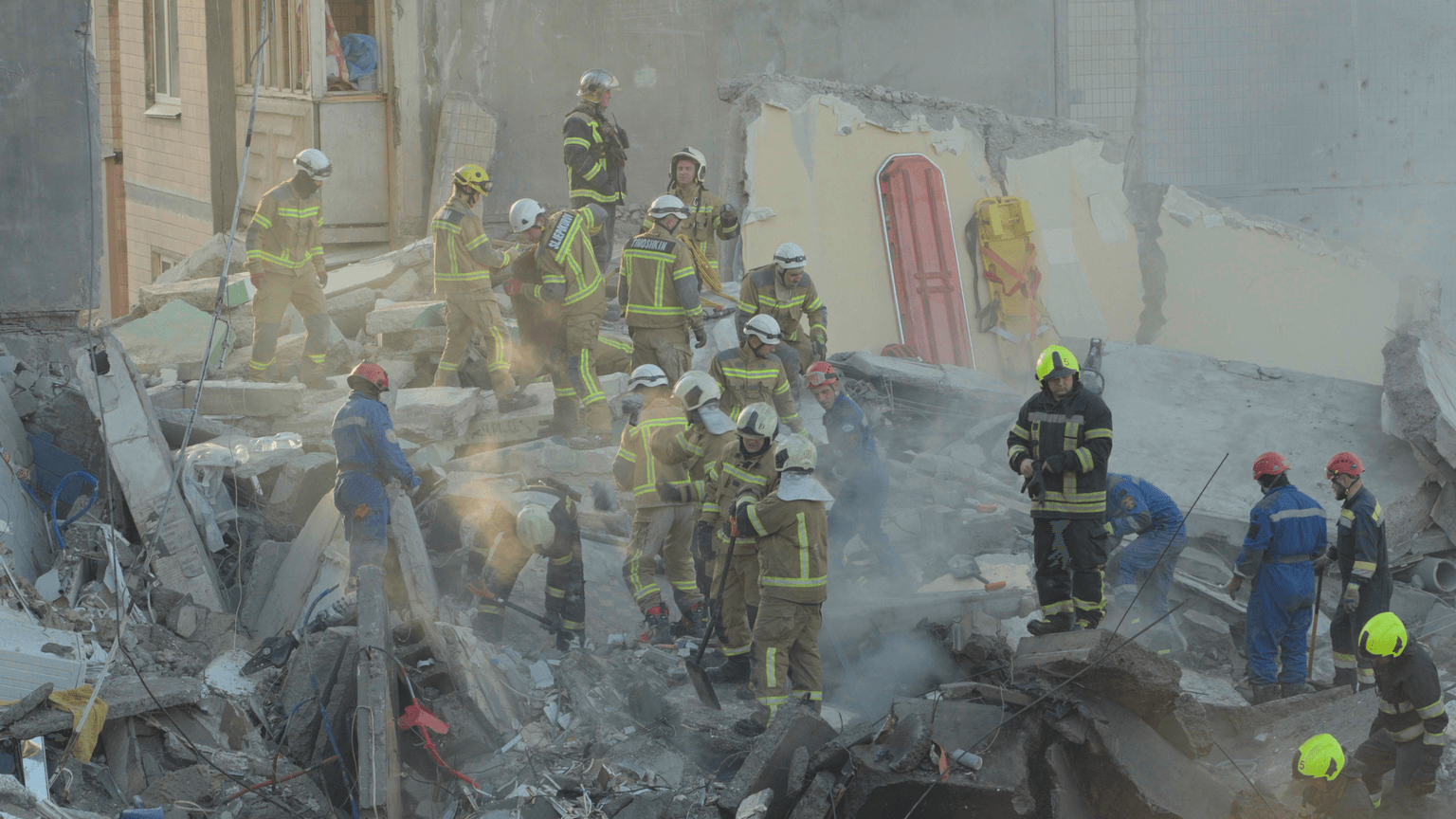
First responders search for victims trapped under the rubble of a residential building that partially collapsed as a result of a Russian drone and missile attack on Kyiv overnight. (Nick Allard/The Kyiv Independent)
In Kyiv City alone, Russian strikes damaged at least 20 locations. The building in Darnytskyi district was the most catastrophic single hit. Drone debris sparked a fire at a five-story building in Dniprovskyi district, fell on a road in Holosiivskyi, set a car ablaze in Solomyanskyi, hit an office building and parking structure and sparked a 12-story residential building fire in Obolonskyi. An unfinished 25-story building was also struck. DTEK, Ukraine’s largest private energy company, reported a transformer substation and high-voltage power line damaged in Kyiv. Water supply to Kyiv’s left bank was cut. Russian strikes also damaged port infrastructure in Odesa Oblast, energy infrastructure in Khmelnytskyi and Chernihiv oblasts, and residential areas in Kharkiv City. At least 28 were injured in Kharkiv Oblast; at least two in Odesa Oblast.
The Building on Krasnopilska Street: 24 Dead, 17 Missing
The nine-story panel residential building in Darnytskyi district was struck by a Kh-101 cruise missile at approximately 3:15 a.m. on May 14. The missile hit around the third floor, causing structural failure. Eighteen apartments were destroyed as floors collapsed. Police confirmed seven bodies pulled from the rubble of one destroyed entrance: three men, three women, and a young girl. A 12-year-old child was confirmed among the dead. Two men aged 21 and 30 were pulled from rubble. A man died in hospital after being brought in from a nearby gas station also struck in the attack. By 6 a.m. on May 15, the DSNS confirmed 24 people killed, including three children, with 47 injured. Seventeen people remain missing. The rescue operation as of May 15 morning: 11 people pulled from rubble; 3,180 cubic meters of debris cleared; 2,800 square meters swept by dog handlers; 398 people provided psychological assistance. Ukraine’s State Emergency Service said operations were ongoing.
Putin Replaces Belgorod Governor with a Commander Accused of Executing POWs
Putin signed two decrees on May 13 replacing the governors of Belgorod and Bryansk — both border oblasts that have been repeatedly struck by Ukrainian attacks. Belgorod Governor Vyacheslav Gladkov, who had led the region since 2021 and documented Ukrainian strikes daily, was replaced with Major General Alexander Shuvayev, 45, a graduate of Russia’s “Time of Heroes” program placing war veterans in government positions. Shuvayev commanded the 4th Separate Motorized Rifle Brigade during the battles for Severodonetsk and Lysychansk in 2022, and then commanded the 1st Motorized Rifle Brigade during the seizure of Avdiivka — during which the unit executed Ukrainian POWs. Ukrainian volunteer war crimes tracking project “Book of Executioners” identifies Shuvayev’s unit as responsible for the February 15, 2025 killing of Colonel Dmytro Verby and Lieutenant Mykola Tkach in his presence. Shuvayev holds a Hero of Russia medal and left military service in 2025 for provincial government before being appointed to Belgorod.
Bryansk Governor Alexander Bogomaz was replaced by Yegor Kovalchuk, former deputy governor of Chelyabinsk Oblast and briefly the occupation chairman of the Luhansk People’s Republic government. ISW assessed: both replacements are part of the Kremlin’s pattern of scapegoating border region officials for its own failure to protect the rear from Ukrainian strikes, while installing “Time of Heroes” loyalists. The replacements complete a full turnover of all three Russian oblasts bordering northern Ukraine since 2022 — Kursk (two governors replaced), Belgorod, and Bryansk. Gladkov’s farewell statement was notable: he acknowledged the toll on residents, criticized the Kremlin’s internet shutdowns for blocking emergency warnings, and signed off by saying “One must always believe in concrete actions, and not words” — a pointed departure from the usual loyalty formulaic. Russian opposition source Vazhnye Istorii reported that the FSB “simply hates Gladkov” because he continued releasing information about strikes despite prohibitions.
Astrakhan Gas Plant Halts Production; Perm Refinery Fully Shut Down
Gazprom’s Astrakhan gas processing plant — one of the company’s key condensate processing facilities — suspended motor fuel production following the May 13 Ukrainian drone strike, Reuters reported on May 14 citing industry sources. A key gas condensate processing unit capable of producing up to 3 million tons annually has halted; repairs could take weeks or months. The unit produces gasoline, diesel, and fuel oil; equipment used to process hydrogen sulfide and extract sulfur was affected, potentially complicating restart. The plant had only recently resumed operations in April after being offline since September 2025. In 2024 it processed 1.8 million tons of condensate, producing 800,000 tons of gasoline, 600,000 tons of diesel, and 300,000 tons of fuel oil. Separately, Reuters reported on May 13 that the May 7 Ukrainian strikes on the Lukoil Perm Oil Refinery forced a complete production halt; repairs could take weeks. Ukraine’s long-range strike campaign has now caused confirmed production halts at two of Russia’s major industrial energy facilities simultaneously.
Zelensky Instructs Military to Prepare Response; Condemns Q2 2026 Missile
In his evening address on May 14, Zelensky focused on two connected facts: the Kh-101 that destroyed the Kyiv building was manufactured in Q2 2026, and Ukraine’s missile intercept rate across the full 56-missile package was only 7 percent — because air defense interceptors had been depleted by the preceding drone waves before the missiles flew. “This is a deliberate terrorist tactic by the Russians,” Zelensky said, “who amassed drones and missiles over a period of time and intentionally calculated the strike so that its scale would be significant, creating the greatest possible difficulties for our air defense.” The production date of the missile demonstrates Russia continues to import sanctioned components; Zelensky said Ukraine is preparing intensified joint action with partners on sanctions enforcement. He instructed the Defense Forces and special services to propose “possible formats for our response.” He also said a UN humanitarian mission vehicle was struck by Russian drones in Kherson on May 14.
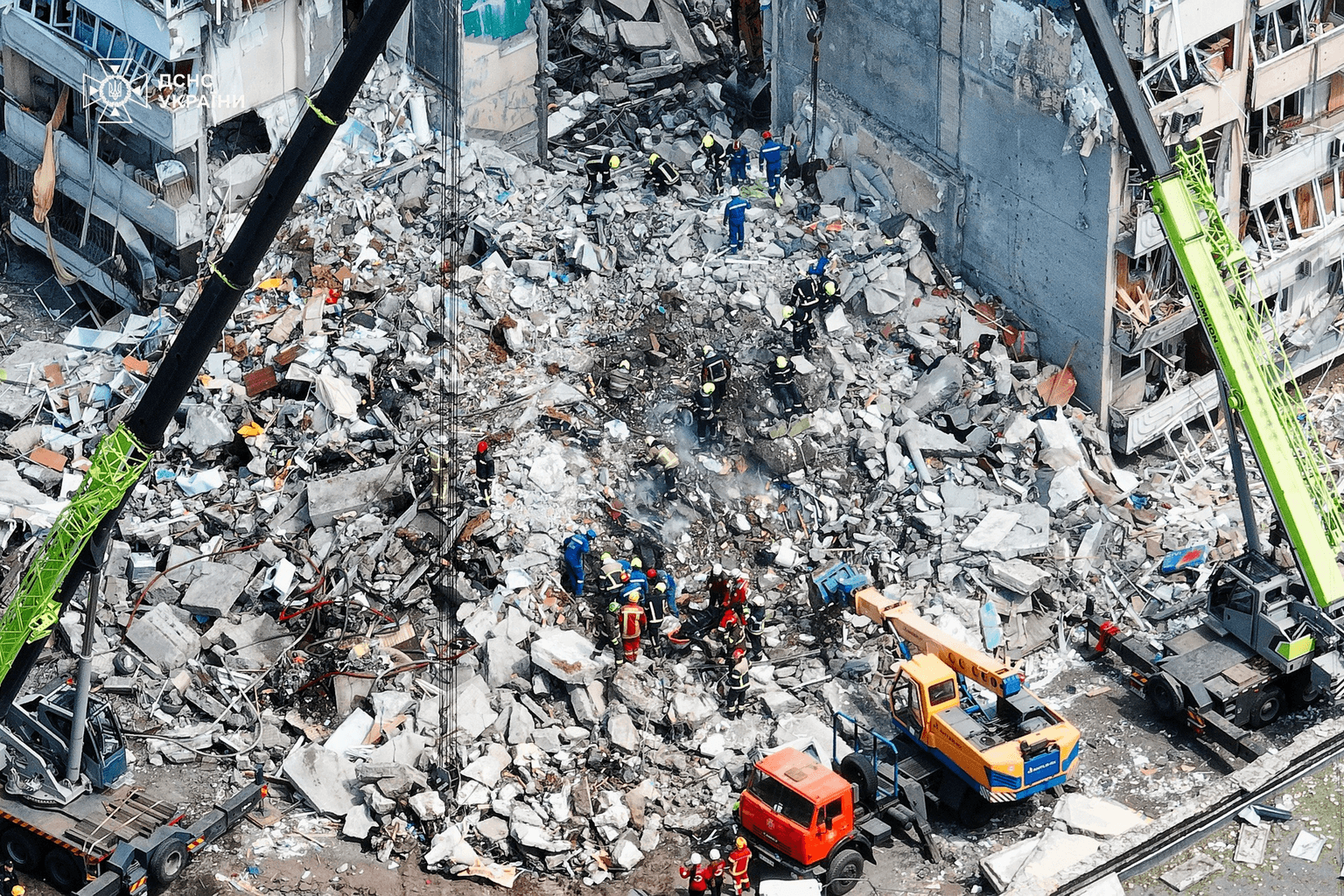
First responders rescue people who are trapped under the rubble of a residential building that partially collapsed as a result of a Russian missile and drone attack overnight. (State Emergency Service/Telegram)
UN Convoy Struck in Kherson; IAEA Warning on Nuclear Plants
Russia deliberately struck United Nations Office for the Coordination of Humanitarian Affairs vehicles in Kherson City’s Korabelnyi district on May 14, Governor Prokudin confirmed. No UN staff were injured. UN humanitarian chief Tom Fletcher called the staff members who escaped “very, very lucky” and called for full investigations and accountability. Foreign Minister Sybiha instructed initiation of a UN Security Council meeting to respond to Russian killings of Ukrainian civilians and attacks on humanitarian personnel. “Such a scale of Russian terror necessitates strong international responses,” Sybiha wrote.
The IAEA reported on May 14 that more than 160 drones were recorded near Ukrainian nuclear power plant sites on May 13–14 — at the Khmelnytskyi, Rivne, and South Ukraine nuclear power plants, and at the Chornobyl site. IAEA Director General Grossi: “Any military action in the vicinity of nuclear facilities significantly increases the risk of a nuclear accident.” No direct impacts on nuclear safety were confirmed. Separately, the IAEA reported that the Zaporizhzhia Nuclear Power Plant has relied on a single off-site backup power line for more than seven weeks, experiencing three total losses of off-site power since its main line was disconnected March 24. The IAEA is continuing to negotiate a localized ceasefire for essential repairs to off-site power infrastructure.
International Reactions: Macron, Merz, Hungary, Rubio, Dubinsky
French President Macron and German Chancellor Merz both condemned the overnight strike on Kyiv on May 14, stating it does not reflect sincere willingness to negotiate from Moscow’s side. Hungarian Foreign Minister Anita Orbán personally conveyed Hungary’s protest to Russian Ambassador Stanislavov on May 14: “I told the Russian ambassador that it is completely unacceptable to Hungary that Zakarpattia, inhabited by Hungarians, is also being attacked.” She called on Russia to secure an immediate ceasefire. Zelensky praised Hungary’s response. U.S. Secretary of State Rubio told Fox News on May 14 that Ukraine’s armed forces are “the strongest, most powerful” military in Europe, citing a five-to-one Russian-to-Ukrainian casualty ratio, and praised Ukraine’s development of “new tactics, new techniques, new equipment, new technology” creating “hybrid asymmetrical warfare.” Rubio acknowledged: “We’ve lost some momentum over the last few months” but said the U.S. remains prepared to facilitate a diplomatic end to the war.
A Ukrainian court on May 14 ordered the pretrial detention of MP Oleksandr Dubinsky until June 5 without bail, in connection with a prior treason investigation. The DBR alleges Dubinsky continued coordinating anti-Ukrainian propaganda from custody using intermediaries, including via his wife in Barcelona, using offline laptops during lawyer meetings to prepare texts, videos, and messaging instructions. His Telegram, Facebook, and YouTube publications were assessed by linguistic and psychological examination as harming state and information security. The treason charge under martial law carries a potential life sentence. The case is linked to a broader probe into a pro-Russian influence network allegedly coordinated by former MP Andriy Derkach, now a Russian senator under U.S. sanctions. Dubinsky was previously sanctioned by the U.S. in 2021 for alleged involvement in Russian interference in the 2020 U.S. election. His family income 2003–2022 totaled $445,000 while estimated asset value reached $2.5 million.
Pentagon Cancels 4,000-Troop Poland Deployment; Ukraine Support Act Vote in June
The Pentagon abruptly cancelled a planned 4,000-troop deployment to Poland on May 13, first reported by Army Times. The Texas-based troops were already beginning to arrive in Poland for a nine-month rotation when the cancellation was announced. No official explanation was provided by Defense Secretary Hegseth. Democratic Senator Shaheen said members of Congress “weren’t notified.” The Pentagon issued a statement calling the decision “not unexpected, last minute,” contrary to the accounts of U.S. and European officials caught off guard. The cancellation follows Trump’s May 1 announcement of withdrawing 5,000 troops from Germany — a decision connected to disputes over Washington’s handling of the Iran war. Trump had floated moving the Germany troops to Poland as recently as May 8. ISW noted the combined German withdrawal and Poland cancellation marks a reduction of U.S. troop levels in Europe toward pre-2022 levels.
The U.S. House Ukraine Support Act is expected to reach a floor vote in the first week of June, a source told the Kyiv Independent on May 14. The discharge petition securing the 218th required signature on May 13 triggered a seven-legislative-day waiting period before the bill can be brought to the floor. The bill would provide over $1 billion in direct assistance to Ukraine, authorize up to $8 billion in loans, expand sanctions against Russia’s oil and mining industries, and prevent Trump from lifting sanctions without justification. Trump—Xi Beijing summit talks on May 14 addressed Iran, Ukraine, and economic cooperation; Chinese state media reported Taiwan was also discussed with Beijing warning against U.S. backing. Trump and Xi also met with the war forming backdrop to Beijing discussions.
Russia’s Drone Force Reaches 114,000 Personnel, Copying Ukraine’s Model
USF Commander Robert “Magyar” Brovdi said in a Ukrainska Pravda interview published May 14 that Russia’s drone force has grown from 86,000 personnel at the start of 2026 to 114,000 by May 1, with a target of 168,000 by year-end. “They are effectively copying the existing franchise of Ukraine’s Unmanned Systems Forces grouping,” Brovdi said. Russia’s centralized command under a Deputy Chief of the General Staff will increase budget allocation and production density on the frontline. The key asymmetry that Ukraine maintains: Russia was cut off from Starlink in February 2026 when Defense Minister Fedorov convinced Elon Musk to disable Russian-used terminals — degrading battlefield command, drone guidance, and real-time situational awareness for Russian units. Brovdi warned Russia is developing a domestic Starlink alternative that, while inferior, could eventually restore some functions. Russia’s 2026 FPV drone production target remains 7.3 million units.
Frontline: Ukrainian Advance in Zakitne; Kostyantynivka Stalls; Pokrovsk Reinforced
Ukrainian forces recently advanced into central Zakitne northeast of Slovyansk, confirmed by geolocated footage published May 13. Russian forces are concentrating attacks on Rai-Oleksandrivka east of Slovyansk as a prerequisite for any assault on the Slovyansk-Kramatorsk agglomeration, per milblogger analysis. In the Kostyantynivka area, Mashovets assessed on May 14 that Russian forces are operating in less than 10 percent of the city despite having infiltrated since October 2025 — advancing at a maximum of one kilometer per week for over a month. Ukrainian counterattacks near Illinivka, Berestok, and Chasiv Yar have blocked any Russian attempt to break into central and western Kostyantynivka. Mashovets assesses Russian forces are shifting attention to Dobropillya and Pokrovsk to attempt to outflank Kramatorsk from the south — an envelopment ISW assesses as “extraordinarily implausible” given the distances and rate of advance.
The Ukrainian 7th Rapid Reaction Corps (Air Assault) confirmed Russian forces are continuing to transfer reserves, equipment, artillery, and personnel to Pokrovsk to convert it into a logistics hub. A 7th Corps strike on a Russian 51st CAA troop concentration in Rivne east of Pokrovsk caused at least 30 Russian casualties. In Kupyansk, a Kremlin-affiliated milblogger claimed Russian forces advanced on eastern outskirts and eastern Kupyansk-Vuzlovyi, while acknowledging Ukrainian drone operators continue to complicate Russian offensives. A Ukrainian brigade spokesperson confirmed Ukrainian forces are extending the kill zone deeper into the Russian rear, targeting Russian drone operators and logistics lines. Order of Battle: the Russian 83rd Motorized Rifle Regiment (69th MRD, 6th CAA, Leningrad MD) was redeployed to the Vovchansk direction — last observed at Velykyi Burluk on March 26. Russian forces also advanced south of Hulyaipilske in Hulyaipole direction and claimed advances in eastern Mala Tokmachka southeast of Orikhiv, not confirmed by ISW. Chaikivka northeast of Kharkiv City: a Russian milblogger refuted earlier Russian claims of its seizure, confirming fighting is ongoing.
Ukrainian mid-range and long-range strikes overnight May 13–14: a Tor air defense system near Stary Oskol, Belgorod Oblast (100 km from border), and a counterbattery radar near Novosyolovka — confirmed by the General Staff. A Tor air defense system near occupied Bursivka, Luhansk Oblast (105 km from front) — confirmed by Magyar’s geolocated footage. A Redut-2US mobile communications system in occupied Frolivske Raion, Donetsk City (46 km). A command post and deployment point of the Kaira Drone Detachment, 39th Motorized Rifle Brigade in occupied Staromlynivka (30 km). A material and technical equipment depot in occupied Perevalne, Crimea (230 km). A repair unit in occupied Hromivka, Kherson Oblast (75 km). Ukrainian forces struck Russian troop concentrations near Tetkino, Kursk Oblast and near Varachyne, Sumy Oblast; a troop concentration near Naumovka, Belgorod Oblast (2 km from border).
Fire Point’s Satellites; Yermak on Bail; Russia’s Prison Population Down 40%
Ukrainian defense manufacturer Fire Point — maker of the Flamingo cruise missile — confirmed it has launched two satellites in 2026 and plans to send “dozens more” into orbit in 2027. The satellites support communications, coordination, and battlefield awareness as Ukraine expands its drone and missile operations. Co-founder Denys Shtilierman: “The idea behind our weapons is that we sell not only weapons and not only security, but independence in security.” The program addresses Ukraine’s vulnerability exposed in March 2025 when the Trump administration suspended intelligence access to Ukraine, blocking strike coordination. Fire Point has also expanded into a “pan-European air-defence shield” concept and is constructing a rocket fuel plant in Denmark.
Andriy Yermak, Zelensky’s former chief of staff, was released on bail after two days of court hearings on May 14, the Kyiv Post reported. He faces money laundering charges tied to Hr 460 million ($8.9 million) funneled through shell companies to construct four luxury mansions in Kozyn south of Kyiv. Russia’s prison chief Arkady Gostev confirmed on May 14 that Russia’s prison population has fallen from 465,000 in 2021 to 282,000 — a 40 percent drop, partly driven by prisoner recruitment into the military. Approximately 85,000 remain in pretrial detention. Prison labor is producing 47 billion rubles ($642 million) per year in war-related goods; 16,000 inmates are assigned to manufacturing for the military. Russia faces a workforce shortage of at least 2.3 million people. Save Ukraine reported eight children and teenagers returned from occupied territories on May 13, including 15-year-old Kseniia who was taught “Ukraine does not exist,” and 16-year-old Lev who received a military draft notice at his home in occupied territory and had a monitoring app installed on his school phone.
Russia’s Ballistic Missile Production Falling Behind Plan; Iskander Shortfall Documented
Procurement documents obtained by Ukrainian outlet Militarnyi showed that the KBM Design Bureau in Kolomna — which produces Iskander-M and Kinzhal missiles — received orders to produce 589 Iskander-Ms in 2024 and 643 in 2025. Russian official reports show only 302 ballistic missiles of all types launched in 2024 and 511 in 2025 — well below production plan. GUR data from July 2025 to April 2026 shows Russia maintained a relatively constant reserve of 200–250 ballistic missiles, suggesting production is not being stockpiled but rather immediately launched — and that Russia has not met its production targets. Downed missile debris from late 2025 and early 2026 shows Russia is launching recently produced missiles. ISW assessed the combined effects of Western sanctions and Ukrainian strikes against the Russian defense industrial base are contributing to the production shortfall.
The Weight of May 14
The missile hit around the third floor. A pensioner watched it from his window, thrown back by the blast. Twenty-four people are dead. Three of them are children. A 12-year-old girl was pulled from rubble. Seventeen are still missing in a building that used to be nine stories.
The missile was made in Q2 2026. Russia manufactured it this year, using components imported through sanctions channels, and fired it at a residential building in Kyiv. Zelensky instructed the military to prepare formats for a response.
Putin replaced Belgorod’s governor with the man who commanded units that shot Ukrainian POWs at Avdiivka. He is now responsible for 1.5 million Russian civilians. He is a graduate of the program designed to place war veterans in government. He holds a Hero of Russia medal. The Kremlin called this an upgrade.
The Astrakhan gas plant halted fuel production. The Perm refinery is fully shut down. Russia launched 1,623 aerial weapons in 36 hours. Ukraine intercepted 94 percent of the drones and 73 percent of the overnight missiles. The intercept rate for the full 56-missile package across both nights was 7 percent, because the drones had come first and emptied the magazines.
This was the deliberate arithmetic of the attack.
A Prayer for Ukraine
1. For the Twenty-Four Killed in Kyiv, Including the Three Children
Lord, twenty-four people were pulled from the ruins of a nine-story building in Darnytskyi district on the night of May 13–14. Three of them were children. A 12-year-old girl was among the dead. Two men aged 21 and 30 were found in the rubble. A woman whose name was still being established. A man who died in hospital after being brought in from a gas station that was hit by the same attack. Seventeen are still missing. Emergency crews are still searching. Receive each of the dead. Hold each of the missing. And hold every family in Kyiv that spent May 14 waiting for a phone call, or not waiting, because they already knew.
2. For the Rescue Workers at Krasnopilska Street
Father, the rescuers have been at the building since 3 a.m. They pulled eleven people from rubble through the night. They cleared 3,180 cubic meters of debris. They swept 2,800 square meters with dog handlers. They are still there. Kyiv has declared a day of mourning for May 15. The search is ongoing. We pray for the emergency workers and the dog handlers and the psychologists who gave assistance to 398 people in one night. Give them the strength to continue searching. Let the seventeen missing people be found. And let the rescuers find some form of rest when the work is done.
3. For the UN Aid Workers in Kherson
God of protection, Russian drones twice struck a clearly marked UN humanitarian convoy in Kherson City on May 14 while it was delivering aid to civilians. No one was injured. They were, as the UN humanitarian chief put it, “very, very lucky.” We pray for the UN workers who will return to Kherson. For the convoy organizers deciding whether to send vehicles back tomorrow. For the civilians in Kherson who depend on those convoys, who live on the east bank of the Dnipro without evacuation routes, in a city that Russia fires on daily. Let the Security Council meet. Let the luck of May 14 not be the only protection these workers have.
4. For the Children Returned and the Children Still Held
Lord, eight children and teenagers were brought home from occupied territories last week. Fifteen-year-old Kseniia, who was taught that Ukraine does not exist. Sixteen-year-old Lev, who received a military draft notice at his home and had a monitoring app installed on his school phone. Fifteen-year-old Maria, who refused to attend a Russian school for two years until authorities threatened her mother with losing parental rights. Eight children came home. At least 20,000 are confirmed deported. Estimates reach 150,000 to 300,000. One of those rescued was a child the Kremlin’s Commissioner described as willingly rehabilitated. One was a child Russia prepared to conscript. Hold each of them. Let the programs that return them continue. Let the 20,000 number on the official list be the beginning of a count that goes to zero.
5. For the Building That Was Nine Stories
God of justice, a missile manufactured in the second quarter of 2026 — assembled in the weeks before it was fired — destroyed a residential building in Kyiv. Russia imported its components through sanctions evasion schemes. Zelensky has instructed the military to prepare a response. He has called on partners to make sanctions more painful. We pray that the response comes. That the sanctions close. That the components stop moving. That the next Kh-101 does not reach its assembly line because the parts that make it were seized at a border, sanctioned at a bank, blocked at a port. Twenty-four people died in a building that was nine stories tall. Let their deaths be the argument that finally makes the sanctions work. In Your mercy, in Your justice, in Your time — bring this war to its end.