
September 11, 2026
Prepared by Diana Bozhyk
Russian drones struck two gas stations in Kyiv today, hitting one of them twice in a deliberate double-tap attack that killed two people and injured 12 more, including a 12-year-old boy. Dmitry Medvedev warned Lithuania would “disappear from the map of the world” if it repeals its constitutional ban on hosting nuclear weapons, while EU ambassadors failed for a second time to renew sanctions against Russia after France joined Slovakia in demanding two Kremlin-linked oligarchs be removed from the list just days before the current measures expire. President Zelensky proposed a step-by-step path toward ending the war, starting with reopening the Black Sea and securing an energy truce, as Russia’s Central Bank held its key interest rate steady for the first time in over a year amid mounting inflation from Ukrainian strikes on its fuel supply chains.
THE DAY’S RECKONING
A gas station attendant in Kyiv used to close only when the sirens turned red — the kind that warn of missiles, not drones. Today that distinction stopped mattering. Russian drones hit two stations in the capital, then came back for a second pass at one of them, killing two people and injuring twelve more, including a child. It’s the kind of attack that doesn’t require a missile to be terrifying, just patience and a second drone.
Everywhere else, the day moved with its own mix of threat and stalemate. Dmitry Medvedev told Lithuania it would cease to exist if it dared change its own constitution. The EU tried, for the second time, to simply keep sanctions on Russia in place — and failed, blocked by two member states haggling over which oligarchs deserve exemption. Zelensky offered Moscow an actual roadmap toward peace: open the Black Sea, then talk about the rest. Russia’s own central bank, meanwhile, quietly admitted what months of Ukrainian strikes have been doing to its economy by simply refusing, for the first time in over a year, to cut interest rates further. Nobody today moved any closer to an ending. Everybody today added one more entry to the ledger of exactly how this war keeps testing everyone it touches.
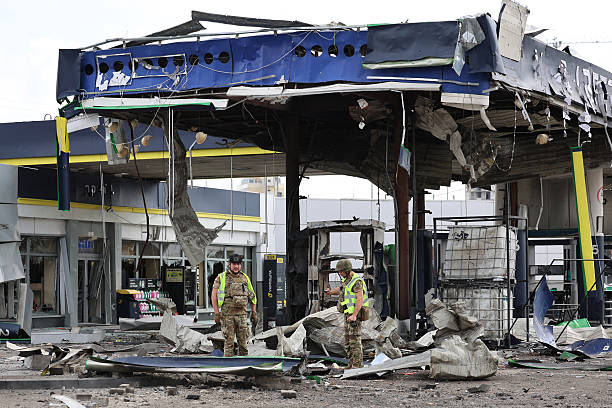
Ukrainian law enforcement officers stand among the debris of a destroyed gas station following an air attack in Kyiv. An early morning Russian drone strike on the gas station killed two people, the city’s mayor said. (AFP via Getty Images)
TWO KILLED IN A DOUBLE-TAP STRIKE ON KYIV GAS STATIONS
Russian drones struck two gas stations in Kyiv today, killing two people and injuring 12 more, including a 12-year-old boy, according to Mayor Vitali Klitschko. An air-raid siren sounded around 9:10 a.m.; explosions followed roughly 30 minutes later. Klitschko said drones hit stations in the Dniprovskyi and Obolonskyi districts, with debris damaging a car at the second site — and Kyiv’s military administration later confirmed Russia carried out a deliberate double-tap attack on the Obolonskyi station specifically, striking it a second time after the first hit drew emergency responders. One emergency responder was among the injured.
The attack has visibly unsettled Kyiv’s commercial fuel network. Artem, a 25-year-old refueling technician who asked to be identified only by his first name, said his station previously closed only during “red-level” air-raid alerts signaling a potential missile attack — a threshold that no longer reflects the actual danger, given how routinely drones now strike gas stations directly. The strikes fit a pattern Russia has expanded from Kharkiv, Sumy, and Zaporizhzhia oblasts into central Ukraine over the summer, deliberately targeting fuel infrastructure to disrupt both civilian mobility and the logistics networks that keep Ukrainian cities running.
Kyiv’s mayor said seven people remained hospitalized by mid-afternoon, with the injury count climbing steadily throughout the day as officials confirmed additional victims. The strikes on gas stations specifically have become common enough this year that some station operators have begun installing their own blast barriers and evacuation protocols independent of any government mandate — a quiet, decentralized adaptation to a threat neither the state nor commercial operators have found a reliable way to fully prevent.
MEDVEDEV THREATENS LITHUANIA WILL “DISAPPEAR FROM THE MAP”
Security Council Deputy Chairman Dmitry Medvedev warned today that Lithuania would “disappear from the map of the world” if it repeals its constitutional ban on hosting nuclear weapons, a change Lithuania’s parliament began advancing in July with a 7-2 committee vote paving the way toward a final decision early next year. “Lithuania, as I understand it, talked about opening the door for the possible placement of any weapon, including nuclear weapons,” Medvedev said, adding that NATO wouldn’t invoke Article 5 to defend the country since doing so would mean “a global catastrophe.”
Lithuania’s President Gitanas Nauseda defended the push regardless: “The geopolitical situation is getting worse. Our constitution was written when geopolitical circumstances were totally different.” The repeal would let NATO deploy nuclear forces on Lithuanian territory, mirroring Russia’s own 2023 deployment of nuclear weapons to Belarus and its December 2025 deployment of the nuclear-capable Oreshnik missile there — the same missile Russia later used in combat against Ukraine for the first time in history. Medvedev simultaneously denied any Russian intention to attack Europe, a claim that sits uneasily alongside his own threat and a documented rise in Russian hybrid provocations and drone incursions into NATO airspace throughout the year.
EU FAILS AGAIN TO RENEW SANCTIONS AS TWO OLIGARCHS BECOME BARGAINING CHIPS
EU ambassadors failed today, for the second consecutive attempt, to agree on extending sanctions against Russia, after France joined Slovakia in demanding the removal of Russian-Uzbek billionaire Alisher Usmanov from the sanctions list — a request that four EU diplomats told Euronews caused “huge frustration” among other member states. Slovakia separately continues pushing to delist Mikhail Fridman, cofounder of Alfa Bank, Russia’s largest non-state bank. Both men are linked to Vladimir Putin and the military-industrial complex sustaining Russia’s invasion.
Ambassadors are scheduled to try again Monday, just one day before the current sanctions expire on September 15. Slovakia raised the identical demand when sanctions were last renewed in March, according to European Pravda, while also insisting the renewal period stay capped at six months rather than extend further. “Slovakia still wants Usmanov and Fridman delisted, but the issue is now further complicated as France also wants Usmanov off the blacklist,” Radio Liberty’s Rikard Jozwiak said.
The impasse arrives as Zelensky separately pressed Washington to move faster on its own long-stalled sanctions bill, arguing “during a war, it’s better to make an imperfect decision at times than to do nothing at all.” The repeated failure to simply renew existing measures, rather than negotiate anything new, underscores how fragile EU consensus on Russia policy has become even on matters that in previous years would have been treated as routine procedural business rather than genuine points of contention among member states.
ZELENSKY PROPOSES A STEP-BY-STEP PATH TO PEACE
Speaking at the Yalta European Strategy meeting today, President Zelensky laid out a narrower, more achievable framework for de-escalation than a full ceasefire: reopen the Black Sea to shipping, then secure a mutual energy truce, then build toward broader talks. “The negotiation process must be about ending the war,” Zelensky said. “If Russia doesn’t want to end it, then partners need to find an approach toward it. If that’s difficult to find, then today, at the very least, we need to move forward step by step.”
Zelensky warned that with the Black Sea food corridor still effectively sealed from both sides, grain prices could fall further for Ukrainian farmers even as costs rise for buyers elsewhere. “Ukrainians will not be left without food,” he said. “But beyond Ukraine, other countries will be in a far worse situation.” He also confirmed Ukraine has developed its own capacity to respond to Russian strikes on energy infrastructure, without matching Moscow’s scale: “I’m not comparing this to the humanitarian catastrophes they are causing today. Ukraine does not do that.”
He said prisoner exchanges remain essential to any broader process, adding, “we need to move toward a trilateral meeting.” The proposal comes as recent diplomatic momentum led by Washington has produced little tangible progress, with the same Yalta European Strategy audience hearing Zelensky frame incremental, achievable steps as a more realistic path forward than waiting for a comprehensive settlement neither side currently appears willing to negotiate directly.
RUSSIA’S CENTRAL BANK HOLDS ITS RATE FOR THE FIRST TIME IN A YEAR
Russia’s Central Bank held its key interest rate at 14 percent today, the first time it has declined to cut the rate since mid-2025, after ten consecutive reductions over the preceding 18 months. Chairwoman Elvira Nabiullina cited intensifying price pressure, with core inflation indicators climbing to seven percent in July compared to a 4.6 percent average the previous quarter; the bank now projects annual inflation between six and seven percent for 2026, not returning to its four percent target until 2027.
Nabiullina acknowledged that Russia’s fuel market shortages were the primary driver of the summer’s accelerated price growth, though she claimed the impact of Ukrainian drone strikes on Russian supply chains “remains insignificant” — a characterization that sits awkwardly next to the bank’s own inflation data. Putin has continuously pressured the Central Bank to loosen policy and expand liquidity for the defense industry, but analysts say his recent prioritization of controlling inflation over growth, ahead of this month’s State Duma elections, may finally be letting Nabiullina’s more cautious instincts hold rather than bending to Kremlin demands as she has in the past.
Nabiullina said the bank will clarify how much further it might cut rates when it meets again in October, though she raised the bank’s own 2027 rate forecast, signaling tighter monetary policy for longer than officials expected earlier this year. The decision marks a genuine test of whether Russia’s economic institutions can maintain any independence from Kremlin pressure even as war spending and sanctions keep squeezing the same budget from opposite directions simultaneously.
UKRAINE STRIKES FOUR MORE RUSSIAN TARGETS DEEP BEHIND THE LINES
Ukrainian forces struck the Saratov Oil Refinery overnight — its seventh time since January and 18th since the war began — with Astra reporting a fire at the facility and Ozon confirming a separate strike damaged its Saratov logistics hub. Ukrainian forces also hit the Uralchem Azot chemical plant in Berezniki, Perm Krai, roughly 1,530 kilometers from the front — Russia’s only producer of higher aliphatic amines and crystalline sodium nitrite used in gunpowder and explosives manufacturing — prompting authorities to evacuate the facility.
Fire Point confirmed its domestically built Flamingo cruise missiles struck the Volgogradpromproekt chemical plant just south of Volgograd City overnight, while Ukraine’s General Staff reported separate strikes on two Pantsir-S1 air-defense systems near Taganrog, Rostov Oblast. Together, the strikes span roughly 1,200 miles of Russian territory in a single night — refineries, chemical plants supplying munitions production, and the air-defense systems meant to protect them all — illustrating how thoroughly Ukraine’s deep-strike campaign now threads through nearly every layer of Russia’s war-supporting infrastructure at once.
Ukrainian forces separately continued their intermediate-range campaign against Russian assets closer to the border, striking a Russian radar station near Berezki in Bryansk Oblast and an FPV drone operator training center run by an Akhmat unit near occupied Petropavlivka in Luhansk Oblast — smaller, less dramatic targets than the night’s headline refinery strikes, but part of the same sustained effort to degrade Russian logistics and reconnaissance capability across every tier of the war’s supporting infrastructure.
MEANWHILE, AT THE FRONT
Russian sources continue disputing the fate of Russia’s own salient north of Lyman, with one milblogger claiming Ukrainian counterattacks have pushed Russian forces back to the Zherebets River and even surrounded two Russian company-sized units near Ivanivka — a post later deleted, though the claim would explain why Russian sources circulated doctored footage of Svyatohirsk days earlier, since no Russian forces appear to actually be present in the area. Near Kostyantynivka, Ukrainian 19th Army Corps Deputy Commander Colonel Ruslan Tkachuk said Russian forces only managed to enter the city’s flanks after nine months of failed frontal assaults, and that Ukrainian troops still hold the city’s southern, central, and northern sections despite Russian efforts to portray a deeper advance.
Near Kharkiv, Ukrainian officials continue refuting Russian claims of an encirclement northeast of the city, describing the disputed area as a contested “gray zone” with no evidence supporting Moscow’s narrative — a pattern a Ukrainian brigade spokesperson said reflects deliberate Russian efforts to fabricate sweeping advances ahead of this month’s State Duma elections. Near Dobropillya, Russian forces remain roughly the same distance from the town as they were in May despite a summer-long redeployment of additional units, after Ukrainian forces destroyed 80 percent of one major Russian mechanized assault before it even reached the front line in June.
Near Kupyansk, Ukrainian forces counterattacked near Zapadne without confirmed Russian advances, while a Ukrainian brigade officer described Russian infiltration tactics as increasingly reliant on small groups of one to three soldiers, with secondary waves sent in once the first group is eliminated. Near Novopavlivka, Ukrainian forces destroyed a Russian self-propelled howitzer with an FPV drone, while in western Zaporizhzhia Oblast, Russian forces continued attempting to encircle Orikhiv by cutting off its main supply highway, though Ukrainian fortifications reportedly continue slowing the effort considerably.
KHERSON’S “HUMAN SAFARI” STRIKES AN AMBULANCE
Russian forces struck an ambulance in Kherson City with a drone this morning, injuring three medical staff, Ukrainian officials reported — the latest incident in what researchers describe as an institutionalized pattern of Russian forces using first-person-view drones to deliberately hunt civilians and emergency workers in the city’s near rear. A separate drone strike wounded another civilian in nearby Sonyachne the previous afternoon.
The tactic has become so routine in Kherson that Ukrainian officials no longer describe it as an anomaly but as a defining feature of daily life in the city — ambulances, civilian vehicles, and individual pedestrians targeted not for any military value but, researchers assess, specifically to terrorize a population that Russian forces can see and reach from positions across the Dnipro River, without needing to actually cross it. The strike on medical personnel specifically adds a war-crimes dimension to a pattern that’s already drawn condemnation from Ukrainian and international human rights monitors throughout the year.
Kherson’s exposure comes directly from geography: the city sits close enough to Russian-held territory on the river’s eastern bank that drone operators can pilot strikes into residential streets and medical vehicles in real time, with minimal flight distance and correspondingly little warning for anyone caught in the open. Ukrainian officials have repeatedly appealed for stronger air-defense coverage specifically tailored to this kind of short-range threat, distinct from the longer-range missile and drone defenses prioritized for cities farther from the front.
A DEATH IN ZAPORIZHZHIA AS A HOME COLLAPSES
A Russian drone destroyed a private home in Zaporizhzhia’s residential sector today, trapping people beneath the rubble; rescuers pulled two survivors out, but one later died from her injuries, regional administration head Ivan Fedorov said. The strike came during an active red-level air alert as emergency crews worked the scene amid continued drone activity overhead. The attack followed an earlier overnight strike that wounded a 32-year-old woman and her 10-year-old son and damaged a nine-story residential building’s roof along with a nearby office building and shopping center.
Zaporizhzhia City sits close enough to the front line that its residential neighborhoods absorb this kind of strike with grim regularity, each one compounding a toll that rarely makes international headlines individually but accumulates, week over week, into some of the war’s most sustained civilian suffering. The active alert during the rescue operation itself underscores a recurring danger for Ukrainian emergency responders nationwide: the risk that a follow-up strike could hit the very site where crews are actively working to save the people the first strike already injured.
Fedorov’s office said assessment teams were still surveying the full extent of damage across the affected neighborhood by evening, with several additional homes reported structurally compromised even where no casualties were confirmed. The strike adds to a summer that’s seen Zaporizhzhia absorb some of the highest per-capita civilian casualty rates of any major Ukrainian city, a consequence of both its proximity to active fighting and Russia’s apparent willingness to treat purely residential areas as acceptable targets.
LUKASHENKO: BELARUS WON’T ATTACK, BUT IS READY
Belarusian President Alexander Lukashenko said today that Belarusian forces are undergoing a readiness inspection “up until mobilization,” while insisting Belarus has no intention of attacking any neighboring state, calling such an attack “tantamount to death.” Speaking at the Obuz-Lesnovsky training ground in western Belarus, Lukashenko said the army needs a “shake-up” and that authorities have already inspected tank and motorized rifle units, with artillery brigades next. Defense Minister Viktor Khrenin told Lukashenko the same day that Belarusian forces are ready to deploy “in the event of a war.”
The statement fits Lukashenko’s now-familiar balancing act: projecting military readiness and loyalty to Moscow while carefully avoiding direct involvement in Russia’s invasion. He has resisted allowing Russia to operationalize Belarus’s own armed forces in support of combat operations in Ukraine, or to recruit Belarusians into the Russian military at scale, since 2022 — even as Belarus continues hosting Russian nuclear weapons, the Oreshnik missile system, and expanding rail infrastructure clearly built to support a larger military presence than either government has fully acknowledged.
Analysts note Lukashenko’s careful language today — readiness without aggression, preparation without commitment — reflects his broader strategy of extracting maximum benefit from the Russian alliance while minimizing Belarus’s own exposure to direct consequences from either Ukraine or the West. Whether that balancing act remains sustainable if Russia’s own war effort demands greater Belarusian involvement is a question Minsk has so far managed to defer rather than answer.
POLAND’S FOREIGN MINISTER ARRIVES IN KYIV UNDER FIRE
Polish Foreign Minister Radoslaw Sikorski arrived at Kyiv’s main train station this morning just as the city came under Russian drone attack. “Good morning from Kyiv,” he posted on social media; explosions rang out in central Kyiv roughly 15 minutes later. Sikorski’s office hasn’t disclosed the visit’s exact agenda, but it follows a diplomatic thaw between Warsaw and Kyiv after a summer-long dispute over Ukraine naming a military unit after the Ukrainian Insurgent Army, with communication between Zelensky and Polish President Karol Nawrocki reportedly reopening in recent weeks.
Likely agenda items include securing Polish support for exporting more Ukrainian agricultural products westward by road and rail given the ongoing Black Sea blockade, with two EU diplomats confirming discussions are underway to expand the bloc’s “solidarity lanes” for Ukrainian produce. Ukraine also hopes to secure formal EU approval to open all six remaining accession “clusters” by year’s end, having opened only two so far — a decision requiring unanimous EU approval that Poland has previously slowed over concerns about competition in its own agriculture and trucking sectors.
Another likely topic is the EU’s next sanctions package, expected to be negotiated this fall and set to become the bloc’s largest yet — a discussion Sikorski’s visit could help shape given Poland’s influential role among member states most committed to maintaining pressure on Moscow, even as today’s own sanctions renewal failure demonstrated how difficult that consensus remains to hold together.
A POLISH FAR-RIGHT POLITICIAN VANDALIZES A UKRAINIAN MEMORIAL
Ukraine’s Foreign Ministry sharply condemned Polish far-right European Parliament member Grzegorz Braun today after he published video of himself smashing a Ukrainian Insurgent Army memorial in Poland’s Lublin province with a hammer. “This is a shameful and immoral behavior that can elicit nothing but shame and condemnation from any normal human being,” the ministry said, urging Polish authorities to assess the legality of Braun’s actions, restore the memorial, and prevent similar incidents.
The monument commemorates UPA fighters killed in a 1946 battle with Soviet secret police, and had reportedly already been vandalized by unidentified individuals before Braun’s attack. Braun, whose ultranationalist party polls around eight percent ahead of Poland’s parliamentary elections next year, called the memorial an offense to victims of the 1943 Volyn massacres and said it “must be dismantled.” The Ukrainian Foreign Ministry accused him of turning “remembrance and respect for the dead into a circus show to score political goals.”
The incident lands awkwardly alongside Sikorski’s Kyiv visit the same day, reviving exactly the kind of historical grievance both governments had spent recent weeks trying to quietly de-escalate. The UPA remains a genuinely divisive symbol between the two nations — remembered in Ukraine primarily for its resistance against Soviet rule, and in Poland chiefly for its role in the wartime Volyn massacres that killed tens of thousands of Poles, a historical wound Braun’s stunt deliberately reopened for domestic political gain ahead of next year’s vote.
EUROPE’S DRONE ALLIANCE HOLDS ITS FIRST MEETING
Nine Ukrainian defense companies and nine EU firms convened in Brussels today for the founding meeting of the EU-Ukraine Drone Alliance, first announced at a Kyiv defense industry forum in July. EU Defense Commissioner Andrius Kubilius told attendees that Europe needs to learn from Ukraine’s drone-warfare experience, offering Kyiv “great defense tech and continental scale” in return. Quantum Systems Vice President Matthias Lehna, representing one of the alliance’s founding companies, called the group “not a symbolic gesture” but a “deliberate structure” meant to shape joint production and technical standards across the entire industry.
Kubilius identified six priorities for the alliance, including accelerating EU-Ukrainian joint ventures and reducing dependence on third-country supply chains. He pointed to Europe’s slow progress building its own Patriot-equivalent missile interceptor as a case study in the urgency involved — Ukrainian company Fire Point isn’t expected to demonstrate its own interceptor prototype until mid-2027, meaning Ukraine must survive the coming winter on already-scarce Patriot PAC-3 supplies regardless. “To copy-paste Ukraine’s system in Europe is the biggest challenge,” Kubilius said.
Kubilius urged member companies to speak openly about their own bottlenecks — components, testing slots, certification, intellectual property, skilled staff — arguing the alliance can only address obstacles it can actually see. Lehna called the partnership potentially defining for Europe’s broader defense ecosystem, describing exactly this kind of structured collaboration between Ukrainian battlefield experience and European industrial scale as the model he expects the rest of the continent’s defense sector to eventually follow.
MODI CALLS PUTIN AGAIN, SERBIA’S VUCIC ANNOUNCES HIS RESIGNATION
Indian Prime Minister Narendra Modi spoke with Vladimir Putin by phone today, their second contact in under two weeks following an in-person meeting at the Shanghai Cooperation Organization summit on August 31, where Modi had urged Putin to move “from endless war” toward ending the invasion. India has maintained formal neutrality throughout the war while continuing to buy Russian fossil fuels and refusing to join international sanctions against Moscow.
Separately, Serbian President Aleksandar Vucic said he’ll resign on September 25 or 26 before campaigning in snap parliamentary elections he called for late October, days after dissolving parliament in what critics call a bid to extend his 12-year hold on power. Vucic, traditionally one of Europe’s most Moscow-friendly leaders, has nonetheless pursued a notable rapprochement with Ukraine this year, hosting Zelensky in Belgrade in August to discuss a prospective free-trade agreement — even as Russia has publicly rebuked Serbia over reports that Ukraine has received Serbian-made ammunition through third-country purchases.
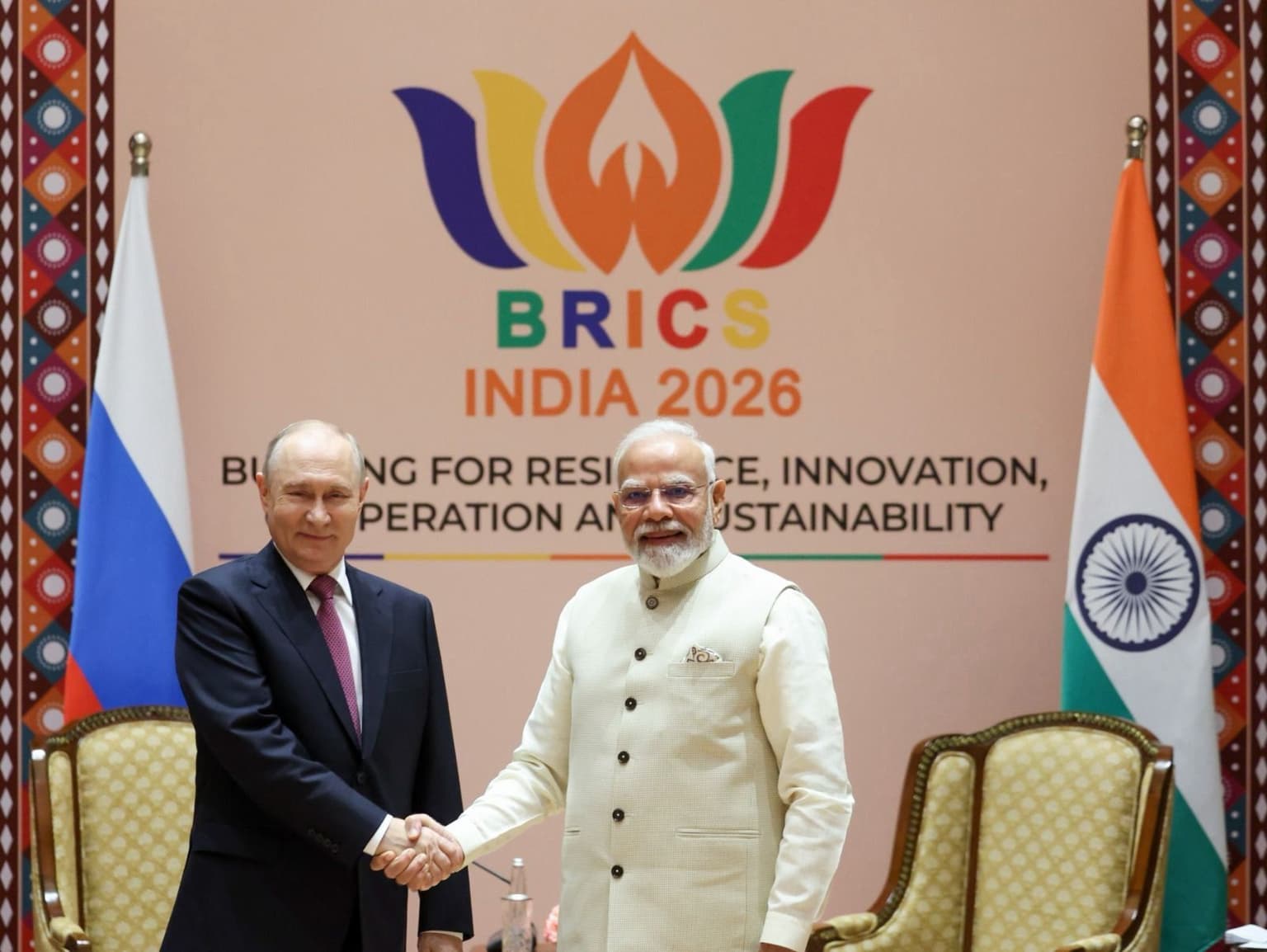
Russian President Vladimir Putin (left) shakes hands with Indian Prime Minister Narendra Modi during a meeting in New Delhi, India, on the eve of a BRICS summit. (Indian Prime Minister Narendra Modi/X)
Vucic first announced his intent to resign back in June, following two years of sustained anti-corruption protests triggered by the 2024 collapse of a railway station canopy in Novi Sad that killed 16 people. His ruling Serbian Progressive Party has already nominated him as its candidate for prime minister ahead of the October vote, suggesting the resignation functions less as a genuine step back from power than as a tactical repositioning ahead of an election he still fully intends to win.
RUSSIA’S MILITARY HOSPITALS BUCKLE UNDER WOUNDED SOLDIERS
An investigation by Polish outlet Vot Tak found that Russian authorities in at least 11 regions have spent 3.2 billion rubles treating and rehabilitating wounded military personnel in civilian hospitals since the invasion began, straining care for ordinary patients in the process. One maternity hospital in Rostov-on-Don stopped delivering babies entirely in early 2024, redirecting pregnant patients elsewhere — one described being discharged a day before giving birth, telling local media “nobody cared about pregnant women.”
The International Institute for Strategic Studies estimates at least 611,000 Russian soldiers had been wounded by early 2025, and Vot Tak calculated Russia currently has roughly 58,300 hospital beds available for wounded troops nationwide, with some departments accommodating more than double their official capacity. Regulations introduced in 2024 require Russian hospitals to treat war participants free of charge and, since 2025, without waiting in line — a policy one doctor said breeds “irritation and social tension” among ordinary patients, even as 19 Russian regions simultaneously plan to cut overall healthcare spending by a combined 107 billion rubles in 2026.
Some civilian hospitals have reportedly established closed wards specifically for wounded soldiers, with staff required to sign confidentiality agreements; one doctor in Siberia said medical records in such wards omit patient names entirely, using only case numbers instead. The arrangement illustrates a quieter, less visible cost of the war than battlefield casualties themselves — an entire civilian healthcare system gradually reorganizing itself around military priority, at the direct expense of the ordinary patients it was originally built to serve.
SBU FOILS AN FSB ASSASSINATION PLOT AGAINST A KYIV ACTIVIST
Ukraine’s Security Service detained a 19-year-old man from Mykolaiv accused of plotting, on Russian Federal Security Service orders, to assassinate prominent civic activist Hennadii Druzenko, a lawyer and co-founder of Ukraine’s First Volunteer Mobile Hospital. Druzenko confirmed on Facebook that the plot, revealed publicly yesterday, actually took place roughly a month and a half earlier. The suspect faces charges of treason, preparing a contract killing, and illegal weapons possession.
Investigators said the FSB recruited the suspect after he came to its attention through social media posts supporting fascist and Nazi ideology, then provided him with coordinates for a weapons cache containing a pistol, ammunition, and a suppressor. He allegedly tracked Druzenko’s daily routine before traveling armed to a forest in Kyiv Oblast’s Vyshhorod district on July 31, planning to shoot the activist during his regular morning dog walk, with a motorcycle pre-positioned for his escape. The SBU said the same day also saw a separate, parallel FSB attempt to kill Ihor Obolienskyi, commander of Ukraine’s Khartiia Corps — two unrelated assassination plots against prominent Ukrainian public figures, run in tandem, underscoring how routinely Russian intelligence now targets civilians with no direct military role simply for their public visibility and support of Ukraine’s cause.
A GAS STATION HIT TWICE, A THREAT TO LITHUANIA, A SANCTIONS DEADLINE MISSED
By nightfall, today’s threads pulled in every direction the war now reaches: a Kyiv gas station bombed twice in the same morning, a nuclear threat aimed at a country that hasn’t even finished amending its own constitution yet, and a sanctions renewal that couldn’t survive two countries’ insistence on protecting two specific billionaires. None of it resolved cleanly.
Two people in Kyiv won’t see tomorrow. A woman in Zaporizhzhia died under the rubble of her own home. And in Brussels, ambassadors are scheduled to try, for a third time, to simply keep sanctions in place before they lapse entirely. Nothing today ended. Everything today measured how much friction still separates the war’s stated diplomacy from the daily violence it’s supposed to be working to stop.
A PRAYER FOR UKRAINE
1. For the Two Killed at a Kyiv Gas Station
Lord, two people are gone tonight, killed by a drone that returned deliberately to strike again once help arrived. We grieve a cruelty engineered specifically to punish rescue itself. Receive them both, comfort the 12 injured including a child now recovering from what should have been an ordinary errand, and protect every emergency responder still running toward danger despite knowing it might return.
2. For the Woman Lost Beneath Rubble in Zaporizhzhia
Father, a woman died today after being pulled from her own collapsed home, rescued only to lose the fight afterward. We grieve a loss that came so close to being a survival story. Comfort her family, and give the rescuers who reached her in time some measure of peace, even in an outcome they couldn’t ultimately change despite everything they tried.
3. For Medical Workers Targeted While Helping Others
Lord of healing, we lift up the three medical staff injured today when their own ambulance became a target in Kherson. Protect every medic, paramedic, and rescue worker operating under a threat that treats their compassion as vulnerability. Give them courage to keep answering calls, and give the world clarity to name this pattern honestly, not euphemistically, as the war crime it actually is.
4. For Wisdom Among Nations Weighing Sanctions and Threats
God of justice, we pray for the diplomats trying, again, to hold a fracturing consensus together against pressure from every direction — nations protecting their own interests, threats aimed at those simply changing their own laws. Give negotiators resolve to prioritize principle over convenience, and give threatened nations courage to make their own choices regardless of what Moscow says they’ll cost.
5. For Every City Learning to Live With This War’s New Normal
God of endurance, we pray for Kyiv, Kherson, and Zaporizhzhia, each absorbing violence that’s become disturbingly routine. Give their residents strength for days that shouldn’t require this much of anyone. And give the wider world enough attention to keep noticing, even when the strikes stop feeling like breaking news and start feeling, wrongly, like simply how things are.
In Your mercy, in Your justice, in Your time — bring this war to its end, and let the ending be worthy of what Ukraine has endured.