
Ukraine Daily Briefing | April 17, 2026 | Day 1,148 of the Full-Scale Invasion
Russia’s defense ministry published the names and addresses of European drone manufacturers and called them legitimate military targets — a threat Medvedev said should be taken literally — as Ukrainian long-range strikes drove Russian seaborne oil exports to their lowest levels since 2024 and a Russian state polling agency admitted that Putin’s approval rating has fallen for six consecutive weeks. Overnight, 172 drones and a ballistic missile rained down on Ukraine, killing at least six people and knocking 380,000 off the power grid in Chernihiv, while intelligence warned Russia is preparing to escalate to seven mass attacks per month — roughly one every four days.
The Day’s Reckoning
Picture a room full of European defense engineers who came to work on a Thursday morning and discovered, scrolling through the news, that the Russian Defense Ministry had published their office addresses. Not as a warning. Not as a negotiating tactic. As what Dmitry Medvedev later clarified should be understood as a target list.
That was April 17, 2026 — a day when the war’s geography expanded again, not on the battlefield, but in the minds of people thousands of miles from the front. The Kremlin is struggling to stop Ukrainian drones from burning its oil terminals and crippling its port exports, so it turned to the factories making them. London. Munich. Prague. Riga. The addresses were there in the ministry’s statement, specific enough to be chilling.
Inside Russia, something else was crumbling. The state’s own polling agency — the kind that takes its cues from the Kremlin — published numbers showing Putin’s approval has fallen for six straight weeks. Sixty-one percent of Russians now describe the political situation negatively. And the Leningrad Oblast governor went before the regional assembly to announce what was, until recently, unspeakable: his region is now a frontline oblast.
On the actual front, 172 Russian drones and a ballistic missile struck cities from Odesa to Chernihiv overnight, killing at least six people. Ukraine’s foreign minister said intelligence shows Russia is preparing to do this seven times a month. And in Donetsk, Russian forces edged forward near Vovchansk while Ukraine quietly notched an advance near Slovyansk — two armies grinding against each other while diplomats in Antalya talked past each other. The war shows no sign of ending. It is, in several measurable ways, getting worse.
The Target List: Russia Publishes European Drone Factories as Legitimate Strikes
The Russian Defense Ministry’s statement on April 17 was constructed to feel like intelligence rather than intimidation. It named companies in London, Munich, Prague, Riga, Spain, and Italy, described them as nodes in the supply chain for Ukrainian drone strikes on Russian territory, and published their addresses. The implicit message was unmistakable. Dmitry Medvedev — Russia’s former president and current author of its most unfiltered threats — made it explicit: the list, he said, should be taken “literally” as targets for Russian armed forces.
The Czech Foreign Ministry moved quickly, summoning the Russian ambassador to explain what Prague called statements that appeared to target Czech companies. The Kremlin’s spokesman, Dmitry Peskov, declined to confirm whether Russia was considering strikes, saying only that European involvement in the conflict was “growing.”
The threat reflects a genuine Russian frustration. Ukraine has expanded its drone strike capacity to approximately 9,000 drones deployed daily, a pace that requires industrial-scale production and European components. Russia cannot stop the strikes at the source inside Ukraine, so it is now gesturing toward the factories across the continent that feed the pipeline. Whether the threats translate into action — or whether they are designed primarily to intimidate European governments into limiting cooperation — remains to be seen. What is clear is that Russia has now drawn a map of what it considers legitimate targets, and that map extends from Kyiv to Munich.
Six Straight Weeks: Putin’s Approval Numbers Tell the Story the Kremlin Cannot
The All-Russian Public Opinion Research Center — VTsIOM — is a state-owned institution. It does not publish numbers designed to embarrass the Kremlin. That makes what it published on April 17 all the more striking.
Putin’s approval rating, according to VTsIOM, has declined for the sixth consecutive week — from 72.9 percent in early March to 66.7 percent for the week of April 6 to 12. Support for United Russia, the ruling party, fell from 32.1 percent to 27.3 percent in the same period. Trust in Putin dropped from 77.3 percent to 72 percent.
These are state numbers. The reality may be grimmer. The independent Levada Center — which takes real risks to publish honest polling — reports that 61 percent of Russians now view the political situation negatively. Nine percent describe it as “critical and explosive,” up nine points since May 2025.
The backdrop matters: Russia is now in its fourth year of full-scale war. Total casualties are approaching one percent of the entire population. The Kremlin has throttled Telegram, causing internet outages in St. Petersburg that prompted Leningrad Oblast’s governor to publicly scold Russians who complained about losing internet access. “What are you doing to help win the war?” was his implicit message to his own constituents. The answer, apparently, is that some of them are growing quietly furious.
Frontline Oblast: Leningrad’s Governor Admits What the Kremlin Has Long Denied
For years, the Kremlin’s domestic strategy rested on a simple premise: shield Russians far from the front from the war’s costs. The fighting was in Donetsk. The explosions were in Zaporizhzhia. The sirens were in Kyiv. Russia’s heartland, and especially St. Petersburg’s wealthy and influential orbit, was supposed to remain untouched.
On April 15, Leningrad Oblast Governor Alexander Drozdenko went before the regional assembly and told them the premise had collapsed. His region, he said, has become a “frontline oblast.” Ukrainian long-range drones have repeatedly struck port and oil infrastructure in Leningrad Oblast — targets that were once considered safely beyond reach. On April 17, Drozdenko announced that air defenses in the region would be reinforced, with additional resources flowing to the 6th Air Force and Air Defense Army.
More revealing still: he called for reservists to form mobile fire groups to be stationed near industrial facilities and critical infrastructure. He specified that veterans of the war in Ukraine or those with combat experience should volunteer. Contracts would run up to three years.
Read between those lines and the picture is stark. Russia’s existing air defense, spread across a country of eleven time zones, cannot protect its industrial rear from Ukrainian drones. The answer is to recruit veterans to stand guard near oil terminals — not to intercept missiles with sophisticated systems, but to put human beings with guns near targets that keep getting hit. Ukraine’s long-range strike campaign is forcing Russia to redeploy resources from the front to the homeland. That is a strategic victory, measured not in territory but in pressure.
The Oil Bleeding Out: Russian Seaborne Exports at Their Lowest Since 2024
The numbers came from Kommersant — a Russian business newspaper that, unlike state media, still sometimes publishes data the government would prefer to hide. Between April 6 and 12, Russian seaborne oil exports fell 16.1 percent to 291,000 tons. The port of Novorossiysk, a critical Black Sea terminal, saw exports collapse by 73.2 percent to just 19,000 tons. According to the Center for Price Indices cited by Kommersant, exports could fall to their lowest point since 2023 by the end of April.
The cause is Ukrainian drone strikes against port infrastructure — the same campaign that drove the Leningrad Oblast governor to address his regional assembly. About 40 percent of Russia’s oil export capacity was reportedly disabled in March alone. The International Monetary Fund, which on April 14 upgraded Russia’s growth forecast by 0.3 percent due to higher global oil prices driven by the Middle East conflict, nonetheless noted it is “monitoring Ukraine’s strikes on Moscow’s energy infrastructure” and acknowledged the “destruction of some of the refining and export capacity.”
Russia’s ability to fund its war is directly tied to its ability to sell oil. Ukrainian drones are making that harder. Every burned terminal, every idled tanker berth, every export ton that never loads onto a ship, is financial pressure on a military machine that requires massive and unrelenting expenditure to continue its operations across a 1,000-kilometer front.
172 Drones and a Ballistic Missile: Another Night Across Ukraine
The overnight attack that ended the evening of April 16 and the morning of April 17 came in familiar form: wave after wave of Shahed-type drones — Russia’s battlefield disposables, produced cheaply in large numbers and aimed at overwhelming Ukraine’s defenses through sheer volume — combined with a single Iskander-M ballistic missile fired from occupied Crimea.
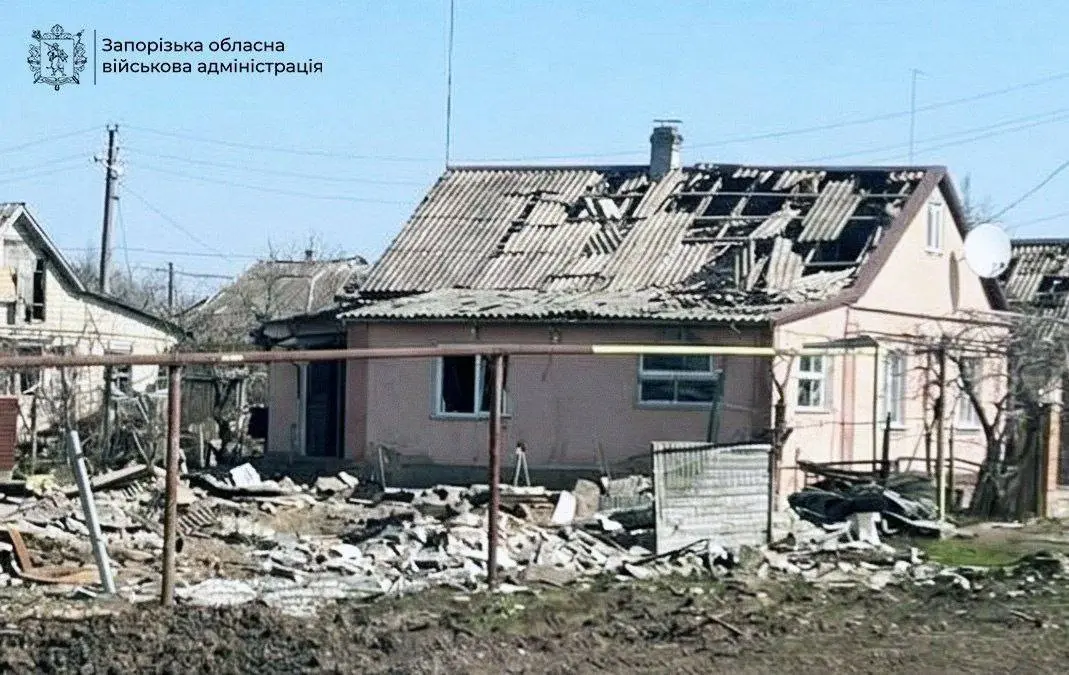
Aftermath of a Russian attack against Zaporizhzhia Oblast, Ukraine. (Zaporizhzhia Oblast Military Administration)
The Ukrainian Air Force reported that forces downed 147 of the 172 drones. The missile and approximately 20 drones broke through. They struck eight locations across Chernihiv, Dnipropetrovsk, Odesa, and Zaporizhzhia oblasts. In Chernihiv, the attack knocked out a water supply facility, leaving 380,000 residents without power. In Zaporizhzhia Oblast, three people were killed and 13 injured across 726 strikes on 39 settlements. In Kharkiv Oblast, a 41-year-old woman was killed and nine people injured. In Sumy Oblast, two people were killed and six injured. In Kherson Oblast, nine people were wounded. In Dnipropetrovsk, three more were injured.
And separately — the numbers that have not yet been absorbed into the current day — the attack the night before, into Thursday, killed five people in Dnipro, eight in Odesa, four in Kyiv (including a 12-year-old boy), and one in Zaporizhzhia.
These are not exceptional events. They are the rhythm of the war.
Seven Times a Month: Ukraine’s Intelligence Warning About the Next Escalation
Speaking at the Antalya Diplomacy Forum on April 17, Ukrainian Foreign Minister Andriy Sybiha delivered a figure that reframed what “large-scale attack” means in this war. According to Ukrainian intelligence, Russia is preparing to conduct attacks of at least 400 drones combined with 20 or more missiles — and to do so seven times per month. That is roughly one every four days.
Currently, Russia is conducting four to five such mass strikes monthly. Ukraine’s air defense is intercepting up to 90 percent of incoming drones during these attacks. But interception rates are only part of the equation. The other part is capacity — specifically, the rapidly depleting stockpile of Patriot interceptor missiles. President Zelensky said on April 14 that the shortage “could not be any worse,” and on April 16 he instructed the Air Force commander to personally reach out to every partner that had pledged missiles for Patriot and other systems.
Ukraine’s military intelligence deputy chief, Major General Vadym Skibitskyi, added detail: Russia is expanding its Iskander-M production to around 60 missiles per month and is increasing launcher capacity. The Russian Spring-Summer 2026 offensive is being shaped not just by ground forces but by an air campaign designed to systematically degrade Ukrainian infrastructure before the armored push begins. The timeline, Skibitskyi told the Financial Times, has Russia targeting capture of the Donbas by September.
The Sting at 2,000 Kilometers: Ukraine’s Interceptor Drone Sets a New Record
An interceptor drone is not the weapon most people picture when they imagine air defense. There are no missiles involved, no radar-guided warheads. The Sting — built by Ukrainian manufacturer Wild Hornets — is a fast, small aircraft that flies into the path of an incoming Russian Shahed and destroys it on impact. It travels over 340 kilometers per hour and can operate at up to 3,000 meters altitude.
On April 17, Wild Hornets announced that a Ukrainian pilot had remotely operated a Sting from outside Ukraine — 2,000 kilometers from the launch site — using the company’s Hornet Vision Ctrl remote piloting system. The operator was in northern Ukraine; the drone was flying somewhere else entirely. The company did not specify the target or the exact operational details, but the demonstration was significant: a Ukrainian pilot sitting far from the front line, connected by encrypted video and control signals across thousands of kilometers, guiding a drone to intercept Russian cruise weapons.
The same system had already been used to intercept two Russian Shaheds at a range of 500 kilometers — what the company called a world record at the time. Now the record has been extended fourfold. Ukraine’s defense industry continues to adapt to Russia’s mass drone campaign not just by building more air defense but by rethinking where the operator needs to be.
Private Air Defense: Ukraine’s New Interceptor Shoots Down a Jet-Powered Shahed
Defense Minister Mykhailo Fedorov announced on April 17 that a private air defense unit had, for the first time, successfully shot down a high-speed jet-powered Shahed-type drone. The interception took place in the Kharkiv region. The drone was traveling at more than 400 kilometers per hour — well above the speed of a standard propeller-driven Shahed, which flies at roughly 185 kilometers per hour.
The significance is in what Russia is adapting to. Slower Shaheds are now interceptable not just by military systems but by improvised Ukrainian mobile fire groups — trucks, crews, and handheld weapons operating as roving defense teams. So, Russia has begun deploying faster, jet-powered variants that outrun many of those improvised systems. Ukraine’s response has been to develop private air defense units — currently being formed at 19 enterprises — that are integrated into the Air Force’s command system and receive military training and transferred equipment.
The first private unit to intercept a Shahed did so in late March. The April 17 interception of a jet-powered variant marks the next level. Fedorov described it as “a new level of complexity” and said Russia is scaling up the use of faster drones. Ukraine is, as usual, adapting in real time.
Joint Production Expands: Ukraine and Germany Deepen the Defense Industrial Partnership
On April 17, Ukrainian defense company TAF Industries and German counter-drone manufacturer THYRA signed a memorandum of strategic cooperation for the serial joint production of interceptor drones in Germany. It was one of several agreements in recent weeks between Ukrainian and German defense companies. The Council of Gunsmiths, Ukraine’s defense industrial cooperation platform, reported that six new cooperation agreements were recently concluded, including one between Ukrainian cruise missile producer Fire Point and German air defense systems manufacturer Diehl Defense on producing anti-ballistic missile systems.
The broader context: Ukraine and Germany recently signed 10 bilateral agreements covering air defense supply, and Germany announced a €4 billion military aid package focused on air defense and drones. These deals are not just about Ukraine’s immediate needs — they are about building a durable, European-based production base that can sustain Ukraine’s defense without depending entirely on American willingness to supply.
Russia has noticed. Its Defense Ministry’s publication of European company addresses was aimed, in part, at intimidating exactly this kind of industrial cooperation. The Russian message: factories that help Ukraine are targets. The European response has been, so far, to accelerate the cooperation rather than halt it.
Vovchansk Holds: Ukraine Contains Russian Build-Up in the North
Vovchansk has been fought over since May 2024. The small city in Kharkiv Oblast, once home to roughly 17,000 people, was largely reduced to rubble in the fighting that followed Russia’s cross-border offensive that spring. Ukrainian forces stopped the Russian advance at the city limits. It has been a stalemate in a ruined place ever since.
Ukraine’s 16th Army Corps reported on April 17 that Russian forces have been accumulating forces near Vovchansk for the past week, focusing on crossing the Vovcha River and securing footholds in the city’s southern portion for advances toward nearby settlements. The Corps reported that no positions were lost and that units are holding their designated lines. During the reporting period, Ukrainian forces destroyed a Russian IMR-2 engineering vehicle and a UAZ vehicle using an FPV drone during what appeared to be a Russian reconnaissance mission ahead of a planned river crossing.
The pattern is familiar: Russian forces mass, probe, suffer losses on approach, and then mass again. Ukraine holds the line, uses drones to pick apart the preparation, and waits for the next push. There is no elegance to it. It is grinding, attritional warfare in a city that no longer exists as a place anyone would want to hold — except that holding it means denying the other side the road to Kharkiv.
The Donetsk Front: Infiltration Tactics and a Ukrainian Advance Near Slovyansk
The front in Donetsk Oblast showed its characteristic texture on April 17: small-unit Russian infiltration missions, Ukrainian FPV drone responses, and one genuine Ukrainian advance.
Near Slovyansk, geolocated footage published on April 16 showed Russian forces striking Ukrainian-occupied trenches northwest of Zarichne — confirming that Ukrainian forces had recently advanced in the area. It is a small gain in strategic terms, but it moves Ukraine closer to the approaches of a city that has been a Russian objective since the beginning of the war.
Near Kostyantynivka, Russian infiltration missions were repelled in multiple locations. The brigade spokesperson for the Kramatorsk direction reported that Russian forces are using motorcycles in large numbers to conduct infiltration missions — a low-cost, fast-moving approach that is harder to track with drones than vehicles. Russia is also deploying more FPV drones to expand the kill zone, making logistics increasingly difficult and forcing both sides to conduct supply runs on foot.
In occupied Mariupol, the Ukrainian Unmanned Systems Forces struck a Russian Pantsir-S1 air defense system overnight. Commander Major Robert “Magyar” Brovdi noted that Ukrainian forces have now destroyed 16 Russian air defense systems and radars in the first 16 days of April — roughly one per day.
Russian Drones in Ukrainian Skies: Camera-Equipped Shaheds Hunt Mobile Fire Groups
Russia has begun installing cameras on its Geran-type long-range strike drones — a modification that transforms them from one-way weapons into surveillance assets during their flight. A Kremlin-affiliated milblogger reported on April 17 that Russian forces are using teams of two or more drones: one to strike, one to watch. The camera-equipped drone identifies Ukrainian mobile fire groups — the roving truck-and-crew teams that intercept drones across the countryside — and allows operators to engage them.
Russian operators have reportedly been conducting daytime reconnaissance flights after overnight strike missions to assess results and map changes in Ukrainian mobile fire group coverage. The adaptation has been used in Dnipropetrovsk and Poltava oblasts.
This is the pace of the drone war: each side finds a method, the other side adapts, and the first side adapts to the adaptation. Ukraine builds interceptor drones that hunt Shaheds. Russia adds cameras to its Shaheds to hunt the interceptors. Ukraine develops remote piloting systems that let operators work from 2,000 kilometers away. The loop does not close.
Train in the Crosshairs: Russia Targets Ukrainian Passenger Infrastructure
Geolocated footage published on April 16 shows a Russian FPV drone — a first-person view drone, essentially a flying bomb guided by a pilot wearing video goggles — striking a Ukrainian passenger train in Kherson City. The target was not a military supply convoy. It was a train.
Attacks on Ukrainian transportation infrastructure have escalated in 2026 as Russia attempts to complicate military logistics and civilian evacuation simultaneously. FPV drones, which cost a fraction of what conventional missiles do, can be produced in large numbers and deployed for small-unit, precision attacks against specific vehicles. They have become Russia’s weapon of choice for this kind of targeting.
The Kremlin’s publicly stated rationale is that any vehicle or infrastructure that could theoretically support Ukrainian military operations is a legitimate target. The practical effect is that civilian trains, buses, and trucks travel with the understanding that a Russian drone operator may be watching from above.
Managed Looting: Russia Moves to Mine Occupied Ukraine’s Manganese
Russia is developing one of the world’s largest manganese deposits in occupied Zaporizhzhia Oblast, Kommersant reported on April 17. Reale Engineering Invest, a company with 25.1 percent held by RT-Business Development — a subsidiary of Rostec, the Russian state defense conglomerate — obtained a license to extract minerals at the Velyko-Tokmak deposit in February 2026 and began geological exploration in April.
The Velyko-Tokmak site ranks among the top five manganese deposits globally, with estimated reserves of 1.7 billion tons. Manganese is essential for steel production. Russia currently imports more than 90 percent of its manganese supply. This deposit, if developed, would dramatically reduce that dependence and provide a massive industrial prize for Russian state-linked companies operating under military occupation.
Construction of a mining and processing plant has already begun. Plans call for roughly 3,000 workers. The project is part of a broader Russian pattern: alongside the Velyko-Tokmak manganese play, Russia has moved on a gold deposit in occupied Luhansk Oblast and a lithium site in Donetsk Oblast. The occupied territories are being mined — literally — while the occupation continues.
Rewriting History at Katyn: Russia Opens a ‘Polish Russophobia’ Exhibit at a Massacre Site
The Russian Military-Historical Society unveiled an exhibition titled “10 Centuries of Polish Russophobia” at the Katyn Memorial site in the Smolensk region. The Katyn Memorial is where Soviet secret police executed more than 20,000 Polish officers, intellectuals, and prisoners of war in 1940. The Soviet Union denied responsibility for decades, blaming Nazi Germany. Russia eventually acknowledged the crime.
The exhibition opened shortly before a commemoration of the Katyn victims and near the site of the 2010 plane crash that killed Polish President Lech Kaczynski and dozens of senior officials en route to the memorial. Its thesis: Poland has harbored historical hatred of Russia for ten centuries. Its location: the site of one of the worst crimes Soviet Russia committed against Poland.
The exhibition is chaired by Vladimir Medinsky — the same Vladimir Medinsky who served as Russia’s lead negotiator in the early Ukraine peace talks, and who has been the primary architect of the Kremlin’s historical revisionist project. Kirill Martynov of Novaya Gazeta Europe called the exhibit “shameful.” Others drew direct parallels to Russia’s pattern in Ukraine: awarding military honors to units accused of the Bucha massacre, denying well-documented crimes, rewriting the record to position victims as aggressors. The war against Ukraine has always been, in part, a war against history.
Zelensky Sanctions 121 Russian Commanders — and Nine Priests
President Zelensky imposed sanctions on more than 121 Russian military commanders responsible for missile strikes against Ukraine, the President’s Office announced on April 17. The list includes commanders of Russian strategic aviation — units that have launched over 4,100 missiles since the start of the full-scale invasion — as well as naval commanders linked to Kalibr cruise missile strikes from submarines and ships, and ground forces officers connected to Iskander-M attacks on civilian targets in Sumy, Chernihiv, and Kharkiv oblasts.
“This is one of the first cases where our special services have managed to clearly identify more than 100 specific individuals who directly issue orders and carry out missile launches against Ukraine,” said Vladyslav Vlasiuk, an adviser to the president on sanctions policy. Ukraine will share the lists with international partners to seek coordinated action.
The sanctions also targeted nine figures connected to the Russian Orthodox Church for publicly supporting the war and calling for violence against Ukrainians — a reminder that the Kremlin’s war machine extends into ecclesiastical as well as military structures. Ukraine is attempting to build a legal and diplomatic record sufficient to pursue accountability in courts long after the shooting stops.
Corruption at the Front: A Brigade Deputy Commander Detained
Ukraine’s 58th Separate Motorized Infantry Brigade confirmed on April 17 that a deputy commander had been detained in connection with an ongoing pre-trial investigation. Reports suggest the case involves alleged bribery related to transfers between military units. The brigade said it supports the investigation and urged the public to wait for a court ruling.
The case touches on one of the most difficult pressure points in Ukraine’s military system. Under current rules, transfers between brigades must be personally approved by the unit commander — a rule designed to prevent unauthorized departures from undermined positions. In practice, the rule has created both an incentive for commanders who struggle or abuse authority to stay in place and a market for soldiers willing to pay to escape those situations. Ukraine’s Human Rights Ombudsman received 6,127 complaints against enlistment officers in 2025 — nearly twice the 2024 figure. Attacks on recruitment officers have reached 620 since the start of the invasion, including a stabbing in Vinnytsia and a killing in Lviv in April alone.
The 58th Brigade has served on some of Ukraine’s hardest fronts since 2015, including Avdiivka, Bakhmut, and Lyman. Despite the detention, the unit said it continues to hold defensive positions in the Kharkiv direction. The case is an uncomfortable reminder that the strains of three years of full-scale war are not distributed only across the physical front lines.
Children Returned, Children Still Taken: Ukraine’s Ongoing Rescue Operation
Save Ukraine, a Ukrainian humanitarian NGO, announced on April 16 that it had returned 19 children and teenagers from Russian-occupied territories and from Russia itself over the preceding week. Among them was 11-year-old Emiliia, forced to participate in militarized events at her school supporting the Russian army. When she refused, teachers allegedly pressured and bullied her until the sustained stress produced serious health problems.
Seventeen-year-old Matvii was forced to sing the Russian national anthem. When he refused, he was threatened with solitary confinement. He went into hiding from Russian patrols searching for boys his age to issue draft notices. Nineteen-year-old Sofiia was persecuted for saying “thank you” in Ukrainian, and punished at college for her pro-Ukrainian stance.
According to Ukraine’s Children of War database, at least 20,000 Ukrainian children have been abducted since February 2022. Ukraine’s ombudsman puts the real figure at up to 150,000; the presidential commissioner for children’s rights estimates between 200,000 and 300,000. The International Criminal Court issued arrest warrants for Putin and Russia’s Children’s Rights Commissioner in 2023 for their role in the deportations. The warrants exist. The abductions continue.
The Equatorial Guinean Who Was Promised a Bodyguard Job and Got Donetsk Instead
Daniel Angel Masie Nchama left Equatorial Guinea in December for what he believed was military training that would lead to a bodyguard job. He was 22 years old, a computer science student who wanted to live abroad. A Cameroonian man known as “Fabrice” had made the pitch. By January, Nchama had a Russian visa. By February, he was in Donetsk.
In late March, a voice message he sent to his parents spread widely across Equatorial Guinea: “Come and help me! I’m on the front line in Ukraine, I’m fighting for Russia. Once I’m there, there’ll be no going back unless the war ends.” He said he had been forced to sign Russian-language documents he could not read.
He is one of an estimated 1,780 Africans from 36 countries fighting alongside Russian forces in Ukraine. More than 300 have died. After the voice message went viral, Equatorial Guinea’s government confirmed the existence of a recruitment network run by “Fabrice” and called for international action to dismantle it. The Russian ambassador, when confronted, promised cooperation. The family has filed a police complaint. Nchama’s fighter replacement at the front confirmed he was still alive as of the last report. The Masie Nchama family is waiting.
Belarus Builds: Zelensky Warns of New Roads and Artillery Along the Northern Border
President Zelensky said on April 17 that new roads and artillery positions are being constructed in Belarus alongside Ukraine’s northern border. “We believe that Russia will once again attempt to drag Belarus into its war,” he said.
Belarus served as the staging ground for Russia’s 2022 attempt to seize Kyiv. Russian columns rolled south from Belarusian territory in the first days of the invasion and were repulsed, but the route exists. The Oreshnik ballistic missile system — with ranges covering Poland and Germany — was deployed to Belarus in December 2025. Satellite imagery has documented significant Belarusian military infrastructure expansion since 2022. Lukashenko has been publicly cooperative with Moscow throughout, though Belarusian forces have not yet joined the fighting.
New roads near a border are not necessarily preparations for an offensive. But in the context of three years of Russian escalation, infrastructure that enables military movement is infrastructure that matters. Ukraine is watching. Its partners in Warsaw and Vilnius are watching. The north, for now, is quiet. Whether it remains so is one of the open questions of 2026.
Debt Deferred: Ukraine and G7 Creditors Agree to Postpone Payments Until 2030
Ukraine’s Finance Minister Serhiy Marchenko signed a memorandum of understanding with G7 creditor nations — Canada, France, Germany, Japan, Italy, the Netherlands, the UK, the US, and South Korea — postponing state and state-guaranteed debt payments due from February 2026 until the end of February 2030. Deferred amounts will be repaid in semiannual installments between 2035 and 2039.
The agreement follows the IMF’s approval of an $8.1 billion Extended Fund Facility program for Ukraine earlier this year. It reflects the international consensus that Ukraine’s wartime budget cannot absorb normal debt service alongside the cost of fighting and reconstruction. Marchenko said the freed resources will support defense spending and economic recovery. “This decision is critically important for Ukraine, because it allows you to substantially reduce the debt burden on the state budget,” he said.
Ukraine’s public debt repayments in the first quarter of 2026 met 99 percent of planned amounts — a signal of fiscal discipline that has helped maintain creditor confidence through nearly three years of total war.
US Weapons Delays Hit Europe as Iran War Strains American Stockpiles
The White House has begun delaying weapons deliveries to European allies, according to officials cited by Reuters, as American military stockpiles are strained by the ongoing US-Israeli campaign against Iran. The conflict began with strikes on February 28 and has continued for nearly seven weeks. Iran’s launches of hundreds of missiles and drones toward Gulf countries have consumed large numbers of PAC-3 Patriot interceptors — the same systems Ukraine is desperate for and that European countries rely on for deterrence against Russia.
European officials have been quietly told that previously contracted deliveries — including weapons purchased through the US Foreign Military Sales program — are likely to be postponed. The countries affected include Baltic and Scandinavian states. The State Department and White House referred inquiries to the Pentagon, which did not respond.
The development represents a significant complication for both NATO’s eastern flank and Ukraine’s air defense crisis. European officials, already frustrated by American pressure to buy US-made weapons, are now being told those weapons may not arrive on schedule. Some European officials are calling for a shift to exclusively European-made arms.
Meanwhile, a separate oil sanctions wrinkle: Treasury Secretary Scott Bessent said publicly on April 15 that the Trump administration would not renew the general license allowing purchases of Russian oil stranded at sea. Two days later, the Office of Foreign Assets Control issued a new license extending the waiver until May 16. The contradiction — a public announcement followed by a quiet reversal — drew attention but no official explanation.
Diplomat’s Verdict: Fried on Peace Talks, Orbán’s Fall, and Russia’s Frustration
Former US diplomat Daniel Fried — who designed American policy toward Russia and Eastern Europe after the Cold War and served under both Republican and Democratic administrations — spoke to the Kyiv Post this week with a clarity unusual for someone of his background.
On peace talks: “I don’t think the talks are [happening] anywhere. The US has been distracted by the Iran conflict.” On the path to serious negotiations: “If the US were doing more for the Ukrainians and working with Europe, we would be in a far better position vis-à-vis the Russians and quite possibly able to push the Russians into serious negotiations for the first time.” On Russia’s escalation threats against European drone suppliers: “They’re frustrated because they cannot beat Ukraine. So, they’re trying to claim that they’re fighting NATO, they’re fighting the US. They’re trying to frighten the Europeans. I don’t think it will work.”
On Hungary: Viktor Orbán’s apparent defeat in recent elections drew a sharp assessment from Fried. “Orban had brought the country economic stagnation and massive corruption, and Hungarians were sick of it.” He added: “Viktor Orban was not so much a conservative as he was a radical nationalist with an agenda that recalled some very bad parts of Hungarian strategic culture from the 1930s. So, I won’t miss him.” Fried argued that Hungary under new leadership could stop acting as Moscow’s “effective agent in Europe” and that Ukraine should move quickly to build ties with Budapest’s incoming government.
Sweden’s King in Lviv: Carl XVI Gustaf Visits Ukraine for the First Time
Carl XVI Gustaf, King of Sweden, arrived in Lviv on April 17 with Swedish Foreign Minister Maria Malmer Stenergard. He met President Zelensky, and the two laid flowers at the graves of fallen Ukrainian soldiers.
It was the Swedish king’s first visit to Ukraine during Russia’s full-scale invasion — a visit with weight beyond its symbolism. Sweden, which only joined NATO in March 2024, has taken increasingly active measures in the war’s orbit: seizing a suspected Russian shadow fleet tanker in Swedish territorial waters in March, announcing a 12.9 billion crown military aid package focused on air defense in February, and most recently deepening defense industrial cooperation with Ukrainian manufacturers. A head of state does not fly to Lviv in the middle of a war without making a statement. Sweden’s statement was unambiguous.
Russia’s Next Generation: Content Camps Train Teenagers to Spread the Kremlin’s War
In early April, more than 120 Russian teenagers gathered in Moscow for a content creation camp run by the Young Army — Russia’s Yunarmiya youth military organization. Clad in green sweaters and red berets, they received lectures from soldiers and state media reporters on how to produce videos, use artificial intelligence, and build social media audiences to spread pro-war messaging.
“We have created a huge team of kids, who understand how to broadcast government values and our organization’s values,” said Vladislav Golovin, a former soldier and chief of the general staff of the Young Army, in a statement from the group. A promotional video showed children cheering a cadet racing Golovin to see who could reload a sniper rifle fastest.
The program sits within a broader campaign. Putin cited Otto van Bismarck in 2023: “Wars are not won by generals, but by schoolteachers and parish priests.” More than half of Russians aged 18 to 24 now list social media as their primary news source, according to Levada Center polling. The Kremlin’s strategy is to embed its war narrative into a generation that has never known a Russia not at war, not censoring, not claiming victimhood while committing violence. AI and disinformation analyst Veronika Solopova noted that social media algorithms are ideally suited for this purpose. “Young people are famously easy to radicalize,” she said.
On the night of April 17, the drones came again — as they do every night now, in their hundreds. Somewhere in occupied Zaporizhzhia, earth-moving equipment broke ground near a manganese deposit that Ukraine used to own. In St. Petersburg, residents complained about the internet going out and were told by their governor to think about what they were doing for the war effort. In a Moscow auditorium, teenagers practiced reloading rifles and learned to point cameras at the world.
And in 19 locations across Ukraine, privately contracted air defense crews sat at their stations and watched the sky. One of them, in the Kharkiv region, got a jet-powered Shahed in its sights — a drone traveling at 400 kilometers per hour, built to outrun the old defenses — and brought it down. The war is not ending. But the people fighting it keep finding ways to make it slightly less unwinnable. That is where April 17, 2026 left things.
A Prayer for Ukraine
1. For the Six Who Did Not Come Home
Lord, receive the six who were killed in the night — in Zaporizhzhia’s villages, in Kharkiv Oblast, in Sumy, in the shelling that never stops. Most of their names are not in the reports. They were killed by something they never saw coming, in places that used to be ordinary: a street, a field, a home. We do not know who was waiting for them. You do. Hold them, and hold those now broken by the silence where a voice used to be.
2. For Emiliia, Matvii, Sofiia, and the 19 Who Came Home
Father, receive the children who came back this week — nineteen of them, carrying what was done to them in occupied territory. Eleven-year-old Emiliia, bullied until she fell ill for refusing to perform loyalty. Matvii, threatened with confinement for refusing to sing. Sofiia, punished for speaking her language. Let the safety they have found be real and not temporary. And for the hundreds of thousands still behind the lines — still being molded into something they did not choose — do not let us forget them when the news moves on.
3. For the Families Waiting in Equatorial Guinea
God of justice, look upon the family of Daniel Angel Masie Nchama — a 22-year-old who wanted to live abroad and was given a contract he could not read and sent to Donetsk. His parents have his voice on a recording, pleading to be brought home. A replacement soldier has confirmed he is still alive. That is all they have. Protect him where our reach cannot go. And bring to account every network that transforms poverty into cannon fodder.
4. For the Defenders Watching the Northern Sky
Lord, cover those who stand watch along Ukraine’s northern border, scanning satellite imagery, monitoring roads being built through Belarusian forests, listening for the signs of a second invasion from the direction that nearly killed Kyiv in 2022. Give them clarity to see what is coming. Give their commanders the will to act on what they know. And hold the thin line of deterrence that stands between that forest and the cities behind it.
5. For Justice That Outlasts the War
Zelensky signed sanctions against 121 Russian commanders who ordered missile strikes against children’s hospitals and apartment blocks. The International Criminal Court issued warrants for the architects of child deportations. A Russian exhibition celebrating Polish Russophobia opened at the site of a Soviet massacre. The record is being written on all sides — in sanctions lists and arrest warrants and historical lies and the testimony of those who survived. God of truth, let the record hold. Let it be read by courts and not forgotten. Let the names on those lists one day meet the weight of what they have done. In Your mercy, in Your justice, in Your time — bring this war to its end, and let the ending be worthy of what Ukraine has endured.