
UKRAINE DAILY BRIEFING
April 16, 2026 | Day 1,878 of the Full-Scale Invasion
In the small hours of April 16, Russia launched its sixth-largest strike of the entire war — 700 drones and missiles in coordinated waves — killing at least 17 civilians in Kyiv, Odesa, and Dnipro, including a 12-year-old boy, while first responders were targeted in a deliberate double-tap attack. Before dawn had fully broken, Ukrainian drones were already burning three storage tanks at Rosneft’s Tuapse Oil Refinery, one of the ten largest in Russia, as Kyiv and the Netherlands signed a landmark drone-manufacturing partnership. The day ended with bipartisan U.S. senators meeting Ukraine’s prime minister in Washington — and President Trump, asked about the mass slaughter, saying only: “Ukraine is moving along, I wish they could get along.”
The Day’s Reckoning
Picture a city at 2:35 in the morning. Air raid sirens have become almost background noise after four years of war — a grim soundtrack to sleep. Then the ballistic missile alert sounds, different, sharper. Minutes later, explosions walk through Kyiv’s residential neighborhoods like footsteps.
A 12-year-old boy does not survive the night. A mother and daughter are pulled from the rubble of their home in the Podilskyi district. Nineteen-year-old Yeva, jolted awake by a blast, ran to steady a family mirror. The second explosion brought the roof down — directly onto the spot where her sister had been standing. “People always believe that this will not happen to us,” she said, standing in the debris. “Our shelter was the basement, but we used it only the first year of the war.”
This was not a one-night event. Over 24 hours, Russia launched 703 strike vehicles — ballistic missiles, cruise missiles, and Shahed-type drones — in a deliberate, layered assault designed to exhaust Ukrainian air defenses before the hardest-to-stop weapons arrived. The tactic debuted during the war’s largest-ever strike on March 23-24 and is now becoming standard doctrine. Three of Russia’s seven 700-plus strikes have come in the past month alone.
While Moscow was still counting its kills, Ukrainian drones were setting Tuapse on fire. As senators convened in Washington to argue about UN reform, the real argument being made was over the Patriot interceptor shortage that Zelensky had described just two days before as “impossible to make any worse.” Europe was signing drone deals. Russia was threatening to target European drone factories. And somewhere in a Russian detention cell, a combat helicopter pilot was recording a suicide video about military corruption, helmets that can’t stop bullets, and a command that couldn’t tolerate the truth.
The Night Ukraine Couldn’t Afford: Six Hundred Drones and Seventeen Dead
The Ukrainian Air Force had seen this pattern before, but never three times in a single month. Beginning at 0900 on April 15 and continuing in waves through the following morning, Russian forces launched 19 Iskander-M ballistic missiles, 20 Kh-101 cruise missiles, five Iskander-K missiles, and 659 drones of the Shahed, Gerbera, and Italmas types. Ukrainian air defenses destroyed 636 drones and 19 of the cruise missiles — an interception rate that would have seemed miraculous three years ago. But the math of modern warfare is unforgiving: twelve missiles and twenty drones still found their targets at twenty-six locations across Ukraine.
Air Force Spokesperson Colonel Yuriy Ihnat explained the strategic logic afterward. The first overnight wave of drones functioned almost as “combat reconnaissance” — probing, exhausting, consuming interceptors. Cruise missiles followed. Then, with defenses depleted, the ballistic missiles arrived. Ukraine relies on U.S.-made Patriot systems to intercept ballistic threats; against the night’s 19 ballistic missiles, Ukrainian forces downed only eight. The remaining eleven fell where they fell — on homes, on playgrounds, on first responders.
Russia has now launched seven strike series of 700 or more strike vehicles since the full-scale invasion began. Three have come in the past thirty days. The pattern suggests deliberate stockpiling — intelligence analysts note that Russia likely accumulated weapons during its own self-declared Easter ceasefire on April 11-12, a truce that, in practice, benefited primarily the side with long-range strike capacity. The ceasefire paused ground operations. It did not pause Russian missile factories.
Kyiv, Odesa, Dnipro: A City-by-City Accounting of the Dead
In Kyiv — struck for the first time in over a month — four people were killed, including the 12-year-old child. Forty-eight others were injured; 26 were hospitalized. Mayor Vitali Klitschko reported damage across multiple districts. In the Podilskyi district, a non-residential building took a direct hit; a residential building caught fire; a three-story hotel and the sixth floor of an apartment building were struck by debris. A missile fragment partially destroyed a family home — the one where Yeva’s sister narrowly survived.
By 7 a.m., as emergency crews were still digging, air raid sirens sounded again. A Russian drone struck an 18-story building. The attacks did not end with nightfall.
In Odesa, the southern port city absorbed several waves of missile and drone strikes overnight. Nine people were killed and 23 injured; a residential building, a city park, and critical infrastructure were damaged. Earlier in the day, a separate drone strike on a multi-story apartment building had already killed one person and injured six. In Dnipro — hit for the second time in a single week — four civilians died and 34 were injured, including five in critical condition. The attack damaged apartments, an administrative building, a factory, and vehicles.
In Zaporizhzhia, five Russian missiles struck the city, killing one woman and injuring eight others. Among the targets was a Baptist church — a sanctuary built to hold over 300 worshippers, now destroyed. In Sumy Oblast, drones struck a gas station, killing one person. Kherson Oblast: two dead, eleven wounded, including two children. Kharkiv Oblast: four wounded. Chernihiv Oblast: two wounded.
Total toll across Ukraine in the twenty-four-hour period: at least 22 killed, 131 injured.
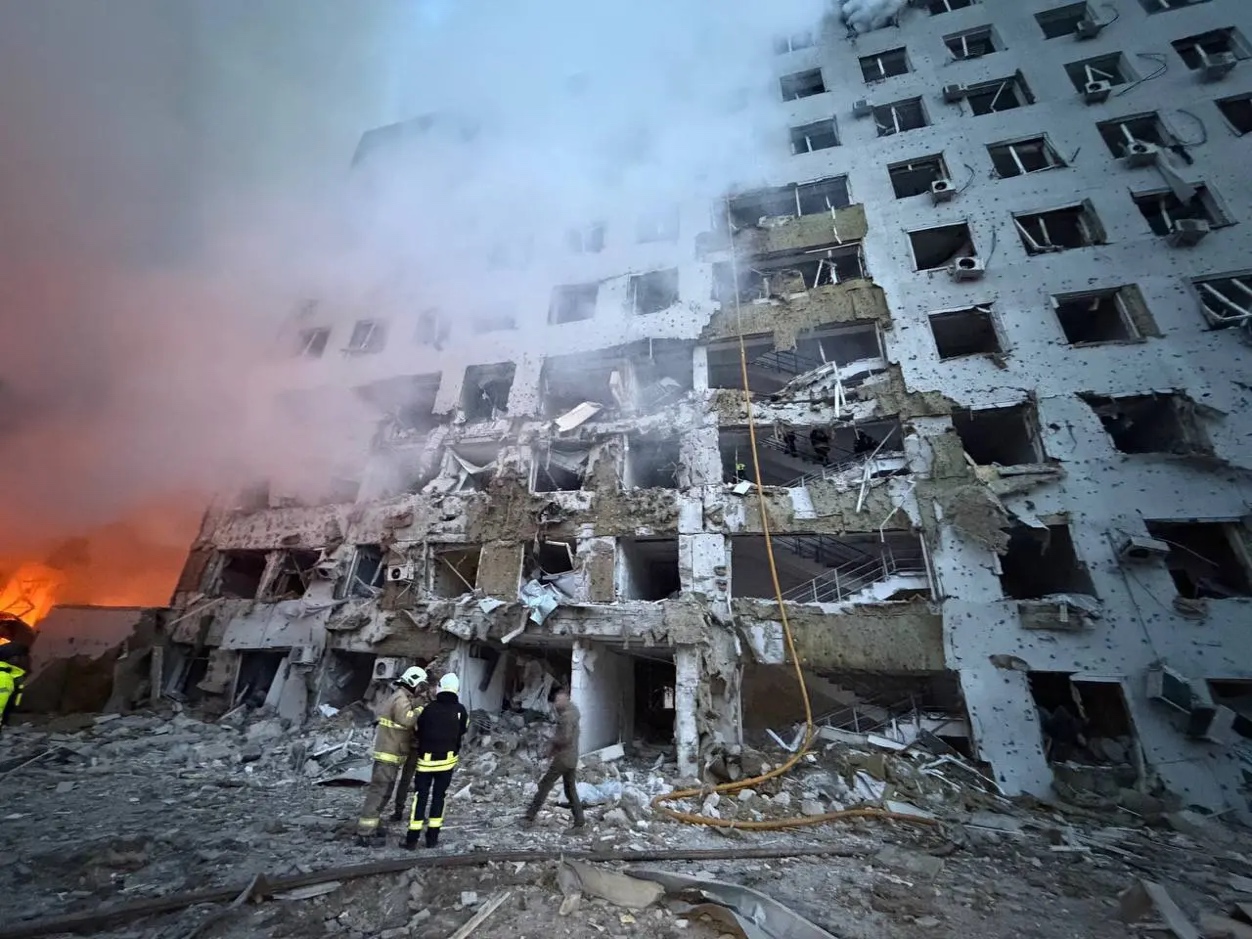 Emergency crews at work at a building in Odesa damaged by Russian attacks overnight. (Oleh Kiper / Telegram)
‘Double-Tap’: When the Second Missile Targets the Rescuers
Among the war’s most documented Russian tactics — and among its most condemned under international humanitarian law — is the double-tap strike: a second attack timed to kill the first responders rushing to the scene of the first. On the night of April 15-16, Russia executed this maneuver in Kyiv’s Obolonskyi district.
Three Ukrainian medics and three police officers were responding to the scene of an initial Russian strike when a ballistic missile hit the same area. At least two medics and one law enforcement officer were injured. No ambiguity exists about what was struck: the people whose legal obligation under the laws of war is to care for the wounded were specifically targeted while performing that function.
Ombudsman Dmytro Lubinets responded the following morning: “These are attacks on civilians. And every time there is no accountability, such tragedies repeat themselves.” Former U.S. Assistant Secretary of State Dan Fried offered a strategic frame: “They are choosing this tactic because they have been unsuccessful on the ground. They are also unable to mount effective strategic attacks on Ukrainian military targets. So, the Russians are not winning the war, and they are killing civilians and trying to terrorize Ukraine.”
The Interceptor Crisis: Why Some Missiles Got Through
Ukraine’s air defense network is, by any objective measure, one of the most effective in the world. That it cannot stop everything is not a failure of Ukrainian ingenuity — it is the arithmetic of a system stretched to its limit by a global shortage that Zelensky described on April 14 as “impossible to make any worse.”
The Patriot missile system — American-designed, capable of intercepting ballistic missiles that no other Ukrainian platform can reliably stop — is the linchpin. Its interceptor missiles are produced in limited quantities and are now being demanded simultaneously by multiple theaters of conflict. The war in Iran, which began in March, has dramatically increased global demand for Patriot interceptors among every operator of the system. Ukraine is competing for a finite supply.
The morning after the mass strike, Zelensky directed Ukraine’s Air Force commander to personally contact every partner nation that had pledged Patriot interceptors and had not yet delivered them. “There are many political commitments from our partners that have already been announced but not yet implemented,” he said. Foreign Minister Andrii Sybiha called for “immediate actions” to increase pressure on Russia. Germany is developing additional Patriot manufacturing capacity, but production timelines are measured in years, not weeks.
The night of April 15-16 demonstrated what Patriot scarcity looks like in practice: eight of nineteen ballistic missiles were shot down. The other eleven were not.
Fire Over Tuapse: Ukraine Burns One of Russia’s Largest Refineries
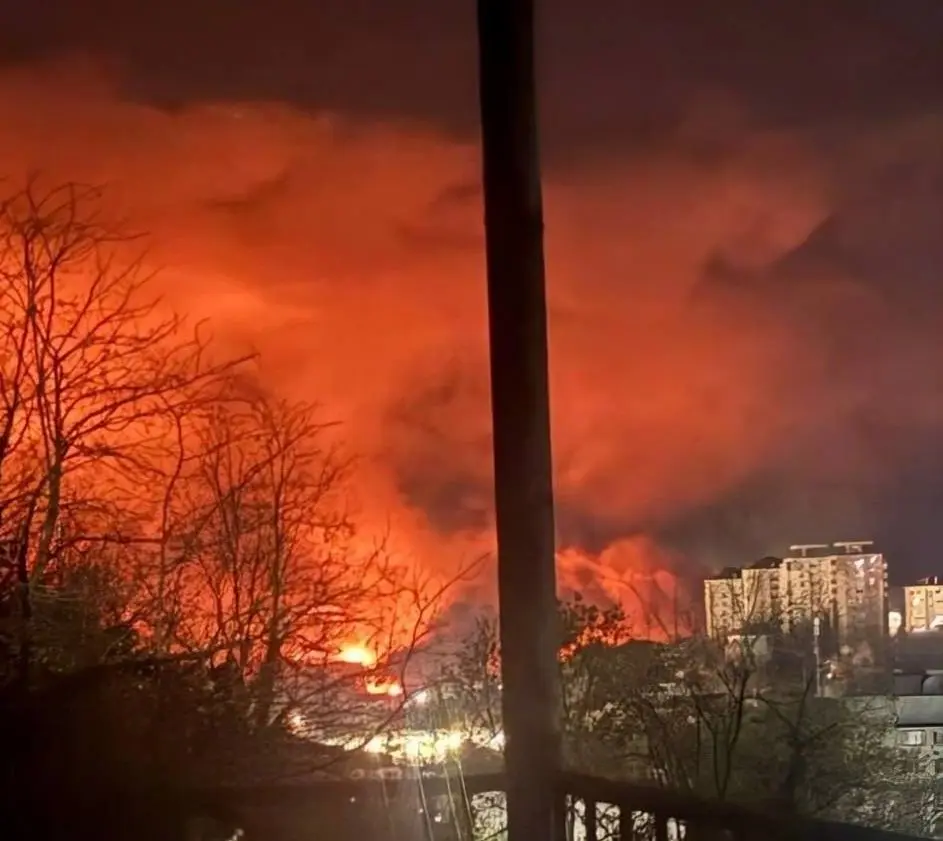
Smoke and flame fill the sky over the Russian port city of Tuapse in Krasnodar Krai after a reported Ukrainian drone attack. (Exilenova-Plus / Telegram)
While Russian drones were still finding their targets in Kyiv, Ukrainian drones were crossing 75 kilometers of southern Russian airspace to reach the port city of Tuapse. Before dawn on April 16, they found the Rosneft Tuapse Oil Refinery — one of the ten largest in Russia, with a processing capacity of 12 million tons of petroleum products per year — and set three storage tanks ablaze.
Krasnodar Krai Governor Veniamin Kondratyev confirmed the attack, describing a hit on “an enterprise in the seaport area.” The Ukrainian General Staff acknowledged the strike and noted the facility’s output capacity. Russian opposition monitoring channel Astra confirmed the fire from open-source analysis; Ukrainian OSINT project CyberBoroshno reported that the blaze had intensified and spread to neighboring tanks. The Port of Tuapse, they noted, handles up to 10 percent of Russia’s total petroleum product exports.
The strike was not isolated. Zelensky’s military command reported that Ukrainian forces also struck a Pantsir air defense system in occupied Feodosia in Crimea, two Iskander missile system bases, a Russian naval logistics center, and an oil depot — all on the same night. Commander-in-Chief Oleksandr Syrskyi had reported just the previous day that Ukrainian forces destroyed 76 Russian industrial targets in March alone, including 15 oil refineries.
In Tuapse itself, the Russian governor also reported civilian casualties — two children, ages 5 and 14, killed in a residential building struck by what he described as drone debris. All schools in the city cancelled classes. The Ukrainian military has not commented on civilian casualties from the strike.
The War Behind the War: Ukraine Hits Russian Logistics Across Occupied Territory
Beneath the headline battles, a quieter but methodical Ukrainian campaign is systematically degrading Russian military logistics far behind the front lines. Ukraine’s Security Service and its Unmanned Systems Forces struck cargo trains carrying fuel at railway stations near occupied Luhansk City — roughly 99 kilometers from the front — destroying oil tankers and damaging rail infrastructure. A Russian milblogger focused on Luhansk responded with unusual candor, acknowledging the strikes and criticizing the Russian military command for underreporting the damage and failing to counter Ukrainian drone incursions.
The 1st Azov Corps reported its drone operators were simultaneously striking Russian logistics on the Donetsk City ring highway and near Zuhres, Andriivka, Starobesheve, Horlivka, and Lysychanske — settlements ranging from 18 to 103 kilometers from the front. Ukrainian forces also struck a Russian Osa-AK air defense system near occupied Vodyane and a workshop and warehouse belonging to the Rubikon Center for Advanced Unmanned Systems near occupied Hirne. Geolocated footage confirmed both strikes.
In Zaporizhzhia, a Ukrainian unmanned systems battalion destroyed a Russian Buk-M1 air defense system near occupied Bahativka, about 59 kilometers from the front. Each Buk destroyed is another gap in the Russian defensive umbrella — a gap Ukrainian drones are increasingly exploiting to reach targets once considered beyond reach.
The Grinding Line: Ground Combat from Lyman to Pokrovsk
Ukraine recorded a confirmed advance in the Slovyansk-Lyman tactical area — geolocated footage posted April 15 shows Ukrainian forces pushing east of Lyman, while footage from the same day confirms Ukrainian troops hold positions within Sosnove, northwest of Lyman, contradicting previous Russian claims. Ukrainian counterattacks were also reported near Lyman itself, Rai-Oleksandrivka, Zakitne, and Nykyforivka. The Lyman direction remains one of the war’s most contested corridors, with forces from Russia’s 37th Motorized Rifle Regiment, Chechen Shram Group, and multiple other formations all operating in the sector.
Around Pokrovsk, Russian forces continued multi-directional pressure but made no confirmed advances. The Ukrainian 7th Rapid Reaction Corps reported Russian forces conducting multiple infiltration waves into central Hryshyne and attempting to push into the settlement’s northern areas. Attacks continued toward Novooleksandrivka, Serhiivka, Shevchenko, Rodynske, and Bilytske. Near Vovchansk in Kharkiv Oblast, a Ukrainian brigade commander reported seizing unspecified streets after eliminating Russian positions; separately, Ukrainian drones struck a rare Russian IMR-3 mine-clearing vehicle in the same direction.
In the Sumy Oblast border zone, Russian forces attacked near Mala Korchakivka, Myropillya, and Novodmytrivka but did not advance. In the Kupyansk direction, Russian forces attacked near the city itself and along the Oskil River approaches but registered no confirmed gains. The pattern across virtually every active sector of the front is consistent: Russian forces are attacking, Ukrainian forces are holding and in some places counterattacking, and the lines are shifting in increments measured in hundreds of meters.
Running Out of Time: Russia Reaches Into Its Strategic Reserve
Ukraine’s Main Military Intelligence Directorate Deputy Head, Major General Vadym Skibitskyi, told the Financial Times on April 16 that Russia is likely preparing to deploy 20,000 fresh troops from its strategic reserve to southeastern Ukraine. The move, Skibitskyi explained, reflects the Russian military command’s inability to meet its own deadlines — including an objective to seize Druzhkivka, Kostyantynivka, and Pokrovsk by the end of April 2026. Russian forces have captured Pokrovsk. They have made insufficient progress on the other two.
The numbers tell the story of the bind. Russia currently has an estimated 680,000 soldiers in theater. Its casualty rates have been rising while recruitment rates have been falling. Twenty thousand fresh troops represent less than one month’s worth of Russian battlefield losses — a number that barely covers the gap, let alone changes the operational equation. Ukrainian military observer Kostyantyn Mashovets has noted Russian forces are deploying reserve elements in the Oleksandrivka and Zaporizhzhia directions, both away from the priority effort in Donetsk Oblast, suggesting Russia is simultaneously under-resourced on multiple axes.
Russia’s stated goal — capturing all of Donetsk Oblast — requires a pace of advance it has never achieved since the early days of the full-scale invasion. The deployment of strategic reserves suggests Moscow is aware of the gap between its ambitions and its capacity, and is gambling that volume can substitute for operational art.
Voyevoda’s Last Post: The Helicopter Pilot Who Chose Death Over Silence
Aleksei Zemtsov flew a KA-52 “Alligator” attack helicopter in Ukraine for years under the call sign “Voyevoda.” He built a Telegram channel with 160,000 followers. He was, by any measure, exactly the kind of figure the Kremlin’s war machine needs: a decorated combat pilot willing to speak publicly in favor of Russia’s invasion.
On the evening of April 15, Zemtsov posted three videos to his channel. He began with a phrase from 19th-century Imperial Russian military tradition: “If you are watching this, it means I am no longer among the living. I have used the Russian officer’s right of ‘final honor.'” He accused Lieutenant General Vladimir Kravchenko, Deputy Commander-in-Chief of Russia’s Aerospace Forces, of pursuing a personal vendetta against him since 2023 — beginning when Zemtsov publicly mocked the policy requiring combat pilots to practice marching drill between missions.
What followed, according to Zemtsov, was a cascade of institutional retaliation: medical disqualification attempts, transfer to an assault infantry unit as punishment, arrest for posting about defective helmets issued to troops, and finally criminal charges carrying five years’ imprisonment for “discrediting the Russian military.” He preferred death to that verdict. As of April 16, multiple Russian sources reported Zemtsov was still alive — but the videos remained public, the accusations unrefuted, and the Russian military command silent.
The episode is not isolated. Prominent milblogger Andrei Morozov similarly died in February 2024 after refusing Russian military orders to delete his reports about high casualty rates around Avdiivka. Russia’s information space is not just a propaganda operation — it is an increasingly coercive one, in which figures who cannot be co-opted are being crushed.
Ukraine’s Drone Economy: From Battlefield Innovation to Global Export
On the same day Russia was raining missiles on Kyiv, Zelensky and Dutch Prime Minister Rob Jetten signed a joint declaration launching formal work on a Ukraine-Netherlands Drone Deal. The initiative covers joint development and production of drones, missiles, electronic warfare systems, and other defense technologies — backed by a €248 million Dutch investment in drone manufacturing across both countries. The deal followed similar announcements with Norway (Ukrainian drones to be manufactured on Norwegian soil), Germany (thousands of drones delivered as part of the Merz partnership package), and framework agreements with Saudi Arabia, Qatar, and the UAE.
The scale of Ukrainian defense-industrial transformation is difficult to overstate. In 2022, Ukraine assembled drones almost entirely from Chinese components. Now, Ukrainian companies produce their own motors, flight controllers, electronic speed controllers, and optical navigation systems. Numo Robotics manufactures over 200 unmanned ground vehicles per month, with more than 100 active feedback loops with frontline units. IRV produces FPV drones in the thousands monthly — one drone on display had logged 400 flights since September without major failure. Abacus-Tech’s “Nameth-D” hemispheric electronic warfare system produced over 1,000 sets last year.
The commercial logic has shifted. Ukraine’s Council of Defense Industry Director Ihor Fedirko, on a tour of French defense firms, reported that 60 French companies met with 27 Ukrainian firms in a single day, holding 164 business-to-business sessions. Gulf states need the technology immediately. “At a maximum over the next two months we’ll see the first export contracts,” Fedirko said. Ukraine is no longer just a consumer of Western arms — it is becoming an arms exporter in its own right, battle-tested at a scale no peacetime manufacturer can match.
The Target List: Russia Names European Drone Factories as Legitimate Strikes
Russia’s Defense Ministry published a list of European companies and facilities it claims are supporting Ukraine’s drone industry — locations in London, Munich, Prague, and Vilnius among them. Former President Dmitry Medvedev amplified the publication, saying the list should be taken “literally” as a register of potential military targets. Russia’s warning followed a statement that European drone supply plans were dragging those countries deeper into war.
The Czech Foreign Ministry summoned Russia’s ambassador to demand an explanation. Former U.S. Ambassador to Ukraine Steven Pifer was less alarmed: “First of all, former President Medvedev says a lot of things that are, quite frankly, borderline crazy or just outright crazy.” He described the publication as an intimidation campaign against European governments and companies. “Given that the Russian military at this point has its hands completely full with the war in Ukraine, does Russia really want to pick a fight with NATO countries?”
The same day, Russian Security Council Secretary Sergei Shoigu warned Finland, Estonia, Latvia, and Lithuania that Moscow reserves its “right to self-defense” if Ukrainian drones strike Russian territory through their airspace — a reference to incidents where drones crashed in Baltic countries during strikes on the Ust-Luga port complex. Ukraine’s Foreign Minister Sybiha had previously stated that Ukrainian intelligence suggests Russia deliberately redirected some drones toward Baltic states to inflame tensions. The Baltic states have rejected the accusations entirely.
Washington’s Fractures: Senators Push Back as Trump Offers a Shrug
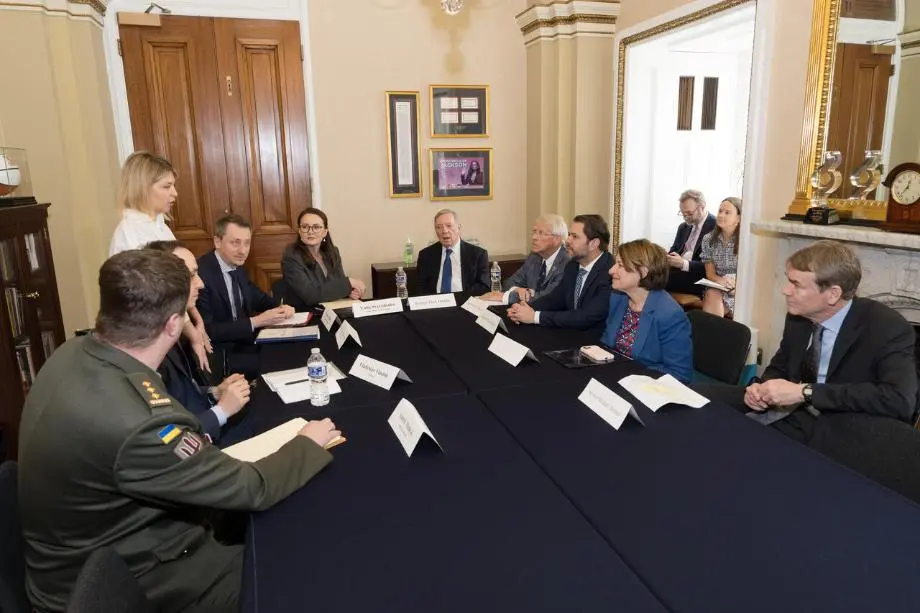
U.S. senators meet with Ukrainian Prime Minister Yuliia Svyrydenko in Washington, D.C. (U.S. Senate Foreign Relations Committee)
The Senate Foreign Relations Committee convened a hearing on UN reform that quickly became a referendum on U.S. policy toward Ukraine. Chairman Jim Risch declared it “incredibly frustrating” that the Security Council cannot even condemn Russia’s invasion. Ranking Member Jeanne Shaheen went further, cataloguing the administration’s recent UN votes: abstaining on a resolution reaffirming Ukraine’s sovereignty, advancing a proposal to strip out that language (supported by Russia, Hungary, and Belarus), and joining Russia and China in opposing a resolution warning that attacks on Ukraine’s energy grid threaten nuclear safety.
The hearing’s sharpest moment came when Senator Chris Coons asked U.S. Ambassador to the UN Mike Waltz whether he still stood by his previous statement that Putin was “an absolute war criminal.” Waltz declined to repeat it. “Statements I made as a member of Congress are very different than what I make now as ambassador to the UN working for President Trump,” he said. Pressed on whether that was a retraction, Waltz answered: “No, I certainly support President Trump in everything he is doing in trying to end this awful conflict.”
Hours after Russia’s mass strike killed 17 civilians, a reporter asked President Trump about the attack. “Ukraine is moving along,” he said. “I wish they could get along.” Asked whether the war could drag on for years, Trump responded: “I think a deal could be reached — possibly. It would be foolish not to. We’re close to a deal.” Senators from both parties met Ukraine’s Prime Minister Yulia Svyrydenko in Washington the same day. Senator Durbin said: “Putin’s evil knows no bounds.” Senator Wicker urged continued military aid. The contrast in language between the executive and legislative branches was, by this point, a feature of American policy rather than a bug.
Money, Sanctions, and the Slovak Veto: Europe’s Support Machinery Strains
Ukraine is set to receive 2.7 billion euros from the European Union’s Ukraine Facility program, Prime Minister Yulia Svyrydenko announced on April 16, after Ukraine’s parliament passed three previously stalled reform measures. The tranche unlocks only because of those reforms — Kyiv has missed deadlines on nearly 20 required EU reforms, with delays caused by poor coordination between the government and parliament and the genuine difficulty of institutional transformation during wartime. Commissioner for Enlargement Marta Kos acknowledged: “It is really demanding, and it takes time.”
The UK transferred 752 million pounds — approximately one billion dollars — to Ukraine under the G7 Extraordinary Revenue Acceleration initiative, drawn from frozen Russian sovereign assets. Finance Minister Serhiy Marchenko said the funds would address “priority needs of the security and defense sector.” The payment is part of a 2.26-billion-pound agreement; two prior tranches totaling 1.5 billion pounds had already been delivered. The G7’s ERA program uses profits from approximately $300 billion in frozen Russian assets to finance Ukraine and repay the associated loans.
The EU’s 20th sanctions package faces a potential Slovak veto. Foreign Minister Juraj Blanar stated Slovakia would block the package unless it receives guarantees on the Druzhba oil pipeline’s reopening — the route through which Russian oil flows to Central Europe. EU foreign policy chief Kaja Kallas announced she would advance the package regardless, with the Foreign Affairs Council taking it up the following week. The episode echoes years of Hungarian obstruction that have complicated EU unanimity on Ukraine-related measures; Hungary’s recent elections removed Viktor Orban’s party from power, but Slovakia is now filling the obstruction role.
Shadow Fleet, Stolen Grain, and the Cryptocurrency Exchange That Isn’t Anymore
Ukrainian drones struck a Liberian-flagged oil tanker off the coast of Krasnodar Krai, injuring its Turkish captain, who was hospitalized. Russia’s Investigative Committee confirmed the incident without disclosing the extent of damage to the vessel. Ukraine has been targeting Russia’s so-called “shadow fleet” — tankers using flags of convenience and opaque ownership structures to export Russian oil in defiance of Western sanctions — in Russian waters and beyond. France has intercepted shadow fleet vessels three times since September 2025; Belgium conducted a joint seizure in early March; the UK authorized its armed forces to board shadow fleet vessels in British waters in late March.
A separate maritime confrontation unfolded in Haifa. The Russian bulk carrier Abinsk arrived carrying nearly 44,000 tons of wheat that Ukrainian investigators say originated from Russian-occupied Ukrainian territory. Ukraine had informed Israeli authorities in advance and expected the vessel to be seized. Israeli Foreign Minister Gideon Sa’ar later told his Ukrainian counterpart that it was “too late to intervene” — the ship had already departed — despite Israeli authorities having been informed roughly two weeks in advance of its arrival. Ukraine’s Foreign Ministry said it submitted a formal request for international legal assistance to seize the cargo.
A sanctioned cryptocurrency exchange called Grinex, linked to Russia and based in Kyrgyzstan, announced it was suspending all operations on April 16 after a cyberattack resulted in the theft of more than 1 billion rubles — approximately 13.1 million dollars. The exchange had been sanctioned by the United States, United Kingdom, and EU for facilitating Russian sanctions evasion. Grinex blamed “foreign intelligence services from unfriendly states” without providing evidence. It had been created, according to the U.S. Treasury, to operate a ruble-backed digital token used by a firm linked to Kremlin-allied Moldovan oligarch Ilan Shor and the sanctioned Russian bank Promsvyazbank.
Corruption in Wartime: Yermak Summoned, Shufrych Released
Ukraine’s war against Russia is not the only battle being fought. The former head of the Presidential Office, Andriy Yermak, has received a summons to attend Ukraine’s High Anti-Corruption Court in connection with a $100 million corruption scheme centered on the state nuclear monopoly Energoatom — the largest corruption investigation of Zelensky’s tenure. Yermak and close Zelensky associate Timur Mindich, who fled to Israel following charges in November, both failed to appear for a hearing regarding an asset freeze. Anti-corruption prosecutor Oleksandr Klymenko previously stated that an individual referred to in investigation recordings as “Ali Baba” was “holding meetings and assigning tasks to law enforcement agencies to ensure they persecute NABU detectives.” Investigators have also used the codename “Khirurg” — Surgeon — for Yermak in their recordings.
On the same day, a Kyiv court released lawmaker Nestor Shufrych from pre-trial detention — where he had been held since 2023 on treason charges — to round-the-clock house arrest with an electronic bracelet. Shufrych is accused of financing Russia’s National Guard in occupied Crimea to protect his real estate there, cooperating with a fugitive former official alleged to run a Russian intelligence network in Ukraine, and possessing Russian Armed Forces medals. The Prosecutor General’s Office objected strongly to the release, arguing that “the risks identified in this criminal proceeding have not lost their relevance.” The ruling cannot be appealed.
One Bright Line: Prisoner Exchange Expected Soon
Against the day’s catalog of destruction, one diplomatic channel has remained open throughout the war: prisoner exchanges. Presidential Office chief Kyrylo Budanov confirmed on April 16 that another exchange is expected in the near future, following the April 11 swap that freed 175 Ukrainian service members and seven civilians. “I confirm that there will be an exchange soon,” Budanov said. “We do not always manage to complete the physical and legal procedures in time — both us and them.”
Prisoner swaps have been one of the few areas of continued, if grudging, cooperation between Kyiv and Moscow since February 2022. They are slow, procedurally complex, and often delayed. They return soldiers to families that have spent months or years not knowing whether their loved ones are alive. In a war defined by its brutality, they represent something that is not quite peace but is not nothing.
— ✦ —
Nineteen-year-old Yeva spent the hours after the explosion searching through what remained of her home in Kyiv’s Podilskyi district, looking for things worth keeping. A 12-year-old boy did not get that chance. In Tuapse, Russian children ages 5 and 14 died in buildings struck by the debris of Ukrainian drones hunting the fuel that feeds the machines that kill the children in Kyiv. The war’s accountants are working overtime, and every ledger is denominated in the same currency.
President Trump said Ukraine is “moving along.” It is. Mostly toward its own dead.
Europe is signing drone deals and debating whether Slovakia will veto the 20th sanctions package. A Ukrainian combat pilot recorded a suicide video about bad helmets and a corrupt general, and 160,000 people watched it. The Patriot interceptors that could have saved eleven more lives in Kyiv have not yet arrived. They were promised.
Day 1,878. The drones keep flying in both directions. The missiles keep falling in one.
A Prayer for Ukraine
1. For the 12-Year-Old Boy Whose Name Has Not Yet Been Released
Lord, a child died before dawn in Kyiv — a boy of twelve, struck in his city in the small hours of the night. We do not know his name yet. We know he had a name. We know someone called it out this morning and it was not answered. Receive him with the mercy that this world denied him. Hold his family in a grief that has no language. And do not let his death become, simply, a statistic in a morning briefing. He was twelve years old. Let that land.
2. For Yeva and Her Sister, and Every Family Who Stopped Using the Shelter
Father, after years of war, people stop believing the danger is meant for them. Yeva’s family stopped using the basement after the first year. She ran for a mirror when the blast hit — and the roof came down where her sister had been standing. A centimeter of difference between grief and gratitude. Forgive us for normalizing the abnormal and be present in that gap — the terrible gap — between what happened and what nearly did. Protect those who have learned, again, that nowhere is safe.
3. For the Two Medics and the Police Officer Hit in the Double-Tap Strike
God of justice, there are rules about this. Rules that have been signed and ratified and called sacred since 1949. People rushing to help the wounded are not targets. And yet in Obolonskyi district, a second missile found them. We ask for healing for those who were injured. We ask that the deliberate targeting of rescuers be named clearly — as a war crime, as an atrocity, as a policy — and not softened into mere unfortunate circumstance. Do not let the language of bureaucracy bury what this was.
4. For the Defenders, and for the Pilots Who Tell the Truth
Lord, sustain the men and women holding the line from Lyman to Zaporizhzhia, in cities and in trenches, through the sixth mass attack of the war. And hear also the prayer of Aleksei Zemtsov, who flew hundreds of missions for a government that ultimately destroyed him for saying that the helmets were broken. He is not innocent — his words called for murder, and we do not pray for his ideology. We pray for the part of him that could not bear a lie. Let truth have somewhere to live, even in the armies of the unjust.
5. For Justice That Moves Faster Than the Missiles
In Your mercy, in Your justice, in Your time — bring this war to its end and let the ending be worthy of what Ukraine has endured.
Ukraine Daily Briefing | April 16, 2026 | Day 1,878