
Ukraine Daily Briefing | June 13, 2026 | Day 1,571 of the Full-Scale Invasion
The United Nations confirmed May 2026 as the deadliest month for Ukrainian civilians since 2022, as Russia deployed upgraded Kh-101 missiles with heat-decoy countermeasures and an Iskander-M successor with a 1,000-kilometer range. Ukraine answered by severing every land route into occupied Crimea, striking Russia’s largest southern fuel terminal, and burning an oil pumping station 500 kilometers inside Russian territory — while fuel rationing spread across Moscow, St. Petersburg, and Kazan.
The Day’s Reckoning
Picture a gas station in Moscow. The pump is working. The tank is nearly full. And then a screen blinks: LIMIT REACHED. Twenty liters. That is what you get today at Tatneft stations across the Russian capital, St. Petersburg, and Kazan — a ration roughly equivalent to filling a compact car halfway. Down the road, Rosneft caps you at 90 liters, Lukoil at 100. The fuel is running short, not because Russia lacks oil, but because Ukraine keeps burning the infrastructure that moves it.
This is what strategic interdiction looks like from the inside. Overnight, Ukrainian drones struck five fuel tanks and two oil-loading facilities at the Tamanneftegaz terminal in Krasnodar Krai — described as the largest hydrocarbon transshipment complex in southern Russia. A second strike hit an oil preparation and pumping station near Kotovo in Volgograd Oblast, 500 kilometers from the front. Fires burned at both. And in occupied Crimea, Ukraine struck the Crimean Titan chemical plant, one of Eastern Europe’s largest industrial facilities, which produces components for Russian rocket fuel and explosives.
Meanwhile, the United Nations confirmed what survivors already knew: May 2026 was the deadliest month for Ukrainian civilians in four years of full-scale war. At least 274 killed. 1,763 wounded. The highest toll since April 2022. Russian forces achieved this with the same weapons they have always used — missiles, glide bombs, Shahed drones — but upgraded, more numerous, and aimed with greater deliberate contempt for the people beneath them.
A Ukrainian weapons researcher named Colonel Zaruba stood before cameras and explained what Russia has built: Kh-101 cruise missiles with automatically activating thermal decoys and chaff. Iskander-M ballistic missiles with countermeasures that imitate their own signature to overload Ukrainian radars. A new variant called the Iskander-1000, with a range that reaches anywhere in Ukraine from almost anywhere in Russia. The arms race is not pausing for negotiations. It is accelerating.
‘The Highest Since 2022’: UN Confirms a War Without Mercy
The number arrives with bureaucratic precision and lands like a blow: 274 civilians killed, 1,763 injured in May 2026. The United Nations Human Rights Monitoring Mission stated it plainly — this was the deadliest month for Ukrainian civilians since April 2022, when Russian forces were still murdering people in Bucha and Mariupol.
The UN’s Danielle Bell framed what the numbers mean: the harm was not confined to communities near the front line. In cities across Ukraine, repeated missile and aerial bomb strikes killed and injured civilians far from active ground combat. Three large Russian missile salvos struck major cities in May, including a May 14 strike on a Kyiv residential building that killed 24 people and injured at least seven.
Near the front lines, short-range drone attacks drove civilian casualties to their own historic record. At least 64 deaths and 539 injuries from short-range drone strikes in May — the highest monthly figure for that weapon type since the invasion began. Kherson suffered 14 deaths and 221 injuries in a single month, six of the deaths and 132 of the injuries caused by drones. Russian operators have turned the skies above that city into what survivors call a ‘human safari’ — hunting civilians in streets, markets, and bus stops.
Even in Russian-occupied territory, civilians died. A strike on a Russian military training facility in occupied Starobilsk on the night of May 21-22 killed 21 civilians and injured others. The war kills everyone it touches. On June 13 alone — the day of this report — Russian attacks killed at least eight Ukrainian civilians and injured 63 others across the country.
The Missile That Learned to Hide: Russia’s Upgraded Kh-101 and the Iskander-1000
Colonel Oleksandr Zaruba, Chief Researcher at Ukraine’s State Research Institute for Armament Testing and Certification, delivered a presentation on June 13 that read less like a briefing and more like a warning. Russia is not simply producing more missiles. It is producing smarter ones.
The Kh-101 cruise missile — already a weapon capable of striking targets across Ukraine — has been upgraded with a doubled warhead payload and new stealth countermeasures. Ukrainian air defenders have now observed these missiles deploying automatically activated thermal decoys and chaff that disrupt radar systems mid-flight. The missile also carries a terrain navigation system that scans the ground beneath it to improve strike accuracy. Ukraine’s air defenses are shooting at something that is actively fighting back.
The Iskander-M ballistic missile has received updated countermeasures that imitate the missile’s own radar signature to overload Ukrainian tracking systems — forcing radar operators to sort the real threat from electronic ghost. Russia is producing between 60 and 70 Iskander-M missiles per month, integrating technical lessons learned from North Korea’s KN-23 ballistic missile to accelerate that output. And Zaruba assessed that Russia is developing a successor called the Iskander-1000, with a range of up to 1,000 kilometers — enough to reach any point in Ukraine from deep inside Russian territory.
The arithmetic is ominous. Russia produces roughly 50 Kh-101 cruise missiles and around 10 Iskander-K cruise missiles per month alongside those Iskander-M ballistic missiles. The United States, by comparison, manufactures approximately 50 PAC-3 Patriot interceptor missiles per month. Russia’s monthly strike production has drawn level with — and in some categories exceeded — America’s capacity to produce the missiles that shoot them down. Ukraine has begun testing its own anti-missile interceptor and is working with European partners on a joint anti-ballistic system. The race to build is inseparable from the race to survive.
Choking Crimea: Ukraine Severs Every Road, Rail, and River Route to the Peninsula
The plan has a name now — a ‘logistics lockdown’ — and the overnight strikes on June 12-13 tightened it further. Ukrainian forces struck the Chonhar road bridge, a railway bridge, and a pontoon crossing that Russian engineers had hurriedly assembled after earlier strikes disabled the permanent span. The occupation governor of Kherson Oblast, Volodymyr Saldo, confirmed what the strike footage already showed: traffic toward the Dzhankoi checkpoint was suspended. The bridge connecting Henichesk to the Arabat Spit — a narrow coastal strip running down Crimea’s eastern flank — was hit and traffic restricted.
The commander of Ukraine’s 1st Separate Assault Regiment, Dmytro ‘Perun’ Filatov, explained the logic. Each time Russia builds a pontoon to replace a destroyed bridge, Ukrainian forces destroy the pontoon. The cycle is asymmetric by design. ‘Pontoon crossings do not have powerful structural designs,’ Filatov noted, ‘and destroying them does not require expensive weapons. We have assets valued at under $5,000 that will sink these crossings.’ Russia’s military engineers are spending millions building what Ukraine’s drone teams destroy for pocket change.
The consequences are compounding. The R-280 ‘Novorossiya’ highway — the primary land corridor running from Rostov-on-Don through Mariupol and Melitopol toward Crimea — has been brought under Ukrainian fire control, reducing heavy military cargo traffic by up to 71 percent. Eyewitness reports from Sevastopol and Yevpatoriya confirm gas stations running completely dry. The Crimean Titan chemical plant in Armyansk, which produces titanium dioxide for Russian military stealth coatings as well as sulfuric acid used in rocket propellant and explosives, was struck overnight. USF Commander Robert ‘Magyar’ Brovdi confirmed fires raging and production suspended at what he described as the largest industrial facility in Eastern Europe. Crimea is not falling. But it is being slowly starved.
500 Kilometers Deep: Ukraine Burns Russia’s Fuel Infrastructure
The Tamanneftegaz oil and gas terminal in Taman, Krasnodar Krai, is the kind of facility that does not appear in most people’s mental map of the war. It sits on the coast of the Black Sea, far from any front line, handling liquefied petroleum gas for export through the Azov and Black Sea routes. On the night of June 12-13, Ukraine’s Security Service Alpha unit, working with Special Operations Forces and military intelligence, sent drones into it.
Five fuel storage tanks struck. Two oil-loading facilities hit. Fires reported near freight vehicle parking areas and warehouse infrastructure. Russian air defense positions at the site were targeted during the attack. Krasnodar Krai Governor Veniamin Kondratyev confirmed a fire at the marine terminal — acknowledging one person killed and three injured — and reported that 96 personnel and more than 30 pieces of equipment were deployed to contain it. The Tamanneftegaz terminal has been hit before. It will be hit again.
The second strike reached deeper. Ukrainian forces struck an oil preparation and pumping workshop near Kotovo in Volgograd Oblast — approximately 500 kilometers from the front line. This facility collects and prepares oil from the Korobkovskoye oil and gas field and neighboring deposits across Volgograd, Astrakhan, and Kalmykia before routing it through Russia’s trunk pipeline system. A fire followed. Volgograd Oblast Governor Andrei Bocharov acknowledged drone debris and a fire at industrial infrastructure in Kotovsky Raion, though he offered no further detail. He rarely does.
These strikes are the reason Russian fuel stations are rationing gasoline in Moscow. The chain of consequences runs from drone teams in Ukraine to petroleum storage in Krasnodar to pumps in Kazan that now cut customers off at 20 liters.
Russia’s War Economy: $81 Billion in One Quarter, and the Numbers Don’t Add Up
Germany’s Janis Kluge, an economist at the Institute for International and Security Affairs, published an assessment on June 12 that reframes what Russia’s military spending actually means at scale. In the first quarter of 2026 alone, Russia spent 5.9 trillion rubles — approximately $81.4 billion — on its military. That figure represents 46 percent of all federal budget spending in that quarter and is 30 percent higher than military spending in the first quarter of 2025.
The numbers become stranger when placed against revenues. Russia’s total budget income for the first four months of 2026 was 8.3 trillion rubles, roughly $114.5 billion. Military spending in that same period consumed approximately two-thirds of everything the Russian government took in. The country’s 2026 budget law had projected military spending would fall from 7.8 percent of GDP to 6.2 percent this year. That projection is already obsolete: first-quarter military spending alone reached 2.5 percent of Russia’s projected annual GDP.
The most telling figure is buried in the classified expenditure line. That category grew 43 percent from Q1 2025 to Q1 2026 and now constitutes 38.2 percent of all federal budget expenditures. Russian law states that approximately 85 percent of classified expenditures are military. Putin has been performing economic stability for domestic audiences while the actual budget tells a different story — one of a government consuming itself to sustain a war it cannot afford to lose and cannot afford to win.
Mobilization’s Ghost: Russia’s Manpower Crisis Deepens Without a Decree
Russia needs 30,000 fresh soldiers every month to replace its losses. In the first quarter of 2026, it signed contracts with 70,500 new recruits — roughly 23,500 per month. The deficit is structural and growing, and it is forcing the Kremlin toward a decision it has spent four years trying to avoid.
Analysts at the Center for Strategic and International Studies estimate that Russia has suffered roughly 1.2 million battlefield casualties as of December 2025, including up to 325,000 killed. The UK’s intelligence chief estimated in May that nearly 500,000 Russian soldiers have been killed since the invasion began. Russian independent media outlets Mediazona and the BBC Russian service confirmed the identities of 225,019 Russian military personnel killed — a figure the outlets themselves acknowledge significantly undercounts the actual toll. Prisons that once held 456,000 people now hold 282,000, partly because the recruitment drive has emptied them.
What comes next is a political calculation, not a military one. Analysts differ on whether Putin will order a formal mobilization. The 2022 call-up triggered protests, drove hundreds of thousands of Russians to flee, and rattled the regime. A second wave would land on a population already absorbing wartime inflation, internet restrictions, and the awareness that Ukrainian drones reach deep into Russian territory. Some analysts believe mobilization could precede a broader escalation — including provocations against NATO’s Baltic members. Others argue the political cost is simply too high, particularly with State Duma elections approaching in September. The Kremlin’s preferred solution has been coercion without announcement: pressuring students, setting recruitment quotas for businesses, summoning reservists for ‘medical checkups’ that produce military service orders. Whether that stops being enough is the question that will define the war’s next phase.
Putin Behind the Cameras: The Security Clampdown and the Generals Who Keep Dying
On June 10, a Russian general was blown up in his car on a Moscow street. It was the second such attack near the same location within a year. Russian state media also reported a simultaneous attempt on an employee of a scientific-industrial enterprise. Roughly 15 Russian military leaders have now been killed in what appear to be Ukrainian clandestine operations inside Russia — a campaign that is accelerating in frequency and growing more brazen in location.
The assassinations are one thread in a broader portrait of a Russian security state that has turned inward in fear. Reports indicate that Putin ordered his daughters and grandchildren into a Black Sea bunker in June after learning that Israeli intelligence had developed an AI-powered facial recognition system that uses urban camera networks to track, profile, and locate high-value targets. The system, reportedly developed in conjunction with the US military, was used to locate Iran’s supreme leader before his elimination in February. It identifies individuals from 14 facial features, reconstructs behavioral patterns across years of camera footage, maps relationships and recurring routes, and can function even on partially obscured faces.
Putin’s response has been systematic. A specialized CCTV network was shut down. Internet restrictions were imposed across Russia. Anyone in regular contact with Putin — from generals to kitchen staff — is now prohibited from using internet-connected personal devices and required to use government-monitored transportation. Kremlin facilities and the residences of senior staff have been comprehensively surveilled and secured. Anti-drone teams and snipers have been deployed across Moscow. The man who built a surveillance state to monitor his people now lives inside one built to protect him — and he knows that Ukraine’s drone operators, armed with AI that can identify Russian soldiers by facial contour and heat signature at a kilometer’s distance in the dark, have already surpassed every defensive measure he has tried.
The Vostochny Training Ground: Ukraine Strikes Three Russian Units Before They Reach the Front
The Kamchatka 40th Naval Infantry Brigade arrived at the Vostochny training ground in occupied Novopetrivka in Zaporizhzhia Oblast having already been nearly destroyed once. The unit spent over a year in catastrophic assaults on Vuhledar, a small Ukrainian fortress city that Russian commanders could not take by direct assault regardless of the human cost. Whatever personnel the brigade has left were gathered at Vostochny to train before rotating back toward the front lines near Hulyaipole.
They were joined by the 1461st Regiment of the 36th Army — a mobilized infantry unit drawn primarily from the Republic of Buryatia — and the 1466th Regiment of the 5th Army, consisting of raw recruits from Primorsky Krai. The 1461st carries its own grim history: in 2023, under pressure from commanders to conduct ‘meat assaults’ in the Zaporizhzhia sector, a company commander shot the regiment’s reconnaissance chief before turning the weapon on himself.
On the night of June 12, Ukrainian Unmanned Systems Forces struck the training ground. USF Commander Major Robert ‘Magyar’ Brovdi confirmed the strike and the three units present. The same operation also destroyed a Tor-M2 short-range surface-to-air missile system in Vershyna Druha, eliminated a ZU-23 anti-aircraft emplacement and a MANPADS crew in Novopetrivka, and obliterated a Russian drone control point in Novoandriivka in Donetsk Oblast. The Tor-M2 — a truck-mounted missile system designed to intercept aircraft and cruise missiles at low altitude — is precisely the kind of air defense asset Russia cannot easily replace. Ukraine did not wait for these units to reach the fight. It found them in the rear and removed them there.
Drone Points in a Library: Ukraine Dismantles Russian Strike Infrastructure Inside Pokrovsk
Pokrovsk is a city that has been under pressure for over a year, its outskirts contested, its streets intermittently struck by Russian drones. What Ukrainian forces discovered this week is that some of those drones were being launched from inside the city itself — or rather, from the buildings that used to define civilian life there.
Ukraine’s 7th Rapid Reaction Corps of the Air Assault Forces reported on June 13 that it had destroyed six Russian drone launch and landing points within Pokrovsk. Russian forces had converted a cafe, a children’s goods store, a library, and a private house into drone infrastructure, using these locations to strike Ukrainian logistics routes and coordinate strikes on the surrounding area. Ukrainian forces identified the network by analyzing the flight paths of incoming Russian drones, tracing them back to their origins, and then destroying those origins.
The revelation carries its own logic of war’s perversion: a library used to stage weapons against the people a library is supposed to serve. In the Slovyansk direction, a Ukrainian brigade reported that Russian forces are infiltrating through windbreaks south of Zakitne and Kryva Luka to accumulate forces and exert fire control over Ukrainian supply routes through drone strikes and remote mining. Russian guided aerial bombs struck the center of Slovyansk at 10:45 in the morning on June 13 — three KABs, satellite-guided, impacting residential high-rises. Twenty-three buildings damaged. Three women hospitalized. A local school struck. Civilian vehicles incinerated. The assault came on a Saturday morning, in the heart of a city center, with people in the streets.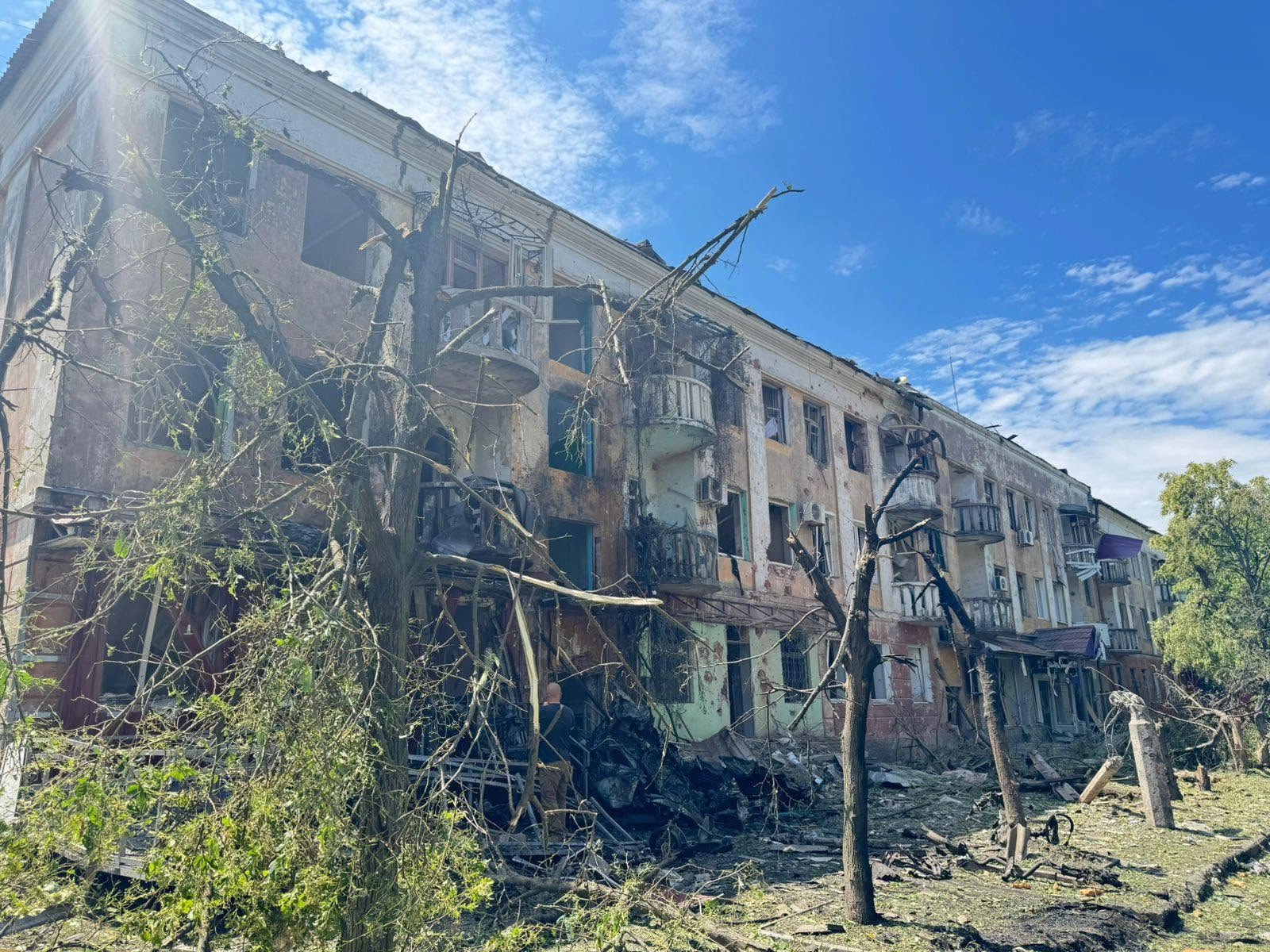
Hulyaipole and the Orders That Won’t Be Filled: Russia’s Zaporizhzhia Ambitions
The Russian military command has issued orders to its forces in Zaporizhzhia Oblast: advance as close as possible to Zaporizhzhia City by the end of summer 2026. Ukrainian Southern Defense Forces Spokesperson Colonel Vladyslav Voloshyn, speaking on June 13, confirmed the directive — and assessed that it reflects a command structure operating on a dangerously inaccurate picture of the battlefield.
In the Hulyaipole direction, Russian forces are conducting 40 to 45 daily combat engagements — the most active sector of the Zaporizhzhia front. Russian infantry is attacking north of Hulyaipole to bypass the settlement from the west and threaten Ukrainian logistics. But for the past two weeks, including near Vozdvyzhivka — which the Russian MoD claimed to have seized on May 27 — no advances have been confirmed. The claim appears to have been false, or at minimum premature.
At night, Russian forces are sending small assault groups into Ukrainian positions wearing thermal cloaks — garments designed to mask heat signatures from infrared sensors — because Ukrainian drone operators have rendered mechanized equipment too costly to move in the open. A battalion commander in the Hulyaipole direction described the night infiltrations on June 13. They are a measure of desperation as much as innovation: when tanks and armored vehicles become magnets for drone strikes, infantry in camouflage cloaks become the tactical solution. It is adaptation, but it is also a symptom of a force that cannot protect its own equipment on an open battlefield.
Frontline Summary: Kupyansk Infiltration, Borova Counterattack, Kostyantynivka Claims
In the Kupyansk direction, Russian forces conducted an infiltration mission that geolocated footage confirms brought them into Kindrashivka, north of Kupyansk. Russian milbloggers claimed advances in and near Kindrashivka and Tyshchenkivka, though independent confirmation is limited. Ukrainian forces struck a Russian manpower concentration near occupied Holubivka immediately north of Kupyansk.
South and southeast of Borova, the picture is more significant. A source reporting on the Russian Western Grouping of Forces described Ukrainian counterattacks near Nove and Lypove toward Zelena Dolyna and advances through Russian lines near Serednie toward Shandryholove and Novoselivka as creating a critical situation for Russian forces. The Russian military command reportedly withdrew a significant share of forces from the Svyatohirsk and Yarova areas northeast of Lyman to respond — a redeployment that, the source claimed, is degrading Russian efforts in the Lyman direction. Ukrainian counterattacks in one axis draining Russian resources from another is exactly the kind of operational stress Ukraine has been trying to impose.
In Donetsk Oblast, the Russian MoD made expansive claims about Kostyantynivka — asserting that elements of three separate Russian formations seized 172 buildings between June 12 and 13. The Institute for the Study of War assessed these claims skeptically: the level of detail is unusual for Russian MoD statements and appears designed to create the impression of broader Russian presence than the situation on the ground reflects. Ukraine’s ability to defend Kostyantynivka is deteriorating, ISW assessed — but Russia appears to be curating its claims to exaggerate the pace of its advance. In the Sumy Oblast buffer zone and northern Kharkiv Oblast, Russian forces continued offensive operations but did not advance.
Putin’s Army on Paper: A Decree Raises the Authorized Force by 7,360
On June 12, Vladimir Putin signed a decree setting the authorized end strength of the Russian Armed Forces at 2,399,130 total personnel, including 1,510,000 military personnel. The previous decree, issued in March, had set that ceiling at 2,391,770. The difference is 7,360 military personnel — a marginal increase in a paper figure that has been growing almost every year since the invasion began.
Context matters here. Putin signed decrees increasing the authorized size of the Russian military by 137,000 in 2022, 170,000 in 2023, and 180,000 in 2024. The 2026 expansions are the smallest so far. These decrees do not reflect actual troop numbers — they reflect the ceiling toward which Russia aspires to staff newly formed military districts, formations, and units announced under then-Defense Minister Shoigu in 2023. The gap between authorized strength and actual fighting capacity is the space where the recruitment crisis lives. Russia can write any number it chooses into a decree. Filling the billets requires bodies it cannot find at current contract rates.
225,019 Names: The Confirmed Dead and the War’s True Scale
Russian independent media outlet Mediazona, collaborating with the BBC Russian service, has confirmed the identities of 225,019 Russian military personnel killed in Ukraine. Since their last update in late May, 3,813 additional names were added. The journalists note with care that the actual figures are likely significantly higher — their database draws only from public sources: obituaries, relatives’ social media posts, regional reporting, and local authority statements.
The breakdown carries its own portrait of the war’s social anatomy: more than 82,400 volunteers, 25,400 recruited prisoners, 19,000 mobilized soldiers. Seven thousand two hundred twenty-six confirmed officers killed. The UK intelligence chief assessed in May that nearly 500,000 Russian soldiers have been killed in total. The CSIS estimated Russian casualties — killed and wounded — at roughly double to two-and-a-half times Ukrainian losses. Zelensky has suggested the ratio may be as high as five or six Russian casualties for every Ukrainian one.
Ukraine’s General Staff estimates Russia has lost approximately 1,380,120 troops in total since February 2022 — a figure encompassing dead, wounded, missing, and captured. Against these numbers, Putin signs decrees raising authorized end strength by 7,360 and offers recruits debt forgiveness on loans up to $139,000. The arithmetic of the war is not hidden. It is simply not being spoken aloud in Moscow.
The drones flew all night and the fires burned through morning. In Krasnodar, emergency workers counted 96 personnel and 30 vehicles fighting flames at a fuel terminal that supplied Russia’s Black Sea export routes. In Crimea, a chemical plant’s production lines went dark. In Moscow, drivers queued at gas stations and learned what 20 liters looks like in a fuel tank.
The UN released its numbers. A Ukrainian weapons researcher explained the missiles. A brigade commander described soldiers in thermal cloaks moving through darkness to reach Ukrainian lines on foot because drones destroy everything with an engine. A library in Pokrovsk was revealed to have been a weapons platform. A Saturday morning in Slovyansk was interrupted by three satellite-guided bombs.
The war modernizes. The casualties accumulate. The fuel runs short. And in the Kremlin, a man who once watched others through cameras now fears what cameras might reveal about him.
A Prayer for Ukraine
1. For the 274 Who Died in May
Lord, the United Nations counted 274 civilians killed in a single month — the highest toll in four years. They were killed in city centers and near front lines, by missiles and glide bombs and drones that hunted them in streets and bus stops and markets. We do not know most of their names. We ask that you do. Hold each one. And hold the 1,763 injured beside them, those who carry the war in their bodies and will carry it long after the guns go still.
2. For the Boy in Mykolaiv
Father, a ten-year-old boy in Mykolaiv watched a drone detonate and take the house next door. Emergency workers recorded his condition as an acute stress reaction. He is ten years old. He has learned what the world can do. Surround what is left of his childhood. Give him people who know how to help him carry what he has seen, and grant that the things he saw do not become the defining architecture of his life.
3. For the Women Who Keep the Lights On
God of justice, a utility worker died at a DTEK thermal power plant struck on June 12. A female railway worker died in Sumy when Russia struck a rail yard in the night. They were not soldiers. They were people who showed up so that trains ran and electricity flowed, and Russia killed them for it. We pray for them. We pray for every worker in Ukraine who walks toward a job that has become a target, and who walks toward it anyway.
4. For the Defenders Wearing Thermal Cloaks in the Dark
Lord, Ukrainian forces hold their lines while Russian infantry infiltrates at night, wearing cloaks designed to make them invisible, moving on foot because Ukrainian drones have made machines too costly to move. The soldiers watching for them are tired. They have been tired for years. Grant them the clarity to see what comes, the strength to hold, and the knowledge that their country and their God have not stopped watching over them.
5. For the Long Arc of Justice
God, 225,019 names have been confirmed. The real number is higher. They were sent by a government that will not speak their names publicly, into a war it cannot justify to the mothers who are now counting the days since the last phone call. We ask that the accounting come — not only in databases and reports, but in the fullness of time, in a reckoning that matches the scale of what has been done. In Your mercy, in Your justice, in Your time — bring this war to its end, and let the ending be worthy of what Ukraine has endured.
Ukraine Daily Briefing is an independent narrative report covering the war in Ukraine.