
Ukraine Daily Briefing | June 12, 2026 | Day 1,570 of the Full-Scale Invasion
Prepared by Dayana Bozhyk
On Russia’s national holiday, Ukrainian drones struck two major refineries in Tatarstan and a synthetic rubber plant in Samara Oblast — more than 1,200 kilometers inside Russia — forcing Nizhnekamsk to cancel its Russia Day celebrations. Hours later, Ukraine’s Air Force warned that Russia is likely to launch a nuclear-capable Oreshnik ballistic missile at Ukraine within 24 to 48 hours. In Kostyantynivka, Russian forces released a wave of staged combat footage to inflate their presence in the city — even as real Russian infiltration continued to erode Ukraine’s defenses there, and a Communist Party lawmaker warned Moscow itself is approaching a “social explosion.”
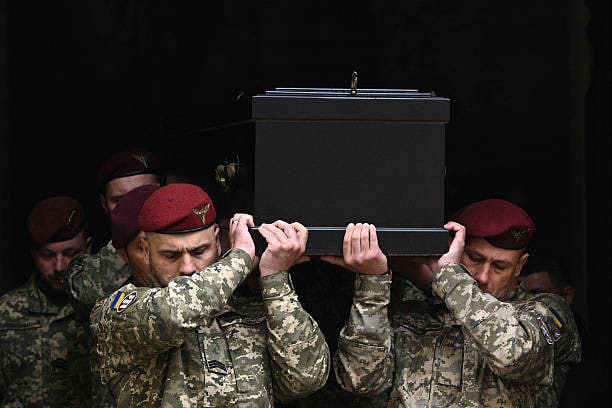
Ukrainian servicemen carry the coffin of Colombian fighter Jhan Sebastian Restrepo Mazo, who served in Ukraine’s 413th Unmanned Systems Regiment “Raid”, during a funeral ceremony, in Lviv. (Yuriy Dyachyshyn / AFP via Getty Images)
THE DAY’S RECKONING
Picture Nizhnekamsk on its national holiday: flags should be flying, streets should be full for Russia Day. Instead the mayor cancels every celebration in the city, because a Ukrainian drone has just set fire to the Nizhnekamskneftekhim synthetic rubber plant — one of the largest petrochemical facilities in Eastern Europe, more than 1,200 kilometers from the nearest point on Ukraine’s border. The smoke is still rising when Vladimir Putin stands before Russian soldiers and says, almost casually, that Russian forces “can’t raise their heads” because of Ukrainian drones.
That single admission sits at the center of June 12. Around it: a warning that a nuclear-capable Oreshnik missile could fly within 48 hours. A Communist Party deputy publicly accusing the Kremlin of looting Russia “more effectively than any invader” could. Staged Russian footage from Kostyantynivka, designed to make a slow, costly infiltration look like collapse — while the infiltration itself quietly deepens. And 117 drones falling on Ukrainian cities overnight, killing six and injuring more than fifty.
Russia Day, 2026. The performance of strength and the admission of weakness, broadcast on the same afternoon.
RUSSIA DAY UNDER FIRE: UKRAINE STRIKES REFINERIES 1,200 KILOMETERS DEEP
Imagine being a resident of Nizhnekamsk, a mid-sized city in Tatarstan that most Russians outside the region have never had reason to think about, waking up on your national holiday to find your mayor cancelling the parade. The reason: a Ukrainian drone strike overnight on June 11 to 12 set the Nizhnekamskneftekhim (NKNK) plant ablaze, sending thick black smoke over the city. NKNK is one of the largest petrochemical enterprises in Eastern Europe — and it has been hit before, including as recently as May. A separate drone reportedly struck a 12-story residential building in the same city, injuring three people.
NKNK was not the only target. The Ukrainian General Staff confirmed strikes on the TANECO and TAIF-NK oil refineries, also in Nizhnekamsk — TANECO is one of Russia’s largest refineries, processing more than 16 million tons of crude per year, while TAIF-NK has one of the highest refining-complexity rates in the country, above 95 percent. Ukraine’s Special Operations Forces said the strike on TANECO seriously damaged its ELOU AVT-7 distillation unit; Russian opposition outlet Astra reported fires at two more units, ELOU AVT-9 and AVT-8. Satellite imagery and geolocated footage from June 11 and 12 confirmed the damage.
Hundreds of kilometers away in Samara Oblast, Ukrainian forces struck the Tolyattikauchuk Chemical Plant near Tolyatti, causing a fire confirmed by satellite imagery. The plant produces synthetic rubber that Russia converts into solid rocket fuel for tactical and ballistic missiles — according to Unmanned Systems Forces commander Major Robert “Magyar” Brovdi, it accounts for a quarter of all Russian synthetic rubber production. Geolocated footage from June 11 also showed smoke at the Slavyansk Oil Refinery in Krasnodar Krai, and both the General Staff and the USF confirmed an earlier strike on the Afipsky Oil Refinery, also in Krasnodar Krai.
Three refineries and a chemical plant, more than 1,200 kilometers apart, struck on the same night Russia marked its founding as an independent state. The symbolism was not subtle, and Russian authorities did not pretend otherwise — they simply cancelled the party.
THE ORESHNIK WARNING: A NUCLEAR-CAPABLE MISSILE, ON A 48-HOUR CLOCK
Here is what it means when the Ukrainian Air Force says Russia is likely to fire an Oreshnik within 24 to 48 hours. The Oreshnik is an intermediate-range ballistic missile — a weapon class that was banned for decades under a Cold War treaty both Moscow and Washington have since abandoned. On reentry it can deploy up to six warhead-carrying vehicles, for a theoretical total of 36 separate impact points. It is, by design, a weapon built to threaten nuclear use.
In practice, Russia has used it three times against Ukraine, most recently on May 24 against Bila Tserkva in Kyiv Oblast — and in every case, the warheads carried inert payloads, not explosives. The damage has been limited each time. But the message has not been: Russian officials have repeatedly framed the Oreshnik as a tool that could strike Ukraine’s “decision-making centers,” a barely-veiled reference to Kyiv’s government buildings.
The Ukrainian Air Force said the launch would likely come from the Kapustin Yar site in Astrakhan Oblast — the same site used for previous strikes. A Ukrainian government source separately told outlet RBK Ukraine that the United States had independently warned Kyiv about the threat. President Zelensky urged Ukrainians to take air raid alerts seriously in the coming days, a warning that follows a string of mass attacks on Kyiv this spring, including a May 14 strike that killed 24 people. Whether or not the missile flies, the warning itself is doing what Oreshnik warnings are designed to do: keeping an entire country’s population listening for sirens.
Analysts see this fitting a pattern. Russia’s long-range strike campaign against Ukraine has intensified specifically since Ukraine’s own deep strikes — the kind that hit Tatarstan overnight — exposed Putin’s inability to defend even St. Petersburg and Moscow from Ukrainian drones. A possible Oreshnik launch, timed just after Russia Day, would be one more attempt to project strength precisely at the moment that strength is being visibly tested.
FIVE NEW LAUNCH SITES NEAR BELARUS: RUSSIA BUILDS A CLOSER ROAD TO KYIV
While Ukraine waits for an Oreshnik that may or may not come, a quieter and more permanent threat has been taking shape for nearly two years along Russia’s border with Belarus. Radio Free Europe/Radio Liberty’s Belarusian service reported that Russia has been constructing at least five long-range drone launch sites in Bryansk, Oryol, and Smolensk oblasts since the summer of 2024 — all of them between 45 and 200 kilometers from the international border with Belarus. Four are already active: the Shatalovo Military Airfield in Smolensk, the Tsymbulova drone port in Oryol, and launch sites near Navlya and Osavitsa in Bryansk. A fifth, the Seshcha Military Airfield, currently serves only as an aviation and cargo hub, though it launched drones from 2022 to 2023.
The geography is the point. Sites this close to Belarus put Kyiv and western Ukraine within easier reach, and — according to Ukrainian military expert Anatoly Khrapchinsky — allow Russian drones to pass through Belarusian airspace en route to targets, using Belarusian communication and relay infrastructure to stay in contact with their operators. Ukrainian Air Force spokesperson Colonel Yuriy Ihnat added a more mundane but telling detail: launching closer to the Ukrainian border lets Russia load these drones with heavier payloads, since they need less fuel to reach their targets. RFE/RL also reported that Russia has been upgrading these sites’ storage and launch capacity, including new launchers for jet-powered Shahed drones at Shatalovo.
ISW assesses this fits a broader pattern: Russia is steadily building military infrastructure in and around Belarus, and may be laying the informational groundwork to one day justify launching strikes on Ukraine directly from Belarusian territory. Khrapchinsky noted that the proximity to the border also raises the odds of Russian drones drifting into Belarusian airspace by accident — through malfunction or electronic warfare interference — normalizing a kind of incursion that could later be repeated on purpose. None of this changes the war today. But five new launch points closer to Kyiv, with Belarusian airspace and infrastructure increasingly available to Russian operators, is the kind of development that quietly redraws the map of what “next year’s war” might look like — and one that, unlike a single missile warning, does not go away after 48 hours.
“THEY CAN’T RAISE THEIR HEADS”: PUTIN’S RUSSIA DAY CONFESSION
There is a particular kind of political theater in watching a president tell his own soldiers, on his country’s national holiday, that the enemy’s drones have pinned them down. That is essentially what Vladimir Putin did on June 12, meeting with Russian troops alongside Defense Minister Andrey Belousov. The soldiers, for their part, performed their assigned role — voicing commitment to victory and to Putin’s objectives.
Putin spent much of the meeting on the things a Kremlin leader is supposed to say: praising Russian advances in first-person-view drones, AI-assisted targeting, electronic warfare, and a homegrown satellite constellation meant to replace Starlink. He highlighted new social-support measures for soldiers, veterans, and their families. He repeated, for the countless time, that Russia is really fighting NATO, not Ukraine — a framing the Kremlin has leaned on since the war’s earliest days to justify its scale and its costs to the Russian public.
Then came the admission. Putin acknowledged that Ukraine’s drone strikes are working — sowing “discord” and causing economic damage, in his framing — and conceded that Russian forces are not advancing “as quickly as we would like,” though he insisted they are still gaining ground “every day, gradually.” He claimed Russian air defenses are strengthening and the economy recovering, and threatened retaliation.
What Putin did not say is at least as telling as what he did. He did not mention that Ukrainian counterattacks have made tactical gains in Zaporizhzhia and Dnipropetrovsk oblasts since March, or that Russia’s overall rate of advance has been declining since November 2025 — with Russian forces suffering a net loss of territory in April and May, once infiltration-only footprints are excluded. Analysts read the partial admission as calculated: a way for Putin to appear “in touch” with frontline realities to an audience of soldiers who are living those realities every day, without having to describe their full scope. Coming one day after a successful Ukrainian strike on St. Petersburg during its economic forum and a scaled-down Victory Day parade in May, Russia Day 2026 was always going to be an exercise in damage control. Putin chose honesty about the symptom — drones — while staying silent on the disease: a war he can no longer win on the terms he set for it.
THE COMMUNIST WHO BROKE RANKS: A DUMA DEPUTY WARNS OF “SOCIAL EXPLOSION”
In a system built on managed dissent, even the opposition parties in Russia’s Duma are expected to perform loyalty on national holidays. On June 11, the day before Russia Day, Communist Party deputy Vyacheslav Markhaev did not get the memo — or chose to ignore it.
In posts on Telegram and VKontakte, Markhaev accused the Kremlin of using events like Victory Day and the St. Petersburg economic forum to project a “false sense of prosperity,” while ordinary Russians face mounting bans, restrictions, and financial burdens that the political elite has done nothing to address. He pointed to a specific statistic: utility tariffs have risen 366 percent over 25 years, even as “communal infrastructure continues to deteriorate” — a burden, he said, that falls hardest on pensioners. He noted the growing number of billionaires alongside corruption arrests as evidence the elite has “lost touch with people’s needs,” and offered one striking formulation: that if a foreign enemy had captured Russia, it would do exactly what the current leadership has already done to its own country — “seize resources, plunder industry, raise tariffs, and build estates for itself.”
Markhaev also said something Kremlin officials rarely say out loud: that Russia’s stated war goals have already been quietly scaled back, from “denazification and demilitarization” of all Ukraine to control of only the territories Russia claims to have annexed. He called for the government to publish “a clear public plan for ending the special military operation,” warning that without one, “a social explosion and chaos become more likely” — and that “all responsibility will fall on the unchangeable power.”
ISW found no indication Markhaev’s accounts were hacked, and noted something notable in its absence: Russian state media and Kremlin-aligned military bloggers have not amplified his remarks. Whether that silence reflects containment or simple irrelevance, a sitting Duma deputy from a nominally loyal party just told the Russian public, in plain language, that the war’s costs are becoming unsustainable — on the eve of the holiday meant to showcase the opposite.
KOSTYANTYNIVKA: THE FOOTAGE IS STAGED, BUT THE GROUND IS REAL
There is a difference between a city falling and a city being made to look like it is falling — and on June 11 and 12, Russia worked hard to blur that line in Kostyantynivka. Russian sources, including a Telegram channel tied to the 4th Separate Motorized Rifle Brigade and the state newspaper Izvestia, released a wave of geolocated footage showing Russian soldiers operating across northern, western, central, and southwestern parts of the city.
ISW’s read on the footage is specific: it shows a series of infiltration missions likely filmed over several days and released all at once, spread across an area too large for the 100 to 250 Russian troops that Ukrainian servicemembers told independent outlet Hromadske are actually operating in the city center. One soldier infiltrates roughly every six to seven hours, moving alone. ISW has documented this pattern before — flag-raisings, AI-generated combat footage, curated release timing — all designed to make Ukrainian lines look like they are collapsing across the theater, timed here to coincide with Russia Day.
But the cognitive operation sits on top of something real. Hromadske’s reporting and the geography of the footage itself indicate Russian forces have likely consolidated positions in southern Kostyantynivka and south of the T-0504 highway, and have advanced in the city’s northwest — at some point before this footage was released, not because of it. One Ukrainian officer told Hromadske bluntly that what Russian forces are doing inside the city “is no longer infiltration” — they have wedged into the center. ISW has adjusted its control-of-terrain map accordingly, expanding the assessed Russian footprint in the city.
Context matters here: Russian forces have spent ten months trying to take Kostyantynivka since capturing nearby Toretsk in August 2025, advancing only eight to ten kilometers in that time, replenishing 80 percent of their attacking units as of June 6, and missing an internal command deadline to seize the city by May. ISW expects further tactical gains this summer but no rapid breakthrough of the broader “Fortress Belt” — Russia would still need to fight through multiple other fortified cities, and has not built a force optimized for the kind of maneuver warfare a real breakthrough would require. The propaganda says the city is falling. The geography says it is being worn down, slowly, at enormous cost — and that, this week, is closer to the truth.
THE WIDER FRONT: ADVANCES AND STALEMATES FROM SUMY TO ZAPORIZHZHIA
Step back from Kostyantynivka and the rest of the 1,000-kilometer front looks like a patchwork of grinding stalemate punctuated by small movements in both directions. In the north, Russian forces pushed against Sumy Oblast on June 11 and 12 without gaining ground, while continuing to shell Sumy City itself — the third artillery strike on the city since the start of 2026. Ukrainian forces, meanwhile, struck back across the border: geolocated footage from June 11 showed a Russian Msta-S self-propelled howitzer destroyed near Sudzha in Kursk Oblast, while Bryansk’s acting governor confirmed Ukrainian strikes on a gas station and an energy facility on Russian soil.
In Kharkiv Oblast, Russian attacks along the Oskil River and toward Kupyansk continued without confirmed advances, though footage showed Ukrainian forces striking Russian infiltrators inside Kupyansk itself. Further south and east, Ukraine’s intermediate-range strike campaign against occupied Luhansk Oblast — described by Ukrainian task force spokesperson Colonel Viktor Trehubov as actively disrupting Russian rear logistics — added a field artillery depot, several control points, and a drone unit to its target list, along with a strike on the command post of Russia’s 88th Motorized Rifle Brigade.
Around Pokrovsk, the pattern from recent weeks held: Russian forces are short on manpower, electronic warfare systems, and drones, according to a Ukrainian battalion chief of staff, yet keep receiving reinforcements to sustain assaults — even as a Russian military blogger admitted his own side is struggling against the density of Ukrainian drones in the area. Ukraine pressed its advantage. USF commander Brovdi said Ukrainian forces preemptively struck a Russian mechanized assault staging out of the Stakhanov mine near Myrnohrad on June 10, destroying four armored vehicles and six quad bikes before the assault could launch. Separately, Ukraine’s 7th Rapid Reaction Corps said it has killed roughly 100 Russian soldiers over the past 50 days along a single two-kilometer stretch of the Pokrovsk-Hryshyne highway — a road so exposed, the unit said, that its windbreaks no longer offer any cover.
Elsewhere, the picture tilted slightly toward Ukraine. Geolocated footage indicated Ukrainian advances in the Kostyantynivka-Druzhkivka area and near Oleksandrivka, even as Russia’s defense ministry claimed to have seized the village of Priyut. And in the south, near Orikhiv, a Kremlin-aligned military blogger admitted something unusual: that Russian forces have lost nearly all the ground they gained in their Spring 2025 offensive there, with Ukrainian troops now advancing in eastern Stepnohirsk and no Russian presence detected near Pavlivka “for some time.” A second milblogger separately disputed Russian claims of an advance near Novoandriivka. When Russia’s own war bloggers start contradicting the official line about where the front actually sits, it is its own kind of admission.
CRIMEA’S SLOW STRANGULATION: A HIGHWAY UNDER FIRE CONTROL
There’s a particular kind of warfare that doesn’t look like warfare from a distance — it looks like traffic data. USF commander Brovdi told Reuters in an interview published June 11 that Ukraine’s interdiction campaign has cut traffic on the M-14 Rostov-Crimea highway, the peninsula’s main overland supply route, by more than two-thirds in the past month alone. Brovdi forecast “total” fire control over the highway within another month, and said Ukraine would be able to “isolate” occupied Crimea “in the near future.”
Russian forces are visibly adapting — and visibly struggling to keep up. Footage from June 12 showed Russian fuel tankers painted and disguised to look like lumber trucks, a tactic Ukrainian and Russian sources alike have reported repeatedly in recent days. One Russian military blogger openly criticized his own side’s response, complaining that bureaucratic inertia delayed any reaction and that authorities failed to even recognize the interdiction campaign had begun until it was well underway.
The campaign’s effects are now visible at the gas pump. Crimea’s Russian-installed leader, Sergei Aksyonov, announced on June 12 that occupation authorities had struck a deal with the peninsula’s two major fuel operators to cap prices: roughly $4.43 per gallon for diesel, $4.12 for regular gasoline, and $4.48 for premium. Price caps are usually a sign that a market is breaking on its own — and on a peninsula that depends entirely on overland fuel deliveries through a highway Ukraine says it will soon control entirely, the caps look less like policy and more like triage.
OVERNIGHT, ACROSS UKRAINE: 117 DRONES, SIX DEAD, A RAILWAY WORKER AMONG THEM
The overnight numbers from June 11 to 12 read, by now, like a grim routine — and that routine is itself the story. Russia launched 117 long-range attack drones — Shahed, Gerbera, and Italmas types, plus Parodiya decoys — from launch points in Kursk, Oryol, Rostov, and occupied Crimea. Ukrainian air defenses intercepted 102. Fourteen drones struck seven locations directly; debris from intercepted drones fell on eight more.
Six civilians were killed and 52 injured nationwide. In Sumy Oblast, Russian artillery struck eight locations across the regional capital in broad daylight, injuring six — the city’s third artillery attack of the year — while drone strikes in front-line areas of the oblast killed two more and injured ten. In Donetsk Oblast, where Russia is pressing hardest around Kostyantynivka, two were killed and four injured. In Zaporizhzhia Oblast, attacks on 44 settlements killed two and injured three. Thirteen were injured in Dnipropetrovsk Oblast, including a 15-year-old; eight in Kherson Oblast, where Russia continues to strike the Ukrainian-held west bank of the Dnipro; five in Mykolaiv, where a Shahed strike also caused an acute stress reaction in a 10-year-old boy, the second such Mykolaiv strike in as many nights. In Kharkiv Oblast, a 15-year-old was among three injured in the village of Nyzhche Solone.
One death stood apart. Ukraine’s national railway operator, Ukrzaliznytsia, reported that a nighttime strike on railway infrastructure in Sumy Oblast killed a female railway worker and injured a colleague, who suffered a fractured pelvis and internal bleeding and underwent surgery. “Another loss in the railway family,” the company wrote — a small, exhausted sentence from an organization that has now lost colleagues to strikes on a network it has been forced to stop publishing schedules for, precisely so that strikes like this one happen less often. Despite the strike, trains kept running, delayed by up to two hours. Separately, a Russian missile struck solar panels at a facility in Odesa Oblast, and a drone hit a logistics terminal in Zaporizhzhia, causing a fire but no reported casualties. And Russia’s own strikes on Ukraine’s energy grid claimed a victim too: a DTEK thermal plant worker was killed and another wounded in a targeted strike on a power facility, part of a pattern that included a coordinated attack on four DTEK facilities in Dnipropetrovsk earlier in the week.
UKRAINE OVERHAULS ITS ARMY: HIGHER PAY, FIXED CONTRACTS, AND A FOREIGN LEGION AT SCALE
Four years into a war with no clear end, the soldier who enlisted in 2022 may still be on the front line today — with no contract, no fixed term, and no defined path home. On June 12, President Zelensky announced the most significant attempt yet to change that, following meetings with Prime Minister Yuliia Svyrydenko, Defense Minister Mykhailo Fedorov, and Finance Minister Serhii Marchenko.
The headline numbers: infantry soldiers serving on the “zero line” — the front-most positions — will receive Hr 300,000 ($6,700) per month, roughly triple the current maximum of about Hr 100,000 ($2,234) even with combat bonuses. Fedorov called it the highest infantry pay rate in the world. Non-combat roles will see their minimum base pay rise from Hr 20,000 to Hr 30,000 ($670). Commanders will also see increases, intended as what Zelensky called a “positive stimulus for maintaining effective command.”
Just as significant is the structural change: for the first time, infantry and assault troops will get fixed contracts of six to fourteen months, after which they are exempt from further mobilization for six months. Other combat roles — drone operators, artillery crews, medics — get 24-month contracts with the same grace period. Fedorov also announced a fix for one of the war’s quieter crises: soldiers will be able to transfer between units within a corps through the Armiia+ app without extra bureaucracy, addressing a problem that has driven many soldiers to go AWOL simply to escape poorly-run brigades, with fast-tracked reintegration for those who do.
The other half of the plan is recruiting outward. Fedorov said Ukraine aims to fill 30 to 50 percent of all assault and infantry positions with foreign volunteers — building on a role foreign fighters, especially from Latin America, already play in the war’s most dangerous jobs. Commander-in-chief Oleksandr Syrskyi called the package “the first stage of a large-scale transformation,” with further recruitment and mobilization reforms to follow. “Our main task,” Syrskyi said, “is to do everything possible to save the lives of soldiers on the front line.” Whether higher pay and a foreign legion can solve a manpower crisis four years in the making remains the open question — but for soldiers who have served since 2022 without knowing when, or if, their service ends, the announcement at least puts a number on the horizon.
RUSSIA’S OIL ENGINE IS SPUTTERING
Numbers can tell a story that no press conference will. According to OPEC’s monthly report, Russian crude production averaged 9.009 million barrels per day in May — its lowest level in a year, and 690,000 barrels per day below Russia’s OPEC+ production target. It is the sixth straight month of decline, a drop of roughly 370,000 barrels per day since a recent peak of 9.38 million in November 2025. Separately, Bloomberg reported that Russian crude-processing rates have fallen to their lowest level in two decades so far in June, citing energy consultancy Energy Aspects.
The timing lines up with what this briefing has documented strike by strike: Ukrainian forces conducted at least 31 strikes on Russian oil facilities in May alone — the highest monthly total since the 2022 invasion began — and the June 12 strikes on Nizhnekamsk and Samara extend that campaign. Oil and gas revenue makes up roughly a quarter to a third of the Russian federal budget. Each burning refinery is, in that sense, doing double duty: it is a tactical strike against fuel supplies for Russian forces, and a slow-motion attack on the money that pays for the war itself. Separately, research from the Center for Strategic and International Studies puts Russia’s total casualties since 2022 at around 1.2 million, including up to 325,000 killed — a human cost that, alongside the economic one, increasingly defines what this war is costing the country waging it.
EUROPE OPENS THE DOOR: UKRAINE’S EU ACCESSION TALKS BEGIN
After months of being blocked by a single member state, Ukraine’s path into the European Union moved on June 12. European Commission President Ursula von der Leyen announced that all 27 EU members agreed to open the first “cluster” of accession negotiations with Ukraine and Moldova at an Intergovernmental Conference on June 15 — the cluster covering “fundamentals,” including rule of law and democratic institutions. “Ukraine is defending itself and, in doing so, all of Europe,” Zelensky said in response, calling it “a strong step” and thanking the EU for “keeping its word.”
The breakthrough came from an unexpected direction: Hungary. New Hungarian Prime Minister Peter Magyar — who took office after Viktor Orban’s ouster in April’s parliamentary elections — announced that Budapest and Kyiv had formally signed an agreement on the rights of Hungary’s 70,000 to 80,000-strong minority in Zakarpattia Oblast, the issue Orban had used for a decade to block Ukraine’s EU bid. “In just a few weeks, we have succeeded in resolving an issue that the Orban government was unable to address in ten years,” Magyar said. Deputy Prime Minister Taras Kachka described the opening as “another milestone,” with Kyiv expecting to open further clusters “shortly” — though EU officials were more cautious about cluster two, covering the internal market, given how difficult free movement of goods and people remains during active war.
THE PRICE OF THE NEXT YEAR: AID REQUESTS, BUDGET FIGHTS, AND A SQUEEZE ON RUSSIAN OIL
Money moved on multiple fronts on June 12, in directions that mostly — but not entirely — favor Ukraine. Politico reported that Kyiv plans to ask allies for an additional $20 billion at the June 18 Ramstein-format meeting, on top of roughly $38 billion already committed this year. “Everyone sees that Russia is burning, and we want it to burn even more, but we need financing to do it,” one senior Ukrainian defense official said, warning that the current battlefield advantage could be temporary: “The window of opportunity tends to close.” The funds would go toward air defense, drones, ammunition, electronic warfare, and long-range strike systems — areas directly connected to the refinery strikes and Crimea interdiction campaigns covered above.
In Washington, the Senate Armed Services Committee voted to include $750 million for Ukraine in the 2027 defense policy bill, alongside language barring U.S. recognition of Russian sovereignty over Ukrainian territory and mandating continued intelligence-sharing — a modest but notable signal of continued Congressional support even as overall U.S. aid to Ukraine has fallen by 99 percent under the current administration. The bill still has a long path through Congress.
In Brussels, the news ran the other way. A draft of the EU’s seven-year budget, covering 2028 to 2034, proposes 89 billion euros for Ukraine — down from the 100 billion euros originally floated by the European Commission, and against a backdrop where Ukraine’s 2026 defense budget already has a documented 20 billion euro hole. Unnamed Commission officials told reporters the number could fall further still, to perhaps 80 or even 60 billion euros, though the current Cyprus presidency’s proposal is an opening position, not a final one.
Two pieces of good news closed out the day’s financial picture. The IMF announced a staff-level agreement with Ukraine on the first review of its four-year lending program, potentially unlocking $690 million — bringing total disbursements under the program to roughly $2.2 billion — while warning that growth will likely slow to just 1 to 1.6 percent in 2026 and pressing Kyiv on tax and anti-corruption reforms. And the U.K. announced that imports of diesel and jet fuel refined from Russian crude — even via third countries — will be fully banned by January 1, 2027, building on restrictions introduced in May. “We’re ratcheting up our sanctions regime to squeeze Russia’s ability to fund the illegal war,” said U.K. Trade Minister Chris Bryant.
JUSTICE FOR ROSHCHYNA, AND A LANGUAGE LAW THAT ANSWERS LAVROV
Two of the day’s developments are bound together by what they say about how this war is remembered, and by whom. President Zelensky signed a new sanctions package targeting dozens of Russian officials and entities — among them a judge connected to the case of Viktoriia Roshchyna, the Ukrainian journalist who died in Russian captivity in 2024 after disappearing while reporting from occupied Zaporizhzhia in 2023. A forensic exam after her body was returned to Ukraine found a broken rib, neck injuries, and marks consistent with electric shocks; a joint investigation by Forbidden Stories and partner outlets reported that several of her internal organs were missing when her body came home, raising the possibility that evidence of torture was deliberately destroyed. Roshchyna, who had weighed about 30 kilograms before her death according to a former cellmate, was the first known Ukrainian journalist to die in Russian custody during the full-scale war. Ukraine’s foreign ministry has been instructed to push the EU, the U.S., and other partners to adopt parallel sanctions.
The same day, Zelensky signed a law removing Russian from the list of languages protected under the European Charter for Regional or Minority Languages in Ukraine — while extending protection to 18 other languages, including several, like Yiddish and Krymchak, that had not been covered before. Verkhovna Rada chairman Ruslan Stefanchuk called it a matter of “dignity, justice, and language security,” arguing that “the language of the aggressor state” should not benefit from protections meant for minorities. The timing answers, almost point for point, a video address Russian Foreign Minister Sergey Lavrov released for Russian Language Day, in which he called the restoration of rights for Russian speakers in Ukraine a non-negotiable condition for any settlement and accused Kyiv of “Russophobia.” One country removed a protected status; the other, on the same day, insisted that protected status was the whole point of the war.
CHINA’S DENIALS MEET A CONFIRMED PAPER TRAIL
For years, Beijing has insisted it is neutral in this war — no weapons, no training, no direct support, just a “crisis” it does not wish to escalate. On June 12, that framing took a hit. A senior EU official told Ukrainian outlet Suspilne that European intelligence services have independently confirmed what Reuters first reported in May: that China secretly trained roughly 200 Russian servicemen at facilities inside China in late 2025, with some of them later returning to fight in Ukraine. “Our services have confirmed that such training took place in several locations on Chinese territory,” the official said. “We are talking about hundreds of people, but this contradicts what Chinese counterparts have told us so far.”
The disclosure is timed to land in front of EU foreign ministers, who meet in Luxembourg on Monday — the same meeting where Ukraine’s accession cluster is set to open — with Europe’s dependence on Chinese suppliers for its own defense industry on the agenda alongside it. China has run joint exercises with Russia since 2022 and continues to reject any claim of direct military support. An EU confirmation of training on Chinese soil, even at a scale described only as “hundreds,” makes that denial considerably harder to sustain — and adds a new pressure point to an EU-China relationship that was already strained heading into a week when Ukraine’s own future in Europe is on the table.
A CHAMPION AT THE WHITE HOUSE
Amid missile warnings and burning refineries, one image from June 12 carried a different kind of weight. Ukrainian heavyweight boxing champion Oleksandr Usyk met with U.S. President Donald Trump at the White House, according to a photo shared by presidential communications adviser Margo Martin. No details of their conversation were disclosed. The meeting came days after Usyk — 38 years old, still undefeated, an Olympic gold medalist for Ukraine in 2012 — successfully defended his world heavyweight title against Dutch boxer Rico Verhoeven, a win he dedicated “to Ukrainian people and to Ukrainian soldiers.”
It is a small thing next to an Oreshnik warning or a burning refinery — but Usyk has spent years using exactly this kind of platform to keep Ukraine in front of audiences who might otherwise tune it out. Whatever was said inside the White House that day, the photograph itself did some of the work: a Ukrainian champion, standing in the most-watched building in American politics, on the same day his country asked the world for $20 billion more to keep fighting.
The smoke over Nizhnekamsk had not cleared by the time Putin stood in front of his soldiers and admitted, in his own words, that they “can’t raise their heads.” A Communist deputy warned his country was edging toward a “social explosion.” A nuclear-capable missile sat on a 48-hour clock aimed at Kyiv. And in Kostyantynivka, staged footage of strength played out over a city where the real ground, slowly and at enormous cost, kept slipping. Russia Day, 2026: the day the performance and the reality of this war occupied the same 24 hours, in plain view of anyone watching.
A PRAYER FOR UKRAINE
1. For the Railway Worker of Sumy Oblast
Lord, we do not know her name, only that she worked for Ukrzaliznytsia and that a nighttime strike on the railway took her life while she was at her post. Her colleague survived with a broken pelvis and internal bleeding and is now recovering from surgery. “Another loss in the railway family,” her company wrote — and a family is what it was. Receive her. Comfort those who worked beside her and who will return to that same stretch of track tomorrow, because the trains are still running. Hold the family that learned of her death today.
2. For the Boy in Mykolaiv
Father, a ten-year-old boy in Mykolaiv suffered an acute stress reaction after a Shahed drone struck near his home overnight — the second such strike on his city in two nights. He was not physically wounded. But he is ten, and he has now twice in two nights heard the sound that precedes an explosion and waited to find out what it meant for his house, his family, his street. We do not ask you to erase what he has already heard. We ask you to be present in the nights that follow — his and every child’s in Mykolaiv, in Sumy, in Kharkiv, in Kherson — and to give the adults around him the steadiness he needs to feel safe again.
3. For Those Who Carry the Weight of the Next 48 Hours
God of wisdom, an Oreshnik may fly within two days, aimed at a country that has already buried people from the last mass strikes on Kyiv. We pray for the air defense crews who will be watching screens through the night, for the officials deciding what to tell the public and when, and for the ordinary families deciding whether to sleep in a shelter or their own beds. Whatever payload that missile carries, the fear it is designed to cause is already doing its work. Be present in that fear. Steady the hands of everyone responsible for a decision tonight, and let no warhead — inert or otherwise — find a home, a school, or a hospital.
4. For the Soldiers of the Zero Line
Lord of the harvest, send laborers — that is almost what is being asked for in Ukraine’s new recruitment drive, a call for tens of thousands more soldiers, foreign and Ukrainian, to fill roles that the men already serving have held for four years without rest or rotation. We pray for the infantry on Kostyantynivka’s western blocks, for the artillery and drone crews along the Pokrovsk-Hryshyne highway where a hundred Russians have died in fifty days, for every soldier whose service began in 2022 and has not yet ended. Let the new pay, the new contracts, the new volunteers arrive in time to mean something for the men holding the line right now. Give them rest. Give them relief. Give them an end date that is real.
5. For Markhaev, and for Every Voice Like His
God of justice, a Communist deputy in Moscow wrote, on the eve of Russia Day, that his own government has plundered its people “more effectively than any invader” and warned of a coming “social explosion.” State media did not repeat his words. We do not know what happens next to a man who says such things inside a system built to silence them. We pray for him, and for every Russian — soldier, pensioner, journalist, official — who sees the gap between what their leaders say and what is true, and has not yet found the words, or the safety, to say so. Let truth find more voices inside Russia, not fewer. And in Your mercy, in Your justice, in Your time — bring this war to its end, and let the ending be worthy of what Ukraine has endured.