
Ukraine Daily Briefing | June 8, 2026 | Day 1,566 of the Full-Scale Invasion
Prepared by Dayana Bozhyk
Russia’s 337th Airborne Regiment is abandoning its positions on the Kinburn Spit in Mykolaiv Oblast after Ukrainian strikes cut off all ammunition, fuel, and food deliveries — the first confirmed withdrawal driven entirely by Ukraine’s mid-range logistics interdiction campaign. Ukraine struck the Grushovaya oil terminal near Novorossiysk — the terminus of Russia’s main southern export pipelines, processing 700,000 barrels per day and accounting for 20 percent of Russia’s seaborne crude exports — while also hitting the Krasnyy Yar pumping station in Volgograd Oblast and the Protasovo Airfield near Ryazan City, home to a drone development and production center. Zelensky had a “very positive” stopover meeting with U.S. envoys Witkoff and Kushner in Chişinău and met King Charles III at Windsor Castle, as the UN Security Council heard that 30 civilians were killed and 200 injured in Ukraine between June 5 and 8 alone.
 President Volodymyr Zelensky met with King Charles III at Windsor Castle. (The Royal Family / X)
THE DAY’S RECKONING
The Kinburn Spit is a narrow strip of land in Mykolaiv Oblast at the mouth of the Dnipro-Buh estuary, four kilometers from Ochakiv. Russian forces have held positions there since the early months of the full-scale invasion, using them to conduct artillery strikes against the Ukrainian port city. On June 8, a Crimea-based partisan agent reported from inside the headquarters of the Russian Dnepr Group of Forces: the 337th Airborne Regiment is abandoning the northern and western sections of the spit. Ammunition deliveries stopped. Fuel deliveries stopped. Food deliveries stopped. The unit cannot repel Ukrainian drone strikes. Losses are growing. The command has begun redeploying elements to the Zaporizhzhia sector. The remaining forces are described as “virtually depleted.”
This is the first reported withdrawal directly caused by Ukraine’s mid-range logistics interdiction campaign. The Ukrainian Southern Defense Forces spokesperson could neither confirm nor deny the report but acknowledged that Ukrainian forces are conducting operations to establish fire control over Russian ground lines of communication in occupied Kherson Oblast. The implication: the same campaign that has closed the M-14 highway, collapsed Crimea’s fuel supply, driven Crimean drivers to queue at the Kerch Bridge, and now forced a significant rail shutdown in Crimea — is now producing maneuver effects. Not just shortages. Positions being abandoned.
While Ukraine’s intermediate-range campaign was generating its first territorial dividend, the deep-strike program was working the other end of Russia’s supply chain. The Grushovaya oil terminal near Novorossiysk — the Caucasus region’s largest oil storage complex, the terminus of Russia’s main southern export pipelines, responsible for 700,000 barrels per day and approximately 20 percent of Russia’s total seaborne crude exports — was set ablaze. The Krasnyy Yar pumping station in Volgograd Oblast, which feeds both the Volgograd refinery and the Grushovaya complex, was also struck. The Protasovo Airfield near Ryazan City, home to the Protos drone research, development, and production center, was hit overnight.
In Moldova, a drone crossed the border overnight and exploded near Lopatna village — another Russian electronic warfare-induced redirection of a Ukrainian drone into a neighboring country’s territory. In Latvia, French Air Force fighters participating in NATO Baltic Air Policing shot down a drone for the first time in Latvian airspace — again redirected there by Russian EW. In Kyiv, eight people were killed and 52 injured in overnight strikes on the day Zelensky was meeting King Charles at Windsor Castle.
KINBURN SPIT: RUSSIA’S 337TH VDV REGIMENT WITHDRAWING AFTER SUPPLY LINES SEVERED
The Atesh partisan network reported on June 8 that an agent embedded in the headquarters of the Russian Dnepr Group of Forces confirmed that elements of the 337th Airborne Regiment (104th VDV Division) are abandoning positions on the northern and western sections of the Kinburn Spit. The agent reported: ammunition deliveries have stopped; fuel deliveries have stopped; food deliveries have stopped; Russian forces cannot repel Ukrainian drone strikes; losses are growing; an unspecified number of troops are being redeployed to the “Zaporizhzhia sector,” possibly the Orikhiv or Hulyaipole directions; remaining forces on the spit are “virtually depleted” and unable to defend their positions.
Southern Defense Forces Spokesperson Voloshyn stated he could neither confirm nor deny the report, but confirmed Ukrainian forces are operating to establish fire control over Russian GLOCs in occupied Kherson Oblast, making withdrawals from the Kinburn Spit “possible.” ISW assessed this as a direct operational effect of Ukraine’s expanding intermediate-range strike campaign against Russian supply routes in occupied southern Ukraine. Russian forces had used the spit to conduct artillery strikes against Ochakiv, four kilometers from the spit’s tip across the Dniprovska Gulf. Their departure, if confirmed, would eliminate that threat and mark the first maneuver-level consequence of Ukraine’s logistics interdiction strategy.
GRUSHOVAYA TERMINAL STRUCK: RUSSIA’S LARGEST BLACK SEA OIL HUB BURNS
The Ukrainian General Staff confirmed overnight June 7 to 8 strikes against the Grushovaya oil transshipment depot in Krasnodar Krai, near Novorossiysk, causing a fire at the facility. The Grushovaya depot is part of the Sheskharis transshipment complex, operated by Transneft subsidiary Chernomortransneft — the terminus of Russia’s main southern oil export pipelines and the largest oil storage complex in the Caucasus region. The facility holds approximately 1.4 million cubic meters of storage capacity, processes roughly 700,000 barrels per day, and accounts for approximately 20 percent of Russia’s total seaborne crude oil exports. Krasnodar Krai authorities acknowledged a drone strike caused a fire at a “transshipment facility in Novorossiysk.” Residents posted footage of thick black smoke rising over the depot.
Ukrainian forces simultaneously struck the Krasnyy Yar linear production and dispatch station in Volgograd Oblast, which directs oil supplies toward the Volgograd refinery and onward to the Grushovaya export terminal via the Kuibyshev-Tikhoretsk pipeline system. A fire was confirmed at Krasnyy Yar. Volgograd Oblast Governor Bocharov acknowledged a drone-caused fire at the facility. Overnight, Ukrainian forces also struck the Protasovo Airfield near Ryazan City, roughly 470 kilometers from the international border. The Protos Ryazan Research and Production Center — a drone development, production, and training facility — is based at the airfield. The General Staff confirmed updated BDA from the June 6 Ust-Labinsk depot strike: automobile loading overpass, multiple fuel tanks, and two lubricant tanks damaged.
RAIL SHUTDOWN IN CRIMEA; ATAN OIL DEPOT IN HVARDIYSKE STRUCK; 530-VEHICLE QUEUE AT KERCH
Crimean occupation head Aksyonov announced on June 8 that Ukrainian forces struck a locomotive on the Moscow-Simferopol railway line, prompting authorities to suspend passenger train service in occupied Crimea. Adviser Kryuchkov confirmed temporary halt of rail service between Krasnodar Krai and occupied Kerch and Simferopol. Ukrainian Special Operations Forces struck the Atan Oil Depot in occupied Hvardiyske overnight June 7 to 8 — a facility with 17 fuel tanks, a pumping station, and railway and vehicle loading terminals. Local Telegram channels confirmed explosions and fire, and posted footage of small arms fire that failed to stop the strike. Strikes also damaged a railway transformer at Hvardiyske, causing power outages along a rail line.
Kerch Bridge queue data confirmed the scale of the fuel crisis: 530-vehicle lines and two-hour wait times were recorded on the afternoon of June 8 as Crimean drivers continued crossing to Temryuksky Raion, Krasnodar Krai to buy gasoline. Aksyonov acknowledged shortages; Kremlin spokesman Peskov stated that authorities are “addressing the issues.” QR codes for June 7 TES gas station access sold out within seconds. Occupation authorities released more codes on June 7 than on June 6; they were claimed equally fast.
ZELENSKY MEETS WITKOFF AND KUSHNER IN CHIŞINĂU; KING CHARLES AT WINDSOR
Zelensky met U.S. envoys Steve Witkoff and Jared Kushner during a stopover at Chişinău Airport on June 8, describing the meeting as “very positive.” The two sides discussed diplomatic prospects ahead of the G7 summit and other June international events. Zelensky briefed the envoys on Ukraine’s assessment of Russian intentions. “We understand how much of the world’s attention is focused on the situation around Iran, but our shared goal of peace in Europe remains on the agenda,” Zelensky said. He thanked the envoys for their readiness to work “as actively as possible already in the coming weeks.” Ukraine-Russia-U.S. trilateral talks have been effectively frozen since February.
Zelensky then met King Charles III at Windsor Castle on June 8, continuing his UK visit from the previous day’s E3 summit. Charles has been among Ukraine’s most prominent royal supporters since the full-scale invasion began, including raising Ukraine in conversations with Trump. Zelensky: “As always, a good audience with His Majesty King Charles III. I thank His Majesty, the people, and the entire United Kingdom for their ironclad support for our people.” The UK is a leading Coalition of the Willing member and one of Ukraine’s principal military and diplomatic allies.
KREMLIN REJECTS E3 JOINT STATEMENT; LAVROV: ‘EVERYTHING DEPENDS ON THE FRONT LINES’
Senior Russian officials systematically rejected the E3 plus Ukraine joint statement of June 7 on June 8. Foreign Minister Lavrov at a press conference: “I don’t know how we can even talk about negotiations against this backdrop. Right now, everything depends not on negotiations, but on the actions of our heroes on the front lines.” Kremlin spokesman Peskov: “Macron, Starmer, and Merz are all trying to talk about peace. At the same time, they are emphasizing their intention to assist Ukraine in producing new types of weapons. Is this not a contradiction?” State Duma Defense Committee Chairperson Kartapolov and member Sobolev stated Russia’s goals can only be achieved by “reaching Ukraine’s western borders.” Foreign Minister Lavrov also repeated Russia’s claim that the Alaska Summit produced “understandings” that obligate Ukraine to accept Russian territorial demands — ISW assessed this as a deliberate exploitation of the summit’s lack of a public communique.
NATO DOWNS DRONE IN LATVIA FOR FIRST TIME; MOLDOVA DRONE LANDS NEAR LOPATNA
French Air Force fighters participating in NATO’s Baltic Air Policing mission shot down a drone in Latvian airspace on June 8 — the first time NATO has downed a drone in Latvian airspace. Air raid alerts were issued across northeastern and eastern Latvia. ISW assessed the drone was a Ukrainian drone diverted by Russian electronic warfare, consistent with the pattern that caused a Ukrainian unmanned surface vehicle to enter Romanian waters on June 5 and a drone to detonate in Romania’s Constanta port on June 5. This was the fifth drone incursion recorded in Latvia since May. The incident contributed to the resignation of Latvia’s previous Prime Minister in May following an earlier drone impact on a Latvian oil facility.
Moldova’s Defense Ministry reported that a drone crossed into Moldovan territory overnight and exploded near the village of Lopatna, with fragments found in an agricultural field. No casualties or property damage. Moldova confirmed it was investigating the drone’s origin. ISW assessed the Kremlin will use such incidents to sustain false narratives about Ukraine being the aggressor, and to pre-position cover for future deliberate strikes against Romania, Moldova, or the Baltic states that Russia would attribute to Ukrainian error.
UN SECURITY COUNCIL: 30 KILLED, 200 INJURED JUNE 5–8; MELNYK DEMANDS RUSSIA BE EXPELLED
The UN Security Council convened at Ukraine’s request on June 8. Acting humanitarian chief Ratwatte: at least 30 civilians killed and more than 200 injured across Ukraine between June 5 and June 8 alone; 10.8 million people require humanitarian assistance; less than half the necessary funding has been secured. “Do not allow this level of civilian harm and suffering to become the new normal.” Denmark’s UN ambassador noted Ukraine has offered an immediate, unconditional ceasefire for more than a year. German Ambassador Beutin questioned Russia’s refusal to engage. Finnish Foreign Minister Valtonen warned Russia is escalating attacks on cities while openly threatening civilians and diplomats.
Ukraine’s UN Ambassador Melnyk demanded Russia be suspended from all UN peacekeeping and police missions following its blacklisting for conflict-related sexual violence. He cited the UN secretary-general’s confirmed 310 cases — 280 men, 26 women, 4 girls — involving Russia’s armed forces, FSB, and Federal Penitentiary Service. He stated Russia has appeared in the UN secretary-general’s children and armed conflict report three years running. He rejected Russia’s claim to UN membership on legal grounds: “The Russian Federation was never properly admitted to the United Nations after the collapse of the Soviet Union.” Russia’s envoy Nebenzya dismissed Zelensky’s ceasefire offer as a “clumsy provocation” and denied Russia targets civilians.
SYRSKYI: UKRAINE NET-POSITIVE BY 100 SQUARE KILOMETERS IN MAY; 600 SQ KM SINCE JANUARY
Commander-in-Chief Syrskyi confirmed on June 8 that Ukrainian forces recaptured nearly 100 square kilometers more territory than they lost in May, bringing total net Ukrainian gains since January 1, 2026, to more than 600 square kilometers. The heaviest fighting continues in the Pokrovsk, Oleksandrivka, and Hulyaipole sectors. Ukrainian forces struck more than 88,000 Russian military targets in May, killed or wounded over 30,500 Russian troops, and conducted deep strikes against 111 Russian military-industrial, energy, and oil infrastructure facilities, causing an estimated $1.058 billion in damage. The Ukrainian Navy conducted approximately 1,500 operations to secure civilian shipping in May, enabling 633 vessels to reach Odesa and Danube ports.
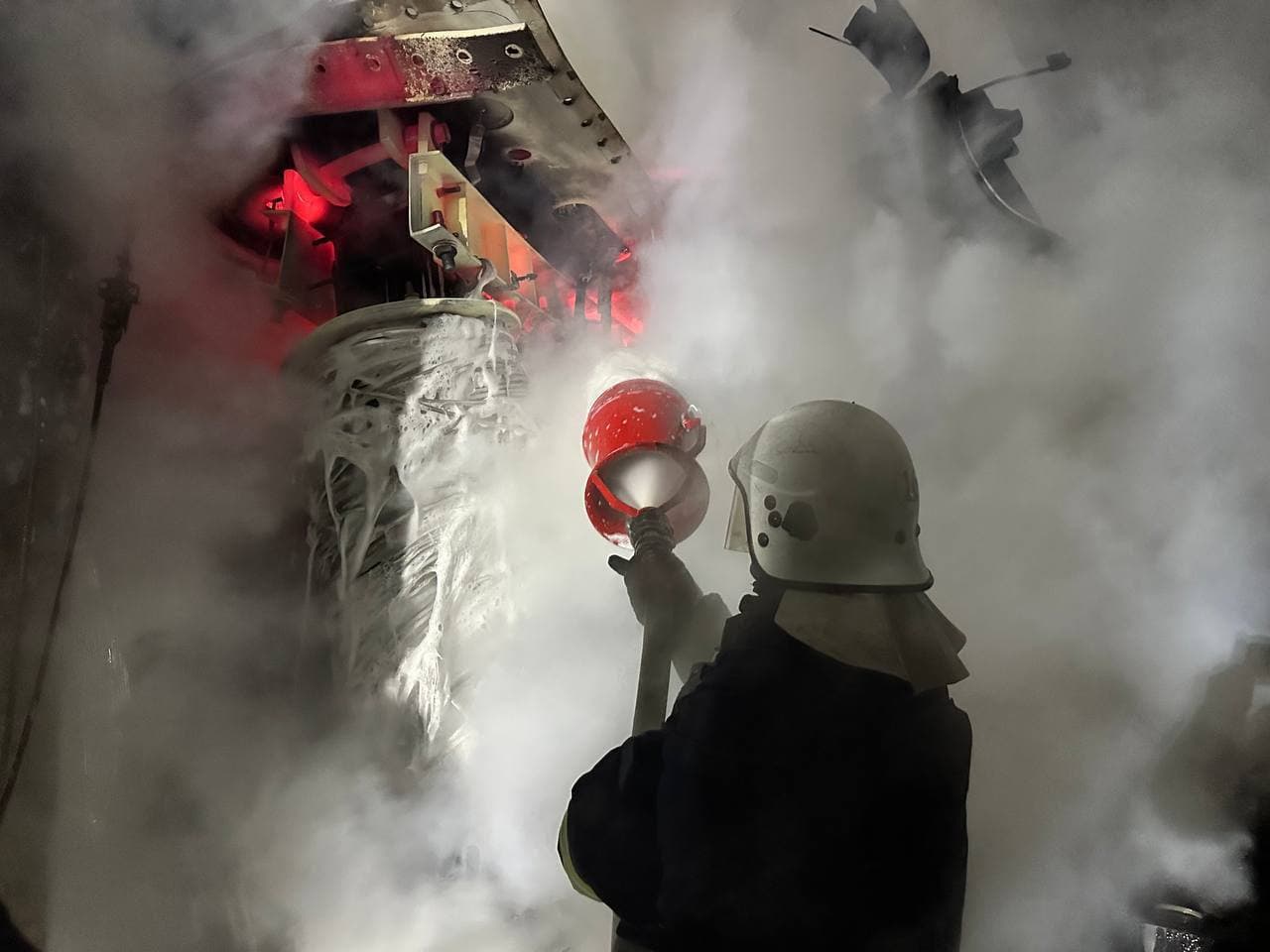
First responders extinguish a fire following a Russian overnight attack on Odesa Oblast. (Ukraine’s Emergency Service/Telegram)
UKRAINIAN ARMY DETAINS FSB-RECRUITED ASSASSIN TARGETING INTELLIGENCE SPOKESMAN YUSOV
Ukraine’s National Police announced on June 8 the detention of a 38-year-old Kyiv resident recruited by Russian special services to assassinate HUR spokesman Andrii Yusov. The suspect, a former soldier with combat and reconnaissance experience, was offered $100,000 to organize the killing, receiving a $10,000 advance. He was tasked with gathering intelligence on Yusov’s movements, residence, and vehicles, and planned to use an FPV drone to execute the attack. He had been seeking a drone operator when detained in a joint operation by National Police, special units, and HUR’s internal security department. If convicted, he faces up to life imprisonment.
Yusov confirmed he was the target: “This latest attempt can also be seen as an assessment of my work at Ukraine’s military intelligence and the Coordination Headquarters for Prisoners of War. It means we’re doing everything right.” This was the second confirmed Russian plot targeting Yusov in 2026; the first was uncovered in February in the “Enigma 2.0” operation involving multiple targets across Ukraine and Moldova. The case is being overseen by the Prosecutor General’s Office.
OVERNIGHT STRIKE: 155 DRONES; 8 KILLED, 52 INJURED; DTEK FACILITIES STRUCK FOUR TIMES IN THREE DAYS
Russian forces launched 155 Shahed, Gerbera, Italmas, Banderol, and Parodiya drones overnight June 7 to 8 from Bryansk, Kursk, Oryol, Millerovo, Primorsko-Akhtarsk, and occupied Hvardiyske. Ukrainian air defenses downed 124. Twenty struck 17 locations; debris fell on six more. Russian attacks killed eight people and injured 52 across eight oblasts. DTEK reported Russian forces struck four of its energy facilities in Dnipropetrovsk Oblast between June 6 and 8; the June 7–8 overnight strike left more than 30,000 consumers without power. Russia’s MoD claimed its air defenses downed 310 Ukrainian drones overnight across Russian territory.
In Zaporizhzhia Oblast, five were killed and 14 injured, including strikes on the regional center and 51 settlements. In Sumy Oblast, one killed and 15 injured including an eight-year-old boy. In Donetsk Oblast, one killed in Yasnohirka, four injured. In Dnipropetrovsk Oblast, a 40-year-old man was killed in the Nikopol district on the evening of June 7; four more injured overnight. In Kharkiv Oblast, four injured across Kharkiv city and 13 settlements. In Kherson Oblast, six injured. In Odesa Oblast, three injured, drone hit a residential building in Chornomorsk, gas pipeline damaged, more than 1,000 consumers left without electricity. In Chernihiv, two men injured.
FRONTLINE: LYMAN AXIS INTENSIFYING; KOSTYANTYNIVKA CLAIMS DISPUTED; POLICE OFFICER KILLED
In the Lyman direction, a Ukrainian air defense battalion commander confirmed Russian forces have intensified assaults since early May, using spring foliage for concealment and attempting to seize dominant heights near Kryva Luka, Zakitne, Rai-Oleksandrivka, and Ryznykivka to create conditions for an offensive on Slovyansk and Kramatorsk. Russian forces struck Slovyansk with three guided glide bombs on the afternoon of June 8. In the Kostyantynivka direction, a Kremlin-affiliated milblogger contradicted the Russian MoD’s claimed seizure of Molocharka on June 8, calling it “doubtful,” noting heavy fighting continues at Mykolaivka despite a mid-May seizure claim, and warning against “rushng reports.” A second milblogger claimed Russian forces advanced in southwestern Kostyantynivka.
In Kharkiv Oblast, one police officer was killed and three officers and one civilian injured when Russian forces struck a police vehicle near Chystovodivka west of Borova on June 7 as officers responded to an unexploded device call. Russian forces also used a North Korean 107mm Type 75 MLRS launcher mounted on a Kuryer unmanned ground vehicle near Vovchansk — the first confirmed integration of North Korean weapons onto Russian UGVs in Kharkiv Oblast. In the Kupyansk direction, Russian servicemembers were photographed in southeastern Kupyansk and striking Ukrainian positions in Kurylivka after infiltration missions. Russian forces continued using tunnels built over three years for drone operations and logistics disruption around Kupyansk.
UKRAINE RECEIVES €2.8 BILLION EU TRANCHE; POLISH ACCESSION OBJECTIONS RESOLVED; FCAS PROGRAM COLLAPSES
Prime Minister Svyrydenko confirmed Ukraine received €2.8 billion ($3.2 billion) from the European Union on June 8 as the latest reform-tied tranche. EU Enlargement Commissioner Kos stated in Kyiv that Poland’s objections to Ukraine’s EU accession progress have been resolved at the working level, with all six enlargement clusters targeted for opening by mid-July — the first opening scheduled for June 15 in Luxembourg. Kos emphasized Ukraine must continue fulfilling reforms and is lagging behind on approximately 20 indicators. On the same day, France and Germany announced the collapse of the Future Combat Air System joint fighter program after Dassault Aviation and Airbus failed to resolve industrial partnership disputes — a setback to European defense integration.
Putin’s “open” trust rating, published by Russia’s state-controlled VCIOM pollster, has not been updated since April 5. Under the open methodology — where respondents name politicians they trust without prompting — fewer than one-third named Putin in March, compared to over 70 percent under the directly prompted method. The Moscow Times reported VCIOM stopped publishing the figure after it fell below 30 percent. Putin’s weekly approval rating stood at 66.6 percent as of May 31, down nearly 10 points since January. North Korea’s economy grew nearly 4 percent in 2024 — driven by arms revenues from supporting Russia’s war, including over 15,000 deployed troops with one-third killed or wounded, earning Kim Jong Un billions in energy, materials, and foreign currency.
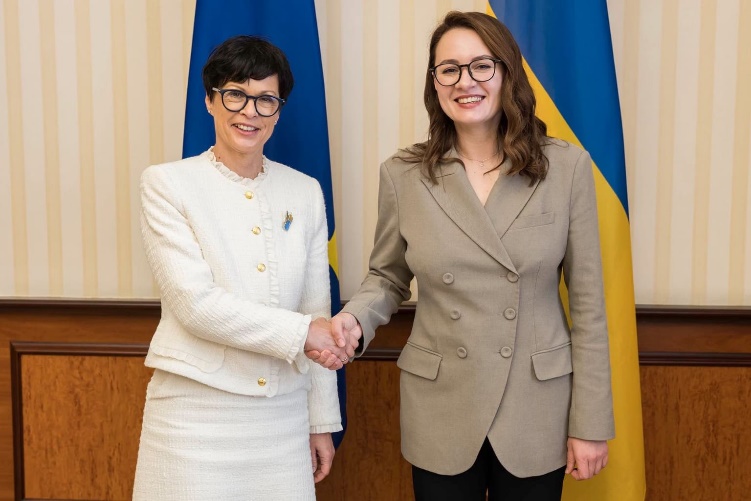
European Enlargement Commissioner Marta Kos (L) shakes the hand of Ukrainian Prime Minister Yulia Svyrydenko in Kyiv. (Marta Kos / X)
30 PRIVATE COMPANIES JOIN UKRAINE’S AIR DEFENSE; FORMER SUPREME COURT CHIEF CONVICTED
Ukraine’s Defense Ministry confirmed 30 companies have received authorization to form private air defense groups as part of the experimental initiative launched in November 2025. Applications from 43 enterprises have been received. Companies undergo security checks, form and train units, then operate under Air Force command to protect specific facilities from low-flying drone threats. Defense Minister Fedorov: the 2026 target is identifying 100 percent of aerial threats and destroying 95 percent. The Specialized Anti-Corruption Prosecutor’s Office confirmed a Kyiv court upheld a plea deal on June 8 sentencing Vsevolod Kniazev — the former head of Ukraine’s Supreme Court — to five years in prison for accepting a $1.25 million bribe, in the most high-profile corruption conviction in independent Ukrainian history. Assets confiscated; he agreed to donate $1.1 million to Come Back Alive.
Russia’s paratroopers on the Kinburn Spit have no food, no fuel, no ammunition, and are withdrawing. Ukraine struck the largest oil terminal on Russia’s Black Sea coast. A drone production center near Ryazan burned. Crimea’s trains stopped. NATO downed a drone in Latvia for the first time. A drone exploded in Moldova.
Eight Ukrainians were killed overnight. Five died in Zaporizhzhia. A police officer was killed responding to an unexploded device call when Russian forces struck his car. Zelensky met Witkoff, Kushner, and King Charles in the same day. The UN Security Council heard that 30 civilians were killed in Ukraine in four days. Russia’s state pollster stopped publishing Putin’s real approval rating after it fell below 30 percent.
Day 1,566. The spit is emptying. The pipeline hub is burning. The trains have stopped.
A PRAYER FOR UKRAINE
1. For the Police Officer Near Chystovodivka
Lord, a police officer was killed near Chystovodivka in Kharkiv Oblast on June 7 when Russian forces struck his patrol car as he and his colleagues responded to a call about an unexploded device. Three other officers and one civilian were injured. He drove toward a hazard. Russia struck him there. This is the human safari in its most precise form: targeting first responders not in their stations but in motion, on their way to protect someone else. Receive him. Sustain his colleagues, who will continue to respond to calls even after this. And let his death be in the record that follows this war into its reckoning.
2. For the Paratroopers Who Are Withdrawing
Father, this prayer is a difficult one. Russia’s 337th Airborne Regiment is withdrawing from the Kinburn Spit because Ukraine’s strikes have severed all supply lines — no food, no fuel, no ammunition. They are described as virtually depleted. They are soldiers who were sent to a narrow strip of land at the mouth of a river delta to fire artillery at a Ukrainian city, and who have now been abandoned by a supply system that Ukraine has dismantled. We do not pray for their mission. We pray that those who withdraw are not simply reassigned to another place to die in another assault. We pray that the conditions building in Russia’s military — men left without resources on diminishing positions — accumulate into the pressure that eventually brings this war to an end.
3. For the 10.8 Million
God of the displaced, the UN acting humanitarian chief told the Security Council on June 8 that 10.8 million people in Ukraine require humanitarian assistance, and less than half the necessary funding has been secured. Ten point eight million. In a country of 44 million before the war. A quarter of Ukraine’s people need help that the world has not fully provided. We pray for every organization working inside Ukraine under bombardment — the WFP warehouses that have been struck twice, the ICRC teams, the UN monitors, the Ukrainian civil society organizations. Give them resources, access, and protection. And give the governments that have pledged support the administrative will to actually disburse it.
4. For Andrii Yusov
Lord, Ukraine’s military intelligence spokesman confirmed on June 8 that he was the target of an FSB-organized assassination plot using an FPV drone. He had already survived a previous attempt in February. He said: “Any Ukrainian could become its target today.” He continued working. He commented publicly on the case. He is the spokesperson for the institution responsible for every prisoner exchange, every intelligence brief on Russian movements, every communication about what Russia is planning. Protect him. Protect everyone around him. And let the transparency with which Ukraine’s intelligence community acknowledges these attempts — rather than hiding them — stand as evidence of the difference between what Kyiv is and what Moscow is.
5. For the Pipeline That Burns
God of accountability, Ukraine struck the Grushovaya oil terminal on June 8 — the terminus of Russia’s southern export pipeline system, 700,000 barrels a day, 20 percent of Russia’s seaborne crude exports. It burned. This is what the long-range strike campaign has been building toward: not just individual refineries, but the export infrastructure that turns Russian oil into the currency of war. We do not pray for the oil terminal. We pray for what this means: that the financial architecture sustaining Russia’s ability to continue killing Ukrainians is being reached, one strike at a time, by operators who fly a thousand kilometers in the dark. Let the pressure accumulate. In Your mercy, in Your justice, in Your time — bring this war to its end, and let the ending be worthy of what Ukraine has endured.