
Ukraine Daily Briefing | June 9, 2026 | Day 1,567 of the Full-Scale Invasion
Prepared by Dayana Bozhyk
Colonel Damir Davydov — head of the Russian MoD’s Main Missile and Artillery Directorate and the official responsible for supplying ammunition to the frontline — was killed in a car bomb in Balashikha, Moscow Oblast, less than one kilometer from where General Moskalik was killed in the same fashion in April 2025. The Russian military command formally banned all military cargo traffic along the M-14 Rostov-Crimea highway and the A-291 Tavrida highway starting June 7, confirming that Ukraine’s interdiction campaign has rendered those routes inoperable for logistics. Ukraine struck the Chonhar Bridge a second time in three days, cutting traffic again. Zelensky traveled to Tallinn for the NB8 summit, signing a Drone Deal with Latvia and a defense declaration with Estonia. The EU unveiled its 21st sanctions package: 170 new listings, entry ban for all Russian military veterans, 30 more shadow fleet vessels, and a freeze on Russia’s oil price cap until January 2027.
THE DAY’S RECKONING
At 5:30 a.m. on June 9, a BMW X3 exploded in Balashikha, a Moscow suburb whose Aviatorov district houses Russian military personnel and their families. The driver was Colonel Damir Davydov, head of a department within Russia’s Main Missile and Artillery Directorate responsible for supplying missile and artillery ammunition to the frontline. The blast, equivalent to 300-400 grams of TNT, was placed beneath the driver’s seat. Davydov was still alive immediately after the explosion; he died before paramedics arrived. Russian investigative outlet The Insider confirmed his identity. No Ukrainian involvement has been established.
The location was almost precisely the spot where Lieutenant General Yaroslav Moskalik — deputy chief of the General Staff’s Main Operations Directorate — was killed in an identical car bombing in April 2025. The same district, the same method, the same military residential neighborhood built for Defense Ministry veterans and their families, within five kilometers of the Military Academy of the Strategic Missile Forces. This is the fourth killing of a Russian officer at or above lieutenant general rank inside Russia since the full-scale invasion began. The FSB has said security around high-ranking officers has been tightened. Evidently not enough.
While Davydov’s car was burning in Balashikha, USF Commander Brovdi disclosed that the Russian military command had already quietly banned all military cargo traffic along the M-14 and A-291 Tavrida highways as of June 7 — confirming what Ukraine’s intermediate-range strike campaign had already made operationally true: Russia’s main surface supply routes from mainland Russia to Crimea are no longer usable for military logistics. Daily freight on the R-280 has fallen 71 percent in two weeks, from 3,800 vehicles to 1,100. The Chonhar Bridge was struck again overnight. Saldo closed it again.
In Tallinn, Zelensky signed a Drone Deal with Latvia, a defense declaration with Estonia, and held bilateral meetings with the leaders of Finland, Sweden, Latvia, and Estonia at the NB8 summit. In Brussels, EU Commission President von der Leyen unveiled the 21st sanctions package: the largest listings in two years, entry ban for all Russian military veterans, 30 more shadow fleet ships sanctioned, and a freeze on Russia’s oil price cap until January 2027 — specifically designed to prevent Moscow from profiting from elevated prices caused by the Iran war.
CAR BOMB IN BALASHIKHA: RUSSIA’S MAIN AMMUNITION SUPPLY CHIEF KILLED
Colonel Damir Davydov, head of the ammunition supply department within Russia’s Main Missile and Artillery Directorate (GRAU), was killed when his BMW X3 was blown up at 5:30 a.m. on Koldunova Street in Balashikha’s Aviatorov district. The explosive device, placed under the driver’s seat, had a yield equivalent to 300-400 grams of TNT. Russian investigative outlet The Insider confirmed Davydov’s identity. The Investigative Committee opened a criminal case. Russian Telegram channel 112 confirmed the explosive characteristics. Eyewitnesses reported hearing paramedics mention the name “Damir” at the scene.
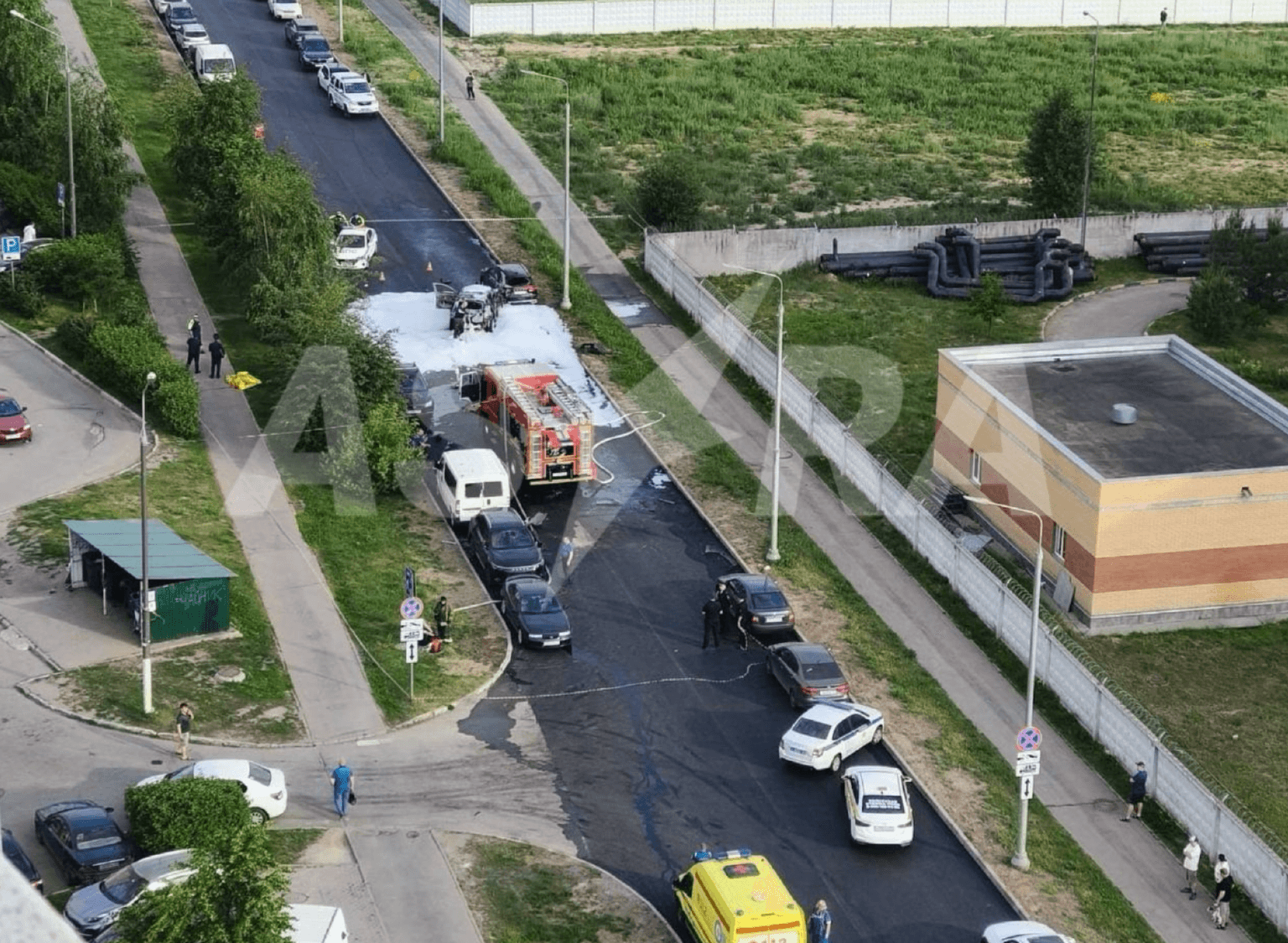
Firefighters arrived at the scene of a car explosion in Balashikha, Moscow Oblast. (Astra/Telegram)
The Aviatorov district is a military residential neighborhood built for Defense Ministry veterans, combat retirees, and their families, all within five kilometers of three major military facilities: the 26th Central Research Institute of the MoD, the Military Academy of the Russian Strategic Missile Forces, and a training center of the Federal Protective Service. The explosion occurred less than one kilometer from the April 2025 site where Lieutenant General Yaroslav Moskalik was killed by an identical car bomb. ISW noted this is the fourth killing of a Russian officer at lieutenant general rank or above inside Russia since the invasion began. Ukrainian authorities had not commented as of publication. No evidence has linked Kyiv to the attack.
M-14 HIGHWAY BANNED FOR MILITARY CARGO; R-280 TRAFFIC DOWN 71%; CHONHAR STRUCK AGAIN
USF Commander Brovdi disclosed on June 9 that the Russian Eastern Grouping of Forces command issued a decree on June 6 prohibiting military cargo traffic along the M-14 Rostov-Crimea highway (R-280) and the A-291 Kerch-Simferopol-Sevastopol Tavrida highway starting June 7. The decree cited safety reasons. ISW assessed this as direct confirmation that Ukraine’s intermediate-range strike campaign has rendered these routes operationally unsafe for Russian military logistics. The M-14 is Russia’s main surface supply route from mainland Russia to occupied Crimea through occupied southern Ukraine. Brovdi separately reported that daily freight traffic along the R-280 has fallen 71 percent over the past two weeks — from roughly 3,800 vehicles per day to approximately 1,100.
Ukraine struck the Chonhar Bridge a second time on the night of June 8 to 9. Occupation head Saldo closed traffic across the bridge and directed drivers to use Armiansk and Perekop crossings. Saldo claimed Russian air defenses intercepted more than 20 approaching Ukrainian drones but acknowledged some reached the target. The bridge was first struck on June 7, closed briefly, and reopened on June 8 before being struck again overnight. The June 7 strike used Ukrainian-made Fire Point FPV drones and the Behemoth UAV. The bridge connects occupied Crimea to occupied Kherson Oblast and is a primary fuel and ammunition route for Russian forces in the Hulyaipole direction.
ZELENSKY IN TALLINN: NB8 SUMMIT, DRONE DEAL WITH LATVIA, DEFENSE DECLARATION WITH ESTONIA
Zelensky and First Lady Zelenska arrived in Tallinn on June 9 for the Nordic-Baltic Eight (NB8) summit, bringing together Finland, Sweden, Norway, Iceland, Denmark, Estonia, Latvia, and Lithuania. Zelensky held bilateral meetings with Finnish PM Orpo, Latvian PM Kulbergs, Swedish PM Kristersson, and Estonian President Karis. He and Karis held a joint press conference in which Karis stated: “It is quite likely that there will be a window of opportunity this summer. We must prepare for that moment already today.” Zelensky: “June and July this year may determine a lot.”
Ukraine signed two defense agreements on June 9. With Latvia: a Drone Deal covering drone production, technology sharing, and defense co-production, providing Ukraine’s battlefield expertise to strengthen Baltic air defense. With Estonia: a Joint Declaration on Enhanced Security and Defense Cooperation formalizing exchange of military experience, defense industry cooperation, and air defense collaboration, with a separate Drone Deal framework to follow. Zelensky awarded Estonian PM Michal the Order of Prince Yaroslav the Wise, 2nd Class. The visit followed the June 7 E3-plus-Ukraine summit in London and precedes the G7 in Evian on June 15–17 and the NATO Ankara summit.
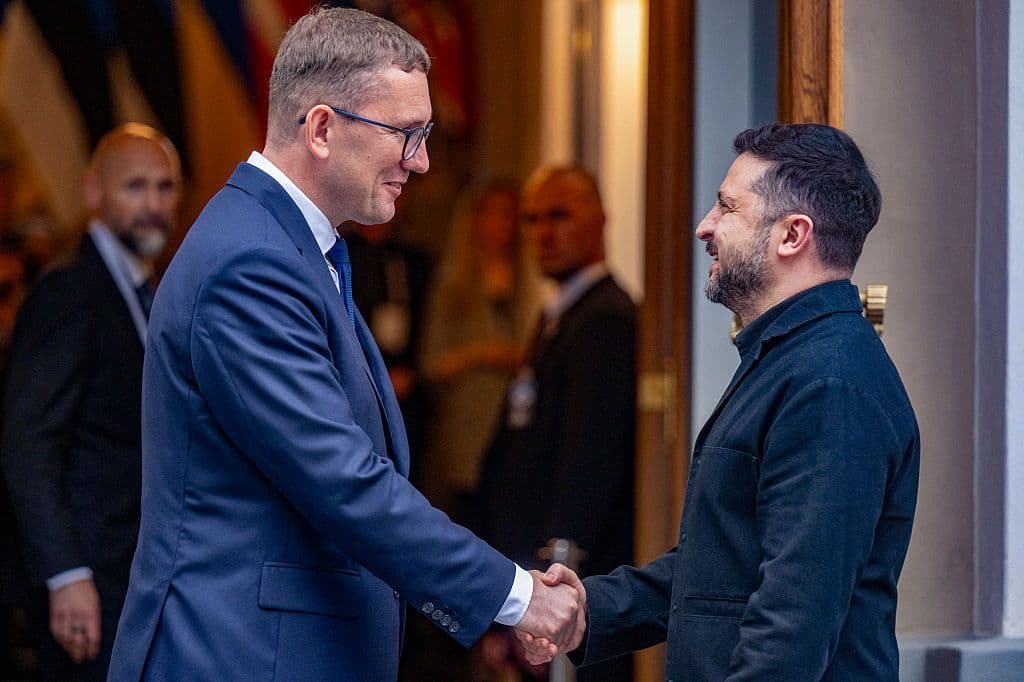
Estonian Prime Minister Kristen Michal (L) greets President Volodymyr Zelensky arriving at the Nordic-Baltic Eight (NB8) Summit in Tallinn, Estonia. (Raigo Pajula / AFP / Getty Images)
EU 21ST SANCTIONS PACKAGE: ENTRY BAN FOR RUSSIAN VETERANS, 170 NEW LISTINGS, OIL CAP FROZEN
European Commission President von der Leyen presented the EU’s proposed 21st sanctions package on June 9 in Brussels. The package contains the largest number of new listings in over two years: over 170 proposals covering the financial sector, energy, and drone production. For the first time, the EU proposes banning entry to any person who has served in Russian Armed Forces since the start of the 2022 invasion. Von der Leyen: “Europe’s door should not be open to Russia’s (ex-)combatants.” Ukrainian FM Sybiha welcomed the measure: “By signing a contract to fight a criminal war of aggression against Ukraine, they also sign an entry ban to Europe.”
The energy component freezes Russia’s oil price cap at the current level until January 2027, preventing Moscow from benefiting from price increases generated by the U.S.-Iran war and Hormuz disruptions. Thirty additional shadow fleet vessels are sanctioned, bringing the total to over 660. For the first time, the package targets companies and vessels providing ship-to-ship support services to shadow fleet ships. Financial restrictions expand to 31 more Russian banks, 20 foreign banks, and crypto platforms facilitating sanctions evasion — with a proposed full ban on crypto-asset services linked to sanctions-evasion jurisdictions. New restrictions target Russian fish imports, Russian oil infrastructure ports and refineries, and materials for aerospace and weapons production. A formal vote on initial elements is expected at the June 15 EU Foreign Ministers meeting in Luxembourg.
GERMANY ADDS €300 MILLION TO CZECH AMMUNITION INITIATIVE; BULGARIA ENDS ARMS TRANSFERS
German Defense Minister Pistorius announced on June 9, during talks with his Czech counterpart Zuna in Berlin, that Germany will contribute an additional €300 million to the Czech-led ammunition initiative — approximately 50,000 additional long-range artillery rounds. Pistorius described the initiative as essential to supplying Ukraine with urgently needed ammunition. The announcement comes after Czech President Pavel disclosed last month that participating countries had fallen from 18 to 9 since PM Babis took office. Over 3 million shells have been delivered since the initiative launched in 2024: 1.5 million in 2024, 1.8 million in 2025, with contracts for approximately 1 million more in 2026.
In contrast, Bulgaria’s new Defense Minister Stoyanov announced on June 9 that Bulgaria’s government — led by Russian-friendly PM Radev, who won April elections — will halt all weapons transfers to Ukraine. “Ukraine needs more people, not more armament,” Stoyanov said. Bulgaria is one of the EU’s largest producers of Soviet-standard ammunition compatible with Ukrainian systems. Sofia had provided 13 military aid packages to Ukraine since 2022, playing a key early role in sustaining ammunition supplies during the war’s critical first phases.
SYRSKYI APPROVES 2030 MISSILE CONCEPT: DOMESTICALLY PRODUCED BALLISTIC AND CRUISE MISSILES TO 2,000 KM
Commander-in-Chief Syrskyi approved a new missile and artillery development concept through 2030 on June 9, targeting domestically produced ballistic and cruise missiles with ranges up to 2,000 kilometers integrated into a unified long-range strike architecture. Syrskyi: “We must increase our ability to deliver firepower across the enemy’s entire operational-strategic and strategic depth.” The concept envisions phasing out outdated Soviet-caliber artillery systems while retaining the most advanced foreign-supplied systems. Key priorities include completing development and serial production of domestically produced cruise and ballistic missiles, expanding artillery reconnaissance, and rapid battlefield information transfer.
The concept builds on existing programs including the Flamingo cruise missile, which has a claimed range of 3,000 kilometers and is already in serial production. Ukraine’s Ground Robotic Complexes have completed more than 50,000 logistics and evacuation missions since January 2026; units using robotic systems have grown from 117 to 230. Autonomous interceptor drones capable of independently targeting and destroying Russian Shaheds have passed combat testing in Kharkiv Oblast, with Fedorov confirming they navigate the entire interception process automatically without operator input.
OVERNIGHT STRIKE: 168 DRONES AND 2 KH-59S; 10 KILLED, 106 INJURED ACROSS SEVEN OBLASTS
Russian forces launched two Kh-59/69 cruise missiles from Voronezh Oblast and 168 Shahed, Gerbera, Italmas, Banderol, and Parodiya drones overnight June 8 to 9. Ukrainian air defenses downed 146 drones. Both cruise missiles and 17 drones struck 18 locations; debris fell on eight more. Russian attacks killed 10 people and injured 106 across seven oblasts.
In Kharkiv Oblast, three were killed including a 22-year-old pregnant woman and two others, with 25 injured including three children across Kharkiv city and 30 settlements — Russian forces used five Kh-59 missiles, seven KABs, and multiple drones. In Zaporizhzhia Oblast, two killed and 38 injured across 46 settlements struck 884 times — including an FPV drone strike on a minibus in Khortytskyy Raion that killed two civilians and injured at least 15, which USF Brovdi described as a deliberate “human safari” strike. In Kherson Oblast, one killed and 13 injured including a child. In Donetsk Oblast, two killed and 11 injured. In Sumy Oblast, one 71-year-old killed and five injured including a two-year-old boy. In Dnipropetrovsk, three injured overnight; separately one person killed on June 8. In Chernihiv, a bread delivery driver was injured by an FPV drone in Semenivka; energy infrastructure struck.
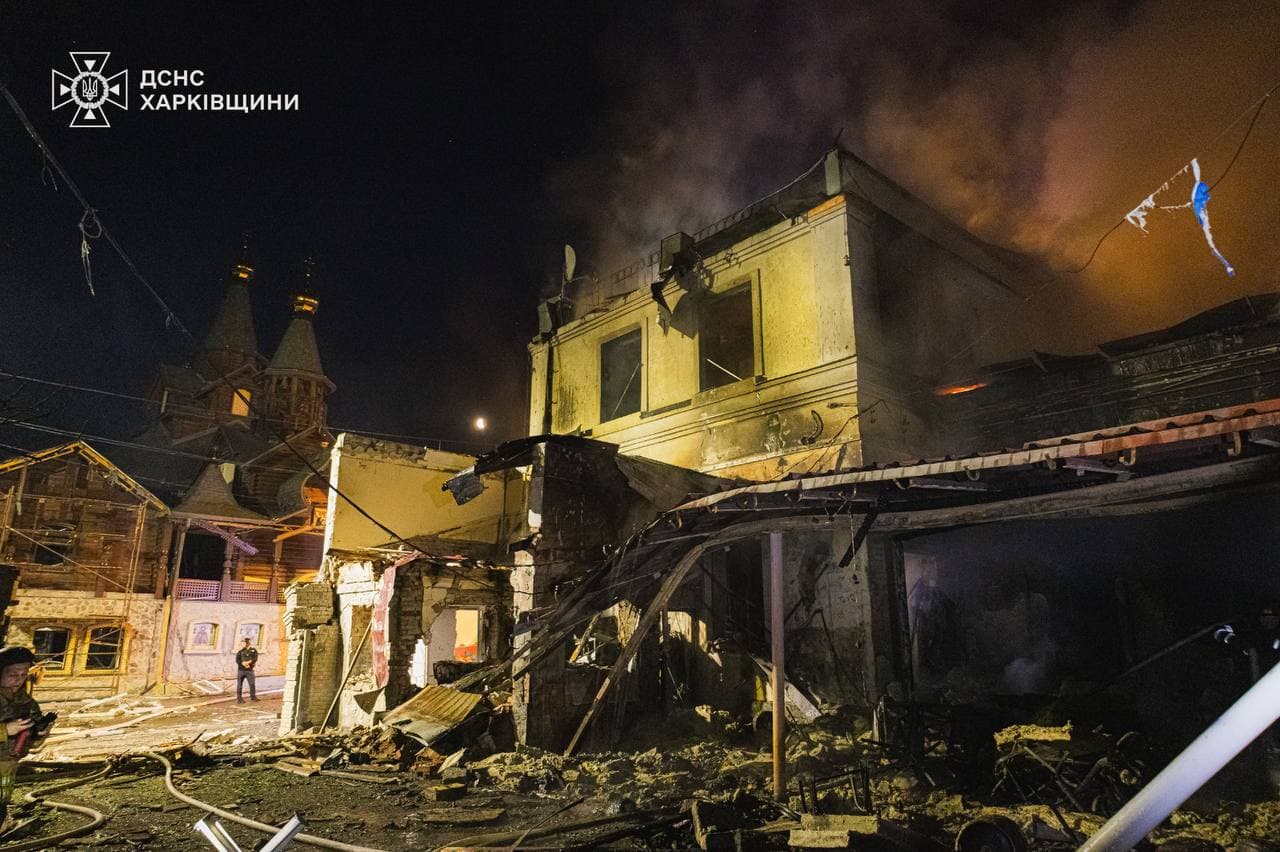
The aftermath of a Russian missile and drone attack that killed three and injured 18 others in Kharkiv Oblast overnight. (State Emergency Service/Telegram)
FRONTLINE: UKRAINIAN ADVANCES IN BOROVA AND KOSTYANTYNIVKA; RUSSIAN FORCES COLLAPSE IN LYMAN
In the Borova direction, geolocated footage confirmed Ukrainian advances near Karpivka, east of Serednie, and northwest of Zelena Dolyna — all southeast of Borova. Ukrainian forces counterattacked toward Hrekivka. In the Kostyantynivka-Druzhkivka tactical area, Ukrainian forces recently advanced or maintained positions in northwestern Chasiv Yar; geolocated footage confirmed Ukrainian presence in eastern and western Kostyantynivka in areas where Russian sources had previously claimed control. Brovdi confirmed a strike on the Rubikon Center command post in Shevchenko Pershe, roughly 10 kilometers from the frontline. A Kremlin milblogger acknowledged Russian forces are struggling to operate in Kostyantynivka under Ukrainian counterattacks and drone interdiction.
In the Lyman direction, a Ukrainian brigade battle captain reported that Russia is sending logistics workers, repairmen, and other non-infantry personnel to conduct assaults because Russian forces cannot bring sufficient infantry to the frontline. Officers lie to superiors and the command keeps ordering advances anyway. Ukrainian Joint Forces Task Force Spokesperson Trehubov reported Russian forces are inflicting 200-250 Ukrainian casualties per day across four directions (Velykyi Burluk, Kupyansk, Borova, Lyman); Ukrainian forces are simultaneously striking those same directions’ Russian GLOCs with superior intermediate-range capabilities. Russian forces struck Slovyansk with three glide bombs on June 8. Russian milbloggers claimed advances in central Lyman; ISW is assessing. Russia has begun using single-shot “Capricorn” rocket launchers in the Pokrovsk direction due to MLRS shortages.
UKRAINE’S MID-RANGE CAMPAIGN: SUBSTATIONS IN LUHANSK, MARIUPOL, MAKIIVKA; RUBIKON HQ STRUCK
Brovdi confirmed on June 9 Ukrainian strikes against: an electrical substation in occupied Lysychansk (35 km from frontline); an electrical substation and gas infrastructure in occupied Luhansk City (104 km); an electrical substation and fuel tanks in occupied Sievierodonetsk (43 km); a temporary deployment point of the 228th Motorized Rifle Regiment in occupied Kurakhove (32 km); and electrical substations in occupied Mariupol (107 km) and Makiivka (58 km). An ammunition depot near Prokhorovka, Belgorod Oblast, was also struck. Geolocated imagery confirmed fires and explosions at an ammunition depot in Mykhailivka, Luhansk Oblast. Ukrainian forces struck two P-19 Terek radar systems in occupied Zaporizhzhia Oblast, drone control points across Donetsk and Zaporizhzhia oblasts, a drone workshop near Burchak, and a substation in occupied Mariupol — the same substation serving the Mariupol port struck previously.
THE KREMLIN TRIES TO DELEGITIMIZE ARMENIA’S ELECTION; RUSSIA’S STARLINK RIVAL LOSES A SATELLITE
Russian government officials and milbloggers deployed a coordinated delegitimization campaign on June 8 to 9 against Pashinyan’s Civil Contract Party victory, claiming he “lost” by not exceeding 50 percent (he received 49.82 percent), alleging Western pressure and domestic suppression, and claiming mass fraud. Russia’s fisheries agency simultaneously threatened increased restrictions on Armenian fish imports if “veterinary risks” arise — a transparent economic threat. ISW assessed this mirrors the Kremlin’s 2024 delegitimization campaign against Moldovan President Sandu’s election victory. Russia’s Suvorovsky Raion court in Moscow issued a warrant for Pashinyan’s arrest on charges of insulting Russia’s 2024 military exercises.
Russia’s Rassvet satellite internet program — Moscow’s attempted Starlink alternative — lost one of its 16 first-batch operational satellites, Kommersant reported. Fifteen remain operational. Bureau 1440 plans to deploy 292 satellites by 2030 with a $5.5 billion combined budget; the program gained urgency after SpaceX deactivated Starlink for Russian military use in February 2026. The commercial launch is planned for 2027. The February Starlink cutoff has been confirmed by multiple Ukrainian commanders as significantly disrupting Russian battlefield command-and-control. One satellite failure in a constellation of 16 — a 6.25 percent loss rate in the first operational months — is not encouraging for a program being built under wartime conditions.
SPORT AND WAR: THE RETURN OF RUSSIAN ATHLETES AND THE NHL’S UNCOMFORTABLE CHOICE
The NHL announced a revamped All-Star format for 2026-27 that includes a “World” team incorporating players from other hockey federations, including Russia — bringing Alexander Ovechkin, Evgeny Malkin, and Nikita Kucherov back into an international team format for the first time since the full-scale invasion. U.S. President Trump has publicly floated a U.S. vs. Russia exhibition matchup. Robert Agee, head of the American Chamber of Commerce in Russia, promoted the initiative at SPIEF. The momentum for Russia’s sporting reintegration is no longer solely Russian-initiated — it is being driven by U.S. commercial and political actors.
The Kyiv Independent’s analysis noted the structural asymmetry: those who object to Russian athletes returning are typically individuals or national associations with limited resources; those advocating return are wealthy institutions — NHL teams, TV networks, sponsors — whose commercial interests are served by Russian star players. Ovechkin, Malkin, and Kucherov have been among the NHL’s most marketable players for years. The NHL is not receiving Kremlin instructions; the commercial ecosystem produces the same result without them. Ukraine qualified for the 2027 IIHF World Championship after a 20-year absence — the first time it will compete alongside Russian players being discussed for reintegration since the invasion began.
KALLAS IN IRELAND: ‘NEUTRALITY DOES NOT PROVIDE IMMUNITY’; IRISH PRESIDENCY COMMITS TO UKRAINE
EU High Representative Kallas told a Dublin press conference on June 9 that military neutrality does not protect any European country from Russian targeting, citing hybrid attacks, cyber operations, and subsea infrastructure sabotage as threats facing non-NATO EU members including Ireland, Austria, Cyprus, and Malta. Kallas welcomed Ireland’s commitment to increase defense spending 55 percent by 2030. Irish FM McEntee stated maritime security will be a priority for Ireland’s six-month EU Council presidency beginning July 1, including protecting subsea cables — all European connections to the island pass through waters where Russian spy ships have been documented loitering.
Ireland’s EU Ambassador O’Donoghue confirmed an ongoing investigation into the Aughinish Alumina plant’s alumina exports to Russia — 83 percent of the plant’s output in Q1 2026 went to Russia for military aluminum production. O’Donoghue confirmed Ireland will support the 21st sanctions package and will prioritize Ukraine’s EU accession during its presidency, aiming to open all six enlargement clusters as quickly as possible. The first cluster opening is scheduled for June 15 in Luxembourg.
Russia’s chief ammunition supply officer was killed in a car bomb in Moscow. The M-14 is now banned for military cargo. The Chonhar Bridge was struck again. The EU banned Russian military veterans from entering Europe. A 22-year-old pregnant woman was killed in Kharkiv. A bread delivery driver was struck by an FPV drone in Chernihiv. R-280 highway traffic fell 71 percent.
Zelensky signed two defense deals in Tallinn. Germany added €300 million to the Czech ammunition initiative; Bulgaria stopped sending weapons. Syrskyi approved a plan for Ukrainian ballistic missiles reaching 2,000 kilometers. The NHL added a Russian team to its All-Star game. Ovechkin is commercially valuable. Ukraine qualified for the 2027 World Championship after 20 years.
Day 1,567. Russia’s ammunition supply chief was killed less than a kilometer from where a general was killed the same way 14 months ago. The same method. The same district. The FSB said security had been tightened.
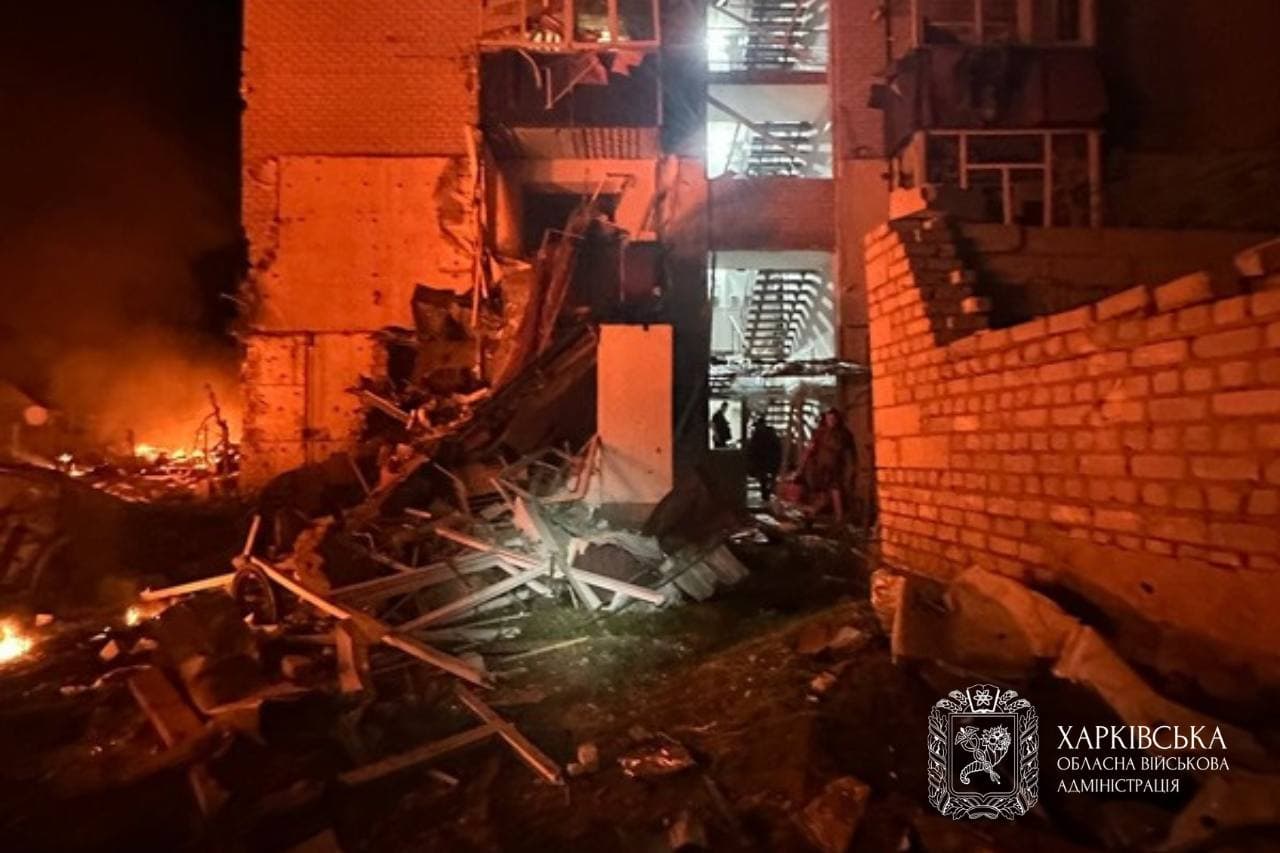
Aftermath of a Russian strike on a residential building in Kharkiv Oblast. (Kharkiv Oblast Military Administration/Telegram)
A PRAYER FOR UKRAINE
1. For the 22-Year-Old Pregnant Woman in Kharkiv Oblast
Lord, a 22-year-old woman was killed in Kharkiv Oblast on June 9 in Russian strikes that hit the city and 30 surrounding settlements with missiles, glide bombs, and drones. She was pregnant. We do not have her name. We have her age and the knowledge that she carried a child and that both of them died. Receive her. Hold the family that is grieving her and the child who never arrived. And let the specific fact of her — 22 years old, pregnant, killed in a city that has been under Russian attack since the first day of the full-scale invasion — be remembered as more than a line in a casualty report.
2. For the Bread Driver in Semenivka
Father, a 55-year-old man was delivering bread in Semenivka, Chernihiv Oblast, on June 9 when a Russian FPV drone struck his vehicle. He survived with injuries. Bread delivery. In a border town in Chernihiv that has been struck repeatedly since 2022. This is the war in its most mundane form: not a soldier, not a military target, not a strategic asset — a man delivering bread to a town that needs it, found by a drone that was programmed to hunt vehicles on roads. Heal him. And let the persistence of everyone in Semenivka who goes to work anyway, who delivers bread anyway, who stays anyway — be understood as the act of courage it is.
3. For Ukraine’s Hockey Team
God of sport, Ukraine qualified for the 2027 IIHF World Championship after 20 years away. They will compete in a tournament where the NHL’s revamped All-Star format is bringing Russian players back into international team formats. They will play alongside the knowledge that Ovechkin and Malkin and Kucherov are commercially valued by the same league whose country’s government is debating whether to invite Russia to a bilateral exhibition matchup. We pray for Ukraine’s players. For the coaches and the federation that built this qualification. For the Ukrainian fans who will watch their team compete on a stage from which they’ve been absent two decades. And for the clarity that international sport has not yet found: that normal takes longer to restore than commercial interests are willing to wait.
4. For the People Inside the M-14 Ban
Lord, Russia’s military command banned its own logistics traffic from its own main highway because Ukraine made it too dangerous to use. The Chonhar Bridge has been struck twice in three days. R-280 traffic fell 71 percent. These are numbers that describe a supply chain collapsing in slow motion — and inside that collapse are Russian soldiers in frontline positions whose ammunition, fuel, and food are now arriving more slowly, or not arriving at all. Some of them are on the Kinburn Spit, already withdrawing. We do not pray for Russia’s logistics. We pray that the pressure building inside Russia’s supply system reaches the commanders who make decisions, and the officials who brief Putin, and the president who receives those briefings on maps that don’t match the terrain. Let the reality that Ukraine has built on the ground finally arrive in Moscow’s decision rooms.
5. For Whoever Is Being Hunted in Balashikha
God of justice, this is a prayer we cannot fully pray. A Russian colonel was killed in a car bomb in Moscow. He was responsible for supplying the ammunition that kills Ukrainians. His death is not mourned in Kyiv. And yet we know almost nothing about what happened, who did it, and what it means. We know the method matches the April 2025 killing of General Moskalik. We know it happened in a military district less than a kilometer from that site. We know Ukrainian authorities have not commented. We pray for clarity — for the truth of this war to be spoken clearly, including the parts that are difficult. We pray that whatever is happening inside Russia’s military system — the false maps, the lying officers, the ammunition chief killed in his own suburb — accumulates into the pressure that ends the war. In Your mercy, in Your justice, in Your time — bring this war to its end, and let the ending be worthy of what Ukraine has endured.