
Ukraine Daily Briefing | April 19, 2026 | Day 1,151 of the Full-Scale Invasion
Ukraine’s unmanned forces made history when a drone launched from a sea-based vessel shot down a Russian Shahed — the first such intercept in naval history — while Zelensky revealed that Russia’s escalating drone war has now cost Moscow $2.3 billion in lost oil revenue in March alone. A 58-year-old Moscow-born gunman killed six people in a Kyiv supermarket on Saturday, sparking a wave of resignations and a national reckoning about police cowardice, as authorities scrambled to determine whether he was a Russian agent. Meanwhile, Bulgaria’s snap election handed a commanding win to Kremlin-friendly ex-President Rumen Radev, delivering Moscow yet another potential ally inside the European Union just one week after Hungary’s Viktor Orban was swept from power.
The Day’s Reckoning
Picture a drone lifted off not from a runway or a rooftop — but from the deck of an unmanned boat riding the Black Sea swells. It climbs. It acquires its target. A Russian Shahed, the same low-flying kamikaze weapon that has haunted Ukrainian cities for three years, fills the screen. Then it’s gone.
That moment, reported by Ukraine’s 412th Nemesis Brigade on April 19, was something the world had never seen: the first sea-launched interceptor drone kill in military history. It was a single intercept, small against the scale of a 236-drone overnight barrage that still sent 32 weapons crashing into 18 Ukrainian locations. But the Ukrainians understand that war is won not just in territory but in the race to make the enemy’s weapons obsolete.
Elsewhere, the day refused to stay on the battlefield. In Kyiv’s Holosiivskyi district, a 58-year-old man born in Moscow walked into a supermarket on Saturday, drew a weapon, and killed six people — including injuring a 12-year-old boy — before police ended his life. Video emerged of two officers running away from the scene. By Sunday, the head of Ukraine’s patrol police had resigned. The investigation asks a question that has no comfortable answer: was this madness, or was this Moscow?
Across the continent, Bulgaria’s voters handed a decisive victory to Kremlin-friendly ex-President Rumen Radev — a man who once called Ukraine’s resistance a “doomed cause.” Fresh off Orban’s defeat in Hungary, the Kremlin now eyes Sofia with renewed interest. And in Washington, the Trump administration quietly extended a Russian oil sanctions waiver it had promised to cancel, handing Moscow another financial lifeline while Ambassador Waltz called the criticism “ridiculous.”
The Russian offensive ground on — underwhelming by design, lethal by persistence. A 16-year-old boy died in Chernihiv before dawn. Three elderly women were wounded by guided bombs in a Zaporizhzhia village. And in a makeshift drone workshop outside Kharkiv, a father of two named Ray soldered microchips by hand and said, simply: “We cannot underestimate the enemy.”
History from the Black Sea: The World’s First Naval Drone Intercept
There is no radar station, no ground-based launcher, no crew of a dozen operators in this story. There is a boat with no captain. And from that boat, a drone rises to kill another drone.
On April 19, Ukraine’s Unmanned Systems Forces announced that the 412th Nemesis Brigade had achieved something no military in history had accomplished: downing an aerial threat using an interceptor drone launched from an unmanned surface vessel — essentially, a robotic boat. The target was a Shahed, Russia’s workhorse long-range strike drone, a one-way kamikaze weapon that has struck Ukrainian cities hundreds of times. This time it never arrived.
USF Commander Major Robert “Madyar” Brovdi reported that Ukraine has already formed one naval drone battalion for such missions inside an existing brigade and is building a second. Russian milbloggers were not celebratory. Several complained that Russia’s own unmanned systems force was lagging dangerously behind, blaming the dysfunction on cronyism within procurement and development circles.
The strategic logic here runs deeper than a single downed Shahed. Ukraine’s coastline and southern cities have long been exposed to aerial threats that approach from unexpected angles over open water, where ground-based air defense has gaps. A robotic boat that can launch its own interceptors extends Ukraine’s defensive perimeter into the sea itself. In the past three weeks of April alone, Brovdi reported, Ukraine’s drone units destroyed 4,465 aerial targets — including 671 Shahed-type drones and similar loitering munitions.
Russia noticed. And Russia is learning. But for now, the sea belongs to Ukraine’s unmanned fleet.
236 Drones, One Dead Teenager, and a City Still Without Power
Before the world learned about the sea-launched intercept, the night had already been long.
Russian forces launched 236 drones at Ukraine overnight from April 18 into April 19 — Shahed-type, Gerbera-type, Italmas-type, and others — fired from Bryansk, Kursk, Oryol, Smolensk, Rostov, Krasnodar, occupied Donetsk City, and Crimea. Ukrainian air defenders downed 203 of them. Thirty-two got through, striking 18 locations. Debris from another eight drones fell across additional sites.
In Chernihiv, a 16-year-old boy was killed. Four others were injured. Seven private homes were damaged, three burned to the ground. An educational institution was struck. Two vehicles were destroyed. This came less than 24 hours after a Russian strike on an energy facility had cut power to 380,000 Chernihiv residents. The city’s emergency services had not finished their work before the next wave arrived.
In Kherson, a Russian drone targeted a civilian car at approximately 7:00 a.m. A 56-year-old man was killed. A 41-year-old passenger was injured. Prosecutors opened a war crimes investigation. In the Zaporizhzhia village of Balabyne, guided aerial bombs — the KAB series, essentially precision-guided glide bombs that can be dropped from aircraft flying well behind the front — struck residential areas, wounding three women aged 59, 63, and 85. In Kharkiv Oblast, one person was killed and strikes hit 19 settlements. In Sumy Oblast, one person was killed and seven injured.
Zelensky, in his evening address, provided the week’s full accounting: over 2,360 long-range strike drones, more than 1,320 guided glide bombs, and nearly 60 missiles in the seven days from April 12 to 19. These are not tactical weapons aimed at military positions. They are a campaign designed to exhaust, terrify, and break a society.
The sky was clear by morning. The counting continued.
The Kyiv Shooter: Six Dead, Two Officers Who Ran, and a Question Moscow Hopes No One Asks
On Saturday afternoon, a 58-year-old man walked into a supermarket in Kyiv’s Holosiivskyi district and opened fire. When it was over, six people were dead. Fourteen others were wounded, including a 12-year-old boy. Police ultimately killed the gunman.
But before that — before the operation that ended the attack — video showed two uniformed patrol officers running away from the building after hearing shots. The footage spread instantly. By Sunday morning, Yevhen Zhukov, head of Ukraine’s patrol police, was at a press briefing announcing his resignation.
“As a combat officer, I have decided to submit a report for dismissal from the position I hold. I think it will be fair,” Zhukov said. He described the actions of the two fleeing officers as “shameful.” Interior Minister Ihor Klymenko called it “a disgrace for the entire system” — but cautioned against condemning the entire police force, praising those who stormed the supermarket and stopped the gunman.
Investigators began assembling a profile of the shooter. He was born in Moscow. He had served in the Armed Forces of Ukraine from 1992 to 2005 in automotive troops near Odesa, then moved to Russia after retirement, returning to Ukraine in 2017. He had lived in Bakhmut. His social media showed “negative views.” Neighbors reported conflicts. His weapon’s origin was under investigation.
Zelensky confirmed that the Security Service of Ukraine — the SBU — is investigating whether the shooter was a Russian agent. He said the shooter’s motives, background, and means of obtaining the weapon were all under joint SBU-National Police investigation. No conclusion has been reached. But the question itself — was this one man’s breakdown, or Moscow’s hand — now hangs over a grieving city.
The two officers who ran have been suspended. Protocols for responding to mass casualty events will be reviewed. Zelensky said Interior Minister Klymenko would examine personnel decisions “across the entire chain of command.” In a country at war, the expectation for those who wear a uniform is not theoretical. It is absolute.
The Atlant-Aero Plant Burns: Ukraine Hits the Factory That Builds Russia’s Drones
There is a certain logic to Ukraine’s deep strike campaign that can be read like a sentence: you bomb our cities with drones, we bomb the factory that makes them.
Overnight on April 18 to 19, Ukrainian forces struck the Atlant-Aero drone development and production plant in Taganrog, Rostov Oblast — approximately 163 kilometers from the front line — using Neptune cruise missiles. The Atlant-Aero facility produces Molniya-type drones and components for the Orion reconnaissance and strike drone. The Orion is no small weapon; it can carry up to 250 kilograms of payload, including guided aerial bombs and missile systems. Geolocated footage published on April 19 confirmed a fire and smoke plume near the plant.
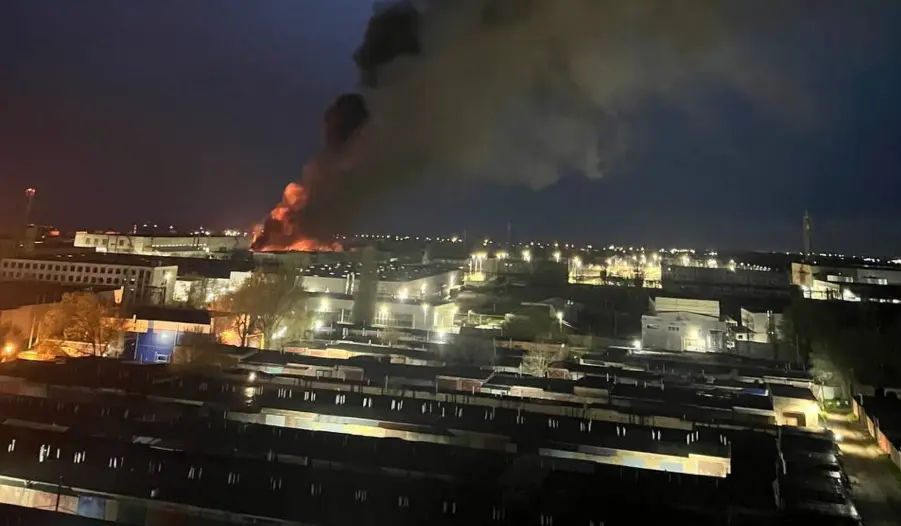
What purports to be a fire burning at a drone plant following reported Ukrainian missile strikes in Taganrog, Rostov Oblast, Russia. (Exilenova Plus/Telegram)
Rostov Oblast Governor Yuri Slyusar acknowledged a Ukrainian strike but described the target only as “commercial infrastructure” and a “warehouse area.” This is becoming a pattern: Russian regional governors confirm destruction but obscure targets, hoping to minimize the psychological impact of Ukraine reaching so far and so precisely into Russian territory.
This was the third strike on the Atlant-Aero plant. Ukraine hit it January 13. Again on March 30. Now April 19. Three strikes in twelve weeks on a single drone manufacturing facility — the same methodical approach ISW analysts have documented across Ukraine’s deep strike campaign: identify, hit, return, repeat.
In the same overnight window, Ukrainian forces struck a seaport in Yeysk, Krasnodar Krai. Ukrainian drone strikes also hit Russian equipment depots near occupied Manhush, Topolyne, and Mariupol — all roughly 100 kilometers from the front line — as well as materiel warehouses near occupied Smile and fuel tanks near Novopoltavka in Zaporizhzhia Oblast. A full night’s work.
$2.3 Billion in March: Ukraine’s War Against Russia’s Oil Economy
Before a single soldier fires a rifle, Russia needs oil revenue. It funds the army, the weapons production, the salaries, the occupation. Ukraine has decided to strike the source.
Zelensky announced on April 19 that Ukrainian long-range strikes on Russian oil infrastructure cost Moscow at least $2.3 billion in lost oil revenue in March alone. In the previous 48 hours, Ukrainian forces had struck four additional oil industry facilities. The USF Commander Brovdi stated that systemic strikes on Russian oil infrastructure — including refineries in Tuapse and terminals in Ust-Luga — are costing Russia approximately $100 million daily, slashing Russia’s oil shipments by roughly 880,000 barrels per day.
Ukraine also clarified the damage from its April 15-16 strikes against the Tuapse oil refinery in Krasnodar Krai: the strikes damaged the refinery’s oil processing unit and storage tanks, as well as oil loading berths, additional buildings, and storage at the Tuapse port oil terminal.
The irony of the current moment is almost too sharp to state plainly: as Ukraine destroys Russian oil infrastructure, global oil prices have been volatile. Brent crude rose to nearly $120 a barrel in March — driven by the U.S.-Israeli war with Iran — before falling back below $90 on April 17 after a ceasefire between Israel and Lebanon took hold. The IMF, accounting for higher energy prices, upgraded Russia’s 2026 growth forecast to 1.1 percent.
Into this environment, the U.S. Treasury Department on April 17 quietly extended a temporary waiver allowing countries to purchase Russian oil stranded at sea — through May 16. This came two days after Treasury Secretary Bessent had publicly said the waiver would not be renewed. U.S. Ambassador to the UN Mike Waltz, appearing on NBC’s “Meet the Press,” called criticism of the move “ridiculous” and framed it as pragmatic market management. Zelensky was direct in response: “This decision will bring no real benefit to diplomacy — and every dollar from oil only encourages Russia to continue the war.”
Senate Democrats called the extension “shameful.” Senate Democrats’ estimates suggest Russia earned an additional $150 million per day — more than $4 billion by the time the first waiver expired — due to market conditions tied to the war in Iran. The oil flows. The war continues.
A Spring Offensive That Isn’t: Russia’s Scattered Mechanized Assaults
The maps of eastern Ukraine tell the story of a grinding war. Every day, small arrows mark small movements. Most do not persist. Most do not matter. But they must still be defended.
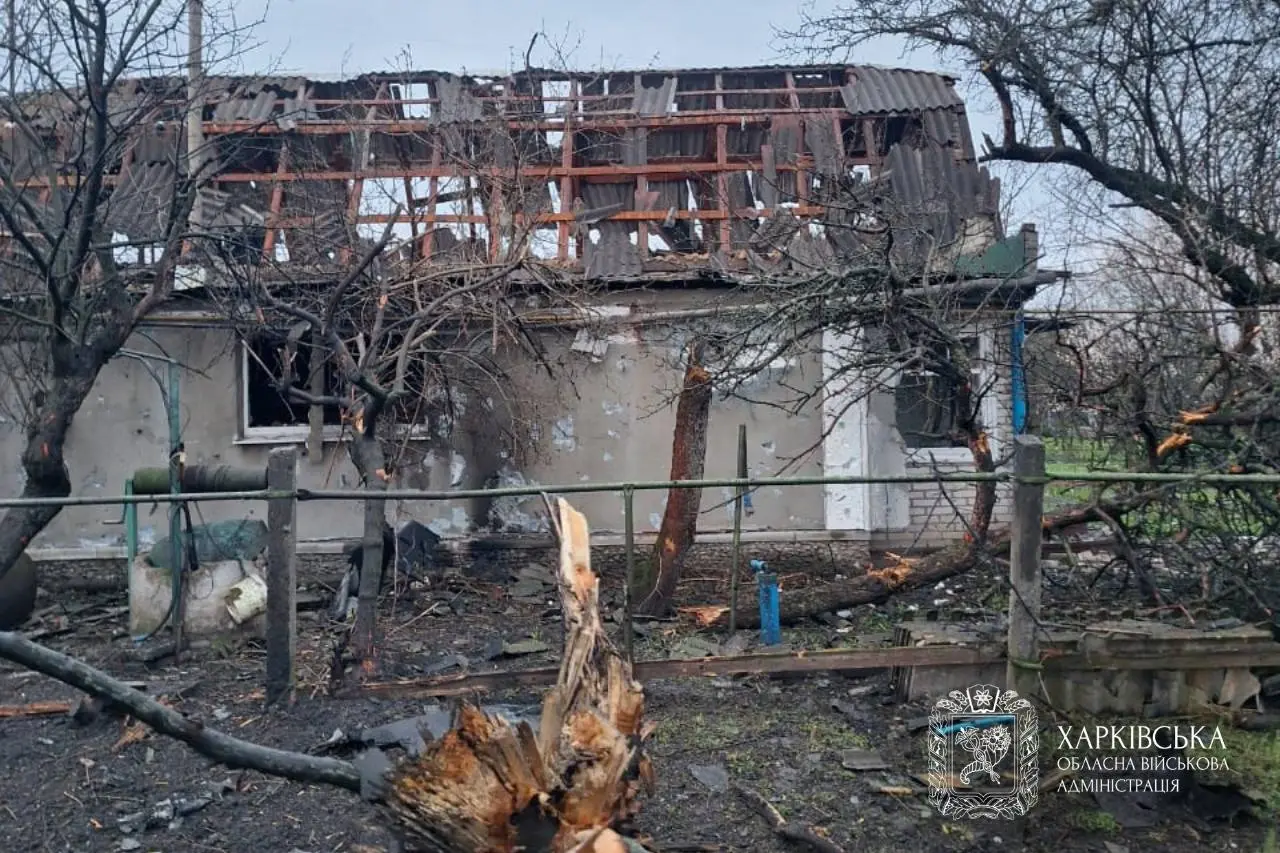
Aftermath of a Russian overnight attack on Kharkiv Oblast. (Local authorities/Telegram)
In the 48 hours spanning April 18-19, Russian forces conducted four platoon-sized or smaller mechanized and motorized assaults across the theater. Two roughly platoon-sized mechanized assaults east of Chasiv Yar, northeast of Kostyantynivka, on April 18 and 19. A motorized assault of multiple Ural transport trucks and at least six motorcycles east of Svyatopetrivka, northwest of Hulyaipole, on April 18. A roughly platoon-sized mechanized assault near Kucherov in Kursk Oblast on April 19. ISW analysts assessed that none of the four produced tactically significant gains and three did not appear to have breached the current line of contact.
These assaults may have served as reconnaissance-in-force operations: probing Ukrainian defenses, testing responses, looking for soft spots before committing larger units. They may also reflect a deliberate Russian cognitive warfare strategy — projecting simultaneous pressure across many axes to suggest imminent Ukrainian collapse, without actually committing resources sufficient to achieve it.
The Russian spring-summer 2026 offensive’s stated priority is Slovyansk — the northern tip of Ukraine’s Fortress Belt in Donetsk Oblast. But Ukrainian forces have restrained Russian advances in the Slovyansk direction and across other pressure points: Vovchansk, Kharkiv Oblast; northwest from Pokrovsk; west from Hulyaipole toward Orikhiv; and along the western bank of the Kakhovka Reservoir. In the Hulyaipole direction specifically, Russian forces conducted 21 ground assaults on April 19 — approximately 50 percent more than the previous day — but made no confirmed advances.
Near Lyman, a different kind of problem: constant Russian fiber-optic FPV drone strikes have made it impossible for Ukrainian forces to restore destroyed anti-drone nets, according to the Lyman Military Administration Head. FPV drones — first-person view kamikaze drones — are small, cheap, and guided by operators watching live video through goggles. Fiber-optic models cannot be jammed by electronic warfare. When they destroy the protective netting meant to stop other drones, they create a vicious cycle.
Ukrainian forces also struck Russian equipment depots near Mariupol and warehouses in Zaporizhzhia Oblast overnight, continuing their mid-range strike campaign against Russian military assets well behind the contact line.
Ray’s Workshop: Inside Ukraine’s War of Constant Adaptation
The room smells of solder and urgency. Batteries, wires, frames, and small components lie across tables and the floor. Men move quickly, packing equipment for transport to front positions. In the corner, a live feed shows six FPV drones in flight, side by side, on a monitor.
This is a former countryside dacha outside Kharkiv, transformed into a small drone laboratory for the Khartia Brigade. The man at the center of it, known by his call sign Ray, is 47 years old. Before the war, he ran a small workshop in western Ukraine making camera adapters — precision metalwork, tolerances down to hundredths of a millimeter. “That was the best decision I could have made,” he says of the engineering courses he took in 2024, before he joined Khartia. He built a drone from spare parts. He learned to fly. He got certified.
Now Ray repairs drones, prepares them for specific missions, and adapts supplied models to front conditions. He picks up different types one by one, explaining their uses. Some are one-way FPV kamikazes built for impact. Others return — logistics drones that drop food, water, or small supplies to infantry on the zero line, where driving a car has become nearly impossible. Hexacopters like the Vampire can carry and drop several mortar rounds before heading back. Standardization is essential: too many different models create maintenance nightmares. “With a limited number — let’s say around 10 — it’s much easier to tweak and adjust them,” Ray explains.
On the screen, a brief flare: one of Ray’s drones has released its payload. A target burns. No one reacts. They turn back to work.
The threat is constant and evolving. Russian forces have begun copying Ukrainian supply packages dropped on the zero line — replacing food and water with explosives. A soldier picked one up and was severely wounded, losing his eyes and arms. The packages are now marked more clearly, with names and position identifiers. “The biggest danger,” Ray says, “is underestimating the enemy.”
Outside the workshop, a reconnaissance drone is shot down overhead as we leave. They rush to the car. Titan, the driver, points out the increased drone danger on roads at dusk. In a field beside the road, camouflaged positions appear beneath netting, blending into the terrain. Somewhere beyond the concrete towers of Saltivka, a training ground hums with rifle fire that doesn’t stop.
From the Tram Stop to the Trench: A Kharkiv Soldier Named Extra
He was at a tram stop when they approached him. On his way back from visiting his grandmother in Kharkiv’s Slobidskyi district — an industrial, residential area that has absorbed repeated Russian drone strikes. Recruitment officers. February 2024.
Extra, 28 years old, had worked in a supermarket warehouse before the war. Organizing deliveries. Stocking shelves. “Completely civilian,” he says, with a small smile. “No connection to the army at all.” But when the officers approached, he was ready. “There was no shock. No fear. I accepted it consciously.”
He served first with the State Border Service, then transferred to the Khartia Brigade, drawn by the unit’s reputation for serious preparation. The training system runs on repetition: one week topography and tactics, the next medicine, engineering, and fire training, rotating in cycles. “Everything I do here helps me. You repeat it until it becomes automatic.”
His last combat mission was not a firefight. It was a pump. Meltwater from the long winter had begun flooding his unit’s dugout position. If it reached the generator, power and communications would fail — the position would go dark, become useless. For three weeks, Extra’s unit pumped water, dug, reinforced trenches, spread displaced soil carefully so it wouldn’t appear as a fresh mound on drone surveillance footage. “You cannot leave anything near the position. Drones will see it.”
He knows people who have avoided conscription — men in his own circle who are afraid. He doesn’t argue with them. “They are very afraid. Of explosions, of contact. It doesn’t make sense to try to convince or even force them.” He pauses. “Let them stay there. I protect them.”
He pulls his safety goggles back down, reaches for his helmet. Another drill is beginning. Beside the training range, a paper target bearing Vladimir Putin’s face lies torn in the grass, carried by the wind. It drifts slowly across the field. Then it’s gone.
More Than 200 Companies, 300 Developments: Ukraine’s AI Drone Economy
It does not look like a defense ministry announcement. It looks like a technology conference. Over 200 companies. More than 300 AI-related developments registered on Ukraine’s Brave1 defense technology platform. Seventy-plus AI and computer vision systems already active on the battlefield.
Ukraine’s Defense Ministry reported on April 18 that the country is rapidly building a defense technology market centered on artificial intelligence. AI systems are already being used on the front line for autonomous drone targeting, detecting camouflaged enemy equipment and personnel, operating automated firing positions, and analyzing battlefield data through systems like Delta — a battlefield awareness platform that aggregates intelligence from multiple sources.
The ministry is building a network of military technology centers focused on key areas: mid-range and deep strikes, ground robotic systems, and artillery. The first hub, the Defense AI Center “A1,” is expected to develop solutions for battlefield operations and optimize military processes. Defense Minister Mykhailo Fedorov was direct: “Technological advantage is critical in modern warfare. We must be faster than the enemy at every stage.”
Ukraine is also training AI models on real combat data through the Brave1 Dataroom platform — providing developers with datasets from actual battlefield conditions: different weather, times of day, sensor types. Through programs called Avengers Labs and Test in Ukraine, foreign companies can train AI models on Ukrainian battlefield data and test technologies in live combat conditions. The ministry reported that Ukraine signed its first agreement with Germany on defense data exchange and joint military technology projects on April 14.
The goal is to equip all deployed drones with machine vision and AI capabilities — removing the human from the loop for targeting, while keeping humans accountable for the decisions. It is a bet that the side that automates faster will outlast the side that scales humans.
Sofia Swings Toward Moscow: Bulgaria’s Election and Europe’s Fragile Flank
One week after Hungary’s Viktor Orban was swept from power in a historic defeat, another European capital delivered a very different verdict.
Bulgaria’s snap parliamentary election on April 19 produced a commanding victory for Progressive Bulgaria, the coalition led by former President Rumen Radev. With over a third of votes counted, Radev’s alliance held 44 percent of the vote — roughly 30 percentage points ahead of the second-place party. Radev declared an “uncontested victory.” The current results would place the center-right GERB coalition led by former Prime Minister Boyko Borisov in third place. Borisov appeared to concede on Facebook after polls closed.
Radev’s record on Ukraine is unambiguous. He has criticized EU aid to Kyiv, called Ukraine’s resistance a “doomed cause,” urged Brussels to stop “pouring weapons” into Ukraine, denounced Bulgaria’s ten-year security deal with Kyiv, and opposed Ukrainian membership in both NATO and the European Union. He once told Zelensky directly, during a 2023 meeting in Sofia, that Bulgaria would not be pulled into conflict. The exchange was not warm.
Bulgaria joined the EU in 2007 and adopted the euro on January 1, 2026 — a decision Radev questioned. The country’s political landscape has been turbulent, with several elections in recent years and seven caretaker governments during Radev’s presidential tenure. His base draws from former socialist politicians and Kremlin-adjacent sentiment in a country that is predominantly Orthodox and Slavic-speaking, with historically warmer attitudes toward Russia than most EU members.
Despite the margin of victory, Progressive Bulgaria will still need coalition partners to govern. And Radev faces the same constraint every EU member does: unanimity requirements on sanctions and aid mean that even a single blocking vote matters enormously. The Kremlin has learned to play this geometry with patience. After Orban’s removal from Budapest, Sofia may now become the most important square on that board.
Orban’s Last Gambit: The Druzhba Pipeline, the €90 Billion Loan, and a Message from Budapest
He lost the election. He does not quite govern anymore. But Viktor Orban is not yet done.
On April 19, the outgoing Hungarian Prime Minister posted on X that Budapest had received signals — through Brussels — that Ukraine is prepared to restore oil transit via the Druzhba pipeline as early as April 20, provided Hungary lifts its blockade of a planned €90 billion EU loan to Kyiv. “Once oil deliveries are restored, we will no longer stand in the way of approving the loan,” Orban wrote.
The Druzhba pipeline is a Soviet-era network that delivered Russian crude to Hungary and Slovakia via Ukrainian territory. It went offline after Kyiv reported it was damaged in a Russian strike in western Ukraine. Budapest and Bratislava accused Ukraine of deliberately withholding transit and began blocking the EU loan in retaliation. Zelensky said in early April that Ukraine was willing to restore oil flows if it was a condition of the loan and that repairs would be completed by spring.
Orban lost to Peter Magyar’s Tisza party in a landslide on April 12. Magyar has not committed to continuing Orban’s EU loan blockade and told reporters he did not see why the loan was causing issues, since Hungary is not financially obligated to contribute. Magyar may assume the prime ministership as early as May 9. Until then, Orban’s Fidesz party still represents Hungary in Brussels — meaning Orban retains leverage for a few more weeks.
Neither Kyiv nor Brussels confirmed Orban’s claim that oil flows could resume April 20. Ukraine’s Foreign Minister Sybiha is expected to attend an EU Foreign Affairs Council meeting on April 21 to discuss unblocking the funds. The signal, if real, would be a significant development — unlocking funds that have been stalled for months while Ukrainian forces fight without them.
Baltic Closure: Three Countries Refuse Fico’s Flight to Moscow’s Victory Parade
There is a specific kind of diplomatic contempt expressed through airspace.
Slovakia’s Prime Minister Robert Fico announced on April 18 that Lithuania and Latvia had refused to allow him to fly through their airspace to attend Russia’s May 9 Victory Day military parade in Moscow. On April 19, Estonia confirmed it would do the same. Estonian Foreign Minister Margus Tsahkna said Tallinn would not permit the use of its airspace for flights to an event “aimed at glorifying the aggressor.”
Fico, who has consistently opposed EU support for Ukraine and is widely regarded as one of Moscow’s closest allies within the European Union alongside the departing Orban, attended Russia’s Victory Day parade in 2024 despite calls from EU foreign policy chief Kaja Kallas to boycott the event. He has indicated he will find another route this year, as he did last time. On May 9, Russia stages elaborate military parades commemorating the end of World War II in Europe — celebrations that critics say serve primarily to justify the current war against Ukraine.
The Slovak Foreign Minister separately threatened on April 19 to veto the EU’s 20th sanctions package against Russia unless Bratislava receives assurances regarding the Druzhba pipeline situation. Slovakia, like Hungary, has made its cooperation on European Ukraine policy contingent on energy guarantees it frames as vital national interests.
The Baltic refusal is symbolic but not merely symbolic. It says: you chose the wrong parade. And you will need to find a longer route to get there.
From Rome: Pope Leo XIV Speaks as Russia Sends 236 More Drones
He took the papacy after the war had already entered its fourth year. He has called for peace repeatedly. This time, he spoke after a week that included a mass missile attack killing 17 civilians, a supermarket massacre in Kyiv, and Easter ceasefire violations numbering nearly 11,000.
Pope Leo XIV posted on X on April 19: “I am deeply saddened by the recent escalation of attacks against Ukraine, which continue to afflict civilians.” He expressed solidarity with those suffering and renewed his appeal for dialogue. “I renew my appeal for weapons to fall silent and for the path of dialogue to be pursued.”
Before becoming pope — then known as Robert Prevost — Leo XIV had criticized Russia’s full-scale invasion of Ukraine. Since assuming the papacy, he has consistently called for a just and lasting peace and offered the Vatican as a venue for negotiations. Zelensky supported the proposal. Russian officials rejected it. Foreign Minister Lavrov stated the previous week that resuming peace talks was not a “top priority” for the Kremlin.
Zelensky and Leo XIV spoke by phone on April 3 to discuss peace negotiations and Kyiv’s proposal for an Easter ceasefire. In the weeks since, Russia reportedly violated the brief truce nearly 11,000 times, continued striking civilian transportation, and launched the mass ballistic missile attack. The Vatican’s overtures have found no purchase in Moscow. But they have found an audience in Kyiv, and in the churches of a country that has spent more than three years burying its dead.

Show Trials in Moscow: A Ukrainian Soldier Sentenced to 15 Years for Kursk
Russia called it terrorism. Ukraine called it a military operation. The difference matters enormously to the man serving 15 years for it.
Russia’s 2nd Western District Military Court sentenced Andrii Hrynchyshyn, a 46-year-old member of Ukraine’s 22nd Separate Mechanized Brigade, to 15 years in prison — five years in a full prison, the remainder in a high-security penal colony. The charges: carrying out a “terrorist act” as part of a group. Russian investigators claimed Hrynchyshyn crossed into Kursk Oblast on February 14, 2025, armed with an AK-74 rifle and grenades, and participated in the “armed blockade” and “illegal occupation” of the village of Guyevo in the Sudzha district. He was captured on April 9, 2025, during combat operations.
This case is part of a broader wave of prosecutions targeting Ukrainian prisoners of war captured during Ukraine’s August 2024 cross-border operation into Kursk Oblast. Ukrainian forces initially seized up to 1,300 square kilometers of Russian territory before Russia counterattacked with approximately 12,000 North Korean troops and ultimately pushed Ukrainian forces out. Russia has consistently characterized the Kursk operation as terrorism rather than conventional warfare — a legal framing that denies POW status and enables prosecution.
Ukraine and international observers have condemned such trials as politically motivated and as violations of international law, citing lack of due process and reports of mistreatment of Ukrainian POWs in Russian custody. The Kyiv Independent could not independently verify the Russian claims. What is verifiable: a Ukrainian soldier who entered Russian territory in uniform, under orders, during active combat operations, is serving 15 years in a Russian prison while his case is called a terrorist act.
“Fundamental Crisis”: A Russian Factory Director Speaks the Unspeakable
In Russia, telling the truth about the economy carries its own kind of risk. Vladimir Boglaev, director of the Cherepovets Casting and Mechanical Plant — which produces machinery and machine tooling components in Vologda Oblast — decided to speak anyway.
Boglaev stated on April 17 that Russian contractionary economic policies have “overcooled” the Russian economy to the point that some experts are warning of a “fundamental crisis.” He questioned where the Russian government was obtaining its economic data, noting that Russian economists had been warning about overcooling for long enough that the current problems should not have been surprising. He suggested the government may not have access to accurate data at all.
A prominent Russian milblogger responded that this is not an information problem but a political crisis: regional and industry officials have been sending rosy, distorted reports up the chain of command, leaving top leadership without an accurate picture of reality. Another prominent milblogger, responding to a repeat Ukrainian strike against a defense industrial facility in Rostov Oblast, called on Russian authorities to relocate all defense industrial base facilities east of the Ural mountain range — far beyond Ukraine’s current strike range — to protect them.
Boglaev’s candor is notable in part because Ukraine recently struck the Cherepovets plant itself in high-profile attacks. His public complaints arrive alongside declining Putin approval ratings — acknowledged even in Russian state-run polls, which have shown weekly drops since early March — and a Leningrad Oblast governor’s public acknowledgment of Ukrainian strike impacts on his region. These are not the sounds of a society fully insulated from the war it started.
The overcooling critique points to a specific Russian economic trap: to fight the war, Russia has poured money into military production and raised interest rates to control inflation. Those high interest rates have cooled the broader civilian economy, reducing the capacity to produce the very import substitutions Russia needs as Western sanctions bite. The war is making the economy worse. The worse economy makes the war harder to sustain. The cycle turns.
Somewhere outside Kharkiv, Ray soldered microchips by hand in a room that could become a target by morning. In Chernihiv, a family buried a 16-year-old boy. In Kyiv, investigators tried to understand why a man born in Moscow walked into a supermarket with a weapon. On the Black Sea, a robotic boat launched a drone that killed another drone.
April 19 contained all of it: the technological breakthrough and the civilian body count, the world-first intercept and the 16-year-old who did not see it. In Sofia, voters chose a man who called Ukraine’s resistance a doomed cause. In Washington, a sanctions waiver was extended that Zelensky said only encouraged Russia to continue. In Rome, a pope offered prayers. In Moscow, a court sentenced a Ukrainian soldier to fifteen years for entering Russia in uniform.
The war did not move much today. It rarely does, in a single day. But it moved.
A Prayer for Ukraine
1. For the Boy Who Died Before the Morning Was Over
Lord, a 16-year-old boy was sleeping, or waking, or beginning his day, when the drone found Chernihiv. His name has not been printed in these pages. We do not know it. But we ask that You do — that You hold him, fully known, in whatever mercy awaits those who die too young and too violently, for no reason except that they lived under a sky that belongs to a war they did not start. Grant his family the grace to grieve in a country that has no safe hours for grief.
2. For the Women of Balabyne
Father, three women — 59, 63, 85 years old — were wounded by guided bombs in a village in Zaporizhzhia. They were not soldiers. They were not near the front. They were simply present in a place where life had continued, however precariously. We pray for their recovery. We pray for the physicians who treated them. And we ask You to hold in particular tenderness those who have survived long enough to become elderly in a war that will not let them simply be old in peace.
3. For the Six Who Were Shopping
God of justice, six people entered a Kyiv supermarket on Saturday and did not come home. They went in for bread, for milk, for whatever ordinary purpose ordinary life still provides in a city three years into bombardment. A man with a weapon ended them. We do not yet know all the reasons. We do not need to know them to grieve the deaths. Receive these six into Your keeping. Comfort the twelve-year-old boy who survived his wounds. And grant investigators the clarity to find whatever truth is still waiting to be found.
4. For Ray and Extra and the Men Who Maintain the Line
Lord, there are men soldering circuits in dark rooms outside Kharkiv, men pumping floodwater from frozen dugouts, men drilling in fields while rifle fire runs without pause. They are not famous. They are not photographed. They are the reason the line holds. Extra said it plainly: “I protect them,” meaning the people who could not bring themselves to serve. Grant these men the steadiness they need, the rotations that let them sleep, and the sense — if it can be granted — that the work is not futile, even on the days when it feels most like it is.
5. For Justice, in the Time That Remains
In Your mercy, in Your justice, in Your time — bring this war to its end, and let the ending be worthy of what Ukraine has endured.