
Ukraine Daily Briefing | April 20, 2026 | Day 1,517 of the Full-Scale Invasion
Russia attempted to assassinate Ukraine’s foremost drone and electronic warfare expert overnight, sending four jet-powered Shahed drones to destroy his home outside Kyiv — a brazen targeted killing that he survived with minor injuries and a defiant photograph posted from hospital. While that hunt unfolded, 142 Russian drones struck cities from Kharkiv to Sumy, killing at least three people in Nikopol and hospitalizing a ten-year-old boy in Kryvyi Rih, even as Ukrainian drones set the Tuapse oil refinery ablaze on the Black Sea coast. And in an interview on April 20, Zelensky called it “disrespectful” that U.S. peace envoys had traveled to Moscow multiple times but had never come to Kyiv — while Sweden’s intelligence chief delivered his verdict on Russia’s economic future: “living on borrowed time.”
The Day’s Reckoning
Before dawn on April 20, four drones found a house in Kyiv Oblast. They were not hunting a power station or a military base — they were hunting a man. The man was Serhii Beskrestnov, callsign “Flash,” Ukraine’s most prominent public voice on drone technology and electronic warfare, an advisor to the Defense Ministry who had spent years mapping the invisible arms race in the skies above the trenches. He survived. His house did not.
That same night, 142 Russian drones fanned out across Ukraine. In Nikopol — a city that looks across the Dnipro River at Russian-occupied territory and the Zaporizhzhia Nuclear Plant — three people were killed and seven wounded. In Kryvyi Rih, a ten-year-old boy was hospitalized. In Kharkiv, drones struck a gas station. In Sumy, apartment buildings shook and a seventeen-year-old was taken to hospital.
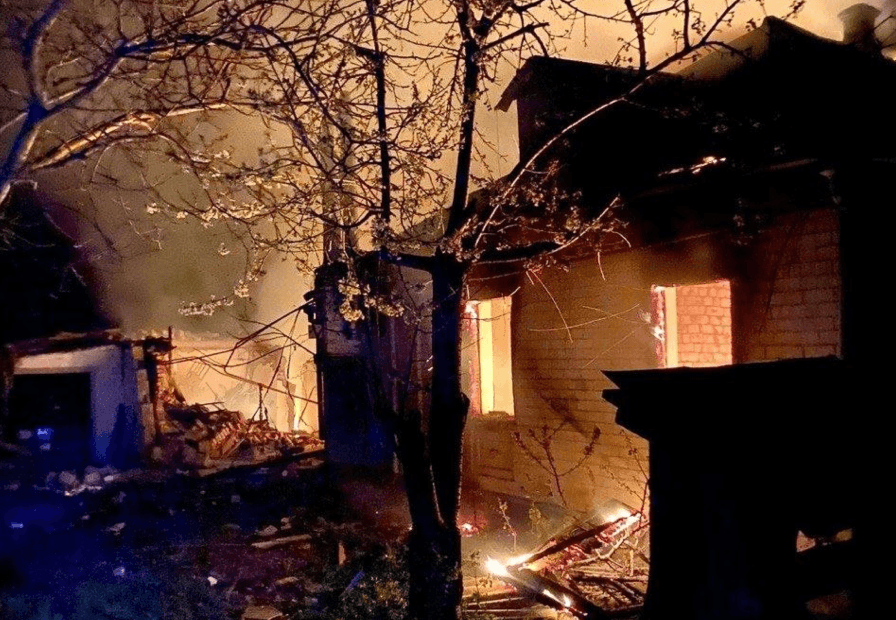
A home is damaged following Russian strikes on Dnipropetrovsk Oblast. (Oleksandr Hanzha/Telegram)
Far to the south, Ukrainian drones found the Tuapse oil refinery in Krasnodar Krai. Large flames rose from storage tanks on the Black Sea coast. Krasnodar Krai’s governor confirmed the strike. Ukraine’s General Staff said nothing yet — but the fires confirmed everything.
In an interview on April 20, Zelensky said the path to ending the war is simple: stop fighting along the current contact line. Russia refuses. Sweden’s top intelligence officer chose this same day to say publicly what Western governments have been reluctant to say plainly: Moscow is fabricating its economic statistics, hiding a $30 billion budget deficit, and the Russian economy is heading toward disaster. The day held, compressed into its hours, the entire shape of the war.
“Tonight the Russians Tried to Kill Me”: The Hunt for Flash
Most people who write about drones do so at a safe distance. Serhii Beskrestnov did not. For years, his Telegram channel — “Serhii Flash: Everything About Technology” — had been essential reading for anyone trying to understand Ukraine’s battlefield revolution. He documented how fiber-optic drones defeated jamming. He analyzed Russian mesh networks. He catalogued innovations and failures on both sides with the precision of an engineer and the clarity of someone who understood what the stakes were.
In January 2026, Defense Minister Mykhailo Fedorov appointed him as an official technology advisor. That appointment, it appears, made him a target.
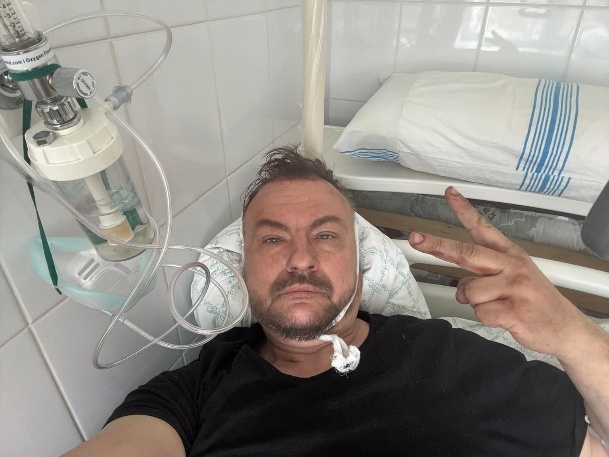
Serhii Beskretnov, an advisor to Ukrainian Defense Minster Mykhailo Fedorov, pictured in a selfie from hospital, posted after he survived a Russian drone strike on his home outside Kyiv. (Serhii Beskretnov / Facebook)
Overnight on April 20, four jet-powered Shahed drones — faster and harder to intercept than the propeller-driven variants — were directed at his home in Kyiv Oblast. Ukrainian air defenses downed two of them. Two reached the house. One hit the wall.
“I no longer have a home,” he wrote from hospital, posting a defiant photograph. “I was hurt, but the main thing is that I am miraculously alive. I was mentally prepared for this development of events, and it will not stop me.”
Beskrestnov noted this appeared to be the first time Russia had used Shahed drones as a precision assassination weapon against a specific individual — an escalation in targeting doctrine with implications for every Ukrainian official, expert, and analyst whose identity is not a secret. He added, characteristically from a hospital bed, that his data suggests roughly 20% of Russian Shaheds are now controlled online via mesh networks — a detail he shared because he is constitutionally incapable of withholding useful information.
Kyiv Oblast authorities had reported a 51-year-old man injured in the drone attack and taken to hospital in stable condition. That man, it emerged, was Beskrestnov.
142 Drones, One Night: Nikopol’s Dead and a Boy in Kryvyi Rih
The Russian strike package launched overnight on April 19 to 20 was enormous: 142 drones dispatched from Bryansk, Kursk, Oryol, Rostov Oblast, Smolensk Oblast, Krasnodar Krai, occupied Donetsk City, and occupied Crimea simultaneously. The Ukrainian Air Force reported on April 20 that 113 were downed or suppressed by jamming. Twenty-eight struck 18 locations. Debris fell at six more. The strike package included approximately 100 Shahed-type drones — among them jet-powered variants — alongside Gerbera-type and Italmas-type long-range drones.
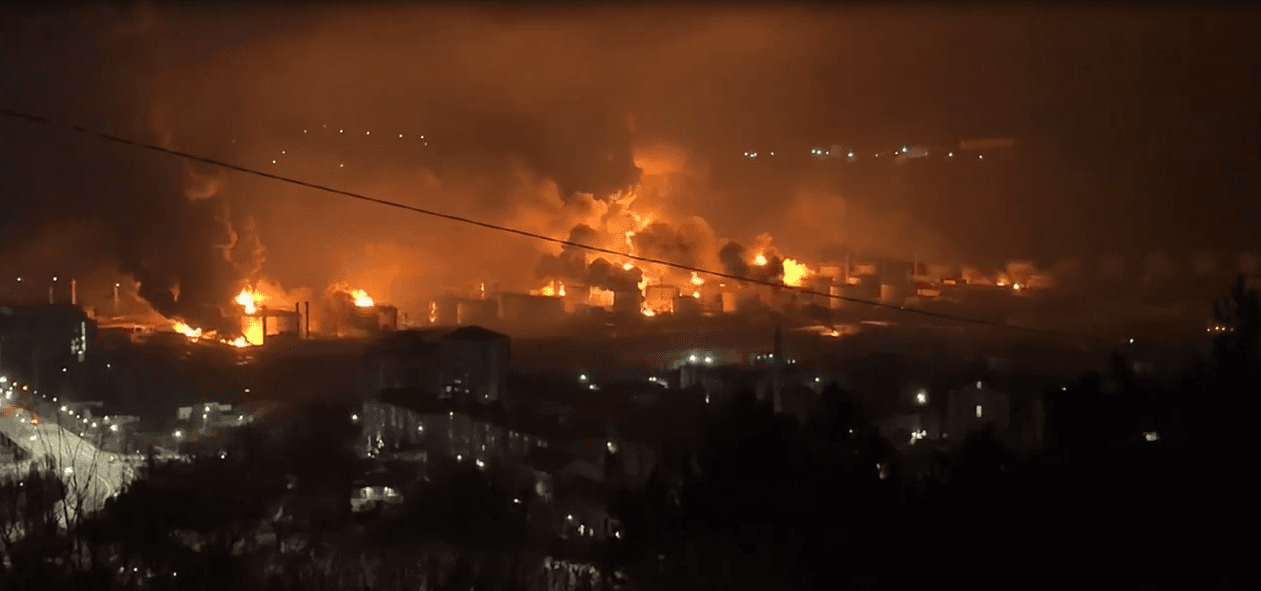
A screenshot from a purported video of the fire at the Tuapse Oil Refinery in southern Russia’s Krasnodar Krai overnight amid a Ukrainian drone attack on the region. (Exilenova_plus/Telegram)
In Nikopol, three people were killed and seven wounded. The city sits directly across the Dnipro River from Russian-occupied territory; on a clear day, residents can see the cooling towers of the Zaporizhzhia Nuclear Plant. Several residential buildings, a home, and cars were destroyed. A man who had been critically wounded in a Russian attack on the city of Dnipro on April 14 died in hospital on April 20 — his death counted in this day’s toll.
In Kryvyi Rih, a ten-year-old boy was hospitalized after Russian strikes reached the city. In Kharkiv’s Osnovianskyi District, seven people were injured in a drone strike; three more were hospitalized when a drone hit a gas station in Bohodukhiv, setting it ablaze. In Sumy Oblast, three people were hurt in three separate drone attacks, including a seventeen-year-old. Russian strikes also damaged energy and residential infrastructure in Chernihiv and Zaporizhzhia oblasts, and public safety infrastructure in Chernihiv Oblast during the afternoon of April 20. Drone strikes hit residential buildings in Brovary — Kyiv’s largest suburb, 20 kilometers from the capital — injuring at least one person and damaging two homes.
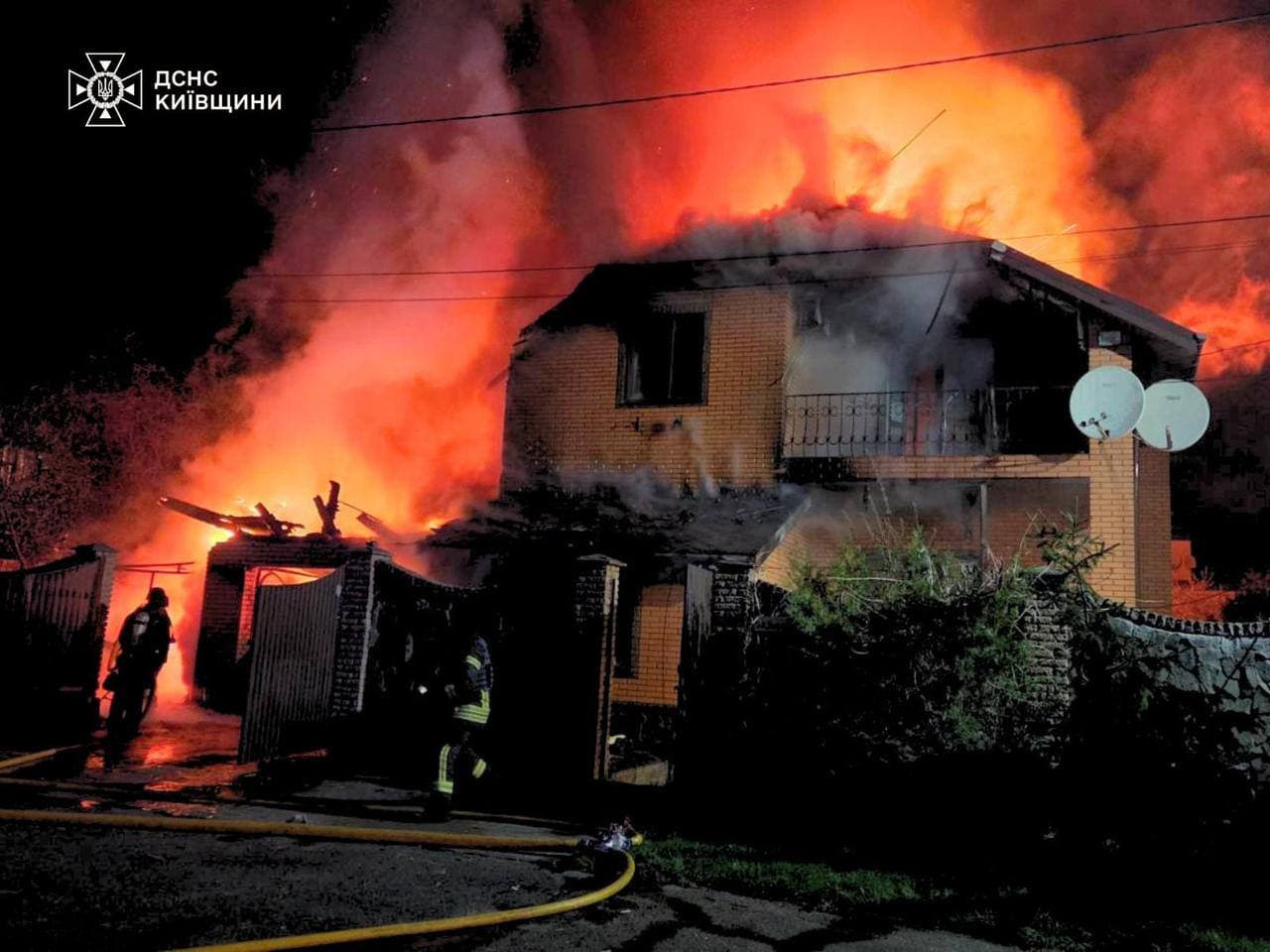
The aftermath of a drone strike on a home in the city of Brovary in Kyiv Oblast. (Ukraine’s State Emergency Service/Telegram)
In total, Russian attacks on April 20 killed at least one person and injured 26 others, according to regional authorities’ consolidated reporting. The true toll of the overnight drone wave will take longer to count.
Tuapse Burns: Drones Reach the Black Sea Refinery
The Tuapse oil refinery is one of Russia’s ten largest, capable of processing approximately 12 million tons of crude oil annually, operated by Rosneft on the Black Sea coast of Krasnodar Krai. On the night of April 19 to 20, Ukrainian drones reached it. Geolocated footage published on April 20 confirmed large fires at the refinery. Krasnodar Krai Governor Veniamin Kondratyev acknowledged the strike “at the seaport of Tuapse,” reporting one person killed and another injured.
The Ukrainian General Staff confirmed that Ukrainian forces struck the oil tank farm at the Tuapse refinery overnight, causing the fire. At least two storage tanks were burning, according to footage reviewed by open-source analysts.
The reach of the strike — deep inside Russia’s southern region, targeting infrastructure that processes millions of tons of oil — reflects a sustained Ukrainian campaign to reduce the revenue flowing into Moscow’s war budget. Zelensky had stated on April 19 that long-range strikes on Russian oil infrastructure cost Moscow at least $2.3 billion in lost oil revenue in March alone. The Tuapse strike extended that campaign into April 20.
Russian ultranationalist television network Tsargrad offered an inadvertent commentary on the state of governance in the region: it criticized Krasnodar Krai authorities for sending “beautiful reports” that present false information to Moscow while prioritizing keeping beaches open for summer tourists despite ongoing Ukrainian strikes and recent oil spills. The criticism — a nationalist channel indicting local officials for lying upward — echoed, in miniature, what Sweden’s intelligence chief was saying about Russia’s national statistical apparatus on the same day.
Sevastopol: GUR Confirms Warship Strikes, Radar Destroyed
Ukraine’s Main Military Intelligence Directorate published geolocated footage and formal confirmation on April 20 of strikes on Russian naval vessels in Sevastopol Bay. GUR reported that its elements struck the Yamal Ropucha-class large landing ship and the Nikolai Filchenkov Tapir-class large landing ship — both of the Black Sea Fleet — overnight on April 18 to 19. A GUR-published radar installation strike was also confirmed: a Podlyot-K1 ground-based air defense radar in occupied Sevastopol was destroyed.
Open-source analysts examining satellite imagery assessed the vessel identifications may differ slightly — suggesting the ship hit on April 18-19 may have been the Olshansky rather than the Yamal, and that the SBU had earlier struck the large intelligence ship Slavutych. The Ukrainian General Staff separately confirmed on April 20 that Ukrainian forces struck an oil depot in occupied Hvardiiske, Crimea, overnight on April 19 to 20.
The April 20 GUR publication is the formal reporting of these strikes — the day’s confirmation event, even where the physical strikes occurred in the preceding 48 hours. Ropucha-class vessels are amphibious landing ships; Tapir-class ships carry heavy vehicles and troops across water. Their degradation reduces any future Russian capability for waterborne assault. The destruction of a Podlyot-K1 radar removes a layer from Russia’s air defense umbrella over the peninsula.
Ukrainian Mid-Range Strikes: Air Defense Systems, Ammunition, Drones
Ukrainian Unmanned Systems Forces Commander Major Robert “Magyar” Brovdi reported on April 20, with geolocated footage confirming, that Ukrainian forces struck a Russian S-350 Vityaz air defense system in Novooleksandrivka in occupied Donetsk Oblast — approximately 130 kilometers from the front line. The S-350 Vityaz is a medium-to-long-range surface-to-air missile system designed to intercept aircraft, cruise missiles, and ballistic missiles. Its destruction degrades Russia’s ability to protect its own rear from Ukrainian strikes.
On the same night, Brovdi confirmed a strike on a Russian Tor-M2KM air defense system near occupied Melitopol in Zaporizhzhia Oblast — approximately 76 kilometers from the front line. The Tor-M2KM is a short-range mobile air defense system; its destruction opens gaps in Russia’s protective coverage of southern occupied territory.
The Ukrainian General Staff reported on April 20 that Ukrainian forces also struck Russian ammunition depots near Loknya in Belgorod Oblast, approximately 46 kilometers from the international border — part of a sustained mid-range interdiction campaign targeting Russian logistics before supplies reach the front. Overnight, Ukrainian forces additionally struck a Russian ammunition depot near occupied Urzuf in Donetsk Oblast (roughly 100 kilometers from the front line), a drone depot near Novaya Karakuba (roughly 50 kilometers), and a command and observation post near Blahodatne (roughly 60 kilometers).
The pattern across all these strikes is consistent: Ukraine is systematically targeting the infrastructure that allows Russia to sustain offensive pressure — air defenses, ammunition stocks, drone depots, command posts — reaching deep enough behind the front that Russian forces cannot easily defend all of it simultaneously.
The Frontlines on April 20: No Breakthroughs, Considerable Pressure
Ukrainian officials pushed back on April 20 against escalating media speculation about Russian advances in northern Sumy Oblast. The Joint Forces Task Force stated explicitly that Russia is not threatening to semi-encircle Sumy City, and that Russian forces have only managed to seize villages directly on the Ukrainian-Russian border. Ukraine’s Kursk Group of Forces reported the situation in its area of responsibility stable. Separately, geolocated footage published on April 20 confirmed Russian forces attempting to infiltrate south of Varachyne — north of Sumy City — through a gas pipeline, in roughly reduced company strength using light equipment. It was the second such pipeline infiltration attempt since April 14.
In northern Kharkiv Oblast, Russian forces continued offensive operations and infiltration missions on April 20 but did not advance. A Kremlin-affiliated milblogger acknowledged that large numbers of Ukrainian drones are preventing Russian forces from consolidating recently seized positions near Okhrimivka and Karaichne, northeast of Kharkiv City. Ukrainian forces counterattacked near Zakharivka. In the Kupyansk direction, Russian forces did not advance; a Ukrainian drone unit commander reported on April 20 that Russian forces have begun using motorcycles due to the appearance of spring foliage, attempting to move through tree cover before drone operators can acquire them.
In Donetsk Oblast, Russian State Duma Defense Committee Deputy Chairperson Alexei Zhuravlyov stated on April 20 that the situation is a “positional standoff” with advances occurring in “hundreds of meters” per week — and that Russian forces could take “months” to seize Slovyansk and Kramatorsk. In the Pokrovsk direction, Russian forces continued offensive operations on April 20 but made no confirmed advances; the Ukrainian 7th Rapid Reaction Corps published footage of striking a Russian troop concentration in Hryshyne. In the Novopavlivka and Oleksandrivka directions, Russian forces continued limited operations on April 20 but did not advance. In the Kherson direction, Russian forces continued limited operations in the Dnipro River Delta on April 20 but did not advance.
In western Zaporizhia Oblast, Russian forces continued limited offensive operations on April 20 but did not advance. In the Hulyaipole direction, Russian forces continued infiltration missions on April 20 but made no confirmed advances.
“Living on Borrowed Time”: Sweden’s Intelligence Chief Breaks Russia’s Economic Fiction
Sweden’s Military Intelligence and Security Service has spent years studying how Moscow represents its own economy to the world. On April 20, Lieutenant General Thomas Nilsson gave an interview to the Financial Times that went public with the conclusion: Russia is systematically fabricating its statistics.
Russian inflation is not 5.86%, as the Kremlin reports. Swedish intelligence assesses it is closer to 15% — consistent with the Central Bank’s own interest rate, which no institution sets that high for an economy with near-price stability. Russia has understated its budget deficit by approximately $30 billion. Defense industrial sectors outside the drone industry are lossmaking, dependent on state bank loans, and riddled with corruption. Russia would need Urals crude to remain above $100 per barrel for at least a year just to close the budget deficit — not to resolve the broader economic deterioration, which would require sustained high prices even longer.
“The Russian economy can only enter one of two scenarios: long-term decline or shock,” Nilsson told the Financial Times. “Either way, they will continue on a downslope to a financial disaster.” Russia is “living on borrowed time,” he said.
GDP contracted by 1.8% over the past two months after slowing to 1% annual growth in 2025. Putin has publicly called for economic revival measures twice in April. The Swedish assessment matters most for what it says about Russia’s negotiating posture: Moscow presents itself at the table as a power that can sustain the war indefinitely. Sweden’s intelligence service — with every incentive to be precise — says that is false, and that the Kremlin knows it. “If you have created a system like Putin has,” Nilsson said, “he might not know how bad the economic situation really is. But even with the false info he gets, you ultimately can’t run from all of this.”
“Disrespectful”: Zelensky Confronts the Asymmetry of American Diplomacy
Jared Kushner and Steve Witkoff have flown to Moscow multiple times. They met Vladimir Putin in January. They have held talks with Ukrainian officials in Miami. They have not come to Kyiv.
In an April 20 interview with Ukrainian outlet ICTV, Zelensky said what Ukrainian officials had been saying privately for months. “It’s disrespectful to come to Moscow and not Kyiv,” he said. “I understand we have complex logistics… If they don’t want to, we can meet in other countries.”
Zelensky outlined Ukraine’s position on a ceasefire with unusual clarity: halt fighting along the current contact line. This, he said, is the simplest possible framework — and Russia refuses. Moscow’s counter-demand is that Ukraine withdraw from Donbas, the territories it still controls. “If the only condition is to withdraw, then it looks like they agreed without us,” he said of the American-brokered process.
He also raised a question no security guarantee architecture has answered: if there are no allied troops on the contact line, what prevents Russia from resuming the offensive after a ceasefire? Trump promises he can guarantee security — but Trump leaves office in roughly two and a half years. “Then what will we do?” Zelensky asked. He explained Ukraine’s refusal to withdraw from Donbas: defensive fortifications would be lost, 200,000 civilians would be abandoned, military morale would collapse. “An urbanized zone is still stronger than any defense lines in a field.”
The Kyiv Shooting: Two Officers Charged, a Patrol Chief Resigns
On April 20, two Kyiv police officers were formally served with suspicion notices — charged with official negligence leading to serious consequences — for their conduct during the April 18 mass shooting at a supermarket in the city’s Holosiivskyi district, where a gunman killed at least seven people and wounded 14 others, including a 12-year-old boy. If convicted, they face two to five years in prison. Prosecutors are seeking pre-trial detention.
Prosecutor General Ruslan Kravchenko released body camera and surveillance footage at the April 20 announcement. The footage shows the officers arriving at the scene, encountering multiple victims — including a man, a woman, and a young boy. The boy can be heard on camera pleading with the officers to help his father rather than him. The gunman then reappears and opens fire again. The officers retreated. The head of Ukraine’s patrol police, Yevhen Zhukov, resigned on April 19 amid the public outrage.
The shooting has been reclassified as a terrorist act. The gunman — a 58-year-old Moscow-born man who had lived in Donetsk Oblast, served in the Ukrainian Armed Forces until retirement in 2005, then moved to Russia, and returned to Ukraine in 2017 — was shot dead by police. His motive remains under investigation. The case is ongoing; April 20 brought the first formal criminal accountability for the institutional failure that allowed the body count to rise.
France Joins the Special Tribunal: “No Peace Without Justice”
France announced on April 20 that it will join the steering committee of the Special Tribunal on Russia’s aggression against Ukraine — a body being constructed specifically to prosecute the crime of aggression, which falls outside the jurisdiction of the International Criminal Court for states not party to the Rome Statute.
Foreign Minister Jean-Noel Barrot made the announcement at a Council of Europe meeting. His formulation was precise: “There is no peace without justice. And there is no justice without truth.”
The steering committee now includes Austria, Costa Rica, Croatia, Estonia, France, Germany, Latvia, Lithuania, Luxembourg, Moldova, the Netherlands, Slovenia, Spain, Sweden, the United Kingdom, and Ukraine — meeting the minimum threshold required to establish the body. France’s addition carries both symbolic and practical weight, making it harder for Russia to dismiss the tribunal as a project of smaller states with limited geopolitical standing.
What the tribunal aims to do is legally unprecedented in the post-WWII order: prosecute the political leaders who ordered an aggressive war, not merely the soldiers who carried out its atrocities. April 20 moved it one significant step closer to existing.
Europol’s Digital Hunt: 45 Leads on Deported Ukrainian Children
Europol announced on April 20 the results of a two-day digital investigation held on April 16-17 in The Hague, coordinated alongside the International Criminal Court and NGO partners, bringing together 40 experts from 18 countries. The operation produced 45 reports containing leads that could help locate Ukrainian children who were forcibly transferred or deported from Russian-occupied territories.
The material gathered is operational rather than abstract: possible transportation routes used to move children across the border, individuals who may have enabled the deportations including orphanage directors, military units that may have assisted in transfers, camps and facilities where children were taken, and online platforms containing photographs of the children. Investigators also found evidence suggesting some deported children may now be connected to Russian military units.
Ukrainian authorities place the total number of forcibly removed children since the full-scale invasion began at more than 19,500. The forced transfer or deportation of children constitutes a war crime under international law. The ICC is already examining cases connected to this issue. April 20’s Europol announcement is the third such operation — the second specifically focused on Ukrainian children — turning scattered digital traces into leads that investigators in Ukraine and partner countries can actually act on.
Russia Buys Drones for Kindergartens: $213 Million to Militarize a Generation
Russian independent media outlet Novaya Gazeta Europe published an investigation on April 20 revealing that Russian educational institutions — from universities to preschools — have spent more than 16 billion rubles, approximately $213 million, on drones for “educational purposes.” Before the full-scale war, the annual figure was around 350 million rubles. The acceleration is not subtle.
The investigation found drones being purchased by kindergartens, including the “Little Light” preschool in Tyumen Oblast and the “Pearl” kindergarten in Yuzhno-Sakhalinsk. One of the primary contract recipients is a St. Petersburg company, Geoscan — linked to a foundation chaired by Yekaterina Tikhonova, Vladimir Putin’s daughter.
The purchases are framed as education. What they represent is the preparation of Russian children for future wars — a program of militarization that begins before children can read, designed to normalize weapons, normalize military service, and fill the ranks that four years of grinding combat have begun to hollow out. April 20’s report quantifies, with rubles and contract numbers, what had previously been visible only anecdotally.
Ukraine Standardizes the Fiber-Optic Drone: One Station for the Front
Ukraine’s Defense Ministry announced on April 20 that troops will begin testing a new standardized control station for fiber-optic drones — a single device designed to replace the three to five incompatible controllers that operators currently carry to their positions. The incompatibility problem is not theoretical: multiple drone systems in use across the front require different ground stations, creating logistical strain and reducing the time available for combat missions.
Fiber-optic drones — weapons that transmit control signals through a thin physical cable rather than radio frequencies — are among the most significant tactical innovations of this war. Because they communicate by wire, not radio, Russia cannot jam them with electronic warfare. They have become essential tools for close-range combat where the electromagnetic environment is saturated with jamming. The new unified station is analog, the type most commonly used by Ukrainian units; a digital version and broader rollout will follow.
The project was developed with Serhii Sternenko, a prominent Ukrainian activist and volunteer who has served as a ministry advisor since Fedorov’s appointment in January 2026. Defense Minister Fedorov framed the announcement in terms of the broader campaign: “Following the president’s directive, we are destroying the enemy across all domains: on land, in the air, and in the economy. To achieve this, we are systematically removing barriers and providing the military with tools that deliver results.”
EU Reform at 87%: Kos Praises Ukraine, Cautions on Backsliding
EU Enlargement Commissioner Marta Kos appeared before the European Parliament’s foreign affairs committee on April 20 to assess the state of EU candidate countries. Her assessment of Ukraine was striking in its context: Ukraine’s rate of implementing EU-required reforms stands at 87%, second only to Moldova’s 93% — and that progress, Kos noted pointedly, is being achieved “in spite of bombs falling on the country, in spite of the country fighting for their lives, for survival.”
Kos called for stronger safeguards built into accession treaties to prevent future backsliding — a lesson from watching Hungary’s trajectory after membership. She acknowledged that the EU’s accession methodology, designed for peacetime, is roughly the same as it was 40 years ago, and proposed flexible paths including “gradual integration” that would allow progress in specific areas to unlock early access to EU benefits. The de facto opening of EU accession talks — the actual cluster-by-cluster negotiations — may begin within weeks.
Kos repeated her view that the 2027 membership deadline Zelensky has named is “impossible” — but added that Zelensky “needs assurance that they will be able to become a member of the EU.” The diplomatic translation: the timeline is unrealistic, but the destination must remain credible, or the reform incentives collapse.
Ukraine Signs Gulf Defense Deals; IMF Flexibility on VAT
Zelensky announced on April 20 that Ukraine has concluded 10-year defense cooperation contracts with Saudi Arabia, the United Arab Emirates, and Qatar, including at least 10 drone export contracts. Ukraine has received requests for cooperation from 11 countries across the Middle East. The deals represent Ukraine’s drone industry earning hard currency and projecting technological credibility — transforming a country fighting for survival into an arms exporter with a roster of serious customers.
On the financial front, Ukrainian Prime Minister Yulia Svyrydenko reported on April 20 that the IMF has acknowledged a key program condition — a new VAT tax on self-employed entrepreneurs — is “non-constructive.” Negotiations will continue on alternative revenue measures for the 2027 budget. Ukraine’s $8.1 billion IMF program, disbursed in tranches over four years, remains in place. What changes is the path to meeting one of its benchmarks — a significant concession from a fund that rarely reopens agreed conditions.
The Weight of the Day
Serhii Beskrestnov posted a photograph from his hospital bed. He was smiling. His house was ash somewhere in Kyiv Oblast, destroyed by the same weapons he had spent years studying — and he was already thinking about the next thing the enemy would try, already composing the next analysis.
In Nikopol, families were counting their dead within sight of a nuclear plant. In Tuapse, refinery workers were cataloguing the damage. In The Hague, investigators were building a digital map of where children had been taken. In Kyiv, a boy on camera had asked police to help his father instead of him, and the police had run.
Sweden’s intelligence chief says Russia is living on borrowed time. The borrowed time is measured in the lives of people in Nikopol, in the floors of a ten-year-old’s hospital room in Kryvyi Rih, in the house that used to belong to a man called Flash. The calendar keeps turning. The arithmetic keeps being made.
A Prayer for Ukraine
1. For the Three Who Died in Nikopol
Lord, they were not soldiers. They were people living in an ordinary city, within sight of a nuclear plant, within range of drones launched by a state that calls its actions a special operation. We do not know their names tonight. We know that someone does — family members, neighbors who are now doing the terrible arithmetic of grief. Hold them in the hollow of your hand, those who died and those who remain. Let this city’s suffering not disappear into a dateline.
2. For the Ten-Year-Old Boy in Kryvyi Rih
Father, a child was taken to hospital tonight. He is ten years old. Whatever he was dreaming before the drone found his neighborhood — whatever game he had left unfinished — it was interrupted by forces he cannot understand and did not invite. Heal him. And beyond healing, protect him from the wound that comes from learning, at ten, that the world is built like this: that grown men in distant buildings make decisions that arrive as fire through bedroom windows.
3. For Serhii “Flash” Beskrestnov
God of the living, a man woke up this morning without a house and posted a photograph showing he was still fighting. He had spent years making himself useful — documenting the weapons, mapping the invisible war, speaking clearly when clarity costs something. For that he was hunted. Sustain him in recovery and in resolve. And extend that mercy to every analyst, expert, volunteer, and journalist whose knowledge makes them a target — the people whose work the soldiers depend on, who therefore cannot afford to stop.
4. For the Defenders Holding Every Direction
Lord, the front is a thousand kilometers of human endurance. Tonight soldiers in Sumy are watching for pipeline infiltrations. In Kharkiv they are flying drones against troops on motorcycles in spring foliage. In Donetsk they are holding settlements measured in hundreds of meters of contested ground. In Zaporizhzhia they are striking air defense systems 76 kilometers behind enemy lines. They are doing technical and physical and moral work simultaneously. See them. Strengthen them. Bring them home.
5. For the 19,500 Children
God of justice, forty investigators in eighteen countries spent two days building a digital map of where 45 children went after Russian forces took them. There are 19,500 more names behind those 45. Children in Russian schools, being taught a history in which their own country does not exist. Children whose photographs exist on platforms investigators have only begun to search. Children whose connection to who they were is being methodically severed. We do not ask for patience. We ask for justice, and for the speed that justice requires. In Your mercy, in Your justice, in Your time — bring this war to its end, and let the ending be worthy of what Ukraine has endured.