
The Ukraine Daily Briefing · Saturday, October 24, 2026
Prepared by Diana Bozhyk
Ten days after Ukraine’s satellite links were throttled, Starlink and Starshield came back at full speed, and Zelensky thanked Congress, the press and President Trump. Overnight, a Ukrainian drone attack near the main substation feeding occupied Crimea was followed by blackouts that left Sevastopol with power in only 40 percent of its apartment buildings, and struck chemical plants in Tolyatti and Omsk. Russian drones killed a young farm worker near Konotop and gravely wounded a 14-year-old boy near Nikopol, as both sides confirmed that the Oleshky truce will begin on Tuesday morning.
The Day’s Reckoning
For ten days, Ukraine’s interceptor drones had been losing their link to the sky whenever they flew faster than 161 kilometers an hour, too slow to catch Russia’s jet-powered Shaheds. Overnight into Saturday, the connection began to return. By morning, the Defense Ministry recorded speeds above 400 kilometers an hour and a stable signal. “The most important development for today,” Zelensky called it.
That is the plot of this Saturday: a tool restored, and both sides putting it to use. Before dawn, Ukrainian drones flew at the substation that links occupied Crimea to Russia’s power grid, satellites picked up a fire there, and lights went out from Sevastopol to occupied Donetsk. Then Elon Musk wrote that Ukraine had “violated” Starlink’s terms and that without it Ukraine’s front “would collapse immediately.” Ukrainian officials answered within hours.
On the ground, the war did not pause for any of it. A woman who would have turned 32 in a few days was killed at a cattle farm in the Sumy region. And in Oleshky, about 2,000 people now know the date their road might open: Tuesday, 3 a.m.
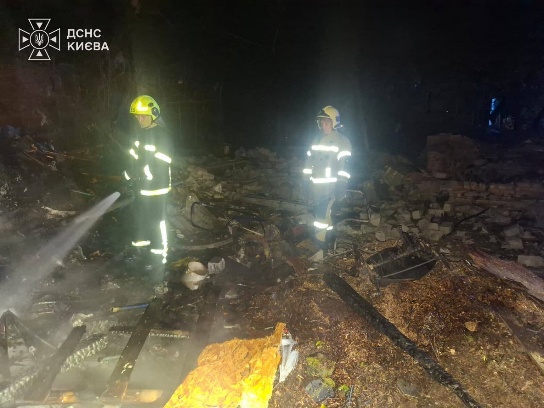
Emergency Service workers at the site of a Russian drone strike in Kyiv’s Obolon District, Kyiv, Ukraine. (DSNS Kyiv/Telegram)
Full Speed
You fly interceptor drones near Kyiv. For ten days, every time you chased a jet-powered Shahed, your drone lost its link as it passed 161 kilometers an hour. On Saturday morning, it didn’t.
“Starlink and Starshield operations have been restored to the speeds that existed prior to all these restrictions,” Zelensky said in a video address. “The restoration began overnight, and by this morning the speeds were already sufficient for operational use. This is very important and significant for our front-line logistics and for defending Ukraine against jet-powered Shaheds.” He thanked “all Americans and all our partners who took this seriously and truly helped us. I thank members of Congress, senators, all the media, the State Department, and the President.”
Defense Minister Yevhen Khmara confirmed it: “We are recording speeds of over 400 km/h, and the connection is stable.” Kyiv Post reported that Ukrainian specialists had earlier driven Starlink-equipped vehicles into EU territory, where the terminals ran without interruption at 180 kilometers an hour, to show the limit was deliberate. The cap had also hampered ground robots carrying medical kits, food and water to isolated front-line positions. On Friday, British Prime Minister Andy Burnham had raised Ukraine’s Starlink access with Trump, his office said.
Then Musk spoke. Ukraine’s “military violated Starlink terms of service and used it for offensive drone strikes to kill people. That loophole was closed last week,” he wrote on X. “Were Starlink to be turned off, the Ukrainian front line would collapse immediately. This is not a threat, it is simply a statement of fact.” He said SpaceX had done more than any company to help Ukraine.
Ukrainian officials rejected the claim. Serhii Sternenko, a former Defense Ministry adviser, said that since February any terminal used on the move had to be on a special list connected to the military Starshield system. “As someone who was inside the process at the Ministry of Defense, I can say with certainty that this is not true,” he wrote. Presidential adviser Serhiy “Flash” Beskrestnov said commercial Starlink terminals in Ukraine are limited to 70 to 90 kilometers an hour and do not work over Russian territory. “Thus, we physically cannot use commercial Starlink for deep strikes and medium-range strikes,” he wrote. “It is very strange that Elon Musk is not aware of Starlink restrictions in Ukraine.”
Zelensky said one problem was solved and another was not. “It is very important that deliveries of air defense interceptors – interceptors against Russian ballistics – are renewed,” he said. “There are packages that we are still awaiting. These include packages from America and from European partners – packages for which political decisions have already been adopted.”
The Lights Go Out in Crimea
You live in Sevastopol. On Saturday morning, your building is one of the 60 percent without electricity.
Overnight, Ukrainian drones struck near the village of Bely in Russia’s Krasnodar region, about 69 kilometers from Ukraine’s border. Russian officials said only that drone debris fell at a substation. NASA fire satellites showed heat at the Taman substation, which the Ukrainian defense outlet Militarnyi called the main node joining all four lines of the “energy bridge” that carries Russian power into occupied Crimea. Russia’s Energy Ministry blamed an “external impact” for outages in Crimea and in occupied parts of the Kherson, Zaporizhzhia, Donetsk and Luhansk regions. Sevastopol’s occupation governor, Mikhail Razvozhaev, said public facilities had switched to backup power and only 40 percent of apartment buildings had electricity.
Ukraine also hit deep. The General Staff said its forces struck the Tolyattikauchuk plant in Tolyatti, in the Samara region, about 775 kilometers from Ukraine, which makes synthetic rubber that the General Staff said is used in solid rocket fuel for tactical and ballistic missiles. “Damage to such objects affects the supply chain of raw materials for the Russian missile program,” it said. The city’s mayor acknowledged damage to industrial sites, and local channels reported evacuations at the nearby AvtoVAZ car plant. Ukraine had struck Tolyatti’s chemical plants before, on April 4 and September 12. Ukrainian forces also hit an aircraft at the Yeysk airfield on the Sea of Azov; the General Staff did not say what type, and the damage is still being assessed. In occupied Zaporizhzhia, Russian-installed leader Yevgeny Balitsky blamed the outages there on a Ukrainian strike on a main grid node outside the region.
Some 2,500 kilometers from the border, in Siberia, a fire broke out at the Omsky Kauchuk petrochemical plant in Omsk, which monitoring channels linked to rocket-fuel supply, and a logistics hub of online retailer Ozon was hit. Omsk’s governor confirmed the drone attack on the logistics hub and said staff were evacuated. Ukrainian drones have repeatedly targeted Ozon and its rival Wildberries, whose wider businesses make up about 8.5 percent of Russia’s economy, the Kyiv Independent reported, because their warehouses often store dual-use goods. The General Staff also confirmed that Friday’s strike in Oryol damaged the main production building of the Proton-Electrotex plant, which makes parts for Iskander-M missiles, Kover cruise missiles and Pantsir air defenses.
A Farm, a Warehouse, a Boy in Pokrovske
You work at a cattle farm in the Konotop district of the Sumy region. On Saturday, a Russian drone hit the farm.
A 31-year-old woman, standing at the center of the blast, was killed; she would have turned 32 in a few days, Governor Oleh Hryhorov said. Four other people were wounded, two of them hospitalized with injuries not considered critical, and livestock were killed. “Russia continues to strike civilian enterprises, destroy farms, and take the lives of people who were simply carrying out their work,” he said.
In the Pokrovske community of the Nikopol district, a Russian drone injured four people, among them a 14-year-old boy who was taken to a children’s hospital in Dnipro in critical condition. A 46-year-old man was hospitalized in serious condition, and two other adults were treated at the scene. In Lozova, in the Kharkiv region, a Russian missile hit a commercial warehouse and set it ablaze; a 45-year-old man died despite medics’ efforts, and two men were wounded. “Medics fought for the life of the victim, but the injuries proved fatal,” Governor Oleh Syniehubov said. In Zaporizhzhia, a strike on an infrastructure facility wounded two people and set cars on fire.
Overnight, Russia launched 126 drones, 61 of them jet-powered, and Ukraine downed 101. Just before 4 a.m., jet drones maneuvered over Kyiv, and one hit a private house in the Obolonskyi district, starting a fire and injuring two people.
Across Ukraine, regional authorities counted four killed and 78 injured over the past day. In the Kharkiv region, seven were wounded, including a 12-year-old girl and a 13-year-old boy, and homes, businesses and gas stations were damaged or destroyed, Governor Syniehubov said. Six were hurt when Russian forces struck residential areas across the Kherson region, and three in the Odesa region, where Russia hit a recreational building, an administrative building and a warehouse. In the Sumy region, the air-raid alert sounded for more than 18 hours, and 40 attacks injured five.
Oleshky: Three Days to Go
The dates now match. Ukraine’s General Staff confirmed it will observe a ceasefire in a “designated area” of occupied Oleshky from 3 a.m. Kyiv time on Tuesday, October 27, the same moment as Russia’s announced 4 a.m. Moscow time. ISW said the geographic extent and other terms remain unclear.
Ombudsman Dmytro Lubinets said the agreement includes demining the road to the town, deliveries of food, water, medicine and medical equipment, and safe passage for civilians. He told European Parliament Vice President Pina Picierno the news, and she ended the hunger strike she began on Tuesday. “It is time to act together, so that diplomacy delivers concrete results and no one is left to die in silence,” she had said when she began.
Zelensky said Ukraine would do its part in what he called an “extremely difficult” operation. “In the temporarily occupied part of our Kherson region, the Russians have mined roads, making the situation difficult – extremely difficult,” he said. “We hope this humanitarian operation will succeed: unblocking Oleshky, providing access to deliver food and medicine, and allowing people to leave this combat zone.”
He also said Ukrainian delegations are preparing consultations in Europe next week with representatives of President Trump and European allies. “Europe must be involved in the diplomatic process,” he said. “Ukraine always involves European partners in diplomatic efforts and counts on their continuation next week.” The White House has estimated that 1,700 to 2,000 people remain in Oleshky, most of them elderly, about 50 of them children. A U.S. official told Sky News that the next round of three-way talks among Ukrainian, American and Russian delegations could come “in a couple of weeks,” in Abu Dhabi or Switzerland. “The goal would be to build to a leader-level meeting eventually, but much work remains to be done before that happens,” the official said.
The Line Near Kharkiv
You hold a position near Vilcha, northeast of Kharkiv. The Russians keep coming at you down the same paths, because the land leaves them no other way.
That is what Col. Viktor Trehubov, spokesman for Ukraine’s Joint Forces Group, described on Saturday: Russian troops attacking toward Vilcha, Vovchanski Khutory and Bilyi Kolodyaz, forced by the terrain to reuse the same routes, which helps Ukrainian forces spot and strike infiltrators. North of Kupyansk, he said, Russian troops pass through Holubivka but cannot stay there, and rarely manage to enter Radkivka except in bad weather. ISW said Ukrainian drone and underground operations are denying Russia a staging ground for infiltrating Kupyansk from the north.
The fighting was heaviest to the south. A Ukrainian brigade near Pokrovsk said Russia mounted its largest motorized assault of the year in the brigade’s sector on October 21, sending motorcycles and other vehicles forward at dawn in poor visibility; Ukrainian troops repelled it, killing 43 Russian soldiers and wounding 12. ISW confirmed a Russian advance into central Bilytske, southeast of Dobropillia, where Ukrainian aircraft struck a Russian position.
Elsewhere, Russian attacks near Lyman, east of Sloviansk, around Kostiantynivka, near Velykyi Burluk and toward Borova made no confirmed gains. Near Orikhiv, Ukrainian forces counterattacked, and a Russian blogger said they were also pushing toward Perebudova along the Mokri Yaly River. Russian bloggers claimed advances toward Novosoloshyne, 12 kilometers beyond any confirmed Russian position near Hulyaipole; ISW called it part of a pattern of fabricated success. A Russian source said troops southeast of Sumy were rotating, and a Russian blogger claimed small gains north of Marivka, near Novopavlivka, which ISW did not confirm. In northern Sumy, ISW saw no evidence of Russian advances, and neither side reported ground fighting in the Kherson direction.
Russia also kept hunting civilians. Footage showed a Russian drone striking a person walking a dog in the Kherson region, a practice ISW calls “human safari.” In Sloviansk, a Russian fiber-optic drone struck a civilian evacuation vehicle, and over the past day a 62-year-old woman was killed and four people were injured in the city, Mayor Vadym Lyakh said. In Zaporizhzhia, footage showed Russian strikes on the cable-stayed bridge over the Dnipro, part of Moscow’s campaign against the river crossings that carry Ukraine’s economy and supplies. Militarnyi reported that Russia has fielded two redesigned Geran-5 variants, the K5-K, built to reach 900 kilometers an hour, as fast as a Kh-101 cruise missile.
Also Today
New Ukrainian sanctions. Zelensky imposed sanctions on 83 Russian citizens and 79 companies tied to missiles, aircraft, armored vehicles and drones, including the aluminum giant RUSAL. Ukrainian intelligence says Russia is stockpiling about 700 ballistic missiles.
A Russian hand in Alaskan gas. The New York Times reported on Friday that Russia’s sanctioned Novatek secretly funded Polar LNG, a U.S. company planning to export gas from Alaska, a project discussed in White House-Kremlin talks. Its former chief executive, John Riddle, said he resigned after learning of the ties. Novatek confirmed it seeks a minority stake. The Times said Witkoff and Kushner had discussed the technology deal with Putin in September; it is unclear whether they knew of the hidden funding. Another reported deal would sell parts of Russia’s Lukoil to the U.S. government and other investors, including some with ties to Kushner and Witkoff.
Germany eyes Ukraine’s Bars. A German official said Berlin is negotiating to buy Ukraine’s Bars jet-powered drones, which fly up to 1,000 kilometers at 700 kilometers an hour. Ukraine launches about 2,000 of them a month at Russian refineries and power plants, and the two countries agreed in July to produce them jointly. Bloomberg reported that Germany plans to buy thousands of cheap deep-strike weapons to overwhelm enemy air defenses, as Washington warns of years-long delays for American missiles. Germany is already Ukraine’s biggest foreign partner in defense tech, with 36 joint ventures, according to the Kyiv School of Economics.
A Ukrainian lab in Finland. Ukrainian firm Sine Engineering, which makes GPS-free drone navigation for about 200 drone producers and was chosen in March as the first project of the U.S.-Ukraine Reconstruction Investment Fund, announced a research center in Finland to develop communications, navigation and autonomy. It hopes to grow its Finnish team to 100 people by year’s end and wants the project included in the two countries’ Drone Deal signed on September 23.
“A sham talk.” Former Prime Minister Arseniy Yatsenyuk warned in Lodz against any Trump-Putin-Xi summit without Ukraine, comparing it to Munich in 1938 and Yalta in 1945, and said Kyiv’s interceptor stocks are “practically zero,” estimating that Russia can fire 70 to 120 ballistic missiles a month. Still, he urged Ukraine to keep bipartisan U.S. support: “We need Americans in, but not out.” He blamed high fuel prices on the war with Iran, not on Ukraine’s refinery strikes.
Border pressure. Ukraine’s border service said Russian strikes on western checkpoints since late August, plus the EU’s new biometric entry system, have complicated crossings, though traffic remains steady at 35 to 37 million crossings a year.
The Closing
Tonight, Ukraine’s interceptor drones can fly fast again, and the man whose satellites carry them says Ukraine’s front would collapse without them. In Sevastopol, the lights are out in most apartment blocks. Near Konotop, a family is mourning a daughter days before her birthday. And in Oleshky, a mined road waits for Tuesday. Ukraine asked only for what it had been promised. Today, some of it came back.
A Prayer for Ukraine
1. For Those Who Defend
Lord of hosts, guide the drone pilots who rise against jet-powered Shaheds, now with full speed restored. Protect the soldiers near Vilcha, Kupyansk, Pokrovsk, Bilytske and Orikhiv, who hold the line as Russia sends men forward on motorcycles in the fog. Watch over the crews who bring food and water to isolated positions, and bring every one of them home.
2. For the Wounded and the Grieving
God of all comfort, receive the young woman killed at the farm in Konotop district, days before her thirty-second birthday, the man lost in the warehouse in Lozova, and the woman of Sloviansk. Heal the fourteen-year-old boy in critical condition in Dnipro, the girl and boy wounded in Kharkiv region, and every family hurt in Kyiv, Zaporizhzhia, Kherson and Odesa. Comfort the farm families who lost their animals and their friend.
3. For Those Who Lead
King of kings, give President Zelensky wisdom as he seeks the interceptors his people need and a peace that does not reward the aggressor. Bless the members of Congress, the officials and the journalists who spoke up for Ukraine, and move every leader who has promised help to deliver it before the winter. Let the coming talks be honest, and let Europe have its seat.
4. For Oleshky and the Captives
Faithful God, clear the mines from the road to Oleshky before Tuesday comes. Let the food, the water and the medicine reach the hungry and the old, and let every person who wishes to leave walk out safely. Strengthen those who negotiated this mercy, and remember every Ukrainian still held in Russian captivity until they too come home to the families who wait for them.
5. For a People Who Keep Standing
Father, Ukraine keeps standing through blackouts, sirens and broken promises, and it keeps giving thanks for every hand that helps. Sustain the farmers, the doctors, the border guards and the volunteers who keep life going under fire. In Your mercy, in Your justice, in Your time — bring this war to its end, and let the ending be worthy of what Ukraine has endured.