
On June 11, 2026, Ukrainian drones struck the last intact bridges linking occupied Crimea to mainland Ukraine and caught fifty Russian supply trucks bottlenecked at Armyansk — the same night a strike set the Afipsky oil refinery ablaze in Krasnodar Krai. In Sevastopol, the occupation governor admitted the fuel trucks simply never arrived, canceling gasoline rations in a city Moscow has held for twelve years. And along NATO’s northern frontier, satellite imagery revealed Russia quietly pouring concrete for the barracks of its next war.
The Day’s Reckoning
Picture a convoy of fifty Russian military trucks idling bumper to bumper on the road through Armyansk, the narrow neck of land where Crimea hangs from mainland Ukraine. They are loaded with fuel and ammunition, rerouted here because the other bridges are already broken. The drivers do not know they have been herded into a kill zone.
By morning, the convoy is burning, the bridge behind it is out of commission, and a Russian monitoring channel concedes what Kyiv has been engineering for weeks: every land route from occupied Kherson Oblast into Crimea is, at least temporarily, severed.
The strangulation radiates outward. In Sevastopol, gas pumps sit dry and ration coupons are canceled. In Krasnodar Krai, Russia’s Afipsky refinery burns for at least the fifth time. In Kyiv, the commander-in-chief publishes arithmetic showing Russia now loses more soldiers than it recruits. And on NATO’s northern border, Russia builds barracks for a war it has not yet started.
A peninsula seized in triumph twelve years ago is becoming a trap. The question now is who escapes it first.
“No Intact Bridges Left”: The Night Ukraine Cut Crimea Loose
The explosions began after dark and marched across the map of occupied southern Ukraine like a fuse burning toward the peninsula. Bridges over the North Crimean Canal near Preobrazhenka and Myrne. The Perekop–Armyansk road bridge. The Stavky road bridge. A crossing at the entrance to Krasnoperekopsk. All of them sit along the routes that feed Russian forces in Crimea, and all of them, according to Kherson occupation head Vladimir Saldo, were hit overnight.
These bridges are not random targets. They carry what military planners call ground lines of communication, or GLOCs — the arteries of trucks, fuel, and ammunition that keep an army alive. The Stavky, Myrne, and Armyansk crossings span the North Crimean Canal along the M-17 highway from Armyansk to Oleshky. Knock them down, and Crimea starts to starve.
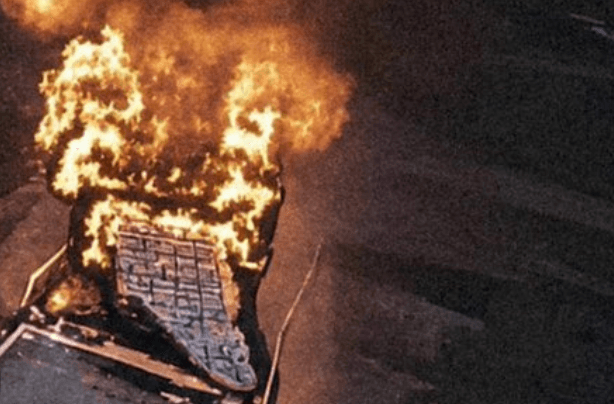
The most important crossing was already gone. Ukrainian strikes on the nights of June 7–8 and June 9 so damaged the Chonhar bridge — the eastern gateway between occupied Kherson Oblast and Crimea — that Saldo closed it to traffic. Andrii Kovalenko, head of Ukraine’s Center for Countering Disinformation, said the strikes destroyed it outright; satellite imagery now shows a pontoon crossing floating where the bridge used to carry military convoys.
Simultaneously, Ukrainian Neptune missiles — the same anti-ship weapon that sank the cruiser Moskva in 2022 — slammed into a Russian weapons and equipment storage site at Striletska Bay in Sevastopol, roughly 238 kilometers (148 miles) from the front line. Witnesses reported four to five additional impacts near Komyshova and Kozacha bays and a large fire near facilities of the Black Sea Fleet. A Russian monitoring channel surveyed the wreckage of the night and reached a stark conclusion: there appear to be no intact bridges left on the overland approaches to the peninsula.
Fifty Trucks at Armyansk: The Slow Strangulation of a Peninsula
Here is how a trap is built. First, Ukrainian drones hammered Mariupol’s port and the road to Berdyansk, forcing Russia to stop supplying the Hulyaipole front from occupied Donetsk Oblast. Then strikes broke the Chonhar bridge, funneling everything onto one remaining artery: the route through Armyansk. Russian logistics officers, with shrinking options, obediently concentrated their convoys there.
Then Ukraine struck the concentration. A Ukrainian regimental commander in the Kherson direction reported that the attack damaged or destroyed roughly fifty Russian military cargo vehicles loaded with fuel and ammunition bound for the Hulyaipole front. The 1st Separate Assault Regiment “Da Vinci” confirmed the strike put the Armyansk bridge out of commission entirely. “The enemy’s important logistical route is completely paralyzed,” the regiment announced — no further assaults required.
Major Robert “Madyar” Brovdi, commander of Ukraine’s Unmanned Systems Forces, explained the strategy with unsettling calm in an interview with Reuters. “We will isolate Crimea in the near future,” he said from a command post near the front. Traffic on the R-280 “Novorossiya” highway — the coastal route from Rostov-on-Don through Mariupol and Melitopol to Crimea — has already fallen 71 percent in two weeks. Hitting targets on it, Brovdi said, is “as easy as shooting partridges in an open field.” He predicted total fire control over the road within a month.
The effects are already visible on the ground. The Ukrainian partisan group Atesh claimed Russian troops have withdrawn from the strategic Kinburn Spit — a sliver of land analysts once called a stepping stone toward Crimea’s liberation. President Zelensky, in his evening address, offered gratitude for the campaign: Russian military logistics across the entire occupied south, he said, are now within reach of Ukrainian drones.
“No Point in Lining Up”: Sevastopol Runs Dry
The bureaucratic language could not hide the humiliation. “Unfortunately, oil tanker trucks were unable to come to the city tonight,” Sevastopol occupation governor Mikhail Razvozhaev wrote on Telegram. Translation: the fuel never made it past Ukraine’s drones, and the city that hosts Russia’s Black Sea Fleet cannot fill its own gas tanks.
Razvozhaev had to cancel the existing fuel ration coupons and promise new ones the next day, with priority for buses, utilities, emergency services, and government vehicles. “I am addressing everyone: there is no point in lining up at the gas stations tomorrow,” he told residents of a city Moscow has occupied since 2014.
The rationing system itself reads like a portrait of a society under siege. Since June 6, anyone buying gasoline in Sevastopol must present a pre-purchased QR code — accessible only through Max, the Kremlin’s state-controlled messenger app. The weekly allowance has collapsed from 20 liters (5.3 gallons) per day to 20 liters per week as shortages of fuel and basic goods spread across the peninsula. Even surveillance-state rationing fails, though, when the tanker trucks cannot survive the highway.
Razvozhaev claimed Russian air defenses downed 33 Ukrainian drones over Sevastopol overnight, repelling what he called two large-scale attacks; one woman was injured and residential buildings damaged. Yet he reported no damage to critical infrastructure — a curious claim, given the fires that witnesses watched rising over Striletska Bay. For ordinary residents, the war’s verdict arrives not in communiqués but at the pump: empty.
The Arithmetic of a Losing Year: Drones, Casualties, and Russia’s Recruiting Collapse
Commander-in-Chief Oleksandr Syrskyi published numbers that read less like a battlefield report and more like an actuarial table of Russian decline. Ukrainian first-person view drones — the cheap, camera-guided aircraft a pilot flies into a target like a kamikaze video game — now outnumber Russian FPVs on the battlefield 1.5 to one, and the gap is widening. In May alone, Ukraine’s drone units struck nearly 180,000 verified targets, a 12.7 percent jump from April. They intercepted some 4,000 Russian Shahed-type attack drones, up 27 percent, and hit nearly 10,000 Russian drone-operator positions.
The mid-range campaign — strikes reaching up to 200 kilometers (124 miles) behind the front — added nearly 2,000 attacks in May, including 414 against Russian headquarters, command posts, and troop concentrations. Ground robots completed 12,500 frontline missions, hauling ammunition and evacuating wounded through kill zones too dangerous for human drivers. Zelensky, presenting awards to the Unmanned Systems Forces, noted the branch has struck more than 356,000 Russian targets in a single year.
Then comes the death ledger. Finnish President Alexander Stubb stated that Russia has lost about 35,000 soldiers killed or wounded per month over the past six months — while recruiting only about 27,000. The exchange rate of death now runs eight Russians for every Ukrainian, up from three to one. Syrskyi reported the same trend from Kyiv’s data: since January, Ukrainian drone operators alone have eliminated 12,500 more Russian soldiers than Russia has managed to recruit. Russia’s drone units have filled just 21 percent of their annual recruitment plan — 14,500 contracts.
In March 2026, Stubb noted, Ukraine fired more missiles and drones at Russia than Russian defenses could repel. For the first time in this war, the mathematics belong to Kyiv.
Afipsky Burns: The Oil War Reaches Russia’s Books
At first there were only the sounds residents of Afipsky have learned to dread: air defenses thudding over the town, then the deeper concussion of something getting through. Geolocated footage captured a drone striking the Afipsky Oil Refinery in Krasnodar Krai, followed by a secondary explosion — the signature of fuel cooking off. Ukraine’s General Staff confirmed the hit; local authorities, reciting Moscow’s standard liturgy, blamed “falling drone debris” for the fire, declared a state of emergency in Afipsky, and reported the blaze extinguished by 7:30 a.m.
The refinery is one of southern Russia’s largest, processing roughly 6.25 million tons of crude annually — about 2 percent of national refining output — and this was at least its fifth strike since September 2025. Drone debris also hit an apartment building in Krasnodar city, and three people were injured across the region. A night earlier, Ukrainian FP-5 Flamingo cruise missiles — built by the Ukrainian firm Fire Point — struck a military factory in Cheboksary, 970 kilometers (603 miles) from the border, that supplies components for Russian drones and missiles, while a drone barrage forced Rosneft to halt processing at its Kuibyshev refinery in Samara.
The cumulative damage is now visible in Russia’s national accounts. OPEC data shows Russian crude production fell in May to 9.009 million barrels per day — its lowest in a year and 690,000 barrels below quota. Bloomberg counted 38 refinery attacks from January through May, 16 in May alone, the highest monthly figure of the war; refinery utilization has fallen 14 percent this year and crude processing has dropped to a two-decade low.
The campaign reaches the sea as well. New satellite imagery confirmed that Ukraine’s June 3 strike on the corvette Boykiy collapsed the warship’s mainmast and primary radar deck inward — damage a Russian military blogger conceded will likely force the navy to decommission the vessel.
Sixty-Six Kilometers of Fiction: The Kremlin’s Video War
The Russian Ministry of Defense released triumphant footage: soldiers of the 126th Motorized Rifle Regiment of the 71st Guards Motorized Rifle Division, it claimed, seizing the village of Okhrimivka northeast of Kharkiv City. There was one problem. A local Kharkiv Oblast Telegram channel recognized the video — because the official channel of Russia’s Northern Grouping of Forces had posted the identical footage a day earlier, labeled as strikes near Ruska Lozova. Ruska Lozova sits 66 kilometers (41 miles) from Okhrimivka.
The same playbook ran in Donetsk Oblast. Geolocated footage showed a lone Russian soldier raising a flag in northeastern Rozkishne during what the Institute for the Study of War assesses was an infiltration mission — a small party slipping through Ukrainian lines, not a force capable of holding ground. The Russian MoD promptly declared the village seized by the 54th Motorized Rifle Regiment.
This is not sloppy propaganda; it is industrial-scale deception that analysts call cognitive warfare. Over recent months, Russia has produced increasingly sophisticated montages with high-production editing — even artificial intelligence-generated footage — to claim advances in places where Russian forces hold no enduring positions. The objective is to paint scattered infiltrations and recycled clips as a sweeping, broad-front offensive, persuading Western audiences and negotiators that Ukraine’s line is collapsing.
All available evidence says otherwise. On the day Moscow claimed Okhrimivka, its forces made no confirmed advances anywhere in northern Kharkiv Oblast. The flag in Rozkishne was a photo opportunity. The film studio, increasingly, is doing the work the army cannot.
Boats Under the Drones: The Northern and Eastern Grind
On the Oskil River northeast of Kupyansk, Russian soldiers keep climbing into boats. Ukrainian FPV drone operators of the 16th Army Corps keep sinking them near Kamyanka. The Russians keep coming anyway — a crossing attempt repeated under drone fire, paying in boats and bodies for a riverbank they cannot hold. It is the eastern front in miniature: relentless Russian pressure, almost no Russian progress.
Across the northern axis, Russian forces attacked from north to southeast of Sumy City and gained nothing. In northern Kharkiv Oblast they pressed near Okhrimivka and northeast and east of Velykyi Burluk without confirmed advances. Ukrainian forces, meanwhile, kept hunting the air-defense systems that protect Russian skies: the 8th Air Assault Corps destroyed a Tor surface-to-air missile system — a mobile launcher designed to swat down exactly the drones now hunting it — in the North Slobozhansk direction, while geolocated footage showed another Tor destroyed west of Levshinka in Kursk Oblast, 40 kilometers inside Russia.
In the Kupyansk direction, geolocated footage caught Russian servicemembers operating in the city’s northeast during what ISW assesses was another infiltration mission rather than a captured position. Southwest of Borova, the strain is showing: the Russian command began shifting the 2nd Motorized Rifle Battalion of the 283rd Motorized Rifle Regiment from Drobysheve toward Rubtsi to prop up its sister 1st Battalion, gutted by heavy losses.
Near Lyman, the initiative briefly changed hands altogether — Russian sources reported Ukrainian counterattacks northwest and northeast of the town, pinning an offensive that was supposed to be advancing on Slovyansk.
Motorcycles Against the Drone Wall: Donetsk and the South
East of Siversk, a vehicle carrying the commander and chief of staff of the Russian 1st Motorized Rifle Battalion, 6th Separate Motorized Rifle Brigade — Naran Ochir-Goryaev — appeared in a Ukrainian drone’s camera feed. Then it appeared in geolocated strike footage. Ukraine’s Unmanned Systems Forces commander announced the hit personally: even Russian battalion command staffs can no longer move safely near the front.
In the Pokrovsk direction, Russia tried speed instead of armor. A Ukrainian brigade repelled a motorized assault that included at least three motorcycles — riders racing across open ground in the hope of outrunning drone operators’ reflexes. They did not. The 7th Rapid Reaction Corps reports Russia is nonetheless massing equipment and artillery there for future assaults.
Elsewhere the map barely moved, and where it did, it moved in Ukraine’s favor. Russian attacks failed in the Slovyansk direction amid Ukrainian counterattacks, in the Dobropillya tactical area, in the Novopavlivka direction, around Hulyaipole, and west to southeast of Orikhiv. East of Kherson City, limited Russian probing toward the Antonivskyi Bridge and Bilohrudyi Island went nowhere. Russian military bloggers claimed gains around Kostyantynivka — at Dovha Balka, Stepanivka, Illinivka, and Rozkishne — but the only confirmed advance of the day belonged to Ukraine: geolocated footage shows Ukrainian forces pushing into central Voskresenka, east of Oleksandrivka.
A Ukrainian drone also destroyed a BM-21 Grad — a Soviet-era truck-mounted rocket launcher that can drench an area with 40 rockets in seconds — near Terny, six kilometers (3.7 miles) from the front. Tube by tube, launcher by launcher, the artillery duel is being decided from the air.
Everything Within Reach: Ukraine’s 200-Kilometer Kill Zone
Behind the Russian front line, there is no longer any such thing as “the rear.” Ukraine’s intermediate-range strike campaign — the drone war waged against everything within roughly 200 kilometers (124 miles) of the front — spent these two days methodically dismantling Russian logistics across three occupied oblasts.
In occupied Luhansk Oblast, drone operators of Ukraine’s 3rd Army Corps struck Russian logistics hubs, trucks carrying personnel, and stores of fuel and ammunition near Starobilsk, Aydar, Novoaydar, Shchastya, and Rubizhne — targets ranging from 32 to 91 kilometers (20 to 57 miles) behind the line. In occupied Donetsk Oblast, a Ukrainian brigade hit transport columns along the M-30 Horlivka–Yenakiieve highway, including vehicles packed with infantry, camouflaged trucks, and a Tigr armored vehicle loaded with ammunition; geolocated footage shows the smoking aftermath of a strike on a gas station in Yenakiieve, 41 kilometers (25 miles) from the front.
In occupied Zaporizhzhia Oblast, the targets were the fuel tankers themselves. Drones destroyed two along the M-14 Rostov–Crimea highway at Prymorsk and another at Pryazovske — both roughly 90 kilometers (56 miles) behind the lines, both on the same coastal artery Brovdi has promised to bring under total fire control.
Each burning truck is small. The pattern is not. Every Russian driver on every highway in occupied southern Ukraine now operates inside a kill zone, and every load of fuel that burns on the road is fuel that never reaches a tank, a generator, or a gas pump in Sevastopol. This is the quiet machinery behind the day’s louder headlines: the strangulation is built one tanker at a time.
221 Drones in the Dark: Russia’s Answer Falls on the Innocent
Russia’s reply to its collapsing logistics came the way it always does — aimed at people asleep in their homes. Overnight, Russian forces launched two Iskander-M ballistic missiles from Belgorod Oblast and 221 attack and decoy drones from six directions. Ukrainian air defenses downed 195 drones, but both missiles and 21 drones struck nine locations, damaging residential, administrative, industrial, and railway infrastructure across five oblasts and knocking out power in six.
In the Shostka community of Sumy Oblast, a 44-year-old woman was killed and a 33-year-old woman seriously injured when drones smashed a civilian infrastructure site. In Znob-Novhorodske, a 67-year-old woman died when a drone hit her home. In Mykolaiv, a Shahed strike hospitalized three people. In Chernihiv Oblast, a 34-year-old police officer was killed at a house in Horodnia. Across the country over the past day, Russian attacks killed five civilians and injured 69 — twelve in Pavlohrad, twelve more in Kherson Oblast including a child, eleven in Kharkiv, eight in Zaporizhzhia Oblast.
Russia is hunting the railways with particular venom. A strike on the locomotive depot in Konotop killed one railway worker and injured four; launched from just across the border, the Shaheds left almost no time to reach shelter. A day earlier, a drone was shot down directly over Sumy’s railway station, its debris setting fire to the roof of a passenger carriage on the Sumy–Rakhiv train — passengers and crew survived in shelters. Ukrzaliznytsia has recorded 983 attacks on railway infrastructure since January.
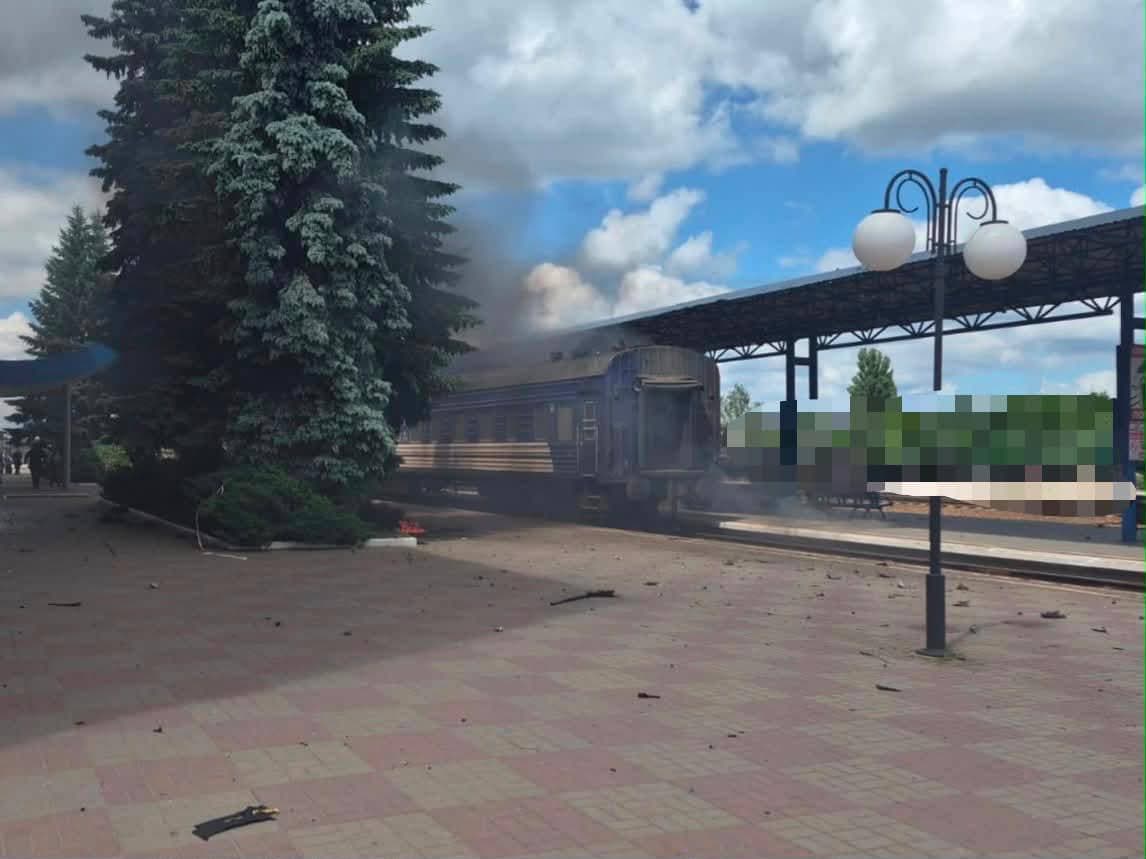
Even neutral shipping was targeted: drones attacked two cargo vessels flying Barbadian and Panamanian flags in Ukraine’s Black Sea grain corridor off Odesa.
Barracks for the Next War: Russia Builds Along NATO’s Border
While its army bleeds in Ukraine, Russia is pouring concrete in the north. A joint investigation by Danish broadcaster DR with Norwegian, Swedish, and Baltic outlets — backed by satellite imagery published by The Telegraph — documented new and expanding Russian military bases along the borders with Finland, Norway, and the Baltic states: fresh barracks, dining halls, and storage facilities.
The details are specific. Construction has begun at Novaya Vilga near Petrozavodsk in Karelia, roughly 190 kilometers (118 miles) from Finland, on a base for 4,000 to 6,000 troops. A former Finnish intelligence officer told DR that Russia plans roughly 115,000 soldiers stationed on the NATO frontier after the war in Ukraine ends; Finland’s army chief expects 80,000 on the Finnish border alone. A Kremlin-affiliated military blogger described the modernization of at least 19 facilities at Pechenga — just 11 kilometers (7 miles) from Finland — and the expansion of a naval infantry base and landing-craft fleet near Baltiysk in Kaliningrad. Elements of the 44th Army Corps are reportedly waiting in Luga to relocate to Karelia the moment the bases are finished.
The intelligence consensus is chilling in its precision. Danish officials describe preparation for conflict rather than a decision for war — most Russian combat power remains locked in Ukraine, and ISW assesses near-term ground operations against NATO as unlikely. But the head of Germany’s army, Lieutenant General Christian Freuding, put a date on the danger: all 32 NATO members agree Russia could be capable of invading an alliance member by 2029. “It’s NATO-agreed intelligence,” he said — and it may come sooner. The bases rising in the birch forests are the infrastructure of that timeline.
Bunkers and Self-Destruct Codes: NATO’s Edges Brace for Spillover
In a small green space at Juhkentali 10 in central Tallinn, workers lowered a reinforced-concrete box into place — Estonia’s first modular public bomb shelter in an urban square. The design is borrowed directly from Ukraine, where such shelters are furniture of daily life. It is a demonstration project, officials say, to teach residents where to run. That a NATO capital is field-testing Ukrainian shelter designs says everything about how Europe now reads the next decade: Estonia has also activated its first stationary drone-detection systems on the southeastern border, and both Estonia and Latvia are planting concrete “dragon’s teeth” anti-tank barriers along the Baltic Defense Line.
The war’s debris is already washing up on NATO’s shores — sometimes literally. On June 5, a stray Ukrainian naval drone, knocked off course by Russian electronic warfare, drifted into the Romanian port of Constanța and exploded. No one was hurt, but Romania’s defense minister, Radu Mîruță, now wants a technical guarantee from Kyiv: any Ukrainian sea drone that loses contact should automatically self-destruct 12 nautical miles (22 kilometers) from Romanian waters. “I want to propose to our neighbors in Ukraine, who are fighting such a brutal war launched by Russia, that they guarantee all drones they launch into the Black Sea are programmed with this technical safeguard,” he said.
Ukrainian drones diverted by Russian jamming have previously strayed into Finland, Estonia, Latvia, and Greece, drawing rebukes and Ukrainian apologies. Russian drones wander too — a Shahed struck a residential building in the Romanian city of Galați on May 29, injuring two. The frontier between war and peace in Europe is no longer a line. It is a probability.
A Minister Walks, a Missile Line Strains: Cracks in the Western Arsenal
The resignation letter landed like a shell in Westminster. U.K. Defense Secretary John Healey — among Ukraine’s staunchest advocates in the British government — quit, accusing Prime Minister Keir Starmer of being “unable, and the Treasury… unwilling, to commit the resources that the nation needs to defend the country at this time of rising threats.” Months of deadlock between the Defence Ministry and the Treasury had stalled Britain’s Defense Investment Plan, leaving defense firms unable to commit to long-term production. Healey’s parting shot quoted Starmer’s own intelligence assessment back at him: Russia could attack NATO as soon as 2030. “You know what defense needs,” he wrote.
Across the Atlantic, the arsenal problem wears a corporate face. Lockheed Martin told reporters at the Berlin Air Show that it cannot guarantee delivery timelines for Patriot interceptor missiles — the PAC-3s that are Ukraine’s only reliable shield against Iskander-M and Kinzhal ballistic missiles. “We do not control what the allocation of those missiles is going to be,” said executive Brian Dunn, noting that the Pentagon decides who gets missiles first amid “a lot of rhetoric” about reordering priorities as America’s war with Iran devours interceptors.
Production is rising — from roughly 650 PAC-3s a year toward 2,000 by 2033 under a $4.7 billion contract — but 2033 is an eternity away from a country whose Patriot stocks Zelensky declared critically short in April, and whose cities face hundreds of drones in a single night. On the same day Russia’s barracks rose on NATO’s border, the alliance’s arsenal showed its seams.
Knocking on the Kremlin’s Door: Europe’s Diplomatic Gamble
Three Western ambassadors walked into the Stalinist tower of Russia’s Foreign Ministry — a sight so rare in this war that AFP journalists staked out the doors. The envoys of Britain, France, and Germany met Deputy Foreign Minister Mikhail Galuzin to press the E3 leaders’ June 7 London statement: support for Zelensky’s call for direct negotiations, a ceasefire along the current front line, security guarantees backed by a multinational force, and Russian compensation for war damages. “We just had a good discussion,” France’s Nicolas de Rivière offered afterward. Moscow’s readout dripped contempt, lecturing the ambassadors on their countries’ “destructive” policies and insisting on the war’s “root causes” — Kremlin code for Ukrainian capitulation.
The diplomacy now accelerates toward next week’s G7 summit, where Britain, France, and Germany will reportedly seek President Trump’s backing for the plan, believing — per Bloomberg — that momentum has shifted to Ukraine and that Trump’s buy-in could pressure Moscow into talks as soon as next month. Finnish President Stubb supplied the thesis: “Ukraine’s in a position of strength now militarily, politically, and economically. It’s high time for Europe to reach out to Putin.” Putin, for his part, has rejected an immediate ceasefire, dismissed Zelensky’s open letter as “rude,” and refused European troops on Ukrainian soil.
Europe’s unity has fault lines of its own. Italy’s Giorgia Meloni, excluded from the London meeting, demanded a single EU negotiator, warning that rival formats breed “fragmentation, confusion, and weakness.” And in Brussels, Poland and Germany are fighting over €6.6 billion ($7.6 billion) in unlocked European Peace Facility funds — Warsaw demanding full reimbursement for weapons it sent Ukraine (“This money, this is our money”), Berlin offering to forgo its share entirely so the funds flow to Kyiv.
The Corps That Stopped Losing Ground: Ukraine’s 3rd Army Corps Turns One
A year ago, the sector now held by Ukraine’s 3rd Army Corps was hemorrhaging up to 70 square kilometers (27 square miles) a month. Today, says deputy chief of staff Danylo “Boroda” Novytskyi, “not a single meter is being lost.” The corps — commanded by Brigadier General Andriy Biletsky, founder of the original Azov volunteer unit — marked the first anniversary of becoming Ukraine’s first new corps-level formation to run its own sector: more than 150 kilometers (93 miles) of front, about 12 percent of the entire line.
The transformation was organizational before it was technological. The corps built a NATO-style mission-command system — commanders define the objective, subordinates decide how to achieve it — created “battle captains” to run combat directly, and slashed the paperwork — 16 redundant reports eliminated on day one, 32 more streamlined within a month — so officers could focus on “combat operations rather than paper wars.” It fields Ukraine’s first corps-level Unmanned Systems Regiment, which has clamped fire control over Russian logistics in Luhansk Oblast, while ground robots have hauled more than 40 tons of supplies to forward positions.
The starkest story belongs to the 125th Heavy Mechanized Brigade. When Colonel Volodymyr Fokin took command last October, the brigade stood at 18 percent strength. “On the entire brigade, we had two pickup trucks and one van,” he recalled. Seven months later — after replacing 90 percent of key leaders — personnel strength is up 234 percent, with a new tank battalion, drone battalion, and electronic warfare units. The 66th Mechanized Brigade, meanwhile, built a 51-day in-house training cycle and now posts one of the army’s lowest desertion rates. “We did not invent something completely new,” Novytskyi said. “We made what already existed work.”
The Day Closes
The convoy at Armyansk is ash now, and the pontoon bobbing where the Chonhar bridge stood is a confession poured in steel. Twelve years after Russia took Crimea without firing a shot, the peninsula’s occupiers ration gasoline by QR code while the bridges behind them fall one by one. Russia answers with recycled victory footage and drones aimed at sleeping women, and builds barracks on NATO’s border for a war its generals schedule like an appointment. The trap is closing. What remains to be seen is whether diplomacy reaches Moscow before the last road does.
A Prayer for Ukraine
1. For the Women Killed Before Dawn
Lord, we bring You the 44-year-old woman of Shostka and the 67-year-old woman of Znob-Novhorodske, who died in the night because machines were sent hunting for homes. We bring You the railway worker of Konotop, killed at his depot keeping the trains running. They were not soldiers. Receive them, comfort those who woke to their absence, and heal the 33-year-old who clings to life. You know each name we were not told.
2. For the Child Wounded in Kherson
Father, somewhere in Kherson Oblast a child is lying in a hospital bed tonight, wounded in a war that child did not choose and cannot end. Guard that small body as it mends. Guard, too, the passengers who sheltered as their train carriage burned over their heads at Sumy station. Protect the children of every city under the drones, and do not let fear become the only country they know.
3. For Those Who Carry the Weight of Decision
God of wisdom, leaders gather next week to decide whether peace will be pursued or postponed. Give clarity to those who negotiate, courage to those who must spend political capital on another nation’s survival, and integrity like that of the minister who resigned rather than pretend the danger was funded. Let no summit trade away what the dead already paid for. Make the powerful honest, and the honest powerful.
4. For the Defenders at the Bridges and in the Sky
Lord of hosts, watch over the drone operators who fly through the night above broken bridges, the soldiers holding the Oskil’s banks, and the rebuilt brigades that found their faith again after losing nearly everything. Steady their hands and keep their hearts from hardening into the cruelty they resist. When the mission ends, bring them home whole — in body, and in soul.
5. For Truth Against the Manufactured Lie
God of justice, a regime is forging victories on film while its soldiers die for meters it cannot hold. Let every fabrication be exposed and every atrocity remembered, recorded, and judged. Sustain those who document the truth at great cost, and let no negotiation be built on a lie. In Your mercy, in Your justice, in Your time — bring this war to its end, and let the ending be worthy of what Ukraine has endured.