
Ukraine Daily Briefing | June 21, 2026 | Day 1,579 of the Full-Scale Invasion
Prepared by Dayana Bozhyk
Ukrainian forces struck oil terminals, ferry infrastructure, and air defense systems on both sides of the Kerch Strait overnight on June 21, setting at least three ferries ablaze and disabling four S-400 radar stations and two Pantsir systems guarding the Kerch Bridge. Crimea’s Russian-installed governor immediately banned all civilian fuel sales on the peninsula — fuel for state services only — while Sevastopol halted ferries, shortened public transport hours, and cancelled outdoor events. Russia launched four missiles and 105 drones at Ukraine overnight, killing at least 11 civilians and injuring 91 more across six oblasts; Poltava was hit by a missile strike killing two people including six injured children. Zelensky disclosed that Trump plans to ask U.S. defense companies to produce Patriot interceptors under license in Ukraine and Europe. Russian forces are massing infantry north and west of Pokrovsk and Dobropillya for a coming intensification of assaults.
THE DAY’S RECKONING
The Kerch Strait is the throat of Russia’s occupation of Crimea. Every tank, every shell, every liter of fuel that doesn’t travel the long land bridge through occupied Donetsk, Zaporizhzhia, and Kherson must cross those 35 kilometers of water between Russia’s Krasnodar coast and the peninsula. On the night of June 21, Ukraine struck both sides of it simultaneously: oil terminals at the Port of Kavkaz on the Russian coast, an oil depot in occupied Kerch, the ferry terminal between them, the air defense systems on the bridge itself. Geolocated footage showed at least three ferries on fire. Russia’s response was immediate and revelatory — Crimea’s governor banned all civilian fuel sales effective 9 a.m. that morning. Not rationing. Not a cap. A complete ban: fuel to state services only.
That single administrative order tells the story of what Ukraine’s interdiction campaign has achieved in June. A month ago Crimea had fuel lines. Three weeks ago it had purchase limits. Two weeks ago it had price caps. Today it has no civilian fuel at all, and the ferry route across the Kerch Strait — the backup supply line since Russia restricted trucks on the Crimean Bridge — was burning.
Meanwhile, Russia launched 105 drones and four missiles at Ukraine overnight, killing at least 11 civilians in six oblasts. A missile hit Poltava, killing two and injuring 14 including six children. And Zelensky disclosed that Donald Trump plans to ask U.S. defense companies to produce Patriot interceptors under license in Europe and Ukraine — the first time the American team, in Zelensky’s words, has responded positively to that request.
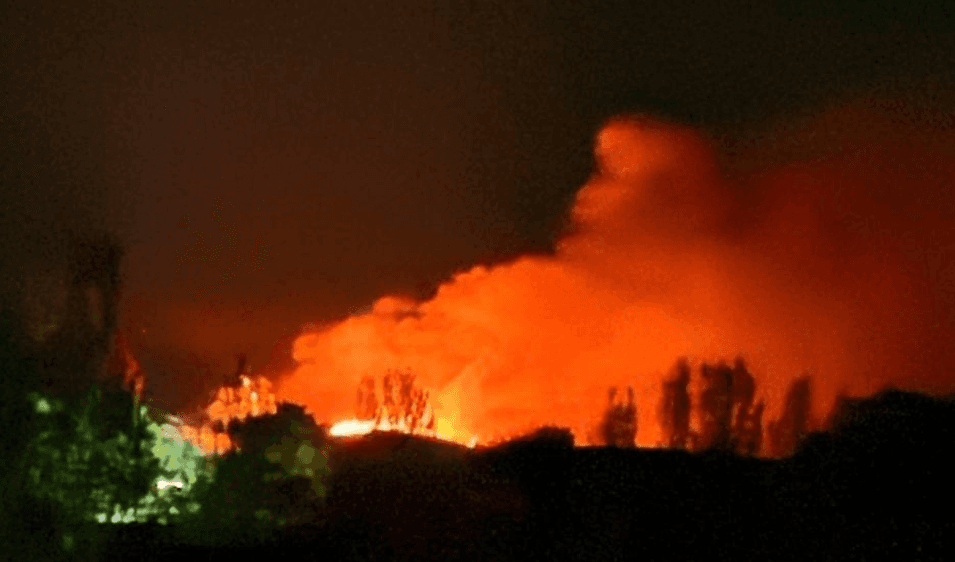
What purports to be the aftermath of a reported Ukrainian drone attack on occupied Berdiansk, Zaporizhzhia Oblast, overnight. (Exilenova Plus/Telegram)
KERCH STRAIT STRUCK ON BOTH SIDES: FERRIES ABLAZE, RADAR DISABLED, FERRY SERVICE HALTED
Ukraine’s Security Service, Unmanned Systems Forces, Main Military Intelligence Directorate, and Special Operations Forces jointly struck Russian maritime logistics, oil infrastructure, and air defense systems on both sides of the Kerch Strait overnight on June 20 to 21. At the Port of Kavkaz on Russia’s Chushka Spit in Krasnodar Krai — northeast of the Kerch Bridge — Ukrainian forces struck the oil transshipment complex, setting its tank farm and oil depot on fire. Geolocated footage recorded northeast of the port showed at least three ferries ablaze. In occupied Kerch on the Crimean side, Ukrainian forces struck the TES-Terminal-1 oil depot less than one kilometer from the Kerch Bridge, which Russia uses to transship fuel oil, liquefied gas, and light petroleum products and to refuel the ferry connection between Crimea and Krasnodar Krai. The Krasnodar Krai Operational Headquarters acknowledged that Ukrainian drones struck the Panagia ferry at the Kerch crossing and started a fire at the Chushka oil terminal.
Ukrainian forces also struck the air defense systems guarding the Kerch Bridge itself: four S-400 radar stations and two Pantsir air defense systems were disabled. Additionally, a Kasta-2E2 radar system in occupied Kurortne on the Sea of Azov coast and a Nebo-U radar system near Kerch were struck, with geolocated footage confirming both strikes. Russia temporarily suspended ferry service across the Kerch Strait following the attack and directed freight traffic to detour via the M-14 highway through occupied Mariupol, Melitopol, and Simferopol — a route already under systematic Ukrainian drone interdiction. A Russian milblogger noted that only seven auto and rail ferries were operating at the crossing even before the attack, and that damage to three ferries could significantly strain logistics between Crimea and Russia. Explosions were also reported in Simferopol, Yevpatoria, and Sevastopol during the broader overnight operation.
USF Commander Brovdi stated that the overall campaign aims to degrade Russia’s ability to use Crimea as a springboard for offensive operations by destroying Russian air defense systems, reducing Black Sea Fleet presence on the peninsula, and degrading logistics, transportation nodes, and energy resources. Ukrainian forces also continued striking railway bridges across the North Crimean Canal near occupied Rozdolne in Kherson Oblast and near Chonhar on the Kherson-Crimea border, used for military personnel and supply transport.
CRIMEA BANS ALL CIVILIAN FUEL SALES; SEVASTOPOL SHUTS FERRIES AND SHORTENS WORKING HOURS
Crimea’s Russian-installed governor Sergei Aksyonov announced on the morning of June 21, effective from 9 a.m., that all gas stations on the peninsula are prohibited from selling fuel to any non-state entities. “Fuel will only be dispensed to state services that ensure the vital activities and security of the Republic of Crimea,” Aksyonov said in a video address — the most extreme fuel restriction imposed on the peninsula since Ukraine’s interdiction campaign began. Sevastopol occupation governor Mikhail Razvozhaev announced parallel emergency measures for June 22 and 23: a complete ban on gas station fuel sales, shortened working hours for public transport and major retailers, suspension of ferry operations, and cancellation of all outdoor events, citing unspecified “recent developments.”
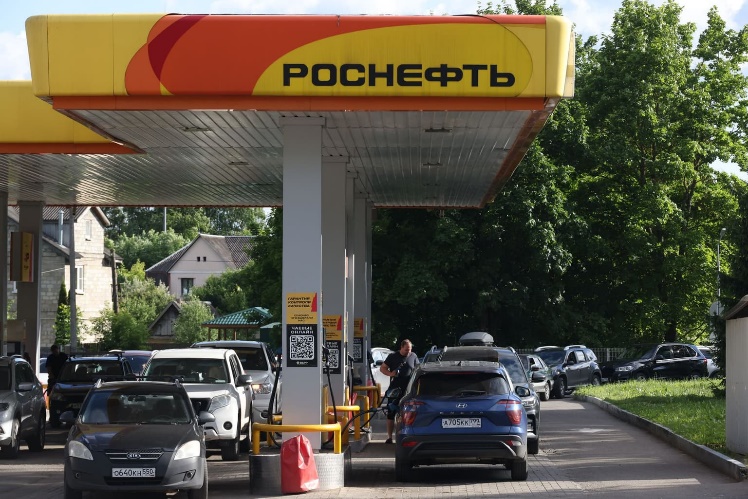
Photo for illustrative purposes. A man fills up his car with gas against the backdrop of a long line of cars at a Rosneft gas station in Dedovsk, Istra municipal district, outside of Moscow, Russia. (Contributor/Getty Images)
The escalation from rationing to a complete ban reflects the cumulative effect of Ukraine’s June campaign: the Kerch Bridge has been restricted to light vehicles since January 2026, forcing heavy freight onto the ferry route; ferry terminals were struck overnight; gas compression stations, power infrastructure, and the Tavriyska Thermal Power Plant have all been hit in the preceding days. Crimean energy company Krymenergo introduced electricity consumption restrictions on June 21 due to unspecified accidents at power grid facilities, with residents reporting outages in Armyansk, Alushta, Simferopol, Sevastopol, and Dzhankoi. Belarusian fuel has been serving as a partial stopgap: Zelensky disclosed on June 21 that Russian imports of Belarusian gasoline increased 13-fold and diesel imports tripled in January through May 2026 compared to the same period in 2025 — a dependency that also makes Belarus’ industrial cooperation with Russia an increasingly direct contribution to the war. Kherson Oblast occupation head Vladimir Saldo publicly denied all reports of traffic restrictions and logistical problems, claiming reports about evacuation buses and administrative border closures between occupied Kherson Oblast and Crimea are false; a Russian milblogger had reported the Dzhankoi checkpoint closure on June 17.
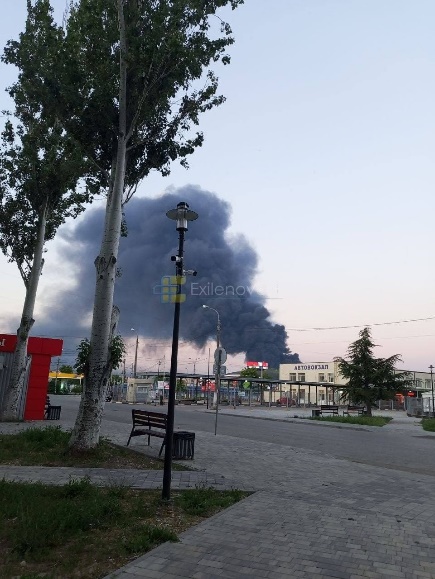
A photo of a fire purportedly emanating from an oil terminal in the city of Kerch in occupied Crimea overnight. (Exilenova_plus/Telegram)
OVERNIGHT STRIKES ON UKRAINE: 4 MISSILES, 105 DRONES, 11 KILLED, 91 INJURED
Russian forces launched two Iskander-M/S-400 ballistic missiles from Voronezh Oblast, two Kinzhal aeroballistic missiles from the airspace over Ryazan Oblast, and 105 Shahed, Gerbera, Italmas, and Banderol drones and Parodiya decoys overnight on June 20 to 21, from Oryol, Kursk, Bryansk, Primorsko-Akhtarsk, Millerovo, and occupied Kacha and Cape Chauda in Crimea. Ukrainian air defenses downed 96 drones; ballistic missiles and six drones struck six locations, with debris falling at five more. Civilian and residential infrastructure was struck in Kyiv City, and civilian infrastructure was damaged in Izmail Raion, Odesa Oblast.
Russian strikes killed at least 11 civilians and injured at least 91 across six oblasts over the 24-hour period. In Zaporizhzhia Oblast, five people were killed and 13 injured following nine Russian glide bombs on Zaporizhzhia City the previous day, with the oblast recording an additional 10 glide bombs on a roadway and civilian infrastructure; Russian forces conducted 24 airstrikes, 642 drone attacks, five MLRS strikes, and 216 artillery strikes against 53 settlements. In Poltava, Russian missiles struck the city on the evening of June 20, killing two people and injuring 14, including six children; fires broke out at enterprises across multiple locations, with more than 100 rescue personnel and 27 pieces of equipment deployed. In Sumy Oblast, one person was killed — a 54-year-old woman in a drone strike — and 19 were injured, including a three-year-old girl; seven guided aerial bombs struck the northwestern section of Sumy City, killing one man and injuring five, damaging at least 20 private homes, school grounds, and infrastructure. In Dnipropetrovsk Oblast, one person was killed and 18 injured as Russian forces struck with drones, artillery, and glide bombs, damaging a school, homes, and a pharmacy. In Kharkiv Oblast, one person was killed and 13 injured including four children; a Russian drone struck the parking lot of a shopping center in the Saltivskyi district, and a double-tap strike hit first responders at a postal enterprise on the outskirts of Kharkiv City. In Kherson Oblast, one person was killed and nine injured in drone and artillery attacks; a 61-year-old man in Kherson’s Dniprovskyi district had an explosive device dropped on him from a drone, sustaining mine-explosive trauma and shrapnel wounds to both legs. In Mykolaiv Oblast, three people were injured in a drone strike that also damaged a bakery, two cars, and a truck. In Donetsk Oblast, two people were injured. In Odesa Oblast, a strike near Izmail damaged housing with no reported injuries.
Russia’s strike intensity over the preceding week: approximately 2,200 attack drones, more than 1,800 guided aerial bombs, and 87 missiles — the highest weekly totals since the full-scale invasion began. The New York Times reported, citing Ukrainian Air Force data, that Russian forces have launched an average of 74 ballistic missiles per month in 2026, compared to 49 per month in 2025 and 28 per month in 2024. The Financial Times reported, citing a Ukrainian military institute, that Russia is on track to launch over 75,000 guided glide bombs in 2026 based on current trends, up from roughly 60,000 in 2025.
NEW RUSSIAN WEAPONS: SHAHED WITH CLUSTER SUBMUNITIONS AND POSSIBLE S8000 BANDEROL MISSILE
A Ukrainian source reported on June 21 that Russian forces have deployed a new Shahed strike drone variant with a double warhead in which the second warhead carries approximately 20 cluster submunitions. The second warhead releases the submunitions around the target, which can detonate between two and 20 hours later, effectively allowing Russian forces to remotely mine an 80-meter area around a selected target before the drone continues to pursue it normally. A prominent Russian milblogger separately analyzed footage from the June 20 Poltava strike and speculated that Russian forces may have used the new S8000 Banderol cruise missile — a light missile reportedly first used in spring 2025 with a 115-kilogram warhead, a range of 500 to 700 kilometers, and designed to be launched from helicopters and drones. A Ukrainian counter-drone battalion commander also reported on June 21 that Ukrainian interceptor drones are currently unable to reliably intercept high-speed jet-powered Shaheds because interceptors lack sufficient battery capacity to sustain the speed required for pursuit, and that clouds and rain further degrade optical guidance systems; the commander noted that Ukrainian forces are developing countermeasures and expects them soon.
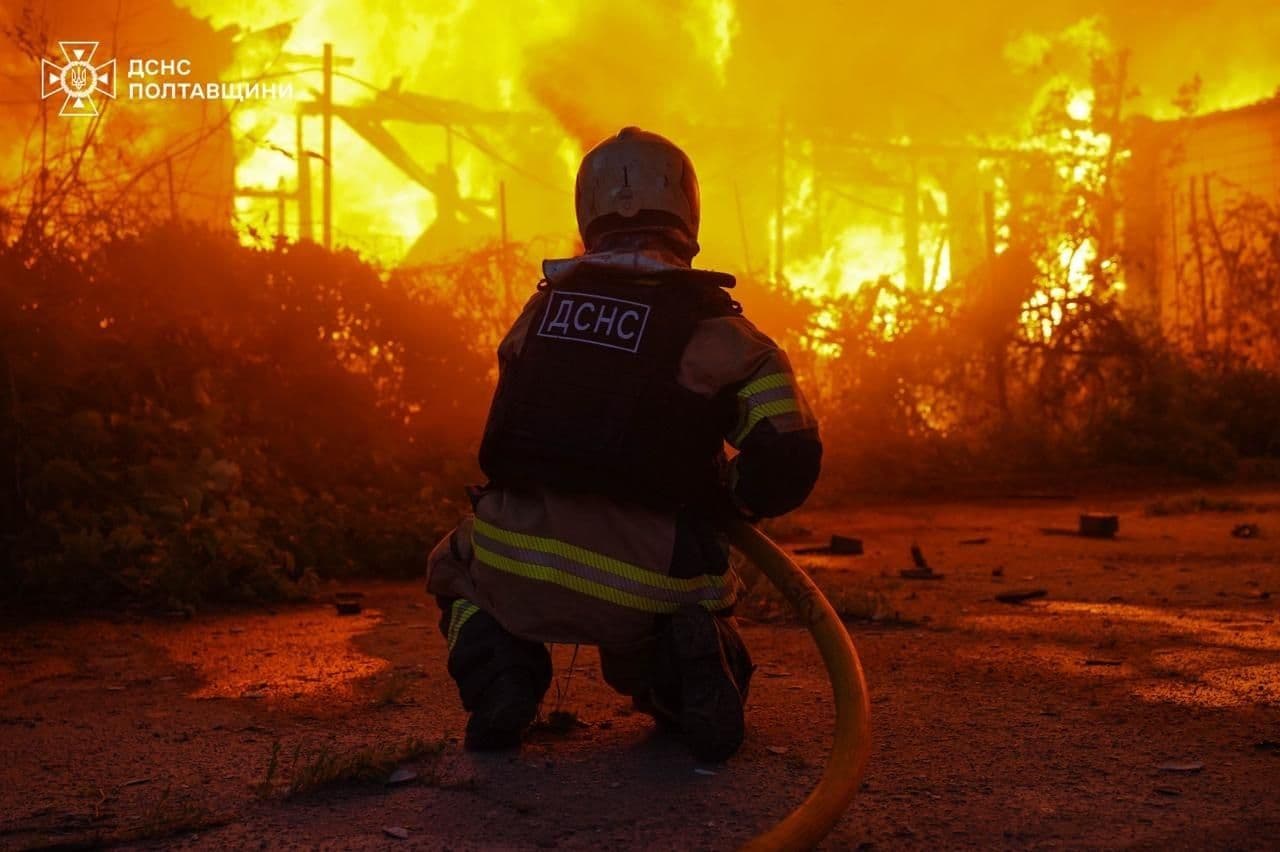
A firefighter extinguishes a fire in the aftermath of a Russian missile strike on the Ukrainian city of Poltava. (State Emergency Service of Ukraine/Telegram)
TRUMP TO ASK U.S. FIRMS TO LICENSE PATRIOT PRODUCTION IN UKRAINE AND EUROPE
Zelensky disclosed in an interview on June 21 that U.S. President Trump plans to ask American defense companies to manufacture missiles for air defense systems under licenses in Europe and Ukraine. “This time, it became quite public that the American team, for the first time, responded positively to the licenses,” Zelensky said, adding that the G7 summit was the first meeting where all G7 members unanimously supported Ukraine. Zelensky noted that Ukraine has the technical capabilities to begin producing Patriot interceptors and needs only U.S. production licenses. “When it comes to defending against ballistic missiles, we rely almost exclusively on the United States,” Zelensky had written to Trump in a May 27 letter warning of critical missile defense shortages. Zelensky also emphasized the rapid implementation of Ramstein and EU Council commitments as the immediate priority: “It is important to quickly implement everything, first of all, the supply of air defense missiles, so that the new contributions provide real protection of lives from constant Russian strikes.”
FRONTLINE: RUSSIA MASSES INFANTRY NEAR POKROVSK AND DOBROPILLYA; LYMAN AND KOSTYANTYNIVKA CONTINUE
The most significant frontline development on June 21 was not a territorial change but a buildup. Ukrainian military observer Kostyantyn Mashovets reported that Russian forces are reinforcing frontline assault units with fresh infantry — drawn from elements of the 51st Combined Arms Army near Bilytske, Novotoretske, Chervonyi Lyman, and Rodynske, and the 2nd Combined Arms Army in northwestern Pokrovsk and near Hryshyne — preparing for an intensification of assaults in the near future. Russian forces transported at least 65 to 70 personnel through Novoekonomichne northeast of Pokrovsk on June 21 to 22. A Ukrainian officer in the Pokrovsk direction corroborated the buildup, noting that the incoming infantry have received better training than previous waves and have been intensifying infiltration missions since approximately June 14. Ukrainian forces recaptured positions in Bilytske — geolocated footage confirmed Russian forces are likely no longer actively infiltrating the settlement — and Mashovets reported that Ukrainian forces still hold Serhiivka and much of the Bilytske area, forcing Russia to concentrate troops for a narrow-sector push between Pokrovsk and Novooleksandrivka. Mashovets acknowledged that some Russian infiltrators have consolidated positions southeast of Shevchenko and between Bilytske and Krasnoyarske.
In the Slovyansk direction, Russian sources claimed advances near the Brusyn Train Station southwest of Lyman and northeast of Brusivka and west of Kryva Luka east of Slovyansk; ISW assessed the geolocated evidence as indicating interspersed rather than consolidated Russian positions in Rai-Oleksandrivka. A Russian milblogger claimed fire control over the T-21-21 highway between Blyznyuky and Barvinkove in southern Kharkiv Oblast, which connects logistics through Izyum to the Lyman direction and through Slovyansk to the Kramatorsk and Kostyantynivka directions; ISW assessed this as part of Russia’s effort to degrade Ukraine’s ability to defend prioritized axes. In Kostyantynivka, Russian forces continued infiltration missions attempting to bypass and consolidate behind Ukrainian defensive lines, with no confirmed advances. Mashovets warned that the 51st Combined Arms Army may attempt to reallocate forces to advance along the Kazennyi Torets River toward Druzhkivka to flank the Kostyantynivka effort, though the army requires frequent and prolonged pauses that would inhibit such a pivot. In Zaporizhzhia Oblast, Russian milbloggers claimed Russian forces seized southern Novodanylivka south of Orikhiv; ISW assessed this as an infiltration rather than a confirmed advance, with Ukrainian forces counterattacking west of Orikhiv. Russian fuel and lubricants depots in the Kupyansk-Lyman corridor were moved at least 100 to 110 kilometers from the frontline as Ukraine’s drone interdiction intensifies; the 4th Tank Division prohibited unarmored vehicle movement within 25 kilometers of the frontline.
Ukrainian intermediate-range strikes continued across occupied Luhansk and Donetsk oblasts: a fuel tanker truck near Horlivka was struck overnight, Russian trucks on the H-20 Donetsk-Mariupol highway burned near Kremenivka and Volnovakha, a railway bridge near Petershahen in Zaporizhzhia Oblast was struck, and logistics trucks on the M-14 highway near Osipenko and Terpinnya were hit. Ukrainian forces struck Russian drone control points in Belgorod and Bryansk oblasts, and a control point near Pochayevo, Belgorod Oblast.
ZELENSKY: FOUR BELARUSIAN RELAY STATIONS IN GOMEL AND BREST HELP RUSSIA STRIKE UKRAINE
Zelensky named specific locations for the first time in his repeated warnings to Lukashenko on June 21, specifying that four Russian and Belarusian communications repeaters are positioned in Gomel and Brest oblasts — the two Belarusian regions bordering Ukraine. These relay systems, mounted on communications towers, extend the range and targeting precision of Russian-guided drones striking railway and energy infrastructure in Zhytomyr, Rivne, and Volyn oblasts. Zelensky also stated that Ukraine is aware of Belarusian enterprises producing critical components for Russian armored vehicles and missile systems, calling Belarus “one of the main suppliers for the Russian army.” He maintained the June 26 deadline for Lukashenko to dismantle the equipment: “Every day our civilians are dying because of this. Children are being wounded. If he does not do it, we will.”
POLISH MEDAL DISPUTE DEEPENS: THREE FORMER PRESIDENTS AND A LAWMAKER RETURN HONORS
The diplomatic dispute between Poland and Ukraine over Zelensky’s decision to name a military unit after the UPA widened on June 21. Former Ukrainian Presidents Leonid Kuchma, Viktor Yushchenko, and Petro Poroshenko all announced they would renounce their Order of the White Eagle honors in solidarity. Former Polish lawmaker Piotr Fogler separately returned his Golden Cross of Merit to Polish President Nawrocki in protest, writing that Nawrocki’s decision to strip Zelensky of the award was “foolish” and accusing Nawrocki of “making a mockery of Poland and all of us.” Polish Prime Minister Donald Tusk cautioned against further escalation, calling continued involvement of politicians on both sides in the controversy a “strategic mistake” that harms both countries. The dispute comes one week before the Ukraine Recovery Conference in Gdansk.
20,000 TEDDY BEARS IN LOS ANGELES: THE CAMPAIGN TO RETURN UKRAINE’S ABDUCTED CHILDREN
An installation of 20,000 teddy bears representing Ukrainian children abducted by Russia was displayed at Gloria Molina Grand Park in Los Angeles on June 20, stretching approximately 230 feet long and standing 8 feet tall, with the message: “Putin abducted 20,000 Ukrainian children. Bring Kids Back.” The display was organized by a coalition of pro-Ukraine organizations including Globe4Ukraine, Shield of Freedom, Razom for Ukraine, and the American Coalition for Ukraine. U.S. Representative Sydney Kamlager-Dove called for the immediate return of the children, saying: “Putin is a war criminal committing atrocities, and we have a moral responsibility to unequivocally condemn these crimes.” According to Ukraine’s national Children of War database, at least 20,000 Ukrainian children have been taken from occupied territories to Russia or Russian-controlled areas since the start of the full-scale invasion; Ukraine’s actual estimate is significantly higher. The International Criminal Court issued arrest warrants for Putin and Children’s Rights Commissioner Maria Lvova-Belova in 2023 for their alleged role in the deportations. Los Angeles was the second U.S. city to host the installation after Washington D.C. in April.
By the close of June 21, the arithmetic of isolation was complete for Crimea in a way it had never been before. No civilian fuel. No ferries. Three ships burning at the Kerch crossing. The M-14 highway — the land detour Russia told its freight trucks to use — is the same road Ukraine has been striking for months. Somewhere in Gomel Oblast, four relay towers are still standing, helping Russian drones find their way to Rivne and Zhytomyr. Lukashenko has five more days. And in Poltava, six children are recovering from a missile strike, having done nothing to deserve it except live in a city Russia decided to target on a Friday evening in June.
A PRAYER FOR UKRAINE
1. For the Six Children Injured in Poltava
Lord, six children were injured in a Russian missile strike on Poltava on the evening of June 20. They were hospitalized. We do not know their names or their ages or what they were doing when the missiles fell. We know that Poltava is 120 kilometers from the Russian border and 230 kilometers from the eastern front — that it is not, in any conventional military sense, a frontline city — and that this did not protect them. We ask for their healing: physical, and in whatever way a child heals from the memory of a sound they will carry for the rest of their lives. We ask for the strength of the parents and doctors beside them. And we ask, as we ask every day now, for this to stop.
2. For the 54-Year-Old Woman Killed in Sumy, and the Three-Year-Old Girl Who Was Injured
Father, a drone found a woman in Sumy Oblast and killed her. She was 54. In the same wave of strikes, a three-year-old girl was injured. We hold those two facts next to each other and ask You to hold them too: a whole life ended and a life barely begun interrupted, on the same day, by the same campaign. There is no theological framework that makes this make sense. We only ask that You receive the woman who died, that You be present with the child who was hurt, and that You give the people of Sumy Oblast the endurance to keep going through what no civilian population should have to endure.
3. For the Man in Kherson Whose Attacker Watched From a Screen
God of dignity, a 61-year-old man was walking in Kherson’s Dniprovskyi district when a drone operator dropped an explosive device on him from above. Mine-explosive trauma. Shrapnel in both legs. Somewhere, at a distance, a person watched this happen through a screen and made a choice. We pray for the man now in a Kherson hospital. We pray for a justice system that will one day account for the operators who hunt civilians in this city as a matter of command policy. And we pray that the people of Kherson, who live inside what amounts to a permanent free-fire zone, find some measure of safety before another day passes.
4. For Crimea’s Civilian Population Under an Occupation Running Out of Fuel
Lord of the ordinary, on June 21 civilians in Crimea were told they could not buy gasoline. Not a cap, not a voucher — a complete ban. The fuel is reserved for the state. The state means the occupation. The occupation is the reason for everything that has happened to this peninsula since 2014. We do not pray for the occupation’s fuel supply. We pray for the civilians — many of them Russians who moved to Crimea for sun and retirement, many of them Ukrainians and Crimean Tatars who never left — who now live in a place where the consequences of a war they did not choose are landing on their daily lives in the most concrete possible ways. Give them clarity about what is happening to them, and give them paths to safety that are still open.
5. For the 20,000 Bears, and the Children They Represent
God who sees every child, 20,000 teddy bears stood in a park in Los Angeles on June 20, and each one represented a Ukrainian child taken to Russia. The real number may be higher. Most of them are still there. The ICC has issued warrants; the warrants have not been enforced; the children have not come home. We pray for every one of them: for their sense of who they are, for the language and the memory and the family ties that are being systematically replaced. We pray for the parents who do not know where their children are tonight. And we ask that the world’s collective failure to return these children becomes, at some point soon, a source of enough shame to produce action.